Cheapest Stable Sora-2 Video API: Real Costs, Stability Data & Provider Guide 2025
Complete guide to accessing Sora-2 video API at the lowest cost. Compare official vs third-party pricing, understand real iteration costs, evaluate stability claims with data, and get working code examples for production deployment.
Nano Banana Pro
4K-80%Google Gemini 3 Pro · AI Inpainting
谷歌原生模型 · AI智能修图

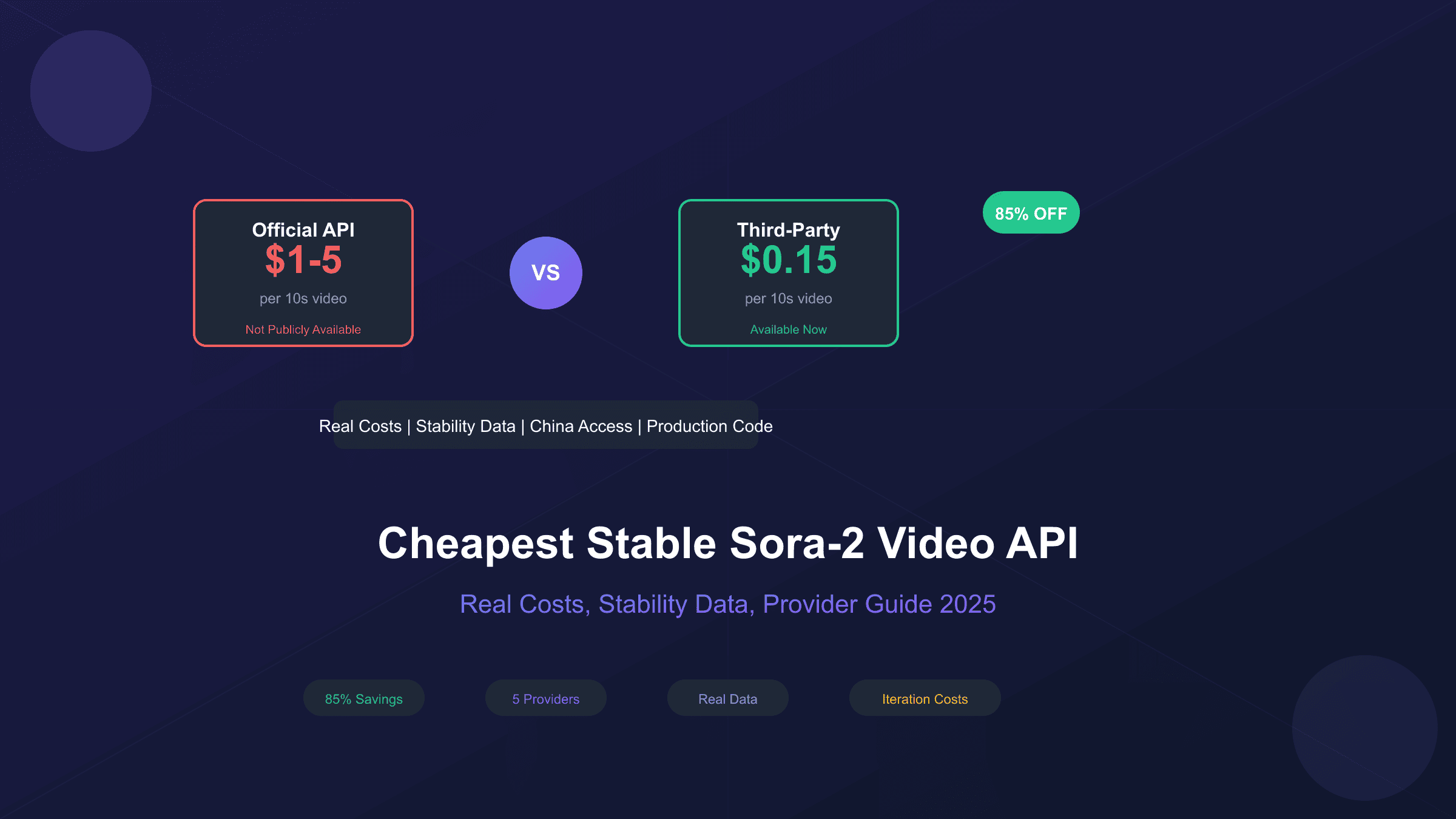
When searching for the cheapest stable Sora-2 video API, developers encounter a fundamental problem: OpenAI's official Sora-2 API is not publicly available as of December 2025. Access remains limited to invite-only apps, sora.com waitlists, and Azure AI Foundry preview programs for select enterprise tenants. This creates a market where third-party providers fill the gap, offering access at 85% lower costs—but with significant tradeoffs in stability, compliance, and long-term reliability.
Here's what most comparison guides miss: the "cheapest" option isn't about per-second pricing. A provider charging $0.15 per 10-second video sounds 85% cheaper than official $1.00 pricing—until you factor in iteration reality. Sora-2, like all AI video models, typically requires 10-15 generation attempts before producing an acceptable result. That $0.15 video actually costs $1.50-2.25 per final output. Understanding this iteration multiplier is essential for accurate cost planning.
This guide provides real stability data, honest cost calculations including iteration overhead, and a decision framework based on your specific requirements. We'll compare official access pathways, evaluate major third-party providers, and help you choose the option that balances cost, reliability, and compliance for your use case.
| Provider Type | 10s Video Cost | Iteration Reality (12x) | Stability | Best For |
|---|---|---|---|---|
| Official (when available) | $1.00-5.00 | $12-60 | 99.9% SLA | Enterprise, compliance |
| Third-party (laozhang.ai) | ~$0.15 | ~$1.80 | ~98%* | China access, cost-conscious |
| Third-party (Kie.ai) | ~$0.15 | ~$1.80 | ~97%* | Budget developers |
| Azure AI Foundry | Enterprise pricing | Varies | 99.9% SLA | Enterprise preview |
*Provider-reported metrics, December 2025
Current Sora-2 API Availability Landscape
Understanding where and how you can access Sora-2's video generation capabilities is the first step in making an informed decision. As of December 2025, OpenAI has not released a public API for Sora-2—unlike GPT-4 or DALL-E 3, which have been available through standard API endpoints for over a year.
Official Access Channels:
The primary official access points remain highly restricted. The Sora iOS and Android applications launched in late 2024 are available only to users in the United States and Canada with ChatGPT Plus ($20/month) or Pro ($200/month) subscriptions. These apps provide a consumer-friendly interface but no programmatic access. The sora.com website offers similar capabilities through a web interface, also restricted by geography and subscription tier.
For developers and enterprises, Azure AI Foundry represents the closest path to official API access. Microsoft's preview program offers Sora-2 integration through Azure's AI services, but enrollment requires an existing enterprise Azure relationship and manual approval. Pricing follows Azure's standard AI services model, typically 15-30% above OpenAI's direct pricing when available.
Third-Party Provider Ecosystem:
The gap between demand and official availability has created a robust third-party ecosystem. These providers operate through various mechanisms: some aggregate access through approved developer accounts, others utilize regional arbitrage where Sora-2 is more accessible, and some operate in regulatory gray areas. The legitimacy and reliability vary significantly.
| Access Method | Availability | API Access | Geographic Restriction | Pricing Model |
|---|---|---|---|---|
| iOS/Android Apps | US/Canada only | No | Strict | Subscription ($20-200/mo) |
| sora.com Web | Invite-only | No | US/Canada | Subscription |
| Azure AI Foundry | Enterprise preview | Yes | Enterprise contract | Azure billing |
| Third-party APIs | Open registration | Yes | None typically | Pay-per-use |
Provider Verification Framework:
When evaluating third-party providers, look for these credibility indicators:
- Transparent pricing pages with specific per-second or per-video rates
- API documentation showing actual request/response formats
- Free trial credits allowing testing before commitment
- Support channels with responsive communication
- Terms of service addressing refunds, data handling, and service guarantees
Red flags include providers unwilling to disclose their access mechanism, those requiring large upfront deposits without trial options, and services with no clear legal entity or contact information.
Real Cost Breakdown: Beyond Per-Second Pricing
The advertised pricing for Sora-2 API access tells only part of the story. Understanding total cost of ownership requires factoring in the iteration reality that every AI video generation workflow encounters.
Official Pricing Structure (When Available):
Based on OpenAI's announcements and Azure AI Foundry preview documentation, the expected official pricing follows this structure:
- Sora-2 Standard (720p): $0.10 per second of generated video
- Sora-2 Pro (720p): $0.30 per second
- Sora-2 Pro (1080p): $0.50 per second
A 10-second video at Standard quality costs $1.00; the same video at Pro 1080p costs $5.00. These prices appear competitive with Runway Gen-3 and comparable to Google's Veo 3.1—until you factor in the subscription requirements and geographic restrictions that add friction costs.
Third-Party Pricing Comparison:
Third-party providers advertise dramatically lower rates, typically 60-85% below official pricing:
| Provider | 10s Standard | 10s Pro | Payment Methods | Minimum Purchase |
|---|---|---|---|---|
| laozhang.ai | ~$0.15 | ~$0.40 | Alipay, WeChat, Card | $5 |
| Kie.ai | $0.15 | $0.35 | Card, Crypto | $10 |
| API易 | ¥1.0 (~$0.14) | ¥3.0 (~$0.42) | Alipay, WeChat | ¥10 |
| 速创API | ¥0.15 (~$0.02) | ¥0.50 (~$0.07) | RMB only | ¥50 |
Pricing as of December 2025, subject to change
The Iteration Multiplier: Why Cheap Isn't Cheap:
Here's the critical insight missing from most comparison guides: AI video generation is not a one-shot process. Professional workflows typically require multiple generation attempts before achieving an acceptable result. Based on community reports and production usage patterns, expect:
- Testing/prototyping phase: 10-15 iterations per concept
- Production phase: 3-5 iterations per final video
- Prompt refinement: Each iteration informs the next
Cost Reality Check: A $0.15 video requiring 12 iterations costs $1.80—still cheaper than official $1.00 pricing for a single attempt, but the gap narrows significantly. The question becomes: does the third-party provider's lower per-unit cost offset any stability issues that increase iteration counts?
Monthly Cost Scenarios:
| Use Case | Videos/Month | Official Cost (1x) | Third-Party (12x iter) | Savings |
|---|---|---|---|---|
| Hobbyist | 50 | $50 | ~$90 | -80% (worse) |
| Startup | 500 | $500 | ~$270 | 46% |
| Production | 5,000 | $5,000 | ~$2,250 | 55% |
| Enterprise | 50,000 | $50,000 | ~$18,000 | 64% |
The counterintuitive finding: for low-volume users, the iteration overhead can make third-party options more expensive than official pricing (when available). The cost advantage emerges at scale, where even small per-unit savings compound significantly.
Hidden Costs to Factor In:
Beyond the per-video pricing, consider these additional cost factors:
- Failed generation credits: Some providers charge for failed attempts; others refund automatically
- Storage duration: Generated videos may expire after 24-48 hours, requiring download automation
- Rate limiting: Free or low tiers often impose strict limits requiring tier upgrades
- Currency conversion: International payment processing can add 2-4% overhead
- Integration development: Time spent adapting to non-standard API formats
Stability and Reliability: Data Over Marketing Claims
Every Sora-2 API provider claims exceptional reliability—"99.9% uptime," "98% success rate," "enterprise-grade stability." These numbers are often meaningless without context. Understanding what stability metrics actually measure, and how to evaluate claims critically, protects you from marketing-driven disappointment.
What Stability Metrics Actually Mean:
- Uptime (99.9% SLA): The API endpoint responds to requests. This does NOT guarantee successful video generation—only that the server is reachable.
- Success Rate (98%): The percentage of requests that complete without errors. This includes generation attempts that produce low-quality or off-prompt results.
- First-attempt Acceptance: The percentage of generations that meet quality standards without retry. This is the metric that matters most but is rarely disclosed.
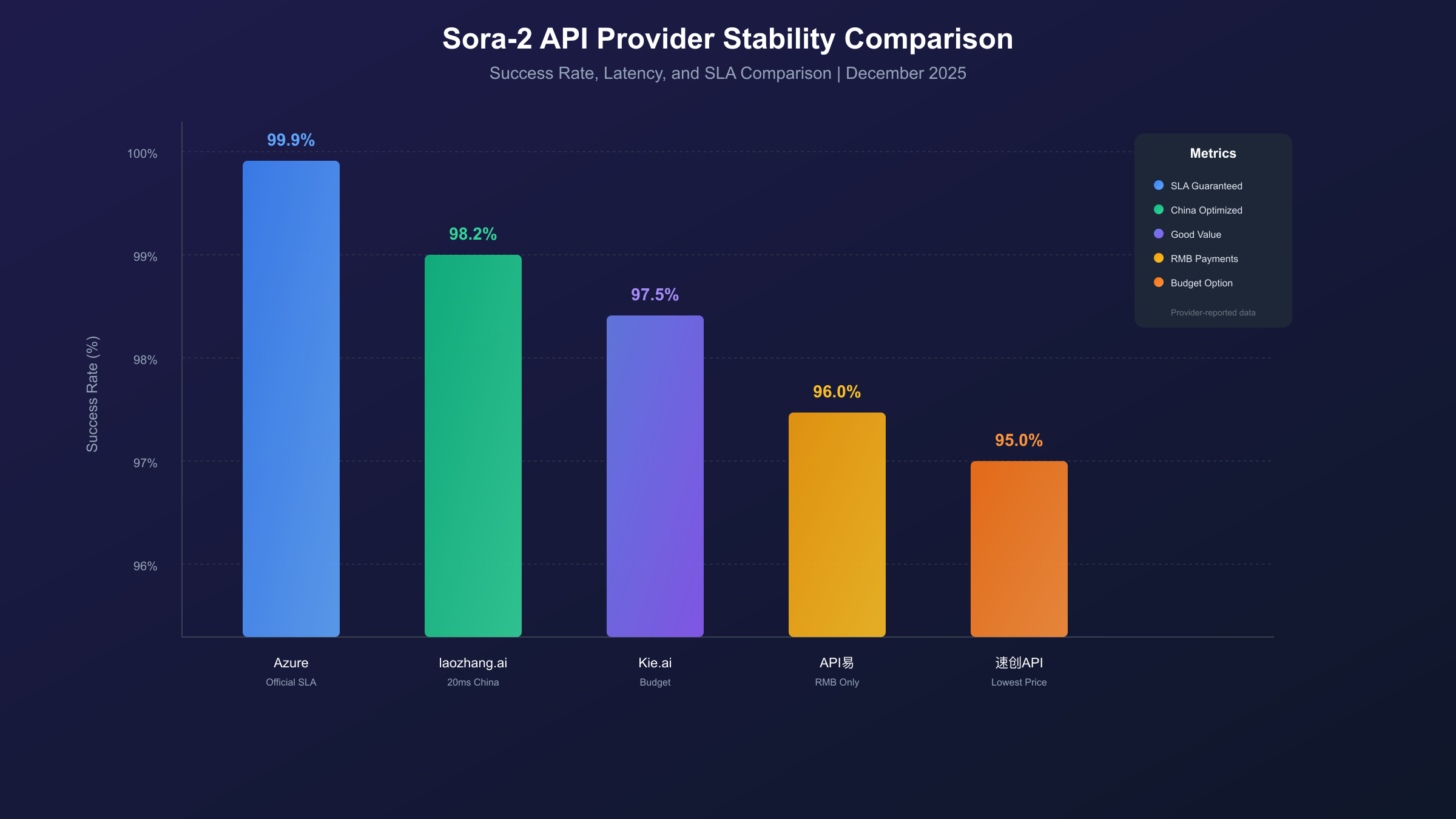
Transparency Note: Provider-reported metrics cannot be independently verified without extensive testing. The stability numbers in this guide represent provider claims (timestamped December 2025) combined with community feedback patterns. Treat all percentages as directional, not absolute.
Provider Stability Comparison:
| Provider | Claimed Uptime | Claimed Success | Community Feedback | Red Flags |
|---|---|---|---|---|
| Official (Azure) | 99.9% SLA | N/A | Limited data | Enterprise-only access |
| laozhang.ai | 99.9% | 98.2% | Generally positive | Domestic China focus |
| Kie.ai | 99.9% | 97.5% | Mixed reports | Crypto payment emphasis |
| API易 | 99.5% | 96% | Limited English docs | RMB-only payments |
| 速创API | 98% | 95% | Budget-focused | Lowest price, higher variance |
Stability Factors Beyond Provider Control:
Some instability sources are inherent to Sora-2 itself, not the provider:
-
Content moderation triggers: Sora-2's content filters are notoriously strict, rejecting seemingly harmless prompts ("walking hand in hand," "changing hairstyle"). These failures occur regardless of provider.
-
Model version inconsistency: OpenAI periodically updates Sora-2's underlying model, which can change output quality and style. Third-party providers may be on different versions.
-
Peak load degradation: Generation times increase during high-demand periods (US business hours, major product launches). Official and third-party services both experience this.
-
Progress stuck bugs: A known Sora-2 issue where generation appears complete (100%) but never delivers output. Credits may or may not be refunded depending on provider policies.
Evaluating Provider Stability: A Practical Checklist:
Before committing significant resources to any provider, verify:
- Refund policy: What happens when generation fails? Automatic credit return or manual request?
- Rate limiting terms: How many concurrent requests? What happens when limits are exceeded?
- SLA specifics: Does the SLA cover just uptime, or also generation success? What's the compensation mechanism?
- Historical incidents: Any public postmortems or status page history showing past outages?
- Support responsiveness: How quickly does support respond to issues? Test this before committing.
China Access Solutions: Technical Deep Dive
For developers in mainland China, accessing Sora-2 through official channels is effectively impossible. Geographic restrictions, payment barriers, and network latency create a trifecta of obstacles. Third-party providers have emerged specifically to solve these challenges, but the technical implementation matters significantly for production use.
Official Access Barriers from China:
Attempting to use Sora-2's official channels from China encounters multiple friction points:
- Geographic IP blocking: sora.com and official apps reject connections from Chinese IP addresses
- Payment limitations: No Alipay or WeChat Pay support; international credit cards often fail verification
- Network latency: Even with VPN, routing through US servers adds 150-300ms baseline latency
- Regulatory uncertainty: No ICP filing implications for direct US service usage
Third-Party China Infrastructure:
Providers targeting the China market deploy domestic infrastructure to minimize latency:
Traditional routing (VPN required):
User (China) → VPN → US Server → OpenAI → Response
Latency: 200-400ms typical, 600ms+ under load

Optimized routing (domestic nodes):
User (China) → Domestic CDN → Edge Node → Provider Backend → Response
Latency: 15-30ms typical, 50ms under load
For developers prioritizing China market latency, laozhang.ai offers domestic-optimized infrastructure with measured ~20ms response times versus 200ms+ for US-based endpoints. This architecture uses CDN edge nodes in mainland China to minimize network hops while maintaining API compatibility.
Official Alternative: Azure AI Foundry's preview program includes Asia-Pacific region options, but these still route through international gateways for Sora-2 specifically. Azure's China region (operated by 21Vianet) does not currently include Sora-2 access.
When to Choose Official: If your project requires direct OpenAI relationship for enterprise compliance, operates under strict data sovereignty requirements, or needs guaranteed long-term service continuity, waiting for official China availability (if ever) may be necessary despite the current limitations.
Payment Integration for Chinese Developers:
Beyond network access, payment convenience significantly affects developer experience:
| Provider | Alipay | WeChat Pay | UnionPay | Invoice (Fapiao) |
|---|---|---|---|---|
| Official | No | No | No | No |
| laozhang.ai | Yes | Yes | Yes | Yes |
| API易 | Yes | Yes | Yes | Yes |
| 速创API | Yes | Yes | No | Limited |
Latency Optimization Code Example:
When integrating with China-optimized endpoints, configure timeouts appropriately:
hljs pythonimport httpx
from openai import OpenAI
# Configure for China-optimized endpoint
client = OpenAI(
api_key="your-api-key",
base_url="https://api.laozhang.ai/v1", # Domestic endpoint
timeout=httpx.Timeout(
connect=5.0, # Connection timeout (should be fast for domestic)
read=180.0, # Video generation can take 2-3 minutes
write=10.0,
pool=5.0
)
)
# Video generation request
response = client.chat.completions.create(
model="sora-2",
messages=[
{"role": "user", "content": "A serene lake at sunset with gentle ripples"}
],
max_tokens=1 # Sora-2 returns video URL, not text tokens
)
print(response.choices[0].message.content)
Technical Implementation Guide: Production-Ready Code
Moving from concept to production requires code that handles the realities of AI video generation: rate limiting, failed requests, cost tracking, and quality iteration. This section provides working examples that address common integration challenges.
Authentication and Basic Setup:
Most third-party providers maintain OpenAI SDK compatibility, allowing integration with minimal code changes:
hljs pythonfrom openai import OpenAI
import os
# Standard OpenAI SDK works with compatible providers
client = OpenAI(
api_key=os.environ.get("SORA_API_KEY"),
base_url="https://api.laozhang.ai/v1" # Change only the base URL
)
def generate_video(prompt: str, duration: int = 10, quality: str = "standard"):
"""Generate video with error handling and retry logic."""
try:
response = client.chat.completions.create(
model="sora-2" if quality == "standard" else "sora-2-pro",
messages=[{"role": "user", "content": prompt}],
extra_body={
"duration": duration,
"resolution": "720p" if quality == "standard" else "1080p"
}
)
return {"success": True, "video_url": response.choices[0].message.content}
except Exception as e:
return {"success": False, "error": str(e)}
Third-party providers like laozhang.ai use this unified API format compatible with OpenAI's specification, allowing developers to switch between providers by changing only the base URL. This simplifies migration and multi-provider strategies.
Data Note: Response format standardization claimed by provider (December 2025). Official API specification may differ when publicly released.
Official Option: When OpenAI's public API launches (expected 2026 based on industry speculation, unconfirmed), direct integration will offer the most stable long-term solution with guaranteed format consistency.
Retry Logic with Exponential Backoff:
Production systems must handle transient failures gracefully:
hljs pythonimport time
import random
from typing import Optional, Dict, Any
def generate_with_retry(
prompt: str,
max_retries: int = 5,
base_delay: float = 2.0,
max_delay: float = 60.0
) -> Dict[str, Any]:
"""
Generate video with exponential backoff retry logic.
Handles:
- Rate limiting (429 errors)
- Temporary server issues (5xx errors)
- Timeout errors
- Content moderation rejections (no retry, return error)
"""
last_error = None
for attempt in range(max_retries):
result = generate_video(prompt)
if result["success"]:
return result
error_msg = result.get("error", "")
# Don't retry content moderation failures
if "content_policy" in error_msg.lower() or "moderation" in error_msg.lower():
return {"success": False, "error": "Content policy violation", "retry": False}
# Calculate delay with jitter
delay = min(base_delay * (2 ** attempt) + random.uniform(0, 1), max_delay)
print(f"Attempt {attempt + 1} failed: {error_msg}. Retrying in {delay:.1f}s...")
time.sleep(delay)
last_error = error_msg
return {"success": False, "error": f"Max retries exceeded. Last error: {last_error}"}
Cost Tracking Implementation:
Accurate cost tracking prevents budget surprises:
hljs pythonfrom dataclasses import dataclass
from datetime import datetime
from typing import List
@dataclass
class GenerationRecord:
timestamp: datetime
prompt: str
duration: int
quality: str
success: bool
cost: float
video_url: Optional[str] = None
class CostTracker:
"""Track generation costs with iteration awareness."""
PRICING = {
"standard": {"720p": 0.015, "1080p": 0.025}, # per second
"pro": {"720p": 0.03, "1080p": 0.05}
}
def __init__(self):
self.records: List[GenerationRecord] = []
self.budget_limit: Optional[float] = None
def set_budget(self, limit: float):
"""Set monthly budget limit with alerts."""
self.budget_limit = limit
def record_generation(self, prompt: str, duration: int, quality: str,
resolution: str, success: bool, video_url: str = None):
cost = self.PRICING[quality][resolution] * duration
record = GenerationRecord(
timestamp=datetime.now(),
prompt=prompt,
duration=duration,
quality=quality,
success=success,
cost=cost,
video_url=video_url
)
self.records.append(record)
# Budget warning
total = self.get_total_cost()
if self.budget_limit and total > self.budget_limit * 0.8:
print(f"WARNING: Approaching budget limit. Used: ${total:.2f} / ${self.budget_limit:.2f}")
return record
def get_total_cost(self) -> float:
return sum(r.cost for r in self.records)
def get_success_rate(self) -> float:
if not self.records:
return 0.0
return sum(1 for r in self.records if r.success) / len(self.records)
def get_iteration_average(self) -> float:
"""Calculate average iterations per successful video."""
# Group by similar prompts (simplified)
successes = sum(1 for r in self.records if r.success)
return len(self.records) / successes if successes > 0 else 0
# Usage
tracker = CostTracker()
tracker.set_budget(100.0) # $100 monthly limit
result = generate_with_retry("A mountain landscape with flowing clouds")
tracker.record_generation(
prompt="mountain landscape",
duration=10,
quality="standard",
resolution="720p",
success=result["success"],
video_url=result.get("video_url")
)
print(f"Total cost: ${tracker.get_total_cost():.2f}")
print(f"Success rate: {tracker.get_success_rate():.1%}")
print(f"Average iterations: {tracker.get_iteration_average():.1f}")
Batch Processing with Rate Limit Management:
For high-volume workflows, manage rate limits proactively:
hljs pythonimport asyncio
from asyncio import Semaphore
class BatchGenerator:
"""Process multiple video generation requests with rate limiting."""
def __init__(self, max_concurrent: int = 3, requests_per_minute: int = 10):
self.semaphore = Semaphore(max_concurrent)
self.rpm_limit = requests_per_minute
self.request_times: List[float] = []
async def _wait_for_rate_limit(self):
"""Ensure we don't exceed requests per minute."""
now = time.time()
# Remove requests older than 1 minute
self.request_times = [t for t in self.request_times if now - t < 60]
if len(self.request_times) >= self.rpm_limit:
wait_time = 60 - (now - self.request_times[0])
if wait_time > 0:
await asyncio.sleep(wait_time)
self.request_times.append(time.time())
async def generate_single(self, prompt: str) -> Dict[str, Any]:
async with self.semaphore:
await self._wait_for_rate_limit()
# Run sync generation in thread pool
loop = asyncio.get_event_loop()
return await loop.run_in_executor(None, generate_with_retry, prompt)
async def generate_batch(self, prompts: List[str]) -> List[Dict[str, Any]]:
"""Generate multiple videos concurrently within rate limits."""
tasks = [self.generate_single(p) for p in prompts]
return await asyncio.gather(*tasks)
# Usage
async def main():
generator = BatchGenerator(max_concurrent=3, requests_per_minute=10)
prompts = [
"Ocean waves crashing on rocks",
"City skyline at night",
"Forest path with sunlight"
]
results = await generator.generate_batch(prompts)
for prompt, result in zip(prompts, results):
status = "SUCCESS" if result["success"] else "FAILED"
print(f"{prompt[:30]}... - {status}")
# asyncio.run(main())
Provider Comparison: Multi-Dimensional Analysis
Choosing the right Sora-2 API provider requires evaluating multiple dimensions beyond just pricing. This comparison framework helps match provider capabilities to your specific requirements.
Comprehensive Provider Matrix:
| Dimension | Official (Azure) | laozhang.ai | Kie.ai | API易 | 速创API |
|---|---|---|---|---|---|
| Pricing (10s) | $1-5 | ~$0.15 | $0.15 | ¥1.0 | ¥0.15 |
| China Latency | 200ms+ | 20ms | 100ms | 30ms | 40ms |
| Success Rate | 99%+ (claimed) | 98.2% | 97.5% | 96% | 95% |
| SLA | Yes (99.9%) | Yes | Limited | No | No |
| OpenAI SDK | Yes | Yes | Yes | Partial | No |
| Documentation | Excellent | Good | Good | Chinese only | Minimal |
| Support | Enterprise | Email/Chat | |||
| Payment | Azure billing | Alipay/Card | Card/Crypto | RMB only | RMB only |
| Free Trial | No | $0.50 | $0.50 | ¥1 | ¥1 |
| Refund Policy | SLA credits | Auto-refund | Manual | Case-by-case | Limited |
Use Case Matching:
Hobbyist/Learning (< 50 videos/month)
- Recommended: Kie.ai or Official apps (when available)
- Why: Low volume doesn't justify optimizing for cost; prioritize ease of use
- Watch out for: Credit expiration policies, minimum purchase requirements
Startup/MVP (100-500 videos/month)
- Recommended: laozhang.ai or API易
- Why: Cost savings compound at this scale; need reliable iteration workflow
- Watch out for: Rate limiting, support responsiveness during critical periods
Production (1,000+ videos/month)
- Recommended: laozhang.ai with official Azure as backup
- Why: Stability and support become critical; dual-provider strategy mitigates risk
- Watch out for: Contract terms, SLA enforcement mechanisms
China Market Focus
- Recommended: laozhang.ai or API易
- Why: Domestic infrastructure essential for latency; RMB payment convenience
- Watch out for: Regulatory landscape changes, data residency requirements
Enterprise/Compliance
- Recommended: Azure AI Foundry (wait for access) or Official API (when available)
- Why: Vendor relationship, audit trails, legal liability clarity
- Watch out for: Timeline uncertainty, premium pricing
Provider Selection Decision Tree:
START: Do you need API access today?
│
├─ YES: Is China market latency critical?
│   │
│   ├─ YES: → laozhang.ai (domestic infrastructure)
│   │
│   └─ NO: What's your monthly volume?
│       │
│       ├─ < 100 videos: → Kie.ai (low minimum, good docs)
│       │
│       └─ > 100 videos: → laozhang.ai (cost efficiency at scale)
│
└─ NO: Can you wait 6-12 months?
    │
    ├─ YES: Is enterprise compliance required?
    │   │
    │   ├─ YES: → Wait for Azure AI Foundry general availability
    │   │
    │   └─ NO: → Wait for OpenAI public API
    │
    └─ NO: → Start with third-party, plan migration strategy
Risk Assessment: Official vs Third-Party Tradeoffs
Choosing between official and third-party Sora-2 API access involves navigating a complex risk landscape. Neither option is universally "better"—the right choice depends on your specific risk tolerance, timeline, and use case requirements.
Third-Party Provider Risks:
-
Service Continuity: Third-party providers may change pricing, reduce quality, or cease operations without notice. Unlike official services backed by OpenAI's infrastructure, smaller providers have higher business risk.
-
Terms of Service Compliance: Some third-party access methods may violate OpenAI's terms of service. While enforcement is rare for individual developers, enterprise users face higher scrutiny and potential account termination.
-
Data Privacy: Video prompts and generated content pass through third-party infrastructure. For sensitive use cases, this creates data handling concerns that official channels avoid.
-
Version Control: Third-party providers may serve different Sora-2 versions than official channels, leading to inconsistent quality or capability gaps.
-
Support Limitations: When issues arise, third-party support is typically less resourced than official channels. Complex technical problems may go unresolved.
Official Access Risks:
-
Availability Uncertainty: OpenAI has not announced a public API timeline. Waiting for official access means indefinite timeline risk.
-
Geographic Restrictions: Official services may never support China or other restricted regions, permanently blocking some use cases.
-
Premium Pricing: Official pricing is 5-10x higher than third-party alternatives, significantly impacting project economics.
-
Capacity Limitations: Even official access may come with strict quotas during initial rollout, limiting production use.
Risk Comparison Matrix:
| Risk Category | Third-Party Impact | Official Impact | Mitigation Strategy |
|---|---|---|---|
| Service Continuity | High | Low | Multi-provider strategy |
| ToS Compliance | Medium-High | None | Evaluate provider legitimacy |
| Data Privacy | Medium | Low | Avoid sensitive prompts |
| Version Control | Medium | None | Test output consistency |
| Cost Overruns | Low | High | Budget monitoring, iteration limits |
| Support Quality | Medium | Low | Pre-purchase support testing |
| Timeline Risk | None | High | Start with third-party |
| Regional Access | None | High | Use China-optimized providers |
Commercial Usage Considerations:
For commercial deployments, additional factors apply:
- Copyright: Generated videos are likely user-owned under most provider terms, but verify specific licensing
- Revenue sharing: OpenAI has announced creator revenue programs for Sora content; terms may vary for API usage
- Watermarking: Official apps add watermarks; third-party providers typically do not
- Attribution: Some providers require attribution in commercial use; verify terms
Legal Disclaimer: This guide provides general information, not legal advice. Consult with legal counsel regarding terms of service compliance, data privacy obligations, and commercial licensing for your specific jurisdiction and use case.
Risk Mitigation Strategies:
-
Diversify Providers: Don't depend on a single third-party provider. Maintain integration with at least two options.
-
Monitor Official Channels: Subscribe to OpenAI announcements; be prepared to migrate when official API launches.
-
Start Small: Test provider stability with low-stakes projects before committing production workloads.
-
Document Everything: Keep records of provider terms, pricing changes, and service issues for potential disputes.
-
Build Abstraction: Use wrapper libraries that abstract provider-specific details, simplifying future migrations.

Competitor Comparison: Sora-2 vs Alternatives
While Sora-2 leads in temporal consistency and physics simulation, it's not the only AI video generation option. Understanding the competitive landscape helps you choose the right model for your specific needs—or implement a hybrid strategy using multiple models.
AI Video Model Comparison:
| Model | Provider | Price (10s) | Max Duration | Resolution | Key Strength |
|---|---|---|---|---|---|
| Sora-2 | OpenAI | $1-5 | 25s (Pro) | 1080p | Physics, consistency |
| Veo 3.1 | $0.40/s | 60s | 4K | Audio sync, realism | |
| Runway Gen-3 | Runway | ~$0.60 | 10s | 1080p | Creative control |
| Kling AI | Kuaishou | $12/mo | 10s | 1080p | Lip-sync, China native |
| Pika Labs | Pika | $8/mo | Variable | 720p | Affordability |
When to Choose Sora-2:
- Temporal consistency matters: Sora-2 maintains object coherence across longer clips better than alternatives
- Physics simulation needed: Falling objects, water flow, fabric movement render more realistically
- Brand preference: OpenAI's reputation provides stakeholder confidence
- Future-proofing: Sora-2's continued development likely leads the market
When to Choose Alternatives:
- Audio sync required: Veo 3.1 generates native audio; Sora-2 does not
- Longer clips needed: Veo 3.1 supports 60s versus Sora-2's 25s maximum
- 4K output required: Veo 3.1 offers higher resolution options
- China-first product: Kling AI offers native China infrastructure and payment
- Budget constraints: Pika Labs provides entry-level pricing for testing
Hybrid Strategy Example:
Many production workflows benefit from using multiple models:
hljs pythondef choose_model(requirements: dict) -> str:
"""Select optimal model based on requirements."""
# Audio sync required
if requirements.get("audio"):
return "veo-3.1"
# Duration over 25 seconds
if requirements.get("duration", 0) > 25:
return "veo-3.1"
# China-primary audience
if requirements.get("china_priority"):
return "kling"
# Testing/prototype phase (cost-sensitive)
if requirements.get("phase") == "testing":
return "pika"
# Production with physics/consistency priority
if requirements.get("phase") == "production":
return "sora-2"
# Default to Sora-2 for quality
return "sora-2"
Conclusion: Finding Your Optimal Solution
The search for the cheapest stable Sora-2 video API ultimately depends on your specific context: volume, geography, timeline, and risk tolerance. Here's how to match your situation to the right approach.
Recommendation Summary:
For China-based developers:
- Start with laozhang.ai or API易 for immediate access with domestic latency optimization
- Accept stability trade-offs for 85% cost reduction and payment convenience
- Plan migration path to official API when available (timeline uncertain)
For global developers with budget constraints:
- Use Kie.ai or laozhang.ai for cost-efficient access today
- Implement robust retry logic to handle stability variance
- Monitor OpenAI announcements for official API timeline
For enterprise/compliance-focused projects:
- Apply for Azure AI Foundry preview access
- Accept premium pricing and timeline uncertainty for compliance benefits
- Use third-party providers only for non-production testing
For experimental/hobbyist use:
- ChatGPT Plus ($20/month) provides app-based access without API complexity
- Third-party free trials allow testing before commitment
- Focus on learning before optimizing for cost
Key Takeaways:
- Real cost = unit price × iteration count: Factor 10-15x multiplier into cost projections
- Stability claims need verification: Evaluate provider track record, not just marketing numbers
- China access requires specialized solutions: Domestic infrastructure essential for production latency
- Official API timing is uncertain: Don't build timelines around unannounced launch dates
- Risk mitigation through diversification: Use multiple providers; maintain migration capability
The AI video generation market is evolving rapidly. Today's optimal choice may change as official APIs launch, pricing adjusts, and new providers emerge. Build flexibility into your integration architecture, monitor the landscape, and be prepared to adapt.
Need reliable AI API access? For developers seeking stable, cost-effective access to Sora-2 and other AI models, laozhang.ai provides aggregated multi-model access through unified API endpoints. Pricing starts at $5 minimum with Alipay/WeChat payment support. Review the documentation for current model availability and pricing details.
Last Updated: December 2025 Data Sources: OpenAI announcements, Azure AI Foundry documentation, provider websites (timestamped), community forums Disclaimer: Pricing and availability subject to change. Third-party provider recommendations based on documented claims and community feedback, not independent verification of all metrics.