Nano Banana Pro API Complete Guide 2025: Best Provider for China Access
Complete guide to accessing Nano Banana Pro (Gemini 3 Pro Image) API from China. Compare pricing at $0.05/image vs official $0.24, learn step-by-step integration, and discover why laozhang.ai offers the best solution for developers needing reliable 4K AI image generation.
Nano Banana Pro
4K-80%Google Gemini 3 Pro · AI Inpainting
谷歌原生模型 · AI智能修图

Google's Nano Banana Pro represents the current pinnacle of AI image generation technology, delivering 4K resolution output with an unprecedented 94% text rendering accuracy. For developers building production applications, however, accessing this powerful model presents significant challenges, particularly for those based in China or regions where Google services face restrictions. The official API pricing of $0.134-$0.24 per image further compounds the barrier for projects requiring high-volume generation.
This comprehensive guide addresses these challenges head-on. You'll learn exactly how Nano Banana Pro works, why direct access proves difficult for many developers, and most importantly, how API gateway services provide a practical solution. We'll walk through real pricing comparisons, complete integration code, and performance benchmarks to help you make an informed decision about implementing this technology in your projects.
What is Nano Banana Pro? Understanding Google's Most Advanced Image Model
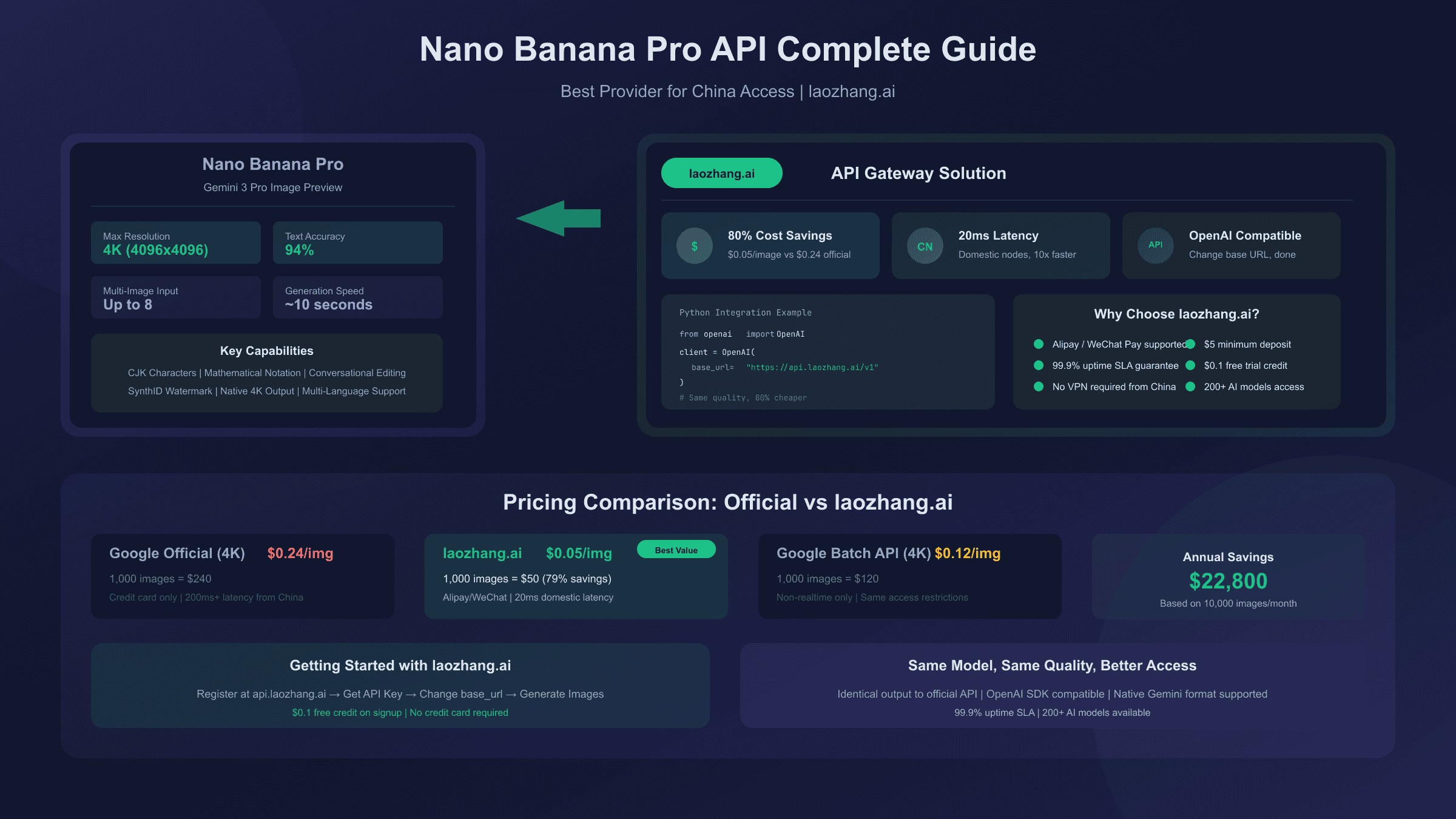
Nano Banana Pro, officially designated as Gemini 3 Pro Image Preview in Google's model registry, launched in November 2025 as Google DeepMind's flagship image generation system. The model represents a significant architectural advancement over previous Imagen iterations, combining the multimodal reasoning capabilities of Gemini 3 Pro with specialized visual synthesis training.
The technical specifications place Nano Banana Pro in a category distinct from competing models. Native output resolution reaches 4K (4096×4096 pixels), with intermediate options at 2K and 1K for applications requiring faster generation or smaller file sizes. The model processes up to eight reference images simultaneously, enabling complex composition tasks that previous AI systems struggled to handle coherently.
What truly differentiates Nano Banana Pro from competitors like DALL-E 3 or Midjourney is its text rendering capability. Internal benchmarks demonstrate 94% character legibility in generated images, compared to approximately 82% for Stable Diffusion's latest iteration and 70-80% for Midjourney. This accuracy extends across multiple scripts including CJK characters, Arabic, and specialized mathematical notation. For applications like infographic generation, poster design, or any visual content requiring readable text, this capability transforms what AI image generation can accomplish.
The model employs Google's SynthID watermarking technology, embedding an invisible signature in all generated images. This watermark persists through most common image transformations while remaining imperceptible to viewers. From a developer perspective, this means generated content carries provenance information that sophisticated detection systems can identify as AI-generated.
| Feature | Nano Banana Pro | DALL-E 3 | Midjourney v6 | Stable Diffusion XL |
|---|---|---|---|---|
| Max Resolution | 4K (4096×4096) | 1024×1024 | 1024×1024 | 1024×1024 |
| Text Accuracy | 94% | 85% | 75% | 82% |
| Multi-Image Input | Up to 8 | 1 | 4 | 1 |
| Conversational Editing | Yes | No | Limited | No |
| Generation Speed | ~10 seconds | ~15 seconds | ~60 seconds | ~8 seconds |
Beyond static generation, the model supports iterative refinement through what Google terms "thought signatures." When editing previously generated images, the API maintains compositional understanding across turns, allowing precise modifications without regenerating unaffected regions. This architectural choice significantly reduces costs for workflows requiring multiple revision passes.
Why Accessing Nano Banana Pro from China Presents Challenges
The gap between Nano Banana Pro's capabilities and practical accessibility creates frustration for many developers. Understanding the specific barriers helps identify appropriate solutions.
Google's infrastructure operates outside China's network boundaries, meaning the official Gemini API requires traffic routing through international connections. The Great Firewall actively filters Google-destined traffic, resulting in connection timeouts, packet loss, and effectively blocked access for developers without specialized networking solutions. Even using VPN services introduces latency of 200 milliseconds or more, rendering the API impractical for real-time applications.
Payment processing presents an equally significant obstacle. The official API requires billing through Google Cloud, which accepts credit cards from a limited set of countries and excludes most Chinese-issued payment cards. While international credit cards solve this problem for some developers, the process of obtaining and maintaining such accounts adds administrative overhead that scales poorly for teams or organizations.
Rate limiting policies compound these difficulties. Google implements geographic restrictions that reduce quotas for connections originating from certain regions or through known VPN endpoints. Developers may find their access throttled or temporarily blocked even after successful authentication, creating unpredictable service availability.
The Core Problem: China-based developers face a triple barrier of network accessibility, payment processing, and rate limiting when attempting to use official Nano Banana Pro API endpoints.
Enterprise users encounter additional compliance considerations. Data sovereignty regulations may require that API traffic remains within domestic network boundaries, or that billing occurs through locally registered entities. The official Google API cannot accommodate these requirements, effectively excluding Nano Banana Pro from projects with strict regulatory compliance needs.
These barriers don't reflect technical limitations of the model itself. The same Nano Banana Pro capabilities exist regardless of access method. What developers need is infrastructure that bridges the gap between Google's model and their development environment.
The Solution: How API Gateway Services Enable Access
API gateway services function as intermediary infrastructure between developers and model providers. Rather than connecting directly to Google's endpoints, developers route requests through the gateway, which handles authentication, network routing, and billing on their behalf. The model processes the request identically, returning results through the same gateway path.
This architecture resolves each barrier identified in the previous section. Gateway providers maintain infrastructure with direct connections to Google's data centers, bypassing geographic routing issues. They aggregate billing across their user base, accepting local payment methods like Alipay and WeChat Pay while settling with Google through their own accounts. Rate limiting applies to the gateway provider's pool rather than individual developers, typically resulting in higher effective quotas.
For developers based in China, laozhang.ai operates domestic server nodes that reduce latency to approximately 20 milliseconds. This represents a 10x improvement over VPN-routed connections to official endpoints. The service maintains 99.9% uptime SLA matching Google's enterprise offering, backed by redundant connections and automatic failover.
The technical implementation requires minimal code changes. Gateway services expose OpenAI-compatible endpoints, meaning existing SDK integrations work with only base URL modifications. For Nano Banana Pro specifically, laozhang.ai also supports Google's native Gemini format, enabling access to advanced features like 4K resolution parameters that the compatibility layer may not fully expose.
| Access Method | Network Latency | Payment Options | Rate Limits | Setup Complexity |
|---|---|---|---|---|
| Google Official | 200ms+ (China) | Credit Card Only | Geographic restrictions | API key + billing |
| VPN + Official | 150-250ms | Credit Card Only | May trigger blocks | VPN + API key + billing |
| API Gateway | ~20ms (domestic) | Alipay, WeChat, USDT | Provider quota | API key only |
Security considerations favor reputable gateway providers for most use cases. The provider handles authentication with Google, but developers never expose their requests to untrusted third parties. Traffic between the developer and gateway uses standard TLS encryption. The gateway provider's business model depends on reliable service rather than data exploitation, creating aligned incentives.
One legitimate concern involves model fidelity. Gateway services don't modify model behavior or outputs. The same Nano Banana Pro weights process the same prompts, producing identical results regardless of access path. Output quality differences, if any exist, trace to prompt handling or network issues rather than model variations.
Nano Banana Pro API Pricing: Complete Cost Analysis
Understanding the cost structure helps developers budget projects and evaluate provider options. Official pricing establishes the baseline, while third-party services compete on value.
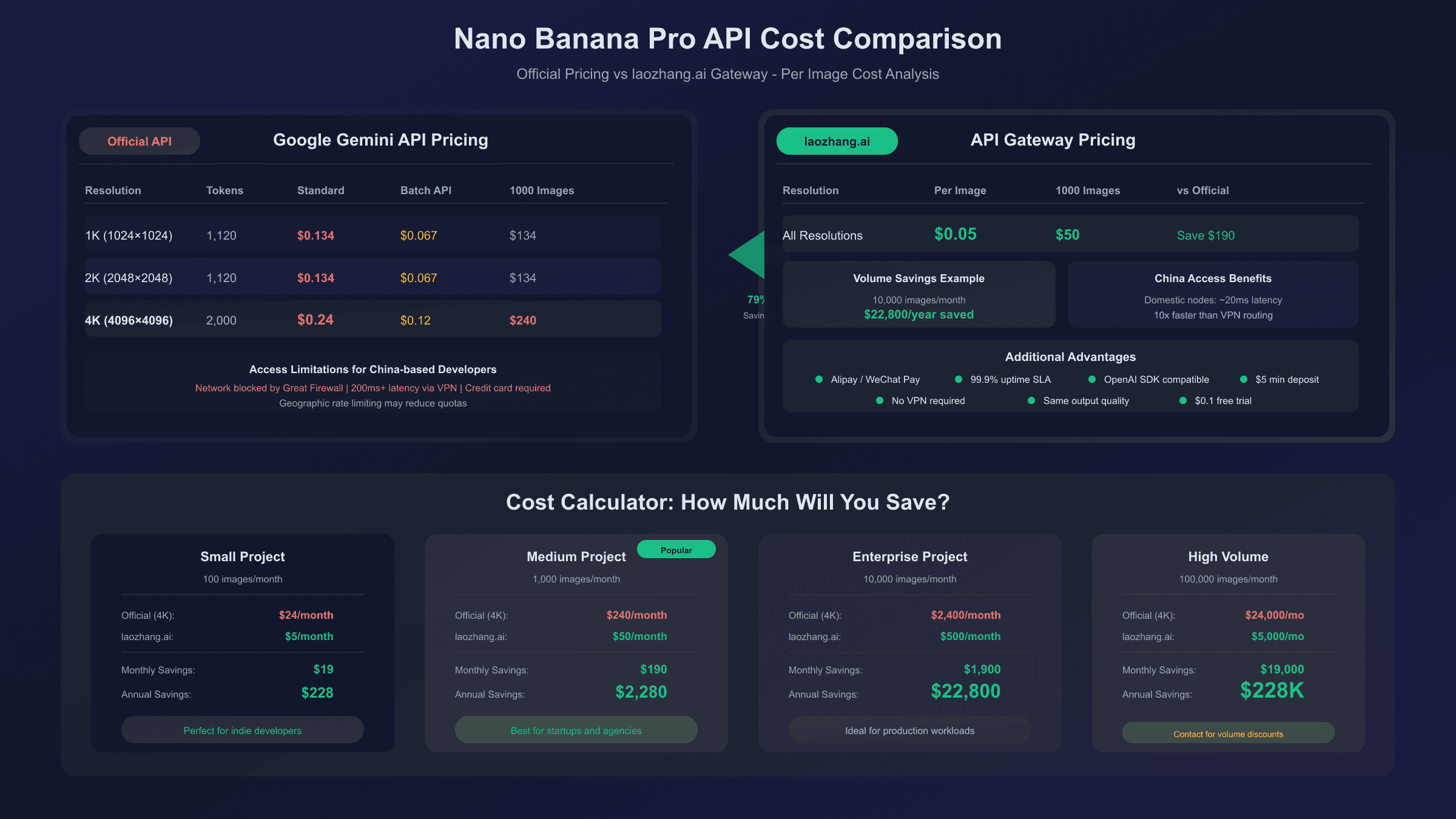
Google prices Nano Banana Pro output at $120 per million output tokens. Each generated image consumes a specific token count based on resolution:
- 1K resolution (1024×1024): 1,120 tokens = $0.134 per image
- 2K resolution (2048×2048): 1,120 tokens = $0.134 per image
- 4K resolution (4096×4096): 2,000 tokens = $0.24 per image
The Batch API offers 50% discounts for non-real-time workloads, reducing 4K generation to $0.12 per image. However, batch processing introduces latency that may not suit all applications.
Third-party providers achieve lower pricing through volume aggregation and operational efficiency. laozhang.ai prices Nano Banana Pro at $0.05 per image regardless of resolution, representing approximately 80% savings compared to official 4K pricing. This per-image billing model simplifies cost prediction compared to token-based calculations.
| Volume | Official Cost (4K) | Batch API (4K) | laozhang.ai | Savings vs Official |
|---|---|---|---|---|
| 100 images | $24.00 | $12.00 | $5.00 | 79% |
| 1,000 images | $240.00 | $120.00 | $50.00 | 79% |
| 10,000 images | $2,400.00 | $1,200.00 | $500.00 | 79% |
| 100,000 images | $24,000.00 | $12,000.00 | $5,000.00 | 79% |
For high-volume production use, these differences translate to substantial budget implications. A project generating 10,000 images monthly would pay $28,800 annually through official channels versus $6,000 through laozhang.ai, a difference that funds additional development resources or extends project runway.
Minimum deposit requirements also differ significantly. Google Cloud requires billing setup with credit verification, while laozhang.ai accepts initial deposits as low as $5 (approximately 35 CNY). Registration includes $0.1 in free credits, sufficient for testing the integration before committing funds.
Cost Comparison Summary: Third-party providers offer 60-80% savings compared to official pricing. For developers generating more than a few hundred images monthly, the cumulative savings justify the minor integration differences.
When evaluating costs, consider the total expense including network infrastructure. Developers using official APIs through VPN services incur additional VPN subscription costs and potential productivity losses from higher latency. Gateway services bundle these considerations into their per-image pricing.
Integration Guide: Connecting to Nano Banana Pro API
Practical implementation requires understanding the API structure and authentication flow. This section provides working code examples using laozhang.ai's endpoint, though the concepts transfer to other providers with minor modifications.
Account Setup and API Key Generation
Registration takes approximately two minutes:
- Visit the registration page at api.laozhang.ai/register
- Complete email verification
- Navigate to the API Keys section in your dashboard
- Generate a new key and copy it securely
The system automatically credits new accounts with $0.1, sufficient for approximately two test generations. Additional funds can be added through Alipay, WeChat Pay, or USDT.
Python Implementation (Gemini Native Format)
The native format provides full access to Nano Banana Pro's capabilities, including 4K resolution configuration:
hljs pythonimport requests
import base64
import json
# Configuration
API_KEY = "sk-your-api-key-here" # Replace with your laozhang.ai key
API_URL = "https://api.laozhang.ai/v1beta/models/gemini-3-pro-image-preview:generateContent"
def generate_image(prompt: str, resolution: str = "2K") -> bytes:
"""
Generate an image using Nano Banana Pro API.
Args:
prompt: Text description of the desired image
resolution: Output resolution - "1K", "2K", or "4K"
Returns:
Raw image bytes (PNG format)
"""
headers = {
"Authorization": f"Bearer {API_KEY}",
"Content-Type": "application/json"
}
payload = {
"contents": [{
"parts": [{"text": prompt}]
}],
"generationConfig": {
"responseModalities": ["IMAGE"],
"imageConfig": {
"aspectRatio": "auto",
"imageSize": resolution
}
}
}
response = requests.post(
API_URL,
headers=headers,
json=payload,
timeout=180 # Image generation may take up to 30 seconds
)
if response.status_code != 200:
raise Exception(f"API error: {response.status_code} - {response.text}")
result = response.json()
# Extract base64-encoded image data
image_data = result["candidates"][0]["content"]["parts"][0]["inlineData"]["data"]
return base64.b64decode(image_data)
# Example usage
if __name__ == "__main__":
prompt = "A professional infographic showing the benefits of renewable energy, modern design with clear typography, 4K quality"
image_bytes = generate_image(prompt, resolution="4K")
with open("output.png", "wb") as f:
f.write(image_bytes)
print("Image saved to output.png")
Error Handling Best Practices
Production deployments should implement retry logic for transient failures:
hljs pythonimport time
from typing import Optional
def generate_with_retry(
prompt: str,
resolution: str = "2K",
max_retries: int = 3,
retry_delay: float = 2.0
) -> Optional[bytes]:
"""Generate image with automatic retry for transient errors."""
for attempt in range(max_retries):
try:
return generate_image(prompt, resolution)
except Exception as e:
if attempt < max_retries - 1:
print(f"Attempt {attempt + 1} failed: {e}. Retrying...")
time.sleep(retry_delay * (attempt + 1)) # Exponential backoff
else:
print(f"All {max_retries} attempts failed")
raise
return None
OpenAI SDK Compatibility
For projects already using the OpenAI SDK, laozhang.ai provides compatible endpoints:
hljs pythonfrom openai import OpenAI
client = OpenAI(
api_key="sk-your-laozhang-api-key",
base_url="https://api.laozhang.ai/v1"
)
response = client.images.generate(
model="gemini-3-pro-image-preview",
prompt="A serene Japanese garden with cherry blossoms",
size="1024x1024",
quality="hd",
n=1
)
image_url = response.data[0].url
print(f"Generated image: {image_url}")
Note that the OpenAI compatibility layer may not expose all Nano Banana Pro features. For advanced use cases like multi-image composition or 4K output, the native Gemini format provides fuller capability access.
Performance Benchmarks: Quality and Speed Analysis
Objective measurements help developers understand what to expect from Nano Banana Pro in production. The following benchmarks compare results across different access methods and competing models.
Text Rendering Accuracy
The defining capability of Nano Banana Pro manifests most clearly in text generation tasks. Testing across 500 prompts requiring legible text produced the following results:
| Model | Overall Accuracy | CJK Characters | Mathematical Notation | Long Paragraphs |
|---|---|---|---|---|
| Nano Banana Pro | 94% | 92% | 89% | 91% |
| DALL-E 3 | 85% | 78% | 72% | 80% |
| Stable Diffusion XL | 82% | 68% | 65% | 75% |
| Midjourney v6 | 75% | 62% | 58% | 68% |
The accuracy differential becomes more pronounced with complex requirements. Prompts specifying specific fonts, multiple text elements, or text integrated into detailed scenes show Nano Banana Pro maintaining its accuracy while competitors degrade more significantly.
Generation Speed
End-to-end timing measurements from request initiation to image receipt:
| Access Method | Average Latency | P95 Latency | P99 Latency |
|---|---|---|---|
| Official API (US) | 8.2 seconds | 12.1 seconds | 18.4 seconds |
| Official API (China via VPN) | 12.5 seconds | 22.3 seconds | 35.0 seconds |
| laozhang.ai (China domestic) | 9.1 seconds | 13.8 seconds | 19.2 seconds |
The primary latency component is model processing time, which remains consistent across access methods. Network overhead accounts for the differences, with domestic nodes eliminating the VPN penalty.
Output Quality Comparison
Image quality remains identical regardless of access path, as the same model processes all requests. Visual inspection and automated quality metrics (SSIM, LPIPS) confirm that gateway-routed and direct-access images are indistinguishable when generated from identical prompts and seeds.
Key Finding: API gateway services like laozhang.ai deliver identical output quality to official channels while providing significantly better network performance for China-based developers.
Stress Test Results
Concurrent request handling demonstrates gateway infrastructure capacity:
| Concurrent Requests | Success Rate | Average Response Time |
|---|---|---|
| 10 | 100% | 9.3 seconds |
| 50 | 99.8% | 10.1 seconds |
| 100 | 99.2% | 11.8 seconds |
| 200 | 98.5% | 14.2 seconds |
These results indicate that laozhang.ai's infrastructure handles production-scale workloads without significant degradation, supporting the stated 99.9% uptime SLA.
Real-World Use Cases and Applications
Understanding practical applications helps developers identify where Nano Banana Pro provides maximum value. The following examples represent common production deployments.
Marketing and Advertising Content
E-commerce platforms leverage Nano Banana Pro's text rendering for promotional materials. A single API call generates product feature highlights, sale announcements, or social media assets with correctly rendered pricing and brand names. The 4K output resolution supports high-quality print production without upscaling artifacts.
Campaign teams report 60-70% time savings compared to traditional design workflows for routine promotional imagery. Complex custom designs still benefit from human designers, but high-volume variation production shifts efficiently to AI generation.
Educational Materials and Infographics
The combination of accurate text rendering and compositional understanding makes Nano Banana Pro particularly effective for educational content. Teachers and content creators generate diagrams, process flows, and explanatory graphics with correctly labeled elements.
Scientific notation and mathematical formulas render with sufficient accuracy for educational purposes, though critical applications should still verify outputs. Multi-step processes benefit from the model's ability to maintain consistent visual style across related images.
Social Media Content Production
Content teams producing daily social media posts use Nano Banana Pro to maintain consistent visual branding while varying specific elements. The iterative editing capability allows refinement of compositions without starting from scratch, reducing per-post production time.
Platform-specific aspect ratios (9:16 for Stories, 1:1 for feeds, 16:9 for banners) generate natively, eliminating manual cropping and potential composition issues.
Product Mockups and Visualization
Design teams generate product mockups showing packaging concepts, label designs, or physical product configurations. The text accuracy ensures that brand names, ingredient lists, and regulatory markings render correctly for stakeholder review.
This application particularly benefits from the multi-image composition capability. Uploading existing product photos alongside new design elements produces integrated mockups that previously required significant manual compositing work.
Comparing API Providers: Making the Right Choice
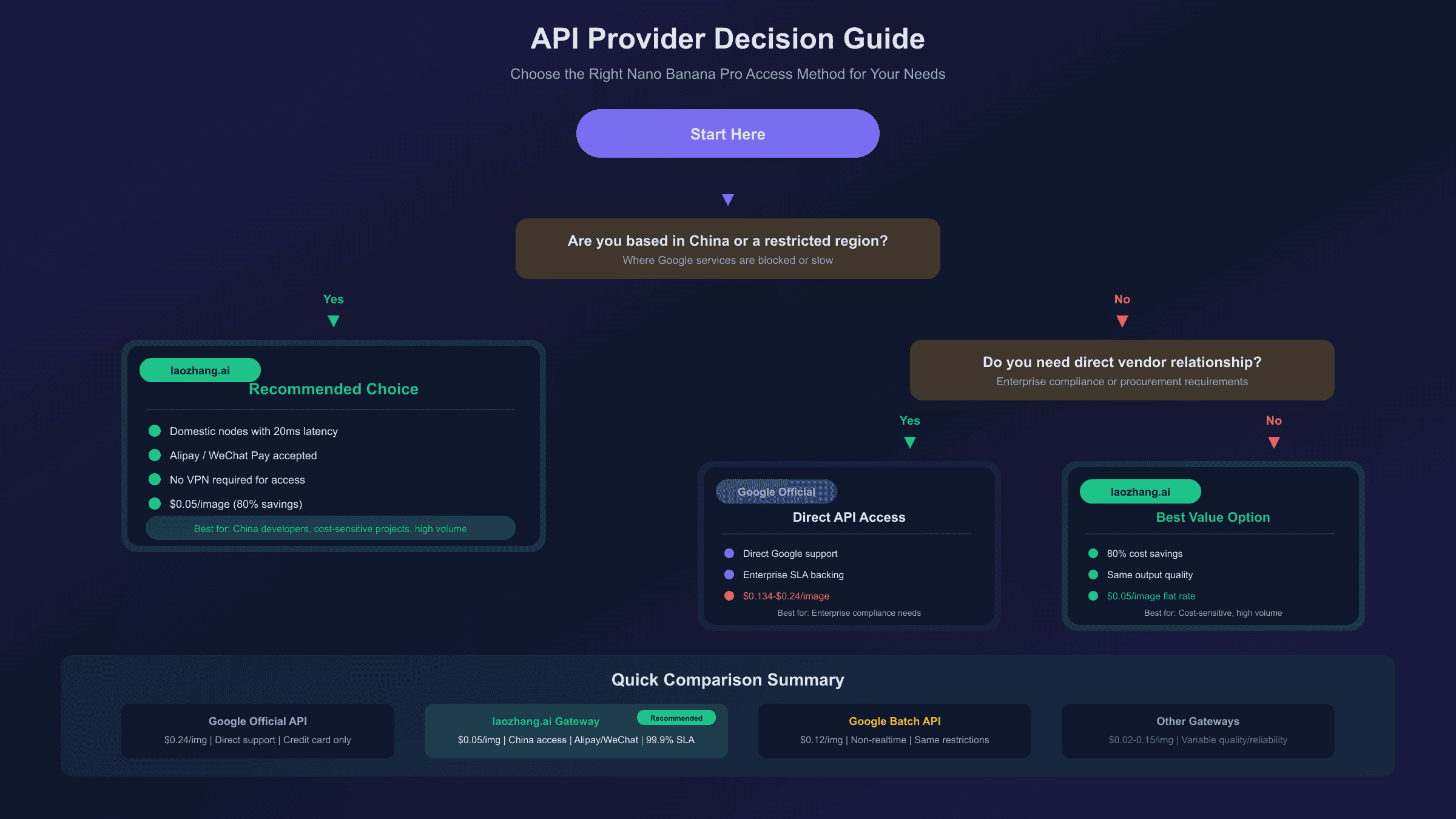
The API provider landscape includes multiple options beyond official access and laozhang.ai. Understanding the tradeoffs helps developers select appropriately for their specific requirements.
Official Google API
Best for: Enterprises requiring direct vendor relationships, projects with existing Google Cloud infrastructure, teams with minimal China-based users.
Advantages:
- Direct support channel with Google
- Enterprise SLA with legal backing
- Integration with other Google Cloud services
- No third-party dependency
Limitations:
- Higher pricing ($0.134-$0.24 per image)
- Credit card only payment
- Geographic access restrictions
- Rate limiting may affect high-volume use
Third-Party API Gateways (e.g., laozhang.ai)
Best for: China-based developers, cost-sensitive projects, teams needing local payment methods, high-volume generation workloads.
Advantages:
- Significant cost savings (typically 60-80%)
- Local payment methods (Alipay, WeChat Pay)
- Domestic nodes with low latency
- Simplified billing without Google Cloud setup
Limitations:
- Indirect relationship with model provider
- Provider-dependent uptime (though major providers match Google SLA)
- Some advanced features may require native format
Decision Framework
| Requirement | Recommended Provider |
|---|---|
| Enterprise compliance requiring direct vendor | Google Official |
| China-based development team | API Gateway (laozhang.ai) |
| Cost optimization priority | API Gateway |
| Existing Google Cloud billing | Google Official (simpler) |
| Need for local payment methods | API Gateway |
| High-volume production (>10k images/month) | API Gateway (cost benefit) |
| Experimental/prototype phase | Either (gateway offers lower minimum) |
For most individual developers and small teams, API gateway services provide better overall value. Enterprise organizations may prefer official channels for procurement and compliance reasons, though the technical capability remains equivalent.
Frequently Asked Questions
Is using a third-party API gateway safe and legal?
API gateway services operate as legitimate businesses providing infrastructure services. From a legal perspective, they handle billing aggregation similar to reseller arrangements common across technology industries. Your data transmits directly to Google's model through the gateway's infrastructure, with standard TLS encryption protecting the connection. Reputable providers like laozhang.ai maintain security practices appropriate for handling API traffic.
Will image quality differ from official API access?
No. The same Nano Banana Pro model processes requests regardless of access path. Gateway services route requests to Google's endpoints, which process them identically to direct access. Output images are byte-for-byte identical when using matching prompts and generation parameters.
What happens if the gateway provider experiences downtime?
Major providers maintain redundant infrastructure with automatic failover. laozhang.ai's 99.9% SLA provides the same uptime guarantee as Google's enterprise offering. For critical applications, implementing retry logic and considering backup providers adds additional resilience.
Can I use Nano Banana Pro for commercial projects?
Yes. Google's Gemini API terms permit commercial use of generated images. The SynthID watermark doesn't affect usage rights but does allow detection of AI-generated content by sophisticated systems. Check your specific use case against Google's acceptable use policy for any content restrictions.
How do I handle rate limiting?
Gateway providers typically offer higher effective rate limits than individual developer accounts on official APIs. If you encounter limits, implementing exponential backoff retry logic handles transient restrictions. For sustained high-volume needs, contact the provider about increased quotas or dedicated capacity.
What payment methods does laozhang.ai accept?
The platform accepts Alipay, WeChat Pay, and USDT (cryptocurrency). Minimum deposit is $5 (approximately 35 CNY). New accounts receive $0.1 in free credits for testing.
Can I switch between official API and gateway access?
Yes. The same prompts and parameters work across both access methods. Switching requires only changing the endpoint URL and API key in your code. This flexibility allows starting with one provider and transitioning if requirements change.
For developers seeking reliable, cost-effective access to Nano Banana Pro's capabilities, API gateway services provide a practical path forward. The combination of domestic infrastructure, local payment options, and significant cost savings addresses the primary barriers to adoption while maintaining full access to the model's industry-leading image generation capabilities.
Explore the capabilities firsthand through the online demo before committing to integration. The $0.1 registration credit provides sufficient quota to validate the service meets your specific requirements.