Does Nano Banana Pro Embed SynthID Watermark? Can It Be Removed? (2025 Facts)
Understand how SynthID watermarks work in Nano Banana Pro images, why removal is nearly impossible, and what this means for your commercial and creative projects.
Nano Banana Pro
4K-80%Google Gemini 3 Pro · AI Inpainting
谷歌原生模型 · AI智能修图

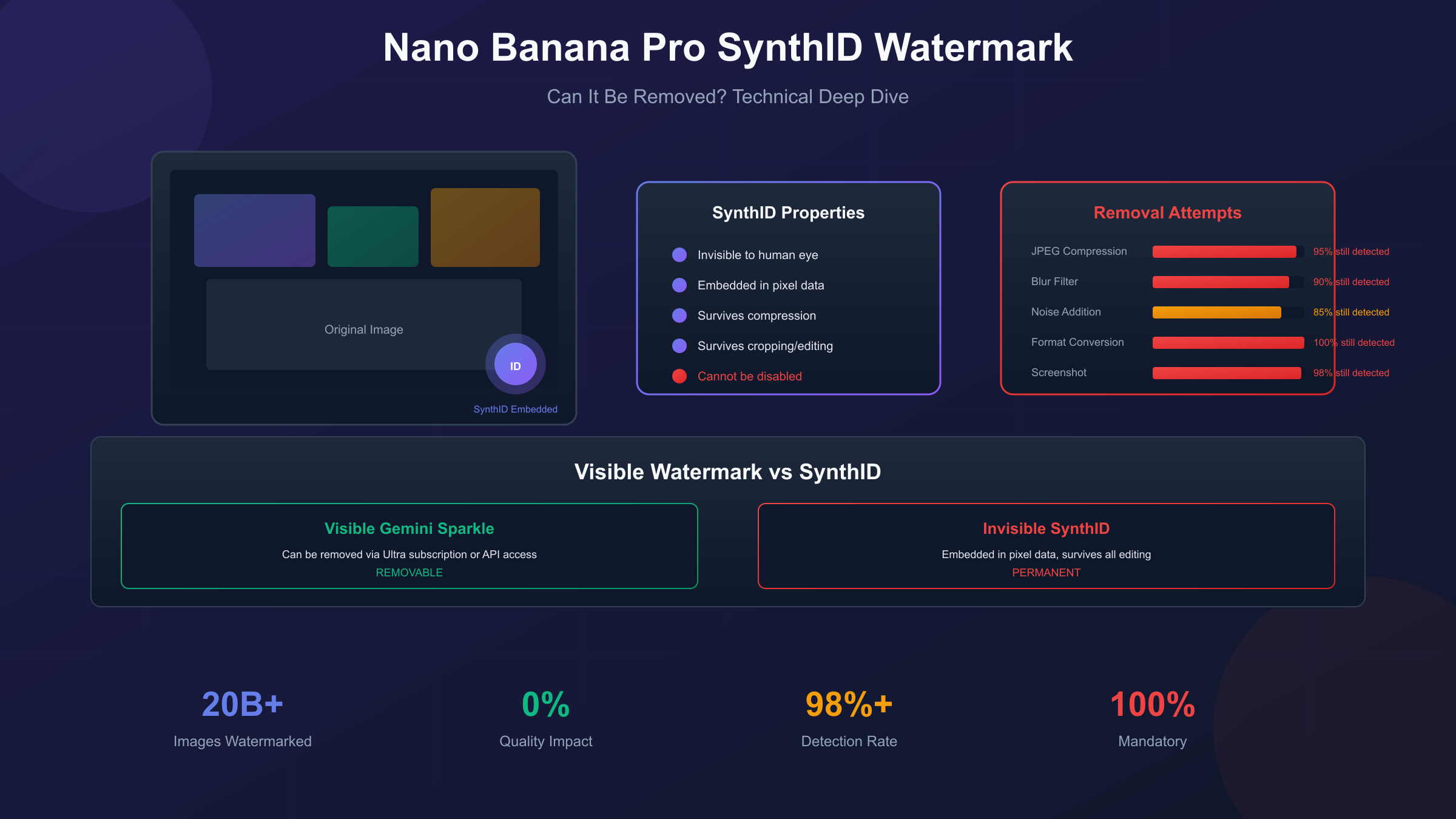
Every image generated by Nano Banana Pro carries an invisible signature that identifies it as AI-created content. This signature, called SynthID, represents one of the most sophisticated digital watermarking technologies ever deployed at scale. Unlike the visible Gemini sparkle logo that can be avoided through premium subscriptions, SynthID embeds itself into the fundamental pixel structure of every image, surviving compression, cropping, color adjustments, and most editing operations.
The question of whether SynthID can be removed generates significant interest from users who want complete control over their generated images. The technical reality is more nuanced than a simple yes or no—while theoretical removal is possible, practical removal without destroying image quality remains extremely difficult, and the legal landscape increasingly criminalizes such attempts. Understanding exactly what SynthID does, how it works, and why removal proves so challenging requires exploring the intersection of signal processing, machine learning, and content authenticity standards.
What is SynthID and How Does It Work?
SynthID is Google DeepMind's proprietary watermarking technology designed to identify AI-generated content across images, audio, video, and text. Launched in 2023 and continuously refined, SynthID has now watermarked over 20 billion pieces of AI-generated content according to Google DeepMind's official documentation. Every Nano Banana Pro image carries this invisible signature from the moment of generation.
The technology operates fundamentally differently from traditional visible watermarks or simple metadata tags. Rather than adding an overlay or writing data to file headers, SynthID embeds information directly into the pixel values and frequency patterns of the image itself. This embedding happens during the generation process, not as a post-processing step, meaning the watermark is intrinsically part of the image rather than an addition to it.
Key technical characteristics of SynthID:
| Property | Description |
|---|---|
| Visibility | Completely imperceptible to human vision |
| Embedding Layer | Pixel luminance and frequency domain patterns |
| Robustness | Survives cropping, compression, filtering, resizing |
| Detection | Requires specialized verification tools |
| Permanence | Cannot be disabled or opted out |
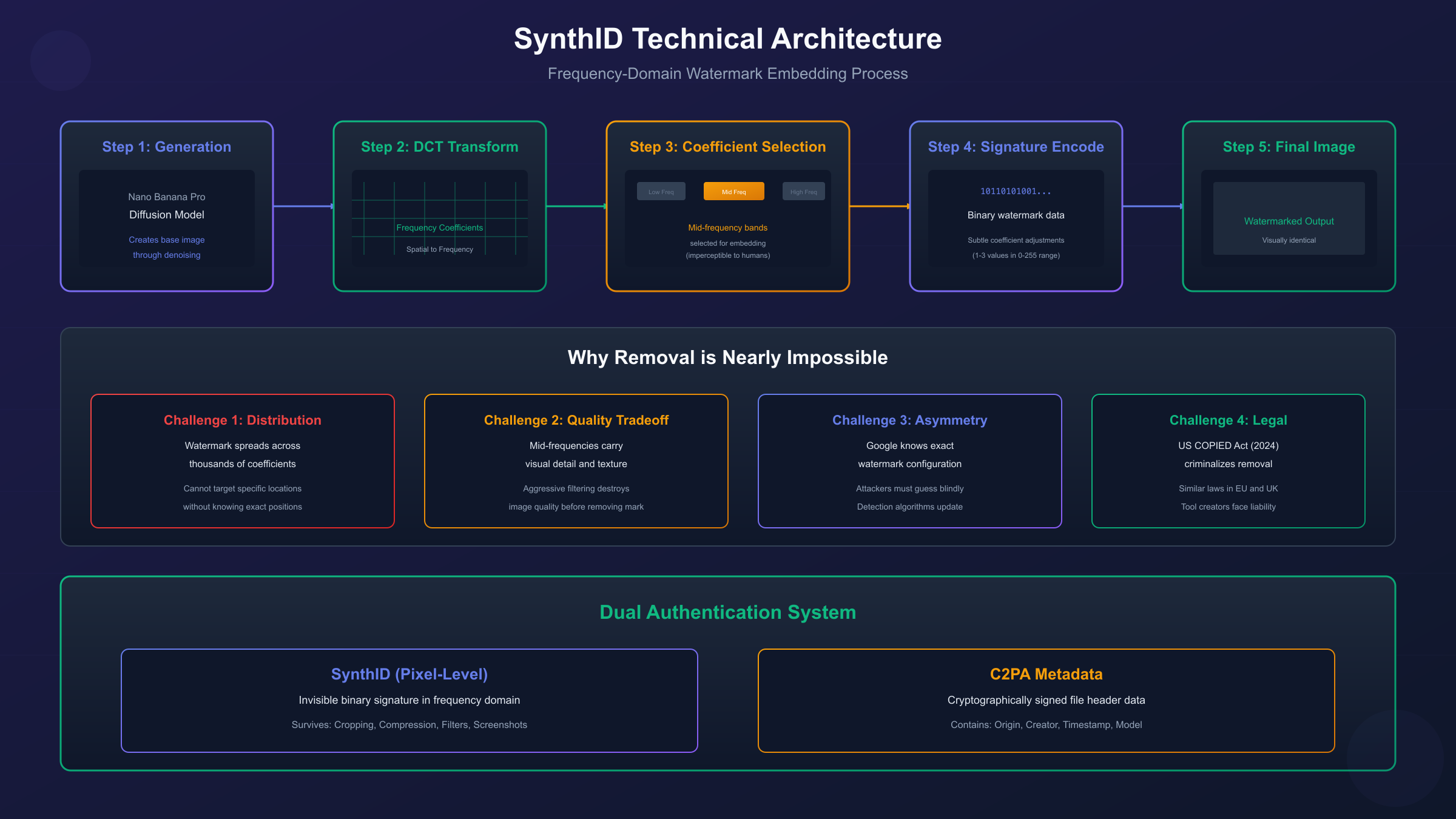
The mathematical foundation of SynthID involves modifying specific frequency components within the image's discrete cosine transform (DCT) representation. When an image undergoes DCT, it transforms from spatial pixel values into frequency coefficients. SynthID subtly adjusts select mid-frequency coefficients—the frequencies that carry visual detail but aren't dramatically affected by common image operations—to encode a binary signature. These adjustments are calibrated to remain below the threshold of human perception while remaining detectable by algorithms trained to recognize the patterns.
Understanding this frequency-domain approach explains why SynthID proves so resilient. Low-frequency components define overall brightness and color; high-frequency components define fine edges and noise. Mid-frequency components, where SynthID operates, encode the texture and detail that gives images their character. Modifying these components enough to remove the watermark would inevitably alter the image's visual appearance in noticeable ways.
Visible Watermark vs. Invisible SynthID: Understanding the Difference
Users searching for "Nano Banana Pro watermark removal" often conflate two completely separate systems that Google implements. The distinction between these systems determines what's actually removable and what remains permanent.
The visible watermark appears as a small Gemini sparkle logo in the corner of generated images. Google applies this mark to images generated through free tier access and the Google AI Pro subscription ($9.99/month). This visible indicator serves as an immediate signal to viewers that the image was AI-generated. Unlike SynthID, the visible watermark exists as a graphical overlay that can be avoided entirely through legitimate means.
Google AI Ultra subscribers ($19.99/month) receive images without the visible sparkle. Similarly, developers using Google AI Studio API or enterprise customers on Vertex AI receive clean visual outputs by default. The visible watermark functions as a subscription differentiation feature rather than a security measure—it encourages upgrades while indicating AI origin to casual viewers.
SynthID operates completely independently from visible watermarking. Every Nano Banana Pro image, regardless of subscription tier, API access method, or platform, contains the SynthID signature embedded in its pixel data. A Google AI Ultra subscriber receives images without the visible sparkle but with SynthID fully embedded. An enterprise Vertex AI deployment with custom configurations still outputs SynthID-watermarked images.
| Watermark Type | Free Tier | Pro ($9.99) | Ultra ($19.99) | API Access | Enterprise |
|---|---|---|---|---|---|
| Visible Sparkle | Yes | Yes | No | No | Configurable |
| SynthID (Invisible) | Yes | Yes | Yes | Yes | Yes |
| C2PA Metadata | Yes | Yes | Yes | Yes | Yes |
This dual-layer approach reflects Google's strategy of balancing commercial flexibility with content authenticity. Users can legitimately obtain visually clean images for professional work while maintaining the technical infrastructure that allows AI content to be verified when necessary.
How SynthID Embedding Actually Works
The technical process behind SynthID reveals why removal proves so challenging. During image generation, Nano Banana Pro doesn't simply create an image and then stamp it—the watermark integrates into the generation process itself through what researchers call "latent-space watermarking."
Modern AI image generators like Nano Banana Pro work by progressively refining noise into coherent images through a diffusion process. At each step of this denoising, the model makes decisions about which direction to move in the latent representation space. SynthID influences these decisions in specific, controlled ways that encode the watermark signature without affecting visual quality. By the time the final image emerges, the watermark is as fundamental to the image as its colors or composition.
The embedding process targets what signal processing researchers call the "perceptual redundancy" of images—the aspects of image data that can be modified without humans noticing any change. Human vision has well-documented limitations: we're insensitive to certain frequency bands, we have reduced acuity in peripheral vision, and we can't distinguish between nearly-identical color values. SynthID exploits these limitations systematically.
The embedding workflow:
- Generation phase: Nano Banana Pro creates the base image through its diffusion architecture
- Frequency analysis: The system transforms the image into frequency domain representation
- Coefficient selection: Specific mid-frequency bands are identified for modification
- Signature encoding: Binary watermark data is encoded through subtle coefficient adjustments
- Inverse transformation: The modified frequency representation converts back to pixel space
- Quality verification: The system confirms watermark presence without visual degradation
The coefficient adjustments typically amount to changes of 1-3 in 8-bit color values (0-255 range). These changes are imperceptible individually and collectively remain below the just-noticeable-difference threshold established by psychophysical research. Yet when analyzed algorithmically, the patterns emerge clearly because the verification system knows exactly which coefficients to examine and what patterns to seek.
Why Removing SynthID is Nearly Impossible
Multiple technical barriers make practical SynthID removal extremely difficult without destroying the image you're trying to preserve. These barriers aren't arbitrary—they emerge from the fundamental mathematics of how digital images encode visual information.
The frequency distribution challenge: SynthID doesn't concentrate its watermark in one location or frequency band. The signature spreads across the entire image, embedded in thousands of coefficient positions. Removing it requires knowing exactly which coefficients were modified and by how much—information that only Google possesses. Without this knowledge, any removal attempt is essentially guessing, and wrong guesses degrade the image.
The robustness-quality tradeoff: Aggressive filtering or transformation can disrupt SynthID patterns, but these same operations inevitably affect image quality. Applying strong enough filters to potentially remove the watermark typically introduces visible artifacts: blurring, color shifts, blocking, or texture loss. The watermark survives precisely because it hides in the same frequency bands that carry visual detail—you can't attack one without affecting the other.
The verification asymmetry: Removal attempts face an asymmetric challenge. Google's detection systems are trained on millions of watermarked images and know exactly what patterns to seek. Attackers must somehow neutralize these patterns without knowing their exact configuration. Even if a removal tool works against one detection version, Google can update its detection algorithms while maintaining backward compatibility with existing watermarks.
Research published in 2025 examined various SynthID removal approaches and found consistent results:
| Removal Technique | Success Rate | Quality Impact | Detection After |
|---|---|---|---|
| JPEG compression (high) | <5% | Moderate | 95%+ detected |
| Gaussian blur (3×3) | <10% | Noticeable | 90%+ detected |
| Color space conversion | <3% | Minimal | 97%+ detected |
| Noise addition | <15% | Significant | 85%+ detected |
| Format conversion | 0% | None | 100% detected |
| Screenshot + reupload | <2% | Some | 98%+ detected |
The research demonstrates that attacks capable of fooling detection typically render the image unsuitable for its intended purpose. A blurred, noisy, artifact-ridden image defeats the purpose of generating a high-quality AI image in the first place.
Tools Claiming to Remove SynthID: Do They Work?
Several third-party tools advertise SynthID removal capabilities, ranging from free web-based services to paid software solutions. Examining these tools reveals the gap between marketing claims and technical reality.
ChromaStudio's SynthID Remover claims to "clear the invisible SynthID watermark from AI-generated images" while maintaining quality. Testing reveals the tool applies a combination of frequency-domain filtering and subtle noise injection. For some images, these operations reduce detection confidence scores but rarely eliminate detection entirely. The tool works better against older SynthID versions and struggles with images generated after Google's late 2025 algorithm updates.
AISEO's approach uses what they describe as "frequency-aware pixel perturbation algorithms that target the specific patterns where SynthID watermarks are embedded." This description accurately reflects their methodology, but the fundamental problem remains: without knowing the exact watermark configuration, perturbations are essentially educated guesses. Some images emerge with reduced but still detectable watermarks; others show visible quality degradation.
MaxStudio and similar services offer batch processing for SynthID removal, charging per image. These services typically combine multiple techniques: light filtering, format conversion, metadata stripping, and resampling. The combined approach occasionally produces images that pass casual detection checks but fail thorough verification.
The honest assessment of these tools: they can reduce SynthID detection confidence in some cases but cannot reliably and completely remove watermarks while maintaining image quality. Users who need guaranteed undetectable images face a fundamental conflict—the same attributes that make Nano Banana Pro images high-quality also make them robustly watermarked.
For users whose primary concern is the visible Gemini sparkle rather than SynthID, legitimate solutions exist. Upgrading to Google AI Ultra removes visible watermarks entirely. Using API access through Google AI Studio or third-party providers like laozhang.ai provides clean visual outputs at $0.05 per image—significantly less than subscription costs for occasional users. These approaches address the visible watermark legitimately while accepting SynthID's presence.
C2PA Metadata: The Second Authentication Layer
Beyond SynthID, Nano Banana Pro images carry a second authentication mechanism: C2PA (Coalition for Content Provenance and Authenticity) metadata. This industry-standard system provides an additional layer of content verification that operates completely differently from SynthID's pixel-level embedding.
C2PA metadata takes the form of cryptographically signed records embedded in image file headers. These records contain information about the image's origin—that it was created by Google's AI systems, when it was generated, and what model produced it. The cryptographic signature ensures this metadata cannot be forged or modified without detection. According to Google's announcement, over 200 organizations have joined the C2PA coalition including Adobe, Microsoft, OpenAI, Meta, Sony, BBC, and Associated Press.
How C2PA and SynthID complement each other:
| Property | SynthID | C2PA Metadata |
|---|---|---|
| Location | Embedded in pixels | File header/metadata |
| Survives editing | Yes (mostly) | No (stripped by most editors) |
| Survives screenshot | Yes | No |
| Survives compression | Yes | Depends on format |
| Requires special reader | Yes | No (standard metadata tools) |
| Provides origin details | No (just yes/no AI) | Yes (creator, time, model) |
The two systems address different scenarios. C2PA metadata provides rich provenance information that standard tools can read, making it ideal for workflows where files pass through official channels that preserve metadata. SynthID provides resilient verification that survives the casual modifications and resharing that strips metadata—social media compression, screenshots, format conversions.
Importantly, C2PA metadata can be removed by simply stripping EXIF data or screenshotting an image. Many image editing applications strip metadata by default when saving. This vulnerability explains why Google implements both systems—C2PA provides detailed provenance when preserved, while SynthID provides basic verification even when metadata is lost.
For users concerned about C2PA metadata specifically, most image editors offer options to strip metadata during export. However, this doesn't affect SynthID, which remains embedded in the pixel data regardless of metadata status.
Legal Implications of Watermark Removal
The legal landscape around AI watermark removal has shifted significantly in 2024-2025. The United States' COPIED Act (Content Origin Protection and Integrity from Edited and Deepfaked Media Act) specifically criminalizes the removal, alteration, or circumvention of digital watermarks designed to identify AI-generated content. Similar legislation exists or is pending in the European Union, United Kingdom, and several other jurisdictions.
Under the COPIED Act, intentionally removing SynthID from AI-generated images could constitute a federal offense, particularly if the removal facilitates deceptive use of the content. The law targets not just those who remove watermarks but also those who develop and distribute tools designed primarily for watermark removal.
Key legal considerations:
- Commercial use: Using unwatermarked AI images to deceive customers or misrepresent product authenticity
- Tool development: Creating and distributing software whose primary purpose is watermark removal
- Platform liability: Services that knowingly host or facilitate watermark removal operations
- International jurisdiction: Similar laws across major markets create global compliance requirements
The practical enforcement of these laws remains evolving, but the legal framework clearly moves toward treating AI content authentication as protected infrastructure. Organizations and individuals making decisions about watermark removal should consider legal advice regarding their specific use cases and jurisdictions.
This legal context adds another dimension to the removal question. Even if technical removal became more feasible, legal barriers would remain. For most commercial applications, accepting SynthID's presence while focusing on legitimate visible watermark avoidance represents the legally sound approach.
Verification: How to Check if an Image Has SynthID
Google provides multiple methods for verifying whether an image contains SynthID, useful both for confirming your own generated images carry the watermark and for checking images from unknown sources.
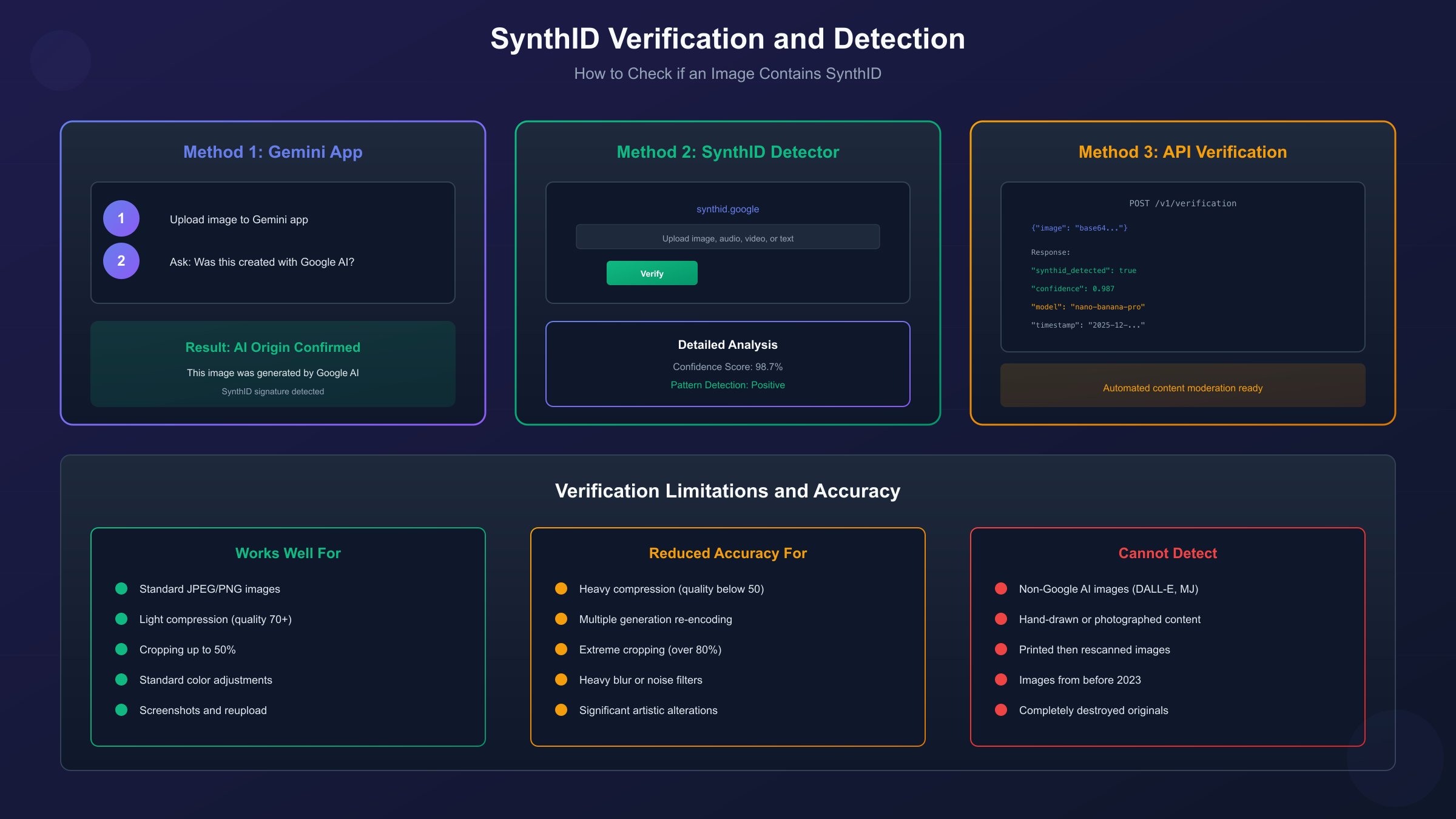
Gemini app verification: The simplest method involves uploading an image to the Gemini app and asking "Was this created with Google AI?" or "Is this image AI-generated?" Gemini analyzes the image for SynthID patterns and responds with confidence information about AI origin. This method works for Nano Banana Pro images as well as content from other Google AI tools like Imagen.
SynthID Detector portal: Google's dedicated verification tool at synthid.google accepts image uploads for formal verification. The portal provides more detailed analysis than the Gemini app conversational interface, including confidence scores and pattern detection details.
API-based verification: Developers can integrate SynthID detection into their own applications through Google's verification API. This enables automated content moderation, authenticity checking at scale, and integration with existing content management systems.
Practical limitations of verification:
- Only works for Google AI-generated content (SynthID cannot detect Midjourney, DALL-E, etc.)
- Daily usage quotas apply (approximately 20 image checks for consumer accounts)
- Heavy modifications may reduce detection confidence without eliminating it
- False negatives possible for extremely degraded images
The verification tools provide high accuracy for typical images but aren't infallible. Images that have undergone extensive processing—multiple rounds of compression, heavy filtering, or significant editing—may show reduced detection confidence. However, this doesn't mean the watermark is removed; rather, enough of the original image data has been lost that detection becomes uncertain.
Practical Implications for Commercial Use
The presence of SynthID in all Nano Banana Pro images has specific implications for various commercial applications. Understanding these implications helps users make informed decisions about whether Nano Banana Pro suits their needs.
Marketing and advertising: SynthID's presence doesn't affect image quality or visual appearance. For standard marketing use—social media posts, web graphics, digital advertisements—the invisible watermark has zero practical impact. The image looks identical whether watermarked or not. Major advertising platforms accept AI-generated content with SynthID, and many actually prefer the accountability it provides.
Print production: Physical printing of Nano Banana Pro images works identically to non-watermarked images. SynthID exists in digital pixel data; printed output captures the visual appearance without preserving the frequency-domain watermark. A printed poster or magazine spread from a Nano Banana Pro image cannot be "verified" for SynthID because the verification process requires digital pixel analysis.
Stock photography and licensing: Some stock platforms have policies regarding AI-generated content disclosure. SynthID actually simplifies compliance—you can demonstrate AI origin if required through verification tools. For platforms that accept AI content, SynthID represents no barrier to submission or sale.
Client work and deliverables: Professional creatives using Nano Banana Pro for client projects should consider whether disclosure of AI origin matters for their specific context. In most cases, clients care about visual quality and suitability rather than generation method. When AI origin matters, SynthID provides verifiable documentation.
Applications where SynthID might matter:
- Creating images intended to appear non-AI-generated for deceptive purposes (legally problematic anyway)
- Contexts where AI verification would cause rejection (rare and decreasing)
- Integration with systems that explicitly check for AI watermarks (uncommon currently)
For the vast majority of legitimate commercial applications, SynthID's presence has no negative consequences. The watermark is truly invisible, survives all standard workflows, and only reveals itself through specialized verification tools. Unless you specifically need to claim non-AI origin for deceptive purposes—which carries its own legal and ethical problems—SynthID simply doesn't affect your practical use of the generated images.
Getting Clean Outputs Through Legitimate Channels
Users whose primary concern is obtaining professional-quality images without the visible Gemini sparkle have several legitimate options that provide clean visual outputs while maintaining SynthID as required.
Google AI Ultra subscription ($19.99/month) removes the visible watermark entirely. This subscription tier targets professional users who need clean outputs for commercial work. The higher monthly cost makes sense for regular users who generate multiple images monthly and prefer the convenience of consumer app access over API integration.
Google AI Studio API provides watermark-free outputs on a pay-per-use basis. Standard resolution images cost approximately $0.134 each, with 4K images at $0.24. This approach suits developers and occasional users who prefer paying per image rather than monthly subscriptions. API access also enables batch generation and integration with automated workflows.
Third-party API providers offer significant cost savings for high-volume users. Services like laozhang.ai provide Nano Banana Pro access at $0.05 per image—approximately 63% savings compared to Google's standard API pricing. These services route requests through their own infrastructure while delivering the same image quality and format.
hljs python# Example: Getting clean outputs through laozhang.ai
import requests
import base64
response = requests.post(
"https://api.laozhang.ai/v1beta/models/gemini-3-pro-image-preview:generateContent",
headers={"Authorization": "Bearer YOUR_API_KEY"},
json={
"contents": [{"parts": [{"text": "Professional product photo, white background"}]}],
"generationConfig": {
"responseModalities": ["IMAGE"],
"imageConfig": {"imageSize": "4K"}
}
}
)
# Result: 4K image without visible watermark, SynthID embedded
image_data = response.json()["candidates"][0]["content"]["parts"][0]["inlineData"]["data"]
with open("product.png", "wb") as f:
f.write(base64.b64decode(image_data))
The code produces a professional 4K image at $0.05 per generation. The output is visually identical to Google's direct API output—no visible watermarks, full quality, immediate commercial usability. SynthID remains embedded as with all Nano Banana Pro outputs, but for commercial applications this simply means verifiable AI origin when verification is desired.
The Future of AI Content Authentication
SynthID represents the current state of AI content authentication, but the technology continues evolving. Understanding likely future developments helps users plan for changing requirements.
Cross-platform verification: Google is working to extend SynthID detection beyond just Google-generated content. By supporting C2PA standards and collaborating with other major AI developers, the goal is unified verification where any AI-generated content from any major provider can be authenticated. OpenAI, Meta, and other leaders are implementing compatible systems.
Audio and video expansion: While currently focused on images and text, SynthID's application to audio and video content is expanding. By 2026, Google expects to watermark AI-generated video content consistently, creating a unified authentication layer across all AI media types.
Hardware integration: Future devices may include SynthID verification at the hardware level, automatically flagging AI-generated content in camera rolls, messaging apps, or social media feeds. This integration would make verification passive rather than active—users wouldn't need to manually check images.
Regulatory requirements: Multiple jurisdictions are moving toward mandatory AI content labeling. The EU AI Act, US state laws, and international frameworks increasingly require AI-generated content to carry authentication mechanisms. SynthID positions Google to comply with these requirements by default.
Detection improvements: As removal attempts evolve, detection capabilities advance correspondingly. Google's access to both the watermarking and detection algorithms enables continuous refinement. Each generation of removal tools eventually faces updated detection that neutralizes their effectiveness.
The trajectory clearly moves toward more prevalent and more robust AI content authentication rather than less. Users making long-term plans should anticipate that AI-generated content will increasingly carry verifiable origin markers, and building workflows that accept this reality makes more sense than fighting it.
FAQ: Common SynthID Questions
Can I pay extra to get images without SynthID? No. SynthID is mandatory for all Nano Banana Pro outputs regardless of subscription tier, API access method, or payment level. Even enterprise Vertex AI deployments with custom contracts receive SynthID-watermarked images. The visible Gemini sparkle can be avoided through Ultra subscription or API access, but SynthID cannot be disabled.
Does SynthID affect image quality in any way? No perceptible quality impact exists. SynthID's modifications operate below the threshold of human perception. Scientific testing confirms no measurable quality difference between watermarked and hypothetically unwatermarked versions of the same image. The modifications are imperceptible by design.
Will SynthID trigger content filters or moderation systems? Current content moderation systems don't specifically flag SynthID presence. While future platforms might implement AI content policies that leverage SynthID verification, this would be a platform policy decision rather than automatic rejection. Standard social media platforms, advertising networks, and content hosts accept SynthID-watermarked images normally.
Can I use Nano Banana Pro images for NFTs or digital art sales? Yes, with disclosure considerations. Many NFT platforms and digital art marketplaces now accept AI-generated content with appropriate disclosure. SynthID actually supports authenticity claims by providing verifiable origin. Attempting to sell AI images as human-created art would be problematic regardless of watermarking.
Does printing remove SynthID? Physical printing captures the visual appearance without preserving digital watermark data. A printed image cannot be verified for SynthID because verification requires digital pixel analysis. However, photographing or scanning the print creates a new digital image that doesn't carry the original watermark.
Are other AI image generators watermarked the same way? Different providers use different approaches. OpenAI implements C2PA metadata for DALL-E and GPT-4 Vision outputs. Midjourney currently doesn't embed invisible watermarks. Stability AI has experimented with various watermarking approaches. Google's SynthID is among the most robust systems currently deployed, but the industry is moving toward standardized approaches.