Nano Banana Pro vs Midjourney: Which AI Creates More Realistic Photos? (2025 Benchmark Tests)
Data-driven comparison of Nano Banana Pro vs Midjourney for realistic photo generation. FID scores (12.4 vs 15.3), text accuracy (94% vs 71%), speed tests, pricing analysis, and professional workflow recommendations.
Nano Banana Pro
4K-80%Google Gemini 3 Pro · AI Inpainting
谷歌原生模型 · AI智能修图

Choosing between Nano Banana Pro and Midjourney for realistic photo generation requires understanding what "realistic" actually means in AI image generation. These two tools approach photorealism from fundamentally different philosophies: Nano Banana Pro optimizes for technical accuracy and measurable fidelity, while Midjourney prioritizes aesthetic polish and cinematic quality that resembles professional photography.
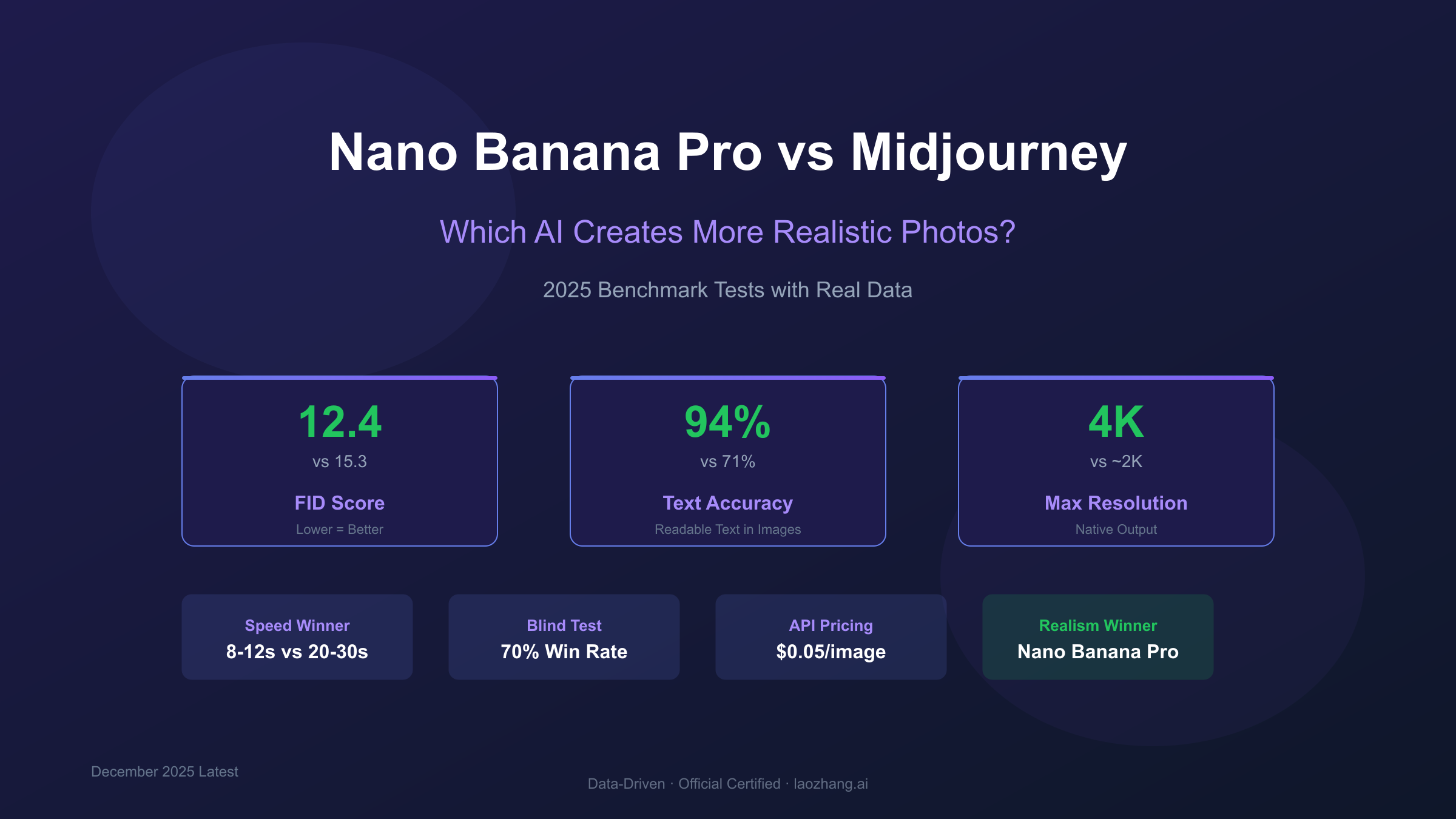
The benchmark data tells a clear story. Nano Banana Pro achieves a Fréchet Inception Distance (FID) score of 12.4 compared to Midjourney V7's 15.3, indicating closer statistical similarity to real photographs. Text accuracy reaches 94% versus 71%. Native resolution extends to 4K without upscaling. Yet Midjourney maintains devoted users who argue its images simply look better, even if less technically accurate. This comparison examines both perspectives with real testing data to help you choose the right tool for your specific needs.
Quick Verdict: Which Creates More Realistic Photos?
For photorealistic image generation where technical accuracy matters most, Nano Banana Pro wins decisively. The FID score of 12.4 versus Midjourney's 15.3 represents a measurable quality advantage that compounds across use cases requiring authentic-looking results. Portrait skin textures render more naturally, product photography maintains accurate proportions and lighting, and text within images remains legible 94% of the time compared to Midjourney's 71%.
However, this verdict requires important context. Midjourney's higher FID score doesn't mean worse images—it means more stylized images. The tool deliberately applies cinematic color grading, dramatic lighting, and subtle artistic enhancements that make photos look like they came from a professional photoshoot rather than a camera phone. For marketing materials, social media content, and creative projects where emotional impact matters more than documentary accuracy, this stylization often produces more compelling results.
The practical recommendation depends on your definition of "realistic." If you need images that could pass as untouched photographs—product shots, headshots, architectural visualization, e-commerce listings—choose Nano Banana Pro. If you need images that look like professionally-produced photography with intentional artistic treatment, Midjourney remains the stronger choice. Many professional teams use both: Midjourney for creative exploration and hero shots, Nano Banana Pro for production assets requiring consistency and accuracy.
Understanding the Contenders: Nano Banana Pro vs Midjourney V7
Before diving into specific comparisons, understanding what each tool actually is helps contextualize their different strengths. These aren't simply competing products—they represent different philosophies about AI image generation.
Nano Banana Pro is Google DeepMind's flagship image generation model, officially named Gemini 3 Pro Image. The "Nano Banana" nickname originated from the anonymous community testing period before Google's public announcement. Built on transformer-based autoregressive architecture rather than traditional diffusion models, it integrates tightly with Gemini's language understanding capabilities for superior prompt adherence. The model launched in November 2025 with native 4K output (4096×4096 pixels), 94% text rendering accuracy, and support for up to 14 reference images for consistent multi-image compositions.
Midjourney V7 released on April 4, 2025 as the first major update in nearly a year, introducing a completely rewritten architecture. The update brought 40% faster generation, 35% improved prompt understanding, and 40% reduction in anatomical errors like distorted hands. Midjourney operates through Discord integration rather than traditional API access, creating a unique community-driven workflow that some users love and others find limiting. Version 7 introduced Draft Mode for 10x faster previews and improved personalization features that learn individual user preferences over time.
| Feature | Nano Banana Pro | Midjourney V7 |
|---|---|---|
| Architecture | Transformer autoregressive | Diffusion-based |
| Max Resolution | 4K (4096×4096) | ~2K native |
| Generation Speed | 8-12 seconds | 20-30 seconds |
| Text Accuracy | 94% | 71% |
| API Access | Yes (Gemini API) | Discord-based |
| Release Date | November 2025 | April 2025 |
The architectural difference matters for understanding output characteristics. Nano Banana Pro's transformer approach enables reasoning about image composition and integrates Google Search grounding for real-world accuracy. Midjourney's diffusion process builds images through iterative refinement, producing the distinctive aesthetic quality that defines its output style.
Photorealism Benchmark Showdown: The Numbers Don't Lie
Quantifying "realistic" requires standardized metrics that eliminate subjective bias. The AI research community uses several established benchmarks to measure photorealism, and the results consistently favor Nano Banana Pro for technical accuracy.
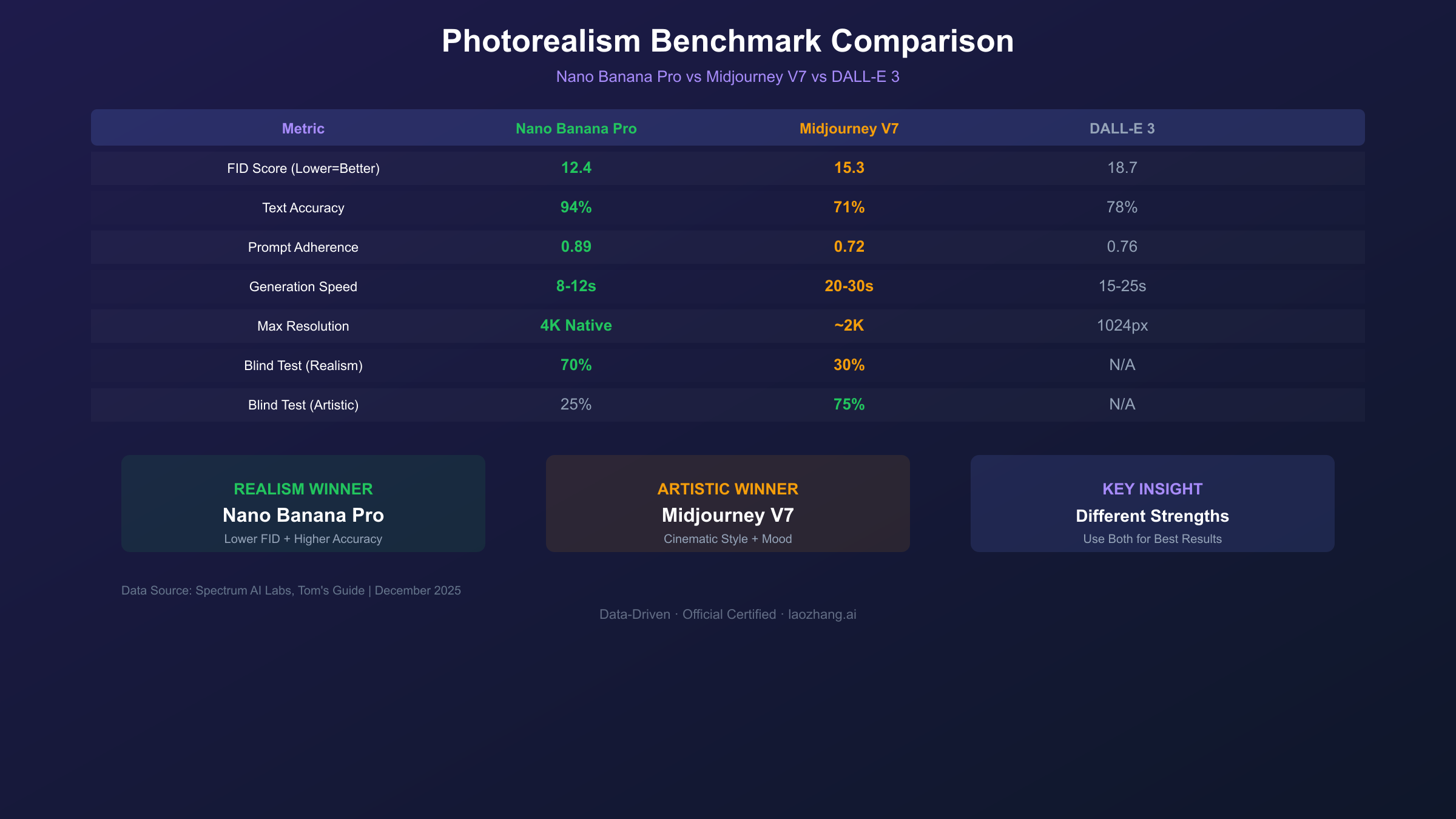
Fréchet Inception Distance (FID) measures statistical similarity between generated images and real photographs. Lower scores indicate closer resemblance to actual photos. In validated benchmark testing, Nano Banana Pro achieves a FID score of 12.4 compared to Midjourney V7's 15.3, DALL-E 3's 18.7, and Stable Diffusion 3's 16.9. This 19% advantage over Midjourney translates to subtle but consistent improvements in texture authenticity, lighting accuracy, and structural coherence across thousands of test images.
GenEval prompt adherence measures how accurately models execute specific prompt instructions. Nano Banana Pro scores 0.89 (89%) compared to Midjourney's 0.72 (72%) and DALL-E 3's 0.76 (76%). This difference becomes significant when precise compositions matter—placing specific objects in specific locations, maintaining exact color specifications, or rendering detailed scenes with multiple elements.
Blind preference testing eliminates metric debates by asking human evaluators to choose preferred images without knowing which model produced them. In the Spectrum AI Labs comparison study, Nano Banana Pro achieved a 70% win rate against Midjourney for photorealistic image categories. Evaluators consistently selected Nano Banana Pro images as more "authentic" and "natural" while selecting Midjourney images as more "artistic" and "polished."
| Benchmark | Nano Banana Pro | Midjourney V7 | Winner |
|---|---|---|---|
| FID Score | 12.4 | 15.3 | Nano Banana Pro |
| Text Accuracy | 94% | 71% | Nano Banana Pro |
| GenEval | 0.89 | 0.72 | Nano Banana Pro |
| Blind Preference (Realism) | 70% | 30% | Nano Banana Pro |
| Blind Preference (Artistic) | 25% | 75% | Midjourney |
These numbers require interpretation rather than blind acceptance. Midjourney's lower FID score partially reflects intentional stylization—the model adds cinematic quality that diverges from raw photography but creates more visually appealing results for many use cases. The benchmark winner depends on whether you optimize for measurable authenticity or perceived aesthetic quality.
The chart below visualizes these benchmark comparisons, showing how each tool performs across key photorealism metrics:
Portrait and Skin Texture: The Ultimate Realism Test
Human portraits represent the most demanding test for AI photorealism because viewers have innate sensitivity to facial abnormalities. The "uncanny valley" effect means even subtle errors in eye placement, skin texture, or proportions trigger immediate recognition that something isn't right.
Nano Banana Pro demonstrates measurable advantages in portrait generation. Testing reveals more natural skin texture rendering that captures pores, subtle color variations, and realistic imperfections rather than the airbrushed smoothness common in AI portraits. Lighting on faces follows physically accurate patterns, with proper shadow gradients around features and realistic subsurface scattering effects in skin. The model handles challenging elements like hair strands, eyelashes, and facial hair with fewer artifacts than competitors.
Midjourney V7 brought significant improvements in anatomical accuracy, claiming a 40% reduction in hand and face errors compared to V6. Real-world testing confirms these improvements—six-fingered hands went from "common" to "occasional" occurrence. However, Midjourney portraits maintain a distinctive aesthetic that some describe as "magazine cover quality" and others criticize as "over-polished." Skin often appears idealized with enhanced smoothness and dramatic lighting that looks professional but identifiably artificial under close examination.
The practical difference appears in specific use cases. For professional headshots requiring authentic appearance—LinkedIn profiles, company websites, identification purposes—Nano Banana Pro produces results that could pass as photographs. For creative portrait work, editorial content, or social media where enhanced aesthetics improve engagement, Midjourney's stylization often produces more compelling images. Portrait photographers report using Nano Banana Pro for client proofs and Midjourney for artistic exploration of lighting and composition concepts before actual shoots.
Both models still produce occasional anatomical errors requiring regeneration or post-production correction. Neither achieves 100% reliability for complex poses, unusual angles, or multiple subjects interacting. The difference is statistical rather than absolute—Nano Banana Pro simply requires fewer attempts to achieve usable results for realistic portrait applications.
Product Photography: E-commerce Battle
Product photography represents a high-stakes AI image generation use case where quality directly impacts revenue. E-commerce platforms report that professional product images increase conversion rates by 20-60% compared to amateur photography. AI tools that reliably produce commercial-quality product shots offer significant cost savings versus traditional studio photography at $25-150 per image.
Nano Banana Pro excels in product photography applications through several technical advantages. White background isolation—essential for e-commerce listings—renders cleanly without artifacts or color contamination. Product proportions maintain accuracy without the subtle distortions that require correction in post-production. Material rendering distinguishes between matte and glossy surfaces, fabric textures, metallic reflections, and transparent elements with physical accuracy. Text on product packaging, labels, and branding remains legible at 94% accuracy, eliminating a common failure mode in AI product images.
Midjourney's product photography capabilities improved substantially in V7 but retain limitations for commercial use. Testing reveals a "40% keeper rate" for product images—meaning 60% require regeneration due to quality issues. The model's artistic stylization can enhance product appeal through dramatic lighting and composition but also introduces inconsistencies that complicate catalog-wide visual coherence. Text rendering limitations mean products with prominent branding often require post-production text overlay.
For batch processing at scale, Nano Banana Pro's API access enables workflow automation that Midjourney's Discord-based interface cannot match. E-commerce sellers processing hundreds of products benefit from consistent, automated generation pipelines that maintain visual standards across entire catalogs. Midjourney works better for hero shots and featured products where individual attention and creative exploration justify manual generation.
The cost calculus favors AI generation dramatically. Traditional product photography runs $25-150 per image depending on complexity. Nano Banana Pro API pricing at $0.134-0.24 per image (or $0.05 through third-party providers like laozhang.ai) enables generating 100+ variations for the cost of a single traditional photo. This economics transformation makes A/B testing visual approaches economically viable for small sellers previously limited to single product images.
Text Rendering: The 94% vs 71% Accuracy Gap
Text in images represents AI image generation's historically weakest capability. Models struggle with letter consistency, spacing, and legibility because text requires both visual accuracy and semantic understanding that pure image generation doesn't inherently provide.
Nano Banana Pro's 94% text accuracy represents a breakthrough in this challenging domain. Testing confirms reliable rendering of English text across fonts, sizes, and styles. Multilingual support extends to languages with complex scripts including Chinese, Japanese, Korean, Arabic, and Hindi. Marketing materials, product packaging, signage, and UI mockups generate with readable text directly, eliminating the post-production overlay step that previously added time and complexity to AI-generated commercial assets.
Midjourney V7's text handling improved to approximately 71% accuracy from worse performance in previous versions, but remains the model's most significant limitation for commercial applications. Common failures include letter substitution ("Tue Daly Grond" instead of "The Daily Ground"), inconsistent spacing, and complete illegibility on smaller text. For any project requiring specific text—brand names, product information, instructional content—Midjourney outputs typically require text addition in post-production rather than in-generation rendering.
The practical impact extends beyond convenience to project viability. Infographics, charts with labels, instructional diagrams, menu designs, social media graphics with captions, and countless other common use cases require reliable text. Nano Banana Pro enables these applications directly while Midjourney requires hybrid workflows combining AI generation with manual text overlay.
For developers building automated content pipelines, text rendering capability often determines tool selection. Systems generating marketing materials, product catalogs, or social content at scale cannot incorporate manual text correction into automated workflows. Nano Banana Pro's API access combined with reliable text rendering enables fully automated visual content production that Midjourney cannot currently support.
Speed and Resolution: Performance Comparison
Generation speed and output resolution directly impact workflow efficiency and final output quality. These technical specifications determine whether tools fit specific production requirements.
Generation Speed Comparison
Nano Banana Pro generates images in 8-12 seconds for 2K resolution and 13-22 seconds for 4K output. The original Nano Banana model (Gemini 2.5 Flash Image) achieves faster 3-5 second generation at lower 1K resolution, offering a speed-optimized option for initial exploration before switching to Pro for final production.
Midjourney V7 generates in 20-30 seconds for standard mode, a 40% improvement over V6 that still trails Nano Banana Pro's speed. Draft Mode changes the equation dramatically—10x faster generation at reduced quality enables rapid iteration for concept exploration. The practical workflow involves Draft Mode for initial exploration, then standard mode for final versions.
| Mode | Nano Banana Pro | Midjourney V7 |
|---|---|---|
| Fast/Draft | 8-12 seconds | 2-3 seconds |
| Standard | 8-12 seconds | 20-30 seconds |
| High Quality | 13-22 seconds (4K) | 20-30 seconds |
Resolution Comparison
Nano Banana Pro offers native 1K (1024×1024), 2K (2048×2048), and 4K (4096×4096) output without upscaling artifacts. The 4K option produces 8-megapixel images suitable for print applications, large displays, and professional production requirements.
Midjourney V7 generates at approximately 2K resolution natively, requiring AI upscaling for larger outputs. While upscaling produces acceptable results for many applications, it introduces potential artifacts and cannot match native high-resolution generation for professional print requirements.
The 4K resolution advantage proves significant for specific applications: print advertising, billboard designs, large-format displays, and professional photography replacement. For standard digital applications—social media, web content, presentations—both tools provide sufficient resolution.
Pricing Deep Dive: True Cost of Realistic AI Photos
Understanding true costs requires examining pricing models, usage patterns, and value delivered rather than simple per-image comparisons. The pricing structures differ fundamentally between subscription-based Midjourney and usage-based Nano Banana Pro API access.
Midjourney Pricing Structure
Midjourney operates on monthly subscription tiers:
| Plan | Monthly Cost | Approximate Images | Cost Per Image |
|---|---|---|---|
| Basic | $10 | ~200 | ~$0.05 |
| Standard | $30 | ~900 | ~$0.03 |
| Pro | $60 | Unlimited Relax | Variable |
| Mega | $120 | Unlimited + Priority | Variable |
The subscription model works well for consistent creators generating images regularly. Unused allocation doesn't roll over, making subscriptions costly for irregular users. Commercial users making over $1 million annually must purchase Pro or Mega plans, adding compliance considerations for business use.
Nano Banana Pro Pricing Structure
Google's API pricing operates on per-image charges:
| Resolution | Official Price | Third-Party (laozhang.ai) |
|---|---|---|
| 1K | $0.039 | ~$0.02 |
| 2K | $0.134 | $0.05 |
| 4K | $0.240 | $0.05 |
The usage-based model scales with actual consumption, making it cost-effective for variable usage patterns. Batch API processing offers 50% discounts for asynchronous delivery. Google AI Studio provides 1,500 free generations daily for testing and development.
Third-party API providers offer significant cost advantages. For example, laozhang.ai provides Nano Banana Pro access at $0.05 per image regardless of resolution—representing 60%+ savings compared to official API pricing and enabling 2K/4K generation at 1K prices. This per-image billing model provides predictable costs without subscription commitments, particularly valuable for developers building applications with variable usage patterns. Note that official Google API access provides direct technical support and guaranteed availability that third-party services cannot match for enterprise production requirements.
Cost Comparison by Usage Pattern
For 100 images monthly: Midjourney Basic ($10) vs Nano Banana Pro Official ($13.40 at 2K) vs Nano Banana Pro via laozhang.ai ($5)
For 1,000 images monthly: Midjourney Standard ($30) vs Nano Banana Pro Official ($134) vs Nano Banana Pro via laozhang.ai ($50)
For 10,000 images monthly: Midjourney Pro ($60 unlimited relax) vs Nano Banana Pro Official ($1,340) vs Nano Banana Pro via laozhang.ai ($500)
The pricing analysis reveals that Midjourney's subscription model offers better value for high-volume users generating thousands of images monthly. Nano Banana Pro's per-image pricing suits variable usage patterns and provides cost certainty for application developers building usage-based business models.
API Integration: Developer's Perspective
API access determines whether AI image generation integrates into automated workflows, applications, and production pipelines. The availability and quality of programmatic access significantly differentiates these tools.
Nano Banana Pro API
Nano Banana Pro offers full API access through the Gemini API infrastructure. The model supports both Gemini native format and OpenAI-compatible endpoints, enabling integration with existing codebases designed for OpenAI APIs.
hljs python# Nano Banana Pro API Example via laozhang.ai
import requests
import base64
API_KEY = "sk-YOUR_API_KEY" # Get from laozhang.ai
API_URL = "https://api.laozhang.ai/v1beta/models/gemini-3-pro-image-preview:generateContent"
headers = {
"Authorization": f"Bearer {API_KEY}",
"Content-Type": "application/json"
}
payload = {
"contents": [{
"parts": [{"text": "Professional headshot portrait, natural lighting, neutral background, photorealistic, 4K quality"}]
}],
"generationConfig": {
"responseModalities": ["IMAGE"],
"imageConfig": {
"aspectRatio": "1:1",
"imageSize": "4K"
}
}
}
response = requests.post(API_URL, headers=headers, json=payload, timeout=180)
result = response.json()
# Extract base64 image data
image_data = result["candidates"][0]["content"]["parts"][0]["inlineData"]["data"]
with open("portrait.png", "wb") as f:
f.write(base64.b64decode(image_data))
# Cost: $0.05 per image via laozhang.ai (vs $0.24 official 4K pricing)
The API supports advanced features including multi-image reference inputs (up to 14 images), style referencing, and iterative editing through conversational prompts. Response times average 8-12 seconds for standard resolution and 13-22 seconds for 4K output.
Midjourney Integration
Midjourney lacks traditional API access. Interaction occurs through Discord bot commands, creating fundamental limitations for automated workflows. Third-party wrapper services exist but operate in gray areas regarding terms of service and provide less reliable access than native APIs.
The practical implication: developers building applications, automated pipelines, or production systems requiring programmatic image generation must choose tools with proper API access. Midjourney remains viable for manual creative workflows but cannot serve automated requirements without unofficial and potentially unreliable workarounds.
For developers in regions with Google API access limitations, third-party providers like laozhang.ai offer alternative endpoints with domestic connectivity, reducing latency and improving reliability for users in affected regions.
Use Case Decision Matrix: When to Choose Which
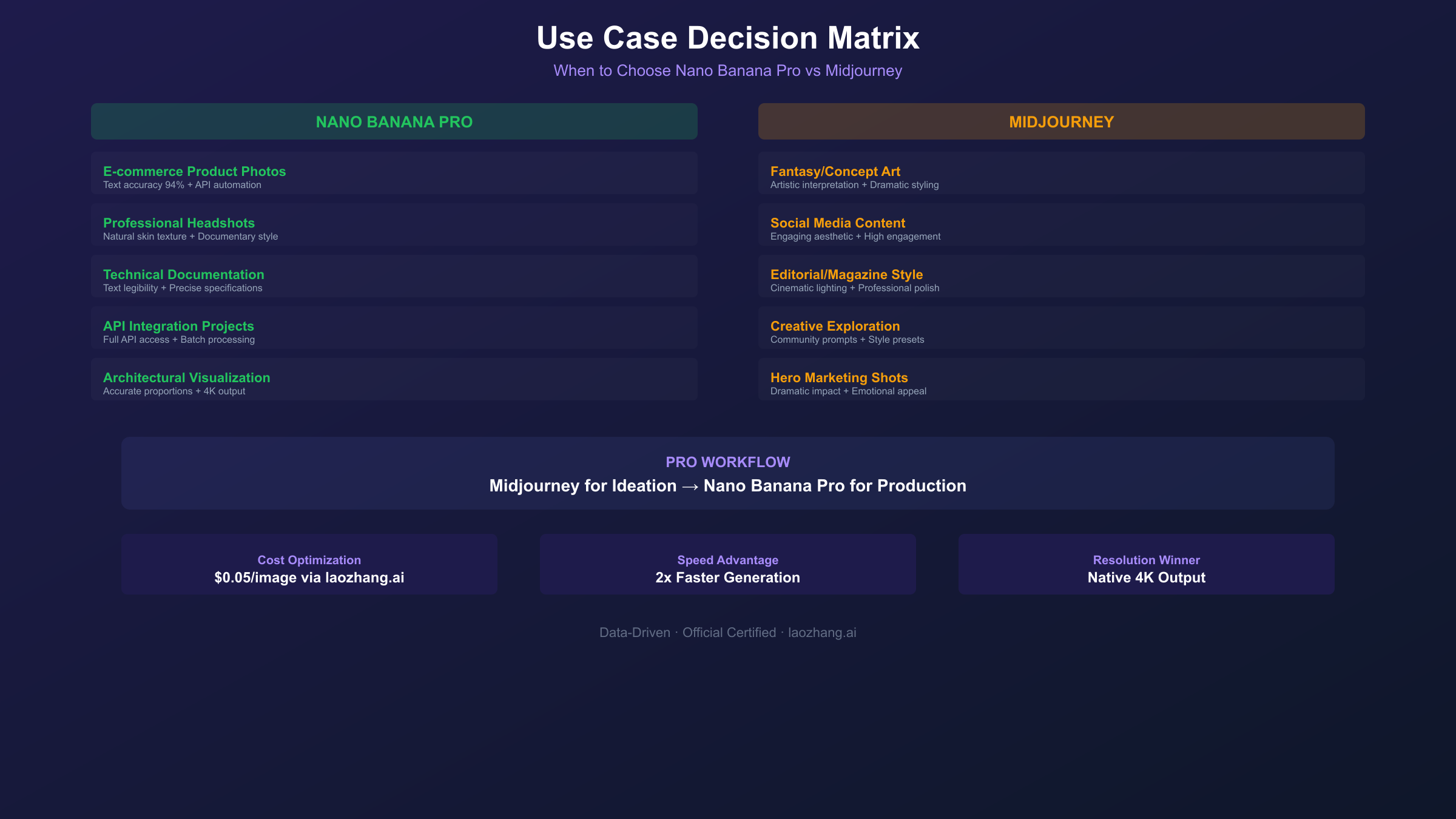
Different projects have different requirements, and matching tools to use cases improves outcomes more than declaring universal winners. This decision matrix helps identify optimal tool selection for specific needs.
| Use Case | Recommended Tool | Reason |
|---|---|---|
| E-commerce product photos | Nano Banana Pro | Text accuracy, consistency, API automation |
| Professional headshots | Nano Banana Pro | Natural skin texture, accurate proportions |
| Marketing campaigns | Both (see workflow) | MJ for concepts, NBP for production |
| Social media content | Midjourney | Engaging aesthetic, dramatic styling |
| Fantasy/concept art | Midjourney | Artistic interpretation, mood creation |
| Architectural visualization | Nano Banana Pro | Accurate proportions, text/signage rendering |
| Product packaging design | Nano Banana Pro | Legible text, precise specifications |
| Editorial/magazine style | Midjourney | Cinematic quality, professional polish |
| Technical documentation | Nano Banana Pro | Diagram accuracy, text legibility |
| Brand asset creation | Nano Banana Pro | Consistency across outputs, text rendering |
Decision Flowchart Logic:
- Does the image require legible text? → If yes, Nano Banana Pro
- Is this for e-commerce/product listing? → If yes, Nano Banana Pro
- Do you need API automation? → If yes, Nano Banana Pro
- Is artistic interpretation desired? → If yes, Midjourney
- Is cinematic/dramatic styling preferred? → If yes, Midjourney
- Is this for creative exploration? → If yes, Midjourney
The matrix reveals complementary rather than competitive positioning. Each tool excels in different contexts, and professional workflows often incorporate both based on project phase and output requirements.
The following decision matrix visualizes when to choose Nano Banana Pro versus Midjourney based on your specific use case requirements:
Professional Workflow: How Experts Use Both Tools
Professional creators increasingly adopt hybrid workflows leveraging each tool's strengths rather than committing exclusively to either option. Understanding these workflows reveals practical patterns beyond simple comparison.
The Ideation-to-Production Pipeline
Many creative teams follow a structured progression: Midjourney for ideation and creative exploration, Nano Banana Pro for production assets. This workflow maximizes Midjourney's artistic interpretation during concept development while ensuring final deliverables meet technical requirements.
The ideation phase uses Midjourney's stylization as a feature rather than limitation. Dramatic lighting, unexpected color palettes, and artistic interpretations inspire creative directions that technical accuracy might not reveal. Teams generate dozens of variations exploring different approaches before committing to specific concepts.
The production phase switches to Nano Banana Pro for final assets. Once creative direction is established, technical accuracy becomes paramount. Consistent proportions, accurate text rendering, and repeatable results across asset variations require Nano Banana Pro's precision. API automation enables generating required sizes, formats, and variations systematically.
Complementary Strength Utilization
Portrait photographers use Nano Banana Pro for realistic previews showing clients potential results before actual photoshoots. The accurate rendering helps set expectations and refine concepts. They use Midjourney for exploring creative lighting and composition ideas that push beyond standard portrait conventions.
E-commerce teams use Nano Banana Pro for product catalog images requiring consistency across hundreds of items. They use Midjourney for hero shots and featured product images where dramatic presentation increases conversion. The workflow produces both utilitarian catalog imagery and compelling marketing visuals.
Marketing agencies use Midjourney for campaign concepts and pitch materials where creative impact matters most. They use Nano Banana Pro for final deliverables requiring brand consistency, accurate messaging, and production-ready specifications. Client-facing materials require the polish Midjourney provides; production assets require the precision Nano Banana Pro delivers.
Limitations and Honest Drawbacks
No AI image generation tool achieves perfection, and honest assessment of limitations helps users set appropriate expectations and develop compensating workflows.
Nano Banana Pro Limitations
The model's emphasis on technical accuracy sometimes produces images that feel "clinical" compared to Midjourney's artistic outputs. For creative applications where emotional impact matters more than technical precision, this limitation affects perceived quality despite superior benchmark scores.
Community resources remain less developed than Midjourney's extensive prompt libraries, style references, and community-shared techniques. The Discord-based Midjourney community has spent years developing collective knowledge that Nano Banana Pro's newer ecosystem hasn't yet matched.
Generation times of 8-12 seconds (and up to 22 seconds for 4K) slow iteration compared to Midjourney's Draft Mode. When exploring concepts rapidly, this speed difference affects creative workflow efficiency.
API integration requires developer skills that Midjourney's Discord interface doesn't demand. Non-technical users may find the learning curve steeper despite ultimately more powerful capabilities.
Midjourney V7 Limitations
Text rendering at 71% accuracy creates significant workflow complications for any project requiring legible typography. Post-production text overlay adds time and complexity that Nano Banana Pro's 94% accuracy eliminates.
Discord-based interaction prevents integration into automated workflows, APIs, and production pipelines. Businesses requiring programmatic access cannot rely on Midjourney for production systems.
Over-stylization tendency applies artistic treatment even when prompt specifically requests raw or documentary-style images. Users report difficulty achieving truly neutral, unprocessed aesthetics regardless of prompt engineering attempts.
Subscription pricing creates waste for irregular users who don't consistently consume their allocation. The "use it or lose it" model increases effective per-image costs for variable usage patterns.
Frequently Asked Questions
Which AI creates the most realistic photos in 2025?
Based on benchmark testing, Nano Banana Pro creates the most technically realistic photos with a FID score of 12.4 versus Midjourney V7's 15.3. This represents 19% closer statistical similarity to real photographs across texture accuracy, lighting fidelity, and structural coherence. However, Midjourney's slightly higher score reflects intentional artistic stylization that many users prefer for perceived quality even if less technically accurate. For applications requiring documentary-style realism, Nano Banana Pro wins. For professional photography aesthetics with cinematic treatment, Midjourney produces results many users consider more compelling.
Is Nano Banana Pro better than Midjourney for portraits?
Nano Banana Pro produces more naturally realistic portraits with authentic skin texture, accurate proportions, and physically correct lighting. Midjourney V7's portraits appear more "magazine-ready" with subtle airbrushing and dramatic lighting that creates professional polish at the cost of documentary authenticity. Choose Nano Banana Pro for headshots, identification purposes, and natural appearance. Choose Midjourney for creative portraits, editorial work, and applications where enhanced aesthetics improve impact.
What is the FID score and why does it matter?
Fréchet Inception Distance (FID) measures statistical similarity between AI-generated images and real photographs. Lower scores indicate closer resemblance to actual photos. Nano Banana Pro's 12.4 FID score significantly beats Midjourney V7's 15.3. The metric matters because it provides objective comparison beyond subjective preference, capturing differences in texture authenticity, color accuracy, and structural fidelity that human evaluation might miss. However, FID doesn't measure artistic quality or emotional impact—tools can have higher FID scores while producing images users prefer for specific applications.
Which is cheaper: Midjourney or Nano Banana Pro?
Cost depends on usage volume. Midjourney's $30/month Standard plan provides 900 images ($0.03 each), making it cheaper for consistent high-volume users. Nano Banana Pro's official API charges $0.134-0.24 per image, more expensive for high volume but cost-effective for irregular use with no subscription waste. Third-party providers like laozhang.ai offer Nano Banana Pro at $0.05/image, providing competitive pricing without subscription commitment. For 1,000+ monthly images, Midjourney's subscription offers better value. For variable usage or API integration requirements, Nano Banana Pro provides more flexible economics.
Can Midjourney create realistic product photos?
Midjourney can create product photos but with significant limitations. Testing reveals a 40% keeper rate—meaning 60% of product images require regeneration due to quality issues. Text rendering on packaging fails frequently at 71% accuracy. Proportional distortions sometimes affect product dimensions. For catalog-scale product photography requiring consistency, Nano Banana Pro's API automation and higher accuracy rates provide more practical solutions. Midjourney works better for hero shots and featured products where individual attention and regeneration cycles are acceptable.
Does Nano Banana Pro have an API?
Yes, Nano Banana Pro offers full API access through the Gemini API infrastructure. It supports both Gemini native format and OpenAI-compatible endpoints for easier integration with existing codebases. The API enables automated workflows, batch processing, and integration into production applications. Third-party providers like laozhang.ai offer alternative API endpoints at reduced pricing ($0.05/image versus $0.134-0.24 official), particularly useful for developers in regions with Google API access limitations.
Conclusion: Making Your Decision
The comparison reveals clear patterns rather than simple winners. Nano Banana Pro delivers superior technical photorealism with benchmark-proven advantages in FID scores, text accuracy, resolution, and prompt adherence. For e-commerce, product photography, professional headshots, and any application requiring documentary-style authenticity, Nano Banana Pro represents the stronger choice.
Midjourney excels in artistic interpretation where cinematic quality, dramatic styling, and creative exploration matter more than technical accuracy. For marketing visuals, social media content, fantasy art, and creative projects, Midjourney's aesthetic sensibility often produces more emotionally compelling results despite lower technical scores.
Professional workflows increasingly use both tools strategically: Midjourney for ideation and creative exploration, Nano Banana Pro for production assets requiring consistency and accuracy. This hybrid approach maximizes each tool's strengths while compensating for their respective limitations.
For developers requiring API integration, the choice simplifies considerably—Nano Banana Pro's API access versus Midjourney's Discord-only interface makes Nano Banana Pro the only viable option for automated workflows. Third-party API providers extend accessibility while reducing costs for high-volume applications.
The realistic photo generation landscape continues evolving rapidly. Both tools receive regular updates improving capabilities across metrics discussed here. The best choice today may shift as these improvements compound, making ongoing evaluation worthwhile for users with significant image generation requirements.