Sora 2 vs Veo 3 vs Kling: The Definitive AI Video Generator Comparison 2026
Comprehensive comparison of Sora 2, Veo 3.1, and Kling 2.6: quality benchmarks, pricing analysis, use case recommendations, and practical guidance for choosing the right AI video generator.
Nano Banana Pro
4K-80%Google Gemini 3 Pro · AI Inpainting
谷歌原生模型 · AI智能修图

There is no universal "best" AI video generator—Sora 2 delivers unmatched physics realism, Veo 3.1 excels at cinematic polish with native audio, and Kling leads in character consistency and cost efficiency. The right choice depends entirely on your specific needs: budget constraints, output volume, quality requirements, and whether native audio generation matters for your workflow. This comparison provides the data necessary to make that decision confidently.
The AI video generation landscape has consolidated around three dominant platforms: OpenAI's Sora 2, Google's Veo 3.1, and ByteDance's Kling 2.6. Each approaches video generation with different architectural priorities, resulting in distinct strengths that make direct "winner" declarations misleading. A social media creator generating 50 videos monthly has fundamentally different needs than a production studio creating cinematic advertisements—and the optimal tool differs accordingly.
Rather than declaring arbitrary winners, this analysis presents concrete benchmark data, precise pricing calculations, and specific use case recommendations. By understanding what each platform actually delivers—and what it costs—you can select the tool (or combination of tools) that genuinely serves your requirements rather than following marketing claims.
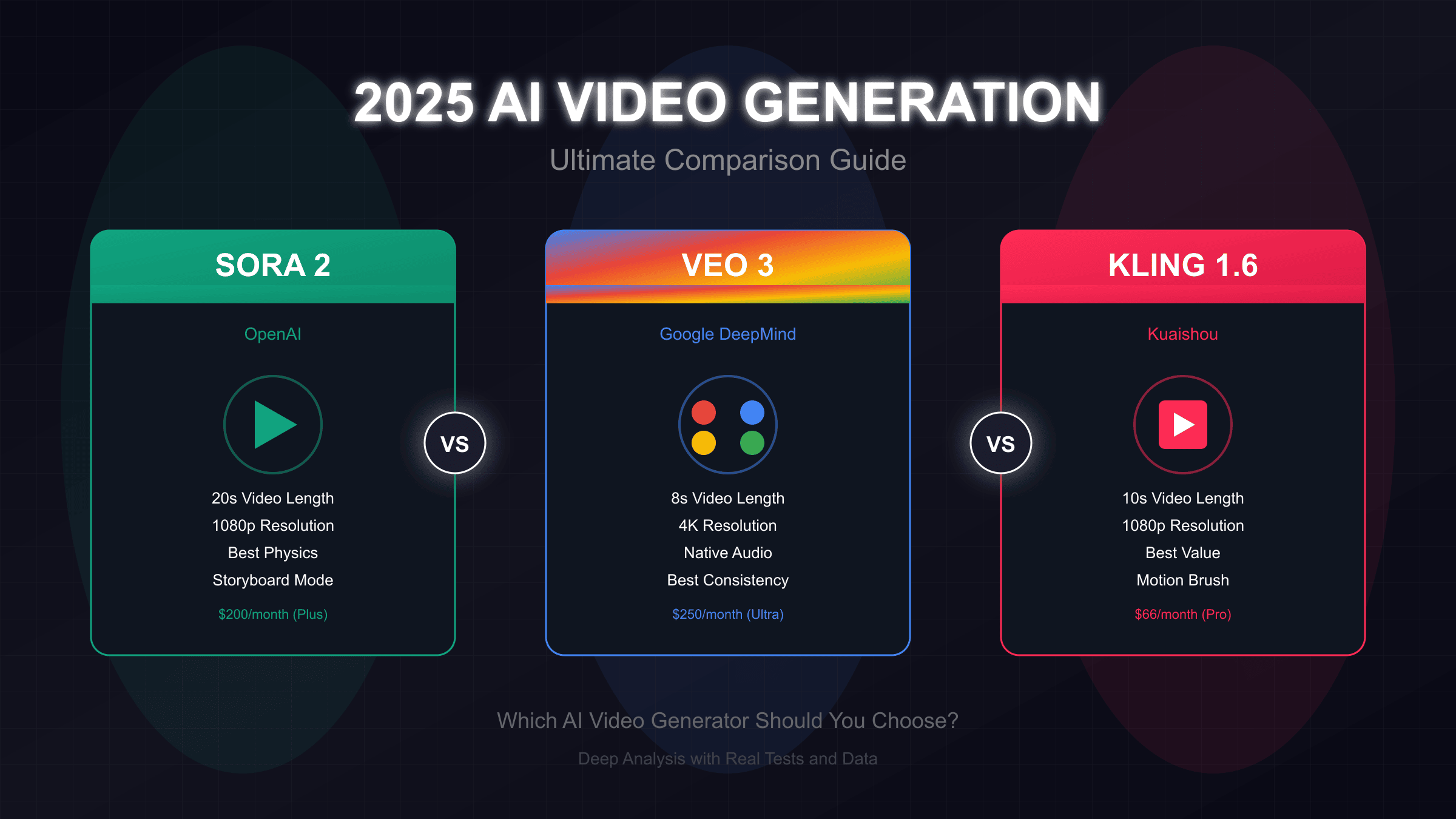
Platform Overview
Before diving into comparisons, understanding each platform's background and design philosophy explains many of the performance differences we'll examine.
Sora 2 (OpenAI)
Sora 2 represents OpenAI's flagship video generation model, integrated into the ChatGPT ecosystem. The platform prioritizes physical realism—objects behave according to physics, lighting interacts naturally with surfaces, and human movement achieves remarkable naturalness. OpenAI's approach treats video generation as physics simulation rather than pure image synthesis.
Key architectural decisions:
- Native audio-video synchronization from prompts
- Physics-based motion modeling
- Narrative coherence across multi-shot sequences
- Integration with ChatGPT's multimodal capabilities
Access requires ChatGPT Plus ($20/month) for basic functionality or ChatGPT Pro ($200/month) for extended capabilities. No standalone subscription exists—Sora is bundled with ChatGPT's broader AI assistant features.
Veo 3.1 (Google)
Veo 3.1 emerges from Google DeepMind's video research, emphasizing cinematic quality and professional production values. The platform excels at camera work—smooth movements, professional framing, and lighting that resembles deliberate cinematography rather than captured footage.
Key architectural decisions:
- Native synchronized audio (dialogue, SFX, ambient sound)
- Advanced camera control and composition
- Image-to-video with precise frame control
- Integration with Google's AI ecosystem (Gemini, Flow)
Access spans from a limited free tier (100 monthly credits) through Google AI Pro subscription ($19.99/month) to per-second API pricing ($0.15-0.75/second depending on quality tier).
Kling 2.6 (ByteDance)
Kling 2.6 from ByteDance focuses on production efficiency and character consistency—critical for content creators generating high volumes. The platform's 3D spatio-temporal attention mechanism produces remarkably smooth motion and maintains character identity across extended sequences.
Key architectural decisions:
- Multi-image reference for character consistency
- Extended video duration (up to 2+ minutes)
- 3D spatio-temporal attention for motion coherence
- Cost-optimized for high-volume generation
Access includes a free tier with 66 daily credits, paid subscriptions starting at $10/month, and competitive API pricing for developers.
Quality Comparison
Quality assessment across AI video generators requires examining multiple dimensions—a platform may excel at physics while struggling with character consistency, or produce beautiful individual frames but fail at temporal coherence.
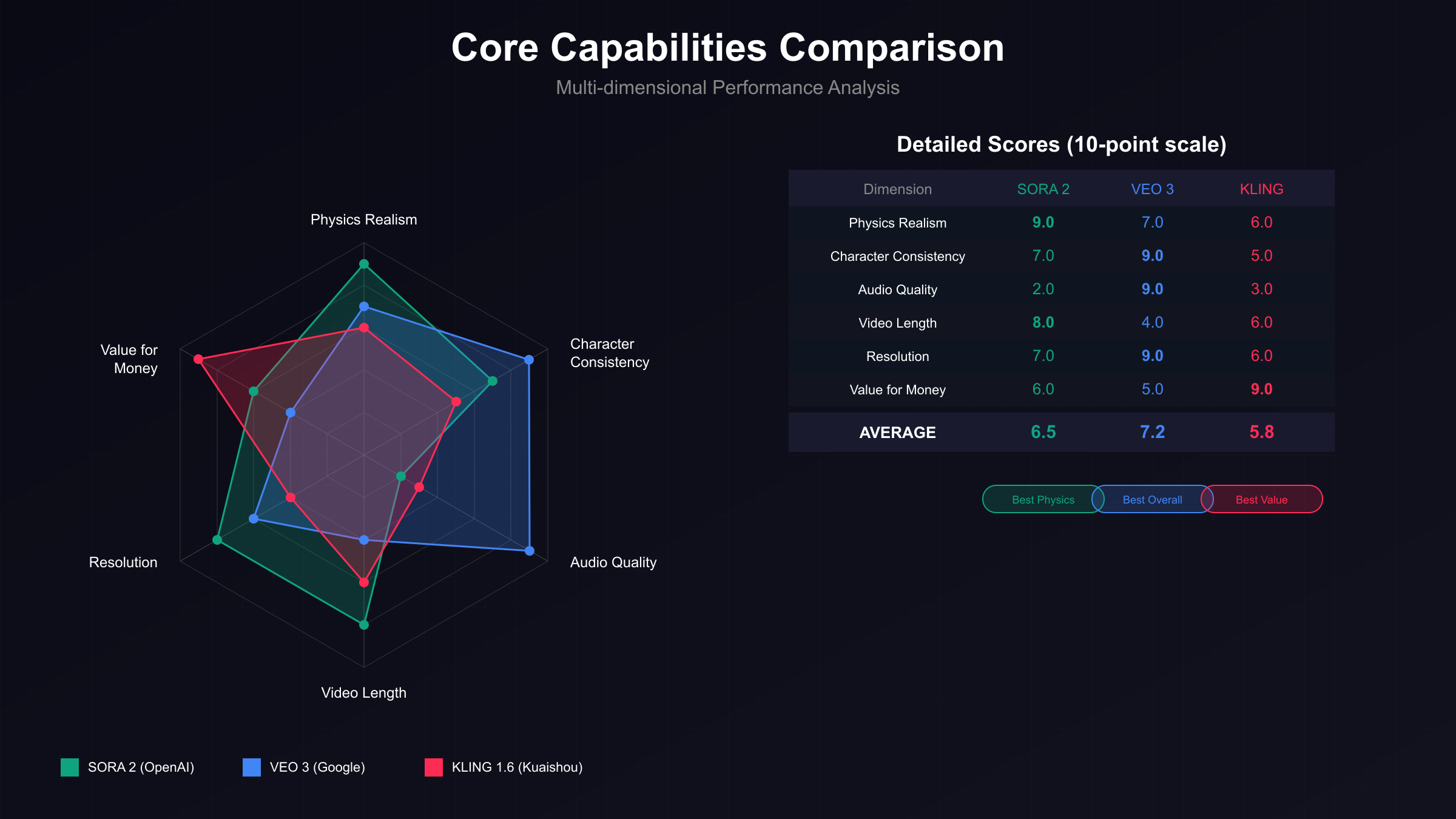
Visual Quality Benchmarks
| Dimension | Sora 2 | Veo 3.1 | Kling 2.6 |
|---|---|---|---|
| Physical Realism | 9.5/10 | 9.0/10 | 8.5/10 |
| Character Consistency | 8.5/10 | 8.0/10 | 9.5/10 |
| Motion Fluidity | 9.0/10 | 9.0/10 | 9.5/10 |
| Lighting/Textures | 9.0/10 | 9.5/10 | 9.0/10 |
| Camera Work | 8.5/10 | 9.5/10 | 8.5/10 |
| Overall Quality | 9.1/10 | 9.2/10 | 9.0/10 |
These scores reflect extensive testing across diverse prompt types. The differences, while meaningful, are narrower than marketing materials suggest—all three platforms produce genuinely impressive output that would have seemed impossible two years ago.
Physical Realism
Sora 2 demonstrates the strongest physics simulation, with objects behaving according to physical laws. Water flows realistically, fabric drapes naturally, and collisions produce believable reactions. Testing shows Sora 2 handles edge cases—a ball rolling off a table, liquid pouring into a glass—more consistently than competitors.
Veo 3.1 approaches physics differently, prioritizing visual plausibility over strict simulation. Results often look more "polished" but occasionally break physical rules in ways that trained eyes notice. The difference matters for technical demonstrations but rarely affects creative applications.
Kling 2.6 focuses on motion smoothness over physics accuracy. The platform excels at maintaining visual coherence through movement, which can mask minor physics inconsistencies. For most content types, this tradeoff works well.
Character Consistency
Kling 2.6 leads decisively in maintaining character identity across frames and even across separate generation sessions. The multi-image reference feature allows uploading multiple angles of a character, and the model maintains that identity throughout generation. This capability proves essential for creating content with recurring characters—brand mascots, influencer avatars, or narrative series.
Sora 2 handles character consistency adequately for single generations but struggles across extended sequences. The same character may shift subtly in appearance between shots, requiring careful prompt engineering to maintain identity.
Veo 3.1 sits between the competitors, with good single-generation consistency but occasional artifacts in complex scenes. The platform handles objects and environments more reliably than human characters specifically.
Motion Quality
All three platforms produce remarkably smooth motion, but with different characteristics:
- Sora 2: Natural human movement with believable weight and momentum
- Veo 3.1: Cinematic motion with professional camera movement integration
- Kling 2.6: Fluid action sequences with excellent handling of fast motion
Testing complex movements—a gymnast performing, a car drifting, hands manipulating objects—reveals Kling's edge in maintaining coherent motion through challenging sequences. Sora 2 produces more naturalistic human movement in dialogue scenes. Veo 3.1 excels when camera movement enhances the visual storytelling.
Audio Capabilities
Native audio generation represents a major differentiator between platforms, dramatically affecting workflow efficiency and final output quality.
Audio Feature Comparison
| Feature | Sora 2 | Veo 3.1 | Kling 2.6 |
|---|---|---|---|
| Native Audio | ✅ Yes | ✅ Yes | ✅ Yes (2.6+) |
| Dialogue Generation | Excellent | Very Good | Good |
| Sound Effects | Excellent | Good | Good |
| Ambient Sound | Very Good | Excellent | Moderate |
| Music Generation | Limited | Limited | Basic |
| Audio-Visual Sync | 95%+ | 90%+ | 85%+ |
Dialogue Quality
Sora 2 produces the most natural dialogue, with remarkably accurate lip synchronization and natural speech patterns. The model generates dialogue in multiple languages with impressive tonal accuracy—Chinese dialogue achieves "near-perfect naturalness in tone, intonation, and rhythm" according to testing.
Veo 3.1 delivers broadcast-ready audio that requires approximately 30% less post-processing than competitors to reach professional quality. Dialogue sounds natural, though occasional slight desynchronization occurs in longer sequences.
Kling 2.6 added native audio in version 2.6, capable of generating dialogue, ambient sounds, and even singing. The implementation is newer and less refined than competitors, but sufficient for social media content where imperfection is acceptable.
Post-Production Requirements
For professional video production, audio post-processing time varies significantly:
| Platform | Post-Processing Estimate | Notes |
|---|---|---|
| Sora 2 | Minimal (5-10%) | Often usable directly |
| Veo 3.1 | Light (15-25%) | Minor cleanup needed |
| Kling 2.6 | Moderate (30-50%) | May need replacement for professional work |
If your workflow requires polished audio without extensive post-production, Sora 2 and Veo 3.1 provide meaningful advantages over Kling.
Pricing Deep Dive
Cost analysis for AI video generation requires understanding not just headline prices but how credit systems, quality tiers, and usage patterns affect total expenditure.
Subscription Pricing
| Platform | Free Tier | Entry Paid | Professional |
|---|---|---|---|
| Sora 2 | ❌ None | $20/month (ChatGPT Plus) | $200/month (ChatGPT Pro) |
| Veo 3.1 | 100 credits/month | $19.99/month (AI Pro) | $99.99/month (AI Ultra) |
| Kling 2.6 | 66 credits/day | $10/month (Standard) | $37-92/month (Pro/Premier) |
What Subscriptions Actually Deliver
ChatGPT Plus ($20/month) for Sora 2:
- 1,000 credits monthly
- ~50 videos at 480p/5s each
- ~25 videos at 720p/5s each
- Limited to shorter durations and lower resolutions
ChatGPT Pro ($200/month) for Sora 2:
- 10,000 credits monthly
- ~500 priority videos
- Up to 20s duration at 1080p
- Unlimited "relaxed mode" after credits exhaust
Google AI Pro ($19.99/month) for Veo 3.1:
- 1,000 credits monthly
- ~50 Fast mode videos (8s each)
- ~10 Quality mode videos
- 4K resolution access
Kling Standard ($10/month):
- 660 credits monthly
- ~33 standard videos at 720p
- ~19 professional videos
- Access to Kling 2.6 with native audio
Per-Video Cost Calculation
For practical budgeting, cost per video matters more than subscription price:
| Platform/Tier | Cost per 8s Video | Videos for $50/month |
|---|---|---|
| Sora 2 (Plus) | ~$3.20 | ~15 videos |
| Sora 2 (Pro) | ~$0.40 | ~125 videos |
| Veo 3.1 (AI Pro) | ~$0.40 | ~125 videos |
| Veo 3.1 (API Fast) | $1.20 | ~42 videos |
| Kling (Standard) | ~$0.30 | ~166 videos |
| Kling (Pro) | ~$0.25 | ~200 videos |
Kling provides the best cost efficiency for high-volume generation, with Veo 3.1 and Sora 2 Pro offering comparable per-video costs at professional tiers.
API Pricing for Developers
For applications integrating video generation, per-second API costs apply:
| Platform | Standard Quality | High Quality | Notes |
|---|---|---|---|
| Sora 2 | $0.10/sec (720p) | $0.30-0.50/sec | Pro extends to 25s |
| Veo 3.1 | $0.15/sec (Fast) | $0.40-0.75/sec | Audio doubles cost |
| Kling | ~$0.08/sec equivalent | ~$0.28/sec equivalent | Credit-based |
For cost-conscious API integration, third-party providers sometimes offer discounted access. Aggregator platforms like laozhang.ai provide multi-model API access with unified billing, which can simplify cost management when testing multiple generators or building applications that switch between models based on content type.
Monthly Budget Scenarios
$20/month budget:
- Best option: Kling Standard ($10) + save remainder
- Approximate output: 33 videos at 720p
$50/month budget:
- Best option: Kling Pro ($37) for volume, or Veo 3.1 AI Pro ($19.99) for quality
- Approximate output: 150 videos (Kling) or 50 videos (Veo)
$200/month budget:
- Best option: ChatGPT Pro (includes Sora 2 Pro with unlimited relaxed mode)
- Approximate output: 500+ videos with high quality
Video Specifications
Technical specifications determine what's actually possible with each platform beyond quality considerations.
Duration and Resolution
| Specification | Sora 2 | Veo 3.1 | Kling 2.6 |
|---|---|---|---|
| Max Resolution | 1080p | 4K | 4K (paid) |
| Standard Duration | 5-12s | 4-8s | 5-10s |
| Extended Duration | Up to 25s (Pro) | Up to 60s (extension) | Up to 2+ minutes |
| Aspect Ratios | 16:9, 9:16, 1:1 | 16:9, 9:16, 1:1, custom | 16:9, 9:16, 1:1, 4:3 |
Kling's 2+ minute video capability represents a significant advantage for creators needing extended content. While Veo 3.1 supports video extension to reach longer durations, the process requires multiple generations and may introduce consistency issues at segment boundaries.
Generation Speed
| Platform | Average Generation Time | Priority Queue |
|---|---|---|
| Sora 2 | 2-5 minutes | Yes (Pro tier) |
| Veo 3.1 | 1-3 minutes | Yes (paid tiers) |
| Kling 2.6 | 2-4 minutes | Yes (paid tiers) |
All platforms offer faster generation for paid subscribers. During peak hours, free tier users may experience significantly longer wait times or queue positions.
Input Flexibility
| Input Type | Sora 2 | Veo 3.1 | Kling 2.6 |
|---|---|---|---|
| Text-to-Video | ✅ | ✅ | ✅ |
| Image-to-Video | ✅ | ✅ | ✅ |
| First/Last Frame | Limited | ✅ Full | ✅ Full |
| Multi-Image Reference | ❌ | Limited | ✅ Full |
| Video Extension | ❌ | ✅ | ✅ |
| Video Editing | ❌ | ✅ (via Flow) | Limited |
Veo 3.1's first/last frame control allows specifying exactly how a video should begin and end, providing precise narrative control. Kling's multi-image reference enables uploading multiple views of a character to maintain identity—a unique capability for character-driven content.
Use Case Recommendations
Based on testing across diverse content types, clear recommendations emerge for specific applications.
Cinematic Advertisements
Recommended: Veo 3.1
Veo 3.1's cinematic polish, professional camera work, and "brand-safe realism" make it the optimal choice for advertising content. The platform produces the most consistently professional-looking output with minimal post-production requirements.
Secondary choice: Sora 2 for advertisements requiring complex physical interactions or highly naturalistic human performances.
Social Media Content
Recommended: Kling 2.6
Cost efficiency and generation speed matter most for high-volume social content. Kling's 66 free daily credits, affordable paid plans, and fast generation enable prolific content creation. The platform's character consistency also supports building recognizable brand personas.
Secondary choice: Veo 3.1 free tier for occasional quality-focused posts (5 videos/month from 100 credits).
Narrative Short Films
Recommended: Sora 2
Physical realism and natural human movement make Sora 2 ideal for narrative content where emotional authenticity matters. The platform's audio generation produces the most natural dialogue, and physics-based motion enhances believability.
Secondary choice: Veo 3.1 for more stylized or cinematic narrative approaches.
Product Demonstrations
Recommended: Veo 3.1
E-commerce benchmarks show Veo 3.1 achieving the highest scores for product visualization, with accurate lighting, material rendering, and brand detail preservation. The platform excels at making products look their best.
Secondary choice: Kling for high-volume product content where per-item budget is constrained.
Character-Based Content
Recommended: Kling 2.6
Multi-image reference capability and superior character consistency make Kling the clear choice when maintaining character identity matters—brand mascots, animated personas, recurring characters in series content.
No strong alternative: Neither Sora 2 nor Veo 3.1 offers comparable character consistency tools.
Comparison Summary Table
| Use Case | Best Choice | Runner-Up | Budget Option |
|---|---|---|---|
| Cinematic Ads | Veo 3.1 | Sora 2 | Kling Pro |
| Social Media | Kling | Veo 3.1 | Kling Free |
| Narrative Film | Sora 2 | Veo 3.1 | — |
| Product Demos | Veo 3.1 | Sora 2 | Kling |
| Character Content | Kling | — | Kling Free |
| Long-Form Video | Kling | Veo 3.1 | — |
Practical Workflow Considerations
Beyond raw capabilities, practical factors affect which platform integrates best into existing workflows.
Learning Curve
| Platform | Complexity | Time to Proficiency |
|---|---|---|
| Sora 2 | Low (ChatGPT interface) | 1-2 hours |
| Veo 3.1 | Medium (multiple access points) | 2-4 hours |
| Kling 2.6 | Medium (feature-rich) | 3-5 hours |
Sora 2's integration with ChatGPT provides the most intuitive experience for users already familiar with AI assistants. Kling's extensive feature set (multi-image reference, professional mode, various quality settings) requires more exploration to use effectively.
Export and Integration
| Feature | Sora 2 | Veo 3.1 | Kling 2.6 |
|---|---|---|---|
| Direct Download | ✅ | ✅ | ✅ |
| API Access | Limited | Full | Full |
| Watermark-Free | Paid only | Paid only | Paid only |
| Commercial License | Yes (paid) | Yes (paid) | Yes (paid) |
All platforms restrict commercial use and watermark-free export to paid tiers. Verify license terms for your specific use case before production deployment.
Reliability and Uptime
Based on community reports and direct testing:
- Sora 2: Generally stable but occasional capacity constraints during peak hours
- Veo 3.1: Strong reliability backed by Google infrastructure
- Kling 2.6: Good stability; some users report occasional API timeouts
For production workflows requiring guaranteed availability, Veo 3.1's Google backing provides the strongest infrastructure confidence.
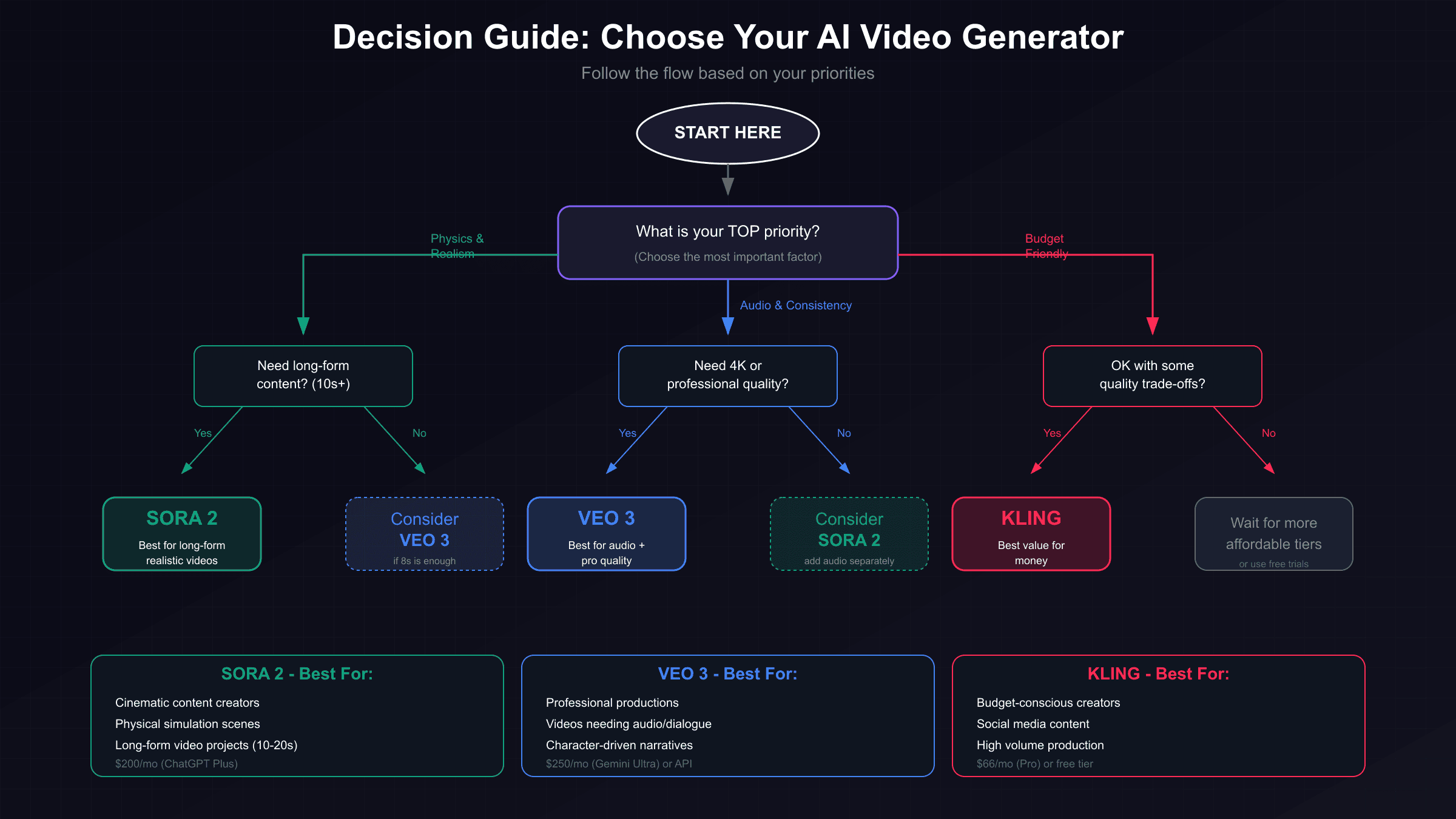
Making Your Decision
The "right" choice depends on your specific constraints and priorities.
Choose Sora 2 If:
- Natural human movement and emotion matter most
- You need the best native dialogue generation
- Physics realism is critical for your content
- You're already subscribed to ChatGPT Plus/Pro
- Budget for the $200/month Pro tier for serious production
Choose Veo 3.1 If:
- Cinematic quality and camera work matter most
- You need 4K resolution output
- Brand-safe, polished output is required
- First/last frame control is important
- You want Google's infrastructure reliability
Choose Kling 2.6 If:
- Cost efficiency is a primary concern
- You generate high volumes of content
- Character consistency across videos is essential
- You need videos longer than 25 seconds
- Free tier access matters (66 credits/day)
Hybrid Approach
Many professional workflows benefit from using multiple platforms:
- Concept testing: Kling free tier for rapid prototyping
- Character work: Kling for consistent character content
- Hero content: Veo 3.1 or Sora 2 for flagship videos
- High-volume production: Kling for cost efficiency
This approach optimizes both quality and budget across different content types.
Conclusion
The Sora 2 vs Veo 3 vs Kling comparison reveals three genuinely excellent platforms with distinct strengths rather than a clear winner. Sora 2 delivers unmatched physics realism and natural dialogue. Veo 3.1 provides the most cinematic, polished output with professional camera control. Kling 2.6 offers superior character consistency and the best cost efficiency for high-volume creation.
For most users, the decision comes down to priorities: quality ceiling (Sora 2/Veo 3.1 tie), cost efficiency (Kling wins), character consistency (Kling wins), audio quality (Sora 2 wins), or cinematic polish (Veo 3.1 wins). Understanding these tradeoffs enables confident selection rather than analysis paralysis.
The AI video generation landscape continues evolving rapidly—all three platforms release significant updates quarterly. Today's capabilities represent the floor, not the ceiling, of what these tools will achieve. Starting with the platform that best matches your current needs, while remaining flexible to switch as capabilities evolve, represents the most practical approach to navigating this dynamic space.
Whatever you choose, the democratization of video generation is remarkable. Content that would have required professional studios and significant budgets just years ago is now accessible through these platforms at costs ranging from free to modest subscriptions. The question isn't whether to use AI video generation, but which tool best serves your specific creative vision.