Nano Banana Pro vs Flux 2: Logic vs Aesthetics - Complete Comparison Guide (2025)
Comprehensive comparison of Nano Banana Pro and Flux 2 AI image generators. Explore logic-first vs aesthetic-first approaches, benchmark results, pricing, and when to use each model.
Nano Banana Pro
4K-80%Google Gemini 3 Pro · AI Inpainting
谷歌原生模型 · AI智能修图

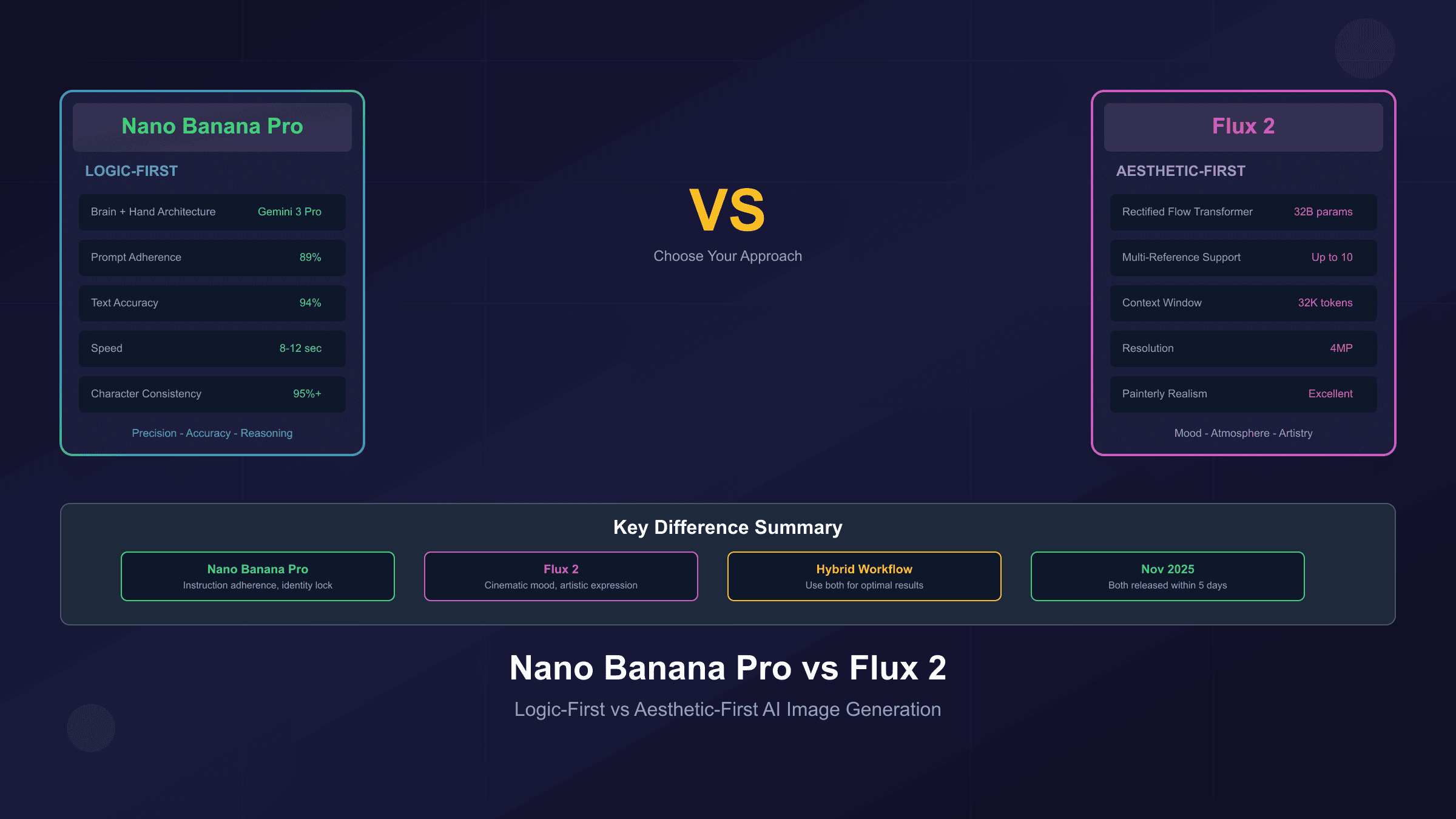
Nano Banana Pro and Flux 2 represent two fundamentally different philosophies in AI image generation. Google's Nano Banana Pro takes a logic-first approach—prioritizing instruction-following, identity consistency, and structural reasoning. Black Forest Labs' Flux 2 leads with aesthetics—delivering cinematic mood, painterly realism, and atmospheric depth. Understanding this core difference is essential for choosing the right tool for your projects.
Released within five days of each other in November 2025, these models have redefined what's possible in text-to-image generation. Based on extensive testing and benchmark data from multiple sources, this guide breaks down exactly how each model performs across key dimensions—from technical architecture to practical use cases—so you can make an informed decision for your specific needs.
The choice between logic and aesthetics isn't arbitrary. If you need precise instruction-following, character consistency across multiple scenes, or accurate text rendering, Nano Banana Pro's reasoning-first architecture delivers measurable advantages. If you're creating cinematic concept art, atmospheric environments, or expressive artistic pieces, Flux 2's aesthetic strengths shine. Many professional workflows benefit from using both—understanding when to deploy each is the real competitive advantage.
The Core Philosophy Difference
Before diving into technical specifications, understanding the philosophical difference between these models explains most of their behavioral differences in practice.
Nano Banana Pro: Logic-First Architecture
Google designed Nano Banana Pro with what the community calls a "brain + hand" architecture. The "brain" is a Gemini 3.0-scale reasoning model that interprets instructions, understands context, and anticipates user intent before any image generation begins. The "hand" is a high-fidelity diffusion engine that executes the reasoning model's structured plan. This separation means the model analyzes relationships, checks for logical consistency, and organizes requests into coherent visual plans before rendering a single pixel.
This architecture manifests in practical capabilities: mathematical expressions written on boards render correctly, count-based instructions like "three cups on the table, two books on the shelf" produce accurate results, and complex layouts maintain sensible spatial relationships. The reasoning core also enables Google Search integration, allowing the model to ground generations in real-world data—generating contextually accurate images of current events, real locations, or trending topics.
Flux 2: Aesthetic-First Architecture
Black Forest Labs built Flux 2 on a 32-billion-parameter rectified flow transformer architecture optimized for visual quality above all else. The model excels at cinematic lighting, atmospheric depth, and the kind of "painterly realism" that makes images feel emotionally resonant rather than just technically correct. Where Nano Banana Pro asks "did I follow the instructions correctly?", Flux 2 asks "does this image feel right?"
Flux 2's architecture natively processes multiple visual embeddings before generation, enabling its signature multi-reference capability—using up to 10 input images simultaneously for style, character, or product consistency. The 32K token context window allows for extraordinarily detailed prompts with nuanced control over every aspect of the final image. This isn't a model that approximates your vision—it's designed to execute it with director-level precision.
| Dimension | Nano Banana Pro | Flux 2 |
|---|---|---|
| Core Philosophy | Logic-first, reasoning-driven | Aesthetic-first, visual quality-driven |
| Primary Strength | Instruction adherence, consistency | Mood, atmosphere, artistic expression |
| Architecture | Brain + hand (reasoning + diffusion) | 32B rectified flow transformer |
| Release Date | November 20, 2025 | November 25, 2025 |
| Max Resolution | 4K (4MP) | 4MP |
Technical Specifications Compared
Understanding the technical foundations helps predict how each model will behave in different scenarios.
Nano Banana Pro Technical Profile
Built on Google's Gemini 3 Pro infrastructure, Nano Banana Pro generates 1,120 tokens for a 2K (4MP) output—fewer tokens than its predecessor Nano Banana, indicating architectural improvements in the image decoder. The model supports native 2K and 4K output resolutions, with generation times averaging 8-12 seconds for standard requests. Google's infrastructure enables rapid scaling, making the model suitable for high-volume production workflows.
The model's reasoning capabilities extend to multimodal inputs. Reference images inform generation through semantic understanding rather than simple style transfer, enabling character consistency across dramatically different scenes without the facial features morphing significantly. Google describes this as "identity preservation"—the ability to lock a character's appearance while changing everything else about the scene.
Flux 2 Technical Profile
Flux 2's 32-billion-parameter model represents one of the largest open-weight image generation systems available. The architecture requires substantial computational resources—90GB VRAM for full model loading, or 64GB in lowVRAM mode. NVIDIA and Black Forest Labs collaborated on FP8 quantization to reduce requirements by 40% while maintaining comparable quality.
The model family includes three variants optimized for different use cases. Flux 2 [Pro] delivers the highest quality for commercial applications. Flux 2 [Flex] exposes parameters like sampling steps and guidance scale for developers who need to tune speed-quality tradeoffs. Flux 2 [Dev] offers the full 32-billion-parameter open-weight checkpoint for complete customization.
| Specification | Nano Banana Pro | Flux 2 |
|---|---|---|
| Model Size | Gemini 3 Pro scale | 32 billion parameters |
| Token Efficiency | 1,120 tokens for 2K | Megapixel-based |
| Context Window | Standard | 32K tokens |
| Multi-Reference | Yes (identity preservation) | Up to 10 images |
| Generation Speed | 8-12 seconds | 6-15 seconds |
| Resource Requirements | Cloud-optimized | 64-90GB VRAM (local) |
Prompt Adherence and Instruction Following
For many professional applications, the ability to follow complex instructions precisely matters more than raw visual quality. This is where the models diverge most significantly.
Nano Banana Pro: 89% Prompt Adherence
In benchmark testing, Nano Banana Pro achieved 89% prompt adherence—significantly higher than competitors like Stable Diffusion v3 at 81% on the same metrics. This translates to fewer retries, more predictable outputs, and lower effective costs for production workflows. The model particularly excels at structural and logical constraints: mathematical accuracy, count-based instructions, and maintaining sensible spatial relationships in complex scenes.
The reasoning architecture shines when prompts contain conditional logic or multi-step instructions. Requests like "show the same character first reading a book, then looking up with surprise, then running toward the door" produce coherent sequences because the reasoning layer plans the logical progression before rendering. Traditional diffusion models struggle with such sequential concepts because they lack explicit reasoning about temporal or causal relationships.
Flux 2: Exceptional Detail Capture
Flux 2 takes a different approach to prompt adherence—rather than explicit reasoning, it relies on an extraordinarily long context window and sophisticated attention mechanisms. The model captures fine to coarse details from prompts with remarkable accuracy, placing elements correctly and maintaining stylistic consistency across complex requests. For creative professionals who think in visual terms and write detailed scene descriptions, this approach often feels more natural.
Where Flux 2 particularly excels is in interpreting aesthetic instructions. Descriptions like "cinematic lighting, soft volumetric atmosphere, neo-romanticism meets ethereal fantasy" translate into coherent visual styles because the model deeply understands these artistic concepts. The 32K context window means prompts can include extensive detail without truncation or loss of nuance—a significant advantage for complex commercial work.
| Capability | Nano Banana Pro | Flux 2 |
|---|---|---|
| Prompt Adherence Score | 89% | High (architectural focus) |
| Count Accuracy | Excellent | Good |
| Logical/Sequential | Excellent | Good |
| Aesthetic Instructions | Good | Excellent |
| Complex Scene Layout | Excellent | Excellent |
Visual Quality and Artistic Styles
Both models produce exceptional visual quality, but they achieve it through different means and excel in different contexts.
Nano Banana Pro: Photorealism with Accuracy
Nano Banana Pro achieves a 12.4 FID score in benchmark testing, indicating strong photorealistic quality. The model excels at generating images that are technically correct—proper anatomy, realistic lighting, accurate textures. Character consistency scores above 95% mean faces and identities remain stable across multiple generations, crucial for commercial applications requiring recognizable characters or brand ambassadors.
The model connects directly to Google Search, enabling contextually accurate generations of real places, historical events, or current trends. This grounding in real-world data produces images that feel authentic rather than generic—a photograph of "the Shibuya crossing at night during rain" will reflect the actual location's characteristics rather than an approximation.
Flux 2: Atmospheric and Expressive
Flux 2 prioritizes what Black Forest Labs calls "painterly realism"—images that combine technical accuracy with emotional resonance. The model produces noticeably better skin texture, fabric detail, and lighting accuracy than previous generations, but these technical improvements serve a larger goal: creating images that feel cinematically compelling rather than just photographically accurate.
The model handles stylized work as naturally as photorealistic shots, shifting effortlessly between 2D anime, hand-drawn illustration, and bold comic-book aesthetics. This versatility makes Flux 2 particularly valuable for creative agencies and entertainment studios that work across multiple visual styles. The model's understanding of artistic concepts allows prompts to reference established styles, movements, or specific artists with consistent results.
| Quality Dimension | Nano Banana Pro | Flux 2 |
|---|---|---|
| FID Score | 12.4 | Not published |
| Photorealism | Excellent | Excellent |
| Artistic Styles | Good | Excellent |
| Texture Detail | Very Good | Excellent |
| Lighting/Atmosphere | Good | Excellent |
| Emotional Impact | Moderate | High |
Text Rendering and Typography
Text accuracy in generated images remains one of the most challenging problems in AI image generation. Both models have made significant advances, but approach the problem differently.
Nano Banana Pro: 94% Character Accuracy
In internal benchmarks, Nano Banana Pro correctly renders approximately 94% of characters in images—a substantial improvement over competitors like Stable Diffusion at 82%. The reasoning architecture contributes directly to this accuracy: the model interprets text as semantic content rather than visual patterns, understanding that letters form words with specific meanings.
This capability extends beyond simple text rendering to contextual placement. Signs in street scenes contain appropriate content, book titles make sense, and UI mockups display readable interface elements. The model understands that text exists within context and renders it accordingly.
Flux 2: Typography as Design Element
Flux 2's approach to text treats typography as a design element first. The model excels at complex typography, infographics, memes, and UI mockups with legible fine text—treating letters as visual components that must integrate with the overall composition. Architecture improvements specifically target text accuracy, supporting readable text insertion, surface text replacement, and preservation of text perspective and reflections.
A notable feature is Flux 2's ability to obey exact HEX color codes. Where previous models interpreted color names loosely, Flux 2 renders color-true brand assets, precise gradients, and product compositions that match brand guidelines exactly. This precision matters for commercial work where brand colors must be accurate.
Identity Consistency and Character Lock
For projects requiring consistent characters across multiple images—comic series, marketing campaigns, video game concepts—identity consistency determines whether the models can deliver production-ready results.
Nano Banana Pro: Reasoning-Based Consistency
Nano Banana Pro's "character lock" feature uses the reasoning layer to understand and preserve identity across scenes. Generate a character once, then place them in dramatically different scenarios—"show the same woman sitting on an office couch," "show her in front of a whiteboard"—without significant facial feature drift. The model maintains consistency not through visual matching but through semantic understanding of identity.
This approach handles complex transformations well. The same character can age, change clothing, or appear in different lighting conditions while remaining recognizably themselves. The reasoning layer understands what elements constitute "identity" versus what elements can change with context.
Flux 2: Multi-Reference Conditioning
Flux 2 achieves consistency through its multi-reference capability—processing up to 10 input images simultaneously and fusing their visual embeddings before generation. This isn't a post-processing trick; the architecture natively incorporates multiple references into the generation process.
For product consistency, style transfer, and character design, this multi-reference approach delivers the best available results. Provide reference images of a character from multiple angles, and the model synthesizes a coherent understanding that generalizes to new poses and situations. The approach particularly excels when you have existing visual assets to work from.
| Consistency Feature | Nano Banana Pro | Flux 2 |
|---|---|---|
| Character Lock | Yes (semantic) | Via multi-reference |
| Identity Preservation | 95%+ | Excellent with references |
| Cross-Scene Consistency | Excellent | Excellent |
| Reference Image Support | Yes | Up to 10 images |
| Novel Pose Generation | Good | Very Good |
Speed and Resource Efficiency
Production environments care about more than visual quality—throughput, cost per image, and infrastructure requirements all affect the bottom line.
Nano Banana Pro: Optimized for Scale
Nano Banana Pro generates images in 8-12 seconds on Google's cloud infrastructure, with the architecture optimized for high-volume production. The model runs on mid-range hardware efficiently, making it accessible for teams without specialized GPU infrastructure. For applications requiring rapid iteration or real-time generation, the speed advantage compounds—a 3x speed difference means 3x more exploration within a time budget.
According to testing, Nano Banana Pro requires far fewer computational resources than Flux 2 for equivalent workloads. This translates to lower effective costs at scale, even before considering API pricing differences.
Flux 2: Quality Over Speed
Flux 2 prioritizes quality over speed, with generation times of 6-15 seconds depending on complexity and resolution. The model requires substantial resources—90GB VRAM for full model loading—making local deployment practical only for well-equipped studios. For cloud deployment, this translates to higher compute costs per image.
The tradeoff is justified when quality matters more than quantity. For hero images, key visual assets, or work that will appear at large scale, the additional time and resources deliver measurable quality improvements. The model excels at producing a small number of exceptional images rather than high-volume commodity content.
Pricing and API Access
Cost structures differ significantly between providers and affect the economics of production workflows at different scales.
Nano Banana Pro Pricing
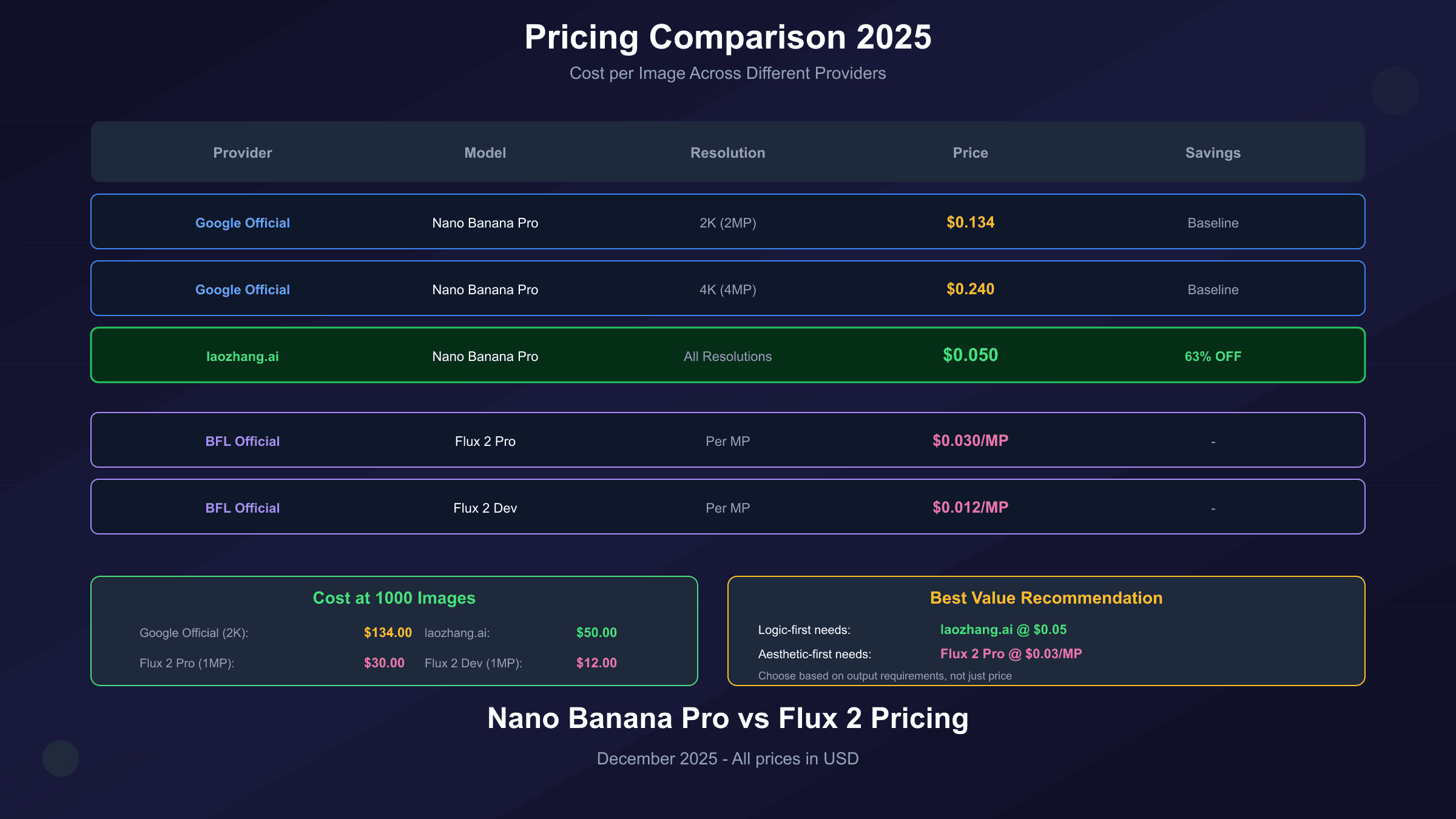
Google's official API prices Nano Banana Pro at approximately $0.134 per 2K image and $0.24 per 4K image using token-based billing at $120 per million output tokens. The Batch API offers 50% savings for non-real-time processing.
For developers seeking cost optimization, third-party providers offer alternative access points. laozhang.ai provides Nano Banana Pro access at $0.05 per image—a 63% reduction from Google's effective pricing—with per-call billing that doesn't consume token quotas. This flat-rate model makes cost prediction straightforward for production planning.
Flux 2 Pricing
Black Forest Labs uses megapixel-based pricing where 1 credit equals $0.01. Flux 2 [Pro] costs approximately $0.03 per megapixel, making a standard 1024x1024 (1MP) generation $0.030. Higher resolutions scale proportionally—4MP outputs cost roughly $0.12.
Flux 2 [Dev] offers the most affordable option at $0.012 per megapixel through providers like Replicate. For teams comfortable with open-weight models, self-hosting eliminates per-image costs entirely but requires significant infrastructure investment.
| Provider | Model | Cost per Image |
|---|---|---|
| Google Official | Nano Banana Pro 2K | $0.134 |
| Google Batch API | Nano Banana Pro 2K | $0.067 |
| laozhang.ai | Nano Banana Pro | $0.05 |
| BFL Direct | Flux 2 Pro (1MP) | $0.03 |
| BFL Direct | Flux 2 Dev (1MP) | $0.012 |
| Replicate | Flux 2 Pro | $0.015 + MP |
For high-volume workflows, cost differences compound quickly. Generating 10,000 images monthly:
- Google Official (2K): $1,340
- laozhang.ai: $500
- Flux 2 Dev (1MP): $120
The pricing comparison reveals important tradeoffs. Flux 2 Dev is cheapest for 1MP output but limited in resolution. Nano Banana Pro via laozhang.ai offers a strong balance of cost, quality, and resolution flexibility.
Hands, Faces, and Anatomical Accuracy
AI image generation has historically struggled with human anatomy—particularly hands and faces. Recent model generations have improved significantly, but differences remain.
Nano Banana Pro: Reasoning About Anatomy
The reasoning architecture gives Nano Banana Pro an advantage in anatomical accuracy. Rather than pattern-matching to training data, the model reasons about what hands should look like, how many fingers they have, and how joints connect. This produces more consistent results, though not perfect—edge cases still occasionally produce anatomical errors.
Face rendering benefits from identity preservation capabilities. The same reasoning that maintains character consistency also ensures facial features remain anatomically plausible across different expressions and angles. This matters for portrait work, character design, and any application where faces appear prominently.
Flux 2: 30% Improvement Over Previous Generation
Black Forest Labs reports that Flux 2 reduced anatomical errors by approximately 30% compared to Flux 1. The model more consistently produces correct hand structure—five fingers with proper joint angles—though still not perfectly reliable. Faces, fabrics, logos, and small objects that previous models missed now render more accurately.
The improvement is particularly notable in photorealistic portraits, where Flux 2 produces skin texture, fine lines, and natural imperfections that create genuinely photographic appearance. Previous models' subtle smoothing made subjects look retouched; Flux 2 achieves raw photographic authenticity.
Best Use Cases for Each Model
Understanding ideal applications helps match models to projects efficiently.
When to Choose Nano Banana Pro
- Technical accuracy matters: Product documentation, instructional content, technical illustrations where precision beats aesthetics
- Character consistency required: Marketing campaigns, comic series, video content requiring the same character across many images
- Text-heavy images: Infographics, social media graphics, UI mockups where readable text is essential
- High-volume production: Workflows generating hundreds or thousands of images where speed and cost efficiency drive decisions
- Logical/sequential content: Multi-panel sequences, before/after comparisons, step-by-step illustrations
- Real-world grounding needed: Images requiring accuracy about current events, real locations, or trending topics
When to Choose Flux 2
- Cinematic quality required: Hero images, key visual assets, high-impact marketing materials
- Artistic expression prioritized: Concept art, mood boards, creative exploration where emotional impact matters
- Style references available: Projects with existing visual assets to guide generation through multi-reference conditioning
- Fine art applications: Gallery-quality prints, artistic portfolios, work where "painterly realism" adds value
- Director-level control needed: Projects requiring precise control over every visual element through detailed prompting
- Maximum resolution: Applications where 4MP output at highest quality justifies longer generation times
Hybrid Workflow: Using Both Models
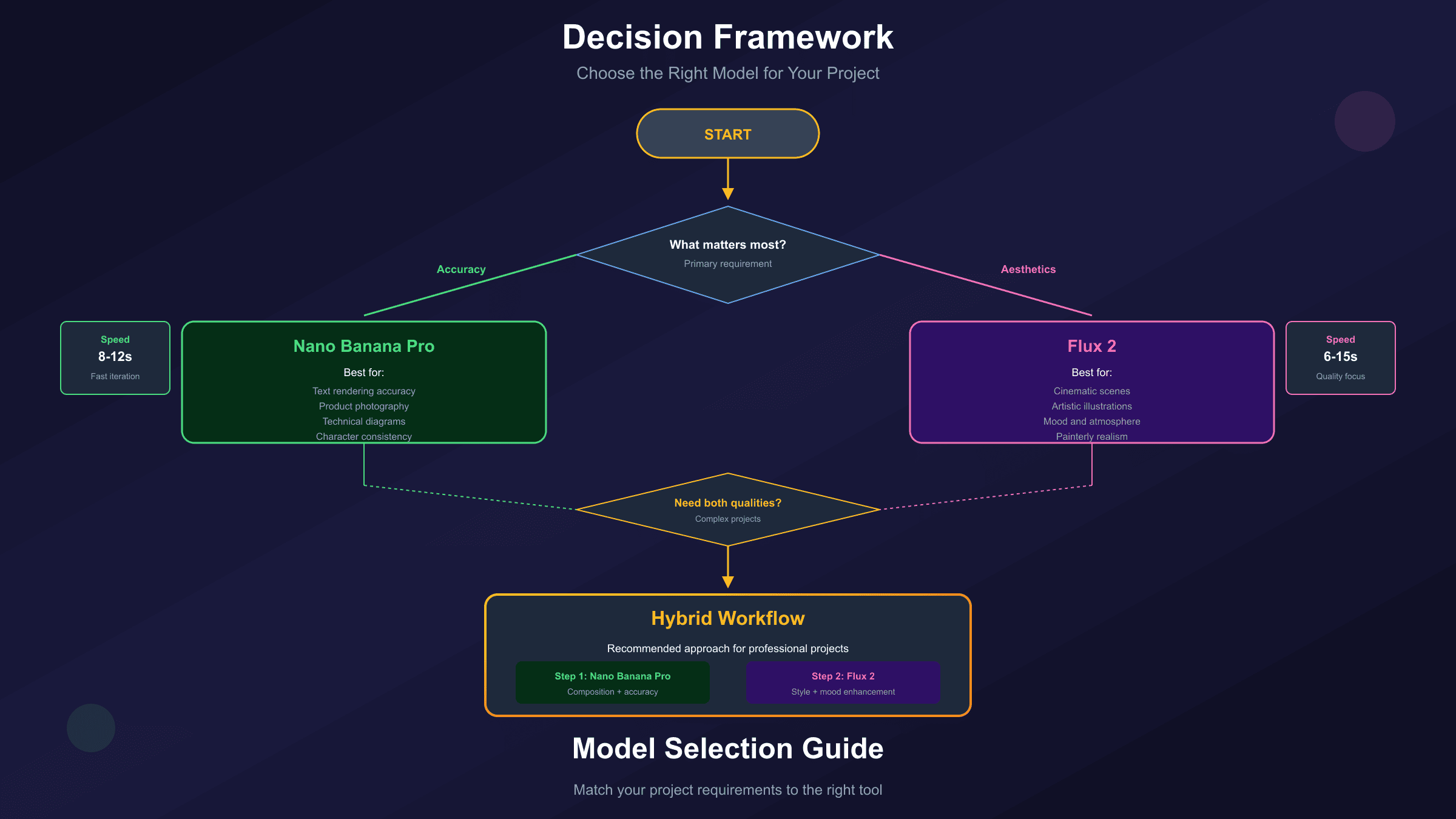
Professional studios increasingly use both models strategically rather than choosing one exclusively. The key is matching each model's strengths to specific workflow stages.
Exploration with Nano Banana Pro
Start projects with Nano Banana Pro for rapid iteration. The model's speed and instruction adherence enable quick exploration of concepts, layouts, and directions. Generate dozens of variations quickly, identify promising directions, then refine.
At $0.05 per image through laozhang.ai, exploration costs remain manageable even at high volumes. Use this phase to establish character designs, composition options, and thematic directions before committing to final production.
Refinement with Flux 2
Once concepts are established, switch to Flux 2 for hero images and key visual assets. Provide reference images from the exploration phase, leverage multi-reference conditioning for consistency, and generate final assets at maximum quality. The longer generation time and higher cost per image are justified when producing the final deliverables.
This hybrid approach combines Nano Banana Pro's efficiency and consistency with Flux 2's aesthetic excellence—optimizing both cost and quality across the project lifecycle.
hljs python# Example: Hybrid workflow implementation
# Exploration phase with Nano Banana Pro via laozhang.ai
import requests
import base64
LAOZHANG_KEY = "sk-YOUR_API_KEY" # From laozhang.ai
LAOZHANG_URL = "https://api.laozhang.ai/v1beta/models/gemini-3-pro-image-preview:generateContent"
def explore_concepts(prompt_variations: list) -> list:
"""Generate multiple concept explorations quickly"""
results = []
for prompt in prompt_variations:
response = requests.post(
LAOZHANG_URL,
headers={
"Authorization": f"Bearer {LAOZHANG_KEY}",
"Content-Type": "application/json"
},
json={
"contents": [{"parts": [{"text": prompt}]}],
"generationConfig": {
"responseModalities": ["IMAGE"],
"imageConfig": {"imageSize": "2K"}
}
},
timeout=180
)
if response.ok:
data = response.json()
image = data["candidates"][0]["content"]["parts"][0]["inlineData"]["data"]
results.append(base64.b64decode(image))
return results
# Generate 20 concept variations at ~$1 total cost
concepts = explore_concepts([
f"Futuristic cityscape variation {i}, cyberpunk aesthetic"
for i in range(20)
])
Decision Framework
Use this framework to choose the right model for specific projects.
Choose Nano Banana Pro when:
- You need to follow complex instructions precisely
- Character consistency across multiple images is critical
- Text accuracy matters for the final output
- Volume is high and cost efficiency drives decisions
- Speed enables your workflow (iteration, prototyping)
- You don't have reference images to work from
Choose Flux 2 when:
- Visual quality and atmosphere are paramount
- You have reference images for multi-reference conditioning
- The project demands cinematic or artistic expression
- You're producing hero images or key visual assets
- Director-level control over visual details matters
- The project budget accommodates premium generation costs
Use both when:
- Projects span exploration through final production
- Teams need both speed and maximum quality at different stages
- Budget allows strategic allocation of resources
- Different deliverables have different quality requirements
Frequently Asked Questions
Which model produces higher quality images?
Quality depends on the definition. For technical accuracy—correct anatomy, precise text, instruction adherence—Nano Banana Pro leads with 89% prompt adherence and 94% text accuracy. For aesthetic quality—cinematic atmosphere, painterly realism, emotional impact—Flux 2 excels with its 32B parameter model optimized for visual excellence. Neither is objectively "better"; they optimize for different outcomes.
Can I use both models in the same project?
Absolutely, and many professional studios do. Use Nano Banana Pro for rapid exploration and concept development ($0.05/image through laozhang.ai), then Flux 2 for final hero assets where quality justifies higher costs. This hybrid workflow optimizes both speed and final output quality.
Which is better for commercial work?
Both support commercial use. Nano Banana Pro excels at scale—product photography, marketing campaigns requiring character consistency, high-volume content production. Flux 2 excels at impact—hero images, premium advertising creative, artistic work where visual excellence justifies premium investment.
Why is Nano Banana Pro called "logic-first"?
Nano Banana Pro uses a "brain + hand" architecture where a Gemini 3.0-scale reasoning model interprets instructions and creates a structured plan before the diffusion engine generates any pixels. This explicit reasoning step produces superior instruction-following, count accuracy, and logical consistency compared to models that attempt to generate directly from prompts.
How do the models handle reference images?
Nano Banana Pro uses reference images for semantic identity preservation—understanding what elements constitute "this character" and maintaining them across novel scenes. Flux 2 processes up to 10 reference images simultaneously through native multi-reference conditioning, fusing visual embeddings before generation for style, character, and product consistency.
For detailed pricing analysis, see our Nano Banana Pro cost per image guide. For prompt optimization techniques, check our Nano Banana Pro prompts guide.