Claude Code Free: Complete Guide to Free Access, Pricing & Alternatives (2026)
Discover 7 ways to use Claude Code for free. Complete 2026 guide covering pricing, free alternatives like Gemini CLI, and setup instructions.
Nano Banana Pro
4K-80%Google Gemini 3 Pro · AI Inpainting
谷歌原生模型 · AI智能修图

Claude Code has rapidly become one of the most powerful AI coding assistants available, but its premium pricing leaves many developers wondering: is there a way to use Claude Code for free? The short answer is that Claude Code itself requires a paid subscription, but several legitimate pathways exist to access its capabilities without paying full price—or even for free.
This comprehensive guide covers everything you need to know about Claude Code's pricing structure, seven proven methods to access it for free or at minimal cost, and the best open-source alternatives that deliver similar functionality. Whether you're a student on a tight budget, an individual developer exploring AI coding tools, or a team evaluating options, you'll find actionable strategies to get started without breaking the bank.
Is Claude Code Free? The Direct Answer
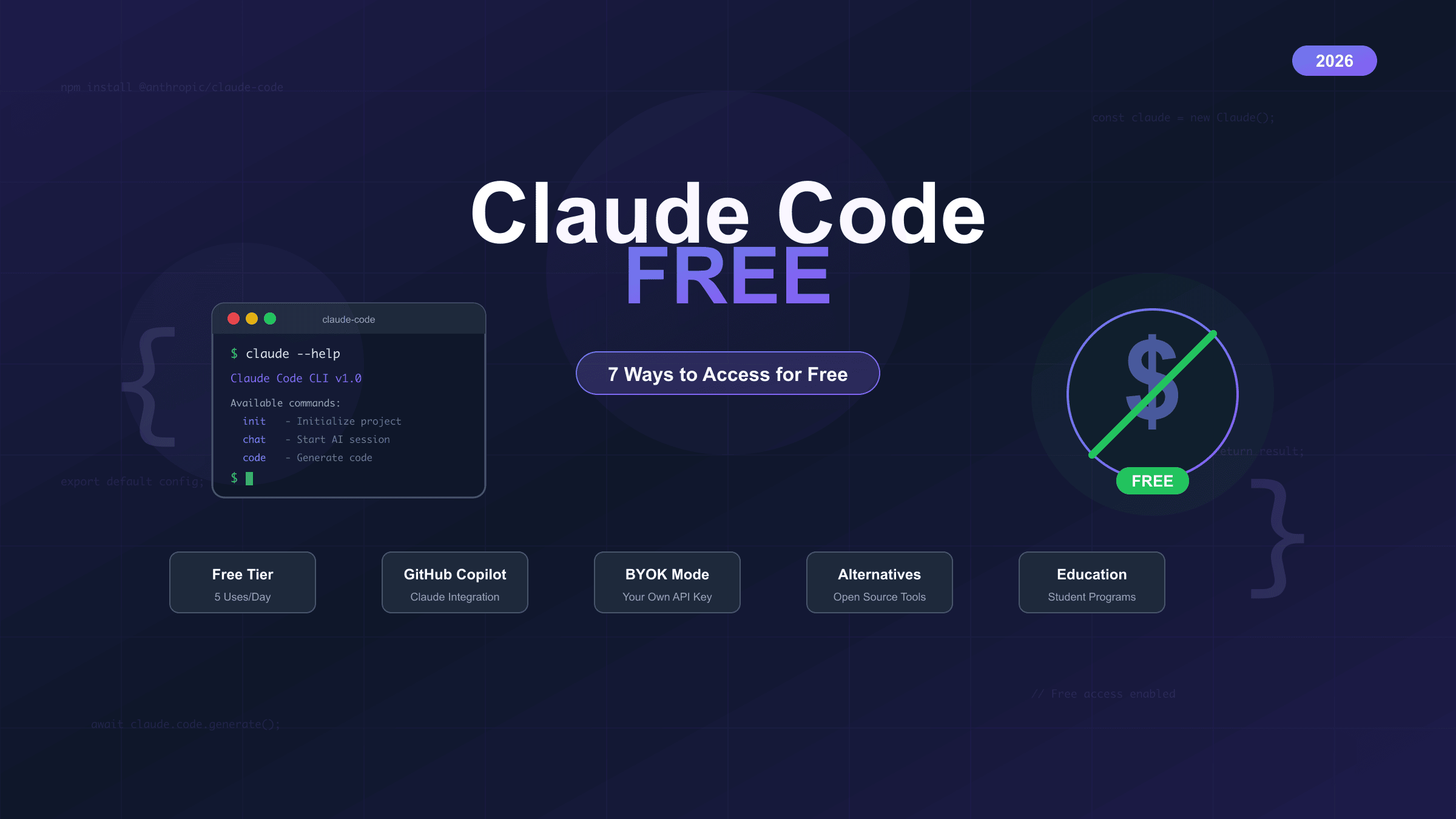
Claude Code is not free. It requires either a Claude Pro subscription at $20 per month or a Claude Max subscription ranging from $100 to $200 per month. The free tier of Claude (available at claude.ai) does not include Claude Code access—this terminal-based agentic coding tool is exclusively available to paying subscribers.
This distinction matters because Claude Code represents a fundamentally different product from the standard Claude chat interface. While the free Claude tier allows basic conversations and limited code assistance through the web interface, Claude Code operates as an autonomous agent in your terminal that can understand your entire codebase, execute commands, edit files across multiple directories, and manage complex git workflows. These advanced capabilities require the processing power and context window that Anthropic reserves for paid tiers.
According to Anthropic's official pricing page, as of January 2026, there is no standalone free tier for Claude Code. However, this doesn't mean you're completely out of options. Several legitimate methods exist to access Claude Code functionality without paying the full subscription price, which we'll explore in detail throughout this guide. The key is understanding which approach best matches your specific use case and budget constraints.
For developers who absolutely need the official Claude Code experience, the Pro subscription at $20 per month represents the minimum investment. But for those willing to explore alternatives or leverage promotional offers, free or near-free access is achievable through the methods outlined in the following sections.
Claude Code Pricing Plans Explained (2026 Update)
Understanding the complete pricing structure helps you make an informed decision about which tier—if any—makes sense for your needs. Anthropic offers several plans, each with distinct Claude Code access levels and usage limits.
| Plan | Monthly Cost | Claude Code Access | Usage Limits | Best For |
|---|---|---|---|---|
| Free | $0 | ❌ No access | 5 messages/hour | Basic exploration |
| Pro | $20 | ✅ Full access | 45 messages/5 hours, 10-40 Claude Code prompts | Individual developers |
| Max 5x | $100 | ✅ Full access | 225 messages/5 hours, 50-200 prompts | Professional developers |
| Max 20x | $200 | ✅ Full access | 900 messages/5 hours, 200-800 prompts | Heavy users, teams |
| Team | $25-150/user | ✅ Full access | Varies by seat type | Organizations |
| API | Pay-per-token | ✅ Full access | No fixed limits | Custom applications |
The Pro plan provides approximately 40 to 80 hours of Sonnet 4 usage per week within your limits, which covers most individual development workflows. Usage varies significantly based on factors like codebase size, the complexity of your prompts, and whether you enable auto-accept mode for file changes.
For the API pricing model, current rates stand at $3 to $6 per million input tokens and $15 to $22.50 per million output tokens for Sonnet 4.5, with Opus 4.5 commanding premium pricing at $5 input and $25 output per million tokens. These rates apply when using Claude Code with an API key rather than a subscription.
One critical detail that catches many developers off guard: your usage across claude.ai, Claude Desktop, and Claude Code all count against the same allocation. Running multiple Claude Code instances in parallel accelerates how quickly you reach your limits. For a detailed breakdown of how these limits work in practice, see our Claude Code usage limits guide and pricing plans comparison.
7 Ways to Access Claude Code for Free (or Almost Free)
While Claude Code itself requires payment, several legitimate pathways exist to access its capabilities at minimal or zero cost. Here are seven proven methods, ranked by accessibility and value.
Quick overview: You can access Claude Code capabilities through GitHub Copilot integration (existing subscribers), Anthropic's $5 API credits (new users), cloud platform credits (AWS/GCP), student programs, guest passes, and API gateway services—each with specific trade-offs between cost, features, and limitations.
1. GitHub Copilot with Claude Integration
For developers already paying for GitHub Copilot ($19/month for Pro), this represents the most cost-effective path to Claude-powered coding assistance. In late 2024, Anthropic partnered with GitHub to integrate Claude 3.5 Sonnet (now upgraded to 3.7) directly into Copilot's interface across VS Code, Visual Studio, JetBrains IDEs, and GitHub.com.
The integration provides access to essentially the same model powering Claude Code, though through Copilot's interface rather than the standalone terminal tool. You get Claude's reasoning capabilities for code completion, chat-based assistance, and code review without additional subscription costs beyond your existing Copilot payment. The main limitation is that you're using Copilot's workflows rather than Claude Code's agentic terminal experience—you won't get the autonomous file editing and command execution that makes Claude Code distinctive.
2. Anthropic API Free Credits ($5)
New Anthropic Console accounts can claim $5 in free API credits through phone verification at console.anthropic.com. This modest amount processes approximately 330,000 tokens—enough for several hours of Claude Code usage when used efficiently.
Important limitations apply: credits expire 14 days after claiming (the countdown starts immediately upon verification, not first use), US phone numbers consistently qualify while UK numbers are explicitly excluded, and this is strictly a one-time offer per account. To maximize these credits with Claude Code, set your ANTHROPIC_API_KEY environment variable and Claude Code will use API billing instead of requiring a subscription. At Sonnet 4.5 rates, $5 translates to roughly 1.6 million input tokens or 330,000 output tokens—sufficient for exploring Claude Code's capabilities before committing to a paid plan.
3. AWS Bedrock Credits
Amazon Web Services provides Claude access through its Bedrock service, and new AWS accounts receive various credit amounts through different programs. The standard free tier includes $300 in credits applicable to various services including Bedrock. For qualifying startups, AWS Activate offers up to $100,000 in credits—these can cover substantial Claude API usage.
Claude Opus 4.5 became available in Amazon Bedrock in late 2025, meaning AWS credits now provide access to Anthropic's most capable models. The setup requires configuring Bedrock integration with Claude Code, which involves more initial configuration than direct Anthropic API access but provides enterprise-grade infrastructure and potentially significant cost savings.
4. Google Cloud Vertex AI Credits
Google Cloud Platform offers Claude through Vertex AI, with new accounts receiving $300 in free credits applicable to AI model usage. Similar to AWS, this approach requires some initial configuration but provides access to Claude models through established cloud infrastructure.
The Vertex AI integration works particularly well for developers already building on GCP infrastructure, as you can maintain consistent billing and access management across your entire stack. Credits apply at Google's published rates for Claude API calls, which remain competitive with direct Anthropic pricing.
5. Student and Education Programs
Anthropic's Student Builder Program provides free API credits specifically for university students pursuing academic projects. To apply, visit Anthropic's Student Builders page, provide your university affiliation and expected graduation date, describe your project, and await approval—typically processed within 5 to 7 business days.
Beyond Anthropic's direct program, both AWS and Google Cloud offer substantial education credits through programs like AWS Educate and Google Cloud for Students. These credits apply to Claude access through their respective AI platforms, potentially providing hundreds or thousands of dollars in free usage for qualifying students.
6. Claude Code Guest Pass (7-Day Trial)
Max subscription users receive three guest pass invitations to share with others. Each pass provides 7 days of Pro-level access, including full Claude Code functionality. If you know someone with a Max subscription, this represents a legitimate way to fully experience Claude Code before deciding whether to subscribe.
The guest pass requires linking a credit card (for verification, not immediate charges), and after 7 days, it automatically converts to a $20/month Pro subscription unless canceled. This trial period provides enough time to thoroughly evaluate whether Claude Code fits your workflow and justifies the ongoing subscription cost.
7. API Gateway Services
For developers seeking ongoing low-cost Claude API access without subscription constraints, API gateway services offer an alternative approach. Services like laozhang.ai aggregate multiple AI model providers and often offer competitive pricing compared to direct API access—particularly valuable for users who need flexibility across different models or face regional access challenges.
These gateways typically provide OpenAI-compatible endpoints, meaning you can configure Claude Code to use them by setting custom base URLs. While this approach requires API-style access rather than subscription features, it provides pay-as-you-go flexibility without monthly commitments. Note that gateway services may have different latency characteristics and support limitations compared to direct Anthropic access—evaluate whether these trade-offs align with your specific requirements.
Best Free Alternatives to Claude Code
If the Claude Code subscription doesn't fit your budget, several excellent free alternatives deliver similar agentic coding capabilities. These tools have matured significantly and represent genuine competition rather than mere substitutes.
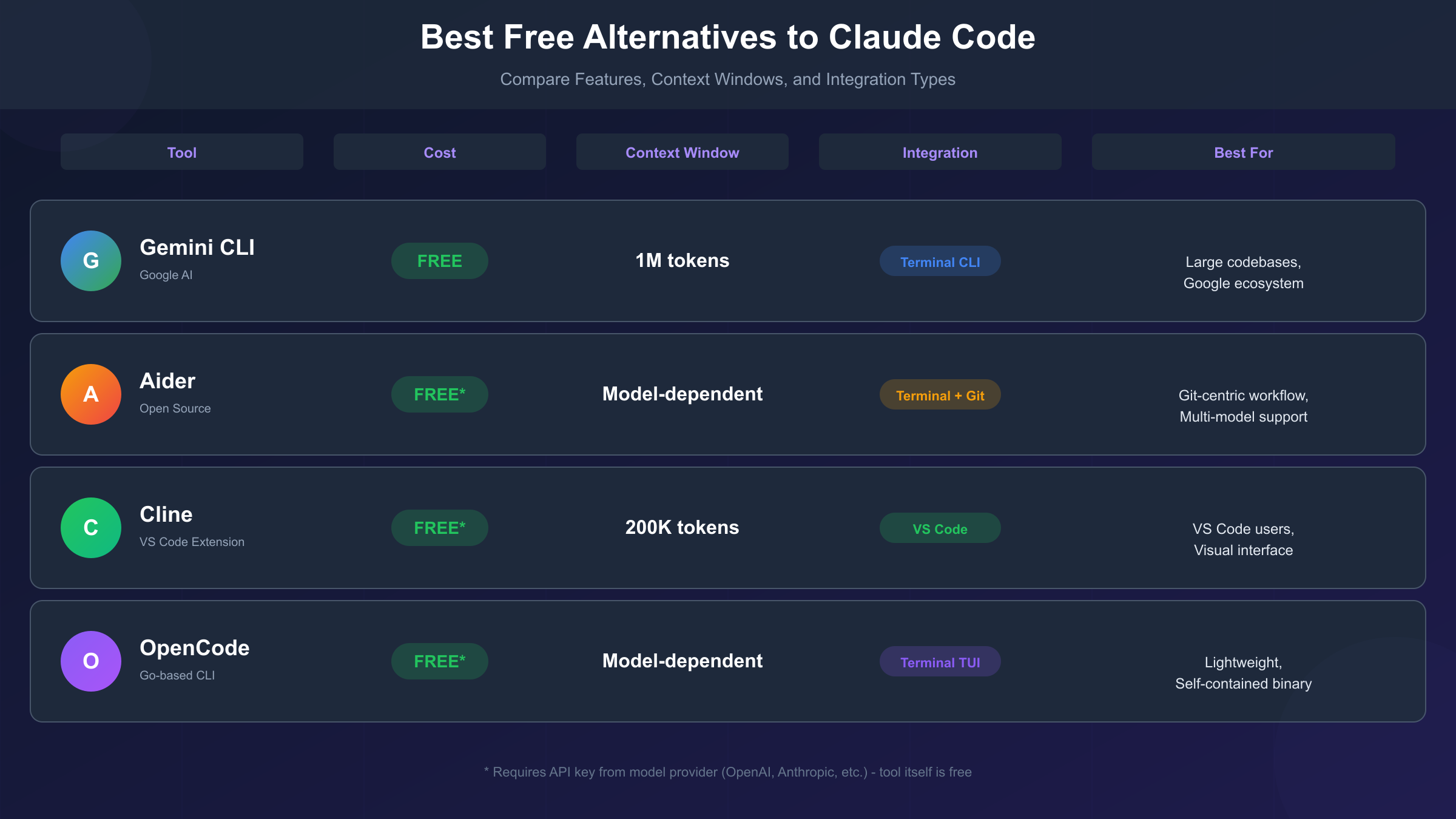
Quick answer: The best free alternatives are Gemini CLI (1,000 free requests daily, open source), Aider (terminal-based with Git integration), and Cline (VS Code extension with MCP support). Each excels in different scenarios depending on your preferred workflow.
| Tool | Type | Cost | Context Window | Best For | Key Limitation |
|---|---|---|---|---|---|
| Gemini CLI | Terminal | Free (1,000/day) | 1M tokens | General coding, cost-conscious devs | Google ecosystem only |
| Aider | Terminal | Free + API | Varies by model | Git-heavy workflows | Requires API key |
| Cline | VS Code | Free + API | Varies by model | VS Code users, plan-review workflows | IDE-dependent |
| OpenCode | Terminal | Free + API | Varies by model | Multi-provider flexibility | Newer, less mature |
| Cursor | IDE | Limited free | Varies | Full IDE experience | Free tier very limited |
| Windsurf | IDE | Free unlimited | Varies | Multi-language projects | Less established |
Gemini CLI stands out as the strongest free option for most developers. Google's official terminal interface provides 1,000 free requests daily with a 1 million token context window matching Claude Code's capacity. It's open source under Apache-2.0, can be self-hosted, and integrates naturally with Google Cloud workflows. The main trade-off is you're limited to Gemini models rather than Claude's distinctive reasoning style.
Aider offers the closest workflow philosophy to Claude Code while remaining completely free and open source. It operates exclusively as a CLI tool with deep Git integration—automatically committing changes with sensible messages and making it easy to review exactly what the AI modified. Aider supports multiple LLM backends, meaning you can pair it with free API credits from various providers or local models for zero marginal cost.
Cline provides a VS Code-native experience for developers who prefer GUI over terminal. Its plan-review-run workflow ensures you approve changes before execution, and MCP (Model Context Protocol) integration enables tool extensions. Like Aider, you bring your own API key, so costs depend entirely on your chosen provider.
For developers who want Claude specifically but at lower cost than official pricing, using these tools with API gateway services can provide the best of both worlds—Claude's capabilities through an interface optimized for cost efficiency. Services like laozhang.ai offer access to Claude models at rates often below official pricing, which you can then use through Aider, Cline, or OpenCode.
How to Install and Set Up Claude Code
For those who decide to proceed with an official Claude Code subscription or want to use it with API credits, here's the complete setup process. Installation takes under five minutes once you have the prerequisites in place.
Prerequisites: Node.js version 18 or higher is required. Check your current version with node --version and upgrade at nodejs.org if needed.
Native Installation (Recommended)
For macOS, Linux, and WSL:
hljs bashcurl -fsSL https://claude.ai/install.sh | bash
For Windows PowerShell:
hljs powershellirm https://claude.ai/install.ps1 | iex
Alternative: npm Installation
If you prefer package management through npm:
hljs bashnpm install -g @anthropic-ai/claude-code
Important: Never use sudo with npm global installs—this causes permission issues. If you encounter EACCES errors, fix your npm permissions instead.
Authentication
After installation, run claude to start an interactive session. You'll be prompted to authenticate with either your Claude subscription (Pro/Max) or Console API credentials. For API-based usage, set your environment variable:
hljs bash# For bash/zsh
export ANTHROPIC_API_KEY="your-api-key-here"
# Add to ~/.zshrc or ~/.bashrc for persistence
echo 'export ANTHROPIC_API_KEY="your-api-key-here"' >> ~/.zshrc
source ~/.zshrc
First Session
Navigate to your project directory and run claude to begin. Useful first commands include asking Claude to explain your project structure, identify the main entry point, or describe the technologies in use. For comprehensive setup guidance and workflow optimization, see our Claude Code best practices guide and Anthropic's official documentation.
Understanding Claude Code Usage Limits
Usage limits represent one of the most confusing aspects of Claude Code pricing. Understanding how they work helps you maximize value from whichever access method you choose.
| Plan | Messages per 5 Hours | Claude Code Prompts per 5 Hours | Weekly Sonnet 4 Hours |
|---|---|---|---|
| Pro | ~45 | 10-40 | 40-80 hours |
| Max 5x | ~225 | 50-200 | 140-280 hours |
| Max 20x | ~900 | 200-800 | 240-480 hours |
All limits reset on 5-hour cycles, with exact countdown timing displayed in the Claude Code interface. A critical detail: weekly limits now operate alongside the 5-hour cycles to prevent abuse, implementing a single weekly cap shared across all models and platforms including web, desktop, and API access.
Several factors affect how quickly you consume your allocation. Large codebases require more tokens for context, complex prompts generate longer responses, auto-accept mode for file changes uses additional processing, and running multiple Claude Code instances in parallel accelerates consumption proportionally.
Optimization strategies include using the /compact command to strategically reduce context size, starting fresh sessions with /clear when switching tasks, and monitoring your remaining allocation with /status. For detailed troubleshooting when you hit limits unexpectedly, see our rate limit solutions guide and usage limits deep dive.
Student and Education Programs
Students have access to several pathways for free or heavily discounted Claude Code access. These programs recognize that tomorrow's professional developers often can't afford premium tools during their educational years.
Anthropic Student Builder Program provides direct API credits for qualifying university students. The application process involves visiting Anthropic's Student Builders page, completing a form with your university affiliation, expected graduation date, and a brief project description. Approval typically takes 5 to 7 business days, after which you receive credits deposited to your Console account.
AWS Educate offers cloud credits applicable to Bedrock services including Claude access. Students can apply through their educational institution or directly through AWS, with credit amounts varying by program and region. These credits provide a professional development environment while learning AI-assisted coding workflows.
Google Cloud for Students similarly provides credits applicable to Vertex AI Claude access. The application requires a valid .edu email address and verification of student status. Combined with Gemini CLI's free tier, Google's ecosystem offers substantial free AI coding resources for students.
GitHub Education bundles various developer tools including enhanced Copilot access. While not providing Claude Code directly, the Copilot Claude integration means GitHub Education benefits extend to Claude-powered coding assistance within that ecosystem.
The key to maximizing student programs is applying early in your academic career—credits typically have expiration periods, so starting sooner provides more time to utilize them across your studies.
How to Get and Maximize Free API Credits
Beyond the initial $5 from Anthropic, several strategies exist for accumulating API credits and stretching them further. Smart credit management can extend free access from days to weeks or even months.
Official sources for free credits include the Anthropic phone verification offer ($5), AWS new account credits ($300 standard free tier), Google Cloud new account credits ($300), and startup accelerator programs (Y Combinator, Techstars, and similar programs often include $1,000 to $10,000 in AI credits as part of their packages).
Maximizing credit efficiency requires understanding token consumption patterns. Claude Code operations consume tokens rapidly due to large system instructions, full file contexts, and detailed outputs. Strategies to reduce consumption include limiting context by focusing Claude on specific files rather than entire codebases, using smaller models like Haiku for simple tasks and reserving Sonnet or Opus for complex reasoning, batching related requests rather than making many small queries, and clearing conversation history between unrelated tasks with /clear.
For ongoing access beyond free credits, API gateway services provide an alternative cost structure. Services like laozhang.ai offer Claude API access at competitive rates with pay-as-you-go pricing—you only pay for actual usage rather than monthly subscriptions. This approach works well for developers whose usage varies significantly month to month or who want to avoid subscription commitments.
Here's a basic example of using Claude through an API gateway:
hljs pythonfrom openai import OpenAI
# Using laozhang.ai gateway (OpenAI-compatible)
client = OpenAI(
api_key="your-gateway-api-key",
base_url="https://api.laozhang.ai/v1"
)
response = client.chat.completions.create(
model="claude-3-5-sonnet", # Claude model via gateway
messages=[{"role": "user", "content": "Explain this code..."}]
)
print(response.choices[0].message.content)
Note that gateway services provide API-style access only—you won't get subscription features like the Claude.ai web interface. Evaluate whether API access alone meets your needs before choosing this route.
Which Option Is Right for You? Decision Guide
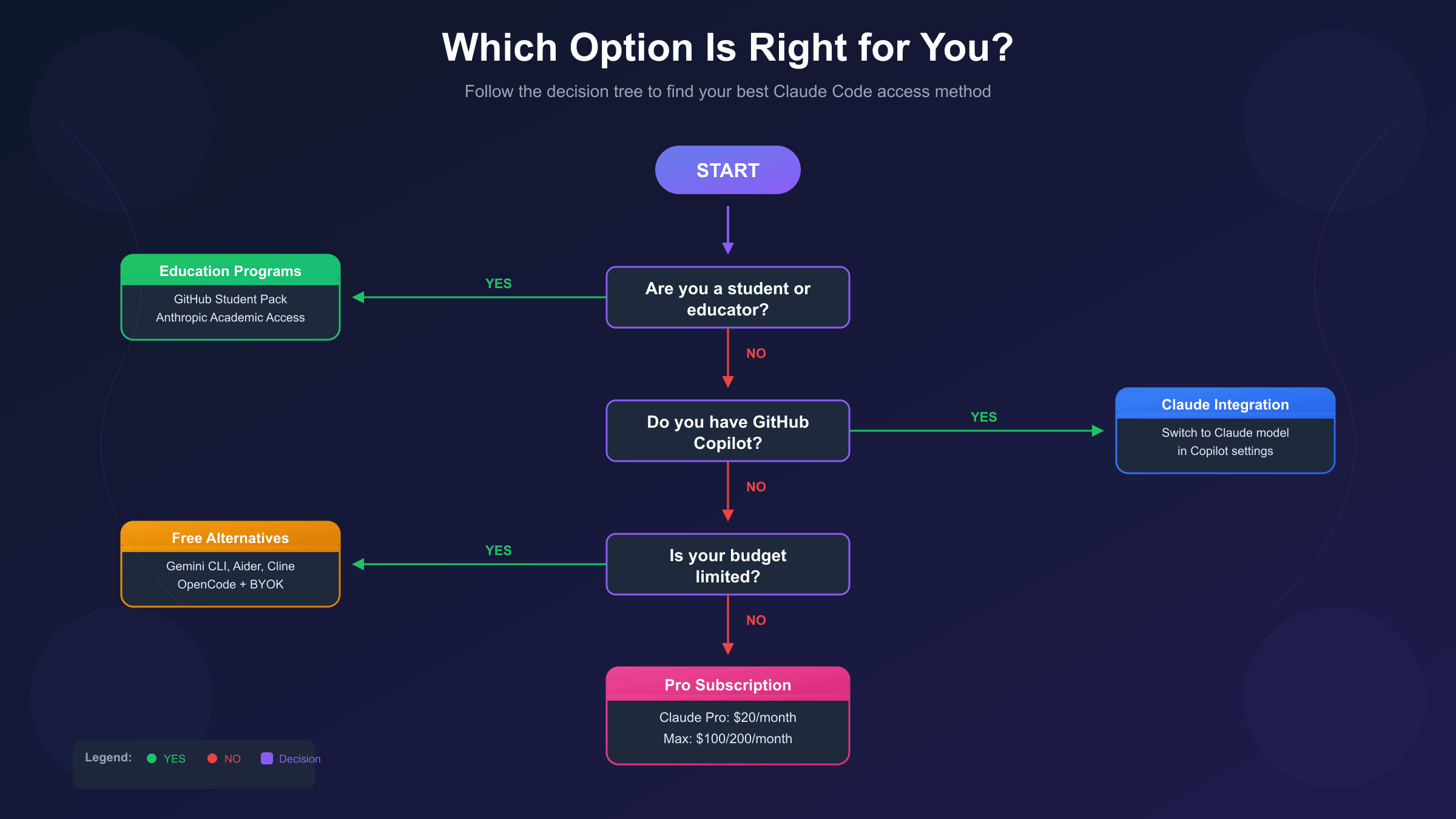
With seven free access methods and six alternatives to consider, choosing the right approach depends on your specific situation. This decision framework helps match options to common user profiles.
| User Profile | Recommended Approach | Why This Works | Monthly Cost |
|---|---|---|---|
| Student | Education programs + Gemini CLI | Maximum free access, build skills | $0 |
| Hobby developer | API credits + Aider | Try before committing, flexible | $0-5 |
| GitHub Copilot user | Copilot Claude integration | Already paying, no extra cost | $0 extra |
| Startup founder | AWS/GCP credits + Pro subscription | Scale with credits, reliable access | $20+ |
| Cost-conscious pro | API gateway + Cline | Control costs, professional tools | Pay-per-use |
| Enterprise evaluator | Guest pass → Team trial | Full experience before commitment | Free trial |
For students and educators, the combination of education program credits and Gemini CLI provides the most comprehensive free access. Apply for Anthropic's Student Builder Program immediately, then use Gemini CLI for daily coding while reserving Claude credits for complex projects where its reasoning particularly shines.
For individual developers testing the waters, start with the $5 API credit offer and Anthropic's free web tier to understand Claude's capabilities. If you find value in the agentic coding workflow, the Pro subscription at $20/month represents reasonable value for active developers—roughly the cost of a few specialty coffees monthly for a tool that can significantly accelerate development velocity.
For teams and organizations, the calculation shifts toward reliability and support. The Team plan at $25 to $150 per user provides administrative controls, unified billing, and enterprise features that matter at scale. Consider starting with guest passes for team members to evaluate fit before committing to seats.
For budget-constrained professional developers who need ongoing access, the API gateway approach offers the best cost control. Services like laozhang.ai provide pay-as-you-go Claude access without subscription commitments, though this requires comfort with API-based workflows rather than subscription convenience. This option particularly suits developers with variable usage patterns who might pay for unused subscription capacity during slower periods.
Frequently Asked Questions
Is Claude Code completely free to use?
No, Claude Code requires a paid subscription. The minimum is Claude Pro at $20 per month, which includes Claude Code access alongside the web interface and desktop applications. The free tier of Claude at claude.ai does not include Claude Code functionality. However, you can access similar capabilities through free alternatives like Gemini CLI, or use Claude Code with API credits from various sources detailed in this guide.
What's the cheapest way to try Claude Code officially?
The Guest Pass program offers the lowest barrier to official Claude Code access—7 days of Pro-level access for free if you receive an invitation from a Max subscriber. Alternatively, the $5 API credits available to new Anthropic Console accounts let you use Claude Code without a subscription, though you'll need to set up API key authentication rather than standard subscription login.
Can I use Claude Code with my existing GitHub Copilot subscription?
Not directly. Claude Code is Anthropic's standalone terminal tool, while GitHub Copilot is a separate product. However, Copilot now integrates Claude 3.7 Sonnet within its interface, so Copilot subscribers can access Claude's model for code completion and chat assistance. This provides Claude-powered coding help, but through Copilot's interface rather than Claude Code's agentic terminal experience.
How do Claude Code limits work across multiple devices?
All your Claude usage—web interface, desktop app, and Claude Code—shares the same allocation. Using Claude Code on your laptop and the web interface on your phone both count against your 5-hour and weekly limits. Running multiple Claude Code sessions simultaneously accelerates consumption proportionally, so avoid parallel instances unless necessary.
Are there any risks with using API gateway services?
API gateways introduce a third party between you and Anthropic's infrastructure. Potential considerations include different latency characteristics, varied uptime guarantees, and different support channels compared to direct access. Reputable gateways like laozhang.ai maintain OpenAI-compatible interfaces and competitive reliability, but evaluate whether their specific terms and performance characteristics meet your requirements before depending on them for production work.
Will Anthropic release a free tier for Claude Code?
Anthropic hasn't announced plans for a free Claude Code tier. Given the computational intensity of agentic coding workflows—where Claude must maintain context across entire codebases and execute multiple operations autonomously—a free tier would be economically challenging. The company's current strategy focuses on subscription tiers and API access with various pricing options rather than free access to their most advanced tools.
Conclusion
While Claude Code itself isn't free, this guide has demonstrated that accessing powerful AI coding assistance without significant investment is entirely achievable. The seven methods outlined—from GitHub Copilot integration to student programs to API gateway services—provide legitimate pathways for nearly every budget level and use case.
For those just starting their AI-assisted coding journey, I recommend beginning with Gemini CLI's generous free tier alongside Anthropic's $5 API credit offer. This combination provides exposure to multiple AI coding approaches without financial commitment, helping you understand which features genuinely improve your productivity before investing in subscriptions.
Developers who determine that Claude Code's specific capabilities justify ongoing costs will find the Pro subscription at $20 monthly offers strong value for active development work. Those seeking maximum flexibility might prefer API gateway approaches that align costs precisely with actual usage.
The AI coding tool landscape continues evolving rapidly—new alternatives emerge regularly, pricing structures adjust, and capabilities expand. Whatever path you choose today, periodically reassessing your options ensures you're getting optimal value as the market matures.
Next steps: Explore our Claude Code best practices for maximizing productivity once you've established access, or dive into our pricing plans comparison for detailed analysis of subscription tiers.