Nano Banana Pro Comparison: How It Stacks Up Against Every Major AI Image Generator
Comprehensive comparison of Nano Banana Pro vs Midjourney, DALL-E 3, Flux.2, and Stable Diffusion. Includes benchmark data, pricing analysis, and use case recommendations.
Nano Banana Pro
4K-80%Google Gemini 3 Pro · AI Inpainting
谷歌原生模型 · AI智能修图

Comparing Nano Banana Pro against other leading AI image generators requires examining multiple dimensions beyond simple image quality. Google's flagship model brings unique strengths in text rendering and resolution, while competitors like Midjourney excel in artistic interpretation and DALL-E 3 offers unmatched accessibility through ChatGPT integration.
This comprehensive comparison analyzes Nano Banana Pro against every major AI image generator using real benchmark data, pricing breakdowns, and practical use case recommendations to help you choose the right tool for your specific needs.
What Makes Nano Banana Pro Different
Nano Banana Pro represents Google DeepMind's most advanced image generation model, built on the Gemini 3 Pro architecture rather than traditional diffusion-based approaches. This fundamental architectural difference shapes its unique capabilities and trade-offs compared to competitors.
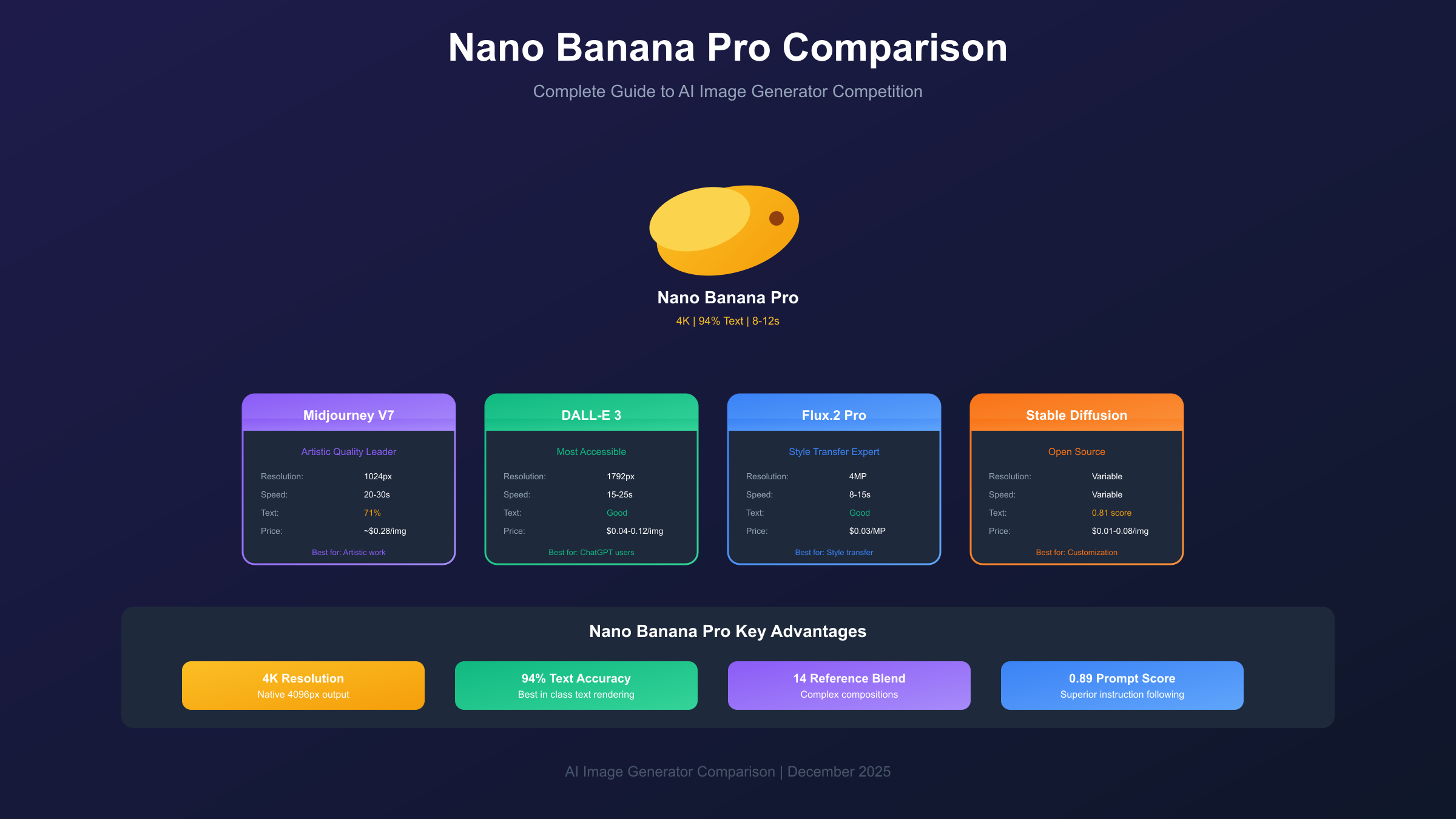
The model launched in November 2025 with several category-leading features. Native 4K resolution output (4096×4096 pixels) surpasses what most competitors offer without upscaling. Text rendering accuracy reaches 94% in benchmark tests, making it the clear leader for images requiring legible typography. The model can blend up to 14 reference images while maintaining consistency across up to 5 people or subjects, enabling complex composition work that previously required significant post-production effort. For a complete overview of all capabilities, see our Nano Banana Pro capabilities guide.
Google's integration of Search Grounding enables Nano Banana Pro to access real-time information when generating images of current events, products, or real-world locations. This capability distinguishes it from static models trained on historical data, though it also raises questions about image authenticity and sourcing that creators should consider.
The transformer-based, autoregressive architecture differs fundamentally from the diffusion and flow-based pipelines used by competitors. This design choice enables tighter integration with Gemini's language understanding, resulting in superior prompt adherence and multi-turn conversation capabilities. However, it also means generation times run longer than speed-optimized alternatives, typically 8-12 seconds compared to 3-5 seconds for the original Nano Banana model.
Nano Banana vs Nano Banana Pro: Essential Differences
Understanding the distinction between Nano Banana and Nano Banana Pro helps contextualize the "Pro" designation and clarify when the premium model justifies its higher cost.
| Feature | Nano Banana | Nano Banana Pro |
|---|---|---|
| Model Base | Gemini 2.5 Flash Image | Gemini 3 Pro Image |
| Resolution | 1MP (1024×1024) | 4K (4096×4096) |
| Generation Speed | 3-5 seconds | 8-12 seconds |
| Text Accuracy | ~70% | 94% |
| Reference Images | Limited | Up to 14 |
| Character Consistency | 90% (single) | 95%+ (5 subjects) |
| Aspect Ratios | Limited | Multiple (1:1, 16:9, 4:3) |
| API Price | $0.039/image | $0.134-0.24/image |
The original Nano Banana prioritizes speed and cost-efficiency. At 3-5 seconds per generation and $0.039 per image, it enables rapid iteration cycles where creators can test 20 variations in the time a premium model produces 3-4 images. This speed advantage proves valuable for initial concept exploration and ideation phases where quick feedback matters more than final quality.
Nano Banana Pro invests additional compute time into quality improvements that matter for professional outputs. The resolution jump from 1MP to 8MP (4K) eliminates the need for AI upscaling in most use cases, saving both time and potential quality degradation. Text rendering improvements from ~70% to 94% accuracy mean creators can generate marketing materials, product images, and social content directly without post-production text overlay.
The practical implication: use standard Nano Banana for exploration and iteration, then switch to Pro for final production assets. This hybrid workflow maximizes efficiency while ensuring deliverable quality where it matters.
Nano Banana Pro vs Midjourney V7: The Artist's Choice
Midjourney has established itself as the artistic benchmark in AI image generation, known for distinctive aesthetic qualities that some creators prefer over more "realistic" outputs. Comparing it against Nano Banana Pro reveals fundamental philosophical differences in approach.
Artistic Quality and Style
Midjourney V7 excels at producing images with mood, atmosphere, and artistic interpretation that goes beyond literal prompt execution. Its outputs often feature dramatic lighting, painterly textures, and stylization that pushes toward artful surrealism. For concept art, fantasy illustration, and creative work where emotional impact matters more than technical accuracy, Midjourney remains the benchmark.
Nano Banana Pro takes a more literal approach to prompt interpretation, prioritizing accuracy over artistic interpretation. While this produces more predictable results aligned with specific requirements, it may feel "clinical" to creators seeking distinctive artistic voice. The model's strength lies in executing complex compositions with precision rather than adding creative flourishes.
Text Rendering Comparison
This comparison produces the clearest winner. Nano Banana Pro's 94% text accuracy dramatically outperforms Midjourney's ~71%, with the latter often producing illegible or distorted text. For any project requiring readable typography—logos, signage, marketing materials, product packaging—Nano Banana Pro eliminates the frustration of regenerating images until text renders correctly.
Speed and Workflow
Midjourney V7 generates images in 20-30 seconds in standard mode, with the April 2025 update bringing 40% speed improvements over V6. Despite these gains, Nano Banana Pro's 8-12 second generation still offers roughly 2x faster iteration. For workflows involving extensive prompt refinement, this difference compounds significantly across a project.
Practical Recommendation
Choose Midjourney V7 when artistic interpretation, mood, and stylization matter more than precision. Choose Nano Banana Pro when you need accurate text, specific composition control, or photorealistic outputs with predictable results.
Nano Banana Pro vs DALL-E 3: Accessibility Showdown
DALL-E 3's integration with ChatGPT provides an accessibility advantage that no other model matches, enabling conversational image creation without technical knowledge or separate subscriptions. This comparison examines whether convenience offsets capability differences.
ChatGPT Integration
DALL-E 3's seamless ChatGPT integration enables natural language image refinement through conversation. Users can request changes in plain English ("make the sky more orange" or "add another person on the left") without understanding prompt engineering syntax. This accessibility opened AI image generation to millions of non-technical users and remains DALL-E 3's primary value proposition.
Nano Banana Pro offers similar conversational capabilities through the Gemini app, though the experience differs somewhat from ChatGPT's polished interface. For developers, both models provide API access, though DALL-E 3 API availability varies by region.
Resolution and Quality
DALL-E 3 supports resolutions up to 1792 pixels with a newer 4K option in some implementations, trailing Nano Banana Pro's native 4K output. Quality-wise, both produce photorealistic results, though Nano Banana Pro's higher resolution provides more detail at equivalent compositions.
Text rendering accuracy favors Nano Banana Pro significantly. DALL-E 3 handles text "reasonably well" according to benchmark testing but occasionally introduces minor errors, while Nano Banana Pro's 94% accuracy provides more consistent results for text-heavy compositions.
Pricing Analysis
DALL-E 3 costs $0.040-0.120 per image depending on resolution and quality settings. Nano Banana Pro's $0.134 (standard) to $0.24 (4K) pricing places it slightly higher, though the quality differential at maximum resolution may justify the premium for professional use cases.
Practical Recommendation
Choose DALL-E 3 for maximum accessibility, conversational editing, and integration with existing ChatGPT workflows. Choose Nano Banana Pro when resolution, text accuracy, and creative control requirements exceed what DALL-E 3 delivers.
Nano Banana Pro vs Flux.2 Pro: Technical Deep Dive
Flux.2 Pro from Black Forest Labs represents the most technically sophisticated alternative to Nano Banana Pro, with a 32-billion-parameter architecture that challenges Google's approach on multiple dimensions.
Architectural Differences
The fundamental difference: Flux.2 Pro is a powerful image generator that happens to include a capable vision-language model, while Nano Banana Pro is a reasoning system that happens to output images. This philosophical distinction shapes their respective strengths.
Flux.2 Pro uses a rectified-flow approach that replaces classical diffusion's random walk with direct flow between noise and target distribution. This enables native 4MP image generation in single-digit to low-double-digit seconds. The architecture prioritizes visual fidelity and style flexibility.
Nano Banana Pro's transformer-based, autoregressive architecture integrates image generation with Gemini's text understanding and reasoning capabilities. This enables superior prompt adherence and complex logical instruction following, but the multimodal overhead adds generation time.
Style Transfer and Complex Scenes
Benchmark testing reveals Flux.2 Pro's superior performance in specialized creative tasks. Style transfer demonstrates impressive ability to adapt to diverse styles—watercolor paintings, Pixar-inspired illustrations, or specific artistic movements. Complex scene composition produces intricate results with clarity, depth, and balance that Nano Banana Pro occasionally misses on finer details.
Nano Banana Pro counters with logic, structure, and identity preservation. When prompts require specific reasoning about spatial relationships, consistent character representation, or accurate real-world object rendering, the Gemini backbone provides advantages.
Cost Comparison
Flux.2 Pro bills at approximately $0.03 per megapixel of combined input and output, making a standard 1024×1024 (1MP) generation cost $0.030. This places Gemini's effective per-image pricing for 1K-2K images at more than 4× the cost of equivalent Flux.2 Pro generation.
However, third-party providers like laozhang.ai reduce Nano Banana Pro costs to $0.05 per image regardless of resolution, significantly narrowing the price gap while providing access to the full 4K capability.
Practical Recommendation
Choose Flux.2 Pro for style transfer, artistic flexibility, and cost-sensitive production at standard resolutions. Choose Nano Banana Pro when text accuracy, reasoning-based prompts, or native 4K output justify the premium.
Nano Banana Pro vs Stable Diffusion: Open Source Alternative
Stable Diffusion represents the open-source approach to AI image generation, offering unmatched customization potential alongside complexity trade-offs. This comparison helps determine when the open ecosystem justifies the additional technical investment.
Customization vs Convenience
Stable Diffusion's open architecture enables fine-tuned models, custom LoRAs, ControlNet integration, and IP-Adapter workflows that no closed API matches. Creators can train models on specific styles, maintain consistent characters across projects, and exercise granular control over every aspect of the generation process.
This flexibility comes at cost. Effective Stable Diffusion usage requires understanding model selection, prompt engineering, negative prompts, sampling methods, and extension ecosystems. The learning curve spans weeks or months rather than the minutes needed to start with Nano Banana Pro.
Benchmark Performance
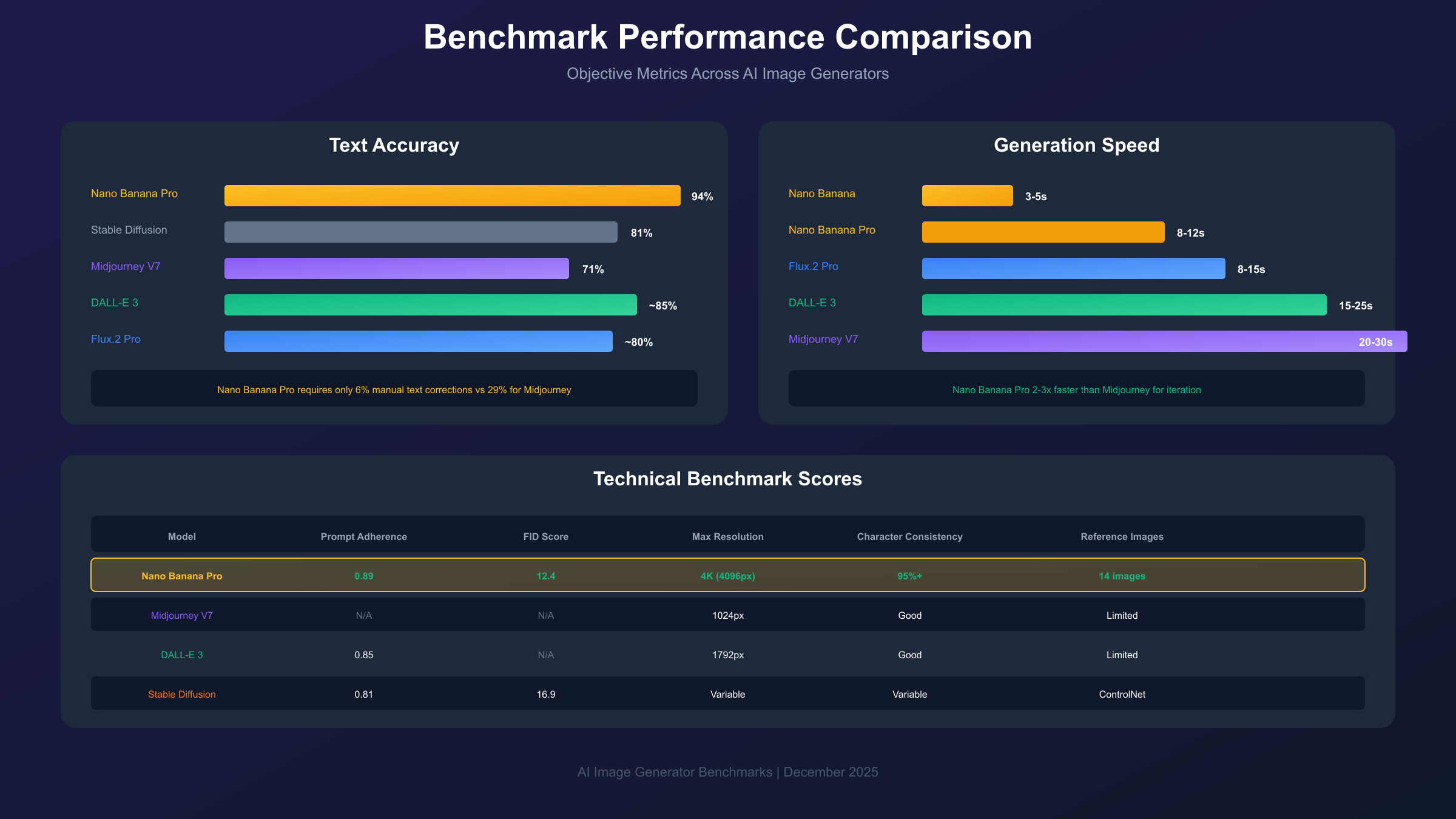
In standardized testing, Nano Banana Pro achieves a prompt adherence score of 0.89 compared to Stable Diffusion v3's 0.81 on the same scale. FID scores measuring photographic fidelity show Nano Banana at 12.4 versus Stable Diffusion's 16.9, indicating closer alignment to real image distributions.
Text rendering shows similar patterns, with Nano Banana's 94% accuracy producing images where only 6% need manual correction, compared to significantly higher correction rates for Stable Diffusion outputs.
Total Cost of Ownership
Stable Diffusion can run locally on consumer GPUs, eliminating per-image API costs entirely. However, hardware requirements for optimal performance (typically an RTX 4080 or better) represent significant upfront investment. Cloud-based Stable Diffusion access through various providers ranges from $0.01-0.08 per image, often cheaper than Nano Banana Pro at official pricing.
The calculation changes when considering development time. A creator spending hours configuring Stable Diffusion workflows might generate better results eventually, but the time investment has real cost. For straightforward generation tasks, Nano Banana Pro's higher per-image cost may deliver better total value when factoring time efficiency.
Practical Recommendation
Choose Stable Diffusion for maximum customization, local generation without ongoing costs, and projects requiring specific trained models. Choose Nano Banana Pro for production efficiency, superior out-of-box quality, and projects where time-to-result matters more than per-image cost.
Benchmark Performance Analysis
Moving beyond qualitative comparisons, standardized benchmark data provides objective performance context across the competitive landscape.
| Metric | Nano Banana Pro | Midjourney V7 | DALL-E 3 | Flux.2 Pro | Stable Diffusion |
|---|---|---|---|---|---|
| Text Accuracy | 94% | 71% | Good | Good | Variable |
| Prompt Adherence | 0.89 | N/A | 0.85 | High | 0.81 |
| FID Score | 12.4 | N/A | N/A | Low | 16.9 |
| Max Resolution | 4K | 1024px | 1792px | 4MP | Variable |
| Generation Speed | 8-12s | 20-30s | 15-25s | 8-15s | Variable |
| Character Consistency | 95%+ | Good | Good | Good | Variable |
Text Accuracy represents the percentage of characters rendered correctly in generated images. Nano Banana Pro's 94% accuracy means only 6 images out of 100 typically need manual text correction, compared to nearly a third for Midjourney. This metric matters most for marketing materials, product photography, and any commercial application requiring readable text.
Prompt Adherence measures how closely outputs match instruction specifications. Nano Banana Pro's 0.89 score indicates superior instruction-following compared to Stable Diffusion's 0.81, with practical implications for complex prompts requiring specific composition elements.
FID (Fréchet Inception Distance) Scores compare generated image distributions to real photographs, with lower scores indicating higher photographic fidelity. Nano Banana Pro's 12.4 versus Stable Diffusion's 16.9 suggests closer alignment to realistic outputs.
Resolution capabilities vary significantly. Nano Banana Pro's native 4K output eliminates upscaling needs for most applications, while Midjourney's 1024px cap requires post-processing for print or large-format use.
These benchmarks should inform rather than dictate decisions. A project prioritizing artistic interpretation might reasonably choose Midjourney despite lower text accuracy, while commercial production workflows would weight these metrics more heavily.
Complete Pricing Comparison
Cost analysis across all major platforms and access methods reveals significant savings opportunities beyond official pricing.
| Model/Provider | Standard Price | 4K/Premium | 1000 Images | Notes |
|---|---|---|---|---|
| Nano Banana Pro (Official) | $0.134 | $0.24 | $134-240 | 10 RPM limit |
| Nano Banana Pro (Batch) | $0.067 | $0.12 | $67-120 | 24h delay |
| laozhang.ai | $0.05 | $0.05 | $50 | 79% savings, higher limits |
| Midjourney | ~$0.28/image | N/A | ~$280 | Subscription-based |
| DALL-E 3 | $0.04-0.12 | $0.12 | $40-120 | Resolution-based |
| Flux.2 Pro | $0.03/MP | $0.12 | $30-120 | Megapixel-based |
| Stable Diffusion | $0.01-0.08 | Variable | $10-80 | Provider-dependent |
Official Nano Banana Pro pricing at $0.134 (standard) and $0.24 (4K) positions it as a premium option justified by superior quality metrics. The Batch API offers 50% savings for non-urgent workloads accepting 24-hour processing delays.
Third-party providers dramatically reduce costs. laozhang.ai offers Nano Banana Pro access at $0.05 per image regardless of resolution—representing 79% savings compared to official 4K pricing. For high-volume production, this pricing difference compounds significantly: 1,000 4K images cost $50 versus $240 through official channels.
Midjourney's subscription model complicates direct comparison. The $30/month Pro plan provides approximately 30 fast generations daily, translating to roughly $0.28 per image at typical usage. Lower tiers increase effective per-image cost further.
Value optimization strategy: Use free tiers for experimentation, third-party providers like laozhang.ai for production volume, and official APIs only when specific features require direct access. For more detailed pricing analysis, see our complete Nano Banana Pro cost guide.
Use Case Matching Guide
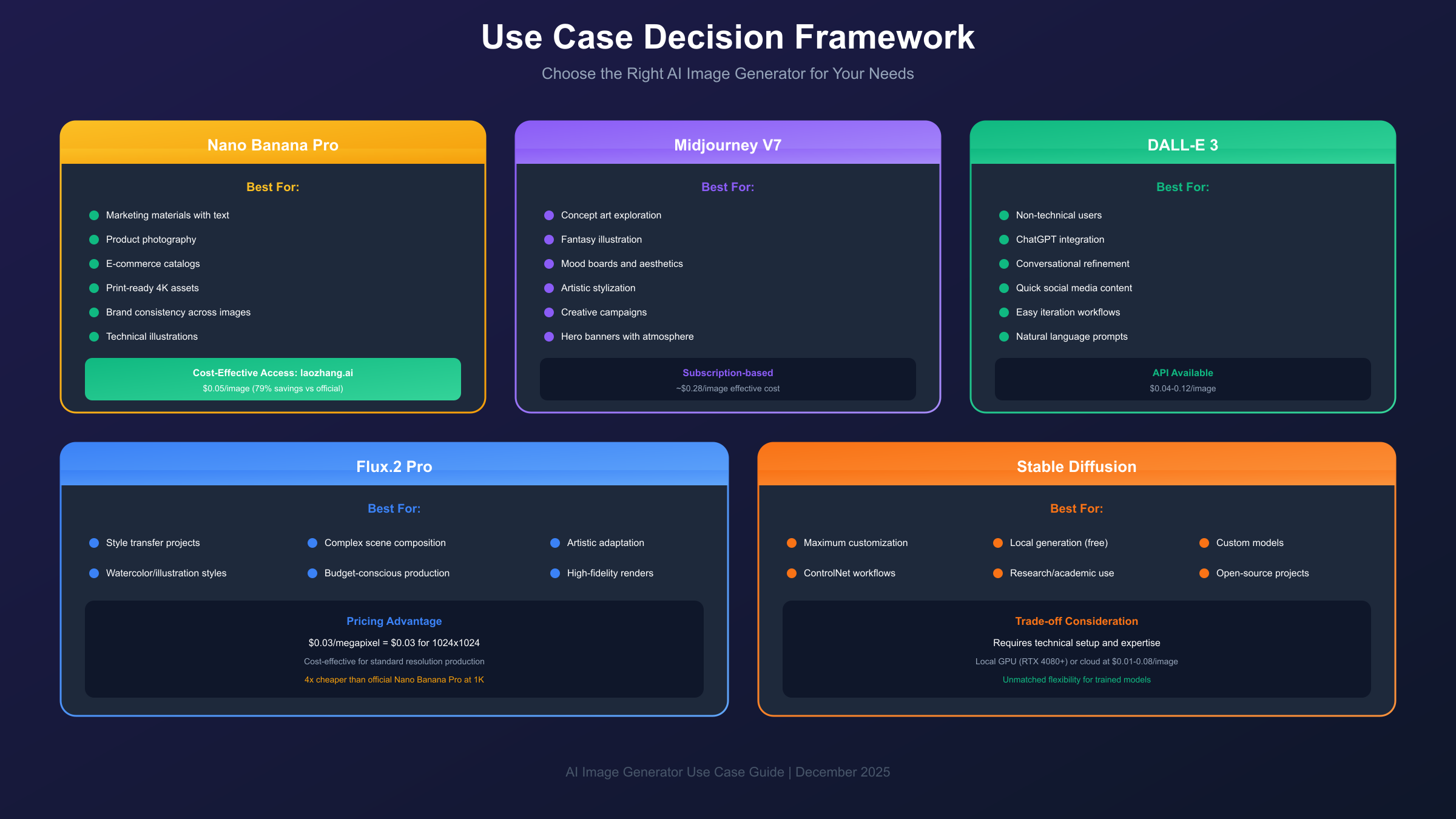
Rather than declaring a single "best" model, matching tools to specific use cases optimizes results and efficiency.
Marketing Materials and Advertising
Nano Banana Pro's text rendering accuracy and 4K resolution make it the clear choice for marketing assets requiring readable copy, product names, or taglines. The model's literal prompt interpretation ensures brand guidelines translate accurately to generated images.
For high-volume marketing production, third-party API access through laozhang.ai reduces per-image costs by 79% while maintaining quality, making scaled content creation economically viable.
Concept Art and Creative Exploration
Midjourney's artistic interpretation adds creative value during ideation phases. Its tendency to push toward stylization, dramatic lighting, and atmospheric effects often sparks directions that literal prompt interpretation wouldn't discover. Use Midjourney for mood boards, initial concepts, and creative exploration.
E-Commerce Product Photography
Nano Banana Pro excels at consistent product imagery with accurate text, pricing displays, and brand elements. Its character consistency across multiple images enables cohesive product catalogs. The model's 95%+ consistency for maintaining subject appearance across edits supports multi-angle product shots and variant generation. Learn the best prompts for Nano Banana Pro to maximize your e-commerce results.
Social Media Content
DALL-E 3's ChatGPT integration provides the fastest path from idea to shareable image for social media managers without technical backgrounds. Conversational refinement eliminates prompt engineering overhead. However, volume creators should consider Nano Banana Pro via third-party providers for cost efficiency at scale.
Technical Illustration and Documentation
Nano Banana Pro's superior prompt adherence makes it ideal for technical content requiring specific diagram layouts, labeled components, or instructional imagery. The model's reasoning capabilities handle complex spatial instructions better than pure generation models.
Artistic Projects and Portfolios
Creative professionals developing distinctive artistic voices should explore Midjourney for its aesthetic qualities and Flux.2 Pro for style transfer capabilities. Nano Banana Pro serves better as a production tool than a creative partner for purely artistic work.
Experimental and Research Applications
Stable Diffusion's open architecture enables research applications, custom model training, and experimental workflows that closed APIs can't support. Academic and research contexts often benefit from the transparency and customization Stable Diffusion provides. For those interested in combining Stable Diffusion with Nano Banana Pro, our ComfyUI integration guide explains the setup process.
Final Verdict: Choosing Your Model
The optimal choice depends on prioritizing your specific requirements across quality, cost, speed, and capability dimensions.
Choose Nano Banana Pro when you need:
- Accurate text rendering in images
- Native 4K resolution without upscaling
- Consistent character representation across multiple images
- Precise prompt adherence for complex compositions
- Production-ready outputs with minimal post-processing
For cost-effective Nano Banana Pro access, laozhang.ai offers 79% savings ($0.05/image) compared to official pricing while maintaining full 4K capability and providing higher rate limits than Google's 10 RPM restriction.
Choose Midjourney when you need:
- Artistic interpretation and stylization
- Dramatic lighting and atmospheric effects
- Concept art and creative exploration
- Distinctive aesthetic quality over accuracy
Choose DALL-E 3 when you need:
- Maximum accessibility without technical knowledge
- Conversational image refinement
- ChatGPT workflow integration
- Quick results without prompt engineering
Choose Flux.2 Pro when you need:
- Style transfer and artistic adaptation
- Complex scene composition
- Cost-effective standard resolution generation
- Technical flexibility with visual fidelity
Choose Stable Diffusion when you need:
- Maximum customization and control
- Local generation without per-image costs
- Custom model training capabilities
- Open-source transparency
Multi-Model Workflow Recommendation
For professional creators, the strategic answer often involves multiple models. A typical workflow might start with Midjourney for initial concept exploration where artistic interpretation adds value, move to Nano Banana Pro for production assets requiring precision and text accuracy, and use Stable Diffusion for specialized tasks requiring custom training.
At combined costs under $100/month for access to all major platforms, the investment in having the right tool for each task typically delivers better results than committing exclusively to any single model. Evaluate your primary use cases, prioritize the model that best serves your most common needs, and expand your toolkit as specific projects demand different capabilities.