Nano Banana Pro Third-Party API Guide 2025: Compare Providers, Pricing & Save 79%
Complete guide to third-party Nano Banana Pro API providers. Compare pricing ($0.05 vs $0.24), reliability, and features. Includes setup code, provider comparison, and decision framework for developers.
Nano Banana Pro
4K-80%Google Gemini 3 Pro · AI Inpainting
谷歌原生模型 · AI智能修图

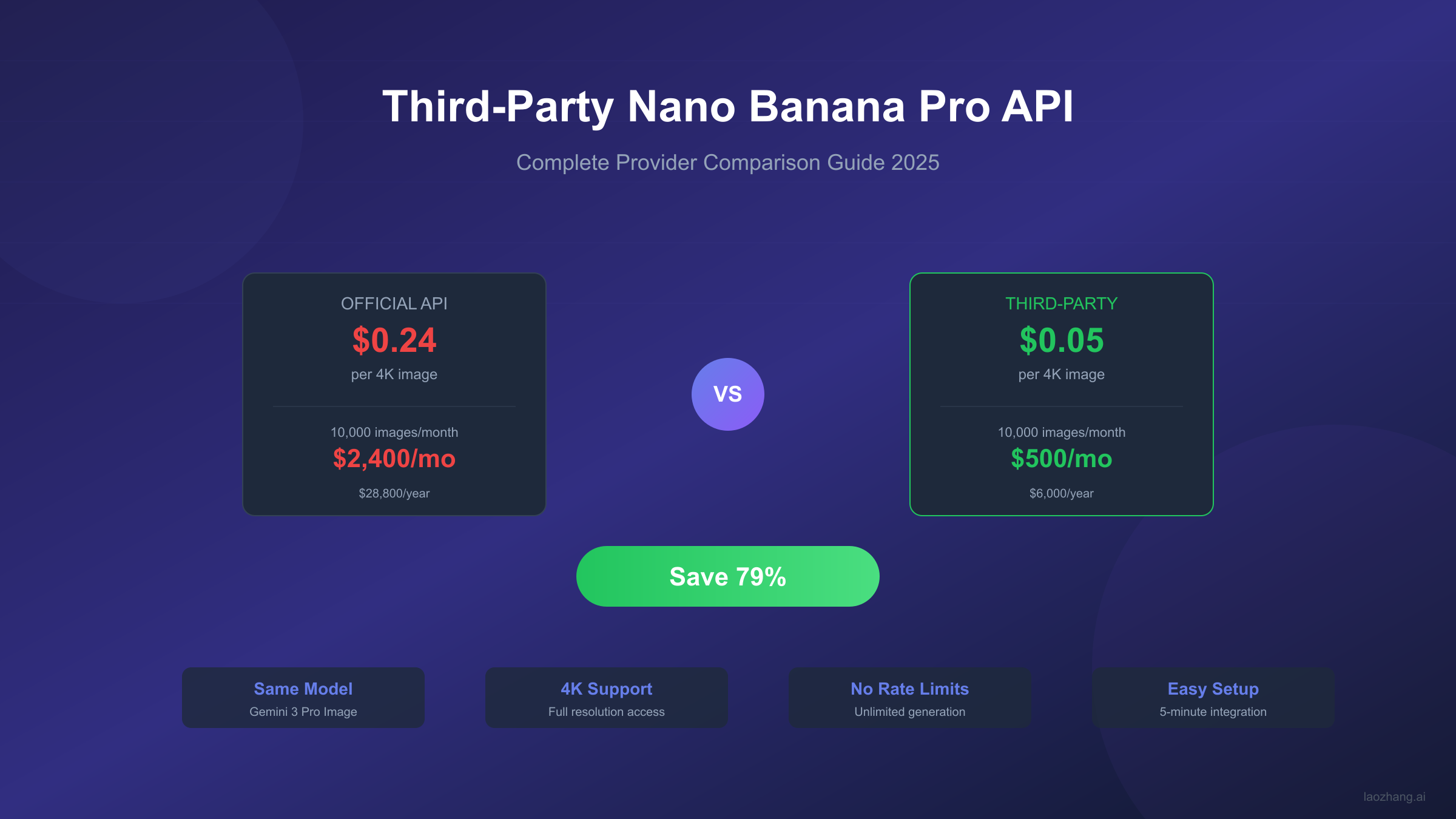
Quick Answer: Third-party Nano Banana Pro API providers offer the same Gemini 3 Pro Image capabilities at 60-79% lower cost than Google's official pricing. While Google charges $0.134-$0.24 per image, legitimate third-party providers offer rates from $0.05-$0.12. This guide compares major providers, explains the technical trade-offs, and helps you choose the right option for your use case.
When Google released Nano Banana Pro (officially Gemini 3 Pro Image) in November 2025, developers gained access to the most advanced AI image generation model available—one capable of accurate text rendering, 4K resolution output, and multi-image fusion. However, the official API pricing of $0.134-$0.24 per image quickly became a barrier for many projects, particularly those requiring high-volume generation.
Third-party API providers emerged to address this gap, offering the same underlying model at significantly reduced rates. But not all third-party options are equal. Some operate as legitimate API forwarding services with proper Google authorization, while others use reverse-engineered access that carries substantial risks. Understanding this distinction is essential before committing to any provider.
This guide provides an objective comparison of third-party Nano Banana Pro API options, including real pricing data, technical considerations, and a decision framework for different use cases. Whether you're building a prototype, scaling a production application, or evaluating options for enterprise deployment, you'll find the information needed to make an informed choice.
What is Nano Banana Pro and Why Consider Third-Party Access
Nano Banana Pro represents Google DeepMind's most advanced image generation technology, built on the Gemini 3 Pro foundation. Released on November 20, 2025, it introduced several breakthrough capabilities that distinguish it from competitors like Midjourney and DALL-E 3.
The model's text rendering accuracy stands as its defining advantage. According to Google's documentation, Nano Banana Pro achieves 94% legibility for generated text across 12 languages—dramatically outperforming DALL-E 3's 78% accuracy, which drops to 31% for non-Latin scripts. This capability makes it particularly valuable for applications requiring readable text in generated images, from marketing materials to UI mockups.
Beyond text rendering, Nano Banana Pro supports native 4K (4096×4096) resolution output, processes up to 14 input images simultaneously, and maintains identity consistency across up to 5 subjects. The model connects to Google Search for real-world grounding, enabling accurate generation of maps, diagrams, and factual content.
However, accessing these capabilities through Google's official API presents several challenges. The pricing—$0.134 per image at standard resolution and $0.24 for 4K—accumulates quickly for high-volume applications. A project generating 10,000 images monthly would face $1,340-$2,400 in API costs before considering other infrastructure expenses. Additionally, developers in certain regions face network accessibility issues, and the Google Cloud billing setup adds administrative overhead for simple API access.
Third-party providers address these friction points by offering pre-negotiated access at volume-discounted rates, simplified billing without Google Cloud accounts, and in some cases, improved network routing for specific geographic regions.
Official API vs Third-Party Providers: Understanding the Trade-offs
Before evaluating specific providers, understanding the fundamental differences between official and third-party access helps set appropriate expectations.
Official Google API Advantages
Google's direct API access provides enterprise-grade reliability with a documented 99.9% availability SLA. You receive direct technical support channels, guaranteed compliance with regulatory requirements, and the stability of dealing with the model's creator. For applications where these factors outweigh cost concerns—particularly enterprise deployments subject to audit requirements—the official API remains the appropriate choice.
The official API also offers the Batch API option at $0.067 per image for standard resolution, providing 50% savings for workflows that can tolerate asynchronous processing with longer completion times.
Third-Party Provider Advantages
Legitimate third-party providers operate as authorized API forwarding services, accessing Nano Banana Pro through proper Google Cloud agreements while offering several benefits. The most significant is cost reduction—providers achieve 50-79% savings by aggregating volume across many customers to negotiate enterprise-tier pricing with Google.
Additional benefits include simplified billing (pay-as-you-go without Google Cloud setup), unified interfaces for accessing multiple AI models, and potentially better network routing for specific regions. For development, prototyping, and cost-sensitive production applications, these advantages often outweigh the trade-offs.
Critical Distinction: Forwarding vs Reverse APIs
Not all third-party access is equivalent. Legitimate forwarding services maintain proper Google authorization and provide the full API feature set without watermarks or restrictions. Reverse-engineered APIs, by contrast, simulate the Google web interface through browser automation, violating Google's Terms of Service and introducing significant risks.
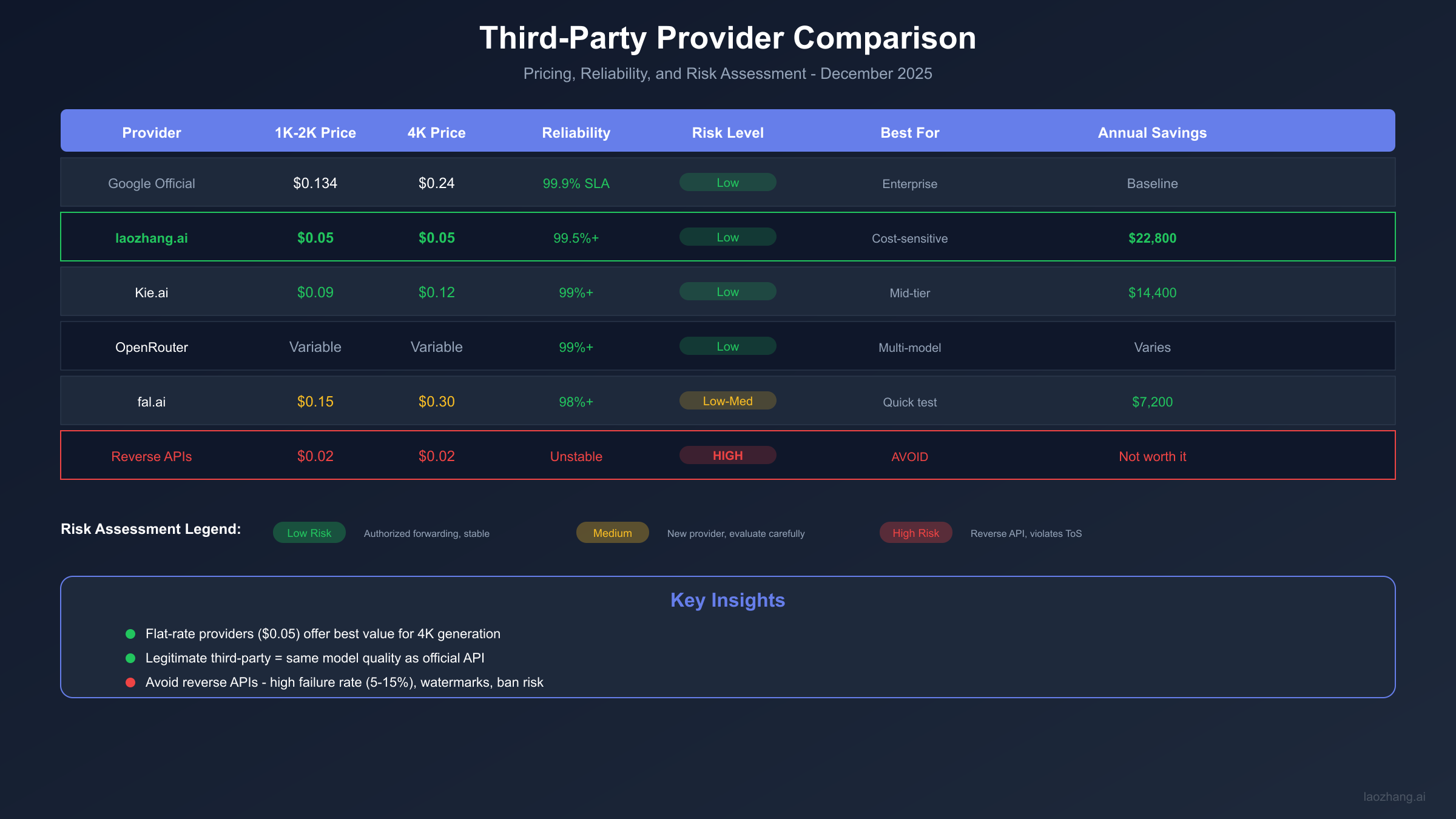
According to an industry analysis, reverse APIs typically show 5-15% error rates versus less than 1% for official forwarding, support fewer than 10 concurrent requests versus 100+, and carry high probability of account bans. The initial cost savings from reverse APIs rarely justify these operational risks.
| Aspect | Official Google | Legitimate Third-Party | Reverse API |
|---|---|---|---|
| Authorization | Direct | Google-authorized | Unauthorized |
| Reliability | 99.9% SLA | 99.5%+ typical | Unstable |
| Error Rate | <1% | <2% | 5-15% |
| Concurrent Requests | 100+ | 100+ | <10 |
| Watermarks | None | None | Possible |
| Long-term Viability | Guaranteed | Stable | Uncertain |
Third-Party Provider Comparison: Objective Evaluation
Several providers offer third-party access to Nano Banana Pro, each with distinct positioning. The following comparison uses publicly available pricing and feature information as of December 2025.
Provider Overview
The third-party ecosystem includes API aggregators (platforms offering access to multiple AI models), specialized image API providers, and general AI infrastructure services. Each category presents different trade-offs between pricing, features, and operational overhead.
OpenRouter operates as a neutral aggregator, routing requests to various AI models including Nano Banana Pro through Google Vertex. Their pricing follows a per-token model ($2/M input, $12/M output) plus image output costs, making total per-image pricing variable based on prompt complexity. OpenRouter's primary value lies in unified access across model providers rather than aggressive cost optimization.
Kie.ai positions as a cost-effective alternative with dedicated Nano Banana Pro support. Their published pricing of $0.09 for 1K-2K images and $0.12 for 4K represents approximately 33-50% savings versus Google's standard API. The platform emphasizes 24/7 technical support and playground testing capabilities.
For developers in China or those prioritizing the lowest flat-rate pricing, laozhang.ai offers Nano Banana Pro access at $0.05 per image regardless of resolution—representing 63-79% savings versus Google's official pricing. The platform supports both OpenAI-compatible endpoints and Gemini native format, with the latter enabling full 4K parameter configuration. This pricing structure proves particularly advantageous for 4K generation, where Google's official rate ($0.24) makes the savings more pronounced.
Other providers including fal.ai ($0.15-$0.30), Replicate ($0.14-$0.24), and CometAPI serve various niches with different pricing models and feature sets.
Detailed Provider Comparison
| Provider | 1K-2K Price | 4K Price | API Format | Key Advantage | Limitation |
|---|---|---|---|---|---|
| Google Official | $0.134 | $0.24 | Gemini | Enterprise SLA | Highest cost |
| Google Batch | $0.067 | $0.12 | Gemini | 50% savings | Async only |
| laozhang.ai | $0.05 | $0.05 | Gemini + OpenAI | Flat rate, lowest cost | No official Google support |
| Kie.ai | $0.09 | $0.12 | REST | Good support | Mid-tier pricing |
| OpenRouter | Variable | Variable | Multi-format | Provider flexibility | Complex pricing |
| fal.ai | $0.15 | $0.30 | Custom | Quick playground | Higher cost |
| Replicate | $0.14 | $0.24 | REST | Developer tools | No savings for 4K |
The flat-rate pricing model used by some providers—where 4K generation costs the same as 1K—creates significant value for applications requiring high-resolution output. For a project generating 5,000 4K images monthly, the annual cost difference between Google official ($14,400) and a flat-rate provider at $0.05 ($3,000) exceeds $11,000.
Pricing Analysis: Real-World Cost Calculations
Understanding true costs requires looking beyond per-image rates to consider total operational expenses across different usage scenarios.
Scenario 1: Development and Prototyping
For developers building proof-of-concepts or testing integrations, usage typically stays under 1,000 images monthly. At this scale, the per-image cost difference matters less than setup friction and free tier availability.
Google offers 500 free images daily through AI Studio for development purposes, making it cost-effective for pure experimentation. However, exceeding this limit or requiring production-grade reliability shifts the calculation toward third-party options with simpler billing.
Monthly cost at 500 images/month:
- Google (within free tier): $0
- Third-party at $0.05: $25
Scenario 2: Small-Scale Production
Applications generating 5,000-10,000 images monthly represent typical small-scale production loads—enough to justify careful cost optimization while not requiring enterprise agreements.
Monthly cost at 10,000 images (mixed resolution):
- Google Official: ~$1,800 (assuming 50% 4K)
- Google Batch: ~$900 (if async acceptable)
- Third-party at $0.05: $500
Annual savings with third-party: ~$15,600
Scenario 3: High-Volume Production
At 50,000+ images monthly, third-party providers offer the most dramatic savings, though enterprise considerations around support and SLAs become more relevant.
Monthly cost at 50,000 images (4K):
- Google Official: $12,000
- Third-party at $0.05: $2,500
Annual savings: $114,000
At this scale, the savings justify serious evaluation—but also warrant direct conversations with providers about SLAs, support response times, and business continuity guarantees.
Setup Guide: Getting Started with Third-Party Access
Setting up third-party Nano Banana Pro access typically takes under 10 minutes. The following walkthrough covers the general process applicable across most providers, with specific examples for common integration patterns.
Step 1: Account Creation and API Key
Most third-party providers offer email-based registration with instant API key generation. The key typically follows a format like sk-xxx... or provider-specific prefixes. Store this key securely—treat it like a password, use environment variables rather than hardcoding, and rotate periodically for production applications.
Step 2: Endpoint Configuration
Third-party providers generally offer one or both of two API formats:
Gemini Native Format: Provides full feature access including 4K resolution parameters, aspect ratio controls, and advanced generation config. The endpoint typically follows Google's API structure but routes through the provider's domain.
OpenAI-Compatible Format: Allows using existing OpenAI SDK code with minimal changes—just swap the base URL and use the provider's API key. Some advanced Gemini-specific features may not be available in this compatibility mode.
Step 3: First Request
For Gemini native format supporting full 4K capabilities:
hljs pythonimport requests
import base64
API_KEY = "sk-YOUR_API_KEY" # From your provider
API_URL = "https://api.laozhang.ai/v1beta/models/gemini-3-pro-image-preview:generateContent"
headers = {
"Authorization": f"Bearer {API_KEY}",
"Content-Type": "application/json"
}
payload = {
"contents": [{
"parts": [{"text": "A professional product photo of a smartphone on a marble surface, studio lighting, 4K quality"}]
}],
"generationConfig": {
"responseModalities": ["IMAGE"],
"imageConfig": {
"aspectRatio": "1:1",
"imageSize": "4K"
}
}
}
response = requests.post(API_URL, headers=headers, json=payload, timeout=180)
result = response.json()
# Extract and save the base64 image
if "candidates" in result:
image_data = result["candidates"][0]["content"]["parts"][0]["inlineData"]["data"]
with open("output.png", "wb") as f:
f.write(base64.b64decode(image_data))
print("Image saved successfully")
For OpenAI-compatible format (simpler but fewer features):
hljs pythonfrom openai import OpenAI
client = OpenAI(
api_key="sk-YOUR_API_KEY",
base_url="https://api.laozhang.ai/v1" # Provider's OpenAI-compatible endpoint
)
response = client.images.generate(
model="gemini-3-pro-image-preview",
prompt="A professional product photo of a smartphone on a marble surface",
size="1024x1024",
n=1
)
print(response.data[0].url)
Step 4: Error Handling
Production implementations should handle common failure modes:
hljs pythonimport time
from requests.exceptions import Timeout, RequestException
def generate_with_retry(prompt, max_retries=3):
for attempt in range(max_retries):
try:
response = requests.post(
API_URL,
headers=headers,
json={"contents": [{"parts": [{"text": prompt}]}]},
timeout=180
)
response.raise_for_status()
return response.json()
except Timeout:
print(f"Timeout on attempt {attempt + 1}, retrying...")
time.sleep(2 ** attempt) # Exponential backoff
except RequestException as e:
print(f"Request failed: {e}")
if attempt == max_retries - 1:
raise
return None
Code Examples for Common Integration Patterns
Beyond basic generation, production applications often require more sophisticated integration patterns. The following examples address common requirements.
Batch Processing with Rate Limiting
When processing multiple images, respect rate limits while maximizing throughput:
hljs pythonimport asyncio
import aiohttp
from asyncio import Semaphore
async def generate_image(session, semaphore, prompt):
async with semaphore: # Limit concurrent requests
async with session.post(
API_URL,
headers=headers,
json={"contents": [{"parts": [{"text": prompt}]}]},
timeout=aiohttp.ClientTimeout(total=180)
) as response:
return await response.json()
async def batch_generate(prompts, max_concurrent=5):
semaphore = Semaphore(max_concurrent)
async with aiohttp.ClientSession() as session:
tasks = [generate_image(session, semaphore, p) for p in prompts]
return await asyncio.gather(*tasks, return_exceptions=True)
# Usage
prompts = ["sunset over mountains", "city at night", "forest path"]
results = asyncio.run(batch_generate(prompts))
Image Editing with Reference Input
Nano Banana Pro's multi-image input capability enables editing workflows:
hljs pythonimport base64
from pathlib import Path
def edit_image(reference_path, edit_instruction):
# Load reference image
with open(reference_path, "rb") as f:
ref_b64 = base64.b64encode(f.read()).decode()
payload = {
"contents": [{
"parts": [
{"inlineData": {"mimeType": "image/png", "data": ref_b64}},
{"text": edit_instruction}
]
}],
"generationConfig": {
"responseModalities": ["IMAGE"]
}
}
response = requests.post(API_URL, headers=headers, json=payload, timeout=180)
return response.json()
# Example: Change background
result = edit_image("product.png", "Replace the background with a clean white studio setting")
Risk Assessment: Choosing Wisely
Not all third-party access carries equal risk. Understanding the risk spectrum helps make appropriate choices for different use cases.
Low-Risk: Legitimate Forwarding Services
Providers operating as authorized Google Cloud resellers or API aggregators present minimal additional risk beyond dealing with an intermediary. Signs of legitimate operation include transparent company information, clear terms of service, established operating history (1+ years), and documented SLA commitments.
These services route requests through proper Google Cloud channels, meaning you receive the full feature set without watermarks or restrictions. The primary trade-off is the lack of direct Google support—issues must go through the provider's support channels.
Medium-Risk: Emerging Providers
Newer providers or those with limited public information require more careful evaluation. Request information about their infrastructure, data handling practices, and business continuity plans. Start with limited usage to assess reliability before committing to production workloads.
High-Risk: Reverse-Engineered APIs
Services offering suspiciously low prices (below $0.02/image) often rely on unauthorized access methods. Beyond the technical instability—high error rates, watermarked outputs, limited concurrency—these services expose users to potential legal liability and sudden service termination.
The cost savings from reverse APIs rarely justify the operational risks. A service failure at a critical moment, or images delivered with unexpected watermarks, creates costs far exceeding the per-image savings.
Best Third-Party Provider for Your Use Case
Different applications have different requirements. The following decision framework matches use cases to appropriate provider choices.
For Startups and Small Teams
Priority: Cost efficiency with acceptable reliability
Recommendation: Third-party providers offering flat-rate pricing around $0.05/image provide the best value. The savings fund additional development resources while reliability remains sufficient for most production applications. Look for providers with proven uptime (99.5%+) and responsive support channels.
For teams based in China or requiring optimized network routing in Asia, laozhang.ai addresses both cost and latency concerns with domestic infrastructure. However, if your application requires official Google support or specific compliance certifications, the official API remains necessary despite higher costs.
For Enterprise Deployments
Priority: Reliability, compliance, support SLAs
Recommendation: The official Google API through Vertex AI provides enterprise-grade guarantees. The 99.9% SLA, compliance certifications (GDPR, CCPA, SOC 2), and direct technical support justify the premium for mission-critical applications. Consider the Batch API ($0.067/image) for workloads tolerating asynchronous processing.
For Prototyping and Development
Priority: Quick setup, minimal friction
Recommendation: Google's free tier (500 images/day through AI Studio) covers most development needs without cost. When you need production-like behavior or higher limits, switch to a third-party provider for testing at minimal expense. Reserve final validation for your production provider choice.
For High-Volume Applications
Priority: Cost at scale, consistent performance
Recommendation: At 50,000+ images monthly, negotiate directly with providers for volume commitments. Many offer additional discounts for committed monthly volumes. Compare total cost including support response time and SLA guarantees—not just per-image pricing.
| Use Case | Recommended Approach | Key Consideration |
|---|---|---|
| Prototype | Google Free Tier | Zero cost, easy setup |
| Startup Production | Third-party ($0.05) | 79% savings, acceptable SLA |
| Enterprise | Google Vertex AI | Compliance, support |
| China-based | laozhang.ai | Network optimization |
| High Volume | Negotiated terms | Volume discounts |
Frequently Asked Questions
Q1: Is using third-party Nano Banana Pro API legal?
Legitimate third-party providers operate as authorized Google Cloud resellers or API aggregators, accessing the model through proper commercial agreements. Using these services is legal and common practice—similar to using AWS Marketplace offerings or other cloud service resellers. However, "reverse-engineered" APIs that bypass Google's authorization violate the Terms of Service and may expose users to legal risk. Always verify that your provider operates through legitimate forwarding rather than unauthorized access.
Q2: Will I get the same image quality from third-party providers?
Yes, for legitimate forwarding services. These providers route requests to the same Gemini 3 Pro Image model that powers Google's official API—the actual image generation happens on Google's infrastructure. You receive identical quality, resolution options (including 4K), and capabilities. The only differences relate to billing, support channels, and potentially network latency based on provider infrastructure.
Q3: What happens if a third-party provider shuts down?
This represents the primary business continuity risk with third-party access. Mitigate by choosing established providers with track records, maintaining the ability to migrate (the API formats are standard), and keeping a documented fallback plan to the official API. For critical applications, consider multi-provider strategies or maintaining inactive official API credentials as backup.
Q4: How do third-party providers offer lower prices?
Third-party providers aggregate usage across many customers, enabling negotiation for Google's enterprise-tier volume pricing. A provider serving 1,000 customers collectively generating 10 million images monthly commands significant negotiating leverage. The savings pass to individual customers while the provider maintains margin through operational efficiency. This model—common across cloud service reselling—benefits both providers and customers.
Q5: Can I switch between third-party providers or back to official?
Yes, migration is straightforward because most providers use standard API formats. For Gemini-native endpoints, switching requires updating the base URL and API key. For OpenAI-compatible endpoints, only the base URL and key change—your existing code works unchanged. Budget 1-2 hours for migration testing to validate behavior matches expectations with the new provider.
Conclusion: Making the Right Choice
Third-party Nano Banana Pro API access offers legitimate, significant cost savings—up to 79% versus official pricing—without sacrificing the model's capabilities. The key is choosing reputable providers that operate through proper authorization rather than risky reverse-engineering approaches.
For most developers, the decision comes down to balancing cost savings against support requirements. Startups and cost-sensitive projects benefit substantially from third-party access, while enterprise deployments may justify official API costs for compliance and support guarantees.
If you're starting a new project with Nano Banana Pro, consider beginning with Google's free tier for initial development, then evaluating third-party options as usage scales. For existing projects seeking cost optimization, third-party migration typically pays for itself within the first month of operation.
The AI image generation landscape continues evolving, with new providers and pricing models emerging regularly. The fundamental comparison framework in this guide—evaluating authorization legitimacy, total cost at your usage scale, and alignment with your reliability requirements—remains applicable regardless of specific provider options.
For detailed implementation examples and the latest provider comparisons, see our related guides on Nano Banana Pro API integration and stable, unlimited API access options.