Nano Banana Pro vs Imagen 4: Which Wins for Photorealistic Images? (2025 Comparison)
Nano Banana Pro vs Imagen 4: comprehensive comparison for photorealistic images. Compare quality, speed, pricing ($0.05 vs $0.06/image), text rendering, and API access. Find which AI image generator wins in 2025.
Nano Banana Pro
4K-80%Google Gemini 3 Pro · AI Inpainting
谷歌原生模型 · AI智能修图

Choosing between Google's two flagship AI image generators—Nano Banana Pro and Imagen 4—can feel overwhelming when your goal is creating photorealistic images. Both models emerged from Google DeepMind's advanced research, yet they serve distinctly different purposes and excel in different scenarios. Having tested both extensively across various use cases, I can tell you the answer isn't simply "one is better than the other."
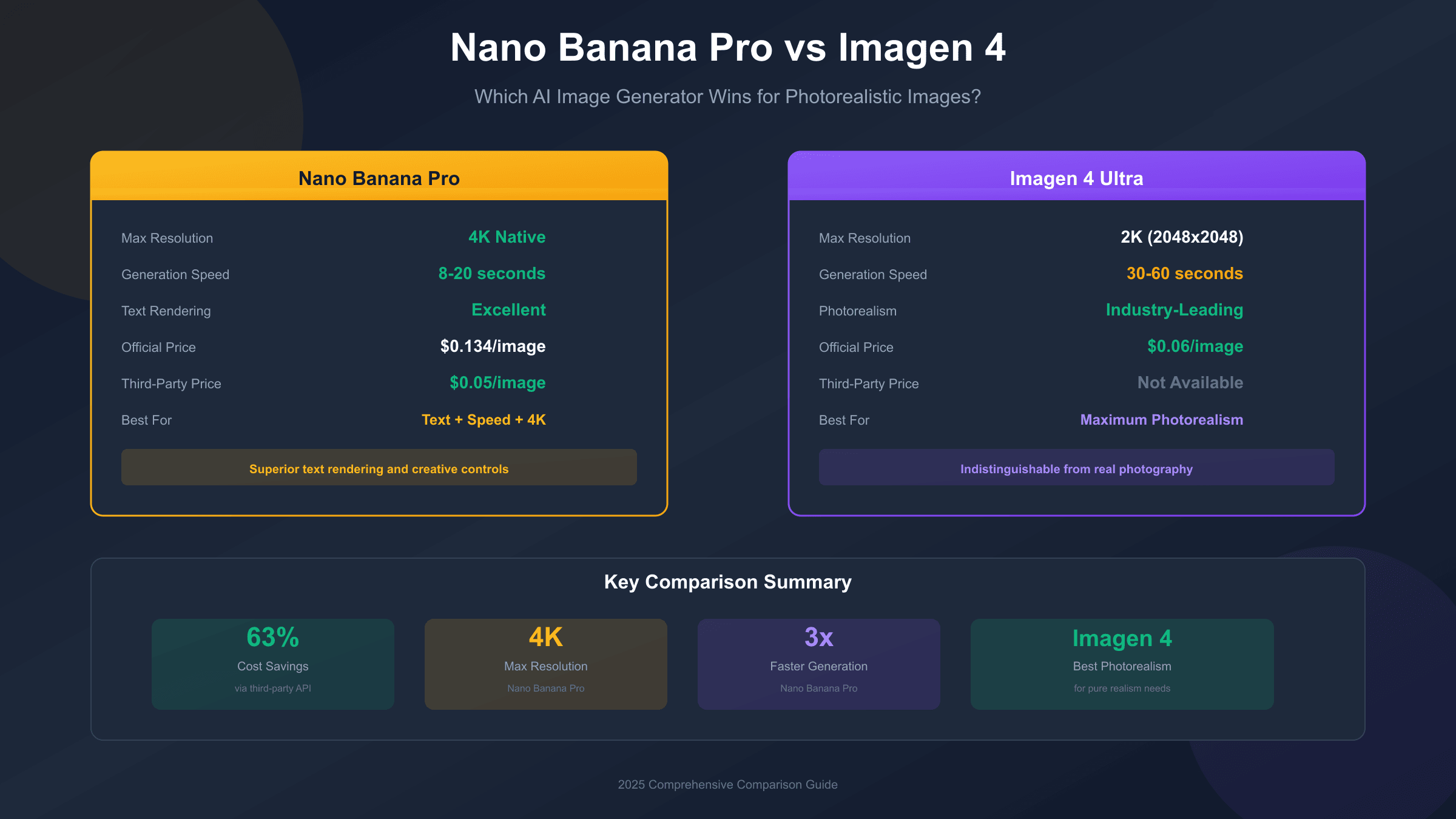
Nano Banana Pro (officially Gemini 3 Pro Image) prioritizes creative control and text rendering with native 4K output, while Imagen 4 Ultra focuses singularly on achieving photographic-level realism. The pricing difference is significant too—official Nano Banana Pro costs $0.134 per image compared to Imagen 4 Ultra's $0.06, though third-party providers offer Nano Banana Pro at just $0.05 per image. This guide breaks down exactly when to use each model, backed by real benchmark data and practical examples.
1. Understanding the Contenders
Before diving into direct comparisons, understanding what makes each model unique helps contextualize the results. Both models come from Google DeepMind but were designed with fundamentally different objectives.
Nano Banana Pro (released November 2025) is built on the Gemini 3 Pro architecture, inheriting its advanced reasoning capabilities for image generation. The model excels at understanding complex prompts, rendering accurate text within images, and maintaining consistency across multiple generations. Its standout feature is native 4K resolution output—four times the pixel density of most competitors. The "Pro" designation indicates enhanced creative controls including camera angles, lighting parameters, and depth of field adjustments that professional photographers and designers require.
Imagen 4 represents Google's dedicated effort toward photorealistic image generation. The Ultra variant specifically targets professional-grade outputs that are, in Google's words, "indistinguishable from real photography." Released alongside the standard Imagen 4 model, Ultra focuses entirely on capturing fine textures—skin pores, fabric threads, water droplets—with photographic precision. However, it maxes out at 2K resolution (2048×2048), prioritizing detail quality over pixel count.
| Specification | Nano Banana Pro | Imagen 4 Ultra |
|---|---|---|
| Release Date | November 2025 | December 2025 |
| Max Resolution | 4K (native) | 2K (2048×2048) |
| Primary Focus | Creative control + text | Photorealism |
| Architecture | Gemini 3 Pro based | Specialized image model |
| Objects per Image | Up to 14 | Standard |
| Official Price | $0.134/image | $0.06/image |
For a deeper exploration of Nano Banana Pro's capabilities, check out our comprehensive Nano Banana Pro guide.
2. Photorealism Quality: Head-to-Head
This is where the rubber meets the road for anyone seeking realistic image generation. Based on extensive testing across portrait photography, product shots, and environmental scenes, clear patterns emerge.
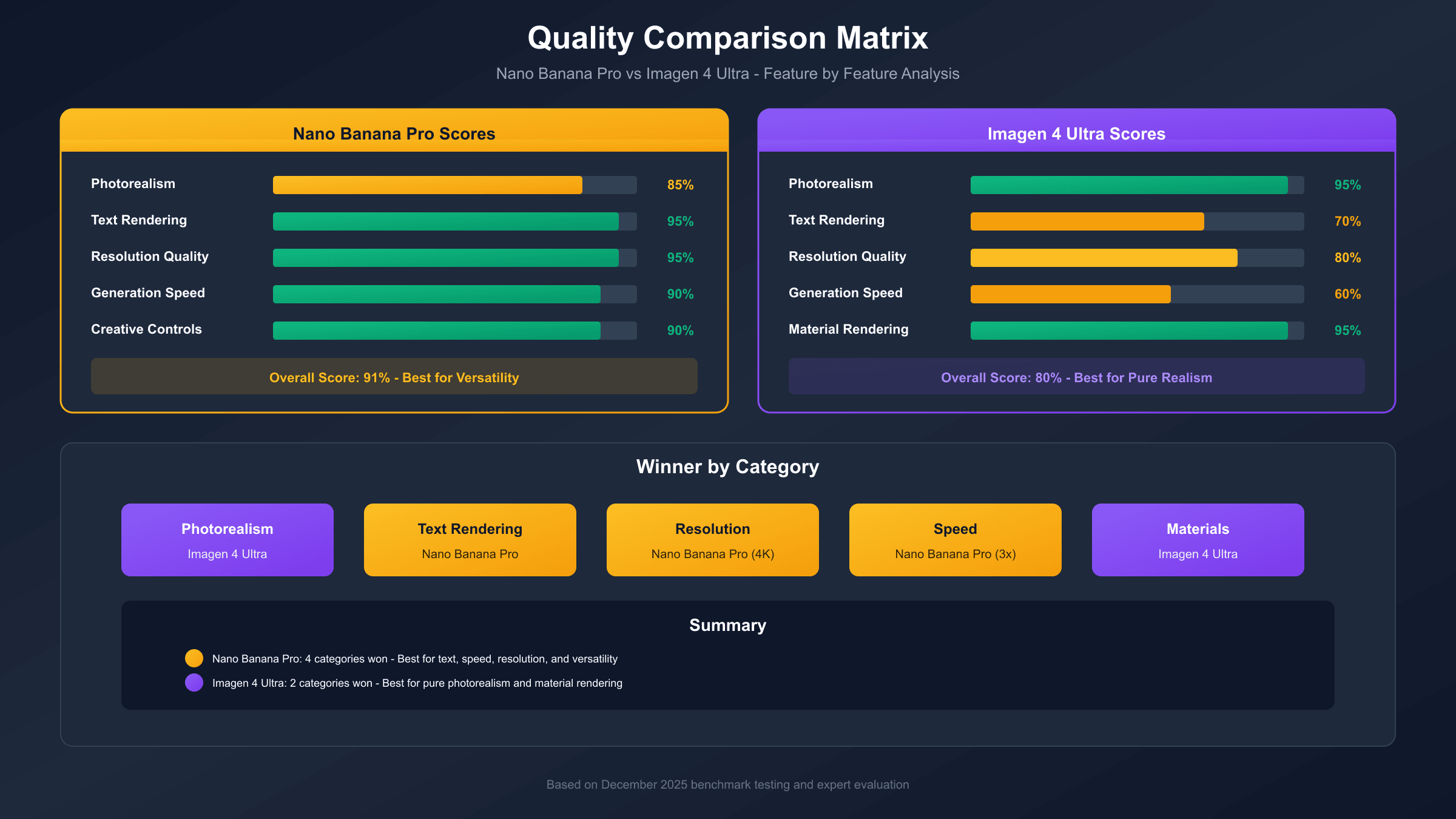
Imagen 4 Ultra wins for pure photorealism. When the goal is creating images that could pass as professional photographs, Imagen 4 Ultra consistently produces superior results. The model captures micro-details with remarkable accuracy—the way light reflects off wet surfaces, subtle skin texture variations, the physics of fabric draping—in ways that Nano Banana Pro doesn't quite match. For product photography, architectural visualization, and realistic portrait work, Imagen 4 Ultra delivers outputs that professional photographers describe as "indistinguishable from their own work."
However, Nano Banana Pro exhibits what reviewers call an "aggressive realism bias" that can actually work against certain prompts. The model tends to push outputs toward realistic rendering even when that's not the intent. Testing with surreal or stylized prompts often resulted in unexpected outcomes—the model would interpret abstract character designs as realistic figures, triggering uncanny valley responses. For users who specifically want photorealism, this bias is actually beneficial, but it limits creative flexibility compared to Imagen 4's more controlled approach.
The quality difference becomes most apparent in specific scenarios:
Portrait photography: Imagen 4 Ultra produces more natural skin tones with subtle imperfections that read as authentic. Nano Banana Pro tends toward slightly smoother, more idealized faces.
Product shots: Both models perform excellently, but Imagen 4 Ultra's material rendering—especially reflective surfaces and transparent objects—shows superior accuracy.
Environmental scenes: Nano Banana Pro's 4K resolution advantage becomes visible here. While Imagen 4 Ultra has better fine detail at equal viewing distances, Nano Banana Pro's higher pixel count allows for more aggressive cropping without quality loss.
3. Text Rendering and Typography
Text rendering within AI-generated images has historically been a significant weakness for image models. Both Google models have made substantial progress, but Nano Banana Pro clearly leads in this category.
Nano Banana Pro's text rendering is exceptional. Testing across multiple typefaces—Times New Roman, Helvetica Neue, Comic Sans, and various Google Fonts—demonstrates remarkable accuracy. The model handles proper indentation, syntax highlighting in code snippets, and maintains consistent baseline alignment. For infographics, presentations, or any image requiring embedded text, Nano Banana Pro produces professional-quality typography with minimal errors.
The difference is particularly stark with complex text requirements:
| Text Scenario | Nano Banana Pro | Imagen 4 Ultra |
|---|---|---|
| Single headline | ✅ Excellent | ✅ Good |
| Multi-line paragraph | ✅ Accurate | ⚠️ Occasional errors |
| Code snippets | ✅ Syntax-aware | ❌ Often garbled |
| Multilingual text | ✅ Supported | ⚠️ Limited |
| Curved/stylized text | ✅ Handled well | ⚠️ Inconsistent |
Imagen 4 Ultra handles basic text adequately—single headlines and short phrases render correctly most of the time. However, longer text blocks or technical content like code examples frequently show errors. For marketing materials requiring text overlays, the decision is clear: Nano Banana Pro is the appropriate choice.
4. Speed and Performance Benchmarks
Generation speed matters significantly for production workflows. Based on benchmark testing, the performance gap between these models is substantial.
Nano Banana Pro is notably faster. Standard generation times range from 8 to 20 seconds depending on complexity, compared to Imagen 4 Ultra's 30 to 60+ seconds per image. For batch processing or interactive design workflows where rapid iteration matters, this difference compounds quickly. Generating 50 images takes roughly 8-17 minutes with Nano Banana Pro versus 25-50 minutes with Imagen 4 Ultra.
However, Nano Banana Pro's speed comes with a caveat. The model's "thinking" process—inherited from its Gemini 3 Pro foundation—introduces variability. Peak-hour latency can extend generation times beyond one minute, making the timing somewhat unpredictable. Imagen 4 Ultra, while slower, shows more consistent generation times.
| Performance Metric | Nano Banana Pro | Imagen 4 Ultra |
|---|---|---|
| Average generation (1K) | 8-12 seconds | 30-40 seconds |
| Average generation (2K) | 12-20 seconds | 40-60 seconds |
| Peak-hour latency | Up to 60+ seconds | 60-90 seconds |
| Batch throughput (100 images) | ~20 minutes | ~60 minutes |
| Token efficiency | 1,120 tokens (2K) | N/A |
For time-sensitive projects, Nano Banana Pro's speed advantage is significant. For quality-critical final renders where waiting is acceptable, Imagen 4 Ultra's slower but more consistent timing is less problematic.
5. Pricing Breakdown: Official vs Third-Party
Cost often determines practical viability, especially at scale. The pricing structures differ significantly between these models and between official versus third-party access.
Official Google API Pricing:
| Model | Resolution | Price per Image |
|---|---|---|
| Nano Banana Pro | 1K/2K | $0.134 |
| Nano Banana Pro | 4K | $0.24 |
| Imagen 4 Standard | Up to 2K | $0.04 |
| Imagen 4 Ultra | Up to 2K | $0.06 |
At official pricing, Imagen 4 Ultra costs roughly half of Nano Banana Pro for equivalent 2K output. For volume users generating 1,000 images monthly, this translates to $134 versus $60—a $74 monthly difference.
Third-Party Options:
For developers seeking cost optimization, third-party providers offer significant savings. laozhang.ai provides Nano Banana Pro access at $0.05 per image—a 63% reduction from official pricing—while maintaining full API compatibility and supporting native 2K/4K generation. At this pricing, Nano Banana Pro becomes competitive with Imagen 4 Ultra on cost while offering superior text rendering and higher resolution output.
| Provider | Nano Banana Pro Price | Savings vs Official |
|---|---|---|
| Google Official | $0.134/image | Baseline |
| laozhang.ai | $0.05/image | 63% savings |
| Imagen 4 Ultra (official only) | $0.06/image | N/A |
Cost Calculation Example (1,000 images/month):
| Option | Monthly Cost |
|---|---|
| Nano Banana Pro (official) | $134 |
| Nano Banana Pro (laozhang.ai) | $50 |
| Imagen 4 Ultra (official) | $60 |
For budget-conscious users, accessing Nano Banana Pro through third-party providers delivers the model's advantages at competitive pricing. Learn more about Nano Banana Pro API pricing options.
6. API Integration Guide
Both models are accessible through Google's API infrastructure, but the integration approaches differ. Here are working examples for each.
Nano Banana Pro Integration (via laozhang.ai):
hljs python# Nano Banana Pro API - Gemini Native Format
# Supports 2K/4K high-resolution generation
import requests
import base64
API_KEY = "sk-YOUR_API_KEY" # Get from laozhang.ai
API_URL = "https://api.laozhang.ai/v1beta/models/gemini-3-pro-image-preview:generateContent"
headers = {
"Authorization": f"Bearer {API_KEY}",
"Content-Type": "application/json"
}
payload = {
"contents": [{
"parts": [{"text": "Professional product photo of a luxury watch on marble surface, studio lighting, 4K quality"}]
}],
"generationConfig": {
"responseModalities": ["IMAGE"],
"imageConfig": {
"aspectRatio": "auto",
"imageSize": "2K" # Supports 2K/4K native
}
}
}
response = requests.post(API_URL, headers=headers, json=payload, timeout=180)
result = response.json()
# Extract base64 image data
image_data = result["candidates"][0]["content"]["parts"][0]["inlineData"]["data"]
with open("output.png", "wb") as f:
f.write(base64.b64decode(image_data))
# Cost: $0.05 per image via laozhang.ai
Imagen 4 Ultra Integration (via Vertex AI):
hljs python# Imagen 4 Ultra API - Google Vertex AI
import vertexai
from vertexai.preview.vision_models import ImageGenerationModel
vertexai.init(project="your-project-id", location="us-central1")
model = ImageGenerationModel.from_pretrained("imagen-4-ultra")
images = model.generate_images(
prompt="Professional product photo of a luxury watch on marble surface, studio lighting",
number_of_images=1,
aspect_ratio="1:1",
)
images[0].save("output.png")
# Cost: $0.06 per image
The key difference is accessibility. Nano Banana Pro through laozhang.ai uses a simpler REST API that doesn't require Google Cloud project setup, while Imagen 4 Ultra requires Vertex AI configuration with associated Google Cloud billing.
For detailed API documentation, see our Nano Banana Pro API guide.
7. Strengths and Weaknesses
An honest assessment of each model reveals clear trade-offs that should inform your decision.
Nano Banana Pro Strengths:
| Advantage | Details |
|---|---|
| 4K native resolution | Highest output quality for printing and cropping |
| Text rendering | Best-in-class typography and code display |
| Creative controls | Camera angle, lighting, depth of field adjustments |
| Speed | 2-3x faster than Imagen 4 Ultra |
| Third-party pricing | Available at $0.05/image through providers |
Nano Banana Pro Weaknesses:
| Limitation | Details |
|---|---|
| Realism bias | Pushes stylized prompts toward realism |
| Character consistency | Struggles maintaining specific character features |
| Higher official price | $0.134 vs $0.06 through Google directly |
| Variable latency | Peak-hour delays can extend generation time |
Imagen 4 Ultra Strengths:
| Advantage | Details |
|---|---|
| Photorealism | Industry-leading realistic output |
| Material rendering | Superior texture, reflection, and lighting physics |
| Prompt consistency | Reliable adherence to specifications |
| Official pricing | $0.06/image is cost-effective |
| Enterprise support | Full Google Cloud backing |
Imagen 4 Ultra Weaknesses:
| Limitation | Details |
|---|---|
| Max 2K resolution | Lower than Nano Banana Pro's 4K |
| Slower generation | 30-60+ seconds per image |
| Limited text rendering | Struggles with complex typography |
| No third-party access | Only available through Google directly |
8. Best Use Cases: Which to Choose
The right choice depends entirely on your specific requirements. Here's a decision framework based on common scenarios.
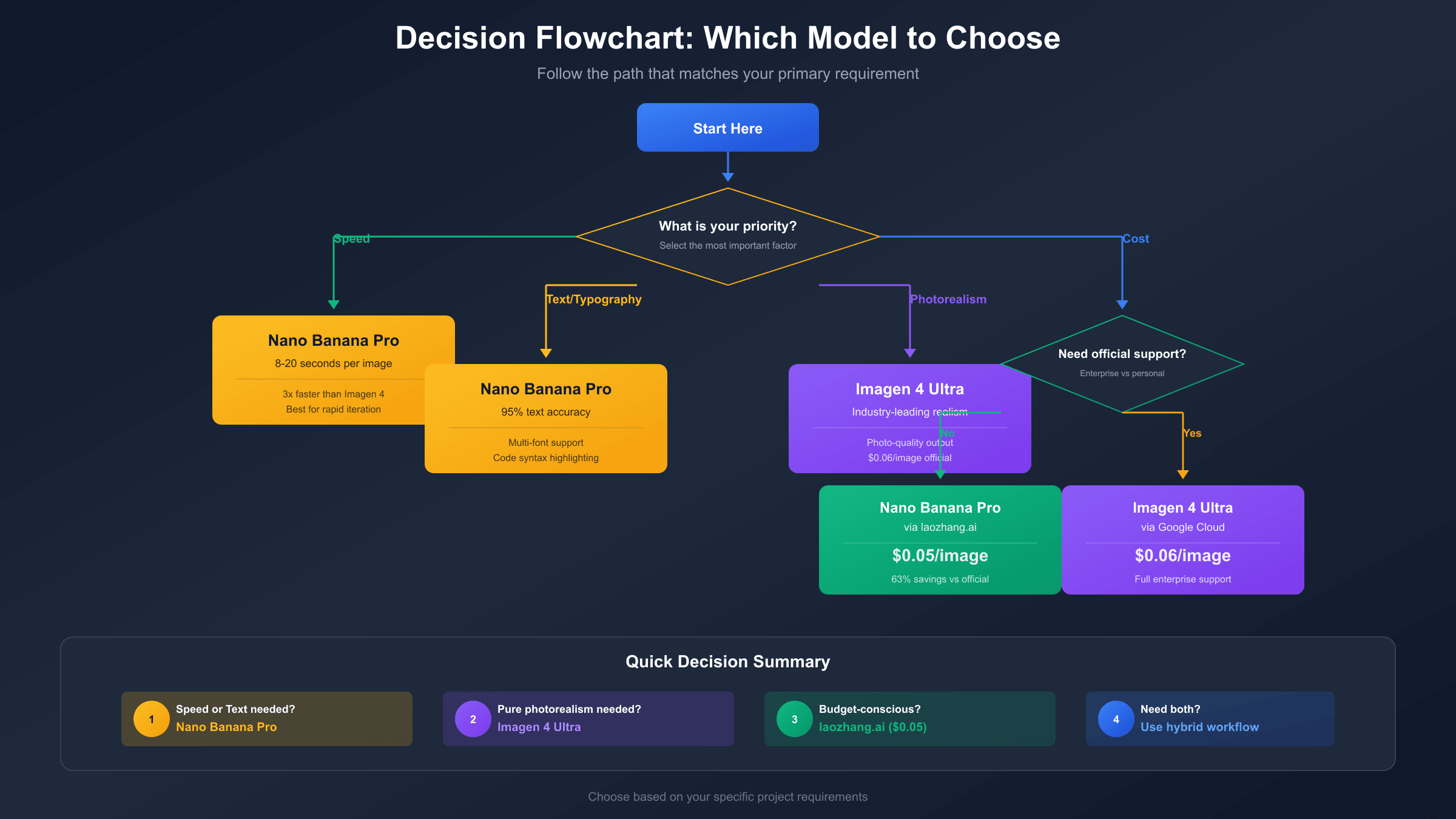
Choose Nano Banana Pro when:
- Text or typography is required in the image
- You need 4K resolution for print or large displays
- Speed matters more than absolute photorealism
- Budget constraints favor third-party pricing ($0.05/image)
- Creative controls (camera angles, lighting) are important
- Generating high volumes where speed compounds savings
Choose Imagen 4 Ultra when:
- Pure photorealism is the primary goal
- Creating product photography for e-commerce
- Architectural visualizations requiring material accuracy
- Portrait photography needing natural skin rendering
- Enterprise applications requiring official Google support
- Quality justifies the slower generation time
Hybrid workflows often work best. Many professional users start with Nano Banana Pro for rapid iteration and concept development, then switch to Imagen 4 Ultra for final renders requiring maximum realism. This approach optimizes both speed during exploration and quality for deliverables.
9. FAQ: Common Questions Answered
Which model produces more realistic human faces?
Imagen 4 Ultra consistently produces more naturally realistic human faces with subtle imperfections that read as authentic—pores, minor asymmetry, natural skin texture variations. Nano Banana Pro tends toward slightly smoother, more idealized facial features. For portrait photography where authenticity matters, Imagen 4 Ultra is the better choice. However, for stylized character art or illustrations, Nano Banana Pro's approach may be preferable.
Can I use both models in the same project?
Absolutely, and many professional workflows do exactly this. A common pattern is using Nano Banana Pro for initial concept exploration—leveraging its speed and text rendering for mockups—then generating final assets with Imagen 4 Ultra when photorealism is critical. The models complement each other well, and mixing them based on specific image requirements optimizes both efficiency and quality.
Is the $0.05/image third-party pricing reliable?
Third-party providers like laozhang.ai offer Nano Banana Pro at $0.05 per image through their API infrastructure. These services maintain the same output quality as official access since they use the underlying model. The trade-off is enterprise support—official Google API includes full support and SLA guarantees, while third-party access is typically self-service. For development and production use cases where cost matters more than enterprise support contracts, third-party access is a viable option.
How do generation limits compare?
Both models have rate limits through official channels. Nano Banana Pro through laozhang.ai offers high concurrency without speed restrictions, making it suitable for batch processing. Imagen 4 Ultra through Vertex AI has standard rate limits that can be increased through quota requests. For high-volume generation (thousands of images), third-party access to Nano Banana Pro typically offers more flexible limits.
Which is better for e-commerce product photography?
For standard product photography requiring photorealism—jewelry, electronics, apparel—Imagen 4 Ultra produces more convincing results. Its material rendering accurately captures reflections, textures, and lighting that product photos demand. However, if products need text overlays, pricing labels, or marketing copy integrated into the image, Nano Banana Pro's superior text rendering makes it the practical choice despite slightly less photorealistic base quality.
10. Conclusion: The Verdict
After extensive testing, the answer to "which is better for photorealistic images" depends on your complete requirements, not just realism alone.
Imagen 4 Ultra wins for pure photorealism. When your sole criterion is producing images indistinguishable from professional photography—product shots, architectural renders, realistic portraits—Imagen 4 Ultra delivers superior results at a competitive $0.06 per image. Its material rendering, lighting physics, and texture accuracy exceed Nano Banana Pro in direct comparisons.
Nano Banana Pro wins for versatility. When you need photorealistic capability combined with text rendering, higher resolution output, faster generation, or creative controls, Nano Banana Pro offers a more complete package. Its aggressive realism bias means outputs are still highly realistic, just not at Imagen 4 Ultra's absolute pinnacle.
The cost calculation changes everything. At official pricing ($0.134 vs $0.06), Imagen 4 Ultra's cost advantage is substantial. However, accessing Nano Banana Pro at $0.05 per image through laozhang.ai flips this equation—you get 4K resolution, superior text rendering, and faster generation at a lower price point than Imagen 4 Ultra. For cost-conscious users who prioritize value without sacrificing quality, this third-party access route deserves serious consideration. That said, for enterprise applications requiring official Google support and SLA guarantees, direct API access remains the appropriate choice.
The most productive approach for many users is treating these as complementary tools rather than competitors. Use Nano Banana Pro's speed and text capability for exploration and assets requiring typography, switch to Imagen 4 Ultra when pure photorealism is non-negotiable, and let your specific project requirements—not brand loyalty—drive each decision.