Sora 2 Third-Party API Pricing: Save 50-95% vs Official OpenAI Costs (2026)
Complete guide to Sora 2 third-party API pricing. Compare providers like laozhang.ai, Kie.ai, and APIyi offering 50-95% savings vs official OpenAI rates. Includes cost calculations and provider selection guide.
Nano Banana Pro
4K-80%Google Gemini 3 Pro · AI Inpainting
谷歌原生模型 · AI智能修图

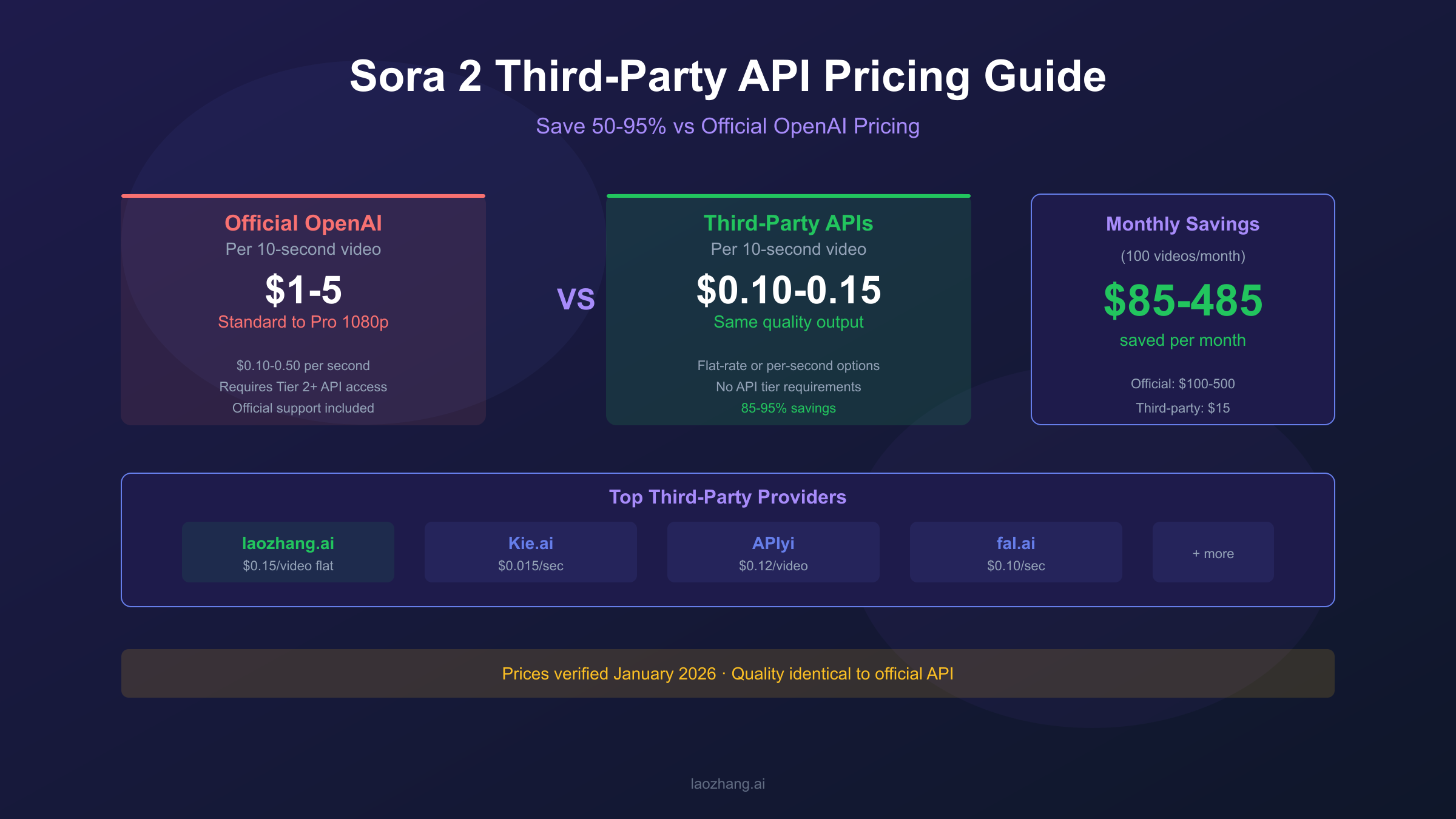
OpenAI's Sora 2 API opens up powerful video generation capabilities for developers, but the official pricing can quickly add up for production use. A single 10-second video costs $1-5 through official channels, making large-scale video generation expensive.
Third-party Sora 2 API providers offer 50-95% cost savings compared to official OpenAI pricing, with standard model access starting at $0.10-0.15 per video versus $1.00+ officially. These services route requests through the same OpenAI infrastructure, delivering identical output quality at a fraction of the cost. This guide compares all major third-party providers, explains how their pricing works, and helps you choose the right option for your use case.
Understanding the Sora 2 API Pricing Landscape
Third-party providers emerged rapidly after OpenAI released the Sora 2 API because official pricing creates a significant barrier for many developers and small businesses. When generating 100 videos per month costs $100-500 through official channels but only $10-15 through alternatives, the economics strongly favor third-party options for most use cases.
The third-party market works through aggregation. These providers purchase API access in bulk at volume discounts, then resell access to individual developers at prices still lower than OpenAI's standard rates. Because the underlying generation uses OpenAI's infrastructure, the output quality remains identical—the savings come from business model efficiency, not quality compromises.
Since January 10, 2026, OpenAI discontinued free Sora access entirely, requiring either a ChatGPT Plus/Pro subscription or API payment for any video generation. This policy change made third-party alternatives even more valuable for developers who need API access without subscription commitments. The API tier requirement (Tier 2 minimum with $10 top-up) adds another barrier that third-party services help developers bypass.
Understanding the pricing landscape requires knowing both the official baseline and the various third-party approaches. Some providers charge per second like OpenAI, while others offer flat per-video rates. The right choice depends on your typical video lengths and volume requirements.
Official OpenAI Sora 2 API Pricing
Official Sora 2 API costs $0.10/second for standard model and up to $0.50/second for Pro 1080p, meaning a 10-second video costs $1-5 depending on quality settings.
OpenAI's pricing structure uses a per-second billing model that varies by model tier and resolution:
| Model | Resolution | Price per Second | 10-Second Video |
|---|---|---|---|
| Standard | 720p | $0.10 | $1.00 |
| Pro | 720p | $0.30 | $3.00 |
| Pro | 1080p | $0.50 | $5.00 |
The standard model supports video durations of 4, 8, or 12 seconds with 720p maximum resolution. The Pro model enables longer videos (10, 15, or 25 seconds) and 1080p output for premium content production.
Beyond per-second costs, accessing the official API requires meeting OpenAI's tier requirements. New accounts start at Tier 1 without Sora access. Reaching Tier 2 requires at least $10 in cumulative API spending, plus successful payment history. This threshold creates friction for developers just wanting to test Sora capabilities.
The official pricing makes sense for enterprise users who need guaranteed uptime, official support channels, and clear commercial licensing. However, for indie developers, startups, and small agencies, the cost-per-video quickly becomes prohibitive at scale. Generating 100 videos monthly at the standard rate costs $100-500 depending on duration and quality—a significant recurring expense that third-party alternatives substantially reduce.
Third-Party Provider Comparison
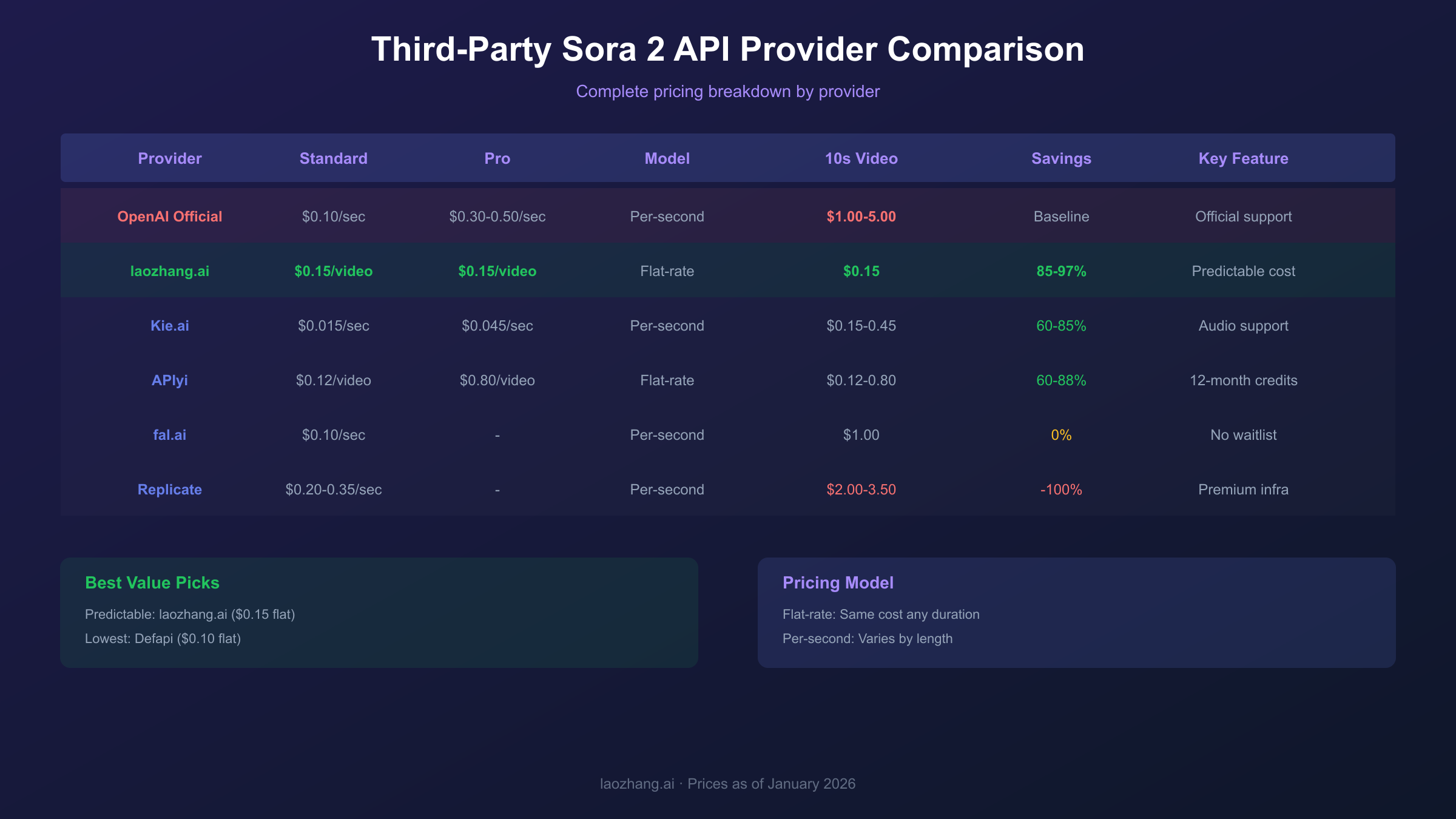
Major third-party providers include laozhang.ai ($0.15/video flat), Kie.ai ($0.015/sec), APIyi ($0.12/video), and fal.ai ($0.10/sec), each offering different pricing models and features.
The third-party ecosystem includes several established providers with distinct pricing approaches and feature sets. Here's a comprehensive comparison:
| Provider | Standard Price | Pro Price | Model | 10s Video | Savings vs Official |
|---|---|---|---|---|---|
| laozhang.ai | $0.15/video | $0.15/video | Flat-rate | $0.15 | 85-97% |
| Kie.ai | $0.015/sec | $0.045/sec | Per-second | $0.15-0.45 | 60-85% |
| APIyi | $0.12/video | $0.80/video | Flat-rate | $0.12-0.80 | 60-88% |
| fal.ai | $0.10/sec | - | Per-second | $1.00 | 0% |
| Replicate | $0.20-0.35/sec | - | Per-second | $2.00-3.50 | Negative |
| Defapi | $0.10/video | - | Flat-rate | $0.10 | 90% |
The providers differ significantly in their approach. Flat-rate services like laozhang.ai charge the same price regardless of video duration, making costs completely predictable. Per-second services like Kie.ai offer lower rates for short videos but costs scale with duration.
Some platforms like fal.ai match official OpenAI rates but remove the API tier barrier and waitlist delays—useful for developers who want streamlined access without cost savings. Replicate charges premium rates but provides enhanced infrastructure and developer tooling that some teams value.
How Third-Party Pricing Works
Third-party providers use two main pricing models: per-second billing (variable costs based on duration) and flat-rate per video (predictable budgeting regardless of length).
Understanding the mechanics behind third-party pricing helps you choose the right provider and predict costs accurately.
Per-Second Model mirrors OpenAI's approach but at lower rates. Your cost equals the rate multiplied by video duration. This model favors short videos but creates uncertainty for varied content lengths. A 5-second video at $0.015/second costs just $0.075, but a 20-second video jumps to $0.30.
Flat-Rate Model charges the same price regardless of duration (within standard limits). A 5-second and 20-second video both cost $0.15 with laozhang.ai. This predictability simplifies budgeting but may overpay for very short videos.
The aggregation model works like this: third-party providers establish business relationships with OpenAI, purchasing API access at negotiated rates unavailable to individual developers. They then build their own API layer on top, adding authentication, billing, and sometimes additional features. The margin between their bulk rate and retail price covers operating costs while still passing significant savings to end users.
Quality remains identical because requests ultimately route through OpenAI's Sora infrastructure. The third-party layer handles authentication and billing but doesn't modify the generation process. Videos produced through laozhang.ai or Kie.ai are technically indistinguishable from direct OpenAI generations.
Most providers use credit-based systems where you prepay for credits and consume them per generation. Minimum deposits typically range from $5-10. Some services like APIyi offer 12-month credit validity, while others have shorter windows or no expiration.
Cost Calculations for Real Use Cases
For 100 monthly videos, official API costs $100-500 while third-party options like laozhang.ai cost just $15—a savings of $85-485 per month.
Let's run concrete numbers for different production volumes to illustrate actual savings:
Small Creator (20 videos/month, 10s average)
- Official Standard: 20 × $1.00 = $20/month
- Official Pro 1080p: 20 × $5.00 = $100/month
- laozhang.ai: 20 × $0.15 = $3/month
- Monthly savings: $17-97
Growing Agency (100 videos/month, mixed lengths)
- Official Standard: 100 × $1.00 = $100/month
- Official Pro 1080p: 100 × $5.00 = $500/month
- laozhang.ai: 100 × $0.15 = $15/month
- Monthly savings: $85-485
Production Studio (500 videos/month)
- Official Standard: 500 × $1.00 = $500/month
- Official Pro 1080p: 500 × $5.00 = $2,500/month
- laozhang.ai: 500 × $0.15 = $75/month
- Monthly savings: $425-2,425
The savings compound significantly at scale. An agency saving $400/month saves $4,800 annually—enough to fund additional team members, tools, or marketing. For startups operating on tight budgets, third-party pricing can make the difference between viable and unviable AI video integration.
These calculations assume standard generation success. Failed generations still consume credits on most platforms (both official and third-party), so budget approximately 5-10% additional for retry scenarios.
Trade-offs and Considerations
Third-party providers route through OpenAI infrastructure so quality is identical, but trade-offs include variable uptime, limited support, and potentially delayed feature access.
Before committing to a third-party provider, understand the trade-offs compared to official API access:
Uptime and Reliability: Official OpenAI API provides enterprise-grade infrastructure with published SLAs and status pages. Third-party providers add another layer that can introduce additional failure points. Most operate without formal uptime guarantees, though established providers maintain good track records.
Technical Support: OpenAI offers documentation, community forums, and enterprise support options. Third-party support typically ranges from Discord communities to email tickets with variable response times. No dedicated account managers or phone support exists at this price tier.
Feature Timing: When OpenAI releases new Sora capabilities, third-party providers need time to integrate updates. New features might appear on official API days or weeks before reaching third-party platforms.
Commercial Licensing: OpenAI's terms of service clearly define commercial use rights. Third-party providers operate in grayer territory—while most explicitly permit commercial use, the legal framework differs from direct OpenAI agreements. For risk-averse enterprises, this ambiguity may matter.
Account Security: Using third-party services means sharing your project data with additional parties. Reputable providers implement security practices, but you're trusting them with your prompts and potentially sensitive content.
For most developers and small businesses, these trade-offs are acceptable given the substantial cost savings. Enterprise users with compliance requirements or mission-critical applications might prefer official API despite higher costs.
Choosing the Right Provider
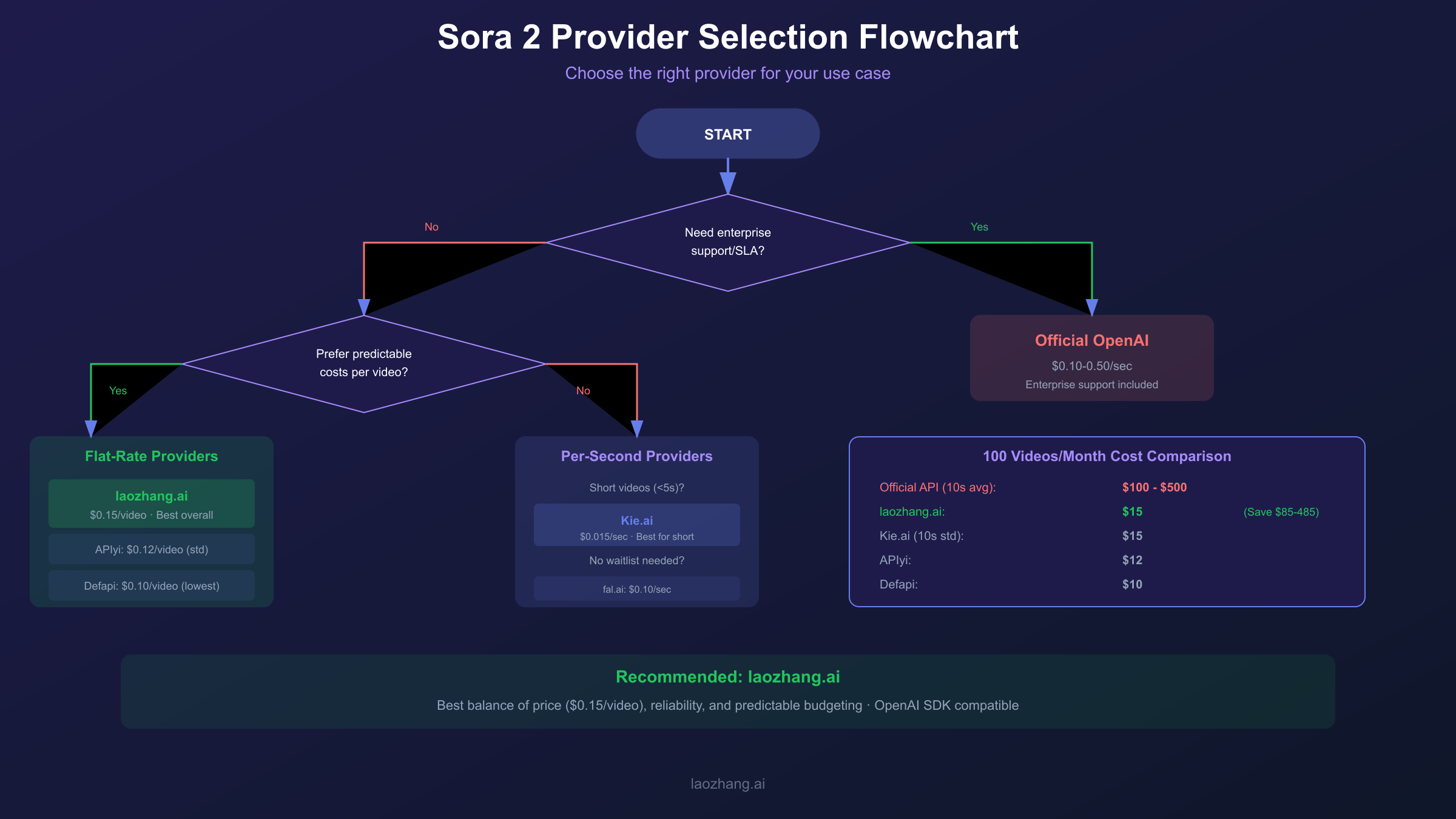
Choose flat-rate providers like laozhang.ai for predictable budgeting, per-second billing for short videos, or official API when enterprise support is essential.
Your ideal provider depends on specific requirements and usage patterns. Here's a decision framework:
Choose laozhang.ai if you:
- Need predictable monthly costs regardless of video length
- Generate mixed-duration videos (5-20 seconds)
- Want OpenAI SDK compatibility for easy integration
- Value the balance of price, reliability, and features
Choose per-second providers (Kie.ai) if you:
- Primarily generate short videos under 5 seconds
- Have highly variable monthly volumes
- Want audio synchronization features
Choose official OpenAI API if you:
- Require enterprise SLAs and support
- Have compliance requirements for vendor agreements
- Need guaranteed immediate access to new features
- Have budget for premium pricing
Choose Defapi or APIyi if you:
- Want absolute lowest cost for standard model
- Generate high volumes of simple videos
- Can accept potentially more limited reliability
For developers getting started, laozhang.ai offers the best balance of cost savings, reliability, and ease of integration. The flat-rate model eliminates billing surprises, the $5 minimum deposit lowers the barrier to testing, and OpenAI SDK compatibility means minimal code changes from direct API usage.
FAQ
Is video quality different with third-party providers?
No, video quality is identical. Third-party providers route requests through the same OpenAI Sora infrastructure—they handle authentication and billing while OpenAI performs the actual generation. Output from laozhang.ai or any reputable provider is technically indistinguishable from direct OpenAI API output.
Are third-party Sora APIs legal to use?
Third-party services operate by reselling API access purchased from OpenAI. This practice is common across the AI API ecosystem. However, ensure your chosen provider has appropriate commercial agreements in place. Established providers like laozhang.ai maintain proper business relationships that enable legitimate resale.
What happens if a third-party provider shuts down?
Your prepaid credits would be at risk if a provider closes suddenly. Mitigate this by avoiding large prepaid deposits—most providers allow minimum deposits of $5-10. Spreading usage across multiple providers also reduces concentration risk. The established providers have operated for extended periods with stable service.
Can I use third-party APIs for commercial projects?
Most third-party providers explicitly permit commercial use. Check each provider's terms of service for specific restrictions. Videos generated through third-party APIs carry the same usage rights as content generated through official channels since the underlying generation occurs on OpenAI infrastructure.
How do I switch between providers if needed?
Switching is straightforward because most providers offer OpenAI SDK compatibility. You typically only need to change the API endpoint URL and authentication key in your code. The actual API calls (prompts, parameters, response handling) remain identical across providers using OpenAI-compatible interfaces.
Conclusion
Third-party Sora 2 API providers deliver genuine value for developers seeking cost-effective video generation. Savings of 50-95% versus official pricing make AI video integration viable for projects that couldn't justify official API costs. The quality remains identical since requests route through OpenAI infrastructure—you're paying less for the same output.
For most developers and small businesses, laozhang.ai offers the optimal balance of price ($0.15/video flat), predictability, and reliability. Per-second providers like Kie.ai work well for short-form content. Only choose official API pricing when enterprise requirements mandate direct vendor relationships.
The third-party market will likely evolve as OpenAI adjusts pricing and policies. Current savings levels may not persist indefinitely, but present conditions strongly favor third-party access for cost-conscious developers. Start with a small deposit to test service quality before committing larger prepayments.
For detailed information on official Sora pricing structure, see our Sora 2 pricing guide. If you're evaluating subscription versus API access, our upgrade tier guide explains the differences.