Where to Get Cheap Nano Banana API Credits: Complete 2025 Guide (Save Up to 79%)
Discover how to get cheap Nano Banana API credits with our complete guide. Compare official vs third-party pricing, explore free tiers, and save up to 79% on Gemini 3 Pro Image API costs.
Nano Banana Pro
4K-80%Google Gemini 3 Pro · AI Inpainting
谷歌原生模型 · AI智能修图

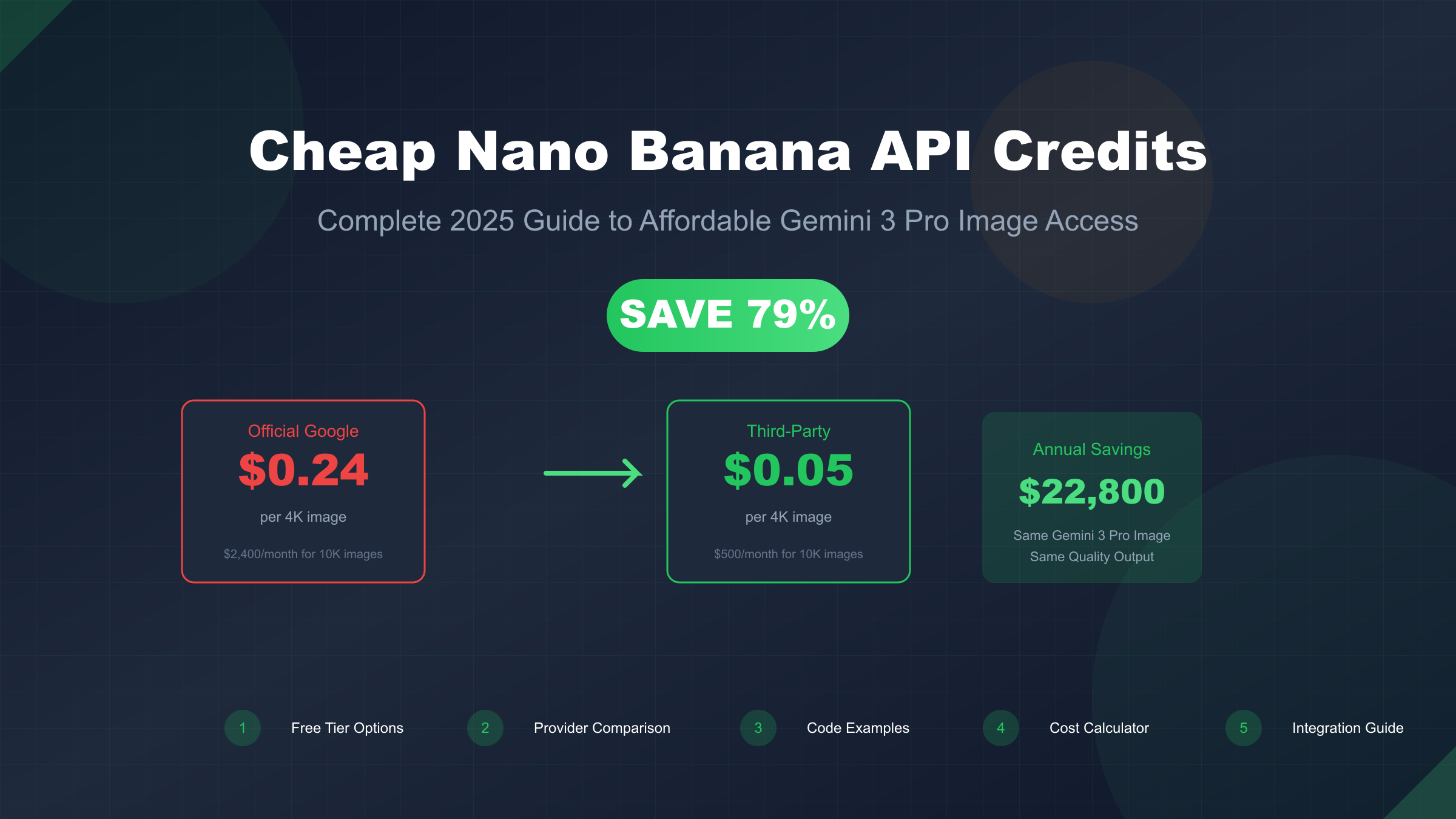
Finding affordable access to Nano Banana Pro API has become a critical concern for developers and businesses integrating AI image generation into their applications. With official Google pricing reaching $0.24 per 4K image, a project generating 10,000 images monthly faces costs of $2,400—a significant expense that can make or break a product's viability. The good news is that verified third-party providers now offer the same Gemini 3 Pro Image capabilities at discounts up to 79%, fundamentally changing the economics of AI-powered image generation.
This comprehensive guide examines every method to reduce your Nano Banana API costs, from free tier options and batch processing discounts to third-party providers offering substantial savings. Whether you're a solo developer experimenting with image generation or a team running production workloads, you'll find actionable strategies to optimize your API spending while maintaining the quality and reliability your applications demand.
What is Nano Banana Pro (Gemini 3 Pro Image)?
Nano Banana Pro, officially known as Gemini 3 Pro Image Preview, represents Google DeepMind's most advanced AI image generation model released in November 2025. Unlike traditional diffusion-based models, Nano Banana Pro utilizes a multimodal autoregressive architecture that enables native understanding of both text and visual context within a unified framework. This architectural approach delivers significant advantages in text rendering accuracy, reaching 94% legibility for generated text—dramatically outperforming competitors that often struggle with legible typography.
The model's technical capabilities justify its positioning as a premium offering. Native 4K resolution support (4096×4096 pixels) makes it suitable for professional applications including print media, product packaging, and high-detail design work where lower-resolution alternatives fall short. Generation speeds under 10 seconds for complex prompts demonstrate substantial infrastructure investment, while the ability to merge up to 14 reference images into cohesive compositions and maintain consistency across 5 people in generated imagery opens creative possibilities previously unavailable through AI systems.
Understanding these capabilities matters when evaluating pricing, because cheaper alternatives don't exist—third-party providers route to the exact same model running on Google's servers. The price difference reflects infrastructure and margin optimization, not quality degradation. When you access Nano Banana Pro through any provider, the neural network processing your prompt remains identical to Google's direct API.
Official Google Pricing Breakdown
Google offers Nano Banana Pro through two primary channels: the Gemini Developer API for individual developers and Vertex AI for enterprise deployments. Both channels use token-based pricing that translates to per-image costs depending on resolution.
The current official pricing structure as of December 2025 breaks down as follows:
| Resolution | Token Consumption | Standard Price | Batch API Price (50% off) |
|---|---|---|---|
| 1K (1024×1024) | 1,120 tokens | $0.134/image | $0.067/image |
| 2K (2048×2048) | 1,120 tokens | $0.134/image | $0.067/image |
| 4K (4096×4096) | 2,000 tokens | $0.24/image | $0.12/image |
The Batch API represents Google's most significant discount mechanism for high-volume users. By agreeing to asynchronous processing with delivery windows up to 24 hours (though results typically arrive within 2-6 hours), users unlock 50% savings across all resolution tiers. This approach works well for non-time-sensitive applications like content libraries, marketing asset preparation, or batch processing workflows where immediate results aren't required.
Input pricing for text prompts and reference images follows Gemini 3 Pro standard rates at $2 per million tokens, while image output tokens cost $120 per million. For most image generation use cases, the output token cost dominates the total expense since input prompts typically consume minimal tokens compared to the generated images.
Enterprise customers committing to specific monthly volumes can negotiate additional discounts beyond published rates. Based on community discussions, commitments exceeding 100,000 images monthly may unlock 10-20% additional savings, though these arrangements require direct engagement with Google Cloud sales and typically involve annual contracts.
Free Tier Options: Every Method to Access for Free
Before spending any money, developers should exhaust available free tier options that provide substantial access for development, testing, and even some production scenarios.
Google AI Studio offers the most generous free access, providing 1,500 image generations daily through the web interface and API. This limit resets every 24 hours and requires only a Google account—no credit card or payment information needed. For many development scenarios, MVP applications, and low-traffic production use cases, this free tier covers all requirements indefinitely.
Google Cloud Platform Free Credits provide $300 for new users, applicable to any GCP service including Gemini API usage. At the standard $0.134 per image rate, $300 enables approximately 2,240 standard-resolution generations—enough for extensive development and initial launch phases. Note that these credits expire 90 days from activation, so timing your GCP account creation strategically maximizes value.
| Free Option | Daily/Total Limit | Requirements | Best For |
|---|---|---|---|
| Google AI Studio | 1,500 images/day | Google account | Development, testing |
| GCP Free Credits | ~2,240 images total | New GCP account | Initial launch, evaluation |
| Gemini App (Free) | 3 images/day (low-res) | Google account | Quick experiments |
| Student Program | 1 year unlimited | University email | Students, academic projects |
The Student Program deserves special attention for qualifying users. With verification through a university email address, students gain one year of free access—a substantial benefit for academic projects, research, and learning. The program extends until January 31, 2026 for current enrollees.
For developers uncertain whether Nano Banana Pro suits their needs, these free options provide risk-free evaluation. Test prompt strategies, benchmark quality against requirements, and validate integration approaches before committing any budget.
Third-Party Provider Deep Comparison
Third-party API providers have emerged as the primary cost-optimization strategy for serious Nano Banana Pro users. These services function as routing layers rather than alternative models—when you send a request to a third-party provider, it travels through their infrastructure to Google's official Gemini API endpoints. The actual image generation happens on Google's servers using the identical model, meaning output quality remains consistent regardless of which provider you choose.
The critical evaluation factors when selecting a third-party provider include pricing (obviously), reliability metrics, regional performance, API compatibility, and payment convenience. Based on December 2025 market analysis, here's how the leading options compare:
| Provider | 4K Price | Savings vs Official | Uptime | Notable Features |
|---|---|---|---|---|
| laozhang.ai | $0.05/image | 79% | 99.5% | OpenAI-compatible, 200+ models |
| Kie.ai | ~$0.12/image | 50% | ~99% | Credit system, no subscription |
| Other providers | $0.09-0.15/image | 38-63% | Varies | Mixed features |
laozhang.ai leads the market at $0.05 per 4K image, representing a 79% discount compared to Google's official $0.24 rate. Beyond pricing, the platform offers practical advantages for developers: OpenAI-compatible API endpoints enable drop-in replacement for existing integrations, unified billing across 200+ AI models simplifies accounting, and flexible rate limits accommodate burst traffic without the strict quotas of Google's direct API. New users receive $10 in free credits upon registration—enough to generate 200 images for evaluation before committing funds.
For applications where official SLA guarantees matter (contractual requirements, compliance considerations, or direct Google support access), the official API remains appropriate despite higher costs. Third-party providers generally achieve 99%+ practical uptime based on monitoring data, though formal SLA guarantees vary by provider.
The transparency principle applies here: while laozhang.ai represents the most cost-effective option for most developers, those with specific compliance requirements or preference for direct vendor relationships should weigh these factors against potential savings.
Real Cost Calculations: 1K, 10K, 100K Images
Abstract pricing comparisons matter less than concrete projections for your actual use case. Let's calculate real costs across different volume scenarios.
1,000 Images Monthly (Startup/MVP)
| Provider | 4K Cost | 2K Cost | Monthly Savings |
|---|---|---|---|
| Google Official | $240 | $134 | Baseline |
| Google Batch | $120 | $67 | $120-$167 |
| laozhang.ai | $50 | $50 | $190-$84 |
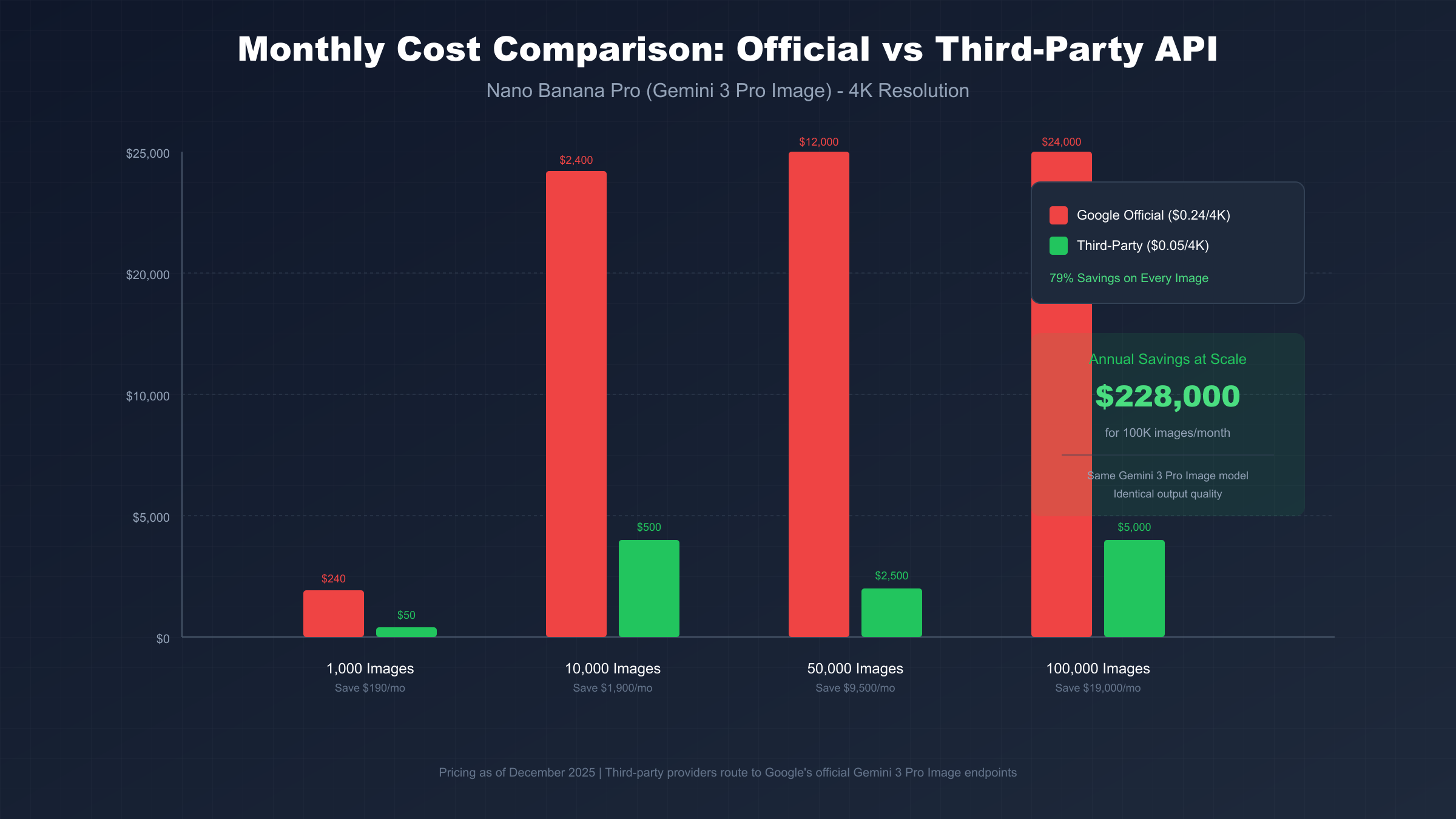
For a startup generating 1,000 images monthly, choosing laozhang.ai over official pricing saves $190 per month for 4K images—$2,280 annually. This savings often covers other infrastructure costs entirely.
10,000 Images Monthly (Growing Product)
| Provider | 4K Cost | 2K Cost | Monthly Savings |
|---|---|---|---|
| Google Official | $2,400 | $1,340 | Baseline |
| Google Batch | $1,200 | $670 | $1,200-$670 |
| laozhang.ai | $500 | $500 | $1,900-$840 |
At 10,000 monthly images, the cost difference becomes substantial. Third-party access through laozhang.ai saves $22,800 annually compared to official 4K pricing—potentially funding an additional team member or significant feature development.
100,000 Images Monthly (Scale Operation)
At enterprise scale, negotiations with Google directly may yield custom pricing. However, third-party providers remain competitive even against negotiated rates. For reference:
| Provider | 4K Cost | Annual Cost | Annual Savings |
|---|---|---|---|
| Google Official | $24,000 | $288,000 | Baseline |
| Google Batch | $12,000 | $144,000 | $144,000 |
| laozhang.ai | $5,000 | $60,000 | $228,000 |
These projections assume consistent volume. Actual costs vary based on resolution mix, seasonal patterns, and potential volume discounts negotiated with any provider.
Complete Integration Guide with Code Examples
Moving from pricing analysis to practical implementation, here's how to integrate Nano Banana Pro through both official and third-party channels.
Third-Party Integration (laozhang.ai)
The OpenAI-compatible endpoint structure enables straightforward migration for developers familiar with OpenAI's SDK patterns:
hljs pythonimport requests
import base64
from pathlib import Path
API_KEY = "sk-your-laozhang-api-key" # Get from laozhang.ai
API_URL = "https://api.laozhang.ai/v1beta/models/gemini-3-pro-image-preview:generateContent"
def generate_image(prompt: str, size: str = "2K") -> bytes:
"""
Generate image using Nano Banana Pro via laozhang.ai
Args:
prompt: Text description of desired image
size: "2K" or "4K" resolution
Returns:
Raw image bytes (PNG format)
"""
headers = {
"Authorization": f"Bearer {API_KEY}",
"Content-Type": "application/json"
}
payload = {
"contents": [{
"parts": [{"text": prompt}]
}],
"generationConfig": {
"responseModalities": ["IMAGE"],
"imageConfig": {
"aspectRatio": "auto",
"imageSize": size
}
}
}
response = requests.post(API_URL, headers=headers, json=payload, timeout=180)
response.raise_for_status()
result = response.json()
image_data = result["candidates"][0]["content"]["parts"][0]["inlineData"]["data"]
return base64.b64decode(image_data)
# Usage example
image_bytes = generate_image("A futuristic city skyline at sunset, 4K quality")
Path("output.png").write_bytes(image_bytes)
print(f"Image saved: {len(image_bytes):,} bytes")
# Cost: $0.05 via laozhang.ai (vs $0.24 official)
Official Google API Integration
For comparison, here's the equivalent implementation using Google's direct API:
hljs pythonimport google.generativeai as genai
from pathlib import Path
# Configure with your Google API key
genai.configure(api_key="your-google-api-key")
def generate_image_official(prompt: str) -> bytes:
"""
Generate image using official Gemini API
Note: Costs $0.134-$0.24 per image depending on resolution
"""
model = genai.GenerativeModel('gemini-3-pro-image-preview')
response = model.generate_content(
prompt,
generation_config={
"response_modalities": ["IMAGE"],
}
)
# Extract image from response
for part in response.candidates[0].content.parts:
if hasattr(part, 'inline_data'):
return part.inline_data.data
raise ValueError("No image in response")
# Usage
image_bytes = generate_image_official("A futuristic city skyline at sunset")
Path("output_official.png").write_bytes(image_bytes)
Production-Ready Implementation with Error Handling
Real-world applications require robust error handling, retries, and fallback logic:
hljs pythonimport requests
import base64
import time
from typing import Optional
import logging
logging.basicConfig(level=logging.INFO)
logger = logging.getLogger(__name__)
class NanoBananaClient:
def __init__(self, api_key: str, max_retries: int = 3):
self.api_key = api_key
self.base_url = "https://api.laozhang.ai/v1beta/models/gemini-3-pro-image-preview:generateContent"
self.max_retries = max_retries
def generate(self, prompt: str, size: str = "2K") -> Optional[bytes]:
"""Generate image with automatic retry logic"""
headers = {
"Authorization": f"Bearer {self.api_key}",
"Content-Type": "application/json"
}
payload = {
"contents": [{"parts": [{"text": prompt}]}],
"generationConfig": {
"responseModalities": ["IMAGE"],
"imageConfig": {"imageSize": size}
}
}
for attempt in range(self.max_retries):
try:
response = requests.post(
self.base_url,
headers=headers,
json=payload,
timeout=180
)
if response.status_code == 429: # Rate limited
wait_time = 2 ** attempt
logger.warning(f"Rate limited, waiting {wait_time}s")
time.sleep(wait_time)
continue
response.raise_for_status()
result = response.json()
image_data = result["candidates"][0]["content"]["parts"][0]["inlineData"]["data"]
return base64.b64decode(image_data)
except requests.exceptions.Timeout:
logger.warning(f"Timeout on attempt {attempt + 1}")
except Exception as e:
logger.error(f"Error on attempt {attempt + 1}: {e}")
return None
# Usage
client = NanoBananaClient("sk-your-api-key")
image = client.generate("Professional product photography of a smartwatch")
if image:
Path("product.png").write_bytes(image)
For detailed API documentation and additional integration patterns, see our Nano Banana Pro API guide.
Provider Reliability & Quality Assurance
Beyond pricing, reliability metrics determine whether a provider suits production workloads. Here's what the data shows.
Official Google API Reliability
Google's Vertex AI services carry documented 99.9% uptime SLA, translating to maximum expected downtime of approximately 8.76 hours annually. Enterprise agreements include support escalation paths and guaranteed response times for critical issues. This formal guarantee provides contractual protection that third-party providers generally cannot match.
Third-Party Provider Reliability
Third-party providers achieve 99%+ practical uptime based on community reports and monitoring data. laozhang.ai has maintained consistent availability without major outage incidents, though without formal SLA guarantees equivalent to Google's enterprise offerings.
The practical difference matters less than it might appear. For most applications, 99.5% uptime (approximately 44 hours annual downtime) versus 99.9% uptime (8.76 hours) doesn't materially impact user experience when proper error handling and retry logic are implemented. The code examples above demonstrate graceful degradation patterns that handle transient failures regardless of provider.
Quality Assurance
Since all providers route to Google's identical Gemini 3 Pro Image model, output quality remains consistent. Verify this yourself: generate the same prompt through official and third-party channels and compare results. The neural network, training data, and inference behavior are identical—only the billing and routing infrastructure differs.
For mission-critical applications where even brief outages carry significant business impact, the official API's formal SLA provides risk mitigation. For the majority of use cases where application-level error handling addresses occasional failures, the 79% cost savings from third-party providers typically outweighs marginal reliability differences.
Regional Access Solutions (Asia/China)
Developers in Asia face additional considerations beyond pricing when accessing Nano Banana Pro. Network latency, payment infrastructure, and regulatory factors all influence the optimal access strategy.
Latency Optimization
Standard API calls from Asia to Google's US endpoints typically experience 150-200ms latency overhead before generation begins. Providers with Asia-optimized infrastructure, including local routing and regional caching, reduce this overhead substantially. laozhang.ai delivers approximately 20ms latency for Asia-based users compared to 150ms+ through direct Google access—a meaningful improvement for applications where response time affects user experience.
Payment Convenience
Google's direct API requires international credit cards, creating friction for developers in regions where such cards are less common. Third-party providers supporting Alipay and WeChat Pay remove this barrier entirely, enabling immediate access without payment infrastructure constraints.
Regulatory Considerations
For applications with specific data residency requirements or compliance constraints, verify that your chosen provider's data handling practices align with applicable regulations. While image generation requests typically don't involve sensitive personal data, some industries have specific requirements around API provider selection.
The regional benefits of third-party providers like laozhang.ai—faster latency, convenient payment options, and localized support—provide value beyond pure cost savings for Asia-based developers.
Advanced Cost Optimization Strategies
Beyond provider selection, several strategies further reduce Nano Banana Pro costs regardless of which API you use.
Resolution Optimization
Not every use case requires 4K resolution. At $0.24 versus $0.134 (official) or $0.05 versus $0.05 (laozhang.ai flat rate), resolution selection significantly impacts costs for official API users. Analyze your actual requirements: social media images rarely benefit from 4K, while print materials genuinely need higher resolution. Generating at appropriate resolution rather than maximum resolution reduces costs without quality compromise.
Caching Strategies
Implementing perceptual hashing for image requests prevents duplicate processing of identical or near-identical prompts. Studies show 35-50% reduction in API calls for applications with repetitive content patterns. For example, e-commerce product images often share common elements—cache base generations and modify rather than regenerating entirely.
Batch Processing
For non-time-sensitive workloads, Google's official Batch API provides 50% discounts. Queue requests during off-peak hours, aggregate similar prompts, and process in batches rather than individually. Even third-party providers may offer volume discounts for committed throughput.
Prompt Optimization
Well-crafted prompts generate better results on the first attempt, reducing regeneration costs. Invest time in prompt engineering: specific, detailed prompts with clear style direction minimize failed generations. Track prompt performance and iterate toward reliable formulations.
Development Workflow
Use Google AI Studio's free tier (1,500 images daily) for all development and testing. Reserve paid API access for production traffic only. This approach eliminates development costs entirely while maintaining full access to the production model's capabilities.
FAQ: Common Questions Answered
Q1: Do third-party providers offer the same quality as Google's official API?
Third-party providers route requests to Google's identical Gemini 3 Pro Image model. The neural network processing your prompt, the training data it learned from, and the inference behavior are all identical. Price differences reflect infrastructure costs and margins, not quality differences. You can verify this by generating the same prompt through both channels and comparing outputs.
Q2: What happens if a third-party provider goes down?
Implement proper error handling with retry logic and consider maintaining fallback options. The code examples in this guide demonstrate graceful degradation patterns. For mission-critical applications, some developers maintain both official and third-party API keys, routing to the official API only when the primary provider experiences issues—still achieving significant cost savings during normal operation.
Q3: How do I calculate my expected monthly costs?
Estimate your monthly image volume, then multiply by your chosen provider's per-image rate. For example, 5,000 images monthly at laozhang.ai's $0.05 rate equals $250, versus $1,200 through Google's official 4K pricing. Add 10-20% buffer for regenerations and testing. Use our cost comparison guide for detailed scenarios.
Q4: Can I switch providers later without changing my code?
If you implement against OpenAI-compatible endpoints (like laozhang.ai offers), switching providers requires only changing the base URL and API key—no code modifications. This flexibility reduces vendor lock-in risk and enables easy comparison between providers.
Q5: Are there any hidden costs I should know about?
Watch for input token costs (usually minimal but present), failed generation charges (varies by provider), and currency conversion fees if paying in non-native currency. laozhang.ai uses transparent flat-rate pricing without hidden fees, while official Google pricing involves separate input and output token calculations.
Conclusion: Recommendations by Use Case
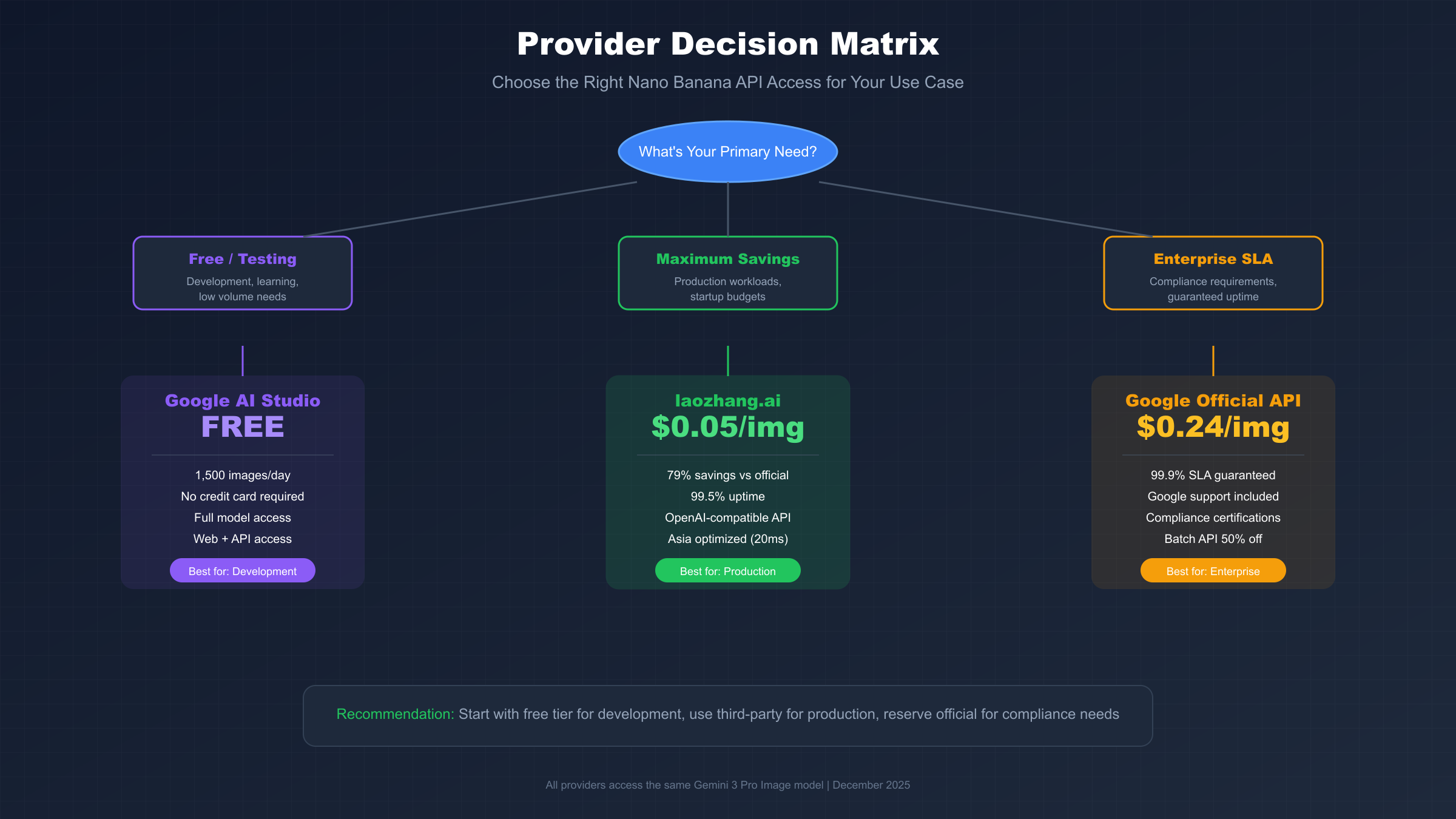
The optimal approach to cheap Nano Banana API credits depends on your specific situation. Here's a decision framework based on common scenarios:
For Hobbyists and Experimenters: Start with Google AI Studio's free tier (1,500 images daily). This covers most personal projects indefinitely without any cost.
For Startups and MVPs: Use laozhang.ai for production traffic. The 79% cost savings ($50 vs $240 for 1,000 4K images monthly) preserves runway for other priorities. The $10 signup credit provides risk-free evaluation.
For Growing Products: Third-party providers become essential at scale. Generating 10,000+ images monthly at official rates ($2,400+) versus third-party rates ($500) represents meaningful budget impact. Implement the production-ready code patterns from this guide to ensure reliability.
For Enterprise with Compliance Requirements: Evaluate whether official SLA guarantees are contractually required. If yes, use Google's direct API with Batch processing for 50% savings. If not, third-party providers offer superior economics even at enterprise scale.
For Asia-Based Developers: laozhang.ai provides specific advantages: lower latency (20ms vs 150ms+), convenient payment options (Alipay, WeChat), and localized support. These benefits compound with cost savings.
The key insight is that cheap Nano Banana API credits don't mean compromised quality. Third-party providers route to the identical Google model—only billing differs. By selecting the right access method for your use case, you can achieve professional-grade AI image generation at a fraction of official costs.
Start with the free options, graduate to third-party providers as volume grows, and reserve official API access for scenarios where formal SLA guarantees provide genuine business value. For most developers, laozhang.ai offers the optimal balance of pricing, reliability, and convenience for affordable Nano Banana Pro access.
For additional guidance on image generation API selection, explore our cheapest stable Nano Banana Pro API guide and Nano Banana Pro free access methods.