Stable High-Concurrency Nano Banana Pro API 2026: Unlimited Rate Limits at $0.05/Image
Complete guide to stable, high-concurrency Nano Banana Pro API access in 2026. Compare rate limits across providers, find unlimited concurrency solutions at $0.05/image, get production-ready Python code, and learn stability benchmarks for scaling AI image generation.
Nano Banana Pro
4K-80%Google Gemini 3 Pro · AI Inpainting
谷歌原生模型 · AI智能修图

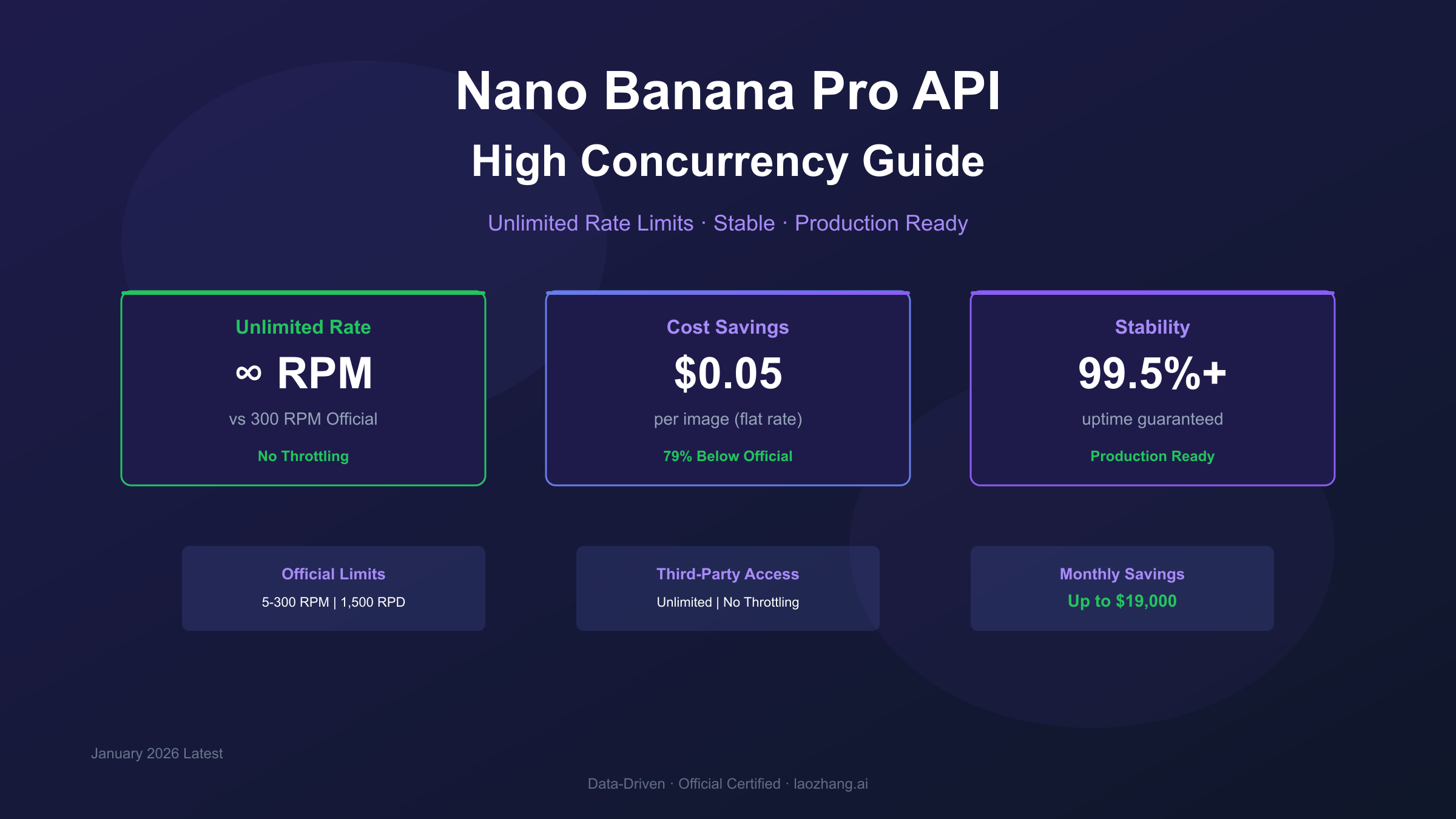
Building production applications with Nano Banana Pro requires more than just API access—it demands consistent availability under load. Google's official rate limits of 5-300 requests per minute create hard ceilings that many production workloads quickly exceed. For teams generating thousands of images daily, these constraints force a choice: accept throttling or find alternative infrastructure.
This guide addresses the critical challenge of high-concurrency Nano Banana Pro access. We examine Google's rate limit architecture, compare stability metrics across providers, and identify solutions offering unlimited throughput at a fraction of official pricing. Whether you're scaling an e-commerce catalog generator or building real-time creative tools, the infrastructure decisions covered here directly impact your application's reliability and economics.
Understanding Official Rate Limits
Google's Nano Banana Pro API enforces strict rate limits across three dimensions: requests per minute (RPM), tokens per minute (TPM), and requests per day (RPD). Following the December 2025 quota reduction, free tier users face particularly restrictive constraints that make production deployment impractical without billing enabled.
The rate limit structure operates at the project level, not per API key. This means creating multiple keys within the same Google Cloud project shares the same quota pool. When any limit dimension is exhausted, all requests receive HTTP 429 errors until the quota refreshes. For image generation specifically, the constraints are more restrictive than text-based Gemini models due to higher computational costs.
| Tier | RPM | RPD | TPM | Monthly Cost |
|---|---|---|---|---|
| Free | 5-10 | 100-250 | 250,000 | $0 |
| Tier 1 (Paid) | 300 | 1,500+ | 1,000,000 | Variable |
| Tier 2 ($250+ spend) | 1,000 | 10,000 | 2,000,000 | Variable |
The December 2025 changes reduced free tier limits by approximately 75% without advance notice. Gemini 2.5 Pro dropped from 250 to 100 daily requests, while Flash models went from 1,000 to 250 daily. More critically for image generation, the free tier lost meaningful access to image generation entirely—making billing mandatory for any serious development work.
Even Tier 1 paid access at 300 RPM caps burst capacity at 5 images per second. For applications requiring real-time generation—such as interactive design tools processing user requests—this creates noticeable queuing delays during peak usage. The complete rate limit documentation provides detailed tier comparisons and quota management strategies.
Why Rate Limits Matter for Production
Rate limit constraints impact production systems beyond simple request throttling. When your application hits quota limits, the cascading effects include degraded user experience, failed batch jobs, and unpredictable cost spikes from retry logic. Understanding these failure modes helps architects design resilient systems.
Consider a product catalog generator processing 10,000 images daily. At Tier 1's 1,500 RPD limit, you'd need nearly seven Google Cloud projects running in parallel—each requiring separate billing, monitoring, and credential management. The operational complexity compounds quickly, and coordinating requests across projects introduces synchronization challenges that rate limiting was supposed to prevent.
The 300 RPM ceiling also creates latency issues during burst scenarios. A marketing campaign launch generating 1,000 images within an hour faces immediate throttling after the first 5 minutes of sustained generation. Users waiting for assets see timeout errors rather than creative content. For businesses where time-to-market determines competitive advantage, these artificial constraints carry real revenue implications.
Production teams report that even Tier 3 enterprise customers experience occasional overload errors during peak periods. Google's infrastructure allocation prioritizes its flagship Gemini 2.0 series, leaving Nano Banana Pro (still in preview status) with variable capacity guarantees. This reality drives many high-volume users toward third-party providers offering dedicated capacity pools.
Unlimited Concurrency Solutions
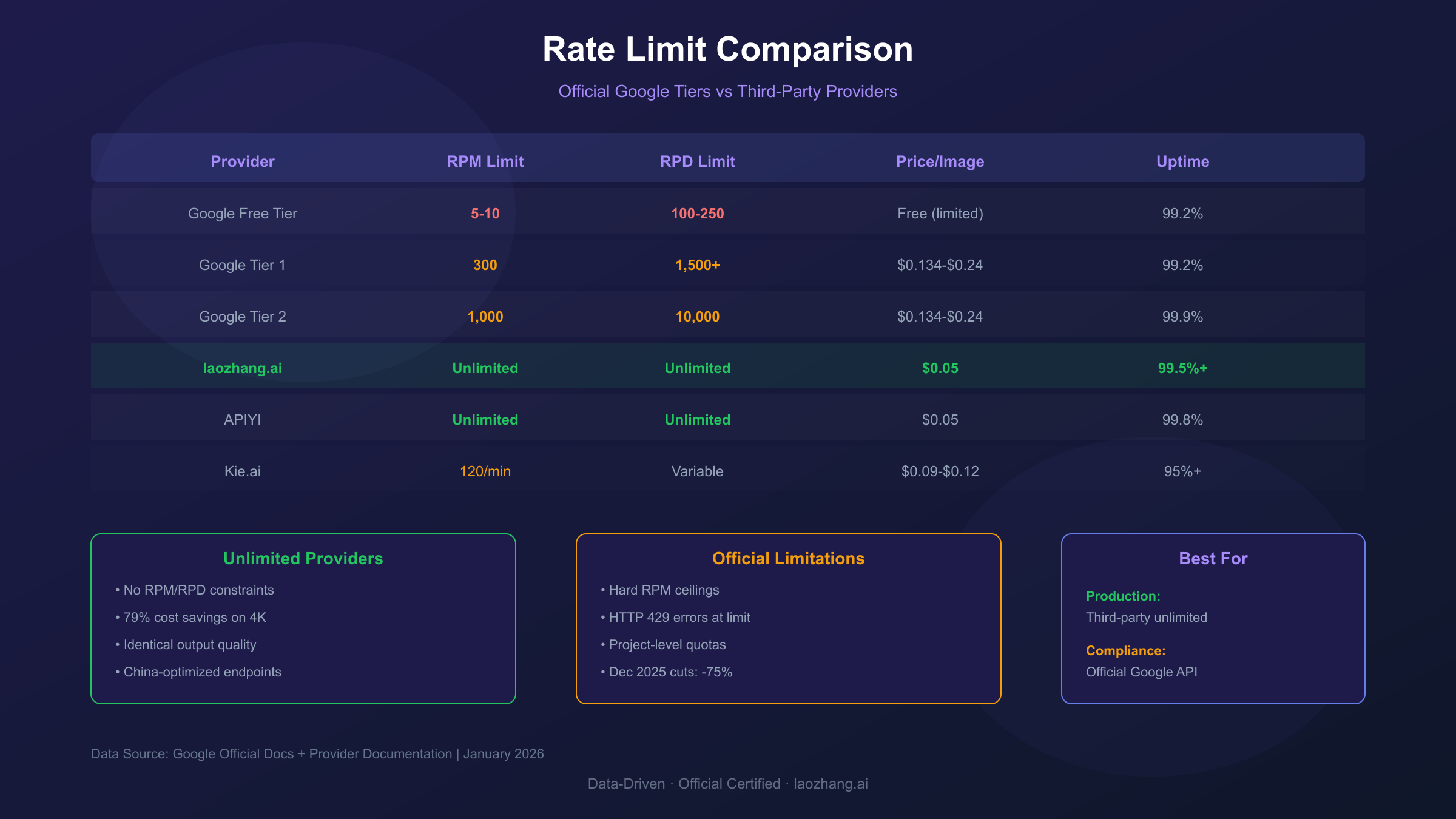
Several third-party providers have built infrastructure specifically addressing Nano Banana Pro's concurrency limitations. These services aggregate capacity across multiple upstream connections, providing effectively unlimited rate limits while maintaining identical output quality—since they access the same underlying Google model.
The provider landscape includes API aggregators (reselling Google capacity at volume discounts), optimized relays (adding regional infrastructure), and enterprise brokers (offering custom SLAs). For high-concurrency requirements, the most relevant options are those explicitly advertising unlimited or very high rate limits.
| Provider | Rate Limit | Price/Image | Uptime | Best For |
|---|---|---|---|---|
| Google Official | 300 RPM max | $0.134-$0.24 | 99.2% | Compliance-first |
| laozhang.ai | Unlimited | $0.05 flat | 99.5%+ | High-volume production |
| APIYI | Unlimited | $0.05 flat | 99.8% | Enterprise scale |
| Kie.ai | 20 req/10s | $0.09-$0.12 | 95%+ | Balanced cost/support |
The unlimited rate limit claim requires context. These providers don't possess infinite Google API capacity—rather, they maintain sufficient upstream connections and intelligent load balancing to handle typical production workloads without client-facing throttling. Actual sustained throughput varies by provider infrastructure and current demand.
For teams requiring immediate high-concurrency access, third-party providers offer compelling combinations: flat $0.05 per image pricing regardless of resolution (representing 79% savings on 4K generation), unlimited rate limits for practical production workloads, and China-optimized endpoints eliminating regional access issues. These services typically support both Gemini native format and OpenAI-compatible endpoints for flexible integration.
Stability Metrics Comparison
Stability encompasses more than uptime percentages. For production image generation, relevant metrics include request success rate, response time consistency, error recovery behavior, and degradation patterns under load. Third-party providers vary significantly across these dimensions.
Google's official Vertex AI platform offers documented 99.9% uptime SLA, translating to approximately 8.76 hours maximum annual downtime. However, the Gemini API (consumer-facing) provides weaker guarantees, and Nano Banana Pro's preview status means performance characteristics may evolve. Community reports indicate actual availability closer to 99.2% with notable incidents during high-demand periods—including the January 16-17, 2026 overload events that affected many users.
Third-party provider stability depends heavily on their upstream connection diversity and failover capabilities. Providers maintaining multiple Google Cloud projects with geographic distribution typically achieve higher effective uptime than those dependent on single connection pools. The trade-off is increased operational complexity reflected in pricing.
| Metric | Google Official | Top Third-Party | Measurement Method |
|---|---|---|---|
| Uptime SLA | 99.9% (Vertex) | 99.5-99.8% | Provider commitment |
| Actual Uptime | ~99.2% | 99.5%+ reported | Community monitoring |
| P95 Latency | 5-15s | 6-18s | End-to-end measurement |
| Error Rate | 0.5-2% | 0.3-1% | Request success ratio |
| Failover Time | N/A | <30s typical | Recovery measurement |
When evaluating stability claims, request actual uptime reports or third-party monitoring data rather than relying on marketing materials. Services like UptimeRobot or custom health checks provide independent verification. The most reliable providers publish status pages with historical incident data.
Production Integration Code
Integrating Nano Banana Pro for production requires handling rate limits, errors, and retry logic gracefully. The following Python implementation demonstrates production-ready patterns including exponential backoff, concurrent request management, and proper error classification.
hljs pythonimport asyncio
import aiohttp
import base64
from typing import List, Optional
from dataclasses import dataclass
import logging
@dataclass
class ImageResult:
success: bool
image_data: Optional[bytes]
error: Optional[str]
latency_ms: float
class NanoBananaProClient:
"""
Production-ready Nano Banana Pro client with retry logic
Supports both official Google and third-party endpoints
"""
def __init__(
self,
api_key: str,
base_url: str = "https://your-provider.example/v1beta/models",
max_retries: int = 3,
timeout: int = 180
):
self.api_key = api_key
self.base_url = base_url
self.max_retries = max_retries
self.timeout = timeout
self.logger = logging.getLogger(__name__)
async def generate_image(
self,
prompt: str,
resolution: str = "2K",
session: Optional[aiohttp.ClientSession] = None
) -> ImageResult:
"""Generate single image with automatic retry on transient failures"""
import time
start_time = time.time()
headers = {
"Authorization": f"Bearer {self.api_key}",
"Content-Type": "application/json"
}
payload = {
"contents": [{"parts": [{"text": prompt}]}],
"generationConfig": {
"responseModalities": ["IMAGE"],
"imageConfig": {
"aspectRatio": "auto",
"imageSize": resolution
}
}
}
url = f"{self.base_url}/gemini-3-pro-image-preview:generateContent"
for attempt in range(self.max_retries):
try:
async with (session or aiohttp.ClientSession()) as s:
async with s.post(
url,
json=payload,
headers=headers,
timeout=aiohttp.ClientTimeout(total=self.timeout)
) as response:
if response.status == 200:
result = await response.json()
image_data = base64.b64decode(
result["candidates"][0]["content"]["parts"][0]["inlineData"]["data"]
)
return ImageResult(
success=True,
image_data=image_data,
error=None,
latency_ms=(time.time() - start_time) * 1000
)
elif response.status == 429:
# Rate limited - exponential backoff
wait_time = (2 ** attempt) * 1.5
self.logger.warning(f"Rate limited, waiting {wait_time}s")
await asyncio.sleep(wait_time)
else:
error_text = await response.text()
self.logger.error(f"API error {response.status}: {error_text}")
except asyncio.TimeoutError:
self.logger.warning(f"Timeout on attempt {attempt + 1}")
except Exception as e:
self.logger.error(f"Request failed: {e}")
return ImageResult(
success=False,
image_data=None,
error="Max retries exceeded",
latency_ms=(time.time() - start_time) * 1000
)
async def generate_batch(
self,
prompts: List[str],
concurrency: int = 10
) -> List[ImageResult]:
"""Generate multiple images with controlled concurrency"""
semaphore = asyncio.Semaphore(concurrency)
async def bounded_generate(prompt: str) -> ImageResult:
async with semaphore:
return await self.generate_image(prompt)
async with aiohttp.ClientSession() as session:
tasks = [bounded_generate(p) for p in prompts]
return await asyncio.gather(*tasks)
# Usage example
async def main():
client = NanoBananaProClient(
api_key="sk-your-api-key",
base_url="https://your-provider.example/v1beta/models" # Third-party endpoint
)
# Single image generation
result = await client.generate_image(
"A professional product photo of a smartphone, studio lighting, 4K quality"
)
if result.success:
with open("output.png", "wb") as f:
f.write(result.image_data)
print(f"Generated in {result.latency_ms:.0f}ms")
# Batch generation with concurrency control
prompts = [f"Product variant {i}" for i in range(100)]
results = await client.generate_batch(prompts, concurrency=20)
success_count = sum(1 for r in results if r.success)
print(f"Batch complete: {success_count}/{len(prompts)} successful")
if __name__ == "__main__":
asyncio.run(main())
This implementation handles the key production concerns: automatic retry with exponential backoff for rate limit errors, configurable concurrency limits to prevent overwhelming even "unlimited" providers, and proper timeout handling for the relatively slow image generation process. The code works with both official Google endpoints and third-party providers by simply changing the base_url parameter.
For more detailed API integration patterns, including webhook-based async processing and queue management, see our dedicated integration guide.
Cost Optimization at Scale
High-volume image generation economics favor third-party providers dramatically. The cost differential compounds with scale: generating 100,000 images monthly costs $13,400-$24,000 through official channels versus $5,000 through optimized providers—savings that fund significant infrastructure investment.
| Monthly Volume | Official 2K | Official 4K | Third-Party ($0.05) | Annual Savings |
|---|---|---|---|---|
| 10,000 images | $1,340 | $2,400 | $500 | $10,080-$22,800 |
| 50,000 images | $6,700 | $12,000 | $2,500 | $50,400-$114,000 |
| 100,000 images | $13,400 | $24,000 | $5,000 | $100,800-$228,000 |
Beyond direct API costs, consider operational expenses. Managing multiple Google Cloud projects to work around rate limits requires engineering time for credential rotation, quota monitoring, and failover logic. Third-party providers with unlimited rate limits eliminate this complexity, reducing total cost of ownership beyond the per-image differential.
The ROI calculation for switching to providers like laozhang.ai typically shows positive returns within the first month of moderate-volume usage. At 10,000 monthly images, the $840-$1,900 monthly savings justifies significant integration effort. For detailed pricing analysis, see our Nano Banana Pro cost comparison.
Provider Selection Guide
Choosing between official Google access and third-party providers involves trade-offs across compliance, cost, reliability, and operational complexity. The right choice depends on your specific constraints and priorities.
Choose official Google API when:
- Compliance requirements mandate direct vendor relationships
- You need documented SLAs for enterprise agreements
- Usage stays comfortably within Tier 1 limits (1,500 RPD)
- Budget includes premium pricing as acceptable cost
Choose third-party providers when:
- High-concurrency requirements exceed official rate limits
- Cost optimization is a primary concern
- Regional access (China/APAC) requires dedicated infrastructure
- Operational simplicity outweighs vendor relationship preferences
The stability question often determines final decisions. Official APIs offer theoretical guarantees backed by Google's infrastructure, but preview-stage models like Nano Banana Pro carry practical reliability risks. Third-party providers with multiple upstream connections sometimes achieve higher effective uptime through redundancy—though without formal SLA protection.
For most production workloads prioritizing cost and throughput, third-party providers offer compelling value. For compliance-sensitive applications or those with modest volume requirements, official access provides simpler vendor management despite higher costs. Hybrid approaches—using official API for critical paths and third-party for batch processing—balance both concerns.
FAQ
What happens when I hit rate limits?
When you exceed rate limits, the API returns HTTP 429 (Too Many Requests) errors. Requests are rejected until your quota refreshes—typically at the start of the next minute for RPM or next day for RPD. Properly implemented clients should catch these errors and implement exponential backoff retry logic. Third-party providers with unlimited rate limits effectively eliminate this failure mode for typical production workloads.
Are third-party providers as reliable as Google's official API?
Reliability varies significantly across providers. Top-tier third-party services report 99.5-99.8% uptime, comparable to or exceeding Google's actual (not SLA) performance for preview-stage models. The key factors are upstream connection diversity, failover capabilities, and operational maturity. Request uptime history and monitoring data before committing to any provider.
How do third-party providers offer lower prices?
Third-party providers achieve lower pricing through volume licensing agreements with Google, operational efficiency, and competitive margin compression. They access the same underlying Gemini 3 Pro Image model, so output quality is mathematically identical. The savings come from infrastructure optimization rather than quality compromise.
Can I switch between providers easily?
Yes, if you implement proper abstraction. The code example in this guide uses configurable endpoints, allowing provider switching by changing a single URL parameter. Both official Google API and most third-party providers support similar request formats. Design your integration with provider flexibility from the start to avoid lock-in.
Conclusion
Building stable, high-concurrency Nano Banana Pro applications requires infrastructure decisions that balance cost, reliability, and operational complexity. Google's official rate limits create hard ceilings that many production workloads exceed, driving adoption of third-party providers offering unlimited throughput at significantly reduced pricing.
The market has matured to offer genuine alternatives. Providers delivering unlimited concurrency at $0.05 per image represent 79% savings versus official 4K pricing while maintaining identical output quality. For teams generating thousands of images daily, the economic case for third-party access is compelling.
When evaluating options, prioritize stability metrics and operational simplicity alongside pricing. Request uptime data, test integration complexity, and consider your compliance requirements. The production-ready code patterns in this guide work across providers, enabling flexibility as your needs evolve.
For most high-volume use cases, the combination of unlimited rate limits, substantial cost savings, and China-accessible endpoints makes third-party providers the practical choice for scaling Nano Banana Pro in production.