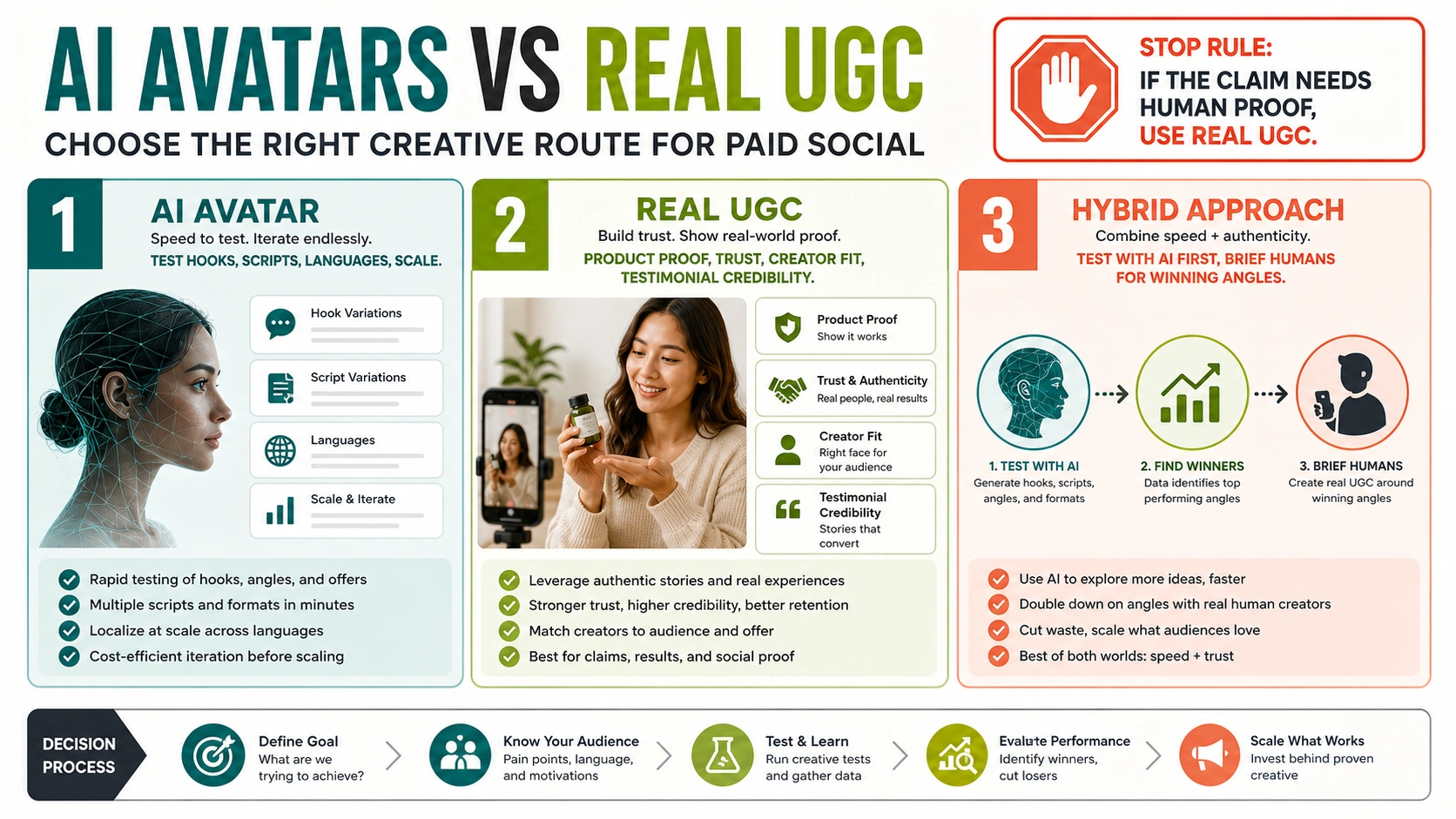
AI avatars and real UGC solve different ad problems. Use avatar videos when you need fast hook tests, script variants, localization, or low-risk explainers. Use real UGC when the sale depends on product proof, human experience, community fit, or testimonial credibility. Use both when AI can cheaply identify the winning angle before a human creator records the ad that needs trust.
| Creative job | Best route | Why it fits | Stop if |
|---|---|---|---|
| Test ten hooks or scripts before spending on creators | AI avatar video | Fast variation, lower production friction, easy language and audience tests | The ad implies a real buyer experience, medical or financial outcome, or personal testimonial |
| Show how the product feels, arrives, fits, tastes, wears, or solves a real problem | Real UGC creator | The human interaction is the evidence, not just the delivery format | The creator cannot honestly use or evaluate the product |
| Find the message first, then make the trustworthy version | Hybrid workflow | AI screens angles; real creators provide proof, context, and audience-specific delivery | The final ad hides that synthetic media or paid endorsement is involved when disclosure is required |
The hard line is proof. A synthetic avatar can borrow the visual language of UGC, but it cannot truthfully provide lived experience, customer proof, or a real testimonial. If the claim needs human experience to be believable, move from avatar testing to a real creator brief before the ad carries that claim.
For AI Avatars vs UGC, the useful choice is not which format looks more modern. It is which route gives the campaign the learning, trust, and compliance margin it needs before the next ad spend or creator brief.
What AI avatars, AI UGC, and real UGC actually mean
AI avatar videos are synthetic spokesperson videos. A platform generates or animates a person-like presenter, then maps a script, voice, pose, background, language, or scene around that presenter. Some workflows use stock avatars. Some use a custom digital double. Some combine generated video, voice, lip sync, and template editing.
AI UGC is a looser marketing phrase. It usually means synthetic content that borrows the format of user-generated content: vertical framing, casual speech, phone-camera rhythm, creator-style hooks, product callouts, captions, and short direct-response pacing. It can look like UGC without being user-generated.
Real UGC is different because a human creator, customer, employee, or user is materially involved. The value is not only the face on screen. It is the credible relationship between the person, the product, the context, and the claim. A real creator can unbox, try, compare, explain a routine, react to a fit problem, show a texture, or speak from a community's language in a way an avatar should not fake.
That distinction matters because paid ads often mix two jobs that feel similar on the surface: learning which message works and proving why the message should be believed. AI avatars are useful for the first job. Real UGC is often safer and stronger for the second.
Choose by the ad job, not by the production format
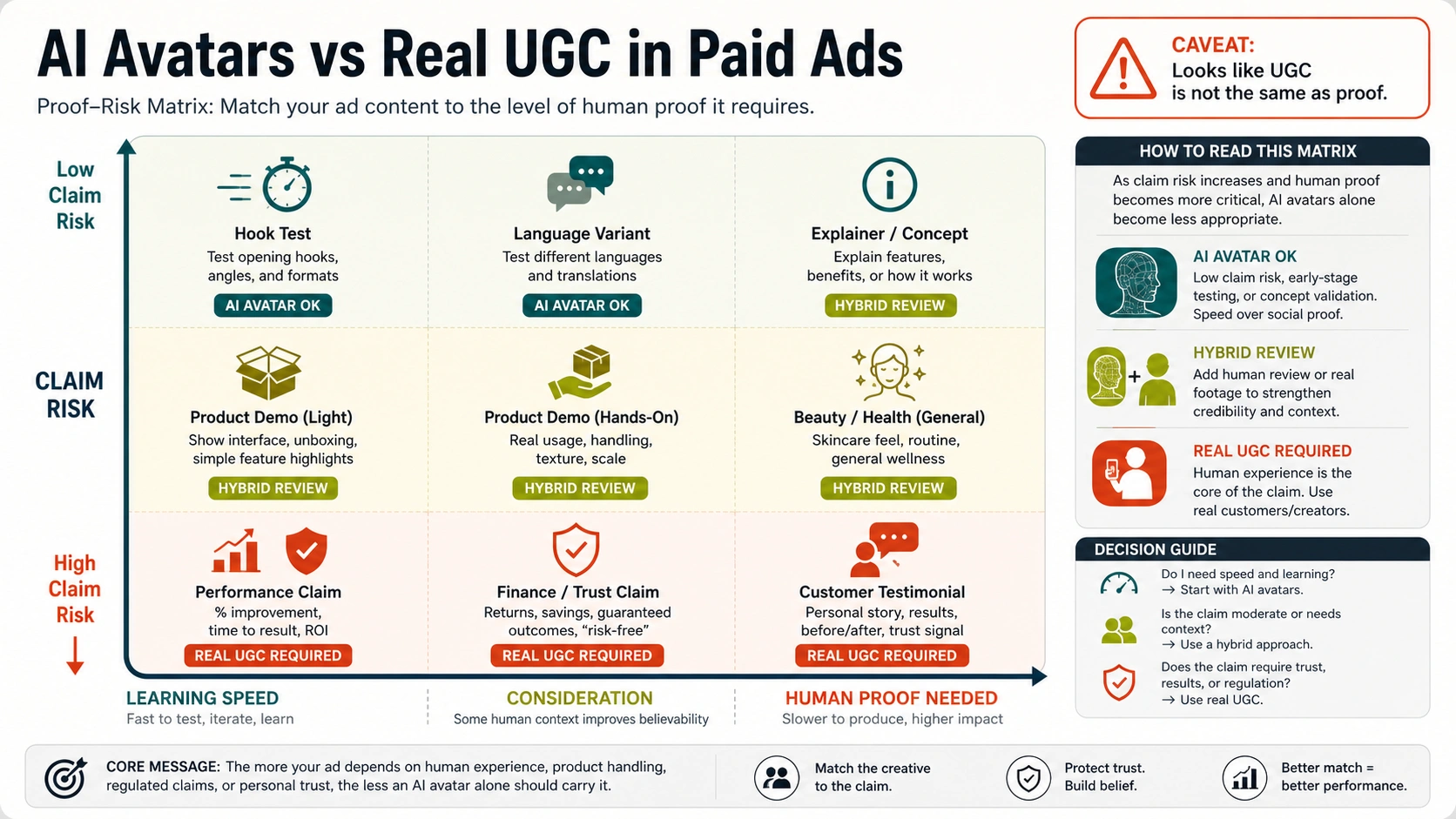
The quickest way to make a good decision is to name the job the next video must perform. If the job is to learn fast, generate variants, test a script, localize a message, or explain a feature that does not require personal experience, an AI avatar can be the practical first route. If the job is to create trust, carry a testimonial, show product contact, or speak with community credibility, real UGC should move to the center.
| If the campaign needs... | Start with | Why | What to measure |
|---|---|---|---|
| Hook learning | AI avatar | You can test multiple openings before committing creator budget | Thumb-stop rate, hold rate, qualified clicks, negative comments |
| Script clarity | AI avatar | A synthetic presenter can isolate wording without changing creator style | Completion, click intent, comprehension in comments or surveys |
| Product demonstration | Real UGC | The product interaction is the evidence | Saves, comments, conversion quality, return reasons |
| Testimonial trust | Real UGC | The speaker's real experience carries the claim | Disclosure clarity, sentiment, qualified conversion, complaint risk |
| New-market localization | AI avatar first, then real creator if trust matters | AI can test translated angle quickly; humans adapt cultural nuance | Local hold rate, comment language, creator resonance |
| Budget discipline | Hybrid workflow | AI filters weak messages before the paid creator shoot | Cost per usable concept, creator brief quality, scaled winners |
The wrong route usually reveals itself through the claim. "Here are three reasons this feature matters" can be avatar-led. "This changed my skin," "I lost money until I tried this," "I fed this to my child," or "I wore this for two weeks" needs a real basis, real disclosure, and often a much higher proof bar. If the viewer would reasonably assume human experience, do not let a synthetic presenter pretend to have it.
When AI avatar videos are the better first move
AI avatars are strongest when the creative problem is variation. A performance team can test different hooks, objections, offers, product angles, and languages without coordinating a new shoot for every idea. That speed is valuable when the team does not yet know whether the message should lead with price, convenience, pain relief, comparison, social proof, or a feature demo.
Avatar video also helps when the content is scripted and low-risk. A software walkthrough, onboarding explainer, product-category education clip, or internal training-style ad may not require a real user's lived experience. In those cases, the avatar is mainly a presenter. The audience is judging whether the message is clear, not whether the presenter personally used the product.
Localization is another strong use case, with a caveat. Synthetic presenters can make it easier to test several languages or regional phrasings before buying creator production in each market. But localization is not just translation. If humor, identity, community codes, buying anxiety, or category trust are central, a local creator can understand what an avatar cannot simply imitate.
The best AI-avatar briefs are narrow:
| Brief element | Good avatar use | Weak avatar use |
|---|---|---|
| Claim | "Here is how the feature works" | "I personally achieved this result" |
| Product contact | Screen, render, light demo, or abstract explanation | Claimed hands-on use that never happened |
| Tone | Clear, direct, repeatable | Over-humanized fake intimacy |
| Test goal | Compare hooks and scripts | Prove customer outcomes |
| Risk level | Low-stakes education or awareness | Health, finance, children, safety, or identity-heavy proof |
AI avatars can be efficient without being deceptive. The discipline is to keep them in the lane where synthetic presentation is enough. Once the creative asks the audience to trust a person's experience, the campaign has moved into a different proof category.
When real UGC earns the extra cost
Real UGC earns its cost when the person on screen is part of the evidence. A creator opening a package, trying a product, wearing an item, cooking with an ingredient, showing a pet's reaction, comparing before-and-after setup, or explaining a problem in their own words gives the ad a proof layer that a synthetic spokesperson cannot manufacture.
This is especially important near the point of purchase. At lower funnel, the viewer may already understand the product. The remaining question is whether it works for someone like them, whether it fits the context, whether the brand can be trusted, and whether the claim feels exaggerated. A real creator can make those questions concrete.
Real UGC also protects against a subtle performance trap. AI avatar ads can test quickly and sometimes produce cheap early signals, but cheap signals are not the same as durable trust. If an avatar-led concept gets clicks because it looks like a casual creator video while carrying a claim no real creator can support, the campaign may buy short-term curiosity at the expense of comments, complaints, refund quality, or brand trust.
Use real UGC first when any of these are true:
| Signal | Why real UGC is safer |
|---|---|
| The ad needs product touch, fit, taste, texture, setup, durability, or routine evidence | The creator's interaction is the proof |
| The claim sounds like a personal result or testimonial | A synthetic speaker should not pretend to be a customer |
| The category is trust-sensitive | Health, finance, beauty, parenting, pets, employment, and safety claims can carry higher audience and policy risk |
| The community has its own language | A real creator can adapt tone, nuance, and objections |
| Comment trust matters as much as click-through | Real creator context can reduce "is this fake?" friction |
The strongest real UGC briefs do not ask creators to recite a brand script word for word. They give the creator the angle, required claims, disclosure needs, product facts, banned statements, and proof shots, then leave room for lived language. That is where real UGC beats a synthetic spokesperson: not polish, but credible specificity.
The hybrid workflow: test synthetically, prove humanly
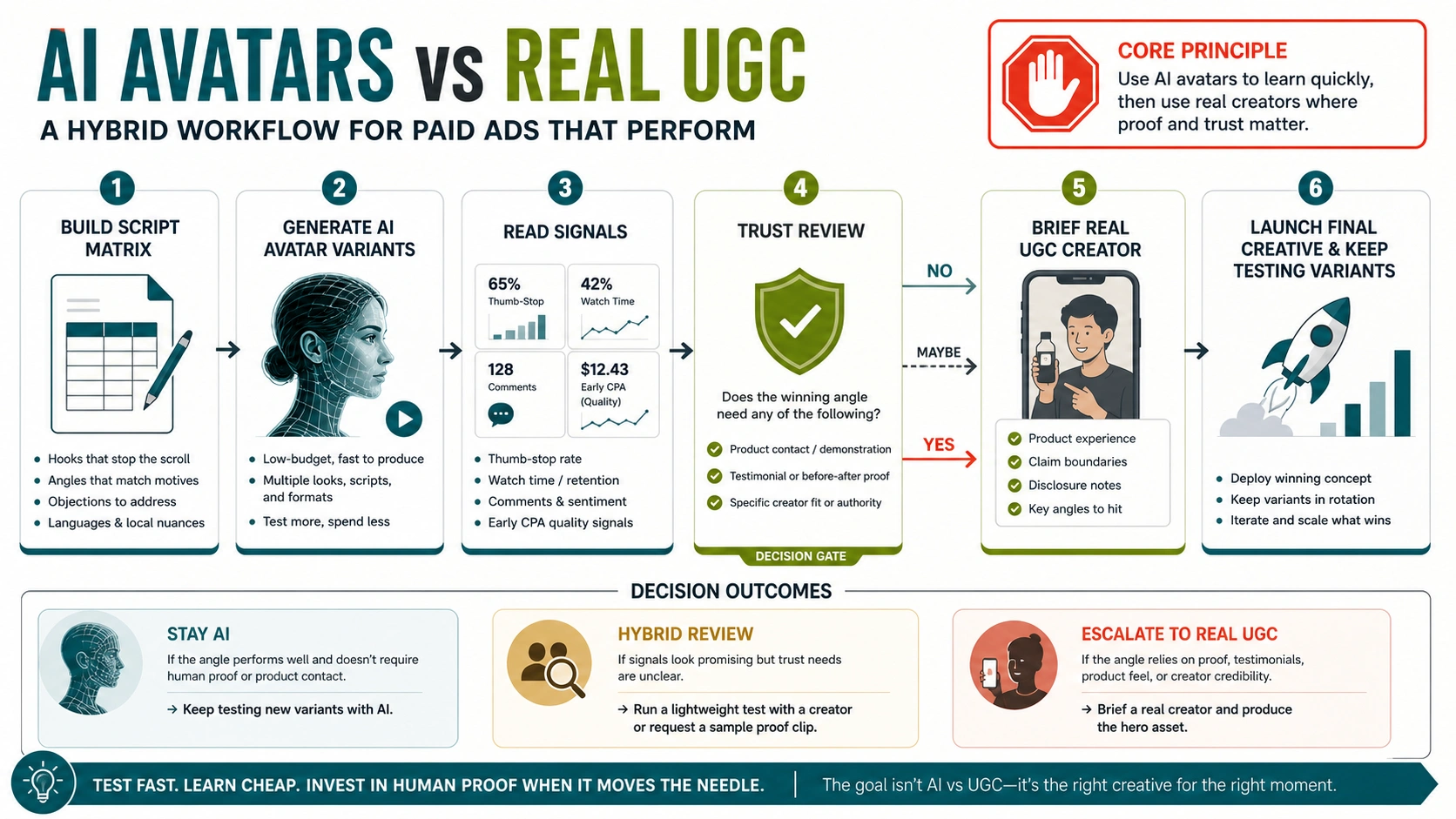
The practical default for many paid-social teams is not AI avatars or real UGC. It is a staged workflow.
First, use AI avatars to test message hypotheses. Write multiple scripts around different jobs: price objection, time saved, social embarrassment, setup anxiety, comparison with the old way, or one surprising product feature. Keep each video honest: no fake user story, no claimed experience, no invented testimonial.
Second, read the results as direction, not final proof. A strong avatar test can tell you which hook earns attention, which objection is worth answering, and which language deserves creator budget. It cannot prove that a real customer had the experience the script describes.
Third, brief human creators around the winning angle. Give them the message that earned attention, the product facts that must remain accurate, the proof shots needed, the disclosure language, and the freedom to express the experience in their own voice. The final ad should not merely reproduce the avatar script with a human face. It should add real product contact, honest context, and creator-specific language.
| Step | Output | Owner | Pass condition |
|---|---|---|---|
| 1. Message map | 6-12 hooks or objections | Performance creative lead | Each script has one clear claim and no fake experience |
| 2. Avatar test | Synthetic variants | Media buyer or creative ops | The test identifies promising angles, not final testimonials |
| 3. Evidence review | Proof and disclosure needs | Brand, legal, policy, or senior marketer | Claims are separated into explainers, demos, and testimonials |
| 4. Creator brief | Human production plan | Creator manager | Creators can honestly show or discuss the product |
| 5. Scale decision | Final ad route | Growth team | AI keeps low-risk variants; humans carry proof-heavy claims |
This workflow also reduces creative waste. Instead of asking ten creators to explore ten unrelated angles, the team can use avatar tests to narrow the brief. Instead of asking AI to replace all creators, the team uses AI to buy learning and reserves human production for claims that need human credibility.
Disclosure and trust guardrails
Synthetic media, endorsements, and ad claims are not only creative choices. They can create disclosure and deception risk. In the United States, the FTC Endorsement Guides explain that endorsements and material connections need clear handling, and the FTC's 2024 rule against fake reviews and testimonials makes fake customer-proof practices especially sensitive. Platform rules also matter: TikTok's synthetic media help page says AI-generated or synthetic media can need labeling and must not mislead viewers, while Google Ads misrepresentation policy focuses on misleading claims, identity, and trust signals. EU transparency obligations can also apply to certain AI-generated or deepfake-style content under the EU AI Act framework.
That does not mean every avatar ad is illegal or every AI video is risky. It means the ad team should classify the claim before production and review the current platform and jurisdiction rules before launch. Compliance language changes by country, platform, product category, and claim type, so this is a guardrail, not legal advice.
Use this stop rule before publishing:
| If the ad says or implies... | Safer route |
|---|---|
| "I tried this," "my results," "my routine," or "my honest review" | Real person with real experience and proper disclosure |
| A medical, financial, body, child, pet, safety, or employment outcome | Higher proof review before any production route |
| A synthetic person is a real customer or unpaid creator | Stop; do not make the ad |
| A paid creator is independent when they are compensated | Add clear disclosure |
| AI-generated media could materially change how the viewer understands the ad | Check platform labeling rules before launch |
The trust question is simple: would a reasonable viewer feel misled if they learned how the video was made? If the answer might be yes, the creative route needs a disclosure, a human creator, a narrower claim, or a different concept.
A practical testing checklist for paid ads
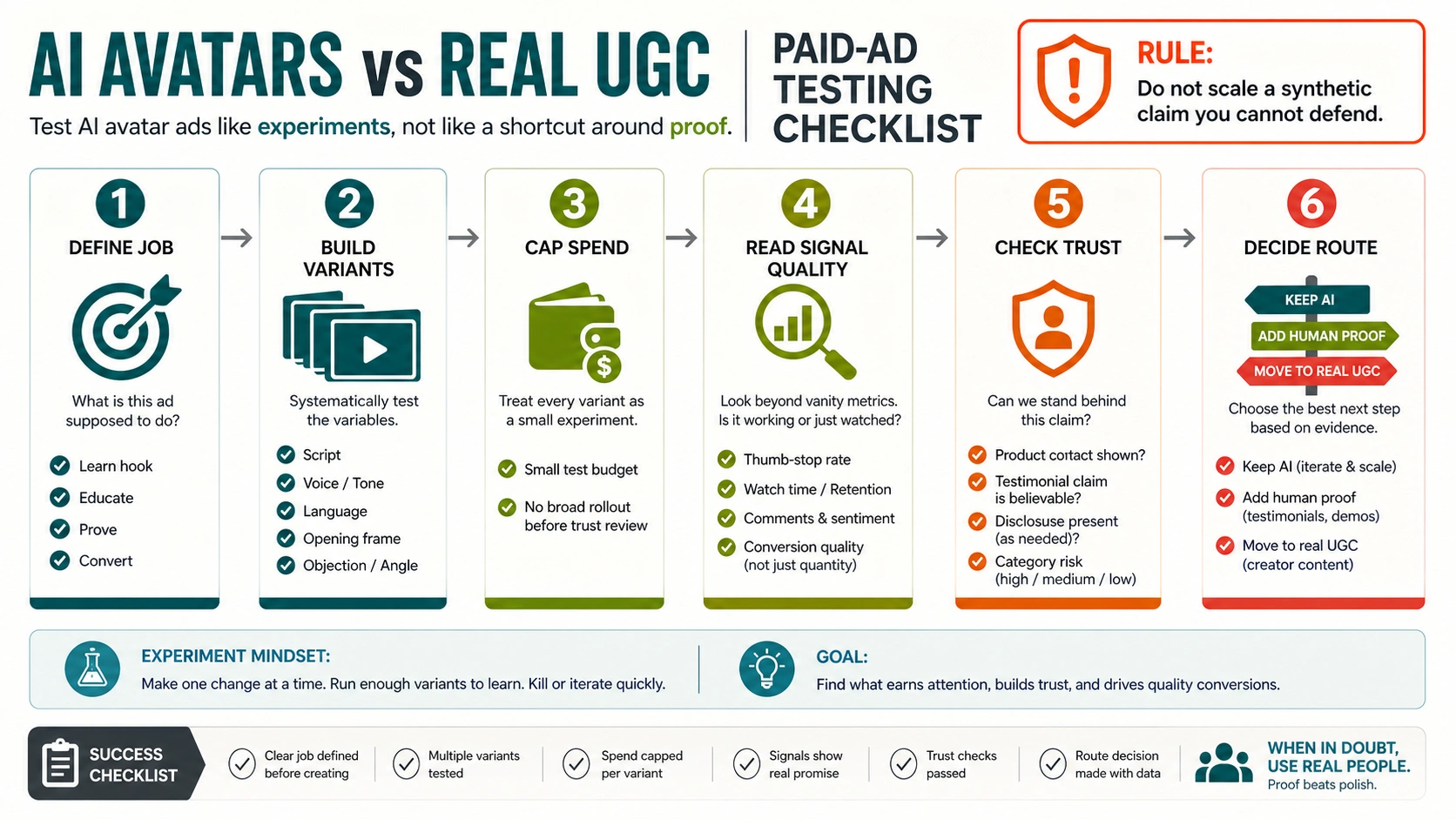
Start every AI-avatar-versus-UGC decision with a small planning sheet. It should name the ad job, proof burden, route, disclosure needs, and next action. Without that sheet, teams tend to choose the route that is easiest to produce rather than the one that matches the claim.
| Question | If yes | If no |
|---|---|---|
| Is the campaign still searching for the winning hook? | Use AI avatars for controlled variants | Move toward creator proof or production polish |
| Does the claim require lived experience? | Use real UGC or rewrite the claim | Avatar route may be acceptable |
| Would viewers assume the speaker is a real customer? | Disclose, use a real creator, or avoid the format | Keep synthetic presentation clearly non-testimonial |
| Is the category trust-sensitive? | Add policy and claim review before launch | Keep normal ad QA but still avoid fake proof |
| Are you localizing into a new market? | Test language synthetically, then validate with local creators if trust matters | Use the original market route |
| Did avatar tests produce a promising angle? | Convert the angle into a human creator brief | Keep iterating scripts before buying creator production |
Measure the route according to its job. AI-avatar tests should be judged by learning speed, cost per usable concept, hook retention, and clarity. Real UGC should be judged by trust signals, comment quality, qualified conversion, product understanding, and whether the ad can scale without creating credibility debt. A hybrid workflow should be judged by whether it improves both: fewer wasted creator shoots and stronger final proof.
FAQ
Will AI avatars replace UGC creators?
AI avatars will replace some low-risk scripted presenter work, especially for fast variants, explainers, and localization tests. They should not replace real UGC when the ad depends on human product experience, testimonial credibility, community trust, or category-sensitive proof.
What is AI UGC?
AI UGC usually means synthetic or avatar-led content that imitates the style of user-generated content: vertical video, creator-style speech, casual editing, captions, and direct-response hooks. It is not automatically real user-generated content, and it should not be used to fake a real customer's experience.
Do AI avatar ads convert better than real UGC?
There is no universal answer. AI avatar ads can be efficient for testing many scripts quickly, and real UGC can be stronger when the buyer needs proof or trust. Treat performance claims by tool vendors, agencies, or social posts as context unless they include transparent test design, product category, audience, spend, and measurement details.
When is real UGC worth the cost?
Real UGC is worth it when the product has to be touched, worn, tasted, installed, compared, or experienced; when the claim sounds like a testimonial; when the category is sensitive; or when community trust matters. The creator's real relationship with the product is the asset.
Do AI avatar or AI UGC ads need disclosure?
Disclosure depends on the platform, country, claim, and production method. Paid endorsements, fake testimonials, synthetic media, and misleading identity signals can all create duties or policy risk. Check the current rules for the platforms and jurisdictions where the ad will run before launch.
What is a UGC avatar?
A UGC avatar is a synthetic presenter used in a UGC-style ad format. It may deliver casual scripts, product hooks, and vertical-video pacing, but it is still synthetic. The safer phrase is "AI avatar video" or "AI UGC ad" unless a real user or creator is actually involved.
What should a team test first?
Test the message first if the team is still unsure about hooks or objections. Use AI avatars for controlled script variants, then move winning angles into real creator briefs when the final ad needs product proof, trust, or testimonial weight.
What is the fastest wrong move?
The fastest wrong move is to make an AI avatar look like a real satisfied customer. That may produce a polished ad, but it also creates the exact trust problem the campaign was supposed to solve.