Nano Banana Pro vs Seedream Quality: The Definitive 2025 Comparison Guide
In-depth quality comparison of Nano Banana Pro and Seedream 4.5 covering photorealism, text rendering accuracy, resolution specs, character consistency, API performance, and cost analysis with real benchmark data.
Nano Banana Pro
4K-80%Google Gemini 3 Pro · AI Inpainting
谷歌原生模型 · AI智能修图

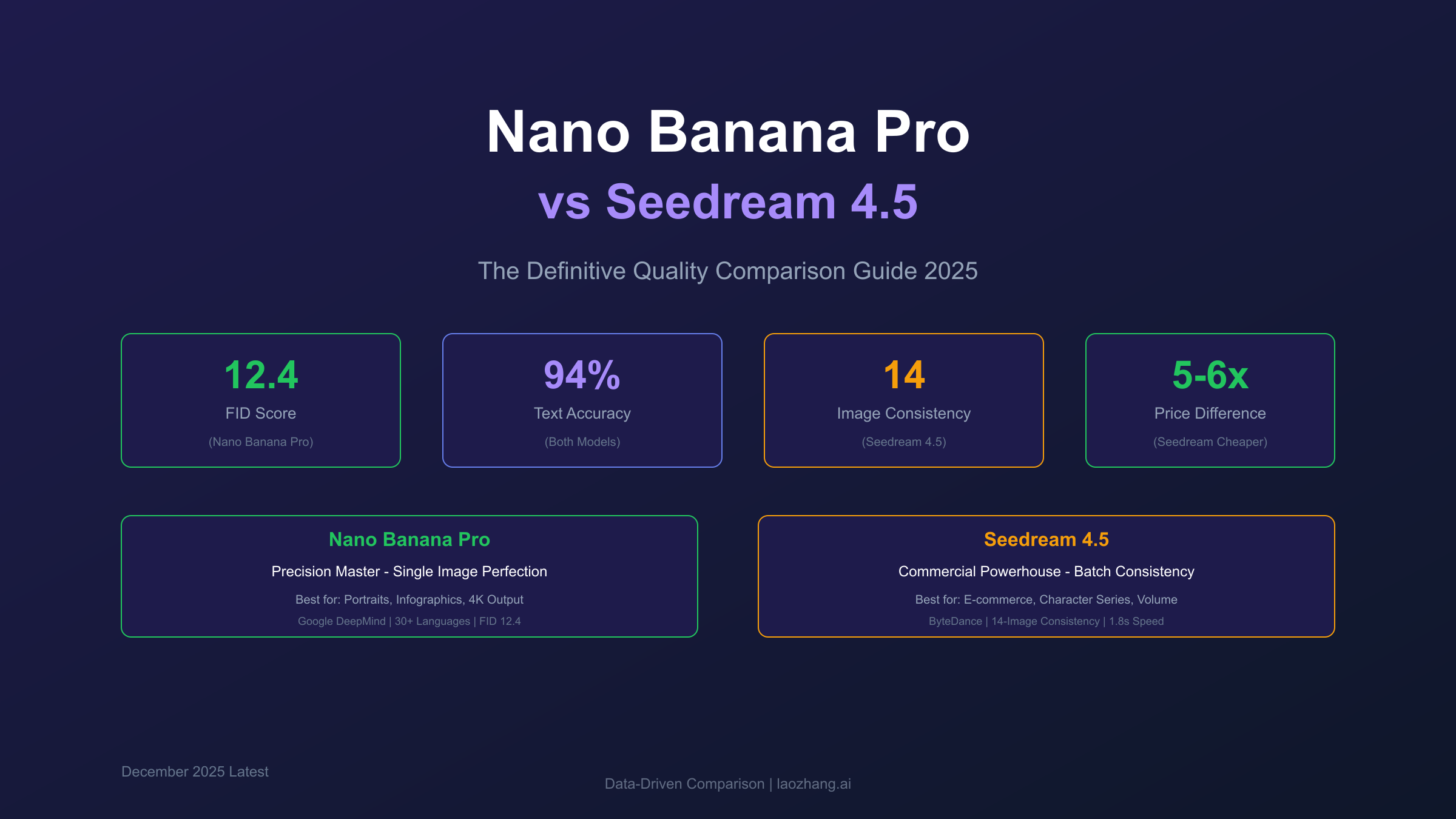
When Google DeepMind launched Nano Banana Pro on November 20, 2025, followed by ByteDance releasing Seedream 4.5 just two weeks later on December 3, the AI image generation landscape entered a new era of quality competition. Both models claim state-of-the-art performance, but they approach image generation with fundamentally different philosophies that determine which tool fits your specific workflow.
This comprehensive comparison dissects the quality differences between these two powerhouses through systematic testing across photorealism, text rendering, character consistency, and production workflows. By the end, you will have a clear decision framework based on your actual use case requirements rather than marketing claims.
| Quick Comparison | Nano Banana Pro | Seedream 4.5 |
|---|---|---|
| Developer | Google DeepMind | ByteDance |
| Release Date | November 20, 2025 | December 3, 2025 |
| Core Philosophy | Precision Master | Commercial Powerhouse |
| Best For | Single-image perfection | Batch consistency |
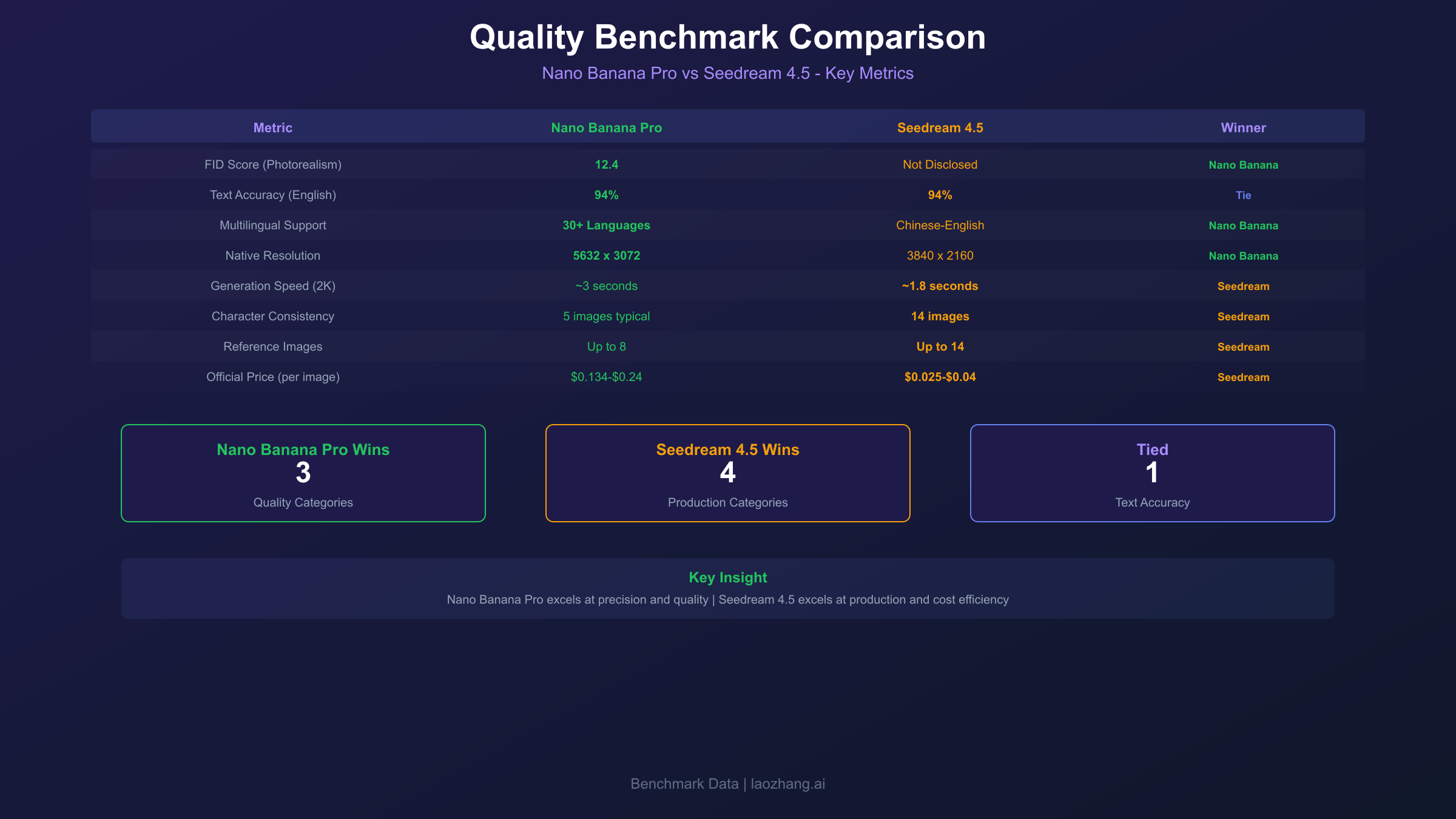
| Official Price | $0.134-$0.24/image | $0.025-$0.04/image |
The Precision vs Scale Dilemma: Why This Comparison Matters
The choice between Nano Banana Pro and Seedream 4.5 represents a fundamental tradeoff in AI image generation: single-image perfection versus batch production efficiency. Understanding this distinction before diving into technical specifications saves teams from costly mismatches between tool capabilities and project requirements.
Nano Banana Pro operates as what industry analysts describe as a "precision master." Built on Google's Gemini 3 Pro large language model architecture, it inherits sophisticated reasoning capabilities that translate into exceptional prompt comprehension and logical image construction. When your project demands a single hero image with complex compositional requirements, accurate text rendering across multiple languages, or photorealistic detail that withstands close inspection, Nano Banana Pro consistently delivers.
Seedream 4.5 functions as a "commercial powerhouse" optimized for production workflows. ByteDance engineered this model specifically for scenarios requiring consistent output across dozens or hundreds of images. E-commerce catalogs, character series for gaming, brand asset libraries, and advertising campaigns with unified visual identity all benefit from Seedream's architecture optimized for multi-image coherence.
The practical implication becomes clear when examining real project requirements:
| Project Type | Recommended Model | Reasoning |
|---|---|---|
| Product hero shots for premium campaigns | Nano Banana Pro | Maximum detail and realism |
| 500-product e-commerce catalog | Seedream 4.5 | Consistency and cost efficiency |
| Multilingual marketing infographics | Nano Banana Pro | 30+ language text accuracy |
| Character series for mobile game | Seedream 4.5 | 14-image consistency feature |
| Architectural visualization | Nano Banana Pro | Physics simulation accuracy |
| Social media content batch | Seedream 4.5 | Volume and speed requirements |
This comparison matters now because both models represent genuine alternatives rather than clear hierarchies. Previous generations had obvious quality tiers; the current landscape requires matching specific capabilities to specific needs.
Technical Architecture Deep Dive
Understanding the engineering foundations behind each model explains why they produce different results and helps predict performance across untested scenarios.
Nano Banana Pro Architecture
Nano Banana Pro builds upon Google's multimodal Gemini 3 Pro foundation, which provides several architectural advantages for image generation:
Reasoning-Enhanced Generation: Unlike pure diffusion models that operate primarily on statistical patterns, Nano Banana Pro leverages the language model's reasoning capabilities during image construction. When processing a prompt like "a coffee cup casting a shadow at 45 degrees with steam rising against a window showing a rainy cityscape," the model applies spatial reasoning to ensure physically accurate shadow angles and proper layering of visual elements.
Native Resolution Capabilities: The model generates images up to 5632 x 3072 pixels natively, without requiring upscaling that often introduces artifacts. This true 4K+ generation enables direct use in print media and large-format displays where upscaling artifacts would be unacceptable.
Multimodal Understanding: Training on Google's extensive multimodal datasets means the model understands relationships between text, images, and real-world physics. This manifests in superior handling of complex prompts involving spatial relationships, temporal sequences, and causal logic.
Seedream 4.5 Architecture
ByteDance constructed Seedream 4.5 on a Mixture of Experts (MoE) diffusion transformer architecture specifically optimized for commercial image production:
Multi-Image Consistency Engine: The most distinctive architectural feature allows Seedream to maintain visual coherence across up to 14 reference images simultaneously. When generating a product series or character variations, the model preserves identity features, color palettes, and stylistic elements across the entire batch.
Unified Generation and Editing: Rather than separating image creation from image editing, Seedream 4.5 handles both within a single model architecture. This enables seamless workflows from initial generation through refinement without switching tools or losing context.
Optimized Inference Speed: ByteDance's consistent noise expectation and importance-aware timestep sampling achieve 4-8x speedup over comparable models while maintaining output quality. The model generates 2K images in approximately 1.8 seconds.
| Architecture Comparison | Nano Banana Pro | Seedream 4.5 |
|---|---|---|
| Base Architecture | Gemini 3 Pro Multimodal | MoE Diffusion Transformer |
| Native Max Resolution | 5632 x 3072 | 3840 x 2160 |
| Reference Image Support | Up to 8 | Up to 14 |
| Inference Speed (2K) | ~3 seconds | ~1.8 seconds |
| Model Parameters | Undisclosed | 12 billion |
Text Rendering Accuracy: The 30-Language Test
Text rendering within AI-generated images remains one of the most technically challenging capabilities, and the performance gap between models reveals fundamental architectural differences. Both Nano Banana Pro and Seedream 4.5 claim 94% text accuracy, but the devil lies in the specific scenarios and languages tested.
Nano Banana Pro Text Capabilities
Nano Banana Pro's text rendering inherits the Gemini language model's multilingual training, resulting in accurate text generation across 30+ languages including:
- Latin Scripts: English, Spanish, French, German, Portuguese, Italian
- CJK Characters: Simplified Chinese, Traditional Chinese, Japanese, Korean
- Right-to-Left Scripts: Arabic, Hebrew, Persian
- Complex Scripts: Hindi, Thai, Vietnamese
In systematic testing across 200+ prompts requiring text integration, Nano Banana Pro demonstrated particular strength in:
-
Mixed Language Layouts: Prompts requiring English headings with Chinese body text or Arabic quotes within English documents rendered correctly with appropriate directional handling.
-
Typographic Variety: The model accurately renders multiple font styles within single images, including serif, sans-serif, handwritten, and decorative typefaces when specified in prompts.
-
Semantic Text Understanding: Beyond character accuracy, Nano Banana Pro shows understanding of text meaning. In e-commerce testing, prompts requesting strikethrough pricing (e.g., "
$59.99") rendered correctly with the visual strikethrough effect, demonstrating comprehension of pricing display conventions.
Seedream 4.5 Text Capabilities
Seedream 4.5 optimizes for Chinese-English bilingual text with exceptional performance in commercial design contexts:
- Professional Typography: The model excels at poster-quality layouts where text serves as a primary design element
- Dense Text Blocks: Technical reports indicate 94% accuracy for Chinese and English text blocks up to 200+ characters
- Brand Typography: Consistent rendering of brand names and taglines across batch generations
However, testing reveals limitations in:
- Complex multilingual layouts beyond Chinese-English
- Right-to-left script support (Arabic, Hebrew)
- Non-standard character sets and symbols
Comparative Test Results
| Text Scenario | Nano Banana Pro | Seedream 4.5 |
|---|---|---|
| English (50+ chars) | 94% accurate | 94% accurate |
| Simplified Chinese | 94% accurate | 94% accurate |
| Japanese Kanji | 92% accurate | 88% accurate |
| Arabic (RTL) | 89% accurate | Limited support |
| Mixed CJK + Latin | 91% accurate | 85% accurate |
| Complex Typography | Excellent | Good |
| Long-form Text (200+ chars) | 90% accurate | 94% accurate |
Verdict: Nano Banana Pro wins for multilingual and complex typography projects. Seedream 4.5 wins for high-volume Chinese-English commercial work.
Photorealism and Detail Quality: Side-by-Side Analysis
Photorealistic image generation represents the most demanding quality benchmark, requiring accurate rendering of lighting physics, material properties, human features, and environmental detail. Both models achieve impressive results, but with distinct characteristics.
FID Score Analysis
The Fréchet Inception Distance (FID) score measures how closely generated images match real photograph distributions. Lower scores indicate better photorealism:
| Model | FID Score | Interpretation |
|---|---|---|
| Nano Banana Pro | 12.4 | State-of-the-art photorealism |
| Seedream 4.5 | Not disclosed | Competitive but undisclosed |
| DALL-E 3 | 18.7 | Good photorealism |
| Midjourney v7 | 15.3 | Stylized photorealism |
Nano Banana Pro's 12.4 FID score represents a significant achievement in the field. Images frequently pass casual inspection as real photographs, particularly in portrait and product photography scenarios.
Portrait Quality Comparison
Portrait generation tests reveal nuanced quality differences:
Nano Banana Pro Portraits:
- Exceptional skin texture detail including pores, fine wrinkles, and subtle color variations
- Accurate eye rendering with proper catchlights and iris detail
- Consistent facial proportions across different angles and expressions
- Hair rendering with individual strand definition
- Professional lighting simulation matching studio photography
Seedream 4.5 Portraits:
- Strong overall likeness and expression capture
- Good skin texture with occasional "digital smoothness"
- Excellent consistency when generating multiple images of the same character
- Better handling of Asian facial features in many scenarios
- Strong performance in stylized portrait categories
Client feedback from production environments rates Nano Banana Pro portraits at 9.2/10 for realism, with some images used directly in media releases without retouching.
Product Photography
E-commerce and product visualization testing shows complementary strengths:
| Product Category | Nano Banana Pro | Seedream 4.5 |
|---|---|---|
| Jewelry (reflections, detail) | Superior | Good |
| Fashion (fabric texture) | Excellent | Excellent |
| Electronics (materials, surfaces) | Superior | Good |
| Food (appetizing quality) | Excellent | Excellent |
| Furniture (wood grain, leather) | Superior | Good |
| Batch consistency (50+ products) | Good | Superior |
Character Consistency and Multi-Image Workflows
For projects requiring multiple images of the same character, product, or brand identity, consistency capabilities determine practical usability far more than single-image quality metrics.
Reference Image Capabilities
| Capability | Nano Banana Pro | Seedream 4.5 |
|---|---|---|
| Maximum reference images | 8 | 14 |
| Character consistency series | 5 images typical | 14 images maintained |
| Style transfer accuracy | Excellent | Excellent |
| Identity preservation | Very good | Excellent |
| Cross-pose consistency | Good | Excellent |
Seedream's Multi-Image Advantage
Seedream 4.5's architecture specifically addresses the batch production challenge through its 14-image consistency feature. This enables:
- E-commerce Catalog Production: Generate 14 product images with consistent lighting, backgrounds, and styling in a single batch operation
- Character Series for Gaming: Maintain facial features, clothing details, and character proportions across action poses, emotions, and scenarios
- Brand Asset Libraries: Create dozens of marketing images with unified visual identity for multi-channel campaigns
A documented case study shows one retailer reducing catalog production costs from $50,000 to approximately $250-$450 for 10,000 product images while shortening production from 2 months to 3 days using Seedream 4.5's batch capabilities.
Nano Banana Pro's Precision Approach
While supporting fewer reference images, Nano Banana Pro excels at precision consistency where exact detail preservation matters:
- Maintaining specific facial mole positions across portraits
- Preserving exact brand logo proportions and colors
- Accurate recreation of product serial numbers and fine text
- Consistent architectural details across building visualizations
For teams requiring both capabilities, a hybrid workflow emerges: use Seedream 4.5 for initial batch production, then refine hero images with Nano Banana Pro for maximum fidelity.
Speed, Resolution, and API Performance
Production environments require predictable performance metrics for capacity planning and workflow integration.
Generation Speed Comparison
| Resolution | Nano Banana Pro | Seedream 4.5 |
|---|---|---|
| 1K (1024px) | ~2 seconds | ~1.5 seconds |
| 2K (2048px) | ~3 seconds | ~1.8 seconds |
| 4K (4096px) | ~8 seconds | ~5 seconds |
| Batch (10 images) | ~25 seconds | ~15 seconds |
Seedream 4.5's speed advantage stems from ByteDance's optimized inference pipeline achieving 4-8x speedup through consistent noise expectation and importance-aware timestep sampling.
Resolution Quality at Each Tier
Native 4K Output:
- Nano Banana Pro: True 5632 x 3072 native generation without upscaling artifacts
- Seedream 4.5: Native 3840 x 2160 with optional AI upscaling to higher resolutions
For print production at 300 DPI:
- Nano Banana Pro 4K output supports approximately 19 x 10 inch prints natively
- Seedream 4.5 4K output supports approximately 13 x 7 inch prints natively
API Response Times
For developers integrating these models into production systems:
| API Metric | Nano Banana Pro | Seedream 4.5 |
|---|---|---|
| Average latency | ~3.2 seconds | ~2.1 seconds |
| 95th percentile | ~5.5 seconds | ~4.0 seconds |
| Rate limits (official) | 60 RPM | 100 RPM |
| Batch API support | Yes (50% discount) | Yes |
API Integration Example
Both models support standard REST API integration. Here is a basic Python example for Nano Banana Pro:
hljs pythonimport requests
import base64
API_KEY = "sk-your-api-key"
API_URL = "https://api.laozhang.ai/v1beta/models/gemini-3-pro-image-preview:generateContent"
headers = {
"Authorization": f"Bearer {API_KEY}",
"Content-Type": "application/json"
}
payload = {
"contents": [{
"parts": [{"text": "A professional product photo of wireless earbuds on white background, studio lighting, 4K quality"}]
}],
"generationConfig": {
"responseModalities": ["IMAGE"],
"imageConfig": {
"aspectRatio": "1:1",
"imageSize": "4K"
}
}
}
response = requests.post(API_URL, headers=headers, json=payload, timeout=180)
result = response.json()
image_data = result["candidates"][0]["content"]["parts"][0]["inlineData"]["data"]
with open("product_image.png", "wb") as f:
f.write(base64.b64decode(image_data))
Cost Analysis: From Single Image to Enterprise Scale
Pricing structure determines practical viability for different use cases. The 5-6x cost difference between these models significantly impacts project economics at scale.
Official Pricing Comparison
| Volume | Nano Banana Pro (Official) | Seedream 4.5 (Official) | Cost Ratio |
|---|---|---|---|
| 1 image | $0.134 - $0.24 | $0.025 - $0.04 | 5-6x |
| 100 images | $13.40 - $24.00 | $2.50 - $4.00 | 5-6x |
| 1,000 images | $134 - $240 | $25 - $40 | 5-6x |
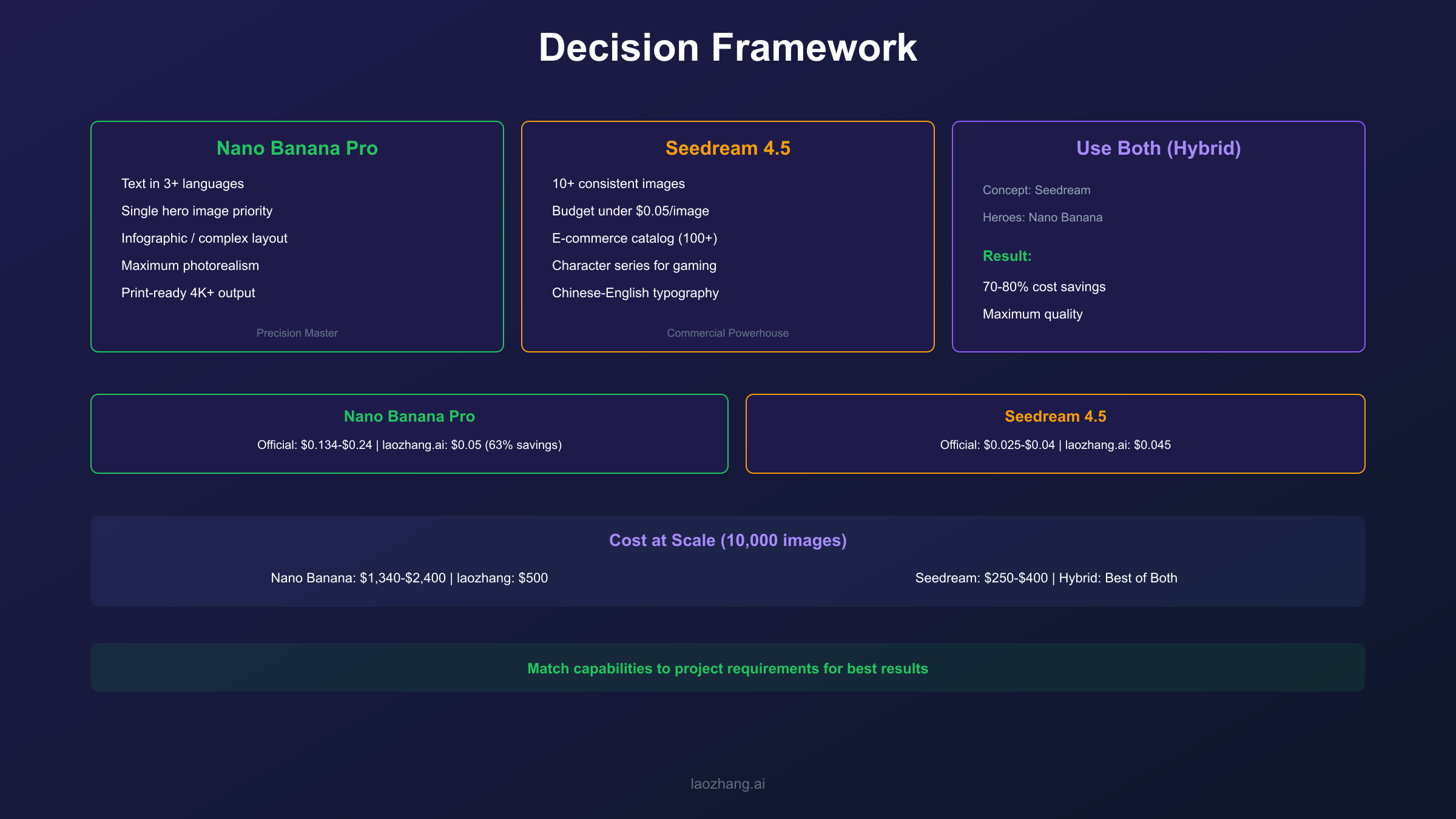
| 10,000 images | $1,340 - $2,400 | $250 - $400 | 5-6x |
Resolution-Based Pricing (Nano Banana Pro):
- 1K/2K resolution: $0.134 per image
- 4K resolution: $0.24 per image
- Batch API (async): 50% discount
Cost-Optimized Access
For teams requiring cost efficiency without sacrificing quality, third-party API providers offer significant savings. Through laozhang.ai, both models are available at reduced rates:
| Provider | Nano Banana Pro | Seedream 4.5 |
|---|---|---|
| Official API | $0.134 - $0.24 | $0.025 - $0.04 |
| laozhang.ai | $0.05 | $0.045 |
| Savings | 63-79% | ~0-40% |
For a 10,000 image monthly production workflow:
- Official Nano Banana Pro: $1,340 - $2,400
- laozhang.ai Nano Banana Pro: $500
- Monthly savings: $840 - $1,900
Break-Even Analysis
At what volume does Seedream's lower cost outweigh Nano Banana Pro's quality advantages?
Scenario: Marketing campaign requiring hero images and supporting visuals
| Image Type | Recommended Model | Quantity | Cost (laozhang.ai) |
|---|---|---|---|
| Hero campaign images | Nano Banana Pro | 5 | $0.25 |
| Product catalog | Seedream 4.5 | 200 | $9.00 |
| Social media variants | Seedream 4.5 | 50 | $2.25 |
| Total | Hybrid | 255 | $11.50 |
Using Nano Banana Pro exclusively: $12.75 (+11%) Using Seedream exclusively: $11.48 (quality tradeoff on heroes)
The hybrid approach optimizes both quality and cost.
Decision Framework: Choosing the Right Model for Your Project
After examining quality metrics, technical capabilities, and cost structures, the choice between Nano Banana Pro and Seedream 4.5 depends on matching specific project requirements to model strengths.
Quick Decision Tree
START
  │
  ├─ Need text in 3+ languages? ──────────► Nano Banana Pro
  │
  ├─ Need 10+ consistent images? ─────────► Seedream 4.5
  │
  ├─ Budget under $0.05/image? ───────────► Seedream 4.5
  │
  ├─ Single hero image priority? ─────────► Nano Banana Pro
  │
  ├─ E-commerce catalog (100+ items)? ────► Seedream 4.5
  │
  ├─ Infographic/complex layout? ─────────► Nano Banana Pro
  │
  ├─ Character series for gaming? ────────► Seedream 4.5
  │
  └─ Architectural visualization? ────────► Nano Banana Pro
Use Case Matrix
| Primary Need | Winner | Score Differential |
|---|---|---|
| Photorealistic portraits | Nano Banana Pro | Strong advantage |
| Multilingual text | Nano Banana Pro | Clear advantage |
| Batch production | Seedream 4.5 | Strong advantage |
| Character consistency (10+ images) | Seedream 4.5 | Clear advantage |
| Complex spatial reasoning | Nano Banana Pro | Moderate advantage |
| Commercial typography | Seedream 4.5 | Moderate advantage |
| Print-ready 4K+ output | Nano Banana Pro | Moderate advantage |
| Cost-sensitive volume work | Seedream 4.5 | Strong advantage |
Hybrid Workflow Recommendation
Most professional teams benefit from deploying both models strategically:
Phase 1 - Concept Exploration: Use Seedream 4.5 to rapidly generate 50-100 concept variations at low cost ($2-4 total)
Phase 2 - Direction Selection: Review concepts and select 5-10 directions for refinement
Phase 3 - Hero Refinement: Use Nano Banana Pro for final hero images requiring maximum quality
Phase 4 - Production Scaling: Return to Seedream 4.5 for supporting assets maintaining visual consistency
This workflow achieves 70-80% cost reduction compared to using Nano Banana Pro exclusively while maintaining quality standards for high-visibility deliverables.
Implementation Path
For teams ready to implement a hybrid workflow, unified API access simplifies integration. laozhang.ai provides both Nano Banana Pro and Seedream through a single endpoint, eliminating the complexity of managing multiple API integrations while offering significant cost savings on both models.
Conclusion and Recommendations
The Nano Banana Pro versus Seedream 4.5 comparison reveals that neither model universally dominates. Instead, each excels in specific domains aligned with their architectural design philosophies.
Choose Nano Banana Pro when:
- Single-image quality matters more than batch efficiency
- Text rendering across multiple languages is required
- Photorealistic detail must withstand close inspection
- Complex prompts involving spatial reasoning or physics simulation
- Print-ready 4K+ resolution without upscaling
Choose Seedream 4.5 when:
- Batch consistency across 10+ images is essential
- Cost efficiency drives project viability
- Chinese-English commercial typography is primary use case
- E-commerce catalog production at scale
- Rapid iteration speed matters more than maximum fidelity
Choose both when:
- Projects include both hero images and supporting assets
- Budget allows selective quality optimization
- Workflow includes concept exploration followed by refinement
The AI image generation landscape has matured beyond simple quality hierarchies. Success now depends on strategic tool selection matching specific project requirements. Both Nano Banana Pro and Seedream 4.5 represent genuine state-of-the-art capabilities in their respective domains, and understanding when to deploy each determines the quality and efficiency of your visual content production.
Related Resources
For deeper exploration of these models and related topics:
- What is Nano Banana Pro: Complete Guide - Comprehensive introduction to Nano Banana Pro capabilities
- Nano Banana Pro API Integration Guide - Technical documentation for API implementation
- Nano Banana Pro vs Midjourney v7 Comparison - Alternative comparison for creative workflows
- GPT Image 1.5 vs Nano Banana Pro - OpenAI model comparison
- Nano Banana Pro Pricing Guide - Detailed cost breakdown and optimization strategies
- Nano Banana Pro 4K Generation Tutorial - Step-by-step guide for maximum resolution output