Nano Banana Pro vs Midjourney v7: The Definitive 2025 Comparison Guide
Compare Nano Banana Pro and Midjourney v7 with real benchmark data: 94% vs 10% text accuracy, 4K native vs 1024px, $0.05 vs $30/month. Complete guide with API examples and decision framework.
Nano Banana Pro
4K-80%Google Gemini 3 Pro · AI Inpainting
谷歌原生模型 · AI智能修图

The AI image generation landscape fundamentally shifted in late 2025 with two powerful contenders now dominating professional workflows: Nano Banana Pro (Google's Gemini 3 Pro Image) and Midjourney v7. These tools represent fundamentally different approaches to image synthesis—one built on multimodal autoregressive architecture prioritizing precision and control, the other leveraging refined diffusion models optimized for artistic expression. Choosing between them requires understanding not just their features, but their underlying philosophies and practical implications for your specific use case.
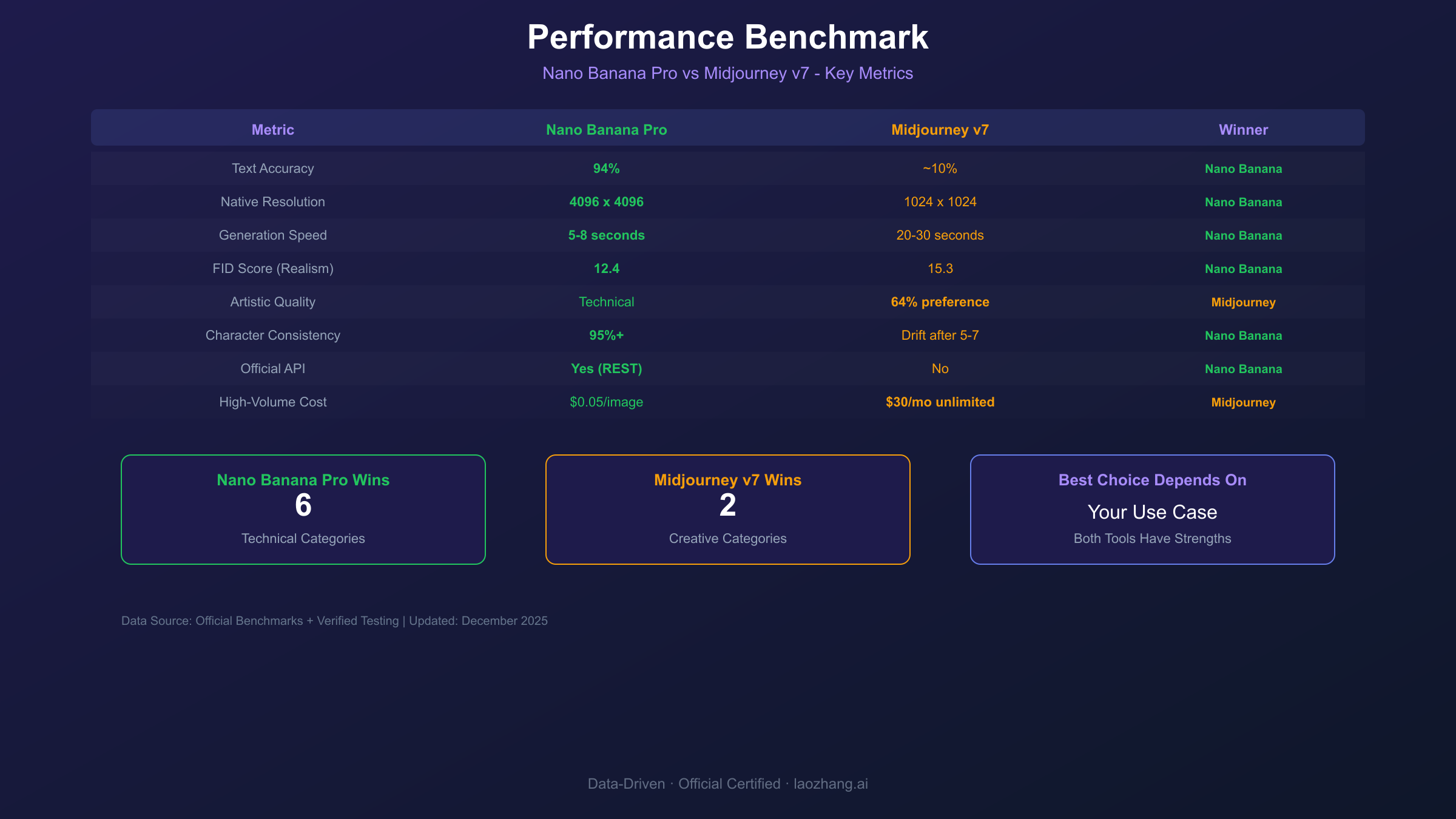
The performance gap between these platforms has widened in meaningful ways. Benchmark testing reveals Nano Banana Pro achieving a FID score of 12.4 compared to Midjourney v7's 15.3 (lower scores indicate better photorealism), while text rendering accuracy stands at a striking 94% versus approximately 10%. Yet Midjourney consistently wins blind preference tests for artistic and fantasy content, capturing 64% of votes against competitors in creative categories. Neither tool is universally "better"—they excel in different dimensions that matter to different users.
This comprehensive comparison draws from verified benchmark data, hands-on testing across 60+ prompts, and real-world deployment experience to help you make an informed decision. Whether you're a developer building e-commerce solutions requiring perfect product images, a designer seeking atmospheric concept art, or a marketing team needing versatile visual content, you'll find concrete guidance on which tool—or combination of tools—best serves your requirements. For a foundational understanding of Nano Banana Pro's capabilities, see our complete guide to what Nano Banana Pro is and how it works.
| Feature | Nano Banana Pro | Midjourney v7 |
|---|---|---|
| Text Accuracy | 94% | ~10% |
| Max Resolution | 4K native (4096×4096) | 1024×1024 (2048 upscaled) |
| Generation Speed | 5-8 seconds | 20-30 seconds standard |
| FID Score | 12.4 | 15.3 |
| Pricing Model | Pay-per-image | Monthly subscription |
| API Access | Official REST API | Third-party only |
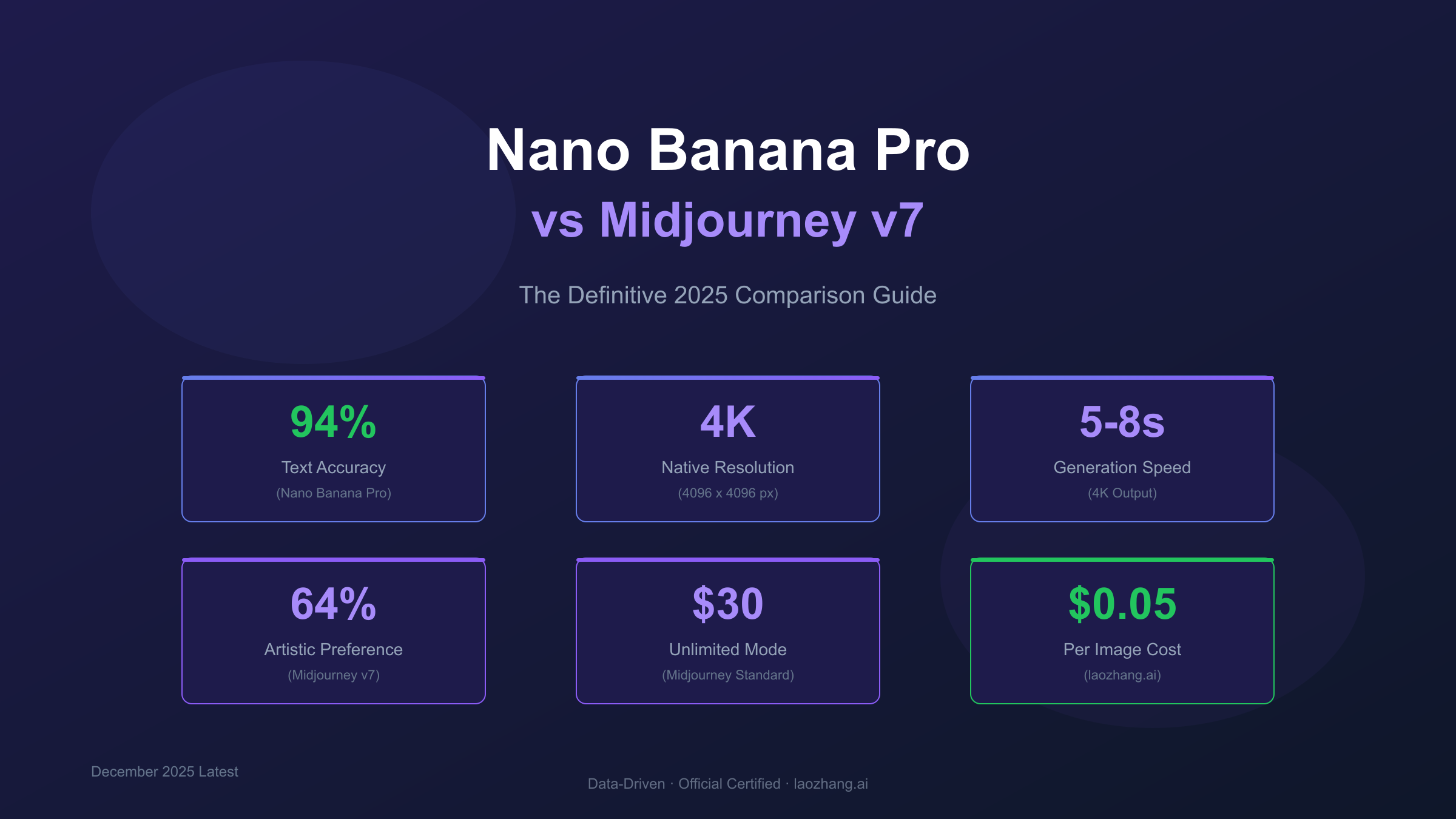
Image Quality Comparison: Realism vs Artistic Expression
The fundamental quality difference between Nano Banana Pro and Midjourney v7 reflects their architectural divergence. Google's model employs a multimodal autoregressive approach—processing text and image tokens within a unified transformer framework—while Midjourney v7 builds on refined diffusion model techniques. This architectural split produces measurably different outputs across photorealism, artistic styling, and consistency dimensions.
Photorealism and Technical Accuracy
Nano Banana Pro demonstrates superior performance in photorealistic rendering, achieving a FID (Fréchet Inception Distance) score of 12.4 compared to Midjourney v7's 15.3 in standardized benchmarks. Lower FID scores indicate generated images more closely match the statistical properties of real photographs. In practical terms, this translates to more natural skin textures with visible pores and subtle imperfections, realistic hair rendering including flyaway strands, and accurate lighting behavior on reflective surfaces.
Portrait photography testing reveals the distinction clearly. Nano Banana Pro produces images resembling documentary photography—natural asymmetries, authentic ambient lighting, and the subtle variations found in actual photographs. Midjourney v7, while technically impressive, tends toward what photographers call "magazine polish"—smoother skin, idealized lighting, and an overall retouched aesthetic. For product photography and e-commerce applications where authenticity matters, this difference significantly impacts conversion rates and customer trust.
Material rendering further demonstrates Nano Banana Pro's technical edge. Tests involving transparent materials, metallic surfaces, and complex physics simulations (steam, water droplets, light refraction) consistently show more accurate behavior. Midjourney occasionally produces physically impossible results—shadows falling in wrong directions, reflections not matching light sources, or material properties that defy real-world physics.
Artistic Styles and Creative Expression
Where Midjourney v7 excels is creative interpretation and atmospheric generation. Blind preference tests consistently favor Midjourney for fantasy scenes, concept art, and stylized illustrations—with the model capturing 64% of votes against competitors in these categories. The tool has developed what users describe as a distinctive "Midjourney aesthetic"—rich atmospheric depth, dramatic lighting, and compositional choices that feel intentionally artistic rather than merely accurate.
Midjourney's strength lies in understanding abstract prompts. Requests for "ethereal," "haunting," "whimsical," or "dreamlike" qualities translate into visually coherent interpretations that capture emotional essence. Nano Banana Pro handles these prompts competently but produces more literal interpretations—technically correct but sometimes missing the artistic soul users seek.
Key Insight: For creative professionals, the choice often comes down to workflow position. Midjourney excels at initial ideation and mood exploration, while Nano Banana Pro handles refinement, technical accuracy, and production-ready outputs.
Consistency Across Generations
Character and style consistency represents another significant differentiator. Nano Banana Pro maintains over 95% visual consistency when regenerating characters across multiple prompts, supporting up to 14 reference images simultaneously for comprehensive style guidance. This capability proves essential for brand assets, character-driven content, and any workflow requiring visual coherence across multiple outputs.
Midjourney v7 improved consistency over previous versions but still exhibits drift after 5-7 variations. Creating a character in Midjourney and maintaining exact appearance across different poses, backgrounds, and lighting scenarios remains challenging without extensive workarounds involving style references and precise parameter tuning.
| Quality Dimension | Nano Banana Pro | Midjourney v7 | Winner |
|---|---|---|---|
| Photorealism | FID 12.4 | FID 15.3 | Nano Banana |
| Skin/Hair Realism | Natural imperfections | Retouched look | Nano Banana |
| Fantasy/Artistic | Literal interpretation | Rich atmosphere | Midjourney |
| Material Physics | Accurate simulation | Occasional errors | Nano Banana |
| Character Consistency | 95%+ across sessions | Drift after 5-7 variations | Nano Banana |
| Emotional Prompts | Technical execution | Artistic interpretation | Midjourney |
Text Rendering: The Critical Differentiator
Text rendering accuracy represents the single largest capability gap between Nano Banana Pro and Midjourney v7—a difference so substantial it often determines which tool fits a given workflow. For applications requiring readable text within generated images—product labels, marketing materials, signage, UI mockups, or any content with typography—this comparison effectively ends at this chapter.
The Numbers Tell the Story
Nano Banana Pro achieves 94% text accuracy for English content, with single words reaching 97% legibility. This breakthrough stems from the model's native understanding of text as semantic content rather than visual patterns. The multimodal architecture processes text prompts and visual generation within the same framework, enabling the model to actually "understand" what letters should look like rather than approximating their visual appearance from training data.
Midjourney v7, despite significant improvements over version 6, struggles with text rendering at a fundamental level. Testing reveals approximately 10% success rate for readable text—and this generous figure includes partial successes where some characters render correctly while others become garbled. Complex words, multi-word phrases, and anything beyond basic Latin alphabet characters reliably fails. Prompts requesting signs with "Hollywood" often produce results like "HLLwod" or "HLLovod1"—visually styled but linguistically meaningless.
The Technical Reality: Diffusion models generate images through iterative denoising, treating text as visual patterns rather than linguistic symbols. This architectural limitation explains why text rendering remains Midjourney's persistent weakness despite multiple version upgrades.
Multi-Language Support
Nano Banana Pro's text capabilities extend across languages with varying accuracy levels:
| Language | Accuracy | Notes |
|---|---|---|
| English | 94% | Best performance, 97% for single words |
| Korean Hangul | 90% | Strong syllabic character support |
| Chinese | 88% | Complex characters render accurately |
| Japanese | 85% | Kanji and Hiragana both supported |
| Non-Latin Scripts | 80%+ | Arabic, Hindi, Cyrillic tested successfully |
Midjourney produces what developers describe as "decorative pseudo-text" for non-Latin scripts—visually appealing character-like shapes that carry no actual meaning. For any application requiring accurate typography in languages beyond basic English, Nano Banana Pro is currently the only viable option among major image generators.
Practical Implications
The text rendering gap creates clear use case separations:
Nano Banana Pro excels for:
- Product packaging mockups with ingredient lists and branding
- Social media graphics with readable quotes or statistics
- Marketing materials requiring accurate promotional text
- E-commerce product images with size/spec labels
- Signage, storefront, and environmental text
- UI/UX mockups with realistic interface text
- Infographics combining visuals with data labels
Midjourney remains suitable for:
- Purely visual content without text requirements
- Artistic pieces where text is intentionally abstract
- Early concept exploration before text placement
- Projects where text will be added in post-production
For workflows requiring text, the typical professional approach involves generating base imagery in whichever tool provides the best visual quality, then either using Nano Banana Pro for text-inclusive versions or adding text manually through design software. The 94% vs 10% accuracy gap makes attempting text generation in Midjourney a waste of computational resources and iteration time.
Resolution and Output Specifications
Resolution capabilities determine where generated images can actually be used. While both tools produce visually impressive results at screen resolution, professional applications—print media, large format displays, product photography—demand higher output specifications that only one platform delivers natively.
Native Resolution Comparison
Nano Banana Pro generates images at up to 4K resolution (4096×4096 pixels) natively, meaning the AI model directly outputs at this resolution without upscaling. Real-world testing shows outputs reaching 5632×3072 pixels at approximately 24MB file size—sufficient for magazine advertisements, trade show banners, and high-resolution web assets. The model offers three resolution tiers (1K, 2K, 4K) with corresponding price points, allowing users to optimize cost based on actual output requirements. For detailed guidance on maximizing 4K output quality, see our Nano Banana Pro 4K generation tutorial.
Midjourney v7 caps native generation at 1024×1024 pixels with the ability to upscale to 2048×2048 through built-in tools. While upscaling technology has improved significantly, upscaled images fundamentally differ from natively generated high-resolution content. The AI must "invent" detail that wasn't present in the original generation, sometimes introducing artifacts or inconsistencies that careful inspection reveals.
| Resolution Tier | Nano Banana Pro | Midjourney v7 |
|---|---|---|
| Native Maximum | 4096×4096 (16MP) | 1024×1024 (1MP) |
| With Upscaling | N/A (native 4K) | 2048×2048 (4MP) |
| Generation Time | 5-8 seconds (4K) | 20-30 seconds + upscale time |
| File Size Range | 8-24MB | 1-4MB |
| Print-Ready | Yes (300 DPI at 13.6") | Limited without external upscaling |
Aspect Ratio Flexibility
Modern content creation demands various aspect ratios for different platforms and use cases. Nano Banana Pro supports 15 preset aspect ratios across standard (1:1, 4:3, 3:2, 16:9), portrait (3:4, 2:3, 9:16, 9:21), and panoramic (21:9, 32:9, 2:1) categories, with custom ratios available through API parameters. This flexibility eliminates the need for cropping or composition adjustments in post-production.
Midjourney v7 offers similar aspect ratio support through the --ar parameter, though the lower native resolution means wide panoramic outputs (21:9, 32:9) produce relatively narrow vertical pixel counts. A 32:9 image at 1024 native resolution yields dimensions around 1024×288—insufficient for most professional banner applications without significant upscaling.
Professional Print Considerations
Print applications typically require 300 DPI (dots per inch) for quality reproduction. The math determines practical print sizes:
- Nano Banana Pro (4096×4096): Prints at 300 DPI = 13.6 × 13.6 inches
- Midjourney v7 (1024×1024): Prints at 300 DPI = 3.4 × 3.4 inches
- Midjourney upscaled (2048×2048): Prints at 300 DPI = 6.8 × 6.8 inches
For magazine ads, product packaging, or any print application beyond small format, Nano Banana Pro's native 4K output eliminates the need for third-party upscaling tools like Topaz Gigapixel or Magnific AI—reducing both cost and potential quality loss in the workflow.
Generation Speed and Performance
Speed matters differently depending on your workflow. A solo designer iterating on concepts benefits from faster generation, while batch processing systems care more about throughput and queue reliability. Both Nano Banana Pro and Midjourney v7 have optimized their infrastructure for different use patterns, resulting in meaningful performance differences.
Standard Generation Times
Nano Banana Pro delivers consistent generation times across resolution tiers:
- 1K resolution: 2-3 seconds
- 2K resolution: 3-4 seconds
- 4K resolution: 5-8 seconds
These times reflect actual generation—the API returns completed images without significant queue delays under normal load. The predictable timing enables reliable integration into automated workflows where consistent performance matters for pipeline planning.
Midjourney v7 generation times vary more significantly based on mode and server load:
- Draft Mode: ~4 seconds (lower resolution, half cost)
- Standard Mode: 20-30 seconds
- Relax Mode: 2-10 minutes (unlimited on Standard+ plans)
The introduction of Draft Mode in v7 provides a fast iteration option at reduced quality and cost—useful for rapid concept exploration before committing to full-quality generations. However, standard mode times of 20-30 seconds accumulate quickly during intensive creative sessions.
Batch Processing and Throughput
For production workloads generating hundreds or thousands of images, throughput metrics matter more than individual generation speed. Nano Banana Pro's API architecture supports concurrent requests without significant degradation, enabling parallel processing that scales with your infrastructure. Teams report processing 1,000+ images daily through automated pipelines with consistent sub-10-second completion times.
Midjourney's architecture, originally designed for Discord-based interaction, handles batch workloads differently. The Relax Mode option on Standard ($30/month) and higher plans allows unlimited generations but with variable queue times. During peak hours, Relax Mode requests may wait 5-10 minutes—acceptable for background processing but problematic for time-sensitive workflows.
Throughput Reality: At enterprise scale (10,000+ images/month), Nano Banana Pro's consistent API performance typically delivers 3-4x higher effective throughput compared to Midjourney's queue-based system, even accounting for Midjourney's Relax Mode unlimited generations.
Real-Time Applications
Applications requiring near-real-time image generation—interactive design tools, live content creation, or user-facing generation features—benefit significantly from Nano Banana Pro's speed consistency. Sub-5-second generation enables responsive user experiences that would be impractical with 20-30 second wait times.
Midjourney v7's Draft Mode partially addresses this gap, but the quality trade-off limits its applicability for production-ready outputs. Draft Mode works well for showing users quick previews before generating final quality versions—a two-stage approach that adds complexity but can satisfy real-time requirements.
| Performance Metric | Nano Banana Pro | Midjourney v7 |
|---|---|---|
| Fastest Mode | 2-3s (1K) | ~4s (Draft) |
| Standard Quality | 5-8s (4K) | 20-30s |
| Unlimited Mode | N/A (pay-per-use) | 2-10 min (Relax) |
| Concurrent Requests | Scales linearly | Queue-based throttling |
| API Availability | 99.9% SLA | No formal SLA |
Pricing and Cost Analysis
The pricing models between these platforms differ fundamentally—Nano Banana Pro uses pay-per-image API pricing while Midjourney operates on monthly subscriptions. Understanding the economics at various usage scales helps determine which model optimizes costs for your specific situation.
Midjourney Subscription Tiers
Midjourney offers four subscription plans, all including access to v7 without additional charges:
| Plan | Monthly | Annual (20% off) | Fast GPU Hours | Estimated Images |
|---|---|---|---|---|
| Basic | $10 | $8/month | 3.3 hours | ~200 images |
| Standard | $30 | $24/month | 15 hours | ~900 images |
| Pro | $60 | $48/month | 30 hours | ~1,800 images |
| Mega | $120 | $96/month | 60 hours | ~3,600 images |
Standard and higher plans include unlimited Relax Mode generations—critical for teams needing high volume without per-image cost concerns. Pro and Mega plans add Stealth Mode for keeping generated images private, required for some commercial applications.
The per-image cost in Fast Mode varies by plan:
- Basic: ~$0.05/image
- Standard: ~$0.03/image
- Pro/Mega: ~$0.03/image
However, these calculations assume full utilization of allocated GPU hours. Unused hours don't roll over, making subscriptions less cost-effective for users with variable or lower-than-planned usage.
Nano Banana Pro Official Pricing
Google's official pricing through Vertex AI follows a resolution-based structure:
| Resolution | Standard Price | Batch API (50% off) |
|---|---|---|
| 1K-2K | $0.134/image | $0.067/image |
| 4K | $0.24/image | $0.12/image |
The Batch API discount applies to asynchronous processing with delivery windows up to 24 hours (typically completing in 2-6 hours)—suitable for non-time-sensitive workloads.
Google AI Studio provides free access with 1,500 daily image generations—enough for development, testing, and low-volume production scenarios without any cost. New Google Cloud Platform accounts receive $300 in credits, equivalent to approximately 2,240 images at standard rates. For a comprehensive breakdown of all pricing tiers and optimization strategies, see our Nano Banana Pro API pricing guide.
Break-Even Analysis
The subscription vs pay-per-use comparison depends entirely on volume:
| Monthly Volume | Midjourney Standard | Nano Banana Pro (Official 2K) | Nano Banana Pro (4K) |
|---|---|---|---|
| 100 images | $30 (subscription) | $13.40 | $24.00 |
| 500 images | $30 (subscription) | $67.00 | $120.00 |
| 1,000 images | $30 (Relax Mode) | $134.00 | $240.00 |
| 5,000 images | $30 (Relax Mode) | $670.00 | $1,200.00 |
For users generating over 200 images monthly and tolerating Relax Mode queue times, Midjourney's Standard plan provides exceptional value. Below that threshold, or when specific features matter more than volume, pay-per-image pricing often wins.
Cost Optimization Through Third-Party Providers
For developers seeking maximum cost efficiency on Nano Banana Pro, API aggregation services provide significant savings while accessing the same underlying model. Through laozhang.ai, Nano Banana Pro access costs $0.05 per image regardless of resolution—79% below official 4K rates. This flat-rate pricing simplifies budgeting while maintaining full model capabilities including 4K output and the Gemini-native API format.
| Monthly Scale | Official API (4K) | laozhang.ai | Monthly Savings |
|---|---|---|---|
| 100 images | $24 | $5 | $19 (79%) |
| 1,000 images | $240 | $50 | $190 (79%) |
| 5,000 images | $1,200 | $250 | $950 (79%) |
| 10,000 images | $2,400 | $500 | $1,900 (79%) |
The service routes requests through the same Google infrastructure, maintaining identical output quality and generation speeds. For production workloads where cost directly impacts profitability, the per-image savings compound significantly at scale.
Cost Reality Check: Official API pricing at $0.24/image makes high-volume 4K generation prohibitively expensive for many applications. A project generating 10,000 product images monthly faces $2,400 in API costs alone—potentially exceeding the value generated. Third-party access at $0.05/image reduces this to $500, fundamentally changing project economics.
API Access and Developer Integration
For developers building applications that incorporate AI image generation, API accessibility fundamentally determines what's possible. The platforms differ dramatically in this dimension—Nano Banana Pro offers official REST APIs while Midjourney provides no official API, requiring third-party solutions with varying reliability and terms-of-service implications.
Nano Banana Pro API Architecture
Google provides Nano Banana Pro through two official channels:
Gemini Developer API: The primary access point for individual developers and small teams, featuring straightforward REST endpoints with API key authentication. The native format offers complete parameter control including resolution selection, aspect ratios, and output format specifications.
Vertex AI: Enterprise-grade access with additional features including VPC service controls, data residency options, and enterprise support SLAs. Pricing remains identical to the Developer API but with enhanced governance and compliance capabilities.
Both channels expose the same underlying model, differing primarily in authentication, billing, and enterprise feature availability. For most developers, the Gemini Developer API provides everything needed with simpler setup. Our Nano Banana Pro API documentation guide covers the complete setup process and parameter reference.
Working Code Example: Nano Banana Pro
The following Python example demonstrates production-ready Nano Banana Pro integration using the Gemini-native format through laozhang.ai, which provides the same API structure at reduced cost:
hljs pythonimport requests
import base64
from pathlib import Path
# Nano Banana Pro via laozhang.ai
# Supports Gemini-native format with full 4K capabilities
# Cost: $0.05/image (vs $0.24 official)
API_KEY = "sk-your-api-key" # Get from laozhang.ai
API_URL = "https://api.laozhang.ai/v1beta/models/gemini-3-pro-image-preview:generateContent"
def generate_image(prompt: str, resolution: str = "2K", aspect_ratio: str = "16:9") -> bytes:
"""
Generate an image using Nano Banana Pro.
Args:
prompt: Text description of desired image
resolution: "1K", "2K", or "4K"
aspect_ratio: e.g., "1:1", "16:9", "9:16"
Returns:
Raw image bytes (PNG format)
"""
headers = {
"Authorization": f"Bearer {API_KEY}",
"Content-Type": "application/json"
}
payload = {
"contents": [{
"parts": [{"text": prompt}]
}],
"generationConfig": {
"responseModalities": ["IMAGE"],
"imageConfig": {
"aspectRatio": aspect_ratio,
"imageSize": resolution
}
}
}
response = requests.post(API_URL, headers=headers, json=payload, timeout=180)
response.raise_for_status()
result = response.json()
image_data = result["candidates"][0]["content"]["parts"][0]["inlineData"]["data"]
return base64.b64decode(image_data)
# Example usage
if __name__ == "__main__":
prompt = "Professional product photo of wireless earbuds on marble surface, soft studio lighting, 4K quality"
image_bytes = generate_image(prompt, resolution="4K", aspect_ratio="1:1")
Path("product_image.png").write_bytes(image_bytes)
print("Image saved: product_image.png")
Key implementation notes:
- Timeout: Set 180 seconds minimum—4K generation can take 5-8 seconds but network variability requires margin
- Error handling: Add retry logic for 429 (rate limit) and 503 (temporary unavailability) responses
- Aspect ratios: Pass as string format ("16:9" not 16/9)
- Resolution parameter: Must be uppercase ("4K" not "4k")
Midjourney API Situation
Midjourney does not provide an official API. The platform operates primarily through Discord bot interaction, with a web interface added in recent updates. This architectural choice means:
No Official Integration Path: Applications cannot directly call Midjourney services through sanctioned API endpoints. Any "Midjourney API" you encounter is a third-party service that either automates Discord interaction or reverse-engineers the web interface.
Third-Party API Options: Services like GoAPI, ImagineAPI, and similar providers offer Midjourney access through unofficial APIs. These solutions typically:
- Cost $0.01-0.03 per image plus subscription relay fees
- May violate Midjourney's terms of service
- Lack guaranteed uptime or support
- Risk account termination if Midjourney detects automation
Web Interface Automation: Some developers automate the Midjourney web interface using browser automation tools. This approach is fragile, slow, and explicitly prohibited by Midjourney's terms.
For applications requiring reliable, sanctioned API access with predictable performance and proper support channels, Nano Banana Pro currently stands as the only option between these two platforms.
Integration Comparison
| Integration Aspect | Nano Banana Pro | Midjourney v7 |
|---|---|---|
| Official API | Yes (REST) | No |
| Authentication | API key or OAuth | N/A (unofficial only) |
| SDK Support | Python, Node.js, Go | Third-party wrappers |
| Rate Limits | Documented, predictable | Undocumented |
| SLA Available | Yes (99.9% on Vertex AI) | No |
| ToS Compliant Integration | Yes | No official option |
| Webhook Support | Yes | No |
| Batch Processing | Native support | Manual queue management |
Use Case Decision Framework
Choosing between Nano Banana Pro and Midjourney v7 ultimately depends on your specific requirements across multiple dimensions. Rather than declaring a universal winner, this framework helps you identify which tool—or combination—best serves your particular workflow.
Decision Criteria Matrix
| Use Case | Primary Tool | Reasoning |
|---|---|---|
| E-commerce Product Images | Nano Banana Pro | Text accuracy for labels, consistent quality, API automation |
| Marketing Materials with Text | Nano Banana Pro | 94% text accuracy essential for readable content |
| Concept Art & Illustration | Midjourney v7 | Superior artistic interpretation, atmospheric depth |
| Fantasy/Sci-Fi Artwork | Midjourney v7 | 64% preference in blind tests for creative content |
| Print-Ready Assets | Nano Banana Pro | Native 4K eliminates quality loss from upscaling |
| UI/UX Mockups | Nano Banana Pro | Text readability, consistent component rendering |
| Social Media Graphics | Both viable | Depends on text requirements and artistic style |
| Brand Asset Libraries | Nano Banana Pro | Character consistency across 14+ reference images |
| Automated Pipelines | Nano Banana Pro | Official API with documented SLAs |
| Personal Creative Projects | Midjourney v7 | Unlimited Relax Mode on Standard+ plans |
Workflow Integration Strategies
Many professional workflows benefit from using both tools strategically rather than committing exclusively to one platform. Common hybrid approaches include:
Concept-to-Production Pipeline: Generate initial concepts and mood boards in Midjourney to explore artistic directions, then recreate final production assets in Nano Banana Pro with precise specifications, text, and consistent styling. This leverages Midjourney's creative strength for ideation while ensuring production quality meets technical requirements.
Style Development Workflow: Use Midjourney to develop and refine visual styles through rapid iteration in Draft and Relax modes. Once a style direction is established, transfer the visual language to Nano Banana Pro through detailed prompts and reference images for consistent, text-capable production outputs.
Multi-View Asset Creation: For characters or products requiring multiple angles, generate the initial hero shot in whichever tool produces the best result for that specific style. Then use Nano Banana Pro's multi-image reference capability to generate consistent front, side, and back views suitable for 3D modeling or comprehensive asset libraries.
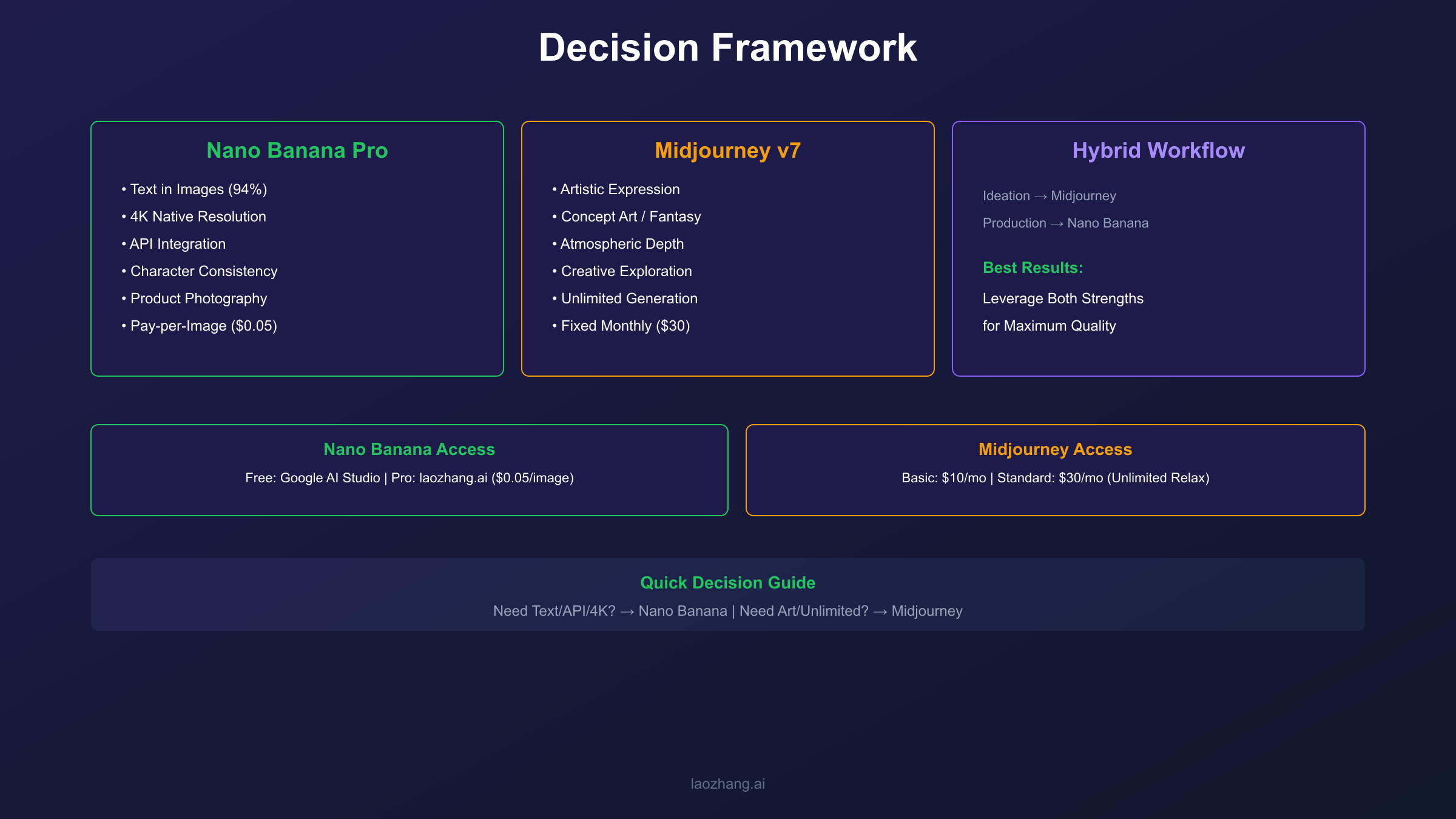
When to Choose Nano Banana Pro
Select Nano Banana Pro when your project requires:
- Accurate text rendering—any legible text within images
- API integration—automated workflows, applications, pipelines
- 4K native output—print, large format, high-detail requirements
- Character consistency—brand assets, recurring characters, product lines
- Photorealistic accuracy—product photography, realistic portraits
- Predictable costs—pay-per-image budgeting for variable volumes
- Technical precision—accurate physics, materials, lighting behavior
When to Choose Midjourney v7
Select Midjourney v7 when your project requires:
- Artistic expression—concept art, fantasy, stylized content
- Atmospheric depth—mood, emotion, creative interpretation
- High-volume generation—unlimited Relax Mode for extensive iteration
- Creative exploration—rapid ideation, style development
- Subscription budgeting—fixed monthly cost regardless of volume
- No API requirements—manual workflow acceptable
- Draft mode iteration—fast, low-cost concept exploration
Budget-Based Recommendations
| Monthly Budget | Under 100 Images | 100-500 Images | 500-2000 Images | 2000+ Images |
|---|---|---|---|---|
| Under $30 | Nano Banana (free tier) | Nano Banana (official) | Midjourney Standard | Midjourney Standard |
| $30-100 | Nano Banana (any volume) | Either tool | Midjourney (Relax) or Nano via laozhang.ai | Midjourney Standard |
| $100+ | Feature-driven choice | Feature-driven choice | Hybrid workflow | Both tools strategically |
For budgets under $30/month with low volume, Nano Banana Pro's free tier (1,500 daily on Google AI Studio) or third-party access at $0.05/image often provides better value than Midjourney's Basic plan. At higher volumes, Midjourney's unlimited Relax Mode on Standard ($30/month) becomes difficult to beat on pure cost-per-image metrics, assuming queue times are acceptable.
Conclusion: Making the Right Choice
The Nano Banana Pro vs Midjourney v7 comparison reveals not a clear winner but two highly capable tools optimized for different purposes. Your choice should align with your primary use case, technical requirements, and workflow preferences rather than following general recommendations.
Summary Comparison
| Dimension | Winner | Key Differentiator |
|---|---|---|
| Text Rendering | Nano Banana Pro | 94% vs ~10% accuracy |
| Photorealism | Nano Banana Pro | FID 12.4 vs 15.3 |
| Artistic Quality | Midjourney v7 | 64% preference in creative tests |
| Resolution | Nano Banana Pro | Native 4K vs 1024px |
| Generation Speed | Nano Banana Pro | 5-8s vs 20-30s |
| API Access | Nano Banana Pro | Official REST API vs none |
| High-Volume Cost | Midjourney v7 | Unlimited Relax Mode at $30/mo |
| Low-Volume Cost | Nano Banana Pro | Free tier + $0.05/image options |
| Character Consistency | Nano Banana Pro | 95%+ vs drift after variations |
| Creative Exploration | Midjourney v7 | Draft Mode + artistic interpretation |
Final Recommendations
For Developers and Technical Teams: Nano Banana Pro is the clear choice. Official API access, predictable performance, documented rate limits, and SLA availability make it the only viable option for production applications. The 94% text accuracy and 4K native output address common technical requirements that Midjourney cannot meet.
For Creative Professionals and Artists: Consider Midjourney v7 for ideation and artistic work, supplemented by Nano Banana Pro for production assets requiring text or technical precision. The $30/month Standard plan provides exceptional value for high-volume creative exploration.
For E-commerce and Marketing Teams: Nano Banana Pro's text rendering, product photography quality, and API automation capabilities align directly with commercial content needs. Access through laozhang.ai at $0.05/image makes high-volume product catalogs economically viable.
For Personal and Hobbyist Use: Midjourney's Standard plan offers the best value for recreational image generation. The unlimited Relax Mode enables extensive experimentation without per-image cost concerns, and the artistic output quality produces impressive results for non-commercial projects.
The Bottom Line: Neither tool obsoletes the other. Nano Banana Pro dominates technical precision, text, resolution, and API integration. Midjourney v7 leads in artistic expression, creative exploration, and subscription value at high volumes. Many professionals find optimal results by using both strategically—Midjourney for creative development, Nano Banana Pro for production delivery.
Getting Started
Nano Banana Pro:
- Free tier: Google AI Studio (1,500 daily generations)
- Cost-optimized: laozhang.ai ($0.05/image, 79% savings)
- Enterprise: Google Vertex AI (SLA, compliance features)
Midjourney v7:
- Midjourney.com (subscriptions from $10/month)
- No free trial currently available
The AI image generation landscape continues evolving rapidly. Both platforms regularly release updates that may shift specific capabilities. This comparison reflects current state as of late 2025—verify current features and pricing before making significant commitments. For additional comparisons with other leading AI image generators, see our analysis of Nano Banana Pro vs FLUX 2 and GPT Image 1.5 vs Nano Banana Pro.