Sora 2 Unofficial API: Complete Guide to 98% Cost Savings in 2026
Comprehensive guide to Sora 2 unofficial API providers. Compare pricing, integration methods, and learn how to save up to 98% on video generation costs with third-party API services.
Nano Banana Pro
4K-80%Google Gemini 3 Pro · AI Inpainting
谷歌原生模型 · AI智能修图

OpenAI's Sora 2 revolutionized AI video generation, but its official API pricing creates a significant barrier for most developers. At $0.50 per second for 1080p video, a single 20-second clip costs $10—making experimentation and production use prohibitively expensive for many projects. This reality has driven developers to seek alternatives that maintain quality while dramatically reducing costs.
Third-party Sora 2 API providers have emerged to fill this gap, offering the same video generation capabilities at 85-98% lower costs. These services relay requests through optimized channels while maintaining OpenAI-compatible endpoints, meaning your existing code works with minimal changes. The January 2026 policy update, which removed free video generation for non-paying users, has accelerated adoption of these alternatives.
This guide provides a complete analysis of unofficial Sora 2 API options, including verified pricing data, working code examples, and an honest assessment of trade-offs. Whether you're a hobbyist exploring video AI or a startup building production applications, you'll find actionable guidance for choosing the right approach.
Sora 2 API Landscape: Official vs Unofficial
Unofficial Sora 2 APIs are third-party services that provide access to OpenAI's video generation model through relay endpoints, typically at significantly lower costs than direct API access while maintaining identical output quality.
Understanding the current Sora 2 access landscape requires examining both official and unofficial channels. OpenAI provides direct API access through their platform, while third-party providers offer alternative endpoints that connect to the same underlying model. The distinction lies not in output quality—which remains identical—but in pricing structure, availability guarantees, and access methods.
Official API access through OpenAI's platform requires either a ChatGPT Plus subscription ($20/month) or ChatGPT Pro subscription ($200/month) as a prerequisite. Beyond subscription costs, API usage is billed per second of generated video, with rates varying by resolution. The official pricing structure creates a significant cost barrier, particularly for developers who need to generate multiple videos during development and testing phases.
Third-party providers operate by maintaining their own OpenAI accounts and relaying API requests through optimized channels. This approach allows them to offer volume-based pricing that benefits individual developers who would otherwise face full retail rates. The technical implementation typically involves OpenAI-compatible endpoints, meaning developers can switch between official and unofficial services by simply changing the base URL and API key in their existing code.
The key distinction for developers lies in the trade-off between cost and certain guarantees. Official API access provides direct support from OpenAI, guaranteed uptime SLAs, and the assurance of a direct relationship with the model provider. Unofficial APIs offer dramatic cost savings but may have different availability characteristics and support structures. For many use cases—particularly development, testing, and moderate-scale production—the cost savings outweigh these considerations.
January 2026 Policy Changes: Why It Matters
In January 2026, OpenAI removed free video generation capabilities for users without paid subscriptions, making unofficial APIs essential for budget-conscious developers who need Sora 2 access.
The January 2026 policy update fundamentally changed the Sora 2 accessibility landscape. Previously, free-tier users could generate a limited number of videos, allowing developers to experiment before committing to paid access. The new policy restricts all video generation to paying subscribers, eliminating this evaluation path entirely.
This change has significant implications for the developer community. Individual developers and small teams who previously used free credits for prototyping must now choose between paying full subscription and API costs or finding alternative access methods. The barrier to entry has increased substantially, particularly for those in the exploration phase who aren't yet certain Sora 2 fits their needs.
The timing coincided with OpenAI's broader push toward sustainable API economics. As video generation consumes significant computational resources, the company moved to ensure all usage generates revenue. While understandable from a business perspective, this shift has pushed many developers toward third-party alternatives that offer more accessible pricing.
For developers already using Sora 2 for video generation, the policy change primarily affects cost calculations. Those with existing paid subscriptions face no immediate impact on capabilities, but the removal of free experimentation means new team members or projects must budget for API costs from day one. This reality has made unofficial APIs increasingly attractive for teams managing multiple projects or exploring video AI capabilities.
Top 5 Unofficial Providers Compared
Among current providers, laozhang.ai offers the best balance of pricing ($0.15/video), API compatibility, and reliability for most developers, while per-second billing options like Kie.ai suit variable-length video needs.
Selecting an unofficial Sora 2 API provider requires evaluating multiple factors beyond headline pricing. Reliability, API compatibility, support quality, and billing transparency all influence the total value proposition. Based on current market analysis, five providers stand out for different use cases and priorities.
| Provider | Pricing Model | 20s Video Cost | API Type | Best For |
|---|---|---|---|---|
| laozhang.ai | Per video | $0.15 | OpenAI-compatible | General use, consistent pricing |
| APIyi | Per video | $0.12 | OpenAI-compatible | Budget priority |
| Kie.ai | Per second ($0.015) | $0.30 | Custom API | Variable-length videos |
| GrsAi | Per second ($0.018) | $0.36 | OpenAI-compatible | OpenAI compatibility priority |
| FreeAPI | Credit-based | ~$0.20 | Custom API | Occasional use |
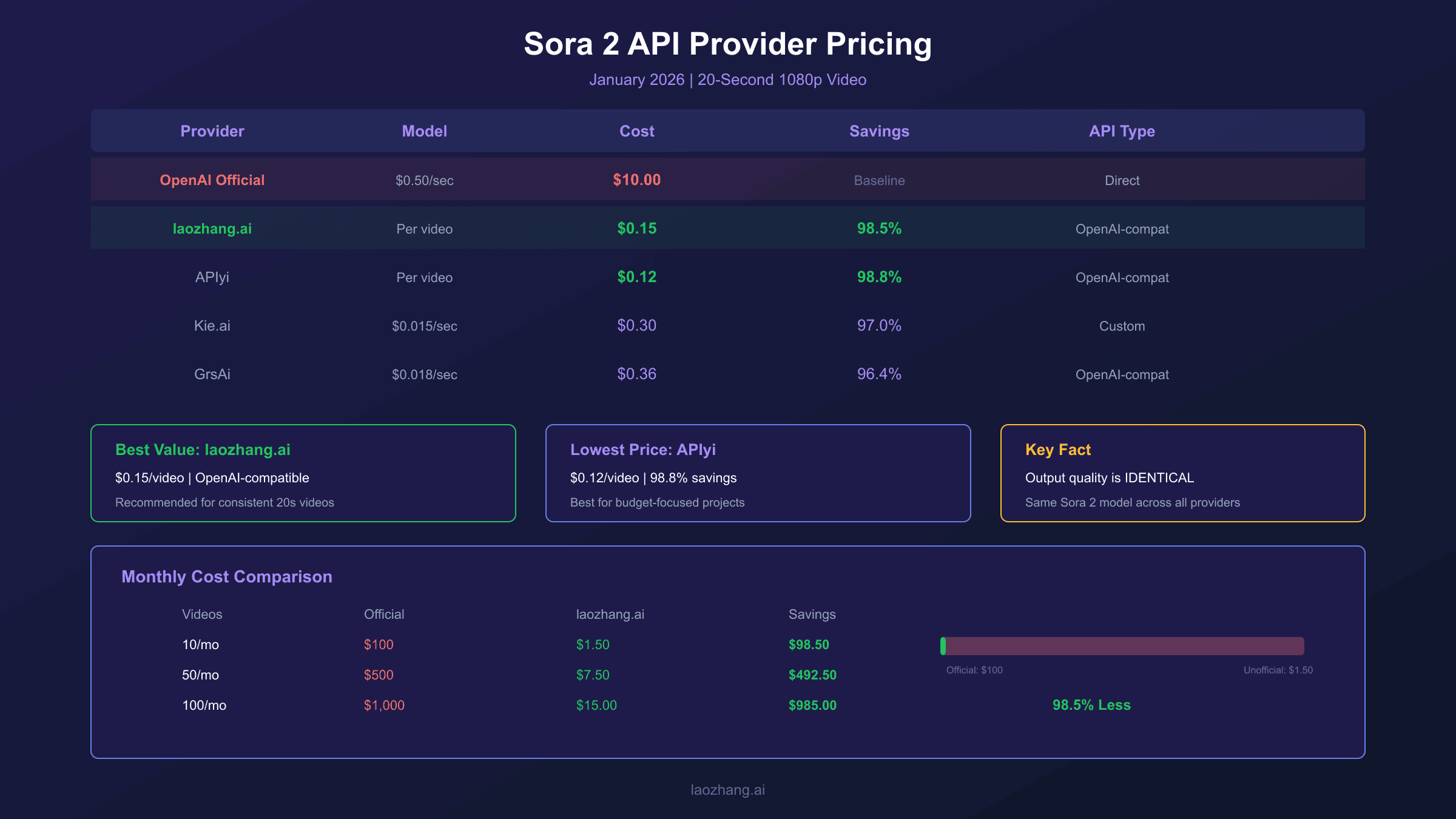
The pricing comparison reveals significant savings across all providers. Official OpenAI pricing for a 20-second 1080p video totals $10.00 ($0.50 × 20 seconds). Even the most expensive unofficial option (GrsAi at $0.36) represents 96.4% savings, while the most affordable (APIyi at $0.12) achieves 98.8% cost reduction.
Among these options, laozhang.ai provides a compelling balance for most developers. The flat per-video pricing ($0.15 for standard 20-second videos) simplifies cost prediction, while OpenAI-compatible endpoints minimize integration effort. The service maintains identical output quality—a critical point, as all providers access the same underlying Sora 2 model. For comparison, official Sora 2 pricing charges $5-10 for equivalent videos depending on resolution.
Per-second billing models from Kie.ai and GrsAi suit specific scenarios better. If your application generates videos of varying lengths—some 5 seconds, others 20 seconds—per-second billing avoids paying for unused duration. However, for consistent 20-second generation, flat per-video pricing typically offers better value.
Note that third-party services may have different availability guarantees than official APIs. While reputable providers maintain high uptime, they cannot offer the same SLA commitments as direct OpenAI access. For mission-critical production workloads requiring guaranteed availability, factor this consideration into your decision.
Complete Integration Guide: Python & JavaScript Examples
Integrating unofficial Sora 2 APIs requires three steps: obtain an API key, configure your client with the provider's base URL, and make generation requests using OpenAI-compatible parameters.
Most unofficial providers offer OpenAI-compatible endpoints, meaning integration follows familiar patterns. The primary difference from official API usage involves changing the base URL and using the provider's API key instead of OpenAI's. This compatibility ensures existing codebases require minimal modification.
Python Integration
hljs pythonimport requests
import time
# Configuration - replace with your provider's details
API_KEY = "your_api_key_here"
BASE_URL = "https://api.laozhang.ai/v1" # Example provider
def generate_video(prompt, duration=20, resolution="1080p"):
"""
Generate a video using Sora 2 unofficial API.
Args:
prompt: Text description of desired video
duration: Video length in seconds (max 20)
resolution: Output resolution (480p, 720p, 1080p)
Returns:
Video URL or None if generation fails
"""
headers = {
"Authorization": f"Bearer {API_KEY}",
"Content-Type": "application/json"
}
payload = {
"model": "sora-2",
"prompt": prompt,
"duration": duration,
"resolution": resolution,
"aspect_ratio": "16:9"
}
try:
# Initiate generation
response = requests.post(
f"{BASE_URL}/video/generations",
headers=headers,
json=payload,
timeout=30
)
response.raise_for_status()
task_id = response.json().get("task_id")
# Poll for completion
for _ in range(60): # Max 5 minutes wait
status_response = requests.get(
f"{BASE_URL}/video/generations/{task_id}",
headers=headers,
timeout=10
)
status_data = status_response.json()
if status_data.get("status") == "completed":
return status_data.get("video_url")
elif status_data.get("status") == "failed":
print(f"Generation failed: {status_data.get('error')}")
return None
time.sleep(5) # Wait before next poll
print("Generation timed out")
return None
except requests.exceptions.RequestException as e:
print(f"API request failed: {e}")
return None
# Usage example
video_url = generate_video(
prompt="A serene mountain lake at sunrise, mist rising from the water",
duration=10,
resolution="1080p"
)
if video_url:
print(f"Video generated: {video_url}")
JavaScript/Node.js Integration
hljs javascriptconst axios = require('axios');
// Configuration
const API_KEY = 'your_api_key_here';
const BASE_URL = 'https://api.laozhang.ai/v1';
async function generateVideo(prompt, options = {}) {
const { duration = 20, resolution = '1080p', aspectRatio = '16:9' } = options;
const headers = {
'Authorization': `Bearer ${API_KEY}`,
'Content-Type': 'application/json'
};
try {
// Initiate generation
const initResponse = await axios.post(
`${BASE_URL}/video/generations`,
{
model: 'sora-2',
prompt,
duration,
resolution,
aspect_ratio: aspectRatio
},
{ headers, timeout: 30000 }
);
const taskId = initResponse.data.task_id;
// Poll for completion
for (let i = 0; i < 60; i++) {
const statusResponse = await axios.get(
`${BASE_URL}/video/generations/${taskId}`,
{ headers, timeout: 10000 }
);
const { status, video_url, error } = statusResponse.data;
if (status === 'completed') {
return video_url;
} else if (status === 'failed') {
throw new Error(`Generation failed: ${error}`);
}
await new Promise(resolve => setTimeout(resolve, 5000));
}
throw new Error('Generation timed out');
} catch (error) {
console.error('Video generation error:', error.message);
throw error;
}
}
// Usage
(async () => {
try {
const videoUrl = await generateVideo(
'A busy city street at night with neon lights reflecting on wet pavement',
{ duration: 15, resolution: '1080p' }
);
console.log('Generated video:', videoUrl);
} catch (error) {
console.error('Failed:', error.message);
}
})();
Error Handling Best Practices
Robust error handling is essential when working with any API service. Common issues include rate limiting (HTTP 429), authentication failures (HTTP 401), and temporary service unavailability (HTTP 503). The code examples above include basic error handling, but production applications should implement retry logic with exponential backoff for transient failures.
For more detailed API integration patterns, see our Sora 2 API access guide which covers authentication, rate limiting, and advanced usage patterns.
Risks and Trade-offs: What You Need to Know
The primary risks of unofficial APIs include potential service discontinuation, variable availability, and lack of direct OpenAI support—factors that matter most for production workloads requiring guaranteed uptime.
Honest evaluation of unofficial API trade-offs helps developers make informed decisions. While cost savings are substantial, several factors warrant consideration before committing to third-party services for critical applications.
Service continuity presents the most significant long-term risk. Third-party providers depend on maintaining their own OpenAI access, which could be affected by policy changes or enforcement actions. While established providers have operated successfully for extended periods, developers should consider contingency plans for provider changes. Maintaining code that works with multiple providers—enabled by OpenAI-compatible endpoints—mitigates this risk.
Availability guarantees differ between official and unofficial services. OpenAI publishes uptime commitments and provides status pages for their API. Third-party providers may not offer equivalent transparency or SLA guarantees. For applications where video generation delays directly impact user experience, this difference matters. For batch processing or non-time-critical generation, it may be acceptable.
Support structures also vary. Official API users access OpenAI's documentation, community forums, and support channels. Unofficial providers typically offer email support or chat-based assistance, which may have different response times and technical depth. Developers comfortable troubleshooting independently will find this less concerning than those requiring extensive vendor support.
Data handling practices require consideration for sensitive applications. While reputable providers don't store generated content, their privacy policies may differ from OpenAI's terms. Review provider documentation carefully if your prompts contain proprietary information.
Quality remains consistent across providers—this point bears emphasis. Since all services access the same Sora 2 model, output quality is identical regardless of which provider you use. The differences lie entirely in business terms (pricing, support, availability), not technical capabilities.
Decision Framework: Choosing the Right Provider
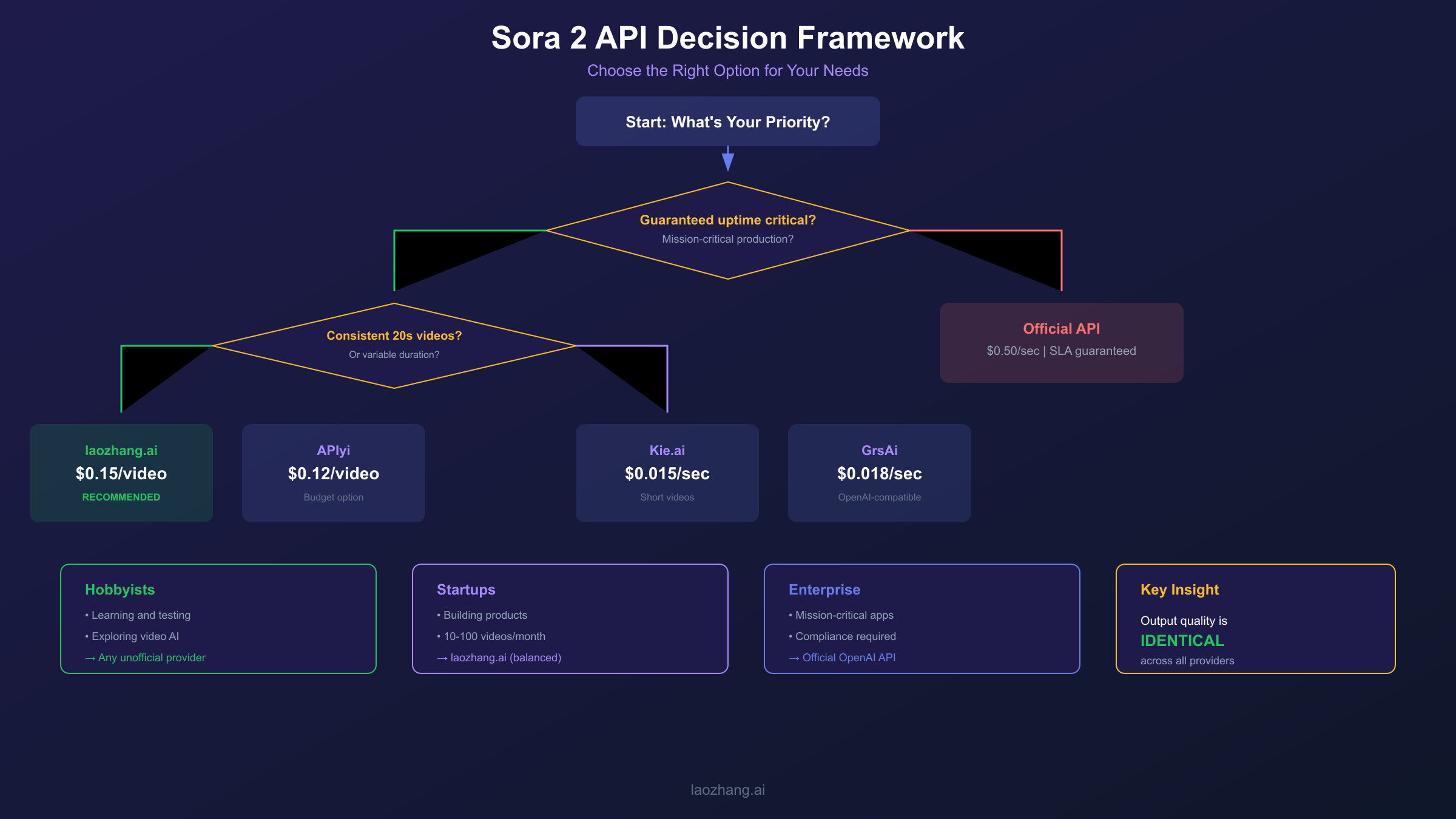
For developers prioritizing cost savings with moderate usage (10-50 videos/month), services like laozhang.ai provide optimal value at ~98% less than official pricing, while production workloads requiring guaranteed uptime should consider official API despite higher costs.
Selecting the right Sora 2 API approach depends on your specific requirements, risk tolerance, and budget constraints. This framework helps match different developer profiles with appropriate solutions.
Hobbyist/Learning Use: If you're exploring Sora 2 capabilities without production requirements, unofficial APIs provide the most accessible entry point. The cost difference—$0.12-0.15 versus $10 per video—enables substantially more experimentation within any budget. Service reliability matters less when generation timing isn't critical.
Startup/Development Teams: For teams building products that incorporate video generation, unofficial APIs offer compelling economics during development and early scaling phases. The 98% cost reduction allows more iteration and testing before committing to production infrastructure. Consider maintaining code compatibility with official APIs for potential future transition.
Production Workloads: Applications serving paying customers face different considerations. While unofficial APIs can serve production traffic successfully, evaluate whether cost savings justify potential availability differences. Hybrid approaches—using unofficial APIs for non-critical generation while reserving official access for customer-facing features—balance economics with reliability.
Enterprise/Compliance-Sensitive: Organizations with strict vendor requirements or compliance needs should default to official API access. The audit trail, support relationship, and contractual terms from OpenAI may be necessary regardless of cost implications.
Monthly cost projections help quantify the decision:
| Videos/Month | Official API (1080p) | laozhang.ai | Savings |
|---|---|---|---|
| 10 | $100 | $1.50 | $98.50 |
| 50 | $500 | $7.50 | $492.50 |
| 100 | $1,000 | $15.00 | $985.00 |
| 500 | $5,000 | $75.00 | $4,925.00 |
For moderate usage patterns typical of development and small-scale production, unofficial APIs deliver substantial value. The decision becomes less clear-cut only at enterprise scale where reliability guarantees and vendor relationships carry significant weight.
Alternatives: Veo 3, Runway, and Other Options
Beyond Sora 2, Google's Veo 3 and Runway Gen-3 offer competitive video generation capabilities with different pricing structures, quality characteristics, and availability options worth considering for specific use cases.
While Sora 2 leads in many benchmarks, alternative video generation models deserve consideration. Different models excel at different content types, and pricing structures may better suit specific use patterns. Evaluating alternatives ensures you select the optimal tool for your requirements.
Google Veo 3: Google's video generation model offers competitive quality with different strengths. Veo 3 excels at photorealistic human motion and natural scenes, while Sora 2 often produces better results for stylized or abstract content. Access through Google Cloud provides enterprise-grade reliability with clearer pricing commitments. For teams already using Google Cloud infrastructure, Veo 3 integration may be more natural. See our Veo 3 API guide for detailed comparison.
Runway Gen-3: Runway positions itself toward creative professionals with a focus on controllability. Their model offers features like motion brush and camera controls that Sora 2 lacks in its current iteration. Pricing follows a subscription model with credit allocation, which may suit teams with predictable monthly usage. The trade-off involves less raw generation quality compared to Sora 2 but more precise creative control.
Kling AI: This emerging option offers competitive pricing and quality for specific content types. Kling performs particularly well with character animation and maintains more consistent character appearance across longer videos. API access remains more limited than established alternatives, but ongoing development shows promise.
For comprehensive comparison of video AI options, see our Sora 2 vs alternatives analysis which includes benchmark results and use case recommendations.
The best choice often involves multiple tools. Developers building production applications frequently use different models for different content types, leveraging each model's strengths while managing costs through strategic provider selection.
Frequently Asked Questions
Is the video quality from unofficial APIs identical to official OpenAI access?
Yes, output quality is identical. Unofficial APIs relay requests to the same Sora 2 model—they don't use alternative models or modified versions. The only differences involve business terms (pricing, support) rather than technical capabilities. A video generated through an unofficial provider is indistinguishable from one generated through official channels.
Can I switch between official and unofficial APIs without changing my code?
For providers offering OpenAI-compatible endpoints (including laozhang.ai and GrsAi), switching requires only changing the base URL and API key. Your generation code, prompts, and parameters work identically. This compatibility provides flexibility to change providers or fall back to official access if needed.
What happens if an unofficial provider shuts down?
Provider discontinuation is a real risk. Mitigation strategies include: maintaining code compatibility with multiple providers, not storing critical data exclusively with any provider, and having contingency plans for transition. The OpenAI-compatible endpoint standard means migration between providers—or to official access—typically requires minimal code changes.
Are unofficial APIs legal to use?
Unofficial APIs operate in a gray area. They don't violate any laws, but may not comply with OpenAI's terms of service regarding account sharing or commercial resale. Most developers use these services without issues, but understand that OpenAI could theoretically take action against providers. This risk primarily affects providers rather than end users.
How do I verify a provider's reliability before committing?
Start with small test purchases before committing to larger volumes. Check developer communities and forums for reputation information. Verify the provider has been operating for multiple months with consistent availability. Reputable providers typically offer documentation, support channels, and transparent pricing—absence of these suggests caution.