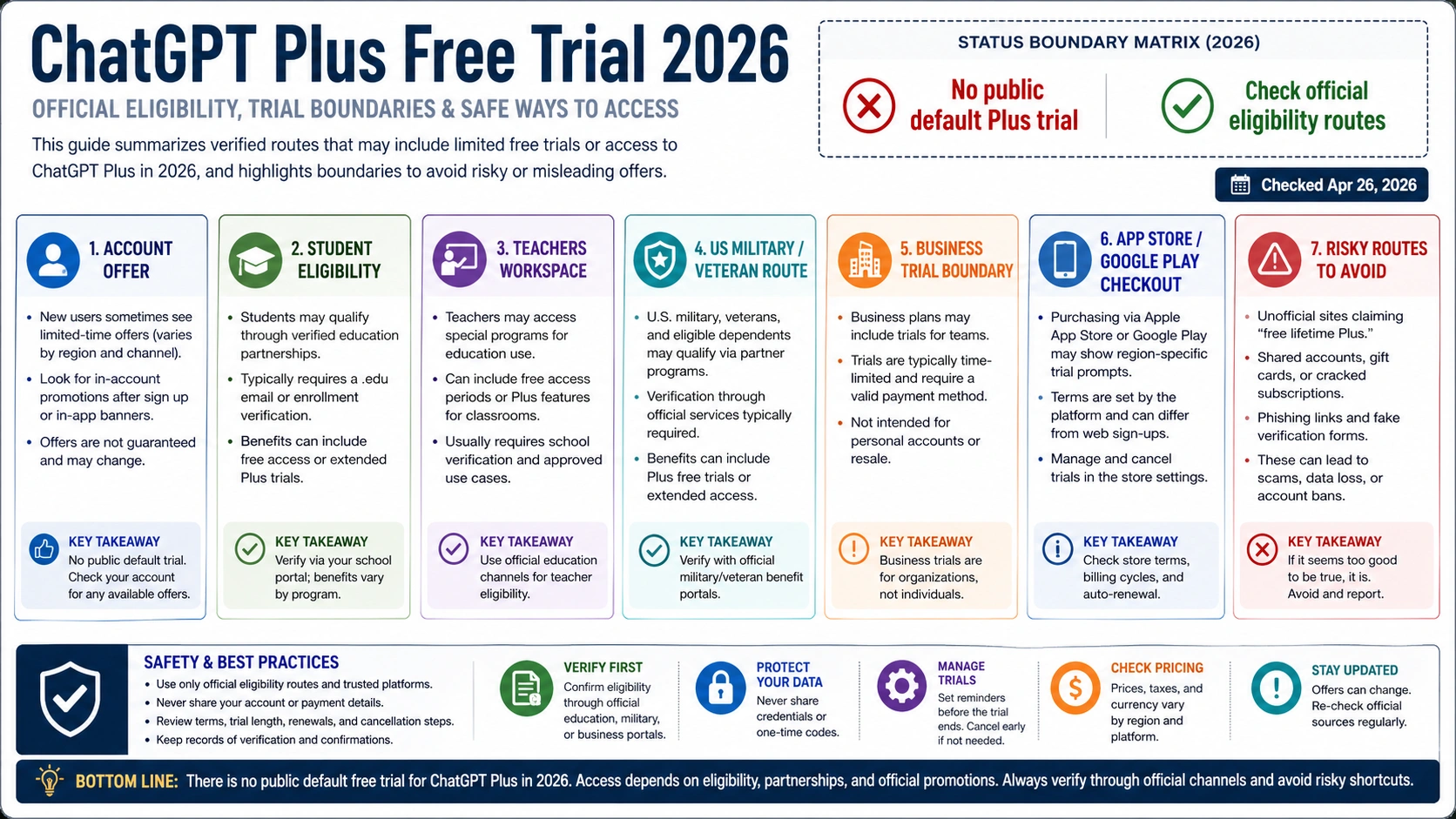
As of July 5, 2026, ChatGPT Plus does not have a public free trial that every student can claim. Some official routes still matter, but they are different contracts: an expired US/Canada student offer, current Australia/Colombia school-limited referrals, account-specific invites or promo codes, university ChatGPT Edu access, and Codex student credits each answer a different question.
Use this route board before you enter payment details or follow a trial code:
| Route | Current Plus trial status | Where to check first | Main caution |
|---|---|---|---|
| Public student trial for everyone | No | No public universal claim page | Treat "all students get Plus free" as outdated or unsafe unless your own official checkout shows it. |
| US / Canada 2025 student offer | Expired historical campaign | Official student terms and the March 31-May 31, 2025 claim window | Do not treat old posts or screenshots as a current 2026 route. |
| Australia / Colombia student referral | Current official Help route, but school and new-user limited | Official referral or school eligibility flow | It is not a global student offer and may not apply to your account. |
| Account invite or promo code | Possible only when official | ChatGPT account, official email, partner link, or checkout | Confirm price, end date, payment method, renewal, and cancellation path. |
| ChatGPT Edu | Institutional access, not personal Plus | Your university or school | Access is controlled by the institution, not by a public Plus code. |
| Codex student credits | Not a Plus trial | Codex student terms | Credits apply to Codex use, not ChatGPT Plus or API billing. |
| Teachers, veterans, or other identity routes | Route-specific, not student-default | Official verification page | Eligibility, geography, and dates control the offer. |
| Public code list, shared account, APK, extension, no-card hack | No | Do not proceed | Account ownership, payment, privacy, malware, and recovery risk. |
A public code list, seller login, shared account, APK, extension, cookie method, or no-card hack is not an official ChatGPT Plus student trial. If the route does not appear in an official account, official email, official Help page, school or institution flow, partner verification page, or your own checkout page, stop.
Is ChatGPT Plus Free For Students Right Now?
No, not as a public default student benefit. OpenAI's Plus help page describes ChatGPT Plus as a paid consumer subscription for the ChatGPT web app, and the current official student surfaces do not expose one public claim flow that every student can use. That is the most important answer because many "free for students" posts are really about a past campaign, a country-specific referral, a university workspace, or a private checkout offer.
The practical question is not "is there any screenshot of free Plus?" It is "does my own official route show a current $0 or discounted Plus offer, with terms I can verify before renewal?" If the answer is no, a code list or seller page cannot turn the route into a legitimate student trial.
Treat "student" as an eligibility layer, not a universal coupon. School, country, account age, campaign window, invite ownership, payment method, and checkout platform can all change the answer. Separate those contracts first, then decide whether to continue, stop, ask your institution, or run a short paid test.
Which Student Routes Are Current, Expired, Or Not Plus?
The US and Canada student offer is the biggest source of confusion because it was real but historical. OpenAI's student discount terms describe a two-month ChatGPT Plus offer for verified U.S. and Canada college students, but the claim window was March 31, 2025 through May 31, 2025. On July 5, 2026, that page is evidence that the campaign existed; it is not evidence that a new student can still claim it.
The Australia and Colombia referral route is different. OpenAI's Student Plus referral program article still documents a limited route for eligible schools, with one month of ChatGPT Plus free per new user sign-up. The safe wording is narrow: eligible schools, those countries, new-user conditions, and the current official referral flow. It should not be rewritten as "students worldwide get Plus free."
General student pages are not the same as a Plus trial. A page that says students can try ChatGPT or use a student-focused experience may be promoting Free-tier use, a campus program, study workflows, or account access. Unless it explicitly takes your account into a Plus checkout or verified Plus campaign, it is not proof of a personal Plus trial.
ChatGPT Edu is also not a coupon. It is an institutional route for universities and campus organizations. If your school provides ChatGPT Edu, your next step is to ask the school or follow its access instructions; you are not redeeming a public Plus code in your own consumer account.
Codex student credits are another separate contract. OpenAI's Codex student terms describe credits for Codex use; they are not ChatGPT Plus, not API credits, and not a consumer subscription waiver. If your real task is coding inside Codex, those credits may matter. If your question is "can I use ChatGPT Plus free?", they should be kept out of the Plus answer.
Are ChatGPT Plus Trial Codes And Invites Real?
Yes, official invites and promo codes can be real, but they are account-specific or campaign-specific. OpenAI's promotional subscriptions and free-trial invites FAQ says eligible users may receive limited referral codes or links, with the plan, duration, invitee eligibility, and restrictions shown in email or in product. That means someone else's invite screenshot does not prove your account has the same route.
Official promo codes follow the same rule. OpenAI's Plus promotions and referrals article points users to a partner-provided code or unique link and tells them to confirm the discount in checkout. A random public redemption list is not the same thing as a partner route or account-specific promotion.
Use this four-part test for any ChatGPT Plus free trial code or invite link:
| Question | Safe answer |
|---|---|
| Who issued it? | OpenAI, ChatGPT, an official email, in-product message, or a clearly identified partner. |
| Where does it close? | Your ChatGPT account, official checkout, app-store checkout, or partner verification flow. |
| What does checkout show? | Current charge, discount, end date, renewal price, taxes, and payment method. |
| Can it be transferred? | Assume no unless the official terms shown to your own account say otherwise. |
If a page asks you to paste a code into a non-OpenAI form, share an account, upload a school ID to a seller, install an extension, or hand over cookies, stop. A legitimate Plus promotion should reduce uncertainty inside an official flow; it should not ask you to surrender account control.
What Should You Check Before Accepting A $0 Or Discounted Offer?
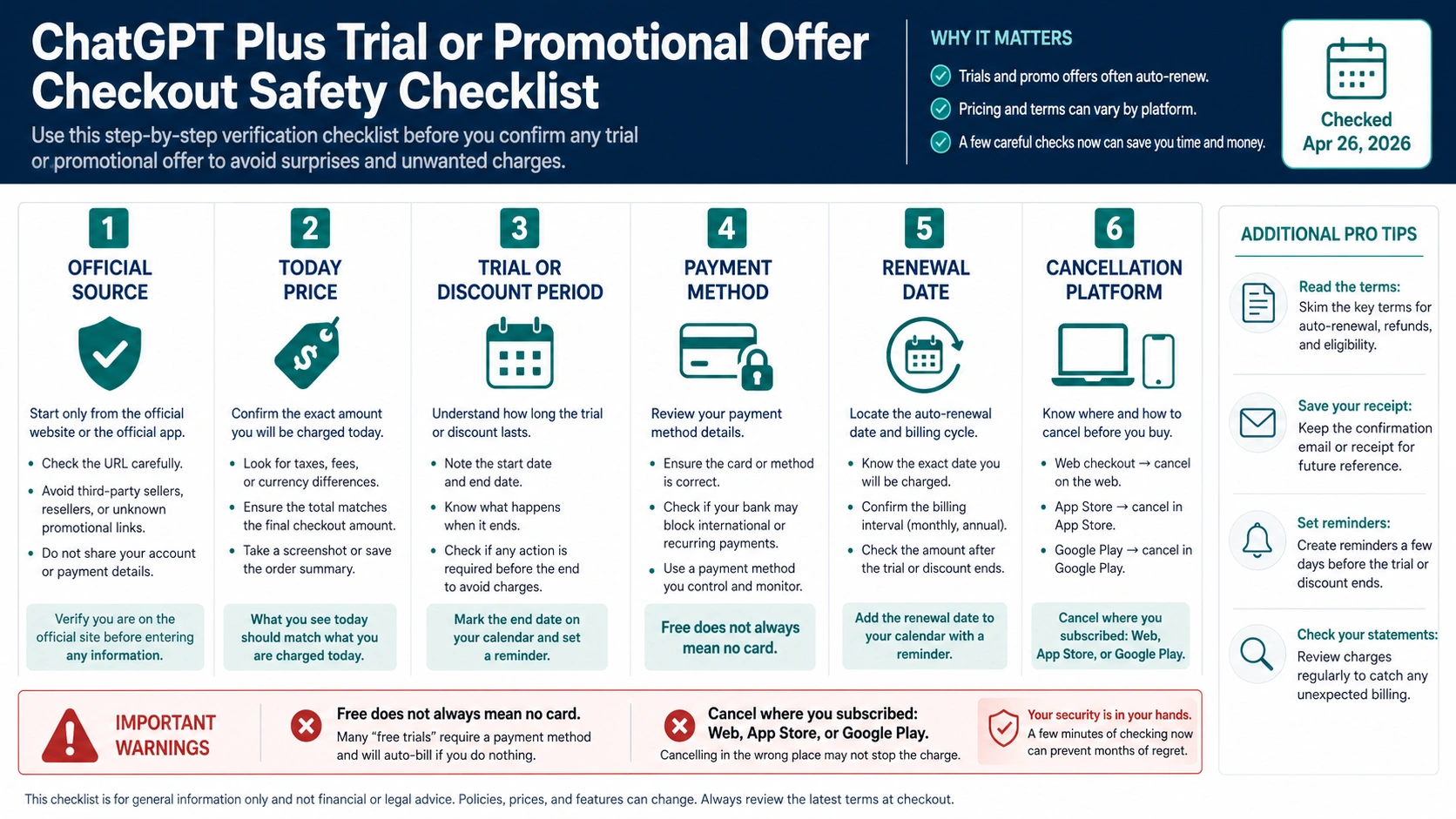
Check source, account, price, period, payment, renewal, and cancellation before you accept. A $0 checkout can still require a valid payment method, and official trial or promotional subscriptions may renew automatically unless canceled before the trial ends. The safe moment to learn those terms is before you click confirm, not on the renewal day.
Start with source. A credible route should remain inside chatgpt.com, openai.com, help.openai.com, the official ChatGPT app, the relevant app-store checkout, or a partner flow that is clearly connected to the official campaign. If the path starts with a forum post but ends in your official account showing terms, judge the official account. If it starts with a seller and asks for credentials before any official checkout appears, stop.
Next check price and period. Look for today's charge, the free or discounted period, the date the offer ends, the renewal price after the offer, taxes, and whether the plan is monthly or annual. "One month free" is incomplete if the next line hides an annual renewal or the payment method requirement.
Then check cancellation owner. Web subscriptions are usually managed through the ChatGPT or OpenAI account. iOS subscriptions are controlled by Apple subscriptions. Android subscriptions are controlled by Google Play. If your route is through a store, do not assume the web cancellation button controls the store subscription.
Finally, capture your own terms. You do not need to publish them anywhere, but you should save the expiration date, renewal price, and cancellation route for yourself. A student offer that is safe on the official page can still become expensive if you miss the renewal boundary.
What About Teachers, Veterans, Business, Free, Go, API, And Codex?
These adjacent routes can be useful, but they should not be merged into a student Plus trial.
ChatGPT for Teachers is for educators, not students. OpenAI describes it as a U.S. K-12 educator workspace, and the official teacher surfaces should be evaluated as workspace access with classroom boundaries. It can solve a teacher's access problem, but it does not prove that a student can claim consumer Plus free.
The U.S. servicemember and veteran route is identity-specific. The current claim page describes one year of ChatGPT Plus free for eligible U.S. servicemembers and veterans with SheerID verification. That is a real route for the eligible audience, but it is not a student invite system and should not be borrowed or resold.
Business and Enterprise trials are team contracts. Even if a business page uses the word "trial," the billing, admin controls, data controls, and eligibility are different from a personal ChatGPT Plus subscription. A student looking for Plus should not treat a team trial as a personal subscription workaround.
Free and Go are separate plan rows. Free is the safest way to test ChatGPT without payment, but it is not Plus. Go or another lower-cost regional plan may appear in some checkouts, but it is still a paid plan and may not be available everywhere. Use the plan your own checkout shows; do not treat one plan name as proof of a free Plus entitlement.
API billing is separate from ChatGPT Plus. OpenAI's Plus help page explicitly separates ChatGPT subscription use from API usage. Buying Plus does not give you API credit, and buying API credit does not give you Plus. Codex student credits are also separate from both. Keeping these boundaries clear prevents the common mistake of paying for the wrong product.
Which Free Plus Methods Should You Stop Immediately?
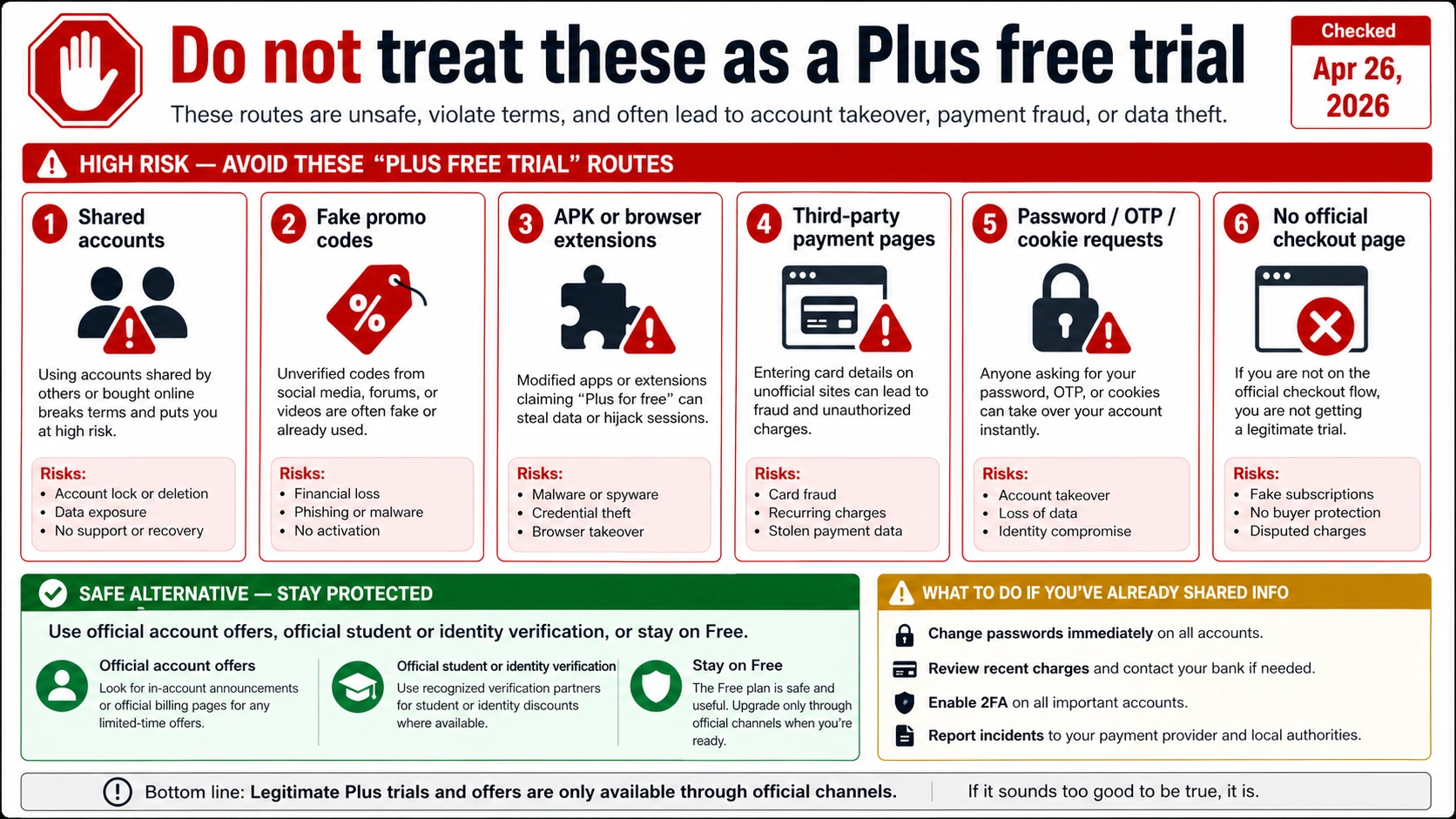
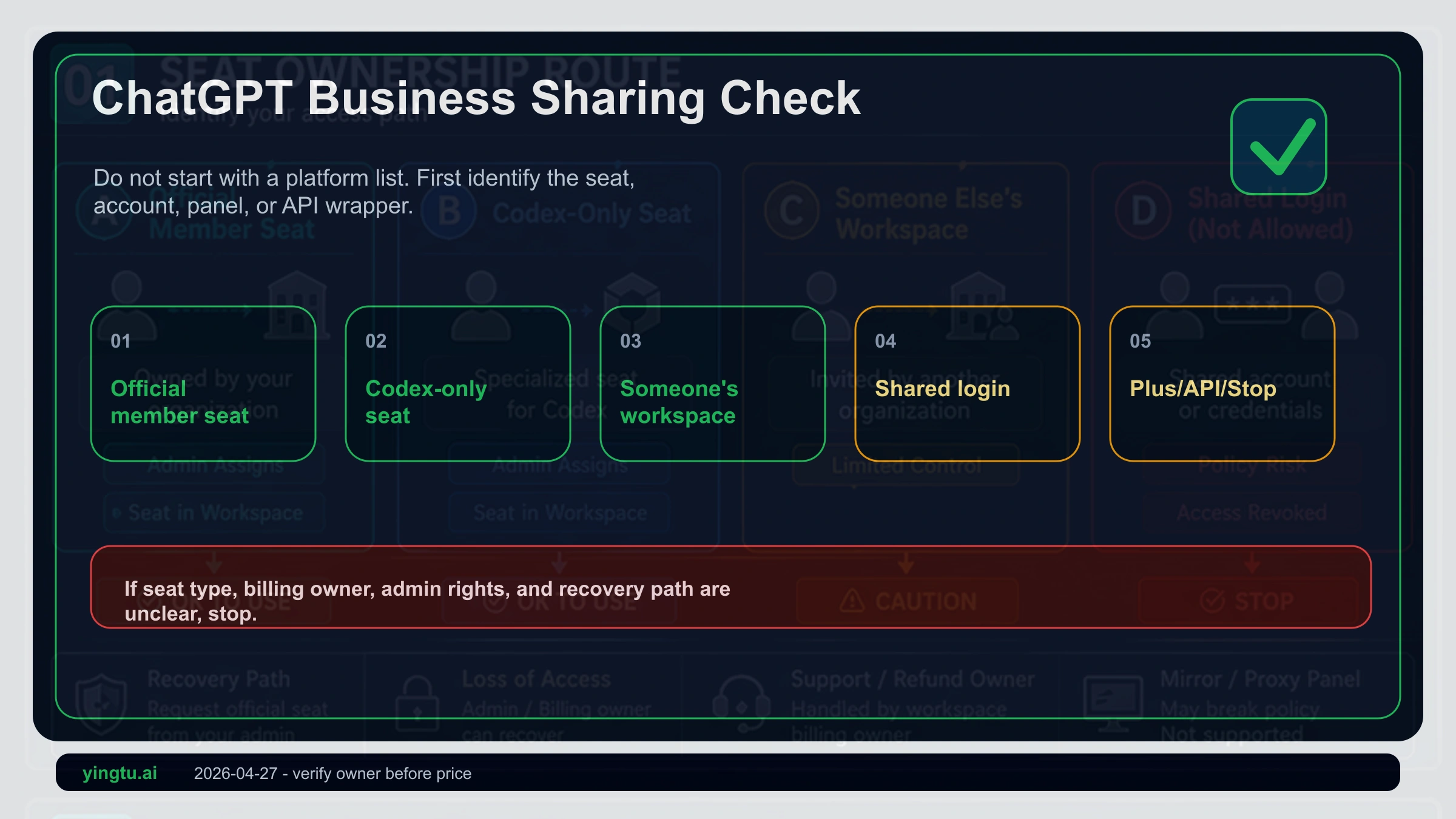
Stop when the route depends on account sharing. A shared Plus account is not your subscription. You do not control billing, password recovery, privacy settings, workspace history, two-factor recovery, or whether another user sees your prompts. If the owner reclaims or loses the account, you lose access.
Stop when the route depends on a public "trial code" list. Official promo codes are tied to campaigns, partners, eligibility, and checkout confirmation. A page that publishes generic codes without an official route is usually trying to collect traffic, credentials, payments, or extension installs.
Stop when the method asks for a browser extension, APK, script, cookie, session token, or device permission. ChatGPT Plus does not require a side-loaded app or browser trick to unlock an official student trial. Anything that asks for account tokens or device access creates a bigger risk than the cost of a one-month subscription.
Stop when the seller wants your school identity, ChatGPT login, OTP, or payment details before you see official terms. Student eligibility is not something to buy from a marketplace. Even when a seller can temporarily provide access, the route fails the ownership test and can create payment, privacy, and recovery problems.
Stop when the claim is "no card required" but no official checkout appears. Some official promotions may not need a payment method, and some may require one. The point is not the card itself; the point is whether your own official checkout tells you the terms.
What Should You Do If No Official Offer Appears?
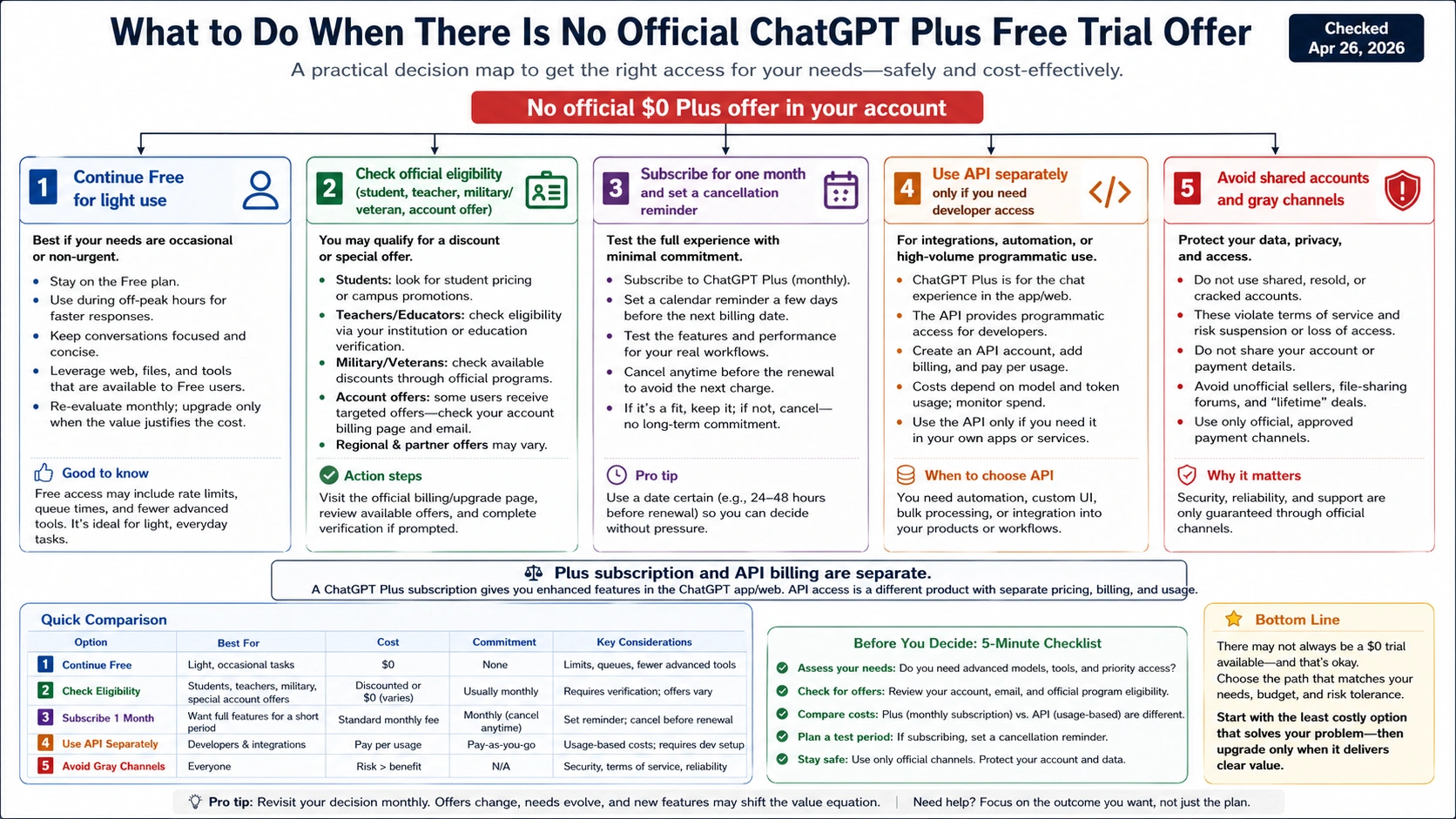
If your account, school, verification page, partner route, or checkout does not show an official Plus offer, stop treating the problem as a hidden-code hunt. Return to the job you need ChatGPT to do.
For light use, stay on Free. It is official, low-risk, and often enough for writing help, study planning, summarization, brainstorming, and basic research questions. Free is not a Plus trial, but it lets you test whether ChatGPT belongs in your workflow without giving payment details to a gray route.
If you may qualify through a school, ask the school. A university may have ChatGPT Edu or a local access process that never appears as a public Plus coupon. A country-specific student referral may also require your school to be on the eligible list. The right next step is official verification, not a third-party seller.
If you only need Plus for a short evaluation, paying for one month and setting a cancellation reminder can be safer than spending hours chasing fake codes. You keep your own account, see the official renewal terms, and can cancel through the right platform if Plus is not worth it.
If your real need is developer access, separate that path early. API, Codex, and ChatGPT Plus are different products with different billing and credits. Do not buy Plus because you saw "student credits" if the work you actually need is API access or Codex usage.
FAQ
Is ChatGPT Plus free for students in 2026?
Not by default. As of July 5, 2026, there is no public Plus trial that every student can claim. Some official student or school-limited routes exist, but they depend on country, school, account eligibility, campaign timing, and checkout terms.
Was the US and Canada student offer real?
Yes, but the official terms describe a historical offer. Verified U.S. and Canada college students could claim two free months between March 31, 2025 and May 31, 2025. Do not treat that expired window as a current 2026 claim path.
Is the Australia or Colombia student referral route current?
OpenAI still documents a limited Student Plus referral route for eligible schools in Australia and Colombia. Treat it as school- and country-limited, and check the official referral or eligibility flow rather than assuming it applies globally.
Are ChatGPT Plus trial codes real?
Official promo codes or invite links can be real when they come from OpenAI, ChatGPT, an official email, an in-product message, or a verified partner route. Public code lists are not proof. Confirm the discount and renewal terms in your own official checkout.
Do I need a credit card for a Plus trial or invite?
It depends on the offer. OpenAI's promotional subscription FAQ says some promotions may require a payment method and may renew unless canceled. Your own checkout page controls the answer.
Is ChatGPT Edu the same as free ChatGPT Plus?
No. ChatGPT Edu is institutional access for universities and campus organizations. It may give students access through their school, but it is not a public personal Plus trial code.
Are Codex student credits the same as Plus or API credits?
No. Codex student credits apply to Codex use. They are not ChatGPT Plus subscription access and not API credits.
Can a teacher route help a student get Plus free?
No. ChatGPT for Teachers is for eligible educators and should be treated as a teacher workspace route, not a student Plus coupon.
Is a shared Plus account safe?
No. A shared account gives you no reliable control over billing, recovery, privacy, or subscription ownership. It is not your personal Plus trial.
What should I do if I cannot find a student offer?
Use Free, check whether your school has an official institutional route, verify any country-specific student route, or pay for one month of Plus with a cancellation reminder. Do not chase public code lists, shared logins, APKs, extensions, or cookie methods.