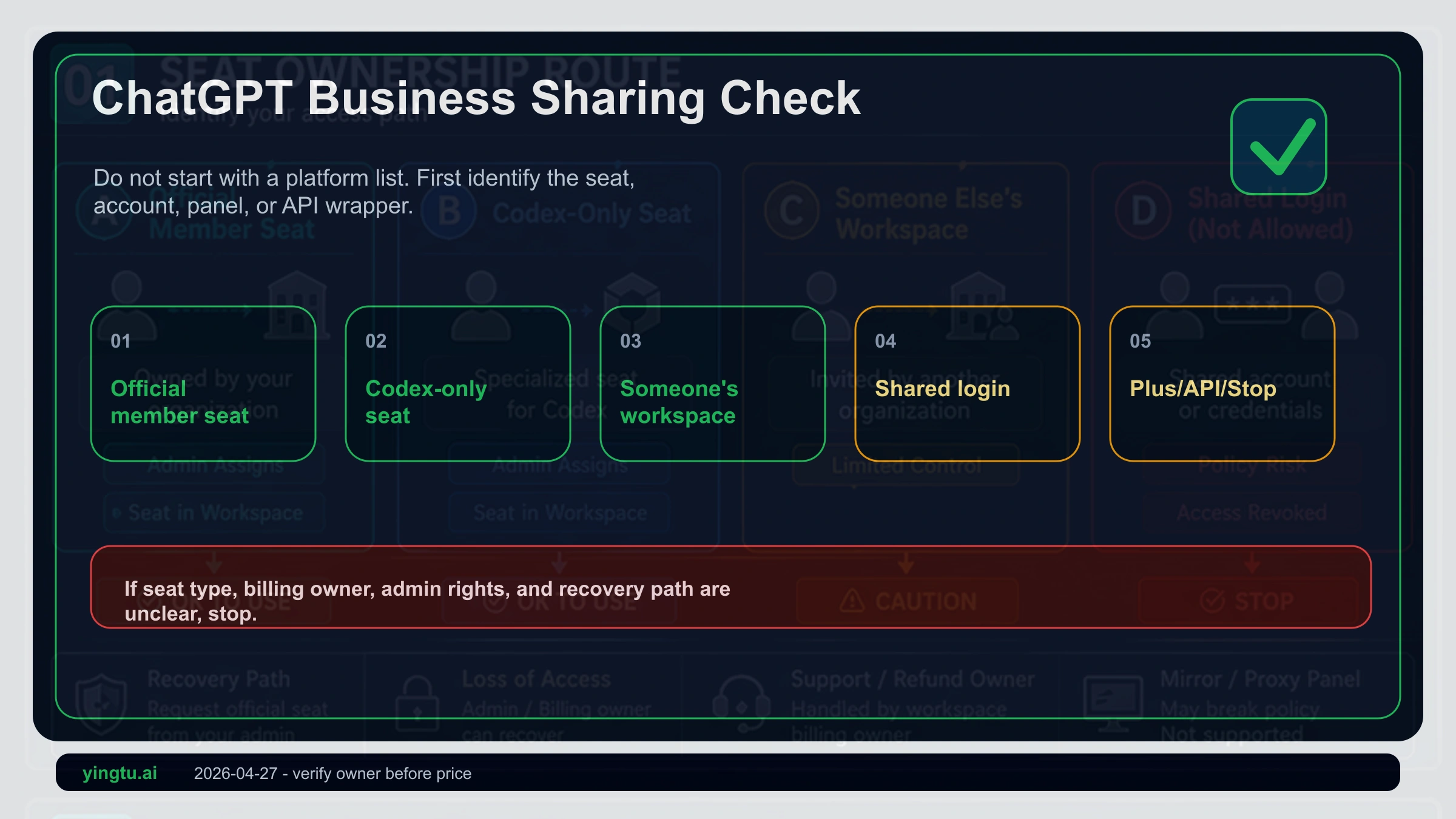
A cheap ChatGPT Business shared seat can mean several different things: an official member seat in a Business workspace, a resold member slot in someone else's workspace, a shared login, a mirror panel, a Codex-only seat, or a Plus/API bundle with a Business label. As of April 27, 2026, OpenAI's public Business billing materials describe standard ChatGPT Business seats at $25 per user per month on monthly billing, or $20 per user per month billed annually, with a two-seat minimum for standard seats. Codex-only seats are a different usage-based route.
| Route being sold | What you actually receive | Main risk | Safer next step |
|---|---|---|---|
| Official Business member seat | Your own account joins a workspace | Admin and bill owner still matter | Verify seat type, workspace owner, invoice, and admin |
| Resold workspace member | A real member slot may be resold | You do not own the workspace | Check admin, receipt, support, exit, and removal rules |
| Shared login | Multiple people use one credential | Privacy, policy, recovery, and lockout risk | Do not enter sensitive data; usually stop |
| Mirror panel or account pool | A third-party interface wraps access | It is not an official ChatGPT workspace | Check logs, model source, receipt, data path, and recovery |
| Personal Plus or API | A consumer subscription or developer route | Not a Business collaboration seat | Use Plus for personal chat, API for integration, Business for owned team work |
Price is the last question, not the first one. The buying decision starts with whether you use your own account, who owns the bill, who controls workspace admin rights, where chats and files live, who restores access after a problem, and whether any seller asks for shared credentials. If those points are unclear, a lower monthly price is not a reason to pay.
Start From the Official Business Seat Baseline
Use OpenAI's own materials as the baseline before judging a shared-seat offer. The ChatGPT Business pricing page and the Business billing help article define the current price, seat types, minimum seat count, and billing owner. That baseline matters because a $3, $10, or $30 shared offer may not be selling the same thing.
A standard Business seat is about membership in a managed workspace: user administration, shared workspace controls, billing ownership, team features, and business data settings. It is not simply "more GPT messages." OpenAI also separates standard ChatGPT seats from Codex-only seats; Codex pricing should not be treated as proof that a buyer receives the full ChatGPT Business chat experience.
The bill owner is as important as the seat label. If another person or platform owns the workspace, they may control billing, members, admin settings, and support escalation. A buyer who is only a member can lose access if the workspace owner removes them, changes billing, closes the workspace, or cannot resolve a support issue.
What a Cheap Seat May Actually Be
The first acceptable form is an official member seat: your own ChatGPT account is invited into a Business workspace. That can be legitimate for a real organization, but it still requires clarity. You should know the workspace owner, seat type, admin role, receipt path, support owner, and exit process.
A resold member slot looks similar from the login screen, yet the power relationship is different. You are not the buyer of the workspace; you are buying access from the person who controls it. If a payment fails or the member list changes, the official support path usually belongs to the workspace owner, not to you.
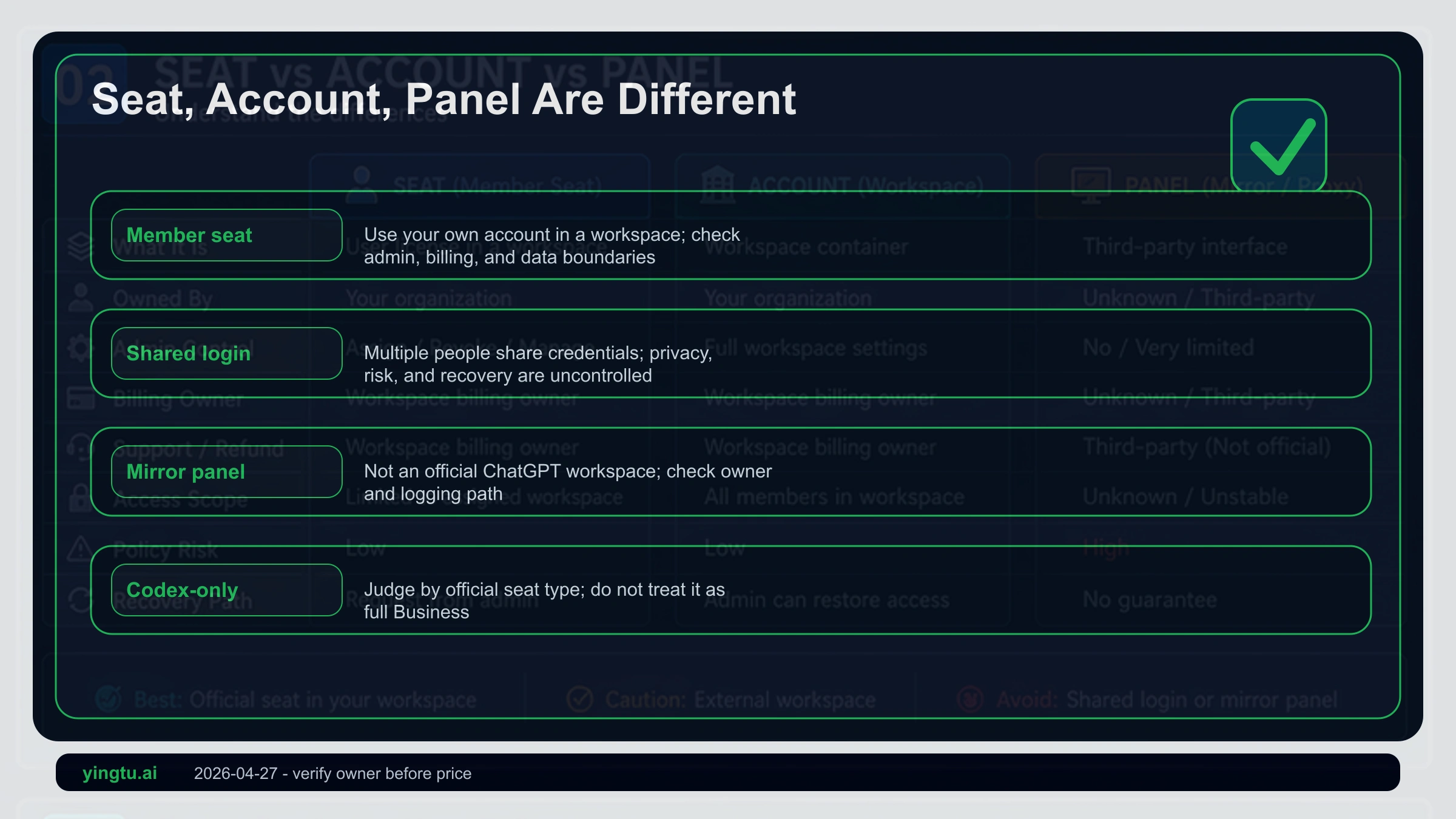
A shared login is a different risk category. Multiple people using the same email, password, session, or cookie should not be described as a Business seat. It creates privacy, account recovery, lockout, and policy risk at the same time.
A mirror panel or platform account pool can be useful as a separate service, but it is not the same as an official ChatGPT Business workspace. Ask where requests go, what logs are kept, whether uploaded files are stored, who can view data, how failures are handled, and what receipt proves the service you bought.
Why Shared Logins and Mirror Panels Are Not Business Ownership
OpenAI's Business Terms restrict sharing credentials, reselling or leasing access, and multiple people using one End User Account. The practical buying lesson is simple: do not build work around access you do not control.
Privacy is the immediate concern. A shared login can expose chat history, files, custom GPTs, projects, browser sessions, recovery email, and security checks. A mirror panel can add another data path: your input may pass through a provider's logging, routing, proxy, or support system before it reaches a model.
Workspace administration also changes the risk. OpenAI's Privacy Policy says Business Account Administrators may access and control business accounts and may access Content. If you join someone else's workspace, assume the admin boundary is real. Do not place client material, company documents, private code, contracts, or personal records into an unclear workspace.
Ask These Questions Before Paying
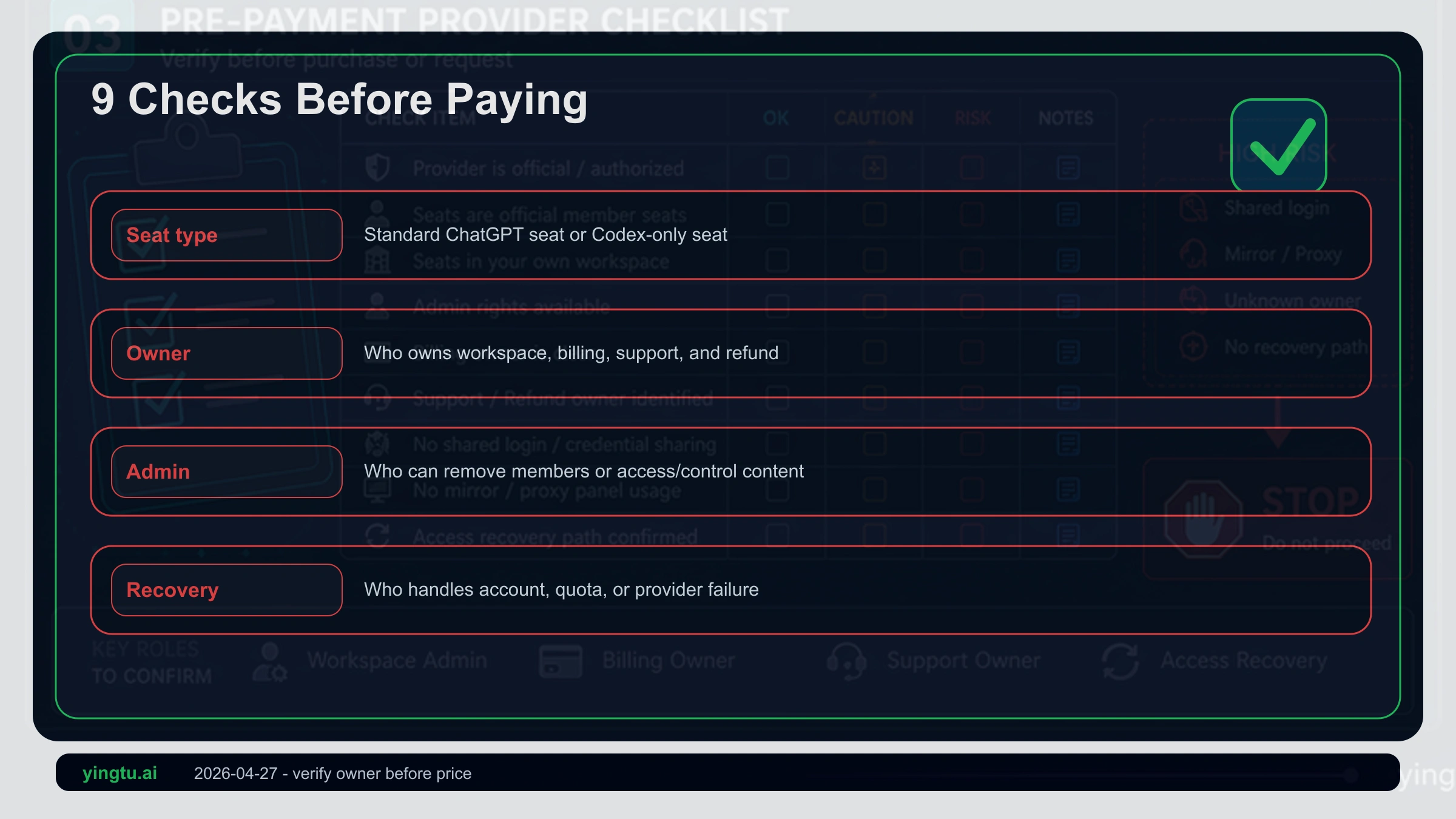
Use this checklist before any payment:
- Will you log in with your own ChatGPT account?
- Is the seat a standard ChatGPT Business seat, a Codex-only seat, or a platform panel?
- Who owns the workspace and bill?
- Can you see the workspace name, your member status, and seat type?
- What receipt, order, or invoice proves the service?
- Who restores access after lockout, payment failure, removal, or workspace closure?
- Can the workspace admin access chats, files, projects, or shared GPTs?
- Does the seller promise no bans, unlimited use, permanent backup, guaranteed privacy, or fixed refunds?
- Can you exit, cancel, request a refund, and delete data without depending on vague support messages?
A route with your own account, clear seat type, clear bill owner, and written recovery rules may be worth limited testing. A route that requires passwords, shared credentials, unverifiable guarantees, or company data in an unknown workspace should stop before payment.
Choose Business, Plus, API, or Stop
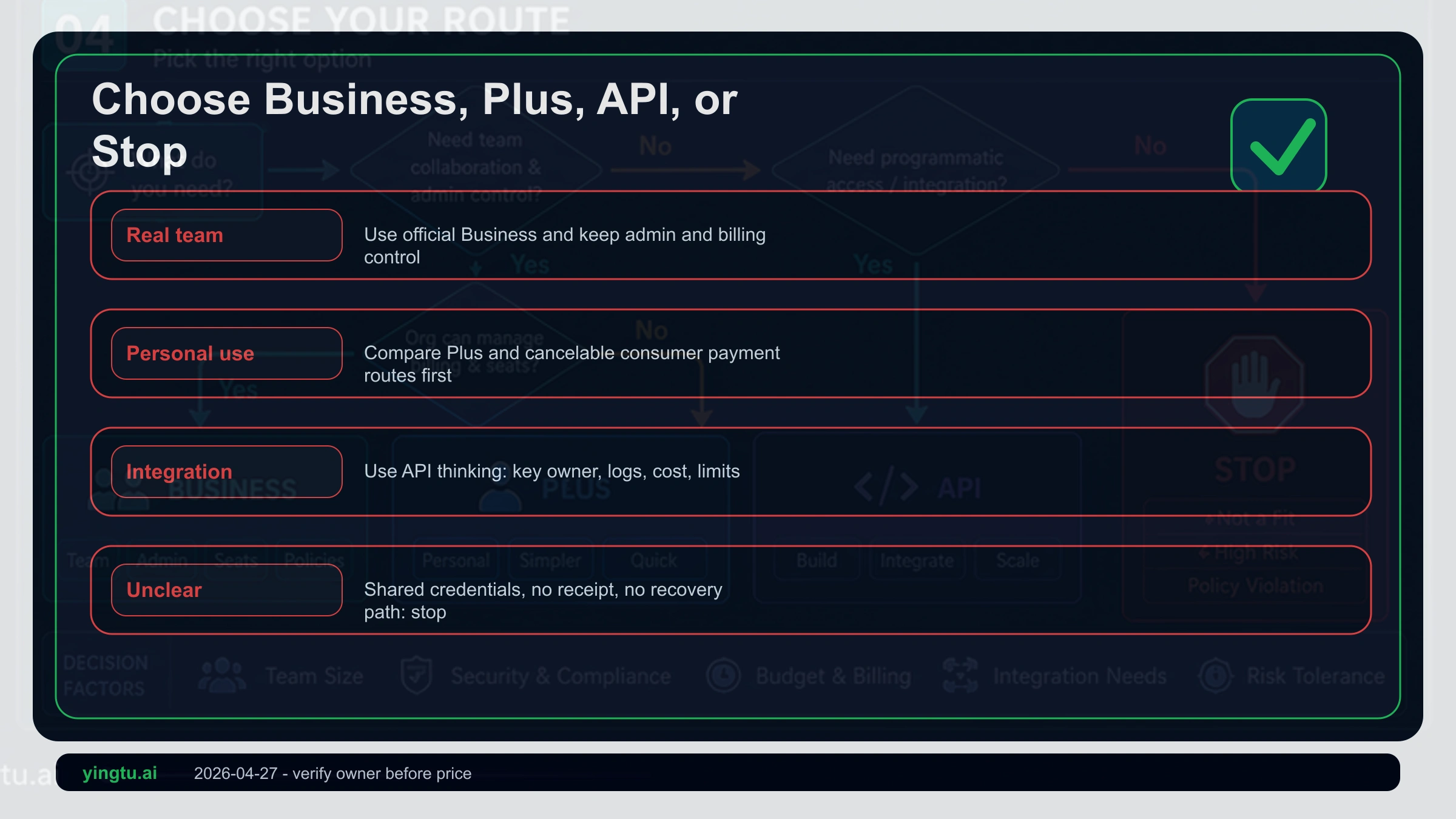
Personal users should compare Plus first. If the real job is writing, study, translation, or occasional personal productivity, a Business seat from an unknown workspace adds admin and data risk without giving you ownership. Related subscription routes are covered by ChatGPT Plus China payment ownership, ChatGPT Plus iOS billing, and ChatGPT Plus trial eligibility.
Small teams should use Business only when the workspace, bill, admin roles, and data settings belong to the organization. Business is valuable because it gives a managed workspace, not because a reseller can market a cheaper slot.
Developers should choose API when they need integration, automation, batch jobs, product workflows, or model calls outside the ChatGPT interface. A ChatGPT UI seat is not a stable API plan.
Stop when a seller asks for credentials, mixes Plus/API/Business/Codex into one vague bundle, cannot identify the workspace owner, cannot explain support recovery, or asks you to upload sensitive company data as a test.
If You Already Bought a Low-Price Seat
First identify the route: official workspace membership, resold workspace member, shared login, or mirror panel. Save the order, receipt, workspace name, support conversation, and any claim about refunds or recovery. Do not renew long-term until the owner chain is clear.
If you joined another workspace with your own account, remove sensitive chats and files that do not belong there, check whether you can leave the workspace, and avoid using it for confidential work unless the admin and data boundary is acceptable.
If you used a shared login, stop entering sensitive material. Change any password you handed over and any reused password elsewhere. Treat the account history as non-private.
If you used a mirror panel, look for data retention, deletion, support, and logging terms. If those terms do not exist, use it only for public or disposable prompts.
FAQ
Is ChatGPT Business shared-seat buying an official OpenAI plan?
No. ChatGPT Business is an official workspace plan. "Shared seat" is market language that may point to official member seats, resold workspace membership, shared logins, mirror panels, Plus, or API packaging.
What is the current official Business price?
As of April 27, 2026, OpenAI's public billing materials list standard ChatGPT Business seats at $25 per user per month monthly, or $20 per user per month billed annually, with a two-seat minimum for standard seats. Check OpenAI's current checkout and help pages before buying.
Is a resold workspace member always unsafe?
Not always, but it is not ownership. You need your own account, clear seat type, known workspace owner, receipt path, admin boundary, support owner, exit process, and refund rule.
How is a shared login different from a member seat?
A member seat uses your own account inside a workspace. A shared login puts multiple people behind the same credential, which weakens privacy, recovery, accountability, and policy boundaries.
Is a Codex-only seat a full ChatGPT Business seat?
Not by default. OpenAI describes standard ChatGPT seats and Codex-only seats separately. Treat Codex-only access as a different route unless official materials prove otherwise.
Can Business protect company data if the workspace is not yours?
Only if the admin, data, workspace, and support boundaries are acceptable to your organization. If someone else controls the workspace, they may also control important parts of your data environment.
Should an individual buy Business or Plus?
Most individual users should compare Plus first. Business makes more sense when a real team owns the workspace and needs managed collaboration.
Should a developer buy a shared Business seat or use the API?
Use API for product integration, scripts, automation, or batch workloads. A shared ChatGPT UI seat is not a reliable developer integration route.