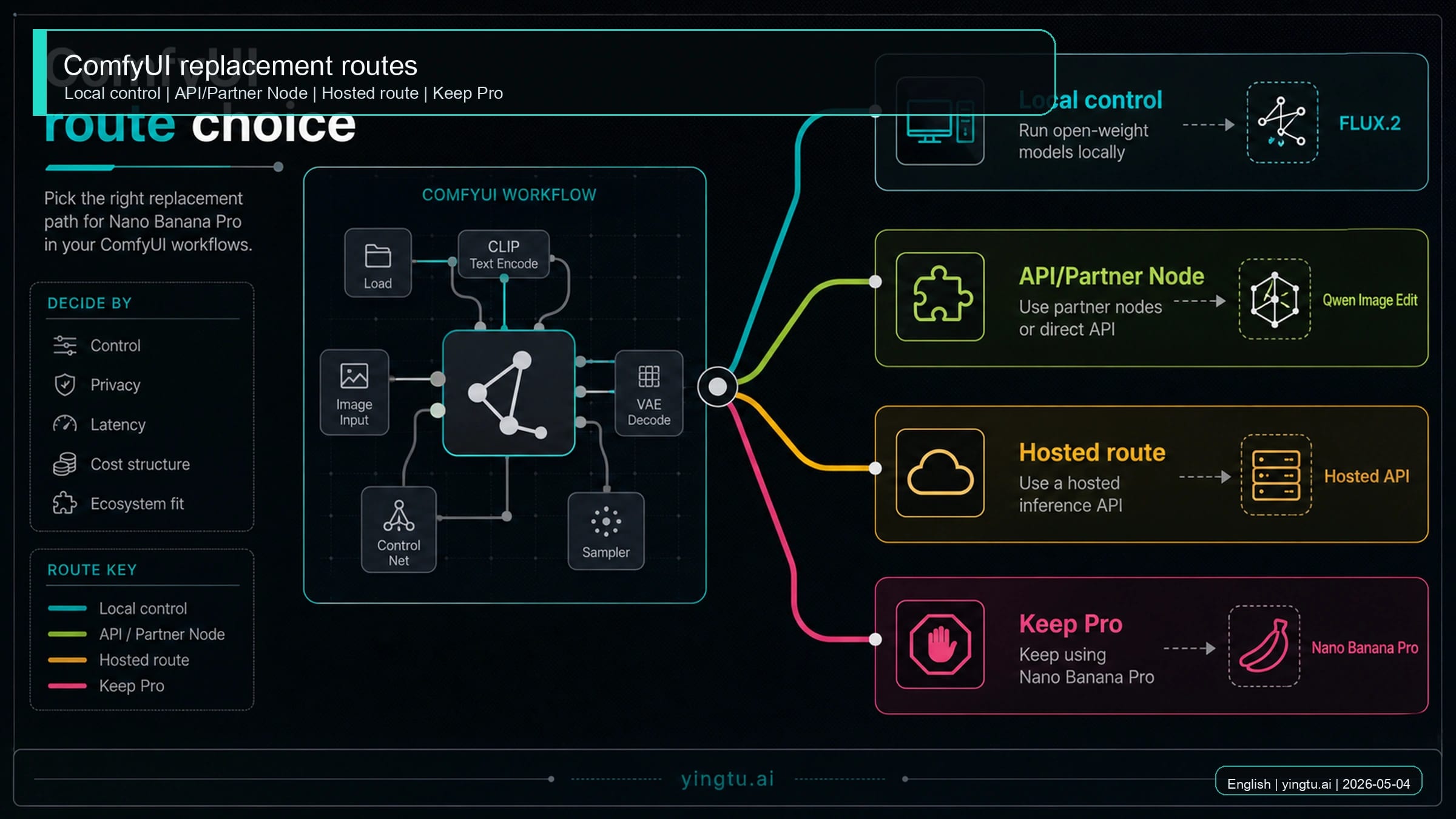
The best replacement for Nano Banana Pro in a ComfyUI workflow is not one universal model. Start with FLUX.2 if the job is local generation control, try Qwen Image Edit 2511 for edit-heavy local experiments, use hosted or API routes only when local runtime ownership is not the point, and keep Nano Banana Pro when dense text, world-aware visuals, or complex multi-reference reliability matter more than local control.
| If your ComfyUI job is... | Start with | Why this route fits | Stop rule |
|---|---|---|---|
| Private or local-first generation where you own the runtime | FLUX.2 in ComfyUI | It is the closest route for local/open-weight workflow ownership and node-level control | Do not expect it to fully match Google's text and world-knowledge strengths without testing |
| Editing, inpainting, refinement, or image-to-image experiments | Qwen Image Edit 2511 | It is a strong local candidate for edit-heavy work and can be tested inside ComfyUI-style pipelines | Treat model builds, quantization, and hardware fit as version-specific |
| Final assets where external runtime is acceptable | Hosted API or provider route | It can preserve a ComfyUI orchestration layer while moving execution, cost, and policy to the provider | Do not call it a local alternative, and verify model ID, price unit, data policy, and limits |
| Text-dense boards, world-aware imagery, or multi-reference reliability | Keep Nano Banana Pro | Google's route can still be the better production choice for tasks where its strengths are the reason you chose it | Switch only after a side-by-side test beats your real prompt set |
If you are trying to set up Nano Banana Pro itself in ComfyUI, use the Nano Banana Pro ComfyUI setup guide instead. For replacement work, make the next decision in order: which route to test first, what that route actually owns, and where a switch would create a worse workflow.
Why The Replacement Decision Starts With Route Ownership
The phrase "ComfyUI alternative" can mean several different jobs. One user wants a local model that keeps prompts, references, and generated images inside their machine. Another wants a cheaper API path while keeping a ComfyUI node graph as the orchestration layer. A third user only wants a final image and does not care whether the runtime lives inside ComfyUI at all. Those are different contracts, even when they appear under the same Nano Banana Pro search.
That split matters because Nano Banana Pro is already a real ComfyUI route. ComfyUI documents a Google Partner Node path for Nano Banana Pro, and its Partner Nodes system is built to call external models through API requests. The official route is therefore not "unsupported"; the replacement question is whether you want to leave that Google-backed API route for a different owner of runtime, cost, privacy, or quality.
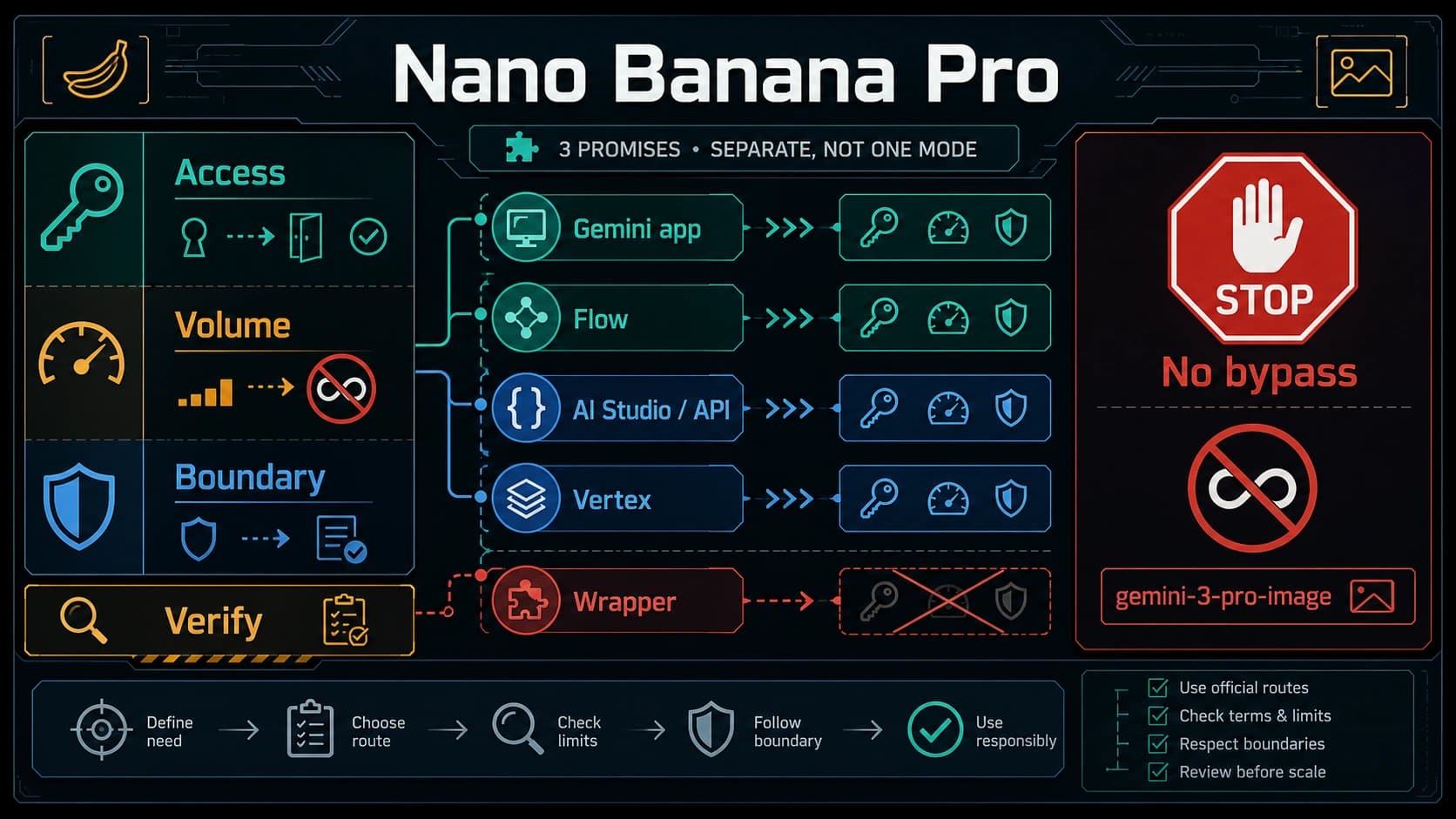
As of May 4, 2026, Google's developer docs map Nano Banana Pro to gemini-3-pro-image-preview, and the Gemini API pricing page lists paid image output for that model with no Free Tier row. That makes the local-control question legitimate, but it does not make every named image model a ComfyUI replacement. A local/open-weight workflow, a Partner Node API call, a hosted API, and a browser image app each solve a different part of the problem.
Use this short version before you test anything:
| Route type | You own | You give up | Better first candidate |
|---|---|---|---|
| Local/open-weight ComfyUI | Runtime, local files, node graph, repeatable workflow | Some of Google's text, grounding, and multi-reference behavior | FLUX.2 first; Qwen Image Edit for editing |
| Google Partner Node/API | ComfyUI orchestration and Google's model behavior | Local runtime ownership and some cost/quota control | Nano Banana Pro or Nano Banana 2 |
| Hosted API/provider | API workflow and production convenience | Local privacy, provider independence, and sometimes model transparency | Seedream 4.0 or another verified hosted route |
| Web app/editor | Fast manual output | ComfyUI workflow ownership | Use only if ComfyUI is not the requirement |
FLUX.2 Is The First Local Route To Try
For a ComfyUI user who means "I want a local or open-weight replacement," FLUX.2 is the most practical first stop. Black Forest Labs documents the FLUX.2 family with multi-reference editing, typography and text-rendering improvements, high-resolution output, and separate model routes. ComfyUI also has FLUX.2 workflow documentation, which gives it a stronger workflow fit than a model that only exists as a demo video or a hosted endpoint.
The important distinction is that FLUX.2 is not one identical product route. BFL describes open-weight [klein] options, API-facing variants, and different capability tiers. If the reason you are leaving Nano Banana Pro is local ownership, focus on the local/open-weight route and then check the exact model size, license, memory requirements, and ComfyUI workflow support. If you select an API-only FLUX.2 variant, you may still get useful output, but you have not solved the local-runtime problem.
FLUX.2 is strongest when the job rewards node-level control: repeated prompt tests, local reference handling, privacy-sensitive exploration, custom ComfyUI pipelines, or hybrid workflows that pass images into upscalers, masks, ControlNet-style tools, or post-processing nodes. It also makes sense when the team can accept setup friction in exchange for owning the execution environment.
The weakness is the same reason Nano Banana Pro still exists in the decision. Google's route can remain better for dense text boards, world-aware prompts, and some multi-reference tasks where the model's external knowledge and instruction following are part of the output quality. Do not switch because FLUX.2 is fashionable. Switch if it passes the exact prompt families, reference counts, image sizes, and workflow latency that matter to your project.
Qwen Image Edit 2511 Fits Edit-Heavy Experiments
Qwen Image Edit 2511 is a different kind of candidate. It should not replace FLUX.2 as the first general local route, but it deserves attention when the task is image editing, inpainting, refinement, or image-to-image experimentation. The Hugging Face FP8 package for Qwen Image Edit 2511 is explicitly ComfyUI-oriented and gives practical placement notes for the model components, which makes it more actionable than a research-only model name.
The catch is setup shape. A ComfyUI-ready quantized package can reduce the barrier, but the workflow still depends on the right transformer, diffusion model pieces, VAE, text encoder, and node support. That makes Qwen more suitable for operators who are comfortable validating model files, reading console errors, and comparing output across builds. It is not the best answer for a deadline where the current Nano Banana Pro node already works.
Where Qwen earns a test is controlled editing. If the current workflow takes an input image, asks for local refinements, and values edit direction more than broad world knowledge, Qwen may reach a useful quality/cost/privacy point faster than a general generation model. Test it on the same reference image, mask type, prompt length, and output size you would use in production. A demo that works on one portrait or product photo is not enough evidence for a pipeline switch.
Treat Qwen as a serious local experiment, not as a universal Nano Banana Pro killer. It can be the right route for edit-heavy workflows, but the decision should be based on your actual image classes: product mockups, character refinements, layout edits, restoration, inpainted objects, or style changes. If the job is text-heavy poster generation or real-world factual scene composition, keep a Google route in the comparison set until Qwen beats it in your own test.
Hosted And API Routes Are Useful But Not Local Alternatives
Hosted and API routes are often excellent production tools, but they should not be mislabeled as local ComfyUI replacements. ComfyUI can orchestrate an external call, pass images between nodes, and keep the workflow graph readable while the model actually runs somewhere else. That is useful when final asset quality, operational convenience, or a specific model capability matters more than local ownership.
Nano Banana 2 is the clearest example inside Google's own family. Google's image-generation docs and pricing docs list Nano Banana 2 separately from Nano Banana Pro, with a different model ID and lower-cost image output than Pro as of May 4, 2026. It can be a practical API alternative if the goal is to reduce cost or latency while staying in the Google image route. It is not a local/open-weight replacement for Nano Banana Pro.
Seedream 4.0 belongs in the same boundary-aware bucket. The technical report describes a unified model for text-to-image, editing, multi-image composition, and high-resolution output, and provider documentation exposes hosted/API access. That can make Seedream attractive for final assets or provider comparisons. It does not become the answer to "local ComfyUI alternative" unless a current local workflow, model release, and ComfyUI integration are verified for the specific route you plan to use.
DreamOmni2 is more of a watchlist item. The research direction is relevant because it points toward multimodal instruction-based editing and generation, which overlaps with the user job behind Nano Banana Pro replacement. But a paper or announcement is not the same as a ready ComfyUI route. Keep it in the research watchlist until runnable artifacts and workflow evidence are current.
Use this boundary test for any hosted route:
| Question | If the answer is no |
|---|---|
| Can you name the exact model ID or provider route being called? | Do not compare quality claims yet |
| Can you see who owns runtime, logs, limits, and policy? | Do not call it a workflow-safe replacement |
| Does it run locally or only through a remote endpoint? | Do not call it a local ComfyUI alternative |
| Can you reproduce the same prompt set from ComfyUI? | Treat screenshots and videos as weak evidence |
| Can you check price units, data terms, and failure handling now? | Do not publish fixed cost or reliability claims |
Keep Nano Banana Pro When The Alternative Creates A Worse Workflow
The strongest alternative decision is sometimes "do not replace it yet." Nano Banana Pro remains the safer route when the thing you need is exactly what the Google image model is good at: dense readable text, world-aware scene details, complex prompt following, multi-reference coherence, and consistent output under a deadline.
Dense text is the most common stop rule. If the job is a product label, app mockup, infographic, local-language poster, or slide-style board, compare real text-bearing prompts before moving the workflow. A local route that wins on privacy can still lose if it turns every final asset into a manual typography repair job.
World-aware visuals are the second stop rule. A local model can produce impressive style and composition, but prompts involving real places, known objects, technical diagrams, historical references, or factual scene details may need a different level of context. If the result has to be visually plausible in a real-world domain, keep Nano Banana Pro in the test set until the alternative proves it can handle that domain.
Multi-reference reliability is the third stop rule. If your workflow depends on several product angles, character references, scene references, or brand constraints, the replacement must preserve identity and relationships across those references. Do not judge from one simple image-to-image prompt. Test the full reference count and the failure modes that actually break your workflow.
Finally, keep the Google route when node availability is the real issue. ComfyUI's Partner Node documentation notes that missing or broken nodes can come from version timing, nightly/stable differences, Desktop or Cloud lag, or import issues. If your only reason for switching is "the node did not appear," update ComfyUI, verify the Partner Node path, and use the setup guide before redesigning the whole workflow.
A Practical Side-By-Side Test Before Switching
Use the same prompt set across every route. A fair test should include at least one pure generation prompt, one edit or inpaint prompt, one multi-reference prompt, one text-bearing image, and one image size that matches production. Keep the seed, source images, aspect ratio, and post-processing steps as stable as each route allows.
Score the output on workflow ownership as well as image quality. The best-looking image is not always the best ComfyUI alternative if it requires a web app, manual upload, unclear data handling, or a provider route you cannot automate. Likewise, the most private local route may not be acceptable if it fails the output standard that made Nano Banana Pro valuable.
Use a simple decision sheet:
| Test axis | What to record |
|---|---|
| Runtime owner | local machine, Google Partner Node/API, hosted provider, or web app |
| Setup burden | model files, node updates, API key, provider account, or no ComfyUI path |
| Text quality | readable labels, multilingual text, layout stability |
| Edit reliability | mask handling, reference preservation, object insertion, style transfer |
| Multi-reference behavior | identity consistency, object relationships, prompt obedience |
| Production risk | cost unit, quota, policy, privacy, repeatability, support path |
The switch is justified only when the replacement wins the axis that caused the search. If the real pain is cost, do not let a local model pass while output repair costs more time than the API bill. If the real pain is privacy, do not settle for a hosted route because it looks good in one demo. If the real pain is quality, keep Nano Banana Pro until the alternative beats your strongest current prompt.
FAQ
What is the best local ComfyUI alternative to Nano Banana Pro?
FLUX.2 is the first local route to try for general ComfyUI generation control. It has current BFL documentation, ComfyUI workflow support, and a clearer local/open-weight path than most named candidates. Qwen Image Edit 2511 is stronger as an edit-heavy experiment, especially when image-to-image refinement matters more than broad generation.
Is Qwen Image Edit better than FLUX.2?
It depends on the job. FLUX.2 is the stronger first pick for local ComfyUI control and general generation workflows. Qwen Image Edit 2511 is worth testing when the workflow is mostly editing, inpainting, or refinement. Neither should be declared better than Nano Banana Pro until it passes your text, reference, size, and production tests.
Is Seedream 4.0 a local ComfyUI replacement?
Treat Seedream 4.0 as a hosted/API candidate unless you have current evidence for the exact local route you plan to use. It can be useful for final assets and provider comparisons, but hosted access does not satisfy a local ComfyUI replacement job.
Does Nano Banana 2 replace Nano Banana Pro in ComfyUI?
Nano Banana 2 can be an API-route alternative inside the broader Google image family, especially if cost or speed matters. It does not replace Nano Banana Pro's higher-end role automatically, and it is still a Google API route rather than a local/open-weight ComfyUI model.
When should I use the Nano Banana Pro ComfyUI setup guide instead?
Use the setup guide when the goal is to install or repair the Google Partner Node route: API key setup, missing nodes, template loading, workflow wiring, or basic generation. Use the replacement decision here only after the Google route is understood and you need to decide whether to leave it.
Should I choose a web app instead of a ComfyUI model?
Only if ComfyUI workflow ownership is not the requirement. Web apps can be fast for manual image creation, but they usually do not preserve node graphs, local files, automated pipelines, or local privacy. If the job is "make a final picture quickly," a web app may help. If the job is "replace Nano Banana Pro inside my ComfyUI workflow," it is a different route.
The Short Decision
Start local with FLUX.2 when runtime ownership and node-level control are the reason you searched for a replacement. Test Qwen Image Edit 2511 when the workflow is edit-heavy and you can tolerate setup validation. Use hosted or API routes when final asset quality matters more than local ownership. Keep Nano Banana Pro when dense text, world-aware details, multi-reference reliability, or a working Google Partner Node route is still the safest production choice.