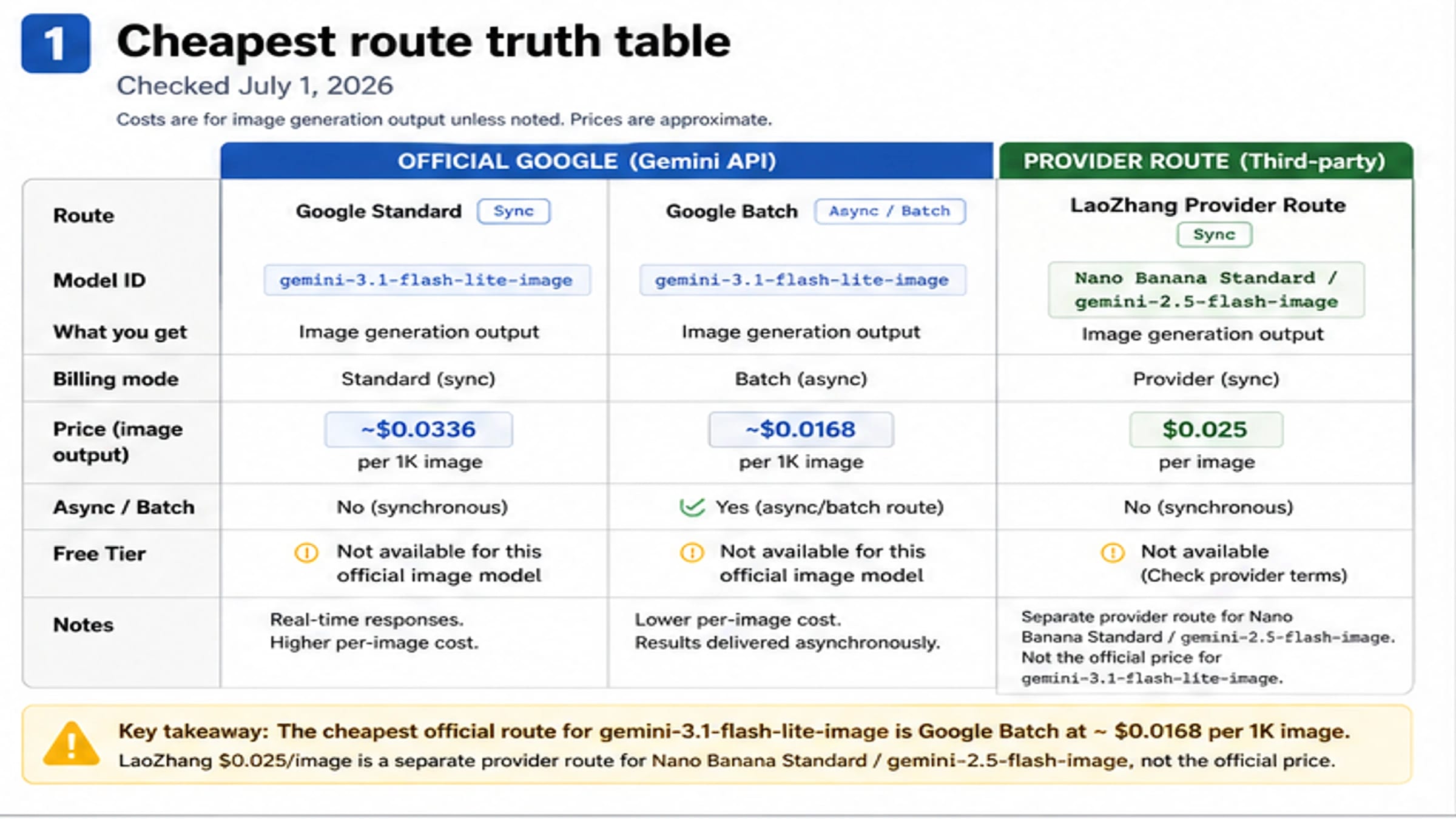
As of July 10, 2026, the cheapest official Google route for gemini-3.1-flash-lite-image is Batch at about $0.0168 per 1K-resolution output image; Standard is about $0.0336 for interactive calls. LaoZhang $0.025/image is a separate provider price for Nano Banana Standard / gemini-2.5-flash-image, not the official Flash Lite Image price. If your code uses gemini-3.1-flash-lite without image, stop and recheck the model ID: that model is text-output only, not image generation.
| Route | What the price means | Use it when | Do not use it when |
|---|---|---|---|
| Google Standard | Official synchronous gemini-3.1-flash-lite-image calls at about $0.0336 per 1K-resolution image. | You need immediate image output and first-party Google billing. | You only care about the lowest official unit cost and can wait. |
| Google Batch | Official asynchronous gemini-3.1-flash-lite-image jobs at about $0.0168 per 1K-resolution image. | You can batch jobs and accept delayed delivery. | You need realtime generation in the request path. |
LaoZhang $0.025/image | Provider-owned Nano Banana Standard / gemini-2.5-flash-image route listed by LaoZhang, with console pricing and call logs prevailing. | You accept the provider route, the different model ID, and fixed-image workflow economics. | You need the official Google Flash Lite Image contract or need to compare official Google rows only. |
The practical recommendation is narrow: choose Google Batch when you want the cheapest official Flash Lite Image route; choose Google Standard when latency matters; consider LaoZhang $0.025/image only when Nano Banana Standard is an acceptable provider route and the console price/call logs match your expected usage. Before running a large batch, verify the exact model ID, image output field, Free Tier status, route owner, per-image unit, and provider invoice or API logs.
Quick Answer
| Question | Short answer | Source to recheck |
|---|---|---|
| What is the cheapest official Google price? | Batch for gemini-3.1-flash-lite-image, about $0.0168 per 1K-resolution output image. | Gemini API pricing |
| What is the realtime official Google price? | Standard for gemini-3.1-flash-lite-image, about $0.0336 per 1K-resolution output image. | Gemini API pricing |
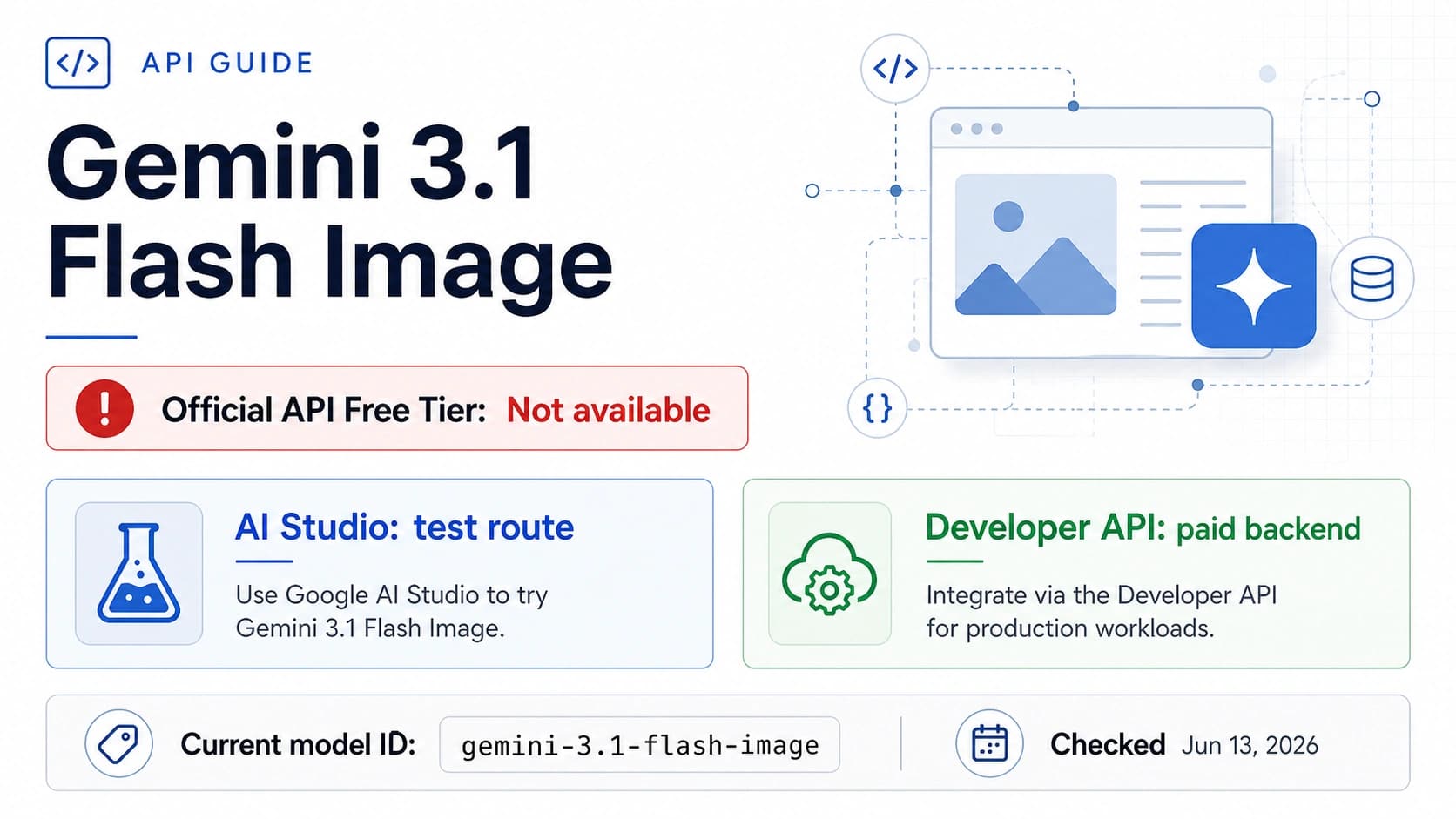
| Is there an official Free Tier? | Not for this official image model row as checked July 10, 2026. | Google pricing row for gemini-3.1-flash-lite-image |
Is LaoZhang $0.025/image real? | Yes, but in the current public docs it maps to Nano Banana Standard / gemini-2.5-flash-image, not official Flash Lite Image. | LaoZhang Nano Banana docs |
Is gemini-3.1-flash-lite enough for image generation? | No. The non-image Flash-Lite model is text-output only. | Gemini 3.1 Flash-Lite model docs |
That is the whole pricing problem in one table. The word "cheapest" only becomes useful after you name the owner of the route: Google official Standard, Google official Batch, or LaoZhang provider-owned Nano Banana Standard.
The Cheapest Official Google Route Is Batch, Not Standard
Google lists gemini-3.1-flash-lite-image as a separate image model, also described as Nano Banana Lite, with image generation and editing support. Its model docs say it supports text and image inputs, image and text outputs, 1K-optimized generation, and Batch API support.
The pricing table is the controlling source for the official cost. As checked July 10, 2026, the Standard row for gemini-3.1-flash-lite-image has no Free Tier and lists image output at $30.00 per 1 million image tokens, equivalent to about $0.0336 per 1K-resolution image. The Batch row is half that output-image price: $15.00 per 1 million image tokens, equivalent to about $0.0168 per 1K-resolution image.
| Official Google lane | Model ID | Delivery style | Output-image equivalent | Best fit |
|---|---|---|---|---|
| Standard | gemini-3.1-flash-lite-image | Synchronous | About $0.0336 per 1K image | Interactive product flows, user waits for result |
| Batch | gemini-3.1-flash-lite-image | Asynchronous | About $0.0168 per 1K image | Backfills, catalog jobs, queued variants, offline generation |
Batch is cheaper on the official Google price sheet, but it is not the best route for every product. It is a queue-friendly cost lane. If the user is waiting in a UI, the cheaper unit price may not compensate for asynchronous delivery. If the work is a nightly catalog refresh, a backlog of creative variants, or a batch of image edits that can arrive later, Batch is the first official lane to test.
Also separate output-image pricing from total request cost. Prompt text, input images, video inputs, tools, or other billable inputs can change the final request cost. The $0.0168 and $0.0336 numbers are useful route anchors, not a promise that every complete request costs exactly that amount.
Where LaoZhang $0.025/image Fits
The LaoZhang $0.025/image route is useful because it is a concrete low-cost provider lane, but it buys a different contract. LaoZhang's public Nano Banana docs currently describe Nano Banana Standard as based on gemini-2.5-flash-image, fixed at 1K image output, with a listed price of $0.025/image. The same docs say actual billing follows the console price and call records.
That makes it a fair recommendation when your job can accept the provider route and the Nano Banana Standard model. It should not be written into the official Google gemini-3.1-flash-lite-image row, and it should not be compared as if all three routes were the same model.
Use LaoZhang when the real job is:
- low-cost 1K image generation or editing through a provider route
- developer API integration where a provider-owned gateway is acceptable
- quick cost comparison against official Google Standard when realtime output is still useful
- a workload where the exact model being Nano Banana Standard is acceptable
Do not use LaoZhang $0.025/image as the answer when the requirement is:
- first-party Google billing
- the exact official
gemini-3.1-flash-lite-imagemodel ID - an official Google Batch comparison
- a procurement or compliance process that forbids provider-owned routes
For this lane, start from the LaoZhang Nano Banana documentation, then check the current console price, model ID, and call logs before production. If you use the provider endpoint, keep the implementation route separate from the official Google route; api2.laozhang.ai is the provider API entry point, not a Google pricing source.
Do Not Mix Up The Model Names
Most bad cost estimates come from one of three naming mistakes.
| Name | What it is | Image output? | Pricing implication |
|---|---|---|---|
gemini-3.1-flash-lite-image | Official Google image model, Nano Banana Lite. | Yes. | Use Google Standard or Batch pricing rows. |
gemini-3.1-flash-lite | Low-cost Flash-Lite model with multimodal inputs and text output. | No image generation output. | Do not use its text-model pricing to estimate image generation. |
Nano Banana Standard / gemini-2.5-flash-image | LaoZhang provider route for the $0.025/image lane. | Yes through that provider route. | Provider-owned price; console records prevail. |
| Nano Banana2 / Gemini 3.1 Flash Image | Adjacent higher-feature image route in LaoZhang docs. | Yes. | Current LaoZhang docs list this separately at $0.055/image, not $0.025/image. |
The naming bridge matters because "Flash Lite" and "Flash Lite Image" sound close enough to collapse in snippets, dashboards, and copied code. In implementation, they are different contracts. A request that logs gemini-3.1-flash-lite should not be expected to return image files. A provider route that logs gemini-2.5-flash-image should not be reported internally as official Google gemini-3.1-flash-lite-image usage.
For the adjacent full Flash Image route, use the existing Gemini 3.1 Flash Image free-tier and API guide to keep Nano Banana 2, current GA model IDs, and official no-free-tier status separate from this Flash Lite Image cheapest-route decision.
Choose By Workload, Not Price Alone
The lowest number is not always the lowest-risk route. Choose by how the generated image is used, how quickly it must arrive, and which bill owner your team can accept.
| Workload | First route to test | Why |
|---|---|---|
| Interactive product feature | Google Standard | First-party model ID, synchronous response, clear official billing. |
| Bulk variant generation | Google Batch | Lowest official unit price when async completion is acceptable. |
| Low-cost provider evaluation | LaoZhang Nano Banana Standard | $0.025/image provider lane can be cheaper than Google Standard for acceptable 1K provider workflows. |
| Strict official procurement | Google Standard or Batch | Keep model, invoice, support, and terms under Google. |
| Model-family comparison | Separate comparison guide or test matrix | Do not make a price-route decision decide quality for every Gemini image model. |
When the user asks for "cheapest," answer with a condition:
- cheapest official and async: Google Batch
- cheapest official and realtime: Google Standard is the comparable lane
- cheapest provider lane in the verified LaoZhang docs: Nano Banana Standard at
$0.025/image - wrong lane:
gemini-3.1-flash-litetext model for image output
This language is more exact than "LaoZhang is cheaper" or "Google is cheaper." Both can be true under different contracts. The useful answer is which price belongs to which model, owner, and workload.
A Small Test Plan Before You Scale
Run a same-prompt test before committing to a route. The goal is not to crown a universal winner; it is to avoid buying the wrong output contract.
Use this minimum test:
- Pick one production-like prompt and one representative reference image if your workflow uses references.
- Run Google Standard with
gemini-3.1-flash-lite-image. - Run Google Batch with the same model and prompt when async delivery fits the job.
- Run LaoZhang Nano Banana Standard only if the provider route and
gemini-2.5-flash-imagemodel are acceptable. - Record generated image count, accepted image count, latency bucket, retry count, and billed cost.
- Compare cost per accepted image, not only cost per attempted call.
The last line is the important one. A cheaper attempted call can become more expensive if too many outputs are rejected, if retries are common, or if the async lane does not fit the product. A slightly higher official lane can be cheaper operationally when support, invoice ownership, latency, and debugging matter.
Use a small logging shape:
hljs txtroute_owner: google | laozhang model_id: gemini-3.1-flash-lite-image | gemini-2.5-flash-image billing_mode: standard | batch | provider requested_images: 1 accepted_images: 1 latency_bucket: realtime | async listed_unit_price: ... observed_call_cost: ... invoice_or_call_log_id: ...
That log makes later arguments cleaner. If someone says the route costs $0.025, you can see whether the call actually used LaoZhang Nano Banana Standard. If someone says Flash Lite Image is cheaper through Batch, you can see whether the job tolerated async delivery. If someone says Flash-Lite was used, you can catch the text-output model before it becomes a production issue.
How To Verify The Price Today
Prices, model names, and provider routes are freshness-sensitive. Before a launch, do the verification in this order:
| Check | What good looks like | Why it matters |
|---|---|---|
| Official model ID | Your Google code says gemini-3.1-flash-lite-image. | Avoids using the text-only Flash-Lite model. |
| Official pricing row | Google pricing still shows Standard and Batch image-output equivalents for the same model. | Keeps dated price estimates from becoming stale. |
| Free Tier row | The official row still says Free Tier is not available, or you update the production cost plan if Google changes it. | Prevents accidental "free API" claims. |
| Provider model ID | LaoZhang route logs or docs show Nano Banana Standard / gemini-2.5-flash-image for the $0.025 lane. | Prevents mapping $0.025 to Flash Lite Image. |
| Provider console price | The console, pricing screen, and call logs agree with the expected per-image unit. | Provider docs can change; records decide billing. |
| Output acceptance | The route returns usable images for your prompt, size, and edit task. | The cheapest call is not necessarily cheapest per accepted asset. |
If any row does not match, pause the batch. Do not patch internal cost docs by blending prices. Either keep the official Google route and provider route separate, or say the cheaper provider route no longer fits the exact job.
When To Use LaoZhang For This Route Decision
LaoZhang $0.025 can be materially useful when the provider route fits the workload. The honest recommendation is not to hide it; it is to name the boundary.
Use LaoZhang $0.025/image when:
- the job is standard 1K image generation or editing where Nano Banana Standard is sufficient
- the team accepts provider-owned billing, logs, and support
- the provider console shows the expected
$0.025/imageunit at the time of use - you are comparing against Google Standard, not pretending it is the same as Google Batch
Prefer Google direct when:
- exact
gemini-3.1-flash-lite-imageoutput is required - official Google billing and support are part of the requirement
- asynchronous Batch economics are enough and the job can wait
- procurement, privacy, or reliability policy requires first-party routing
The balanced version is simple: LaoZhang is the low-cost provider lane; Google is the official lane. The right route is the one whose model, bill owner, latency, and output acceptance match the workload.
FAQ
Is LaoZhang $0.025/image the official Gemini 3.1 Flash Lite Image price?
No. It is a provider-owned Nano Banana Standard / gemini-2.5-flash-image route in the current LaoZhang public docs. The official Google gemini-3.1-flash-lite-image pricing row is separate.
What is the cheapest official Google price for gemini-3.1-flash-lite-image?
As checked July 10, 2026, Google Batch is about $0.0168 per 1K-resolution output image. It is cheaper than Standard, but it is asynchronous.
What is the official realtime price?
Google Standard is about $0.0336 per 1K-resolution output image for gemini-3.1-flash-lite-image. Use it when the app needs an immediate response.
Does gemini-3.1-flash-lite generate images?
No. The non-image Flash-Lite model has text output. For official image generation, use gemini-3.1-flash-lite-image.
Should I use Google Batch or LaoZhang for the cheapest route?
Use Google Batch when you need the cheapest official Google route and can accept async delivery. Use LaoZhang $0.025/image when Nano Banana Standard, provider-owned billing, and the provider's console/call-log pricing fit your job.
Is Nano Banana2 the same as the LaoZhang $0.025 route?
No. LaoZhang's current public docs list Nano Banana2 / Gemini 3.1 Flash as a separate image route at $0.055/image. The $0.025/image lane is Nano Banana Standard / gemini-2.5-flash-image.
Is there a free official API tier for Flash Lite Image?
Not in the official gemini-3.1-flash-lite-image pricing row checked July 10, 2026. Recheck Google's pricing table before publishing a production cost plan because model billing can change.
What should I verify before production?
Verify the model ID, image-output capability, Standard or Batch billing mode, Free Tier status, provider model ID, console price, call logs, output acceptance rate, and retry behavior. The cheapest route is only useful if the accepted images and billing records match the plan.