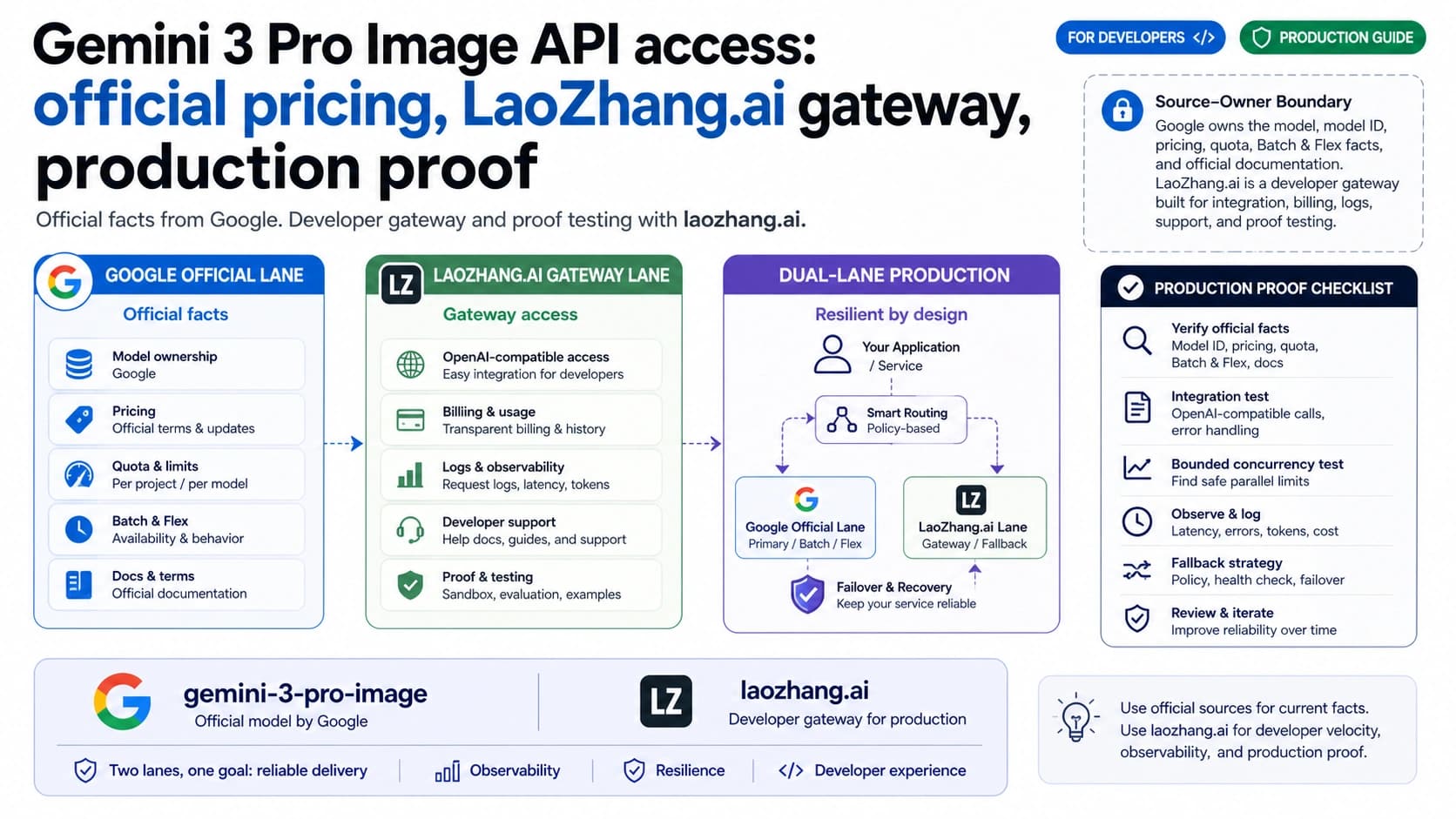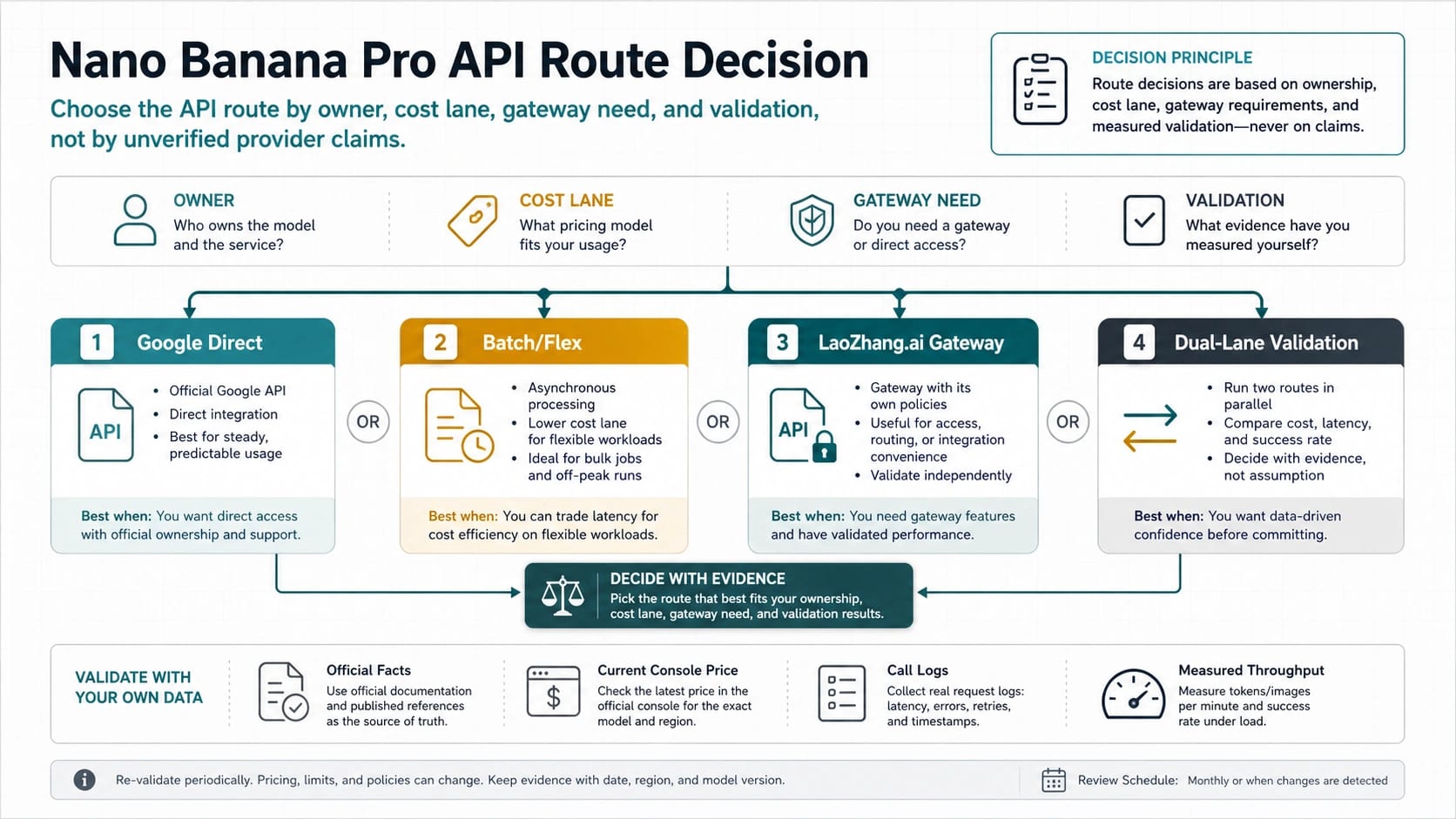
The cheapest stable Nano Banana Pro API is a route decision, not a provider slogan. Use Google direct when official ownership, quota, compliance, and first-party billing matter. Use Google Batch or Flex when the job can wait. Test a gateway only when OpenAI-compatible migration, local payment, request logs, order checks, support, proof-of-concept work, or a fallback lane solves a real integration problem. Do not budget production traffic from old fixed-price, fixed-latency, open-ended throughput, or uptime claims.
| Route | Best fit | Check before production |
|---|---|---|
| Google Standard | Real-time generation with first-party model, price, quota, and support ownership | Current gemini-3-pro-image price row, project quota, region, billing, and error handling |
| Google Batch/Flex | Non-real-time catalogs, scheduled assets, and jobs that can wait for cheaper official processing | Queue window, retry policy, delivery monitoring, and product latency tolerance |
| Verified gateway route | OpenAI-compatible calls, local payment, logs, order review, support, POC testing, and fallback validation | Current route in docs or console, current platform price, call logs, billing records, and support evidence |
| Dual-lane validation | Teams that want a Google baseline and a gateway fallback before switching traffic | Same prompt set, same acceptance rules, cost per accepted image, and owner for each failure mode |
The safe first move is simple: treat Google as the official owner of model names, prices, Batch/Flex behavior, and limits; treat a third-party gateway as an operating route that must be verified through current docs, console, request logs, and orders; treat stability as something measured with your workload, not inherited from a marketing line.
If the broader question is Gemini 3 Pro Image API channel selection, start with the Gemini 3 Pro Image API access guide. For Nano Banana Pro cost, gateway fit, billing, and high-concurrency validation, keep the decision grounded in the four routes above.
What Nano Banana Pro Means In API Naming
Nano Banana Pro is the reader-facing name many developers use for Google's higher-end image model. In current Google API documentation checked on July 8, 2026, the official image generation route is presented as Gemini 3 Pro Image with the model ID gemini-3-pro-image. That is the name to use when you are checking Google official pricing, quota, capabilities, and release behavior.
Gateway routes can expose different route labels. That does not automatically make the gateway wrong, but it means the official model ID and the platform route are different ownership surfaces. If a provider still uses preview-flavored naming, confirm whether it is a compatibility alias, a stale route, or a different upstream model before production rollout.
| Naming surface | Who owns it | Safe implementation rule |
|---|---|---|
gemini-3-pro-image | Google official API docs | Use it for Google direct checks, official pricing, quota, and capability references |
| Nano Banana Pro | Market and product shorthand | Use it for reader recognition, then map it to the current route owner |
| Gateway route string | Gateway docs and console | Keep it configurable and verify it before rollout |
| Preview-flavored strings | Route-specific or legacy context | Do not treat them as universal official names |
Price Owner Map
As of July 8, 2026, Google's public Gemini API pricing page lists Gemini 3 Pro Image with official Standard, Batch, Flex, and Priority lanes. The Standard image-output baseline is equivalent to about $0.134 for 1K/2K output and $0.24 for 4K output. Batch and Flex are lower-cost official lanes for jobs that can accept asynchronous or flexible processing, with image-output equivalents around $0.067 for 1K/2K and $0.12 for 4K.
Those official rows are not the same thing as a gateway price. A gateway's public docs, console, call logs, and order records own its own price. Older $0.05 gateway claims are stale for budgeting unless the current account, docs, order record, or console shows otherwise.
| Claim | Primary owner | How to write it safely |
|---|---|---|
| Official model price | Google pricing page | Date the Google Standard, Batch, and Flex baseline |
| Gateway price | Gateway docs, console, balance, and orders | Verify the current account price and actual charge records |
| Savings | Your workload comparison | Compare accepted images, retry cost, latency tolerance, and support time |
| High-volume cost | Your test logs and finance records | Budget by accepted output, not just request count |
The useful question is not "who advertises the lowest number?" The useful question is "which route gives this workload the lowest verified cost per accepted image, with logs that can explain failures and charges?"
When A Gateway Is Worth Testing
A gateway is most defensible when the reader's actual blocker is gateway friction, not official model discovery. Test one when a team wants an OpenAI-compatible endpoint, local payment or top-up flow, unified billing, request logs, order checks, quick POC setup, or a fallback lane while Google direct remains the official baseline.
The recommendation should stay bounded: verify the current provider docs, confirm the callable route in the console, run a small prompt set, inspect call logs, reconcile charges, and decide whether the gateway belongs in production. A fair recommendation also says when Google direct is better.
Use Google direct first when first-party contracts, direct Google quota, compliance review, Cloud logging, official support, or Batch/Flex ownership matter more than gateway convenience. Use the gateway first only when setup and operating evidence solve a concrete developer problem.
| A gateway helps when... | Google direct is stronger when... |
|---|---|
| Existing code already uses OpenAI-compatible SDKs | The product needs first-party support and contract ownership |
| Local payment, balance, or order review is easier | Google billing and quota are already approved |
| Logs and support packets are needed for fast POC review | Compliance requires fewer intermediaries |
| The team wants a fallback lane beside Google direct | Batch/Flex is a better fit for delayed work |
Prove Stability And High Concurrency
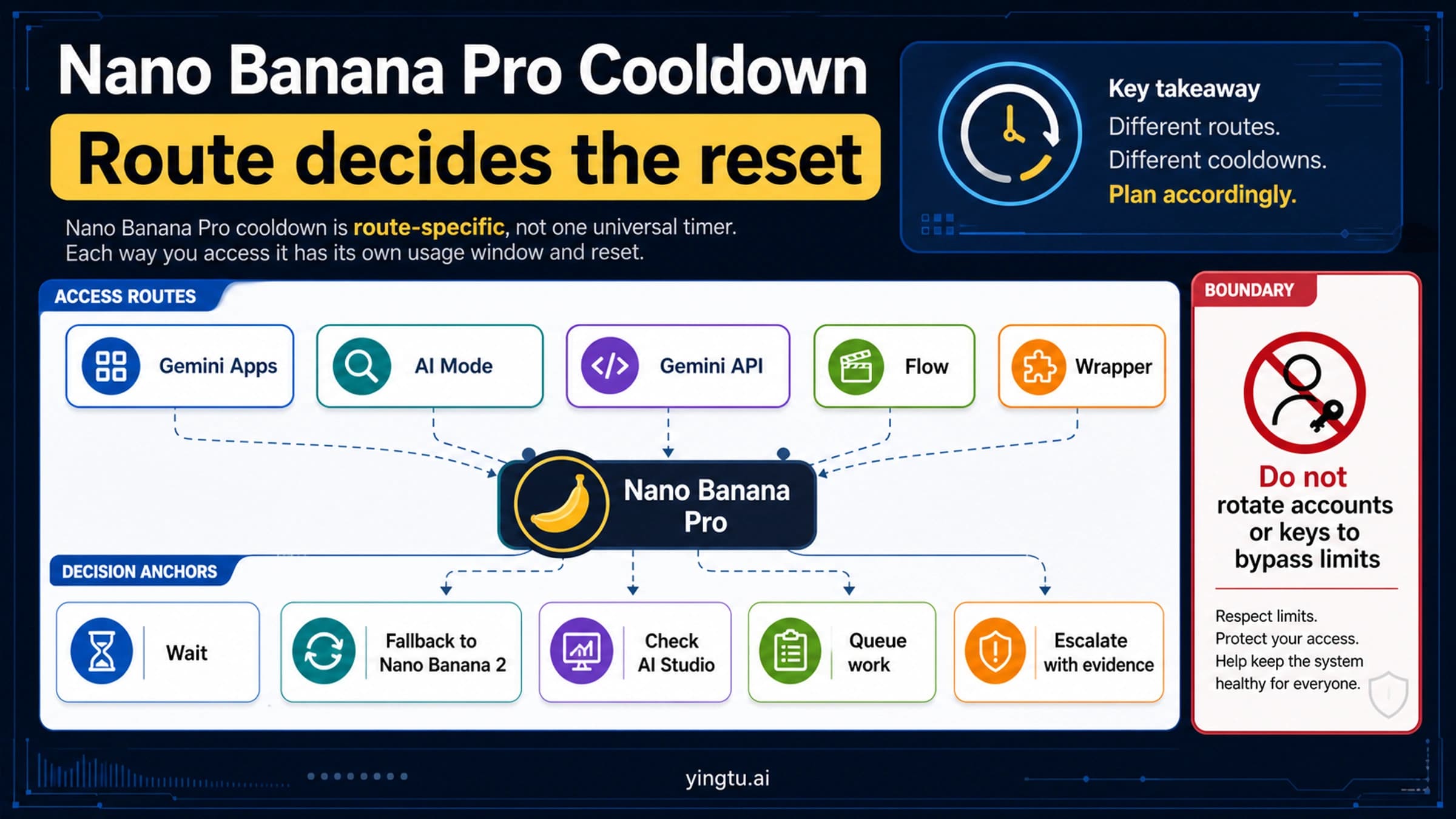
Do not call a Nano Banana Pro API route stable until it has survived a workload-shaped test. Google's rate-limit docs describe project-tier limits and warn that active capacity can vary by account and model. A gateway can add a different throttle, queue, timeout, retry, or upstream dependency. None of that can be summarized by one public adjective.
Run the same 20 to 50 production-like prompts through the routes you are considering. Keep resolution, reference images, timeout, retry count, and acceptance criteria fixed. Record route, model or route string, request ID, status code, whether an image returned, whether the image passed acceptance, elapsed time band, retry count, and billing record. Then raise concurrency gradually.
| Metric | What to record | Why it matters |
|---|---|---|
| Success rate | Returned image, accepted image, rejected image, and no-image response | Separates API success from usable output |
| P50 and P95 latency | Median and tail response time by route | Shows user experience and queue pressure |
| 429 and quota errors | Google quota, platform throttle, and client concurrency | Shows the true bottleneck |
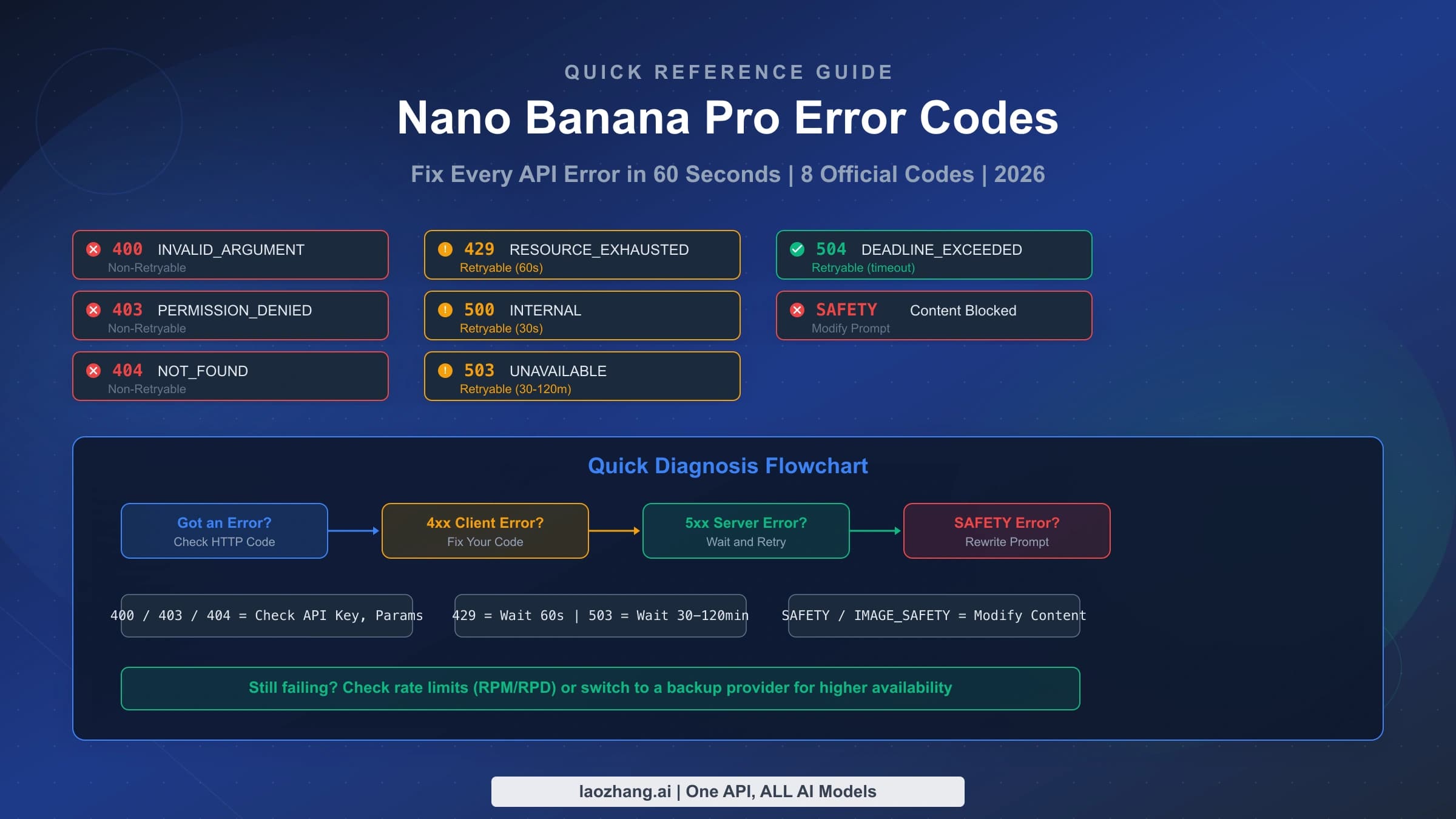
| 5xx and timeout errors | Provider route, upstream status, and retry outcome | Shows whether retry policy helps or multiplies cost |
| Billing trace | Request ID, order ID, balance movement, and charge | Shows whether the cost model matches reality |
Stop the test when errors rise faster than accepted images, when logs cannot explain charges, or when retry cost starts hiding the real price. A route that looks cheaper per request can become more expensive if it produces more rejected images, unclear billing, or manual support work.
Billing And No-Image Checks
Image APIs create billing edge cases that a simple price table misses. A request can return a technical success but no usable image. A prompt can trigger a safety or upstream control. A retry can produce a second charge. A gateway can show an order record that needs to be reconciled with the response body.
Gateway docs say actual charges should be checked in call logs and order status. Use that workflow. For every failed, delayed, or no-image case, save timestamp, route, request ID, input summary, response body, order ID, balance movement, retry count, and whether any image data was returned.
| Symptom | First check | Next move |
|---|---|---|
| Success status but no usable image | Response fields, route log, safety data, order record | Preserve the exact request and ask support to inspect it |
| Repeated quota or throttle errors | Google project quota, platform route limit, client concurrency | Lower concurrency, request quota, use Batch/Flex, or fail over |
| Timeout | Client timeout, platform log, upstream response, retry policy | Add idempotency and avoid blind retry bursts |
| Billing mismatch | Call log, order status, balance movement, timestamp | Reconcile before changing route or retrying at scale |
OpenAI-Compatible Vs Native Gemini Paths
OpenAI-compatible access is useful because it lowers migration friction. Google itself documents an OpenAI compatibility path for Gemini by changing the SDK base URL, and many gateways use a similar SDK shape. The compatibility layer is a request-shape convenience, not proof that every Google-native option, route string, image size, or billing behavior is identical.
Keep the model or route value configurable:
hljs tsimport OpenAI from "openai";
const client = new OpenAI({
apiKey: process.env.IMAGE_GATEWAY_API_KEY,
baseURL: process.env.IMAGE_GATEWAY_BASE_URL,
});
const image = await client.images.generate({
model: process.env.NANO_BANANA_PRO_ROUTE,
prompt: "A product hero image with readable bilingual packaging text",
size: "1024x1024",
});
console.log(image.data?.[0]);
For Google direct, use the official Gemini route, current model ID, and current parameter set from Google's docs. For a gateway, use the route string shown in that platform's docs or console. Do not reuse a gateway route string in first-party calls or rename a first-party model as if the gateway owns it. The same application can support both by moving the base URL, credential, route value, timeout, and retry policy into configuration.
A Safe Production Rollout
Start with a POC lane, not a full traffic switch. First, run Google direct as the official baseline. Second, run the gateway against the same prompt set if gateway value is part of the job. Third, compare accepted output cost, error categories, billing traceability, and support response. Fourth, decide whether the gateway should be primary, fallback, or POC-only.
| Rollout step | Pass condition |
|---|---|
| POC | The route can generate accepted images and every charge can be traced |
| Bounded load test | Success rate, P95 latency, retry cost, and log quality stay within target |
| Dual-lane trial | Google direct and gateway outputs are compared with the same acceptance rules |
| Production ramp | Traffic increases only while errors, costs, and support tickets stay explainable |
| Fallback review | The team knows when to switch, when to retry, and who owns each incident |
The strongest answer for a "cheapest stable Nano Banana Pro API" request is not a permanent vendor ranking. It is a route choice with current price owners, a gateway fit rule, and a test plan that can prove whether the chosen route is cheap enough and stable enough for the actual workload.
FAQ
What is the cheapest stable Nano Banana Pro API route?
For official control, start with Google direct and compare Standard, Batch, and Flex. For gateway convenience, test a gateway only when OpenAI-compatible integration, payment, logs, support, POC speed, or fallback design solves a real problem. The cheapest stable route is the one with the lowest verified cost per accepted image under your workload.
Is the gateway cheaper than Google direct for Nano Banana Pro API?
It can be cheaper for some real-time gateway jobs, but do not use old $0.05 claims as budget data. Google owns official pricing. The platform owns its own price, and actual charges should be checked in provider docs, console logs, and billing records. Compare against Google Standard, Batch, and Flex for the same accepted-output target.
Is the gateway stable enough for high concurrency?
Treat that as a test, not a promise. Run a fixed prompt set, raise concurrency gradually, record success rate, P50/P95 latency, 429/5xx errors, retry cost, returned images, accepted images, and billing traceability. Use production traffic only after the logs can explain both failures and charges.
What model ID should I use?
Use gemini-3-pro-image when you are using the official Google API context. If a gateway exposes a different route string, use the value shown in that gateway's docs or console and keep it configurable. Do not hard-code a preview-style name as a universal official model ID.
When is Google direct better than a gateway?
Google direct is better when first-party support, compliance, direct quota ownership, Google billing, official logs, or Batch/Flex processing matters. A gateway is better to test when integration friction, payment, local support, logs, or fallback validation is the real blocker.
Can I use the OpenAI SDK?
Yes, when the route supports an OpenAI-compatible request shape. Keep the base URL, credential, route value, timeout, and retry policy configurable, and verify that the image parameters you need are supported by the route you are using.
How should I check billing?
Record request ID, route, timestamp, response body, returned image status, order ID, balance movement, retry count, and support notes. Reconcile the call log and order status before deciding that a route is cheap, expensive, broken, or safe to scale.