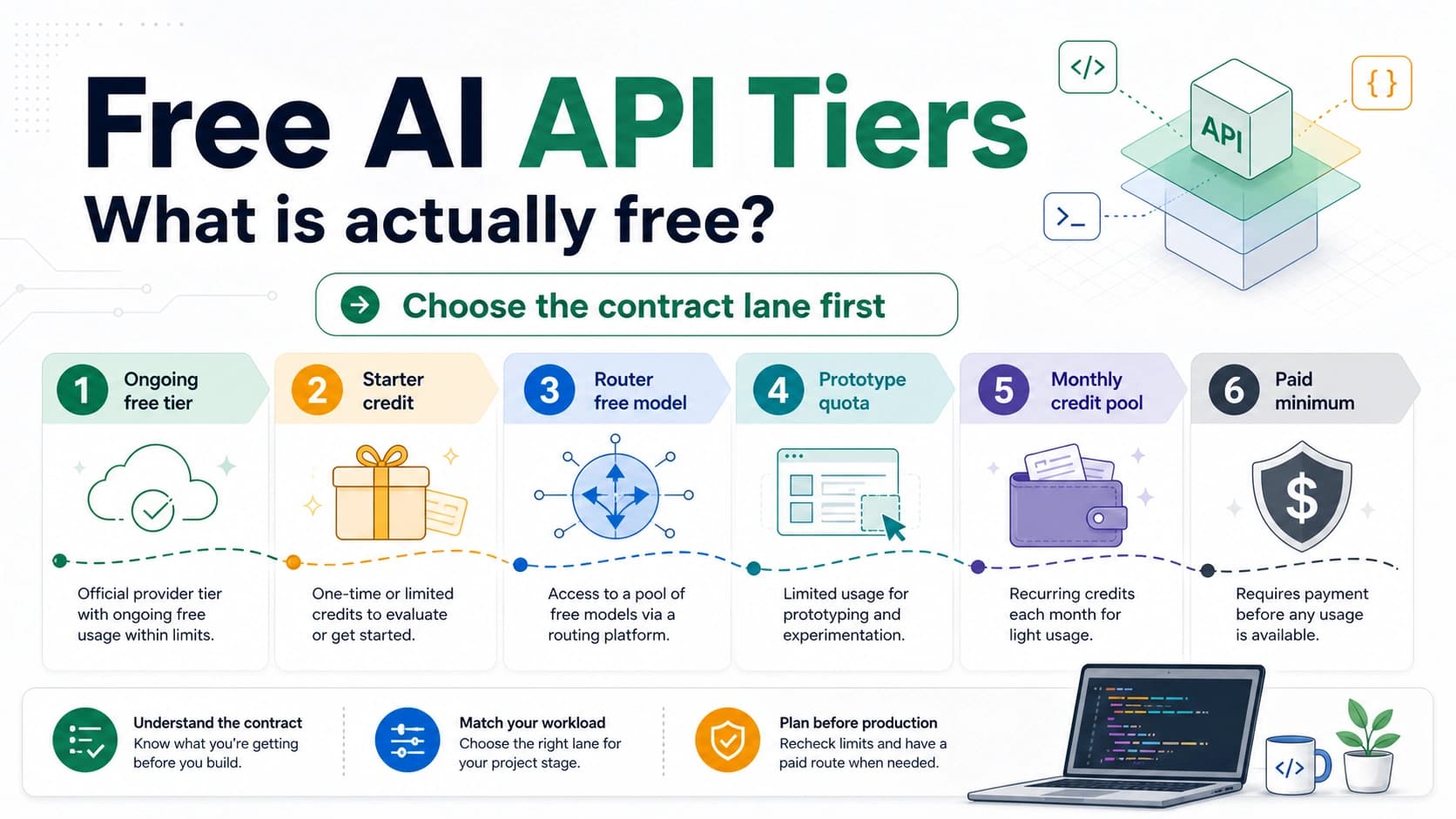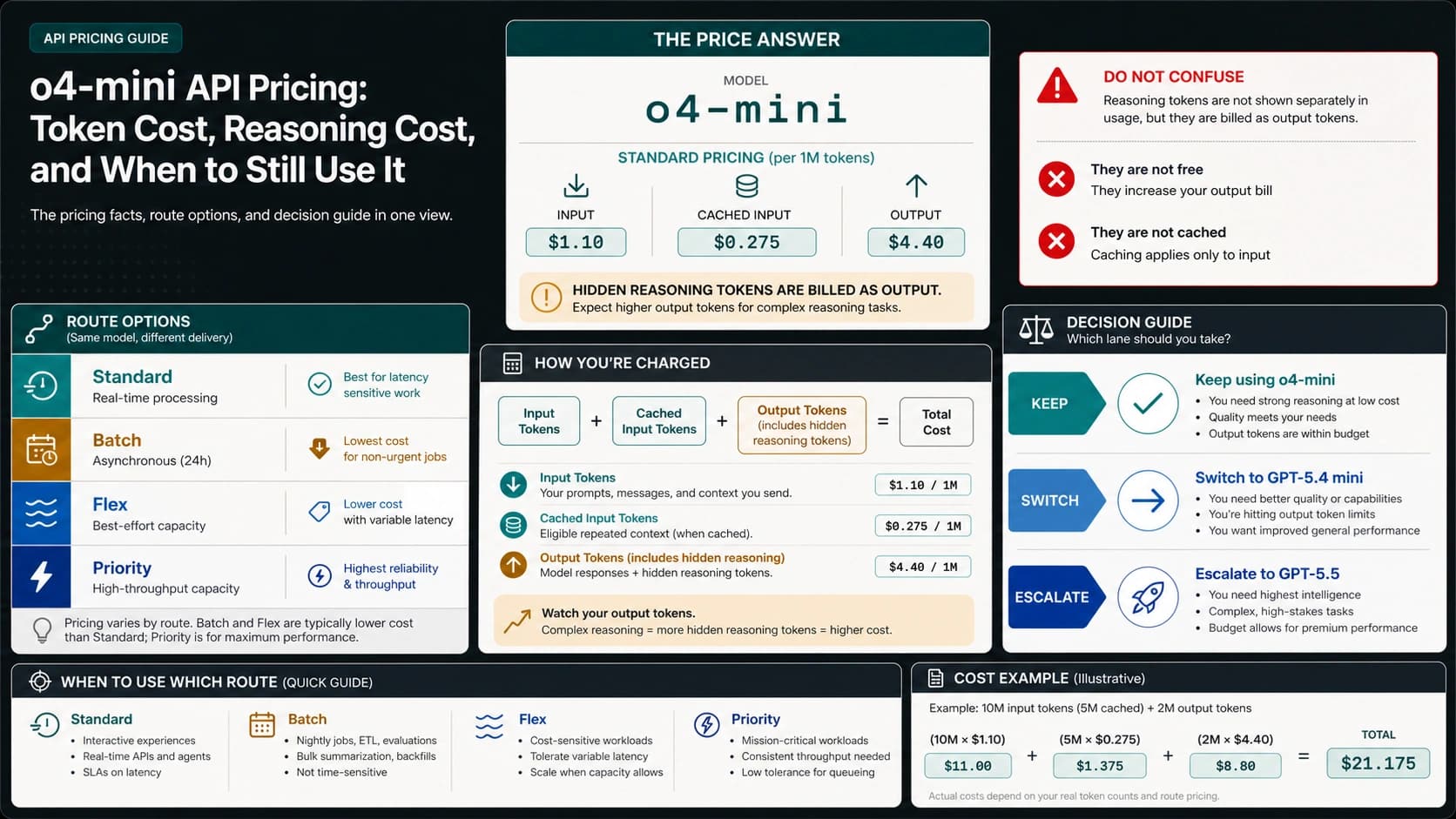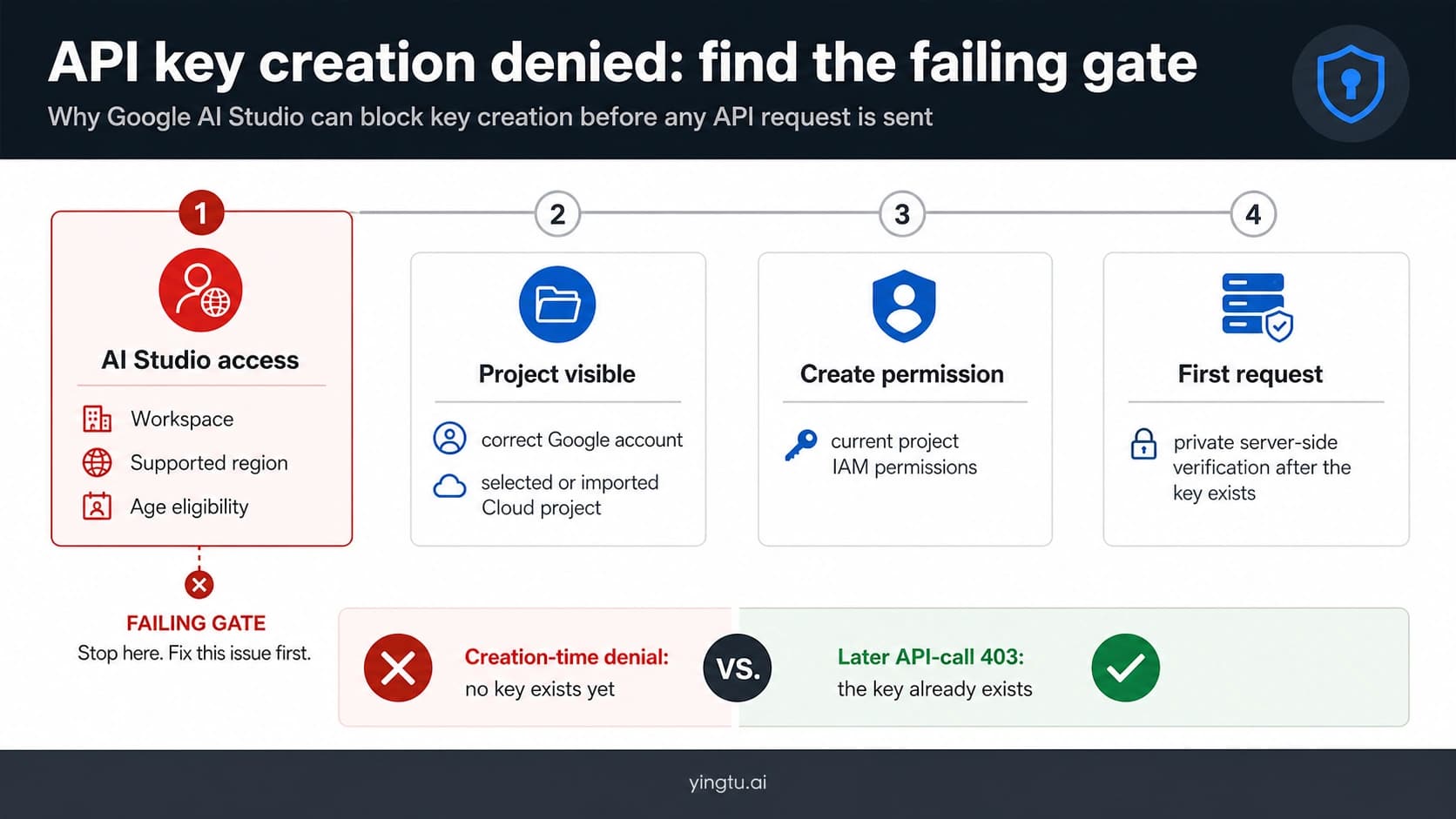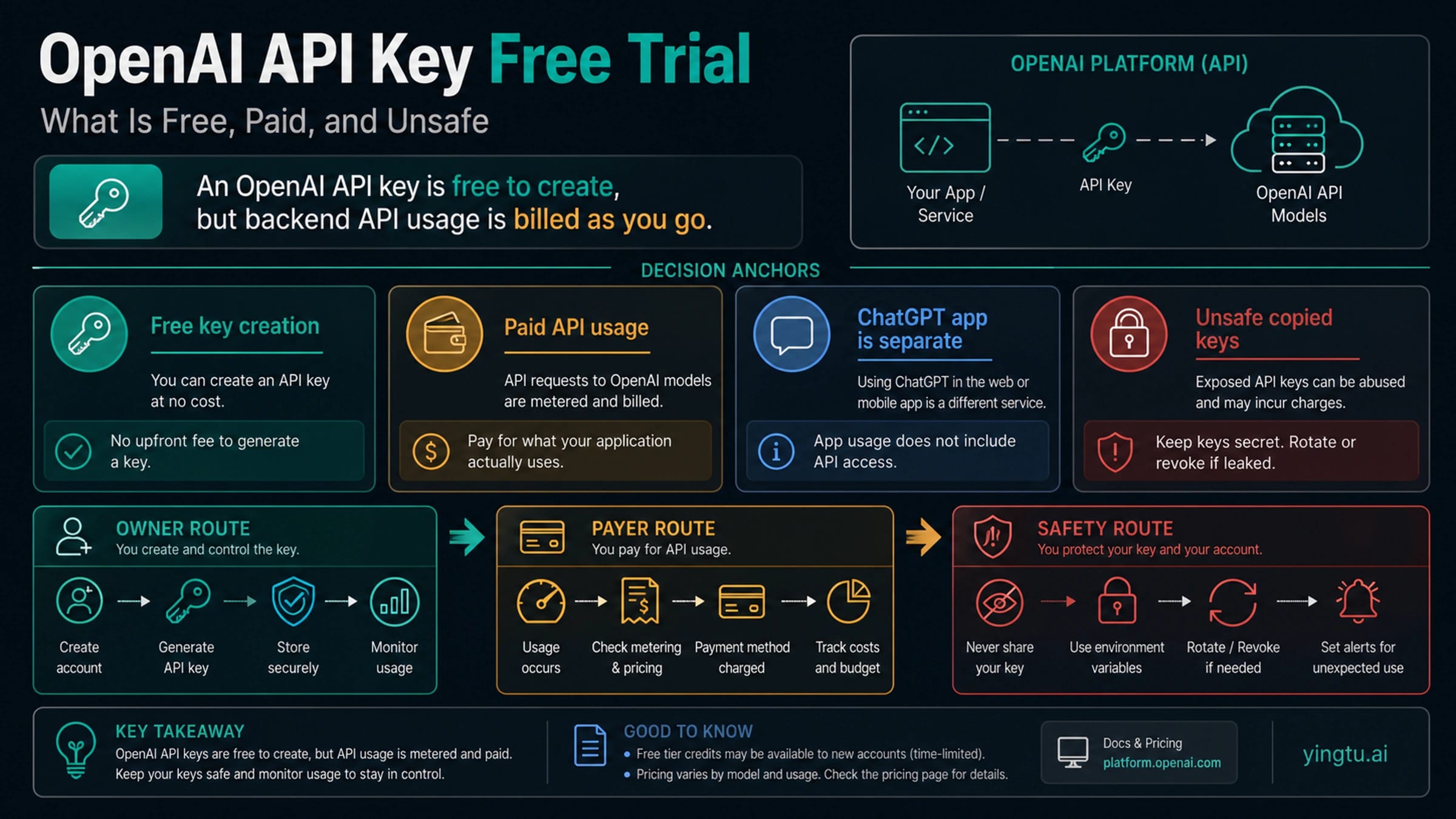
As of April 29, 2026, an OpenAI API key can be created without paying, but it does not provide free unlimited official API usage. Many people call this a "ChatGPT API key"; the developer credential is an OpenAI Platform API key, and the usage behind it is controlled by billing, credits, project permissions, model access, usage limits, and rate limits.
| Route | Who owns the account or key | Who pays | What it is safe for | Check before trusting |
|---|---|---|---|---|
| OpenAI Platform API | Your OpenAI Platform org/project | Your API billing account, credits, or prepaid balance | Production API work and controlled tests | Billing state, model access, usage limits, rate limits |
| ChatGPT app access | OpenAI consumer app account | Free/Plus/Pro app plan or quota | Manual ChatGPT use, not backend API calls | Whether you need API credentials; app plans do not become API billing |
| Trial credit | OpenAI Platform account when available | Account-specific credit first, paid usage later | Short official tests | Credit balance, expiry, allowed models, billing fallback |
| Provider route | Third-party provider | Provider credit, plan, or your provider bill | Non-sensitive evaluation if terms are clear | Owner, price unit, data terms, limits, support |
| User-pays route | SDK or platform owner plus each end user | End user at runtime | Apps where users bring their own session or payment | Consent, privacy, abuse controls, rate limits |
| Free open-weight model | Model/provider/community host | Provider/community or your own infrastructure | Some no-cost experiments, not ChatGPT API access | Model identity, host limits, context window, data policy |
| Copied key or generator | Unknown or exposed owner | Unknown; often someone else's account | Reject | Key ownership, billing risk, logs, malware, policy violation |
The stop rule is simple: if a route cannot show who owns the key, who pays after the free action, what limits apply, what terms cover prompts and outputs, and how failures are supported, do not use it with real data or production code. If you want the official path, create your own Platform key, verify billing or credits, set a low usage limit, make one minimal request, and monitor usage before scaling.
A key is a credential, not quota
An OpenAI Platform API key proves that a request is allowed to act inside a specific organization or project. It does not create a separate budget, an independent free allowance, or a hidden pool of model access. The key sits below account, project, role, model, usage-limit, and billing decisions.
That distinction explains why a new key can still fail. The key may be syntactically valid, but the project may have no usable credits, the model may not be enabled for the account, the request may exceed a rate limit, or the organization may have hit a usage limit. Rotating the key is useful for security hygiene; it is not a way to multiply free usage.
OpenAI's API reference uses bearer authentication with the OPENAI_API_KEY environment variable. The same docs also attach usage to organization and project context. Treat the key like a secret credential: store it in a server-side environment variable or secret manager, never paste it into public repos, front-end bundles, screenshots, or shared notebooks.
For team work, project-level roles matter. A person may be able to create a personal key in one project and have no access in another. Service-account keys have their own management and should be scoped tightly. If a key works on a laptop but fails in production, check the owning project and role before assuming the API is down.
What is actually free
Creating a key can be free. Opening the dashboard, pressing create, and storing the resulting secret do not themselves prove that API usage will be free. The useful question is whether the project behind that key has usable credits, billing, model access, and enough limits for the request you want to send.
OpenAI's public pricing surface is the current owner for official per-model API prices. Pricing changes by model and unit, so a generic promise of free official backend access is not a contract. The pricing page is also why a free-looking wrapper should not be treated as OpenAI credit unless the route clearly says who is paying and under whose terms.
Prepaid billing is another common source of confusion. OpenAI Help currently describes prepaid billing as a way for API users to buy usage credits in advance, with a minimum purchase of $5. That is a low official start, not an unlimited free entitlement. If an account has promotional or trial credit, check the balance, expiry, allowed models, and whether requests will fall back to paid balance after the credit is gone.
Rate limits and usage limits are separate from price. OpenAI rate-limit docs define limits by dimensions such as requests per minute and tokens per minute, and usage limits cap spend. A free or low-cost test can still fail on rate, model access, project permission, or usage cap. The right diagnostic is not "make another key"; it is "which limit owner stopped the request?"
ChatGPT app access and API billing are separate
ChatGPT app plans and OpenAI Platform API billing are managed as separate surfaces. A Plus, Pro, Business, or free app experience can be useful for manual work, but it does not automatically fund programmatic API calls from your server. Conversely, an API billing balance does not change the message caps or app-plan features inside ChatGPT.
That separation is the heart of the reader mistake. A person may be able to use a model in the app and still see insufficient_quota, billing, or model-access errors from code. The app route answers "can I use the assistant manually?" The API route answers "can my application call a model through an authenticated project and pay for usage?"
Use app access when the task is exploratory prompting, personal writing, or manual analysis. Use the Platform API when the task is automation, backend integration, logging, retries, controlled spend, and application ownership. If a workflow needs both, document both budgets and both limits instead of assuming one account state covers everything.
Which free-looking route are you really choosing?
Provider routes, user-pays SDKs, and free open-weight models can be legitimate, but they are not official OpenAI free usage just because the request shape looks familiar. The first classification question is always ownership: who owns the key, who pays the bill, who handles logs, and who supports failures?
A provider credit can be useful for non-sensitive evaluation. It may give a small balance, a playground, an OpenAI-compatible endpoint, or a hosted model that looks close enough for prototype work. The tradeoff is that the provider owns the price unit, model mapping, data terms, rate limits, and support path. The safer language is "provider evaluation route", not "free OpenAI API."
A user-pays route is different again. It can reduce the developer's central API bill by making each end user bring a session, token, or payment relationship. That may fit a browser app or personal automation tool, but it changes privacy, abuse controls, consent, support, and rate-limit behavior. It is free only for one party, not free as a whole system.
Free open-weight models are useful when the real goal is no-cost experimentation rather than OpenAI parity. An OpenRouter free model, a community host, or self-hosted open weights can be the right experiment for learning, classification, or low-stakes demos. They do not become ChatGPT app access or official OpenAI Platform API credit.
Unsafe shortcuts to reject
Copied keys, public key lists, "key generator" pages, no-owner wrappers, and account-pool offers should be rejected for production and sensitive data. They can expose someone else's account, leak your prompts, install malware, disappear without support, or create billing and policy risk for the person whose credential is being abused.
The more generous the promise sounds, the more proof it needs. "Unlimited", "no rate limit", "no ban", "free forever", and "no billing needed" are not usable production claims unless the owner, payer, limits, abuse controls, terms, and failure support are visible. If those pieces are missing, the cheapest safe action is to stop.
Do not paste a secret key from a forum into a local tool just to see whether it works. A working response only proves that some credential accepted one request at one moment. It does not prove permission, safety, durability, cost ownership, data handling, or recovery. The same rule applies to GitHub repositories that publish keys or promise random generated keys.
If you already exposed a real key, rotate it, review usage, set stricter project limits, and check billing. If unexplained usage appears, treat it as a credential incident rather than a normal quota problem.
Smallest safe official test path
The smallest official test is deliberately boring. Sign in to the OpenAI Platform dashboard, choose the correct organization and project, create a new secret key, store it in a local environment variable, verify billing or credit state, set a low project usage limit, and send one minimal request with a low-cost model that is enabled for the account.
After the request, open the usage page and confirm that the cost landed where expected. Then inspect rate-limit headers or account limit pages if the request was throttled. If the error mentions quota, billing, model access, or permission, fix that owner before changing code. Re-running the same request with new keys usually wastes time.
For production, add three controls before inviting users: server-side key storage, budget alerts or low usage caps, and a fallback message for quota or billing failures. A prototype can tolerate a manual retry. A customer-facing app needs visible failure handling, logging, and a support route.
Keep the test payload non-sensitive until the route is proven. The first request should answer credential, billing, and limit readiness. Privacy, retention, audit, and data-policy decisions come before production data, not after the first incident.
Decision rule
Use the official OpenAI Platform API when you need first-party documentation, direct API behavior, project limits, billing visibility, and production ownership. Use ChatGPT app access when a human is working inside the app. Use a provider route only when its owner, payer, limits, terms, and support are clear enough for the risk. Use user-pays only when your product intentionally shifts payment and consent to the end user. Use free open-weight models when no-cost experimentation matters more than OpenAI API parity.
Reject copied keys and generators. They do not solve the cost problem; they move it into security, billing, privacy, and reliability risk.
FAQ
Can I get an official OpenAI API key for free?
You can create an API key without paying, but official API usage still depends on billing, credits, model access, project permissions, usage limits, and rate limits. A key is not a free unlimited usage entitlement.
Does ChatGPT Free, Plus, or Pro include API credits?
No. ChatGPT app access and Platform API billing are separate. App plans can improve manual ChatGPT use, but they do not automatically fund backend API calls from your code.
Are OpenAI trial credits still available?
Treat trial credit as account-specific and volatile. Check the Platform billing page for your own account, credit balance, expiry, allowed models, and paid fallback. Do not write a product plan around an assumed universal credit.
Is a provider free route the same as OpenAI free API usage?
No. A provider route owns its own price unit, credit policy, model mapping, data terms, rate limits, and support. It can be useful for evaluation, but it should be labeled as a separate contract.
Is a user-pays route really free?
It can be free for the developer's central bill, but the user may pay with their own session, account, quota, or balance. The product must make that consent and privacy boundary clear.
Are free OpenAI API keys on GitHub safe?
No. Public keys, copied keys, and key generators should be treated as unsafe. They do not prove permission, cost ownership, data handling, support, or durability.
What should I do first if my new key says quota exceeded?
Check the project billing state, credit balance, model access, usage limits, and rate limits. If those are not ready, creating more keys inside the same project will not fix the underlying owner.