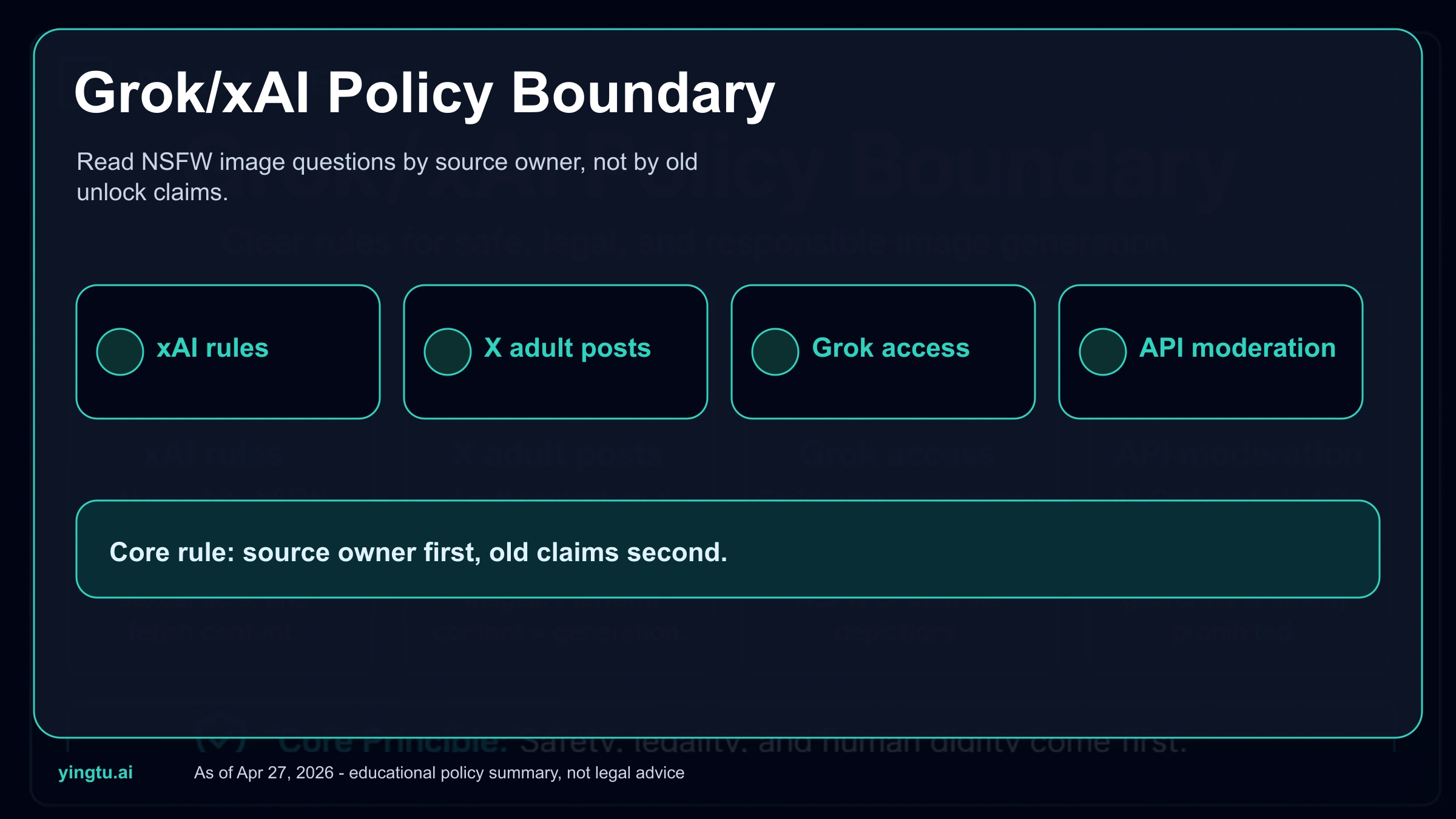
As of April 27, 2026, the useful answer to Grok/xAI NSFW image policy questions is policy-boundary first: xAI rules govern use, X adult-content rules govern labeled posts on X, Grok consumer access can vary by account and surface, and the xAI image API is a moderated developer route.
That means old Spicy Mode advice should not be treated as a current permission slip. xAI policy draws hard lines around pornographic depictions of real people's likenesses, nonconsensual intimate imagery, child sexualization or exploitation, safeguard circumvention, and illegal or regionally noncompliant use. X may allow consensually produced adult content when it is properly labeled, but that posting rule is not the same thing as permission to generate sexualized images with Grok.
If the immediate problem is whether Spicy Mode is visible for an account, the Grok Imagine Spicy Mode availability guide belongs after the policy boundary. The policy question here is whether a requested use is allowed, who owns the rule, and which old claims should be ignored.
The Four Policy Sources To Separate First
The first split is ownership. There is no single public page that turns every Grok, X, Spicy Mode, and API question into one adult-image contract. The current answer comes from four sources that have to be read together.
| Source owner | What it controls | What it does not prove | Practical implication |
|---|---|---|---|
| xAI Acceptable Use Policy and consumer terms | Use of xAI services, account enforcement, legal compliance, privacy and publicity rights, child-safety limits, and safeguard rules | A detailed Spicy Mode allowlist, current checkout price, country matrix, or prompt-level success rate | Treat prohibited likeness, NCII, minors, and safeguard circumvention as stop rules |
| X Adult Content Policy | Whether adult material posted on X can remain when it is consensual, properly labeled, and not shown in highly visible placements | Permission to generate sexualized imagery with Grok, especially from real people's photos | Labeled adult posts on X and Grok image generation are separate decisions |
| Grok consumer surfaces | What a signed-in account sees in Grok apps, Grok.com, or Grok on X | A permanent entitlement, universal region availability, or parity across every app surface | Trust the current official UI for access, but do not let access override policy |
| xAI image API documentation | Developer image-generation routes, request shape, model name, image URLs or base64 output, and moderation metadata | A consumer Spicy Mode entitlement or an unmoderated route around app limits | Treat API use as developer production with policy review, logging, billing, and compliance risk |
xAI's Acceptable Use Policy applies to consumers, developers, and businesses. It says violations can lead to account action, and it prohibits use that violates law, privacy, publicity rights, or child-safety rules. The consumer terms also state that xAI is separate from X Corp. and that users are responsible for evaluating and using outputs appropriately.
X's Adult Content Policy is narrower than many readers assume. It allows consensually produced and properly labeled adult content on X, including AI-generated material, but it also prohibits exploitation, nonconsent, objectification, sexualization or harm to minors, and highly visible adult placements. That helps with X posting rules; it does not erase xAI's generation policy.
What xAI Policy Treats As A Stop Sign
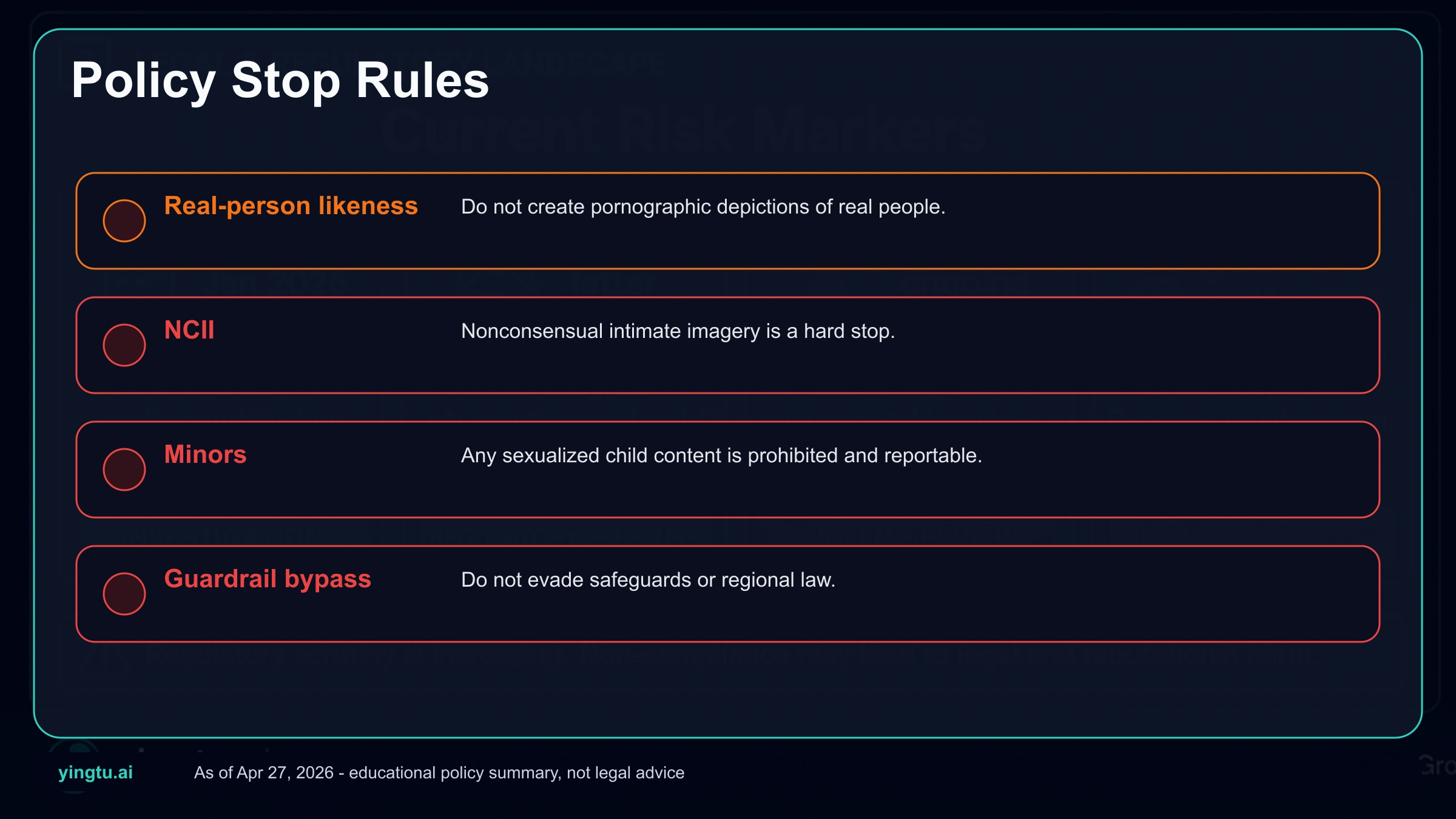
The safest current rule is to treat real-person sexualized likeness and nonconsent as stop signs, not as moderation challenges. xAI's AUP explicitly includes pornographic depictions of a person's likeness, sexualization or exploitation of children, and safeguard circumvention among the categories users must not pursue.
| Requested use | Policy reading | Safe decision |
|---|---|---|
| Sexualized image of a real person, celebrity, public figure, coworker, classmate, or private individual | Privacy, publicity, harassment, and pornographic-likeness risk converge | Do not generate, edit, publish, or share it |
| Any minor or age-ambiguous subject in sexualized context | Child sexualization and exploitation boundary | Stop immediately and report suspected child sexual abuse material through the relevant platform or authority |
| Nonconsensual intimate imagery or "undressing" a person from an ordinary photo | NCII and privacy harm, with legal and platform exposure | Do not create or distribute it; preserve evidence if reporting harm |
| Prompting designed to defeat safety controls | xAI AUP says users must respect safeguards unless acting under official red-team authorization | Do not attempt it |
| Consensual adult fictional or artistic material | Still depends on the current product surface, account state, local law, and moderation outcome | Use only inside visible official controls and do not share where platform rules disallow it |
This is also why a current policy page should not copy old setup steps for adult output. If the request falls into the stop-rule categories, the next move is not another setting check. The next move is to stop, report harmful content when appropriate, and avoid turning a consumer feature into a legal or reputational risk.
What Changed After The Spicy Mode Backlash
The January 2026 policy context matters because it explains why old permissive descriptions age badly. California Attorney General Rob Bonta announced an investigation on January 14, 2026 into nonconsensual sexually explicit material reportedly produced with Grok. On January 16, 2026, the California Attorney General also sent a cease-and-desist letter demanding action over deepfake nonconsensual intimate images and child sexual abuse material.
In the United Kingdom, Ofcom opened a formal investigation into X over Grok sexualised imagery on January 12, 2026 and updated the matter on January 15 after X said it had implemented measures. Ofcom stated that the investigation remained ongoing and that it was examining duties under the Online Safety Act, including illegal-content prevention, takedown, privacy protection, child-risk assessment, and age assurance.
Those are investigation and enforcement-pressure signals, not final findings that every claim in an old article is proven. The useful takeaway is narrower: legal and regulator attention now centers on nonconsensual intimate imagery, child sexual abuse material, real-person likeness misuse, age assurance, reporting, and whether platforms move quickly enough when illegal content appears.
The U.S. legal background also changed before the Grok controversy. The Congressional Research Service summary of the TAKE IT DOWN Act says the law was signed on May 19, 2025, with criminal prohibitions taking effect immediately and covered platforms given until May 19, 2026 to establish a notice-and-removal process for qualifying nonconsensual intimate visual depictions. That does not replace xAI or X policy, but it makes NCII risk a legal and operational issue rather than a mere content-preference debate.
The xAI API Is A Moderated Developer Surface
xAI's image generation documentation describes a developer endpoint for grok-imagine-image, image generation and editing requests, temporary generated URLs, and response metadata. The same documentation shows moderation metadata and states that generated images are subject to content policy review.
For developers, that creates a different decision from consumer Spicy Mode. An API key may be useful for a product workflow, but it does not prove a consumer account can see Spicy Mode, does not make adult-image policy disappear, and does not turn prohibited real-person or child-safety requests into acceptable use. Production teams should treat xAI API use as a logged, billable, auditable, policy-reviewed surface.
The operational checklist is simple:
| Developer question | Safer reading |
|---|---|
| Can the API generate images? | Yes, xAI documents image-generation and image-editing routes for grok-imagine-image. |
| Does that prove consumer Spicy Mode access? | No. Consumer UI availability and API documentation are different contracts. |
| Does moderation exist? | Yes. The docs expose moderation response handling and say images are subject to policy review. |
| Should an app accept user-uploaded faces for sexualized transformations? | No. Real-person likeness, consent, privacy, and NCII risk make that an unacceptable product path. |
| Should compliance teams rely on old price or limit tables? | No. Check current account, console, and billing surfaces before publishing or budgeting against a number. |
How Different Readers Should Use The Policy
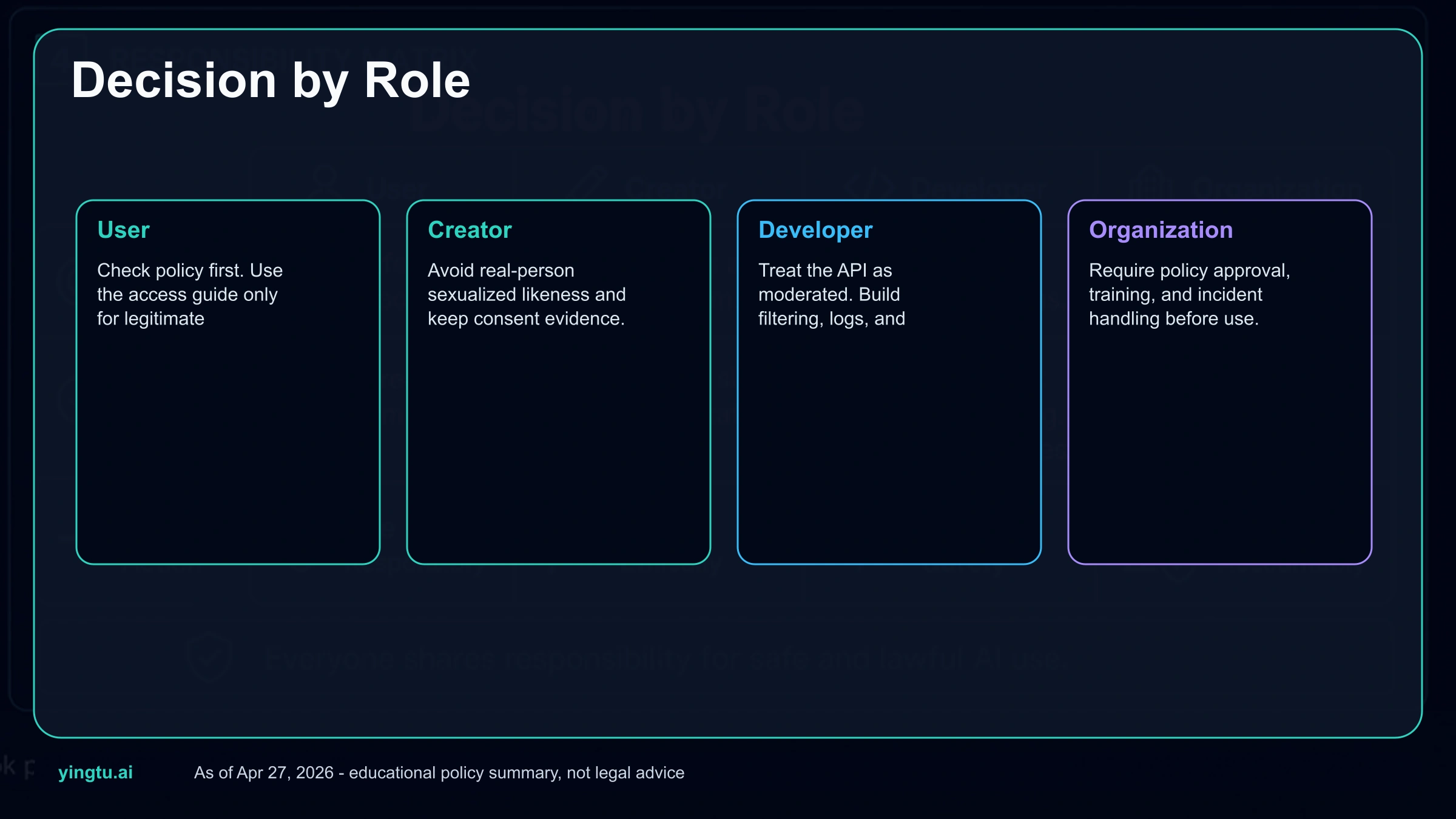
For personal users, the policy decision comes before the access decision. If the content request is fictional, consensual, adult, legal in the relevant region, and available inside the current official app surface, the remaining question is whether the account's current controls permit it. If the request involves a real person, a minor, nonconsent, humiliation, harassment, or safety-control circumvention, stop.
For creators and social-media managers, the split is generation first, publishing second. A created image still has to pass X's adult-content labeling and placement rules if it is posted on X, and it may have to satisfy additional rights, consent, brand-safety, and platform rules elsewhere. A labeled X post is not a legal clearance document.
For developers, the API decision should start with use-case design. Avoid workflows where users upload another person's image and ask for sexualized edits. Require consent boundaries, user reporting, moderation logging, and a takedown path before any user-generated image feature goes live. If the product cannot tolerate those controls, do not build the feature.
For organizations, the question is not whether Grok can produce mature imagery. The question is whether the workflow can tolerate the policy, legal, support, trust-and-safety, and public-relations risk. A regulated company, school, marketplace, community platform, or consumer app should assume that adult image generation involving real people or minors is outside acceptable deployment.
| Reader type | Best next move | What to avoid |
|---|---|---|
| Personal user | Check the current official app only after the requested use clears the stop rules | Forum workarounds, shared accounts, modified clients, or repeated blocked requests |
| Creator | Keep consent, labeling, and placement rules separate from generation controls | Treating an X label as consent or legal clearance |
| Developer | Build only around allowed, consensual, auditable image use cases | User-uploaded sexualized likeness editing |
| Organization | Require legal, safety, and trust review before procurement or rollout | Buying access because an old post says the feature is permissive |
Old Claims To Ignore Unless They Are Rechecked
The old version of this topic attracted a lot of claims that sounded useful but were not durable enough for a current policy answer. Treat these as stale unless the same claim is visible in an official current source or in the exact account surface being used.
| Old claim type | Why it is risky | Safer handling |
|---|---|---|
| Exact Premium, Premium+, SuperGrok, or app-store prices | Checkout screens, regions, taxes, app-store rules, and bundle names can change | Do not quote a static number unless it was verified in the current official checkout |
| Country-by-country ban or availability matrix | Product access and legal responses can change quickly; old news may not prove today's account state | Say availability can vary by account, app, region, rollout, and policy enforcement |
| Exact adult-output block rates or generation-per-hour figures | Hard to reproduce and often tied to a short-lived model state or third-party analysis | Use policy and current official controls as the decision base |
| API as a way around consumer restrictions | xAI documents moderation and content policy review on the API | Treat API as a developer route with compliance obligations |
| Broad platform comparison tables | Competitor policy details are not needed for the reader's Grok/xAI decision | Keep the page focused on Grok, xAI, X, API, and legal status |
Removing stale numbers is not a loss of depth. It makes the answer more useful. A reader deciding whether a Grok-related adult image use is acceptable needs source ownership, stop rules, legal status, and role-specific next moves more than a copied price table or country tracker.
FAQ
Does X allowing adult content mean Grok can generate any NSFW image?
No. X's adult-content policy governs how adult material may be posted or viewed on X when it is consensually produced, labeled, and not displayed in restricted placements. xAI's acceptable-use rules still apply to Grok and xAI services, and those rules prohibit real-person pornographic likeness misuse, child sexualization, illegal use, and safeguard circumvention.
Is Spicy Mode currently available for every account?
No reliable public source proves universal account access. Grok features can vary by account, app surface, subscription state, region, rollout, content controls, age state, and policy enforcement. For availability troubleshooting, use the dedicated Grok Imagine Spicy Mode guide after confirming the requested use is allowed.
Can the xAI API be used instead of the Grok app for adult images?
The xAI API is a developer image-generation route, not a consumer access replacement. xAI's documentation shows moderation metadata and says images are subject to content policy review. Developers still need consent, logging, reporting, safety, and legal controls.
What is the safest rule for real people?
Do not generate or edit sexualized imagery of a real person without clear, lawful, and documented consent. Avoid public figures, coworkers, classmates, private individuals, minors, and age-ambiguous subjects. For nonconsensual intimate imagery, preserve evidence and use the relevant platform or legal reporting route.
Are the California and Ofcom actions final rulings?
No. They are regulator and law-enforcement actions that should be described carefully. California announced an investigation and sent a cease-and-desist letter in January 2026. Ofcom opened a formal investigation into X and said the matter remained ongoing after X reported mitigation steps. Those facts raise risk; they should not be overstated as final adjudications unless later official records say so.
What should be checked before publishing a policy-sensitive Grok article or product page?
Check the current xAI AUP, xAI consumer or enterprise terms, X adult-content rules if X sharing is involved, current API docs if a developer workflow is involved, current checkout or console screens for pricing and limits, and any active legal reporting obligations. Do not reuse old adult-output steps, exact prices, region tables, or moderation-rate claims without current source proof.