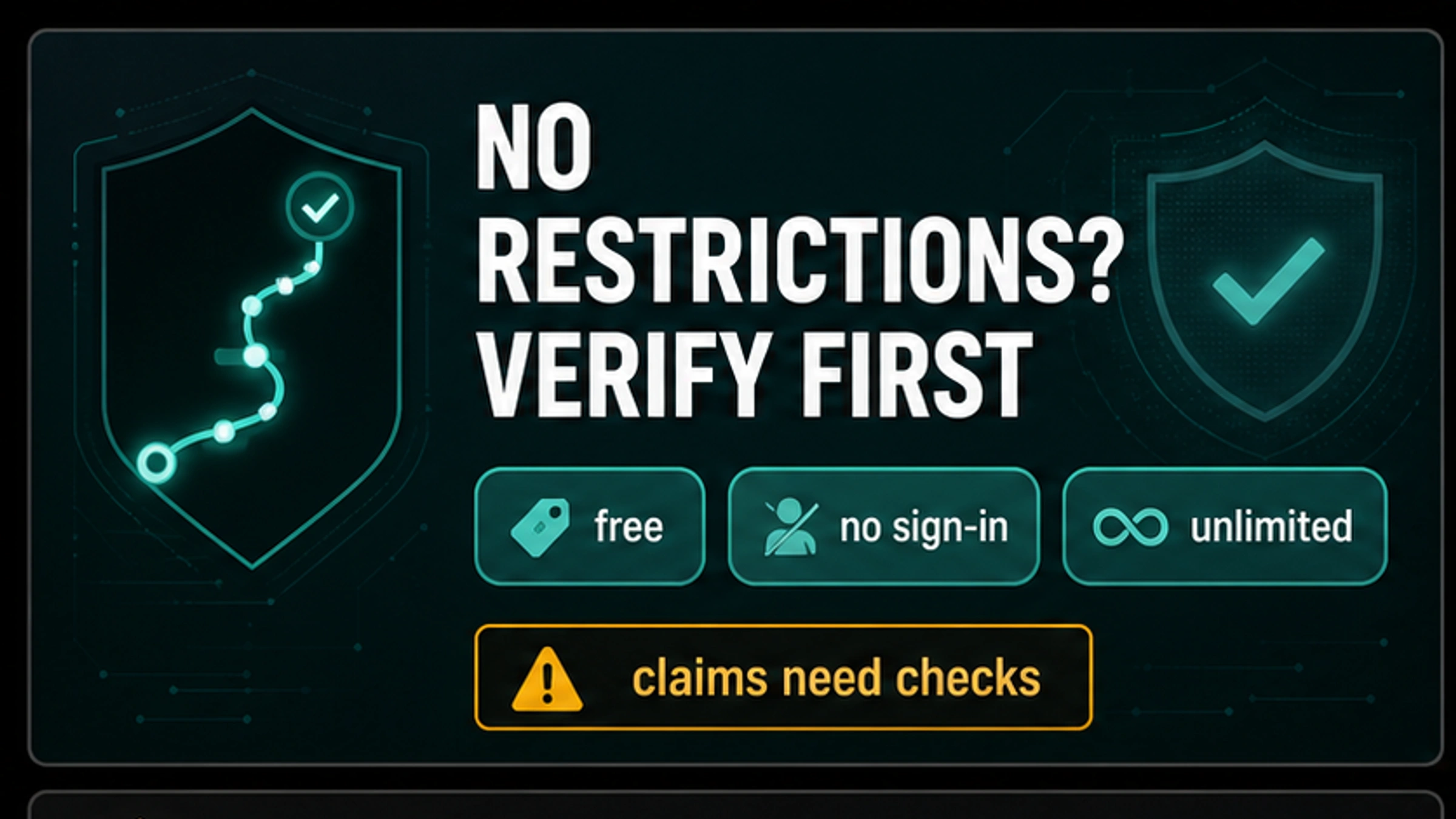
No-restrictions AI image generator claims are promises to verify, not safe defaults. A free, no-signup, unlimited, or no-filter page can still store prompts, expose outputs, add watermarks, throttle queues, limit commercial rights, or reject risky requests.
Stop before upload if the job involves a real person without clear consent, a minor or unclear age, private or intimate material, harassment, impersonation, public-figure deception, or attempts to bypass safeguards. For legitimate image generation, choose the route by risk: mainstream moderated tools for accountable production, no-login wrappers only for non-sensitive tests, documented free-credit or free-to-start routes when the limit model is clear, local generation when upload exposure is the main concern, and reporting or removal paths when harm is already present.
| What you need | Start with this route |
|---|---|
| Accountable production work | Mainstream moderated generator with clear owner, support, and rights terms |
| Non-sensitive quick experiments | No-login wrapper only after checking storage, gallery, deletion, and usage terms |
| Free, unlimited, or no-filter claim | Treat it as a claim audit: check owner, cost model, limits, moderation, storage, deletion, rights, watermark, and support |
| Sensitive private prompts | Local workflow, but only when consent, storage, and legal duties are still handled |
| Harmful image already exists | Do not edit or reshare it; use platform reporting and removal resources |
Quick answer: use free and unrestricted claims as a checklist
The useful question is not "which generator has the fewest blocks?" It is "can this route handle my image job without creating privacy, rights, safety, or support risk?" That shift keeps legitimate creative work moving while stopping the cases where a less-filtered tool would make the situation worse.
A relaxed generator can be fine for fictional art, mood-board exploration, non-sensitive product concepts, background ideas, or quick prompt tests. The same route can be a bad choice for personal photos, client assets, private documents, likeness edits, or any request where the output could be used to harass, impersonate, sexualize, or expose someone. "Free," "unlimited," "unfiltered," "no filter," and "no restrictions" do not decide the risk; the input, output, ownership, and distribution path do.
Use a no-restrictions claim only after four checks:
| Check | What to confirm | Why it matters |
|---|---|---|
| Request | The prompt does not involve non-consensual likeness, minors, private material, harassment, impersonation, or safeguard evasion | Some jobs should stop before any provider is chosen. |
| Route owner | You know who runs the generator, who pays for compute, and who supports failures | Hidden ownership makes privacy and reliability unverifiable. |
| Data path | The page explains storage, public galleries, training use, deletion, logs, and support review | No account does not prove the file disappears. |
| Output rights | Terms explain commercial use, watermarking, redistribution, and model/source constraints | "Free" does not automatically mean usable in campaigns or products. |
If any of those answers are missing, keep the route in the throwaway-experiment bucket or choose a more accountable path.
Start with the request, not the tool
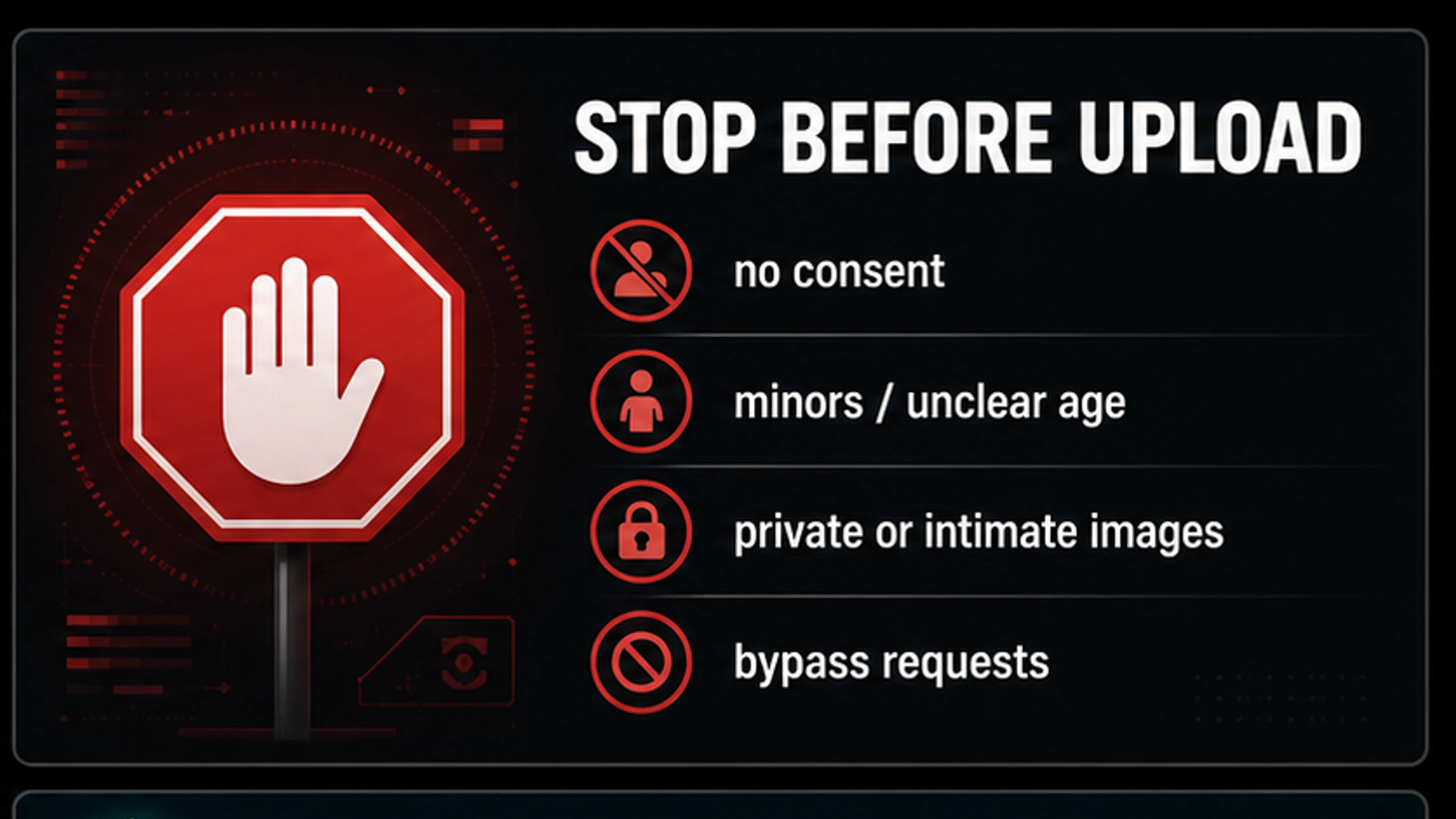
Some image jobs should end before upload. Do not use a generator, wrapper, local model, or prompt variation when the task involves a real person who did not consent to the specific output, a minor or age-ambiguous subject, private or leaked material, sexualization, harassment, impersonation, or a request to evade a provider's safety controls.
That boundary is not only an OpenAI or Google preference. OpenAI's usage policies prohibit sexual exploitation, non-consensual intimate content, misuse of likeness, and attempts to circumvent safeguards. Google's Gemini policy guidelines also draw boundaries around child sexual exploitation, explicit sexual material, harassment, dangerous activity, and other harmful content. Those policies are not identical, but they point to the same practical rule: a generator refusing a risky prompt is often doing the job it is supposed to do.
Use this stop table before comparing tools:
| Request pattern | What it signals | Better next move |
|---|---|---|
| Real person's image without clear consent | Likeness, privacy, harassment, or impersonation risk | Stop before upload. |
| Minor, school photo, or unclear age | Child-safety boundary | Stop and use reporting paths if harmful content exists. |
| Private, intimate, leaked, or revenge-style material | Non-consensual intimate image risk | Do not upload, edit, download, or reshare. |
| "Make it look real" for a public figure or private person | Authenticity and deception risk | Use fictional subjects or clearly synthetic concepts. |
| Filter-avoidance wording | Safety-control evasion | Stop rather than rephrasing around a refusal. |
| Fictional landscape, product concept, logo mood board, or abstract style test | Lower-risk creative job | Continue after checking route ownership and rights. |
For a legitimate job, rewrite the task in plain safe terms before picking software: "create a fantasy city concept," "generate a product-background idea," "make a non-real character sheet," "try a color palette," or "mock up a poster style." If the task cannot be described without harming or exposing someone, the route is wrong.
What "completely free" and "unlimited" can mean
The search phrase usually mixes cost, account friction, output limits, and moderation into one promise. Split those promises before trusting the route. A generator can be free because it gives a small daily allowance, because it runs ads, because it downgrades quality, because it delays exports, because it uses local compute, or because it reserves advanced model access for paid users. None of those mechanics is automatically bad, but each one changes how much you can rely on the route.
| Claim on the page | It may actually mean | What to check |
|---|---|---|
| Completely free | The first generation path costs nothing, or the provider subsidizes a limited flow | Renewal, export resolution, watermark, queue priority, model choice, and whether paid steps appear later. |
| No signup or no login | You can generate without an account | Storage, logs, browser fingerprints, public galleries, deletion, and whether support can identify your job. |
| Unlimited | The page does not show a small counter | Fair-use terms, hidden throttles, abuse controls, quality downgrade, queue behavior, and paid export. |
| Free credits | The allowance renews daily, monthly, or only once | Reset schedule, expiry, refund rules, model restrictions, and what happens after credits run out. |
| Free to start | The prompt box works before payment | Export locks, watermark removal, commercial rights, speed caps, and paid model upgrades. |
| Local or self-hosted | Your own machine pays the compute cost | Hardware limits, model license, storage, safety review, and who handles incidents. |
The practical test is simple: if the page cannot explain who pays for generation, where the limits appear, what quality or export tradeoff exists, and how abuse is handled, "unlimited" should stay in the experiment bucket. A route can still be useful for a quick fictional prompt, but it is not a dependable production route just because the first click is free.
What "no restrictions," "no filter," and "unrestricted" can mean
Restrictions can refer to prompts, account requirements, watermarks, commercial use, queue limits, public galleries, model choice, or copyright warnings. The risky mistake is treating all of those meanings as one promise. A page that removes account friction may still moderate prompts. A page that markets fewer prompt refusals may still limit private uploads, real-person likeness, commercial use, or export resolution.
| Claim on the page | It may actually mean | What to check |
|---|---|---|
| No filters or no filter | The site markets fewer refusals or less prompt rewriting | Prohibited-use rules, abuse reporting, child-safety handling, and whether the claim invites unsafe use. |
| Uncensored or no censorship | The provider positions itself against mainstream refusals | Whether it still bans non-consensual, minor-related, harassing, impersonating, or illegal content. |
| Private | The provider says uploads are protected | Retention, training use, encryption, access controls, deletion scope, and whether guests get the same protections. |
| No watermark | Output may export cleanly | Resolution, attribution requirements, paid export rules, and downstream license constraints. |
| Commercial use | Outputs may be usable beyond personal testing | License terms, input rights, trademark/copyright limits, model source, and jurisdiction-specific risk. |
| No accountability signal | The page hides owner, terms, report path, or policy language | Treat the route as non-production and avoid sensitive uploads. |
Provider landing pages can be useful examples of market language, but they do not prove the claim for your use case. Treat each promise as a starting point for verification. If a page says it is private but gives no retention or deletion terms, the safer reading is "unknown," not "safe." If a page says unlimited but gives no payer, fair-use, abuse, or support model, the safer reading is "not reliable for real work."
Check the promise behind free, no-login, unlimited, no-filter, and private
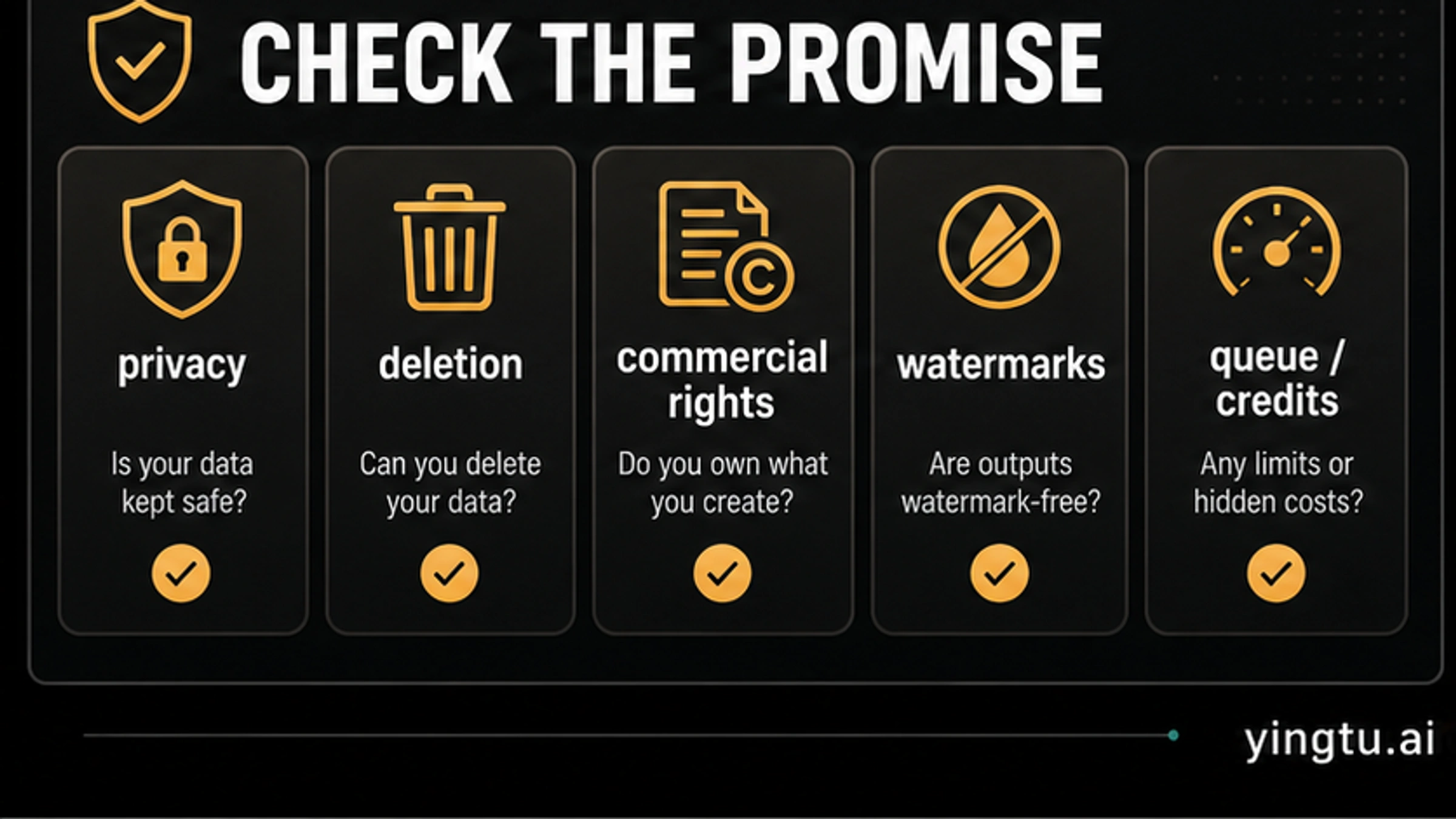
No login can be convenient for a quick non-sensitive test. It can also make the route harder to audit because there may be no account dashboard, no deletion center, no billing record, no support thread, and no clear owner for failures.
Before uploading anything that matters, check these items in the route's terms, privacy policy, help center, pricing page, or export flow:
| Audit item | Acceptable signal | Red flag |
|---|---|---|
| Owner | The company, operator, or open-source project is identifiable | The page hides who runs the generator. |
| Payer | Free credits, provider subsidy, local compute, or paid export is explained | "Unlimited" appears without any cost, fair-use, or abuse model. |
| Storage | Source and output retention are described | Uploads may be stored, reused, or displayed without a clear policy. |
| Public gallery | Outputs are private by default or public sharing is explicit | User generations appear in feeds or examples without clear opt-in. |
| Training use | The policy says whether inputs or outputs train models | The page is silent on training or uses vague "improve service" wording. |
| Deletion | Deletion covers source, output, thumbnail, and derived files where possible | Only the visible output can be removed, or no deletion route exists. |
| Rights | Commercial terms, prohibited uses, and input responsibility are written | The page says "yours" but excludes important cases elsewhere. |
| Support | There is a report, abuse, refund, or failure path | The generator has no contact or only a generic form. |
| Moderation boundary | The site explains what it will still refuse and how abuse is handled | "No filter" is used as the whole policy. |
The more sensitive the input, the less tolerance you should have for vague answers. For client work, product imagery, likeness, brand assets, legal documents, medical context, or anything private, a no-login page should usually lose to an accountable provider or a local workflow with strict file handling.
Which route fits a legitimate image job
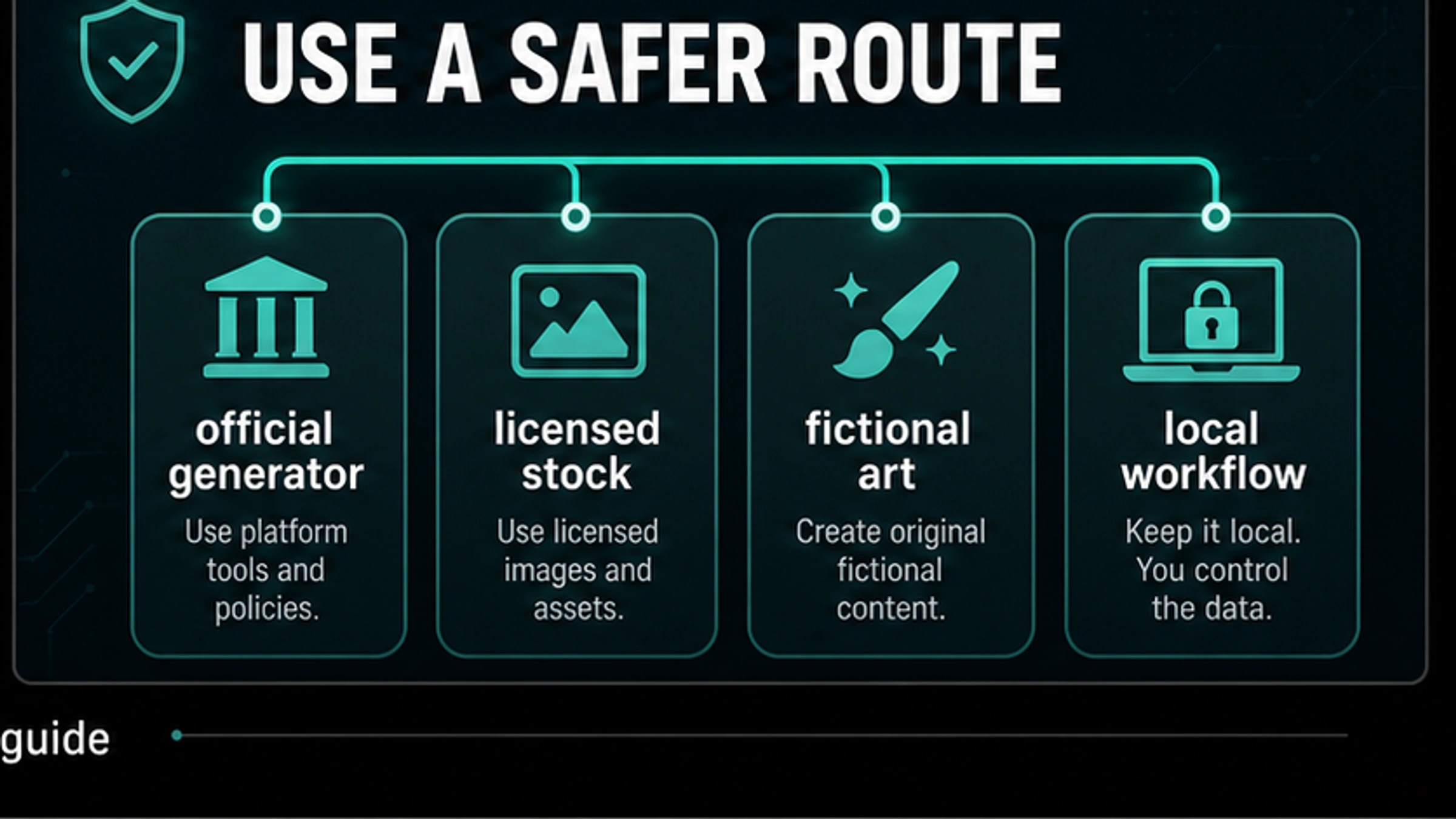
Choose by workflow risk rather than by the most generous marketing line.
| Legitimate job | Better route | Why |
|---|---|---|
| Prompt exploration, style brainstorming, fictional concepts | Mainstream app or low-risk no-login test | Fast feedback is useful when the prompt and output are not sensitive. |
| Production image generation for a business | Mainstream moderated provider or verified paid provider | Clear owner, support, rights, account history, and failure handling matter more than frictionless access. |
| Commercial campaign or ecommerce asset | Paid provider, licensed stock, or professional image workflow | The output must match usage rights, brand controls, and client approval. |
| Private drafts, sensitive concepts, or confidential inputs | Local workflow or controlled enterprise route | Upload exposure is lower, but consent, storage, security, and lawful use still matter. |
| Real-person likeness or celebrity-adjacent creative | Consent-based workflow, licensed model, or fictional substitute | Likeness and authenticity risk should be solved before generation. |
| Existing harmful AI image | Reporting, takedown, trusted support, and legal resources | The right job is reducing spread, not making another generation. |
No-login and no-filter wrappers belong in a narrow lane: non-sensitive experiments where you can afford unknown limits, unknown moderation behavior, and unclear support. They are a poor fit for production promises, customer uploads, personal photos, or anything where deletion and rights need to be provable.
Mainstream moderated tools belong in a different lane. They may block more prompts, but they usually offer clearer account ownership, policy language, data controls, help paths, and business terms. Those are not obstacles when the image has real stakes; they are part of the product surface you are paying for.
Local generation is also not a magic exemption. It can reduce upload exposure because the source file stays on your machine or controlled infrastructure, but it can increase your responsibility for model choice, file storage, access control, output review, distribution, and legal compliance. Use it when you can manage those duties, not because you want to ignore them.
Why mainstream generators block some prompts
Moderation is easiest to resent when the blocked request looks harmless to the person typing it. The provider sees a wider risk pattern: a request that appears to be a private experiment may still involve another person's likeness, a child, a leaked image, a synthetic intimate image, public harassment, political deception, or a prompt designed to remove a safety barrier.
When a mainstream generator refuses a request, classify the branch before trying another tool:
| Refusal branch | What to ask | Safer action |
|---|---|---|
| Likeness | Is this a real person, public figure, private person, or image from someone else? | Use a fictional subject, licensed model, or consented SFW edit. |
| Sexual or intimate content | Could the output sexualize or expose someone? | Stop for real people and minors; use lawful fictional-adult routes only where allowed. |
| Child safety | Is age unclear or under 18? | Stop and use child-safety reporting if harm exists. |
| Deception | Could the image confuse viewers about authenticity, endorsement, or real events? | Label synthetic content, avoid real-person impersonation, or choose a non-real subject. |
| Policy evasion | Are you asking how to get around a safety block? | Stop; route choice should not be filter evasion. |
| Rights | Do you own or have permission for the input and planned output use? | Switch to licensed stock, owned assets, or provider terms that fit the job. |
This is also why a useful page should not rank "uncensored" or "unfiltered" generators as the main answer. That kind of list solves only the friction problem and ignores the reason the friction exists. Legitimate users need the route that fits their job; harmful users should hit a boundary before tool selection.
What local generation changes
Local image generation can be valuable when upload exposure is the main problem. It can keep drafts on your device, let a company manage its own storage, and reduce dependence on a browser wrapper whose owner or retention policy is unclear.
It does not remove the hard parts. You still need consent for people-related work, rights for source images and outputs, secure storage for private files, rules for who can access the model, and a review step before publication. A local workflow can also create new obligations: model provenance, checkpoint safety, prompt logging, output filtering, employee access, backups, and incident response.
Use local generation when the operating environment is mature enough to handle those obligations. For one-person creative experiments with fictional prompts, the bar may be light. For client assets, personal images, internal documents, or regulated material, the bar is higher. "It ran locally" answers only the upload question. It does not answer consent, legality, rights, or distribution.
When harmful AI images already exist
If a harmful intimate, sexualized, or child-related AI image already exists, do not treat it as an editing problem. The goal is to reduce spread, preserve appropriate evidence, and use reporting or removal paths.
For child sexual abuse or exploitative AI content, NCMEC's generative AI safety page describes risks including AI-generated child sexual abuse material, sextortion, and peer victimization. NCMEC also points families toward reporting and removal resources such as Take It Down. Do not download, remix, or circulate explicit material while trying to fix it.
For adult non-consensual intimate image issues, platform reporting, trusted support organizations, local law, and qualified legal help may matter. U.S. and U.K. rules have been changing quickly, and jurisdiction matters. Use official reporting paths and document what happened safely; do not turn the incident into another generation test.
Related routes that should stay separate
If the real task is clothing or undress editing, use the AI clothing remover no sign-in free safety guide. That page handles consent gates, SFW clothing-edit alternatives, no-login upload risk, and harmful AI nude response in more detail.
If the real task is a specific GPT Image 2 free or unlimited route, use the GPT Image 2 free and unlimited guide. That is a model/route contract question, not a generic no-restrictions generator question.
If the real task is Grok, xAI, or NSFW policy, use the Grok xAI NSFW image generation policy guide. Product-specific access and policy should not be treated as a generic workaround.
FAQ
Is an AI image generator with no restrictions safe?
Not by default. Treat the claim as a checklist, not as permission. Check the request, route owner, data handling, rights, limits, moderation, and support before uploading anything meaningful.
What is the best completely free unrestricted AI image generator?
There is no universal best completely free unrestricted route. For harmless fictional concepts, a free or no-login generator may be enough after privacy, limits, storage, watermark, and rights checks. For business, client, likeness, private, or commercial work, choose an accountable provider, paid/licensed route, or controlled local workflow instead of chasing the fewest visible filters.
Does no sign-in mean private?
No. A no-sign-in page can still process files on a server, store prompts, keep logs, show outputs in a gallery, use files for service improvement, or provide weak deletion controls. Privacy needs a policy and a workflow, not just fewer account steps.
Are free or unlimited image generators really unlimited?
Usually those words mean fewer visible limits, not zero cost or zero controls. Look for payer, fair-use terms, queue behavior, quality limits, watermarks, export caps, abuse rules, and support. If those are hidden, do not rely on the route for real work.
Can I use a no-filter generator for adult or NSFW images?
Do not use any generator for non-consensual, minor-related, private, harassing, impersonating, or safeguard-evasion requests. Fictional adult content depends on provider rules and local law, but real-person and child-safety boundaries should stop before tool selection.
Can I use generated images commercially?
Only if the specific route's terms, your inputs, and the planned use allow it. Commercial rights depend on provider terms, source-image rights, trademarks, likeness, brand policy, and local legal requirements. Do not infer commercial permission from "free."
Why do mainstream AI image tools block prompts?
They often block prompts to reduce predictable harms: child sexual exploitation, non-consensual intimate images, real-person likeness misuse, harassment, deception, violence, and attempts to defeat safeguards. A block is a signal to classify the request, not an invitation to find weaker controls.
Is local generation safer than online generation?
It can reduce upload exposure, but it does not remove consent, rights, storage, review, or legal responsibilities. Local generation is safer only when the whole workflow is controlled well enough for the material being handled.
What should I use for quick creative testing?
Use a mainstream app or a no-login route only for non-sensitive fictional prompts, style ideas, product concepts, or mood boards. Avoid personal photos, client assets, private files, and anything involving another person's likeness unless the route and rights are clear.
What should I do if someone made a harmful AI image of me or someone else?
Do not edit, reshare, or experiment with it. Preserve safe evidence, report it through the platform, use trusted removal resources, and seek local support or legal advice where appropriate. For minors or suspected child sexual abuse material, use child-safety reporting paths such as NCMEC resources.