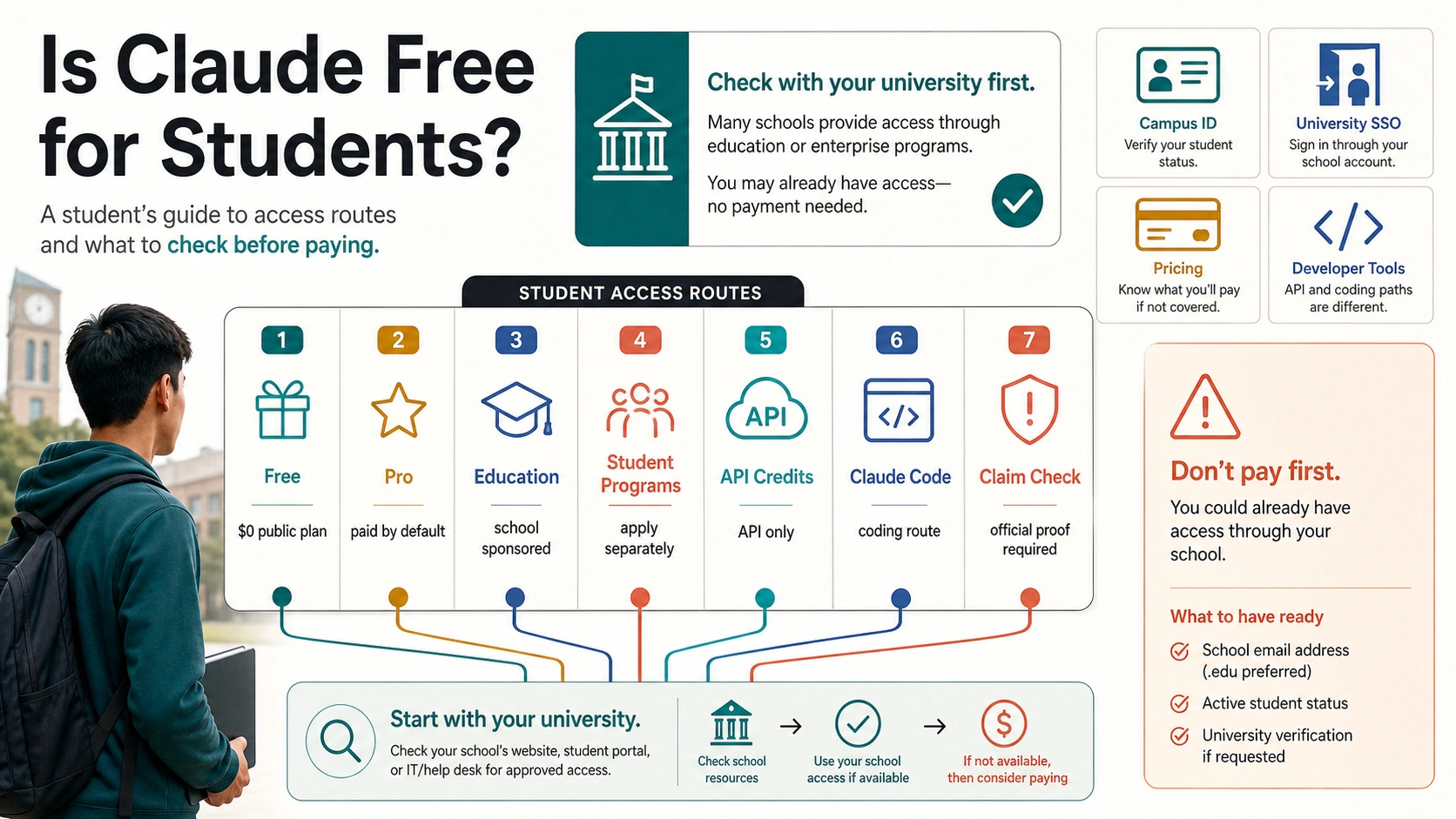
Claude is free for students only in the same way it is free for everyone: Claude Free costs $0. Claude Pro is a paid personal plan by default, and Claude for Education can give school-sponsored access only if your university participates.
As of July 5, 2026, the public Claude pricing page shows Free at $0 and Pro as a paid individual plan, not as a public student checkout discount. Student status matters when your school, an official student program, or an API-credit program gives you a separate route with current terms.
| Route | What it means for a student | Check first | Stop rule |
|---|---|---|---|
| Claude Free | The public free plan is available to students because it is available to everyone. | Your account's visible Free plan and current feature limits. | Do not call it a student-only benefit. |
| Claude Pro | Personal Pro is paid by default on the public pricing page. | Current monthly or annual billing terms before you subscribe. | Do not treat annual billing as a student discount. |
| Claude for Education | A university can sponsor access for eligible students, faculty, or staff. | Your university IT, library, AI tools, or SSO page. | Do not copy another school's rule to your campus. |
| Student programs | Campus Ambassador or Student Builder paths may offer resources or opportunities. | Official Anthropic or Claude program pages. | Do not assume acceptance or Pro access. |
| API credits | Research or builder credits can help API work. | Console/API terms and the program page. | Do not treat API credits as web-app Pro. |
| Claude Code | Coding access follows plan, Console, or developer-route rules. | The Claude Code or Console route you actually use. | Do not let coding access rewrite the web-app answer. |
| Free-Pro or one-year claim | A claim is only useful if current official terms prove it. | Official Claude, Anthropic, or university page with audience, plan, duration, billing, and renewal terms. | Do not trust videos, coupon pages, shared accounts, or resellers as policy proof. |
Start with your school before paying. If your university has Claude for Education, use the official campus route and follow its data and academic-use rules. If it does not, use Claude Free, decide whether paid Pro is worth it for your workload, and treat any free-Pro offer as unproven until the source names the exact official terms.
What is actually free for students
Claude Free is the legitimate no-payment route. It is not a student benefit; it is the public free plan. That distinction protects you from two common mistakes. First, a student can use Free without proving student status. Second, student status alone does not change Free into Pro.
Use Free when your work is occasional chat, light writing support, brainstorming, summarization, or a first test of whether Claude fits your study workflow. Keep the exact usage limits out of your plan unless you have just checked your signed-in account or the current support article, because limits can vary by demand, conversation length, model availability, and product changes.
If your task is a semester-long research assistant, heavy coding work, repeated file analysis, or daily writing production, Free may be too constrained. That does not mean you should chase a "student Pro" link. It means you should classify the next route: paid Pro, school-sponsored Education access, API credits, or a separate coding route.
For broad Free-plan context, the adjacent Claude AI Free guide covers the general tier. The student-specific decision is narrower: whether school status changes the access route, cost, or proof requirement.
Why Claude Pro is not a public student checkout discount
The current individual pricing surface makes the Pro boundary simple: Pro is paid by default. It lists Pro as an individual subscription with monthly and annual billing options. Annual billing can lower the effective monthly price, but it is still a paid subscription and should not be described as a student discount.
That matters before you add a card. A real student discount would need to state the eligible audience, the plan name, the duration, the billing terms, the renewal price, and the cancellation route. A page that merely says "students can use Claude for free" may be talking about Free Claude, a school program, API credits, or a third-party claim.
If your account shows a first-party promotion, read the terms inside the official Claude account surface. Account-specific promotions can be real, but they are different from a standing public student row. For broader promotion and free-trial policy, use the Claude Pro free trial guide after you have separated student access from general Pro trial questions.
The safe paid-plan rule is strict: if the official account or official program terms do not say your student status changes Pro pricing, treat Pro as paid.
How Claude for Education works
Claude for Education is the route that makes the student question legitimately different. It is not an individual coupon code. It is an institutional higher-education program where a university can make Claude available to eligible students, faculty, or staff under that school's account, policy, and deployment choices.
Anthropic's Education solution page positions the plan for institutions, and the Claude for Education university FAQ describes a school-sponsored account route with advanced models, increased usage, projects, file uploads, and priority access, while also noting that universities can customize available features and policies.
The important reader-facing conclusion is not "Education equals free Pro." The conclusion is "your university may be the account owner." If the school sponsors access, your first obligation is to follow the campus route: identity login, eligibility rules, academic-use policy, data-handling policy, and the tier your campus has actually purchased or enabled.
If your school does not have a Claude page, Education still may exist as a sales route for the institution, not as a self-serve student discount. In that case, a student can ask a department, library, IT help desk, teaching-and-learning office, or AI tools program whether the campus is evaluating Claude for Education. That request is different from buying personal Pro.
How to check your school before paying
Check your university before you subscribe to Pro. The fastest path is not a coupon search; it is a campus-access search with proof.
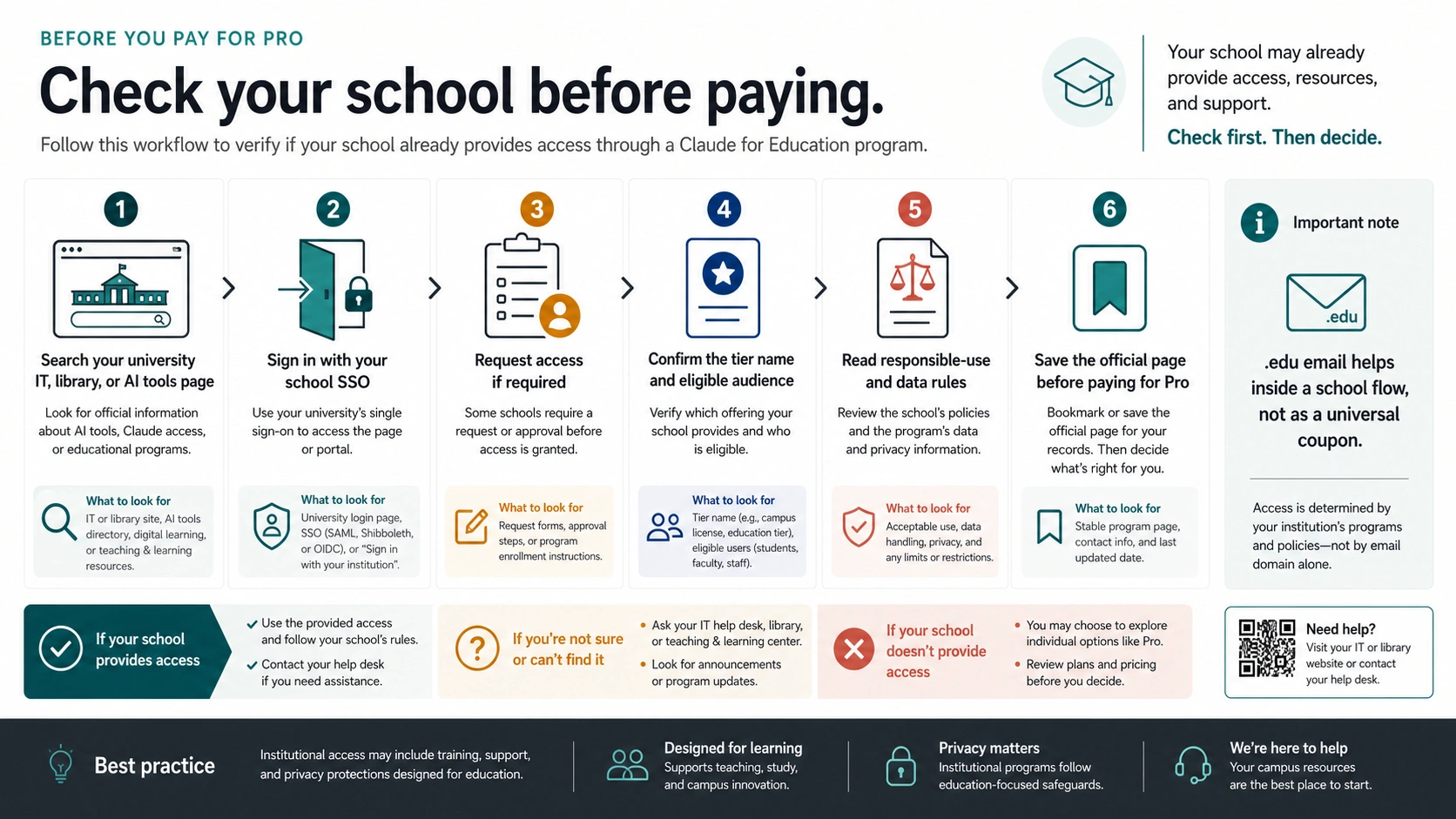
Use this order:
- Search your university site for "Claude for Education", "Claude AI", "Anthropic", "AI tools", "generative AI", and "library AI".
- Check central IT, library, teaching-and-learning, research computing, and student technology pages before trusting a department blog post.
- Look for SSO, identity, request, or login instructions. A real campus route usually tells you how to authenticate.
- Confirm the eligible audience. "Students" may mean active enrolled students, selected courses, graduate researchers, staff, faculty, or approved users.
- Confirm the tier and cost. Some schools may offer a free standard tier; others may restrict access or charge a department.
- Read the responsible-use, data, privacy, and academic-integrity rules before uploading class material or research data.
- Save the official page or confirmation email before relying on the access for coursework.
The page you want is the one that answers your own school's terms. A Stanford page can show what is possible. A Columbia page can show that another implementation exists. Neither page decides your university's eligibility.
Why school examples vary
School examples are useful only when they are kept bounded. Stanford's University IT page for Claude for Education says its Standard tier is free to active faculty, students, postdocs, and staff who meet Stanford identity requirements. Stanford's related pages describe a school activation path through Stanford systems and responsible-use terms.
That is a real student-friendly example, but it is not a universal Anthropic promise. It proves that a participating campus can give active students school-sponsored access.
Columbia's Claude for Education page shows why copying one campus rule is unsafe. It frames access for approved faculty and staff and lists an annual per-user price. The useful lesson is not that one school is "better" than another. The lesson is that Claude for Education is locally implemented.
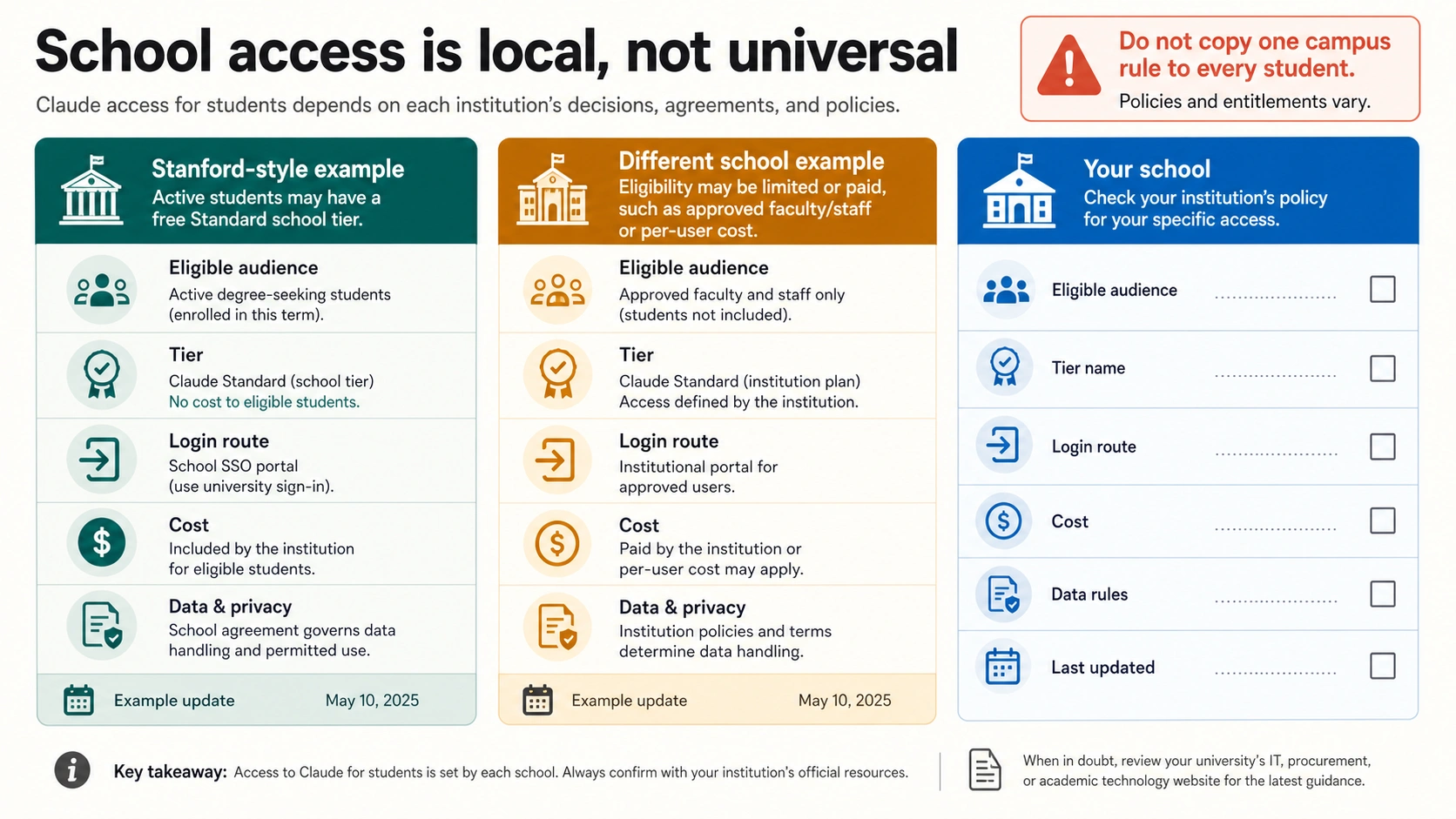
When you compare examples, track four details:
| Detail | Why it changes the answer |
|---|---|
| Eligible audience | Some pages include active students; others focus on faculty, staff, courses, departments, or approved users. |
| Payment owner | Access may be centrally funded, department-funded, individually charged, or unavailable. |
| Tier and limits | Standard, Premium, enterprise, or school-specific labels can carry different features and limits. |
| Data rules | Campus policy can decide what class data, research data, and personal data may be uploaded. |
That is why "is Claude free for college students" needs a school check. The answer can be yes at one institution, no at another, and "available only through a particular program" at a third.
Student programs, API credits, and Claude Code are separate routes
Anthropic has student-facing and academic-facing programs, but they should not be collapsed into free Pro.
The Claude Campus Program is a student community and ambassador route. It asks students to run workshops, share resources, collaborate with Anthropic, and participate in campus activity. That can be valuable, but it is an application or program route, not a public checkout discount.
The Education contact flow also points students toward Campus Ambassador and Student Builder paths. Treat those as opportunities with their own terms. They may provide resources, community access, or project support, but they do not automatically prove that every student gets Claude Pro free.
API-credit programs are different again. Anthropic's AI for Science program may provide free API credits to qualifying researchers in academia and nonprofit organizations. The key boundary is explicit: those credits are for API use and do not apply to the Claude web app. If your project needs API calls, model evaluation, or research automation, API credits may matter. If your goal is Claude Pro chat in the web app, API credits are not the same access.
Claude Code should also stay in its lane. The Claude Code product page presents coding access through eligible subscriptions, Team or Enterprise routes, or Console/API billing. A student using Claude Code needs to know whether the active route is a paid Pro or Max login, school account, API key, or another developer setup. For terminal-specific access and billing checks, use the Claude Code free credits guide.
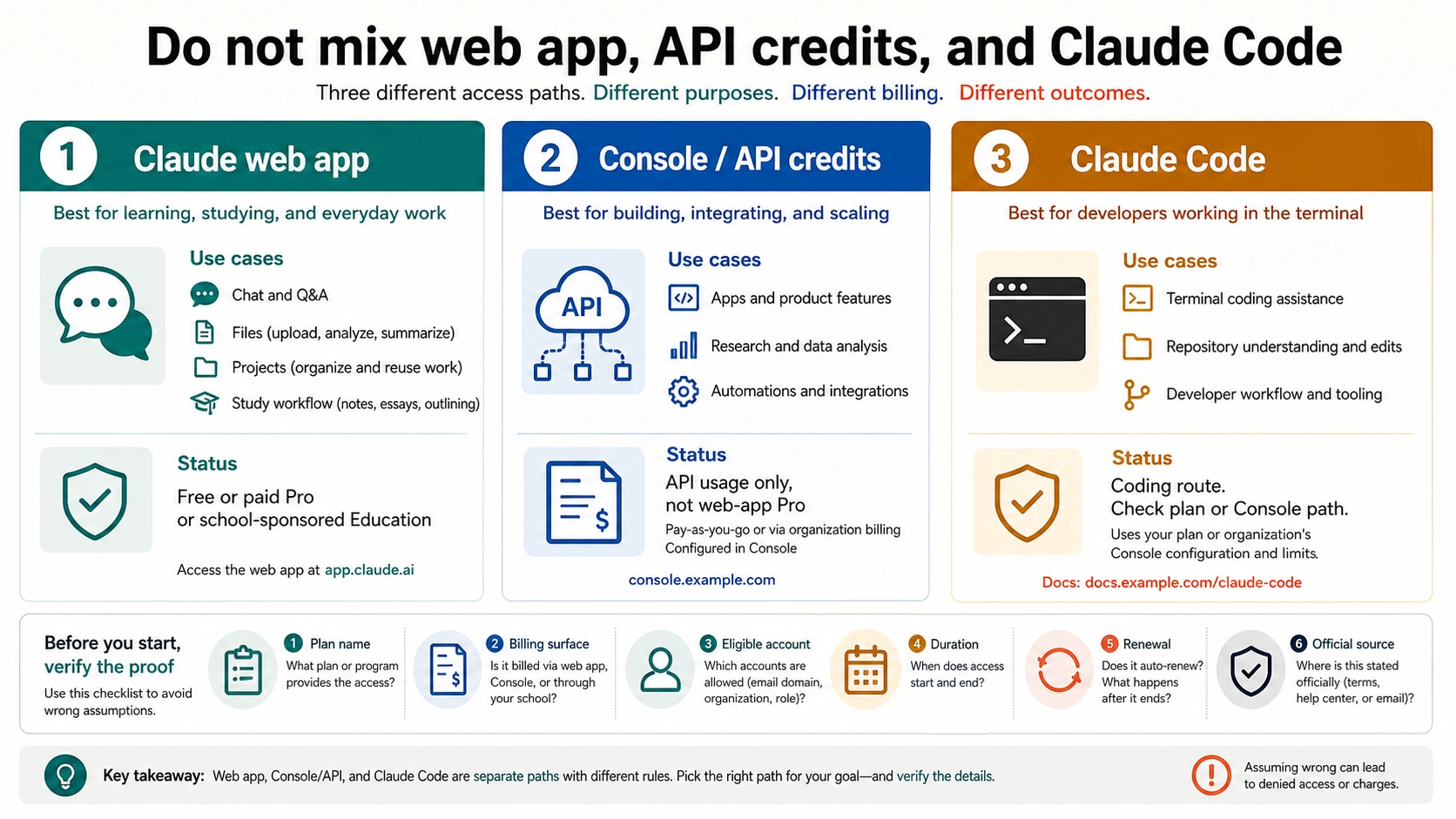
Keep this three-way split:
| Surface | What student status can change | What it does not prove |
|---|---|---|
| Claude web app | School-sponsored Education access may change eligibility and cost. | It does not prove API credits or Claude Code billing. |
| Claude Console/API | Academic or research programs may provide API credits. | It does not unlock web-app Pro. |
| Claude Code | Plan, school, Console, or organization route can decide access. | It does not make personal Pro free by itself. |
If a page uses the word "credits", identify the surface before acting. Credits inside Console, paid-plan overflow, school sponsorship, and student programs are different meters.
If your school is not a partner
If your university does not offer Claude for Education, you still have legitimate options.
Use Claude Free when it is enough. It keeps you on an official route without payment. It is a reasonable fit for occasional studying, short writing help, idea generation, and one-off document questions, as long as you respect the visible limits.
Use paid Pro only when your workload justifies it and the official billing terms are acceptable. Compare monthly and annual billing, renewal timing, cancellation route, and whether your assignment or research work truly needs the extra capacity. Do not buy Pro just because a discount page implies that students should have a hidden plan.
Ask your school through the right channel. A student government request, department request, library technology request, or teaching-and-learning inquiry can be more useful than searching for a coupon. If a school is evaluating Claude for Education, campus IT will usually care about licensing, privacy, academic integrity, data retention, and accessibility.
Apply only to programs that match your work. If you are organizing workshops, the Campus Program may fit. If you are doing qualifying research, an API-credit program may fit. If you need coding-agent access, inspect the Claude Code route and billing owner.
Avoid shared accounts, resale offers, and "lifetime" student deals. They can put your messages, files, payment information, and account control in someone else's hands, and they do not establish Anthropic policy.
How to verify a free-Pro or one-year student claim
A "Claude 1 year free student" claim is not useful until it names the official terms. Use this checklist before you give an email address, upload school ID, add a card, or share login access.
| Proof item | What to look for | Why it matters |
|---|---|---|
| Official owner | claude.ai, claude.com, anthropic.com, Anthropic support, or your university's official domain. | Third-party pages can summarize badly or sell a different route. |
| Audience | Active students, all users, faculty, staff, researchers, course participants, or selected applicants. | Student status may not be enough. |
| Plan name | Claude Free, Pro, Max, Claude for Education, API credits, Claude Code, or another named route. | "Claude access" is too vague. |
| Duration | Month, semester, academic year, one year, pilot window, or while enrolled. | A claim without a duration is not a benefit contract. |
| Cost and renewal | Free, school-funded, department-funded, discounted, annual billing, or paid renewal. | Free today can become paid later. |
| Card and cancellation | Whether payment details are required and how renewal can be stopped. | A trial can still create a subscription. |
| Data and account owner | Personal account, school SSO, organization account, Console organization, or third-party account. | Ownership decides privacy, support, and loss of access. |
| Source date | Current page date, support update, campus announcement date, and expiry. | Old promotions should not drive today's decision. |
If any of those fields are missing, treat the claim as unproven. The strongest evidence is not a video title or coupon article. It is a current first-party or university page that states the plan, audience, duration, billing, and account route.
Best route by student situation
Choose the route that matches the job, not the most attractive headline.
| Student situation | Best first route | Reason |
|---|---|---|
| You only need occasional Claude chats | Claude Free | It is official, $0, and does not depend on student status. |
| You need more personal web-app usage | Compare paid Pro terms | Pro is the normal individual upgrade route. |
| Your campus offers Claude for Education | Use the official school route | School sponsorship may change cost, features, and data policy. |
| You are in a course or lab with approved access | Follow the course, department, or school instructions | Local eligibility can be narrower than "all students". |
| You are running campus AI events | Check the Campus Program | It is a student program route, not a universal Pro discount. |
| You are doing qualifying research with API needs | Check API-credit programs | API credits help Console/API usage, not web-app Pro. |
| You need terminal coding access | Check Claude Code route owner | Subscription, school, organization, and API-key routes bill differently. |
| You found a one-year-free offer | Run the proof checklist | No official proof means no policy claim. |
The most reliable student answer is often less dramatic than the headline: Free Claude is real, school-sponsored access can be real, Pro is paid by default, and unsupported free-Pro claims should stop at the proof checklist.
FAQ
Is Claude free for students?
Yes, but only through routes that are actually free. Claude Free is $0 because it is available to everyone. A student may also receive school-sponsored Claude for Education access if their university participates. Personal Claude Pro is paid by default unless current official terms say otherwise.
Is Claude free for college students?
College students can use Claude Free. Some college students also get Claude for Education through their institution. There is no single rule for all colleges, so check your university IT, library, AI tools, SSO, or official access page.
Does Claude Pro have a student discount?
The current public Claude pricing page does not show a public individual student-discount row. Treat Pro as paid unless your own official Claude account, Anthropic page, or university page gives student-specific terms.
Can students get Claude Pro free for one year?
Do not treat a one-year-free claim as Claude policy unless the official source names the audience, plan, duration, billing, renewal, and account route. Videos, coupon pages, shared accounts, and resellers are not enough proof.
Is a .edu email enough to get Claude for free?
No universal .edu entitlement is confirmed by the official route. A school may use SSO, active-student status, department approval, a request form, or no student access at all. Your school's page decides.
What is Claude for Education?
Claude for Education is an institutional higher-education route. A participating university can sponsor Claude access for eligible users and set local policies, features, and eligibility. It should not be renamed as a universal personal Pro discount.
Does Claude for Education include students?
It can include students when the university's implementation includes them. Stanford currently shows free Standard-tier access for active students and other eligible users. Other schools can define eligibility differently.
Do API credits count as free Claude Pro?
No. API credits belong to Console/API usage. The AI for Science program, for example, is an API-credit route and does not apply to the Claude web app.
Does Claude Code come free for students?
Claude Code access depends on the route: eligible subscription, school or organization access, or Console/API billing. It should be checked separately from web-app Pro. Do not assume a school or API credit automatically covers Claude Code.
What should I do if my school is not listed?
Use Claude Free if it fits, compare paid Pro only if the workload justifies the cost, ask campus IT or the library whether Claude for Education is planned, and apply only to student or research programs that match your actual work.
Can I trust third-party Claude student discount pages?
Use them only as pointers. The deciding source must be Claude, Anthropic, or your university. If the page cannot show official plan, audience, date, duration, billing, and account terms, do not rely on it.