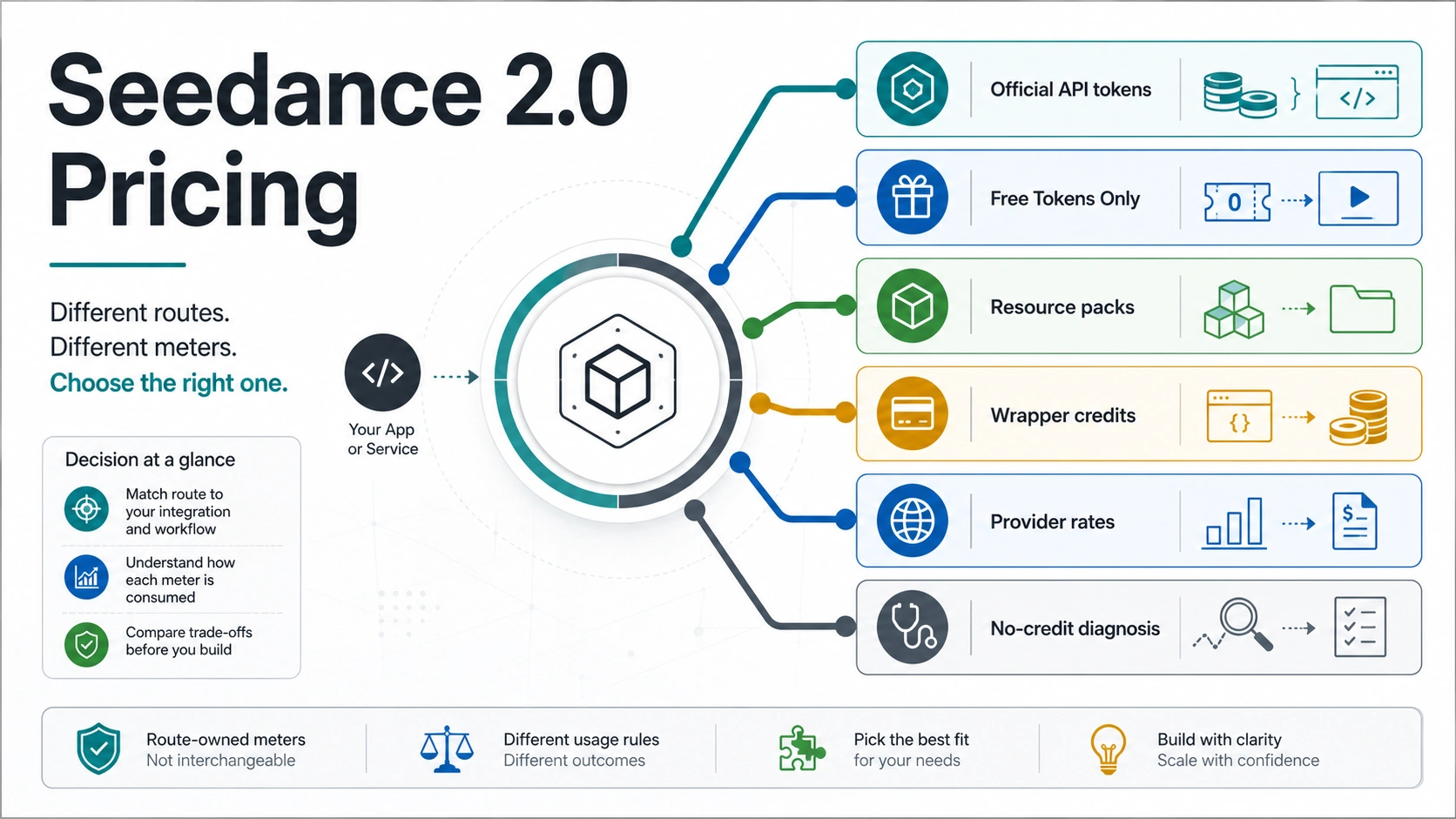
Seedance 2.0 pricing changes by route owner, so the first step is not finding the lowest number; it is naming which meter controls the job. On the official BytePlus developer API route, the current checked lane is token-based: a five-second, no-input Dreamina Seedance 2.0 example is estimated at about $0.35 for 480p, $0.76 for 720p, $1.87 for 1080p, and $3.89 for 4K, but the final charge follows the actual usage.completion_tokens returned by the successful task. Free Tokens Only, resource packs, wrapper credits, provider USD/sec rows, and app subscriptions are separate account states or contracts, not alternate names for the same official price.
| Route owner | Meter to compare first | What to verify before paying | If you see no credits |
|---|---|---|---|
| BytePlus official API | Token price times actual token use | Model route, duration, resolution, input mode, pricing page date, and usage.completion_tokens | Check account balance, resource-pack deduction, pay-as-you-go fallback, and task result |
| BytePlus Free Tokens Only | Account-level free-token state | Whether developer mode is enabled, remaining platform-granted tokens, and the 500k-token limit | Exhaustion can pause service and return SetLimitExceeded |
| BytePlus resource packs | Prepaid online inference resources | Pack size, 90-day validity, deduction before pay-as-you-go, and whether the model route is covered | Expired or exhausted packs push excess to pay-as-you-go if billing is available |
| Wrapper site | The wrapper's own credit unit, often credits/sec | Credit price, seconds billed, model label, refund or failed-job rule, and support owner | Refill or diagnose the wrapper wallet; do not treat it as BytePlus balance |
| Provider route | The provider's USD/sec or job-rate row | Resolution, audio/input mode, provider markup, billing owner, limits, and support path | Fix provider billing or quota; official BytePlus free tokens do not apply |
| App or subscription route | App-plan credits, caps, or entitlements | Direct owner evidence for credits, plan limits, and what counts as a billable generation | Treat it as that app's account state until the owner page proves otherwise |
Stop rule: do not buy credits, switch routes, or call one option cheapest until duration, resolution, input mode, model variant, failure-charge rule, billing owner, and support owner all match. A cheap-looking credit table is not comparable to official API pricing unless those fields line up.
Quick Answer: What Seedance 2.0 Costs Depends on the Route
If you are asking for the official developer API price, use the BytePlus ModelArk pricing page, not a wrapper credit table. The page checked on July 5, 2026 and last updated July 2, 2026 says Dreamina Seedance 2.0 API is live, uses token-unit price times token consumption, and reports final usage through usage.completion_tokens. It also says only successfully generated videos are charged on that route; a content-moderation failure is not charged there. That is why a fair comparison starts with the billing owner before the model name.
If you are asking whether Seedance 2.0 has free credits, separate three meanings of "free":
- BytePlus Free Tokens Only is a developer account mode for eligible new accounts, disabled by default, with 500k platform-granted free tokens.
- Wrapper or app credits are controlled by that wrapper or app. They are not official BytePlus tokens unless the owner explicitly says so.
- Provider trial credits, if any, belong to the provider account and should be verified on that provider's current billing page.
If you are asking why Seedance says "no credits," diagnose the route before buying anything. A BytePlus account can be out of account balance, out of a valid resource pack, or stopped by Free Tokens Only exhaustion. A wrapper account can simply have an empty wallet. A provider account can have a provider billing or quota issue. Those states look similar to the user but have different fixes.
Official BytePlus API Pricing: Token Math, Not App Credits
The official API lane is the cleanest place to start because it gives the owner, formula, and usage field. BytePlus describes the Dreamina Seedance 2.0 API cost as:
hljs txtCost = token unit price x token consumption
That is not the same as credits/sec on a wrapper site. It is also not the same as a consumer app subscription. The API route bills by model, resolution, duration, and whether video input is part of the task, then reports actual usage after the job.
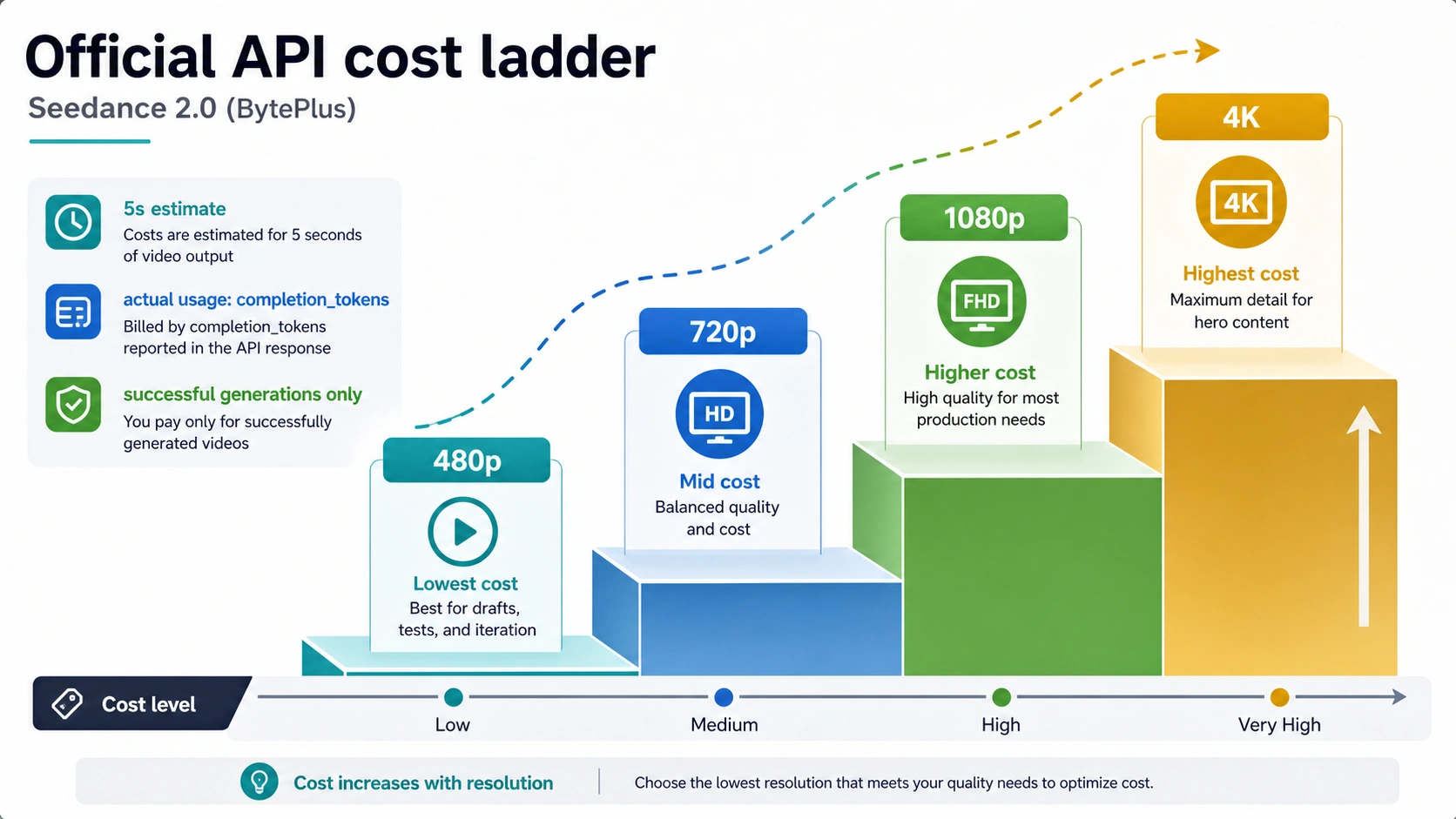
The official page's five-second, 16:9, no-video-input examples checked July 5, 2026 are:
| Official BytePlus example | 480p | 720p | 1080p | 4K |
|---|---|---|---|---|
| Dreamina Seedance 2.0, five seconds, no video input | $0.35 | $0.76 | $1.87 | $3.89 |
| Dreamina Seedance 2.0 Fast, five seconds, no video input | $0.28 | $0.60 | Not listed in this example set | Not listed in this example set |
| Dreamina Seedance 2.0 Mini, five seconds, no video input | $0.18 | $0.38 | Not listed in this example set | Not listed in this example set |
For Seedance 2.0 jobs with 2-15 seconds of video input and a five-second output, BytePlus gives wider estimated ranges:
| Official BytePlus example with video input | 480p | 720p | 1080p | 4K |
|---|---|---|---|---|
| Dreamina Seedance 2.0, 2-15s input plus 5s output | $0.39-$0.86 | $0.84-$1.86 | $2.06-$4.57 | $4.20-$9.33 |
Treat those rows as official API estimates, not universal prices. They are useful for planning because they show the shape of the cost curve: resolution and input/output length matter. They are not a promise that every provider, app, or wrapper will bill the same job at the same number.
The official token-unit rates also show why a simple "price per video" answer can mislead. The Seedance 2.0 online rows checked July 5, 2026 list different USD-per-million-token prices by resolution band and input type. For example, 480p and 720p no-video-input rows use one unit price, 1080p uses another, and 4K uses a different row. The final video consumes a different number of tokens depending on the request, so the example table is an estimate, not the billing record.
Use the official API lane when:
- you need a developer-owned integration;
- logs, moderation, billing, usage fields, and support need to map to BytePlus ModelArk;
- your team can inspect
usage.completion_tokensafter generation; - you want official failure-charge rules instead of wrapper-level assumptions;
- you are comparing provider markup against a first-party baseline.
Use a wrapper or app lane instead only when that product's workflow, account, editor, or distribution path matters more than official API ownership.
Free Tokens Only: Why "Free Seedance" Is a Narrow Developer State
BytePlus Free Tokens Only mode is not a universal free Seedance 2.0 offer. It is an account-level developer setting for eligible new accounts. The page checked July 5, 2026 says it is disabled by default, can be enabled by users who have never incurred paid fees on ModelArk, and uses 500k platform-granted free tokens for model inference.
The key part for "no credits" searches is the stop behavior. When Free Tokens Only mode reaches the configured inference limit, the service pauses and API calls can return 429 SetLimitExceeded. If a user disables the mode, the same page says it cannot be re-enabled. That means the fix is not "buy random Seedance credits" by default. The fix is to identify whether the current task is actually running under BytePlus Free Tokens Only, then check the account state, limit, and billing route.
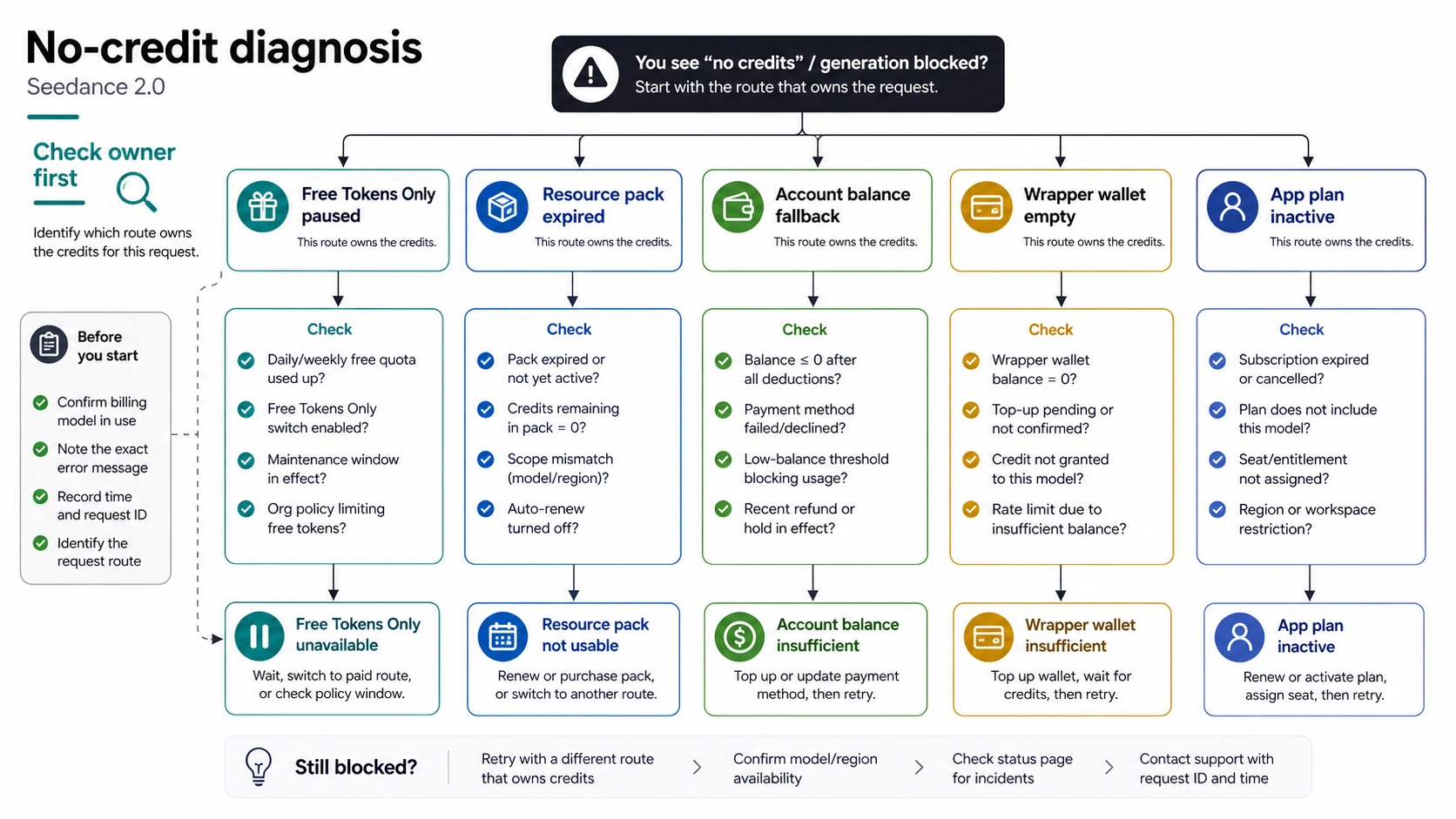
Use this diagnostic when a Seedance route says no credits:
| Symptom | First branch to check | Likely next move |
|---|---|---|
API call returns 429 SetLimitExceeded | BytePlus Free Tokens Only inference limit | Confirm Free Tokens Only mode, remaining free tokens, and whether paid billing should be configured |
| Official API task creates but later stops on billing state | BytePlus account balance or resource pack | Check whether a valid resource pack is being deducted before pay-as-you-go and whether account balance exists |
| Wrapper UI says no credits before generation | Wrapper wallet | Check the wrapper account balance, credit package, seconds-per-credit rule, and support page |
| Provider API returns quota or payment error | Provider billing/quota | Check the provider dashboard, rate limit, spend cap, and model route |
| App surface says credits unavailable | App entitlement | Check the app plan, region, daily cap, and owner help page before assuming API credits apply |
The safest recovery order is owner, account state, then purchase. If you buy credits before naming the owner, you may top up the wrong wallet.
Resource Packs and Account Balance: The Hidden Middle Between Free and Pay-As-You-Go
BytePlus resource packs sit between free-token testing and pay-as-you-go billing. The resource-pack page checked July 5, 2026 describes them as prepaid online inference resources. It also says resource packs are non-refundable, valid for 90 days, and deducted before pay-as-you-go. After packs expire or are exhausted, excess consumption automatically moves to pay-as-you-go if billing is available.
That creates several "no credit" states:
| Account state | What it means | Reader action |
|---|---|---|
| Valid resource pack remains | API usage should deduct from the pack first | Confirm the task's model route is covered and inspect pack deduction |
| Pack expired | The prepaid resource no longer covers new usage | Move to pay-as-you-go if intended, or buy a new matching pack |
| Pack exhausted | The prepaid quota is used | Check account balance and pay-as-you-go fallback |
| No pay-as-you-go balance | Excess usage cannot continue | Add official account billing only if this is the route you want |
| Wrapper credits empty | Official resource packs do not help | Diagnose the wrapper wallet separately |
The resource-pack prices themselves are not consumer credit prices. They are prepaid token-resource references for the BytePlus route. Do not convert them into credits/sec unless the same owner publishes that conversion.
Before buying a pack, write down the model variant, expected resolution, expected duration, and whether the workload includes video input. If your volume is uncertain, pay-as-you-go can be safer for testing because it avoids expiring prepaid resources. If your usage is predictable and tied to a covered model route, a resource pack can make billing more controllable, but it still needs current owner verification.
Provider and Wrapper Rows: Useful, But Not Official BytePlus Pricing
Provider and wrapper pages are not wrong just because they use a different meter. They are wrong only when readers treat those meters as official BytePlus prices. A wrapper can sell credits/sec because it owns the account, queue, UI, payment flow, and support contract. A provider can list USD/sec because it owns the API route it exposes to customers. Those rows are useful when you are comparing real routes, but they must stay owner-labeled.
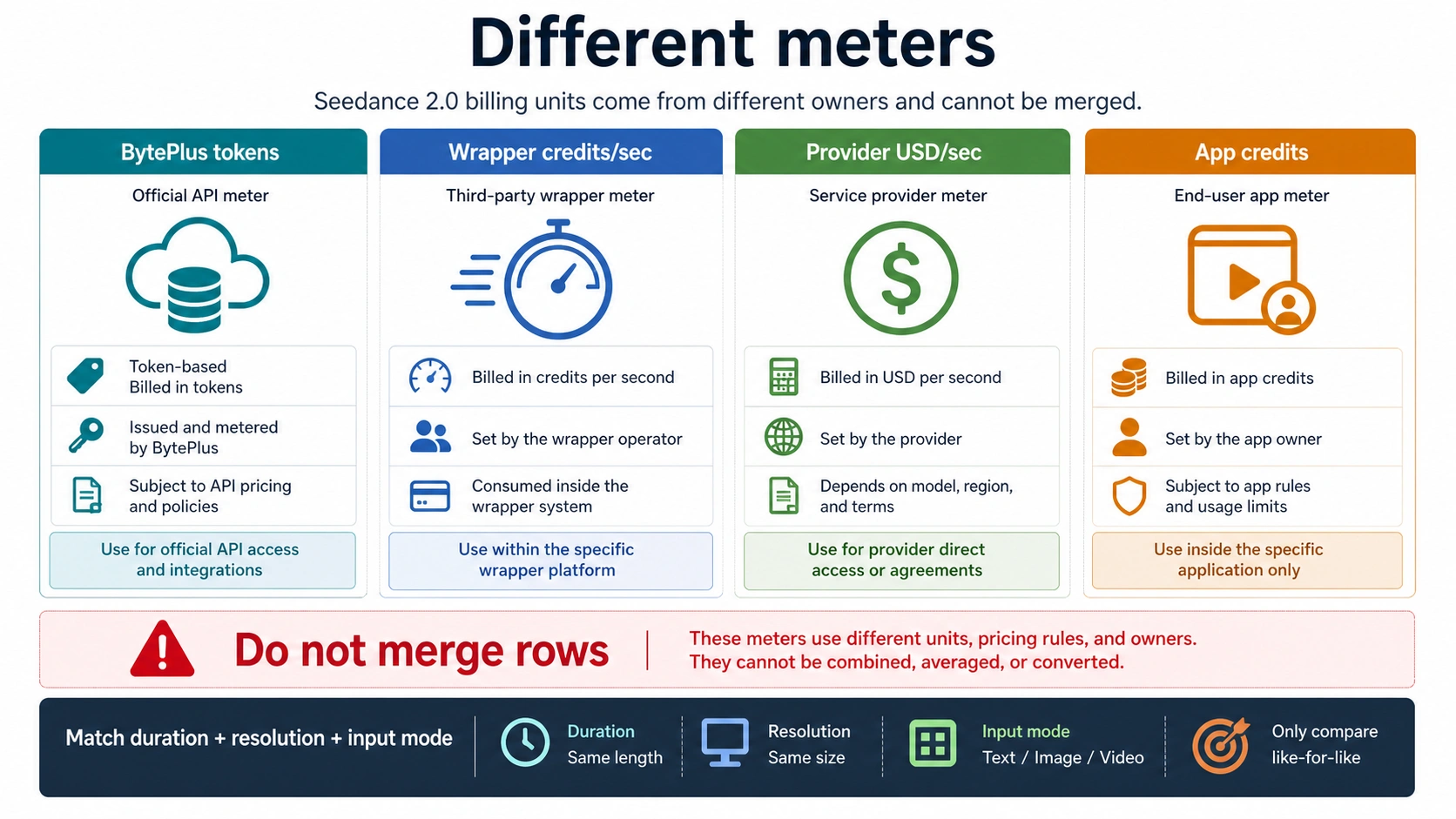
Two current examples show the boundary:
| Owner-labeled route | Example checked July 5, 2026 | How to use it |
|---|---|---|
| seedance2.ai wrapper | The pricing page uses credits/sec, with separate standard, Mini, resolution, and input-mode rows | Use only as a wrapper-owned credit example; do not merge into official API token pricing |
| fal.ai provider | The model page lists provider-owned per-second prices such as 720p with audio, 720p fast, and 1080p with audio rows | Use only as a provider API route; compare duration, resolution, audio, support, logs, and billing owner |
This is where many "Seedance 2.0 cost" comparisons break. A provider rate may include its own markup, infrastructure, queueing, account management, or route convenience. A wrapper credit may include UI, storage, presets, or platform risk. A first-party API call may require more integration work but gives the cleanest official usage and charge record. None of those lanes is automatically cheapest for every reader.
For the separate access and safety question, use the existing Seedance 2.0 access guide when the next problem is APK/MOD risk, official-vs-wrapper access routes, app safety, or upload stop rules. Stay with the pricing workflow here when the problem is cost, credits, or a no-credit account state.
A Practical Cost Worksheet Before You Buy Credits
Use this worksheet before topping up any Seedance route:
| Question | Why it changes the cost |
|---|---|
| Who owns the route: BytePlus, provider, wrapper, or app? | The owner controls the meter, support path, and failure rules |
| Which model variant is selected: Seedance 2.0, Fast, Mini, or a provider label? | Model variants can have different unit rates and supported resolutions |
| What is the output duration? | Official examples and provider rows often scale by seconds or token use |
| What is the resolution? | 480p, 720p, 1080p, and 4K can land in different rows |
| Is there video input? | Input video can change the official example range and the task cost |
| Is audio included? | Some provider rows distinguish audio-capable routes |
| Are failed or moderated jobs charged? | BytePlus says content-moderation failures are not charged on the official route; wrappers and providers need owner evidence |
| What happens when credits run out? | Free-token pause, resource-pack expiry, wallet exhaustion, and quota limits have different fixes |
| Can you inspect usage after the job? | usage.completion_tokens is useful for official API reconciliation |
| Does support belong to the same owner as billing? | The fastest no-credit fix usually comes from the billing owner |
The decision rule is simple: compare only rows that describe the same job. A 720p five-second official no-input estimate, a 720p provider with audio per-second rate, a wrapper credits/sec table, and an app subscription cap are four different contracts. You can place them side by side, but you should not average them, convert them casually, or call one cheaper until the job shape matches.
For a developer team, the official API lane usually makes sense when auditability and integration control matter. A provider lane can make sense when the endpoint, docs, and account workflow are easier for the current stack. A wrapper or app lane can make sense for one-off creative work if the product's editor and payment model are clear. The wrong route is the one where the price looks low but the owner, support, charge rule, and credit behavior are hidden.
FAQ
Is Seedance 2.0 free?
Not universally. BytePlus Free Tokens Only is a limited developer account mode for eligible new accounts and has a 500k platform-granted token boundary. A wrapper, provider, or app may have its own credits or trial behavior, but that is not official BytePlus free API quota unless the owner proves it.
How much does official Seedance 2.0 cost for a five-second video?
The official BytePlus examples checked July 5, 2026 estimate a five-second, 16:9, no-video-input Dreamina Seedance 2.0 video at about $0.35 for 480p, $0.76 for 720p, $1.87 for 1080p, and $3.89 for 4K. Actual API billing follows token consumption and the returned usage.completion_tokens.
Why does Seedance say no credits?
First identify the route owner. On BytePlus, it may be Free Tokens Only exhaustion, a missing account balance, an expired or exhausted resource pack, or pay-as-you-go not available. On a wrapper, it usually means the wrapper wallet or package state. On a provider, it can be provider billing, quota, or spend-cap state. The same phrase does not have one universal fix.
Are Seedance wrapper credits the same as BytePlus API tokens?
No. A wrapper's credits/sec table belongs to the wrapper's own pricing contract. BytePlus official developer pricing uses token-unit price and token consumption. Keep the two tables separate unless the same owner publishes a current conversion rule.
Are resource packs cheaper than pay-as-you-go?
They can be useful for predictable BytePlus online inference usage, but they are prepaid, non-refundable resources with 90-day validity. Buy them only after the model route, expected volume, and fallback to pay-as-you-go are clear. For early testing, pay-as-you-go can be simpler.
Does BytePlus charge failed Seedance videos?
The current BytePlus pricing page checked July 5, 2026 says only successfully generated videos are charged and that content-moderation failures are not charged on that route. Do not copy that rule into wrappers or providers unless their own pages say the same thing.
Is fal.ai cheaper than the official API?
Not by a universal rule. fal.ai publishes provider-owned per-second rows for its Seedance 2.0 endpoints. Compare only after matching duration, resolution, audio/input mode, model variant, support owner, and failure behavior against the official BytePlus lane or another provider lane.
Should I use the official API, a provider, or a wrapper?
Use the official API when you need first-party usage records, billing control, and developer integration. Use a provider when its endpoint, pricing shape, or account workflow is better for your stack and you accept provider-owned billing. Use a wrapper or app when the editor, presets, and one-off creative workflow matter more than official API ownership. In every case, solve the no-credit state with the billing owner that actually controls the route.