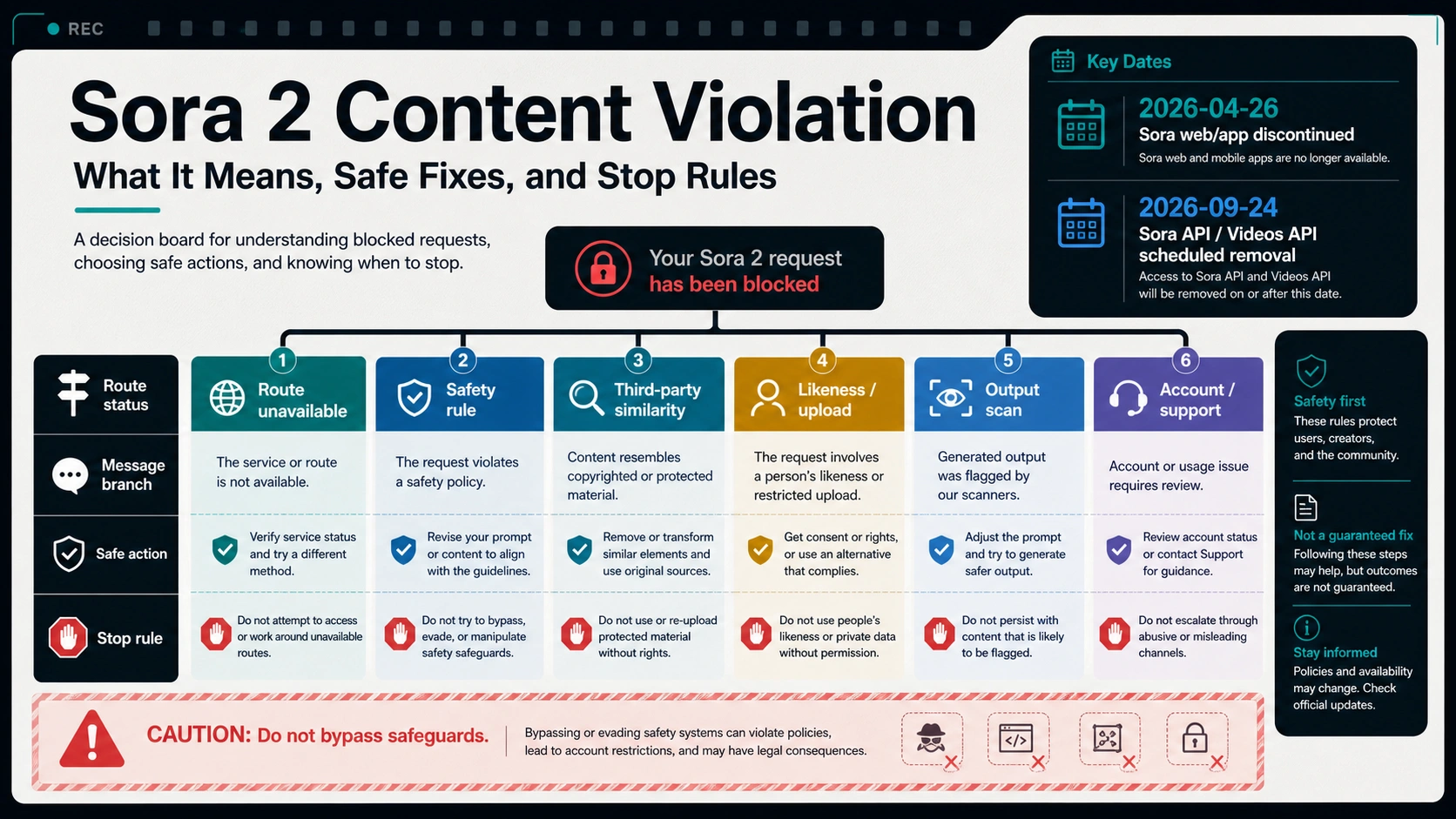
A Sora 2 content violation is not one single error, so do not start by rewriting the prompt until you know which branch blocked you. As of July 5, 2026, OpenAI says Sora web and app experiences were discontinued on April 26, 2026, while the Sora API / Videos API and Sora 2 models are deprecated with removal scheduled for September 24, 2026. If you are still on an API route or reading an older Sora error, the block can come from the request, an upload or reference image, generated frames or audio, account/feed review, or the route itself.
| Branch to check first | What it usually means | Smallest safe next action |
|---|---|---|
| Route unavailable or deprecated | The Sora surface you are trying may no longer be usable | Check the current route status before retrying |
| Broad safety rule | The request depends on restricted sexual, violent, illegal, deceptive, or harmful content | Change the idea into a compliant one or stop |
| Third-party similarity | The prompt leans on a brand, character, franchise, public figure, or near-copy concept | Make the subject original and remove the dependency |
| Likeness or upload issue | A real person, public figure, minor, or uploaded reference creates consent, privacy, or identity risk | Remove the likeness dependency or use only consent-safe material |
| Generated-output scan | The output frames, audio, transcript, or feed/posting state triggered review after generation began | Save the state and avoid repeated risky retries |
| Possible false positive | The concept appears compliant but still blocks | Save the exact message, route, prompt, upload context, timestamp, output state, and one compliant retry |
The safe fix is not to bypass safeguards. Rewrite only when the concept becomes original, consent-safe, non-graphic, non-deceptive, and policy-compliant; stop when the idea depends on minors, non-consensual sexual content, unauthorized likeness, graphic harm, scams, IP recreation, or safeguard evasion.
Decode the message by surface
Start with the surface that blocked you. A Sora content violation shown before generation is a different problem from a block that appears after frames were created, after an upload was attached, or after a feed/posting action. The same words can point to different owners depending on whether you are using an older API integration, reading historical app guidance, handling an exported asset, or debugging a wrapper that relays an OpenAI-side rejection.
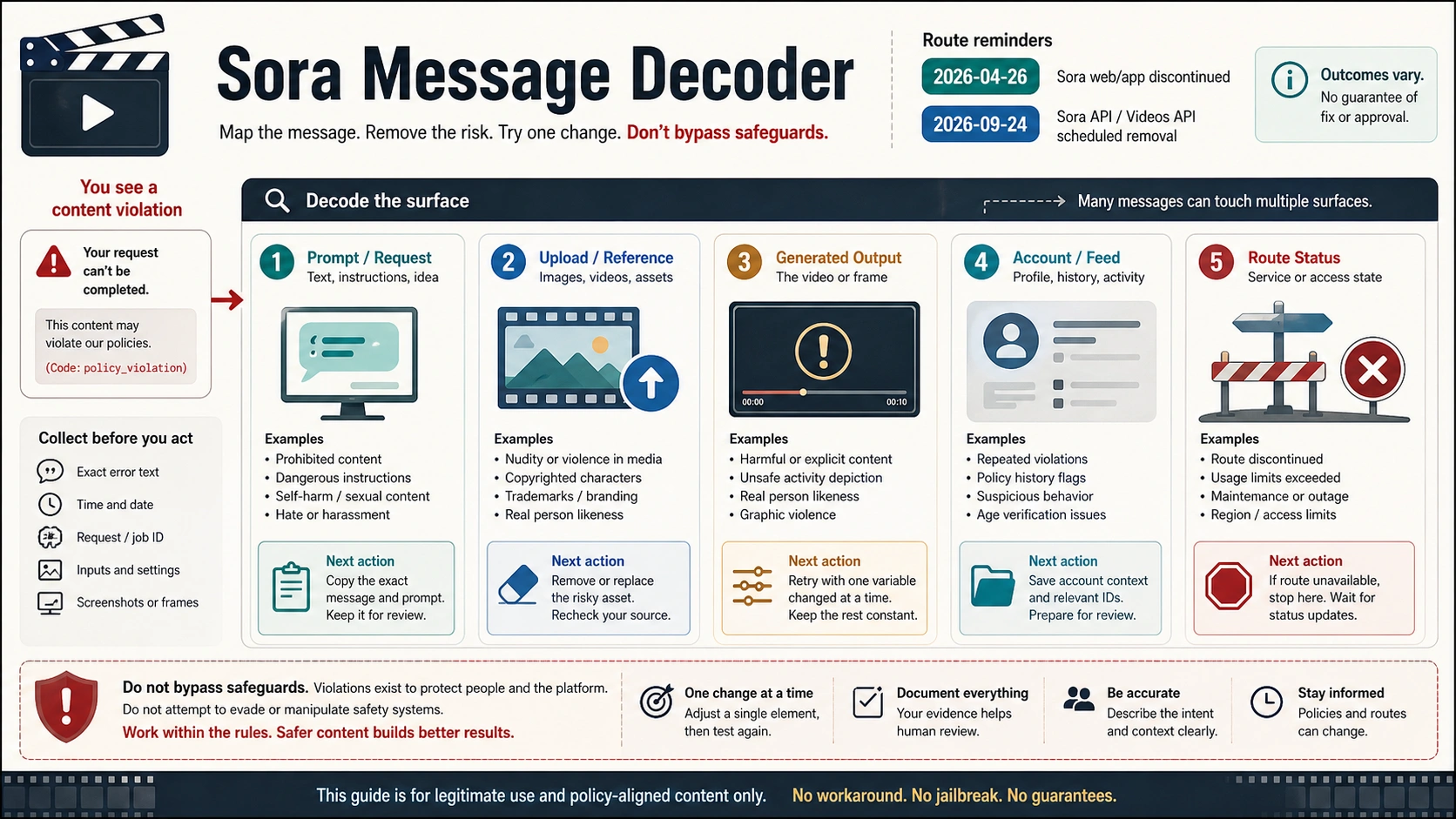
Use the visible state to choose the branch before changing the prompt.
| Surface or moment | Likely owner | What to inspect | Safe next move |
|---|---|---|---|
| Immediate request rejection | Prompt or request policy | Exact message, full prompt, model, size, duration, reference fields, and API response if available | Remove the risky dependency or stop if the concept itself is disallowed |
| Upload or reference-image rejection | Likeness, consent, privacy, or rights | Who appears in the image, whether they consented, whether minors or public figures appear, and whether the edit could mislead | Use only consent-safe material or switch to an original fictional subject |
| Block after generation starts | Generated output scan | Frames, audio, transcript, motion, visible text, likeness drift, and unexpected graphic or deceptive elements | Save the state, simplify the concept, and avoid repeated near-duplicate retries |
| Feed, post, share, or report state | Product review or account/feed context | Whether the content was reported, whether the asset is being shared, and whether account policy messages appear | Preserve evidence and use support/reporting paths instead of repeatedly reposting |
| Route unavailable or deprecated | Product lifecycle or endpoint route | Whether the Sora web/app route is already discontinued, or whether the API removal date affects the integration | Fix the route question before treating it as a prompt problem |
| Compliant idea still blocked | Possible false positive | Exact message, timestamp, surface, route, prompt, upload context, and one clean compliant retry | Build a support evidence packet without claiming a guaranteed appeal |
This order prevents a common mistake: treating every content violation as a wording issue. If the route is unavailable, a clearer sentence will not restore it. If the upload creates likeness or consent risk, swapping adjectives does not solve the real problem. If the output scan blocked generated frames, the next step is to inspect what the system may have produced, not to keep resubmitting the same concept with softer language.
The official safety stack behind the block
OpenAI's Sora materials describe a safety stack that can act before, during, and after generation. The Sora 2 System Card describes input moderation, output blocking, text/image checks, frames, audio, transcripts, likeness safeguards, minor protections, reporting, and review. The Sora discontinuation help page and API deprecations page add the current route boundary: Sora web/app experiences are no longer active, and the Videos API / Sora 2 models are on a removal schedule.
A content violation can therefore happen because the request is plainly restricted, because the request is ambiguous in a safety-sensitive way, because an uploaded image or reference creates rights or privacy risk, because generated output drifted into a restricted pattern, or because the surrounding product route is no longer the one the reader thinks it is.
| Safety layer | What it can catch | Why the next move changes |
|---|---|---|
| Input or prompt moderation | Explicit restricted content, unsafe intent, IP recreation, deceptive framing, or ambiguous real-person requests | Rewrite only if the actual concept can become compliant |
| Upload/reference review | Real-person likeness, minors, private contexts, rights problems, and consent gaps | Remove the upload or replace it with consent-safe original material |
| Output blocking | Generated frames, audio, transcript, motion, visible text, or likeness drift that creates risk | Save state and simplify the scene; do not assume the prompt text was the only problem |
| Feed/reporting review | Public sharing, reports, policy review, and account context | Preserve the asset state and support evidence before further posting |
| Route status | Discontinued app/web route or deprecated API route | Check route availability and migration needs before editing content |
OpenAI's Usage Policies and Terms of Use also matter here. They set the boundaries around illegal activity, sexual or exploitative content, violence, self-harm, scams, privacy violations, IP misuse, unauthorized likeness, and attempts to circumvent protective measures. The practical result is simple: a safe Sora fix is a compliant reclassification of the idea, not a hidden way around the policy layer.
Safe rewrite versus stop rule
A safe rewrite changes the risky dependency. It does not merely hide the same request behind vague language. If the original idea depends on a real celebrity, a child, a protected character, a graphic injury, a sexualized real person, a scam, a deceptive political scene, or a request to dodge filters, the correct action is to stop. If the underlying creative job is allowed, you can make it clearer, more original, and less ambiguous.
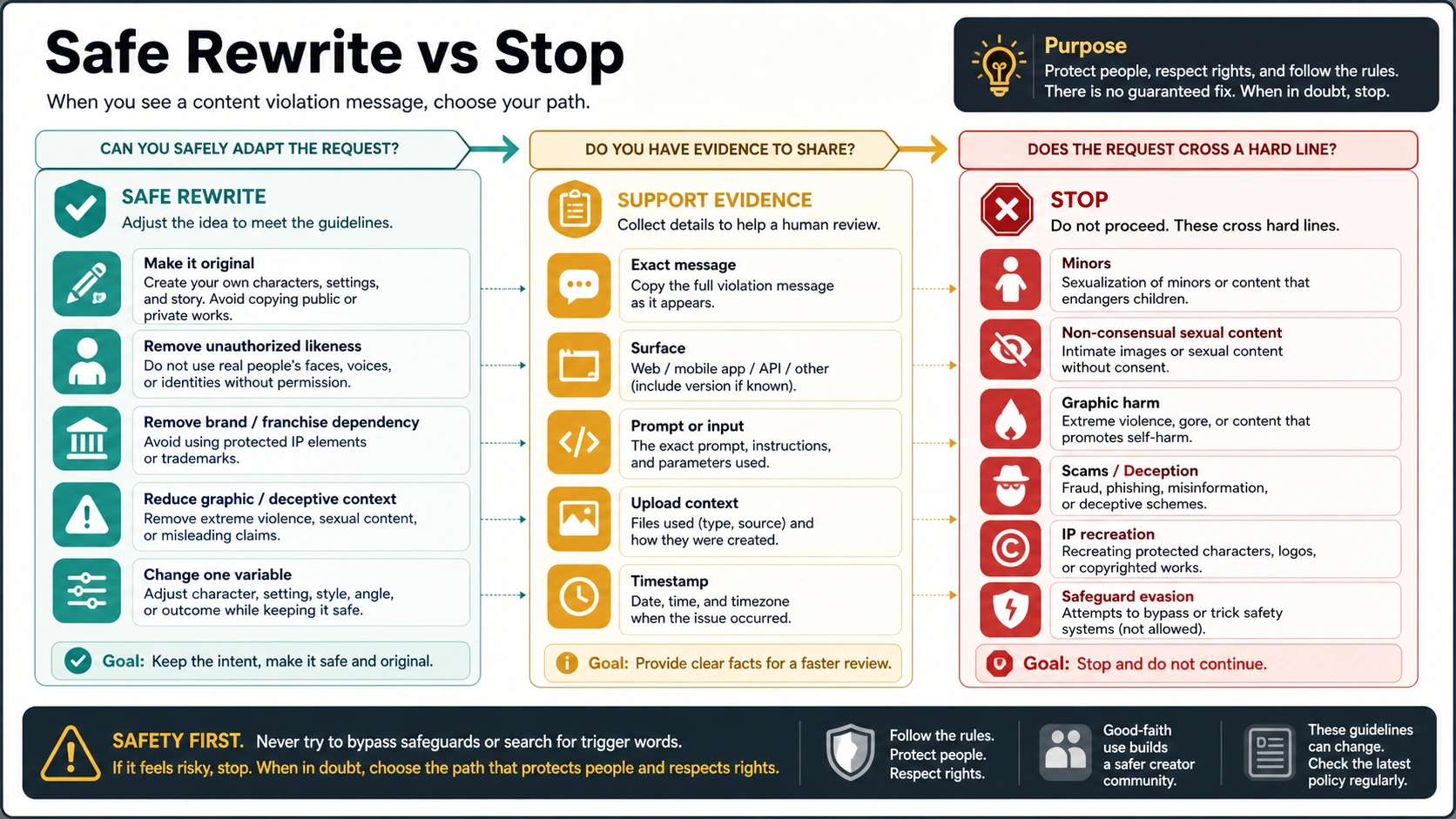
Use this decision table before retrying.
| Original blocker | Unsafe move | Policy-safe rewrite direction |
|---|---|---|
| The prompt names a franchise character or protected brand world | Change one letter or use slang to imply the same character | Create an original character with a different backstory, costume language, and setting |
| The request depends on a public figure likeness | Use indirect references or visual clues to recreate the person | Use a fictional spokesperson or a non-identifying role description |
| The upload contains a real person | Ask for a more dramatic identity-preserving edit without consent context | Use only consented material and keep the edit non-deceptive, non-sexual, and privacy-safe |
| The scene implies graphic harm or illegal activity | Replace the harshest word while keeping the same action | Change the scene goal to aftermath-free, non-graphic, educational, or harmless action |
| The output scan blocked generated frames | Resubmit several close variants quickly | Save the failed state, simplify motion, remove risky elements, and retry once only if the concept is allowed |
| The route is discontinued or deprecated | Keep changing prompt text | Fix the route or migrate the workflow before diagnosing content |
One compliant retry can be useful when the block looks like ambiguity rather than a real stop. For example, a "dramatic rescue scene" can become "a calm training demonstration with no injury, no panic, and no graphic content." A "famous superhero style" can become "an original bright-costume city rescue concept with no franchise marks or character likeness." A "make this person look more persuasive" edit can become a non-deceptive lighting or background adjustment only when the person is authorized and the edit does not mislead.
The retry should change one meaningful variable at a time. Keep a note of what changed, because a support case or team review is much easier when the evidence shows the original message, the compliant rewrite, and the route that blocked it.
Third-party similarity and IP-adjacent prompts
A similarity block is different from a general content-policy block. It often means the prompt relies too heavily on someone else's protected world: a brand, logo, character, franchise setting, public figure, song/video concept, or near-copy visual identity. The prompt may not be sexual, violent, or illegal, but it can still depend on third-party material that Sora should not recreate.
The safe direction is originality, not coded imitation.
| Risky dependency | Why it is fragile | Stronger original direction |
|---|---|---|
| Named character | The output goal depends on recreating protected identity | Describe a new character role, personality, costume palette, and environment |
| Franchise scene | The prompt asks Sora to rebuild a recognizable protected world | Move the action into an original setting with different visual rules |
| Brand/logo focus | The video may imply endorsement or reproduce protected marks | Use generic product shapes, blank labels, or your own brand assets |
| Public figure likeness | The result can create unauthorized identity or deception risk | Use a fictional presenter or get consent through the proper route |
| Style as identity | The request leans on a living artist, studio, or protected look as the main value | Translate the goal into broad visual attributes you can own |
This is also why prompt lists and social examples are weak evidence. A third-party page can show what people ask for, but it cannot prove that a prompt is safe, allowed, or repeatable in your route. For Sora content violation work, the useful test is whether the output remains valuable after you remove the third-party dependency. If it does not, the concept is not ready for a safe retry.
Likeness, uploaded images, and photorealistic people
Uploads and reference images raise the stakes because they can carry identity, age, private setting, sensitive context, or hidden metadata. Even when the prompt text looks harmless, a reference image can make the request about a real person rather than an abstract video concept. OpenAI's Sora safety materials emphasize consent-based likeness and protections around minors and deceptive identity use, so a content violation around an upload should be treated as a consent and context question first.
Use a stricter checklist for people and faces:
| Check | Pass condition | Stop condition |
|---|---|---|
| Consent | The person is authorized for this use and understands the edit | The person is public, private, or uploaded by someone else without clear permission |
| Age | The subject is clearly adult, and the context is ordinary and non-sensitive | A minor, age-ambiguous subject, school context, family/private context, or sexualized framing appears |
| Identity | The video does not impersonate, defame, deceive, or imply endorsement | The prompt asks Sora to make someone say, do, endorse, or appear in a misleading way |
| Privacy | The source image is yours to use and not private, medical, intimate, or confidential | The image exposes private context or could harm the subject if shared |
| Edit goal | Lighting, background, framing, or non-deceptive creative polish | Sexualization, humiliation, political deception, fake evidence, or identity manipulation |
If the image fails these checks, changing tools or wording does not make the request safe. If the image passes, write the request in a way that names the benign goal: "non-deceptive background cleanup for an authorized product shoot" is clearer than "make this person look more intense." The more realistic the person looks, the more important it is to make consent, purpose, and non-deception explicit.
Generated-output or feed block after a prompt looked fine
Sometimes the prompt appears to pass, but the generated output, transcript, audio, or posting step triggers review. That branch can surprise creators because the original sentence may look compliant. Video systems can still produce unexpected frames, motion, text, likeness drift, or audio cues that make the final asset riskier than the request.
When the block happens after generation starts, do not erase the evidence. Save the state first:
| Evidence item | Why it helps |
|---|---|
| Prompt and settings | Shows what you actually requested |
| Upload or reference context | Shows whether the block may be about input material |
| Output state | Shows whether frames, audio, transcript, or visible text appeared before the block |
| Exact message | Separates policy, similarity, route, posting, and account branches |
| Timestamp and route | Makes lifecycle and support review concrete |
| One compliant rewrite | Shows whether the issue persists after you removed ambiguity |
A good second attempt should simplify the scene rather than push harder. Reduce ambiguous motion, remove visible text, avoid real logos, avoid realistic injury or panic, use fictional people, and keep audio direction plain. If the second attempt blocks for the same reason, stop and move to evidence. Repeated near-duplicate retries can make the situation harder to interpret and can weaken your own support record.
For cases where the content was generated but will not post or export, use the narrower failed-to-post Sora 2 guide after confirming the problem is posting, export, or recoverability rather than initial content-policy rejection.
False-positive evidence packet and account-risk caveat
A possible false positive needs a clean evidence packet, not a promise that support will reverse it. OpenAI policies allow for enforcement mistakes to be reviewed through the appropriate channels, but a blocked Sora request is still only one signal. It does not by itself prove that your account will be deactivated, and it does not prove that the content is allowed.
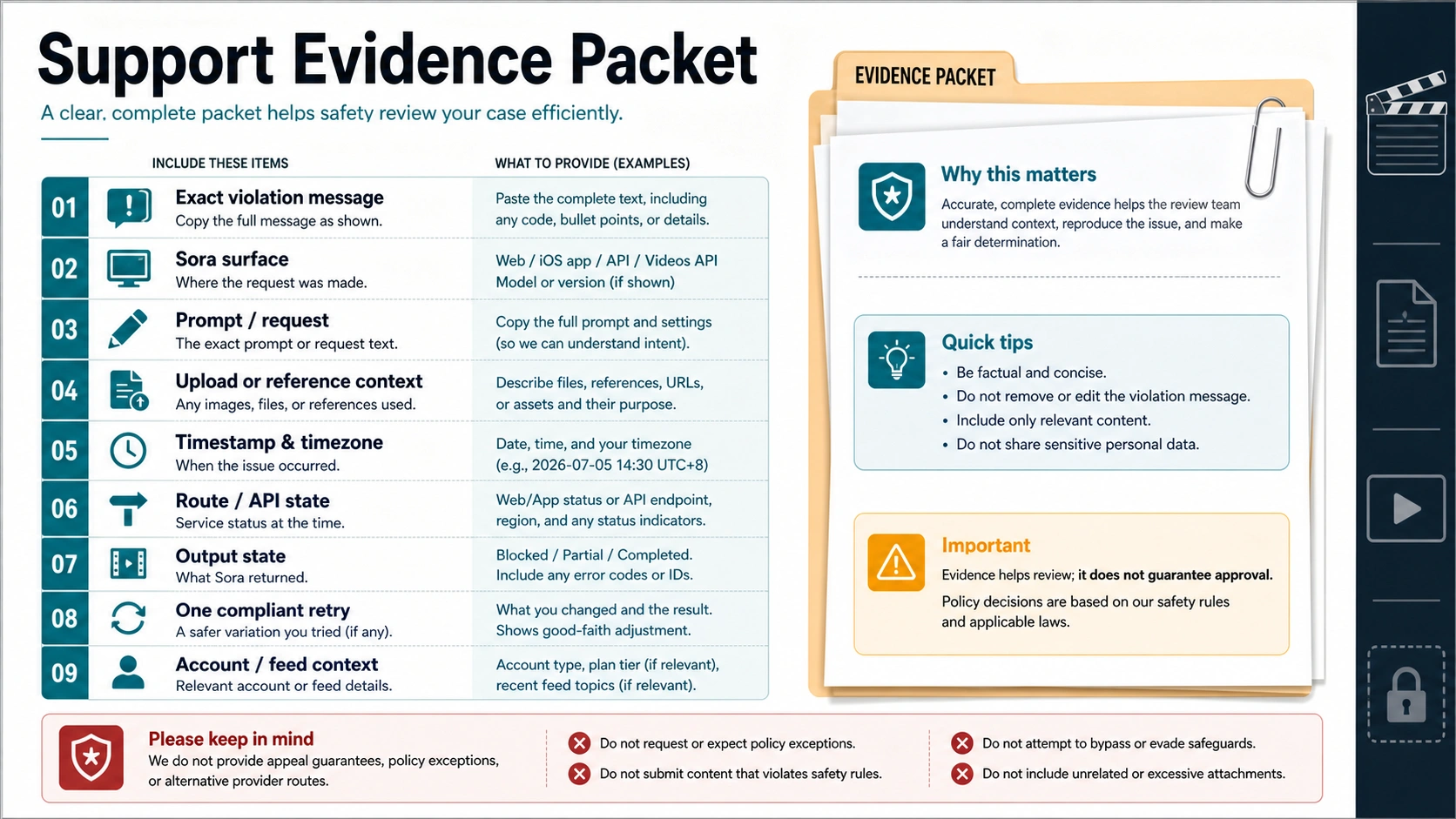
Capture the packet before you keep retrying:
| Packet field | What to save |
|---|---|
| Exact visible message | Copy the full content violation, similarity, policy, upload, output, or account wording |
| Surface and route | Sora API, Videos API, older app guidance, export route, feed/posting surface, SDK, or wrapper |
| Date and timestamp | Use your local time and note the current lifecycle boundary |
| Prompt and settings | Include model, size, seconds, reference fields, and request shape if available |
| Upload context | Describe who or what appears, consent status, and whether the image is private or sensitive |
| Output state | Note whether frames, audio, transcript, or posting state appeared before the block |
| Compliant retry | Save one rewritten attempt that removed risky dependencies |
| Account context | Note whether you also saw suspension, warning, deactivation, or reporting messages |
If the issue is account-level, read the message literally. OpenAI's account-help materials describe policy violations as one possible reason for deactivation, but a single content block is not the same as a confirmed account action. If you see only a content violation, handle it as branch diagnosis. If you see a warning, suspension, deactivation, or report-related notice, preserve the exact account message and use the official account/support path.
Do not post private uploads, face images, or sensitive prompts publicly while asking for help. Redact personal data, remove third-party material, and keep the report focused on the branch: route, prompt, upload context, output state, and exact message.
Use the narrower Sora guide after the branch is clear
The content-violation branch should not absorb every Sora problem. Once you know the owner, move to the guide that matches the next job.
| Confirmed branch | Better next guide |
|---|---|
| Broad invalid prompt, sentinel-style rejection, or moderation wording beyond content violation | Sora 2 invalid prompt fix |
| Allowed idea, but you need stronger prompt structure, request settings, or shot-brief workflow | Sora 2 prompt guide |
| Content already exists but posting, export, or recoverability is failing | Failed to post Sora 2 |
| Unknown error code or non-policy failure | Sora 2 error code list |
| Endpoint, authentication, model, or developer access question | Sora 2 API access guide |
| Cost, duration, credits, or retry budgeting | Sora 2 pricing per second and Sora 2 credits and limits |
That separation keeps the safe fix small. A policy block should not become a pricing article. A route shutdown should not become a prompt rewrite. A broad invalid-prompt article should not replace the stricter likeness, third-party similarity, and support-evidence decisions that a content violation needs.
FAQ
Does a Sora content violation mean my account is banned?
Not by itself. A content violation means the request, upload, output, posting state, account context, or route hit a guardrail. Account warnings, suspensions, or deactivation messages are separate signals. Preserve the exact wording before assuming the block is account-level.
Can I appeal a Sora content violation?
Treat it as support evidence, not a guaranteed appeal. Save the exact message, route, prompt, upload context, timestamp, output state, and one compliant retry. If the block appears mistaken, use the official support or reporting path with that packet.
Can I keep rewriting until Sora accepts the prompt?
Only when the concept is allowed and the rewrite removes the risky dependency. If the idea depends on minors, non-consensual sexual content, unauthorized likeness, graphic harm, scams, IP recreation, or safeguard evasion, stop instead of retrying.
Why does Sora block a prompt that looks harmless?
The visible sentence may not be the only signal. Uploaded images, reference material, real-person likeness, generated frames, audio, transcript, feed review, or route status can all affect the result. It can also be a possible false positive, which is why the evidence packet matters.
Are public figures allowed in Sora prompts?
Do not assume public visibility equals permission. Public-figure likeness can create consent, deception, endorsement, or similarity risk. Use a fictional subject or an authorized route instead of trying to recreate the person indirectly.
What if I use my own photo?
Your own photo is safer than a third-party upload, but the edit still matters. Keep the use consented, non-deceptive, non-sexual, privacy-safe, and ordinary. Stop if the request would mislead viewers, expose sensitive context, or involve minors or age-ambiguous people.
Are copyrighted characters or brands the same as content policy?
They are related but not identical. A third-party similarity block may happen because the request depends on protected characters, franchise worlds, logos, or near-copy visual identity. The safe rewrite is an original character, setting, product, or scene that does not rely on the protected material.
Is the Sora API still usable for content-violation testing?
As of July 5, 2026, OpenAI's help and developer deprecation pages say the Sora API / Videos API and Sora 2 models are deprecated with removal scheduled for September 24, 2026. If your integration still works before removal, diagnose the branch normally. If the route is unavailable, fix route status instead of editing prompt text.
Should I use another provider if Sora blocks the request?
Do not use another route to carry a disallowed request. A different tool may have different interfaces, but consent, privacy, IP, safety, and deception boundaries still matter. If the concept is compliant and the issue is truly Sora-specific or route-specific, document the branch before testing another legitimate workflow.