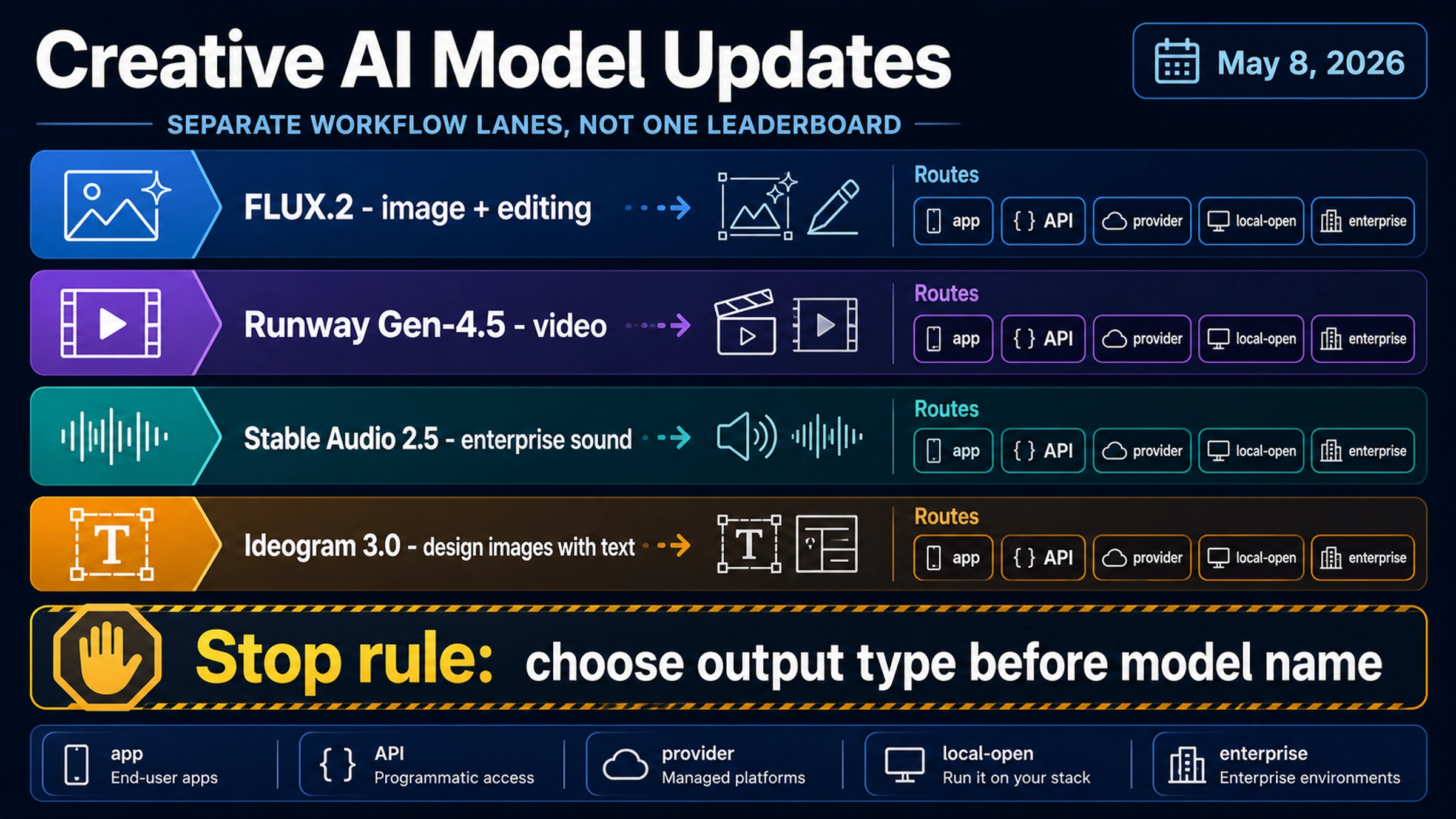
These four releases should not be read as one AI model leaderboard. As of May 8, 2026, FLUX.2 belongs in the image generation and editing lane, Runway Gen-4.5 belongs in the video lane, Stable Audio 2.5 belongs in the enterprise sound-production lane, and Ideogram 3.0 belongs in the design-image lane when text, layout, and style references matter.
The useful adoption question is therefore not "which model is best?" It is "which output are we trying to ship, and which route owns the current contract?" Owner pages prove model identity and first-party access; provider pages prove provider access only. Prices, limits, model availability, and API status can change, so treat every route note below as dated and recheck the owner surface before production use.
| Workflow need | Model to test first | Route boundary to verify |
|---|---|---|
| Image generation or editing | FLUX.2 | Pro, Flex, Dev, and Klein have different route implications; do not collapse them into one label. |
| Video generation | Runway Gen-4.5 | Check Runway's app and API route, not a third-party summary. |
| Production sound | Stable Audio 2.5 | Treat it as an enterprise audio route with API, partner, and on-premise boundaries. |
| Design images with text | Ideogram 3.0 | Use it where text rendering, style reference, and layout control are the job. |
Stop rule: choose the output type before you choose the model name. A cross-media list is useful only after image, video, audio, and design-image work are separated.
What Changed Across The Four Lanes
The common thread is not medium, price, or a single benchmark. The common thread is that each release gives a different creative team a new route to evaluate. Black Forest Labs positions FLUX.2 as a next-generation image generation and editing family. Runway positions Gen-4.5 as a video model with stronger motion, prompt adherence, physical plausibility, and cinematic control. Stability AI positions Stable Audio 2.5 around enterprise sound production at scale. Ideogram positions Ideogram 3.0 around design images, photorealism, style reference, and text rendering.
That means the comparison should begin with output type:
| Release | Primary lane | Strongest first question | Route owner to check |
|---|---|---|---|
| FLUX.2 | Image generation and editing | Do we need image quality, edit control, local work, or a commercial API path? | Black Forest Labs |
| Runway Gen-4.5 | Video generation | Do we need motion, physical realism, or an API route for video generation? | Runway |
| Stable Audio 2.5 | Music and sound production | Do we need production audio generation, editing, or enterprise deployment options? | Stability AI |
| Ideogram 3.0 | Text-heavy design images | Do we need readable text, style reference, and layout control inside images? | Ideogram |
The practical mistake is to turn that table into a winner list. A video model does not beat an audio model at audio work. A text-heavy design-image model does not replace a video model. A local or open-weight image route does not prove a first-party API contract. Each row needs its own owner, route, and test threshold.
FLUX.2 Is The Image And Editing Lane

FLUX.2 is the row to start with when the output is a still image, an edited image, a product shot, a multi-reference scene, or a typography-heavy visual. Black Forest Labs describes the FLUX.2 family around image quality, speed, controllability, multi-reference control, identity holding, product context, and text rendering. Those are image-production jobs, not video or audio jobs.
The important detail is that FLUX.2 is not one undifferentiated label. The current BFL ecosystem uses variant names such as Pro, Flex, Dev, and Klein, and those names should be read as route and tradeoff signals. A quality-first commercial route, a more controllable route, an open or local-oriented route, and a small route do not answer the same production question.
Use the split this way:
| FLUX.2 decision | What it means for testing |
|---|---|
| Pro or quality-first route | Start here when final image quality, brand review, or client delivery matters more than local ownership. |
| Flex or controllable route | Start here when the team needs more steering room across references, edits, or repeated prompt passes. |
| Dev or open route | Start here when local workflow ownership, reproducibility, or ComfyUI-style experimentation matters. |
| Klein or small route | Start here when fast iteration, lighter deployment, or early prompt exploration matters more than final fidelity. |
For ComfyUI-specific replacement work, keep the boundary narrow. The sibling article on ComfyUI Nano Banana Pro alternatives owns the local replacement decision. Here, FLUX.2 is part of a broader creative stack update: it tells image teams which route to test, while the other releases tell video, audio, and design teams not to force their work into an image-model comparison.
Runway Gen-4.5 Is The Video Lane
Runway Gen-4.5 belongs in a video-generation evaluation. Runway's release language focuses on prompt adherence, motion quality, physical plausibility, controllability, and cinematic output. Those are video production concerns: how a subject moves, how a shot holds together, how the camera language feels, and whether the generated sequence can survive an edit pass.
The developer route also matters. Runway announced Gen-4.5 API availability, and the announcement uses gen4_5_turbo in API context. That makes Gen-4.5 more than an app-only curiosity for teams that build generation pipelines, but the route remains Runway-owned. A provider wrapper or model directory can be useful for discovery, yet it should not be treated as the owner of API status, limits, model ID, data handling, or billing behavior.
Evaluate Gen-4.5 with video-native prompts. A fair first test is not "make the same image another model made." It is a small set of motion-heavy scenes: a product in a camera move, a character action with continuity pressure, a physically plausible object interaction, or a cinematic shot where prompt following matters. If those are not your deliverables, Gen-4.5 may be impressive without being the next model your team needs.
Stable Audio 2.5 Is The Enterprise Sound Lane
Stable Audio 2.5 should be evaluated as an audio-production model. Stability AI describes it as built for enterprise sound production at scale, and its guide material emphasizes production-ready tracks plus editing and inpainting workflows. That is a different contract from "generate a picture" or "generate a video clip."
The access boundary is also different. Stability's launch language points to Stable Audio product access, Stability AI API access, on-premise or self-hosted options, and partners. That combination is useful for enterprise teams because sound workflows often involve licensing, brand safety, library management, post-production, and deployment requirements that do not look like a consumer image app.
The first test should be audio-native: prompt-to-music for a campaign bed, sound design for a scene, a loop that needs to edit cleanly, or an inpainting task where a partial track must be repaired. Do not compare Stable Audio 2.5 against FLUX.2 or Ideogram on visual criteria. The relevant question is whether it shortens sound production while preserving the ownership, licensing, and deployment path your team needs.
Ideogram 3.0 Is The Design-Image Lane
Ideogram 3.0 matters when the image itself has to carry text, layout, or a design reference. Ideogram's 3.0 launch emphasizes photorealism, style references, and text rendering. Its developer docs for v3 image generation also make the API route visible for teams that want to generate through a developer workflow instead of only through a browser surface.
That makes Ideogram 3.0 different from a general "best image model" claim. A photoreal portrait, a product scene, a poster, a social card, and a diagram-style image stress different skills. Ideogram earns its place in this bundle when the job includes readable words, visual hierarchy, style matching, or a designed composition where text cannot be fixed later without breaking the workflow.
Test it with design-native prompts: a poster with a short headline, a product launch card with a layout constraint, a brand-style reference, a menu or label concept, or a social creative where the text is part of the generated image. If the job is local image editing or ComfyUI pipeline ownership, FLUX.2 may be a better starting point. If the job is final design imagery with text, Ideogram 3.0 deserves an early slot.
Access Routes Need Owner Labels

The release name is only half the decision. The route tells you who owns model access, data handling, support, pricing, limits, and production recovery. A first-party app, a first-party API, a partner provider, an open-weight local route, and an enterprise deployment route can all expose the same model name while creating different operational contracts.
Use this route language consistently:
| Route label | What it proves | What it does not prove |
|---|---|---|
| First-party app | The model owner exposes a user-facing surface. | It may not prove API availability or production terms. |
| First-party API | The model owner exposes a developer route. | It does not guarantee price, quota, or data handling without current docs. |
| Provider route | A provider offers access through its own product. | It does not become first-party availability or owner support. |
| Local/open-weight route | The model or weights can fit a local or open workflow. | It does not guarantee the same quality, license, or memory profile as hosted routes. |
| Enterprise/on-premise route | A deployment path may exist for enterprise control. | It still requires contract, support, and compliance verification. |
This is why a provider page is useful but limited. It can show a route worth testing. It can show a model ID, endpoint shape, or example workflow. It cannot replace the owner page for the model's public status, release notes, official API posture, or long-term support boundary.
How To Decide What To Test First

Choose the first test by role, not by hype:
| Team | First test | Pass condition |
|---|---|---|
| Image team | FLUX.2 on real prompts for generation, editing, reference control, or local workflow ownership. | It beats the current route on the exact image classes and handoff constraints that matter. |
| Video team | Runway Gen-4.5 on motion, camera, physical plausibility, and prompt adherence. | It produces clips that survive the edit path, not only impressive demos. |
| Audio team | Stable Audio 2.5 on production music, sound design, editing, or inpainting. | It fits licensing, deployment, and post-production requirements. |
| Design team | Ideogram 3.0 on text-heavy images, layout, style reference, and social or product creatives. | Text and layout are good enough to avoid a manual redesign loop. |
| Developer | The owner API or route-specific docs before provider wrappers. | Model IDs, request shape, usage policy, and recovery path are clear enough to build safely. |
The smallest safe adoption path is a two-step test. First, choose the output type and owner route. Second, run a compact prompt set that represents the work you actually ship. Do not ask an audio model to justify itself on image criteria, and do not ask an image model to replace a video route. The result should be a route decision, not a universal ranking.
FAQ
Are FLUX.2, Runway Gen-4.5, Stable Audio 2.5, and Ideogram 3.0 direct competitors?
Not as a single set. FLUX.2 and Ideogram 3.0 overlap more because both generate images, but even there the jobs differ: FLUX.2 is the stronger route to inspect for image generation, editing, local, or variant decisions, while Ideogram 3.0 is especially relevant when the image must include readable text and design structure. Runway Gen-4.5 is video. Stable Audio 2.5 is audio.
Which one should an image team test first?
Start with FLUX.2 when the core work is image generation, image editing, references, or local/open workflow ownership. Add Ideogram 3.0 early if the deliverable is a text-heavy poster, product card, label, social creative, or design image where typography and layout are part of the output.
Does Runway Gen-4.5 have an API route?
Runway announced Gen-4.5 API availability and used gen4_5_turbo in that context. Treat that as a Runway-owned developer route and check Runway's current docs or release notes before building production code, because model IDs, limits, and terms can change.
Is Stable Audio 2.5 only for enterprise teams?
The release positioning is enterprise sound production, and the published route language includes product, API, partner, and on-premise or self-hosted paths. That does not mean every experiment requires a large deployment, but it does mean audio teams should verify licensing, deployment, support, and usage terms before treating it like a casual image-app alternative.
Can provider pages decide which model is available?
Provider pages can prove that a provider route exists. They cannot replace the owner page for first-party model identity, API status, support, or long-term route commitments. Use provider pages as implementation evidence, not as the source of truth for the model's public contract.
What is the safest adoption order?
Pick the output type first, then the owner route, then a small test set. For image and editing work, test FLUX.2. For video, test Gen-4.5. For production sound, test Stable Audio 2.5. For text-heavy design images, test Ideogram 3.0. Recheck volatile facts before production: availability, model IDs, API status, limits, pricing, and data-handling terms.