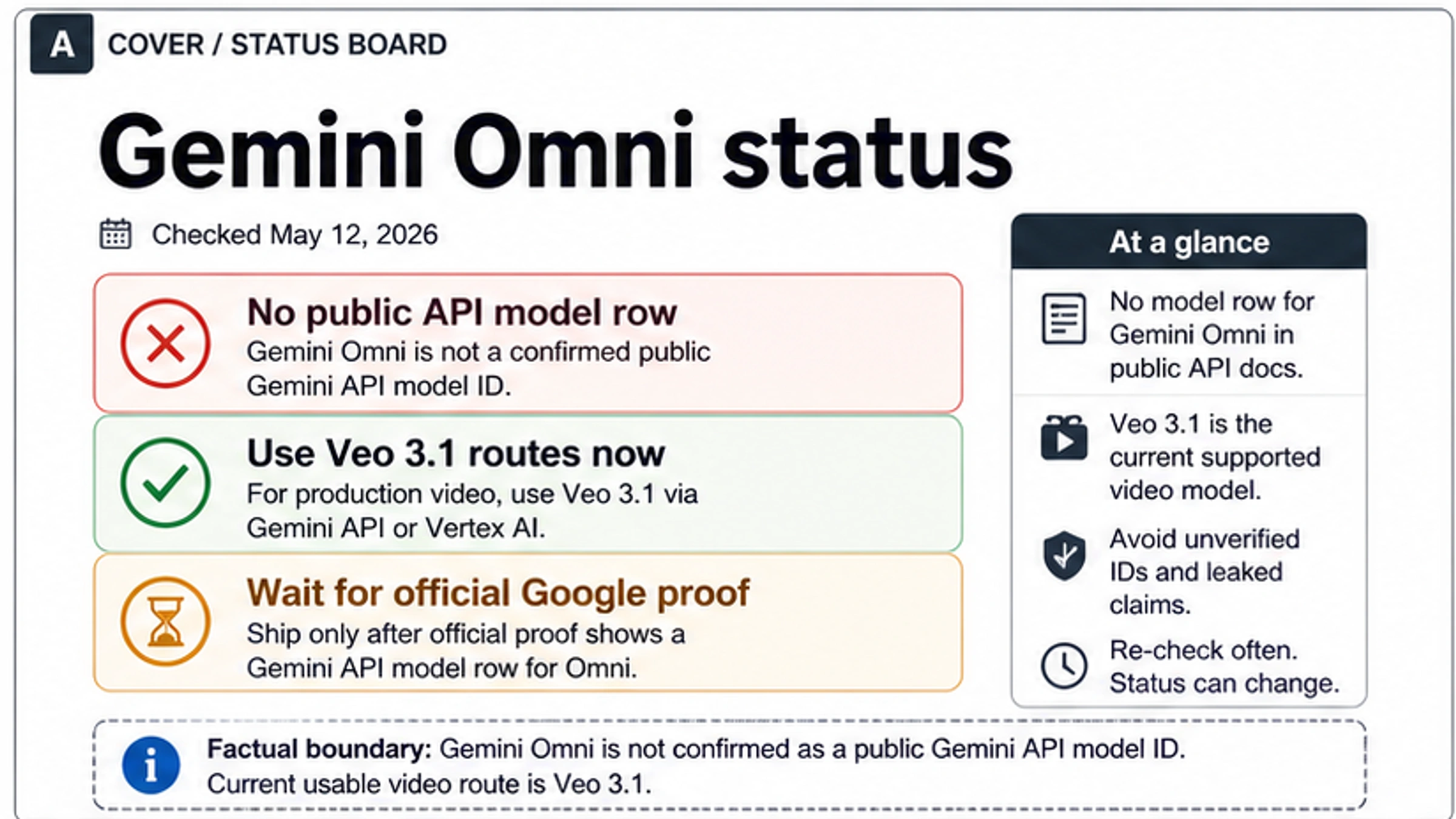
Gemini Omni is now official, and Google says it replaces Veo in the Gemini app. That does not mean Veo has disappeared for developers: the Gemini API video documentation checked on May 21, 2026 still routes video generation through Veo model IDs, so the right answer depends on the surface you are using.
Use Gemini Omni when you are deciding how to create or edit video inside Gemini app, Flow, or related creator surfaces. Keep using documented Veo routes when you are writing API code, estimating cost, setting quotas, or supporting a production workflow. Treat an Omni API migration as pending until Google exposes model IDs, video docs, pricing or quota language, and AI Studio or Vertex visibility.
The comparison is therefore not "which model wins everywhere?" It is "where has Google moved the user-facing video experience to Omni, and where does the deployable developer contract still say Veo?"
Quick route answer
The safest way to read Google's wording is by surface. The Gemini video generation page names Gemini Omni as the video creation and editing experience in the Gemini app and says it replaces Veo there. The Gemini API video documentation still presents video generation through Veo 3.1 model IDs. The Gemini API pricing page also shows Veo 3.1 pricing rows, while this refresh did not find a public Gemini Omni pricing row.
| If your job is... | Start with... | Do not assume... |
|---|---|---|
| Creating or editing video inside Gemini app | Gemini Omni | That this proves an API model ID exists |
| Creator iteration in Flow or YouTube-linked surfaces | Gemini Omni or Flow access where available | That app-plan access equals developer access |
| Building video generation into code | Gemini API video docs with Veo 3.1 IDs | That gemini-omni is callable |
| Enterprise deployment or governance | Vertex AI and official Google Cloud notices | That a consumer launch settles IAM, billing, logs, or regions |
| Evaluating third-party Omni pages | Treat them as separate service claims | That wrapper marketing proves Google-owned availability |
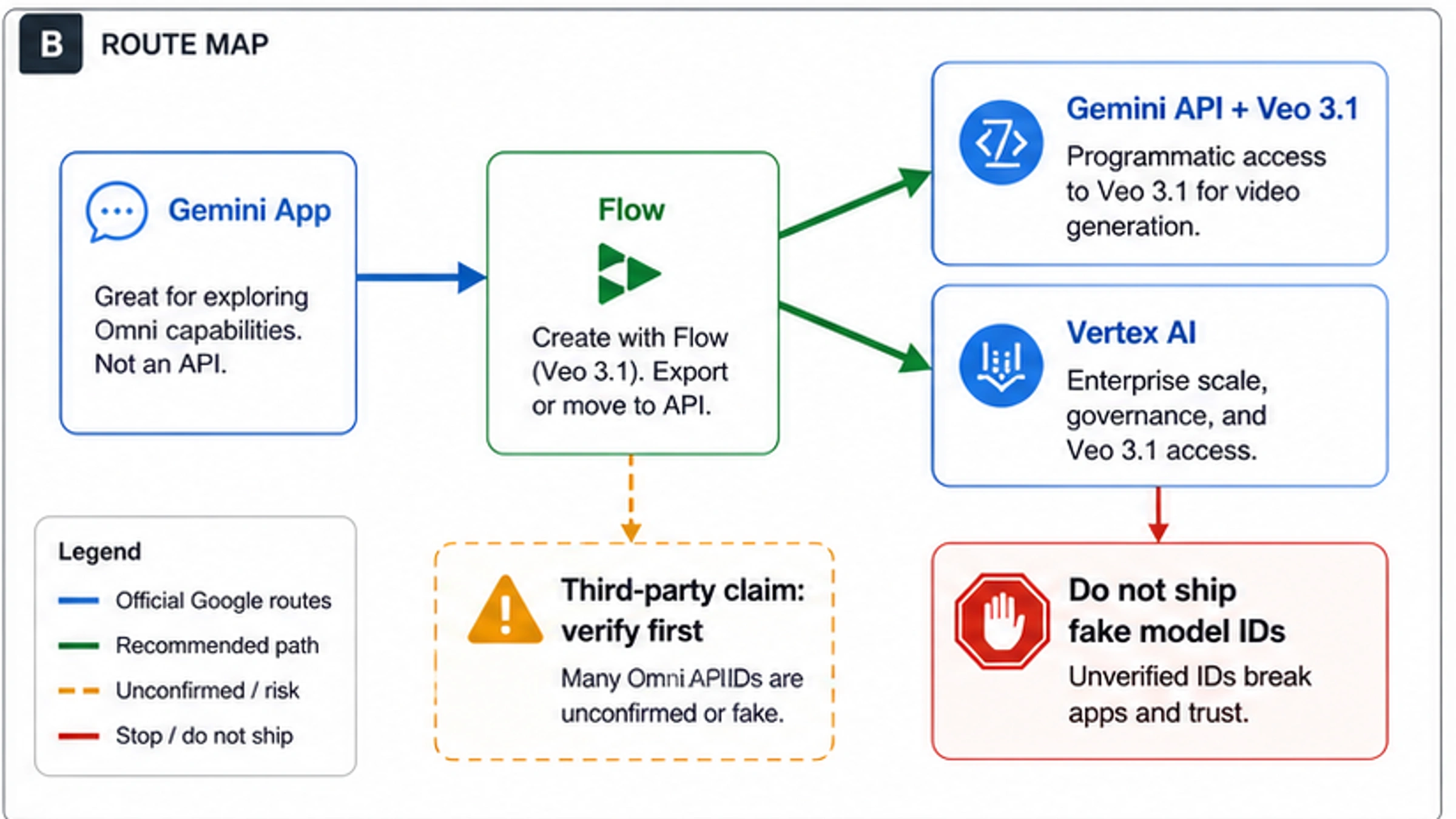
This route board is more useful than a single "better model" answer because the reader jobs are different. A creator wants to know what to open and what features to expect. A developer needs model strings, request shapes, cost rows, quotas, retry behavior, and an owner for support. A production team needs a rollback path if Google changes a preview model.
What changed with Gemini Omni
Google's Gemini app surface is no longer in the same state as the old status checks. The official Gemini page now presents Gemini Omni as a conversational video creation and editing model. It describes text, image, and video inputs; photo-to-video; video-to-video editing; multi-turn editing; avatars; SynthID-related safety notes; and access through Google AI Plus, Pro, or Ultra in markets where Gemini app is available.
The official Google announcement goes further on rollout scope. It says the first model in the Omni family is Gemini Omni Flash, that it is rolling out to Google AI Plus, Pro, and Ultra subscribers through Gemini app and Google Flow, and that developer and enterprise API rollout is coming in the following weeks. That last phrase matters: it proves Google intends API access, but it does not itself give developers a model ID, price row, request contract, or Vertex availability.
The practical consequence is a status flip with a boundary. The old answer, "there is no official Gemini Omni release," is stale. The new answer is: Gemini Omni is official for the app and creator story, but developer migration still depends on official API documentation catching up.
Why Veo still matters
Veo remains the documented developer video route. Google's Veo page still presents Veo 3.1 as a leading video generation model with native audio, text-to-video, image-to-video, and creative control surfaces. Google's developer docs still show Veo examples and model IDs for Gemini API video generation, including the current Veo 3.1 preview family.
For code, that documentation matters more than the launch headline. A production integration cannot safely use a model name because it appears in a product announcement. It needs an API path that explains input types, output handling, safety behavior, polling or long-running operations, pricing, limits, and deprecation expectations.
As of May 21, 2026, the official developer proof chain is asymmetric:
| Proof point | Gemini Omni | Veo |
|---|---|---|
| Official app or creator page | Yes | Historical app role is being replaced in Gemini app |
| Google launch announcement | Yes | Mentioned as the prior app route |
| Gemini API video docs | No public Omni row found | Veo 3.1 video docs and examples are present |
| Gemini API pricing row | No public Omni row found | Veo 3.1 pricing rows are present |
| Safe production model string | Wait | Use documented Veo IDs |
That does not mean Veo is "better" in every creative sense. It means Veo is still the deployable contract for API builders until Google's official developer surfaces publish Omni details.
Capability comparison without a fake leaderboard
Gemini Omni and Veo are not best understood as two boxes on the same scoreboard. Gemini Omni is being positioned as a conversational, multimodal creation layer inside Gemini: start from text, images, or video, then refine the result through natural language. The value is workflow control: remix, edit, preserve details, make adjustments, and keep the creative loop inside the Gemini app.
Veo is still positioned as a high-quality video generation model with developer and professional workflow surfaces. Its current public material emphasizes cinematic quality, prompt adherence, physics, audio, and controls. That makes Veo especially relevant when the reader needs reproducible API calls, price modeling, batching, project-level governance, or enterprise deployment through Google Cloud.
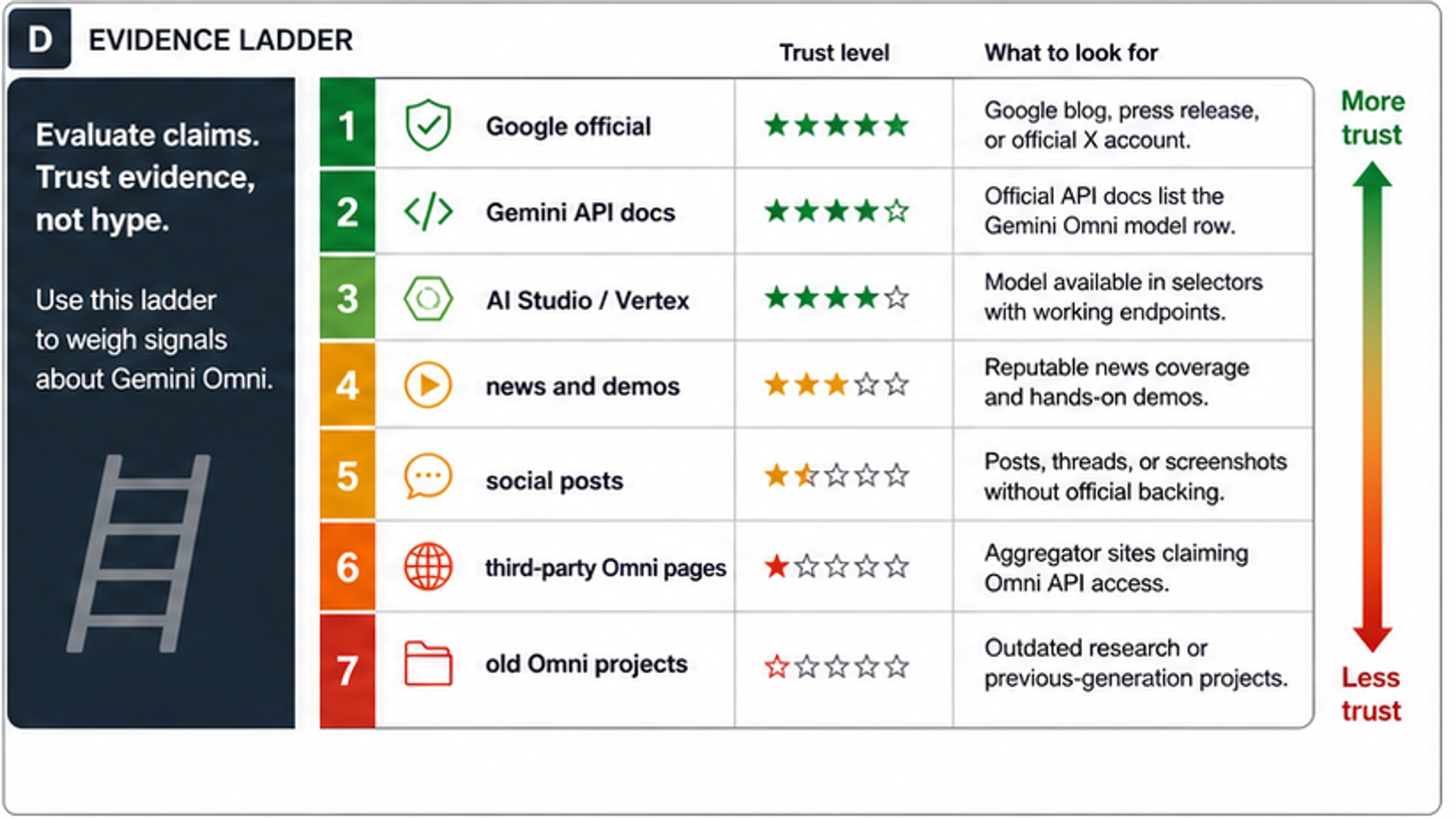
The useful comparison is therefore not "Omni beats Veo" or "Veo beats Omni." It is:
| Need | Better current reading |
|---|---|
| Natural-language video editing in Gemini app | Evaluate Gemini Omni |
| Multi-turn creator workflow around photos, video, and templates | Evaluate Gemini Omni or Flow |
| Programmatic video generation | Use documented Veo API routes |
| Cost estimate for an API product | Use Veo pricing rows until Omni pricing exists |
| Enterprise governance | Wait for Vertex or Google Cloud documentation before migrating |
| Existing Veo code | Keep it unless official Omni docs change the route |
This split also avoids a common mistake in comparison articles: treating a consumer feature rollout as if it automatically deprecates an API model. Google can replace Veo in the Gemini app while still keeping Veo as the developer-facing video model in Gemini API.
The API proof checklist
For developers, the model row matters more than the name. Do not migrate an integration to Gemini Omni until the official proof chain is visible in the surfaces your team actually uses.
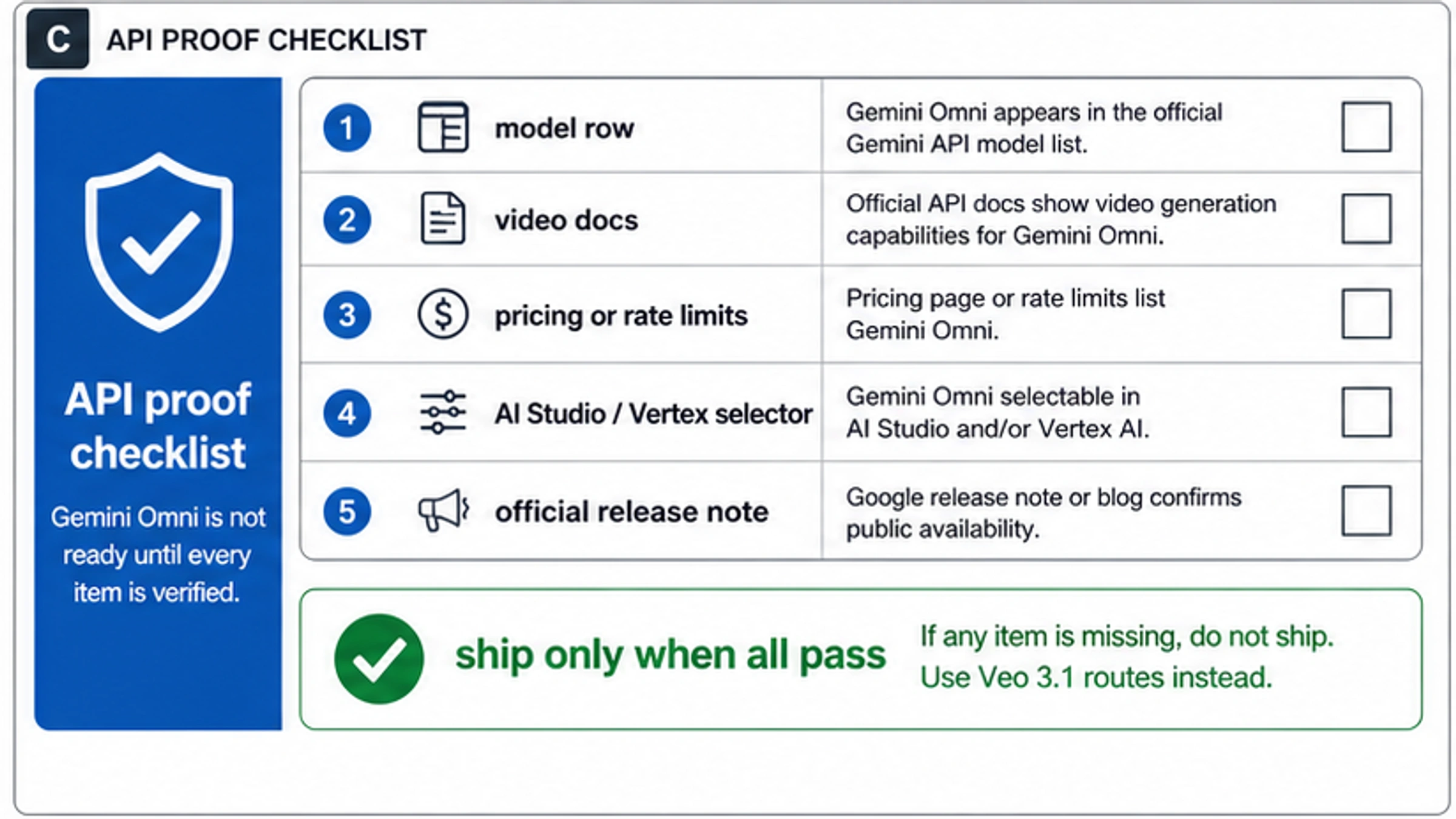
Wait for these five items before treating Gemini Omni as callable:
| Required proof | Why it matters |
|---|---|
| Model row or model documentation | Establishes the exact model string or mode name |
| Video docs or API reference | Defines request shape, supported inputs, outputs, limits, and examples |
| Pricing or quota language | Makes cost, tier, and rate-limit planning possible |
| AI Studio or Vertex visibility | Lets a real project verify access instead of trusting a headline |
| Release notes or official rollout note | Explains status, audience, regions, preview risk, and migration timing |
Missing one item is enough to stop a production tutorial. A pricing gap means cost promises are unsupported. A missing model row means code examples are guesses. Missing console visibility means a reader cannot verify access in the same route where they will build.
What app users should do
If you are using the Gemini app, the answer is direct: try Gemini Omni if your account, plan, age, country, and language surface show it. Google's page says access is tied to Google AI Plus, Pro, or Ultra in Gemini app markets, with some features varying by tier and geography. Keep that wording narrow. It should not be converted into a universal availability claim.
For video editing, Omni's promise is not just generation from a prompt. The app-facing value is conversational correction: changing wardrobe, background, lighting, stabilization, reference photos, and video-to-video edits through chat. That is why app users should not evaluate Omni only by a single output sample. The useful test is whether it reduces the number of restarts between idea, first clip, and revision.
For Flow or YouTube-linked creator routes, use the same discipline: open the official surface, check what is visible in your account, and avoid copying third-party availability claims into client work. Creator access can roll out differently from API access.
What API teams should do
If you already use Veo through Gemini API, keep the integration on documented Veo model IDs until Google's developer docs expose an Omni route. Record the checked date in your internal decision notes, because this is a fast-changing surface. The official blog says developer and enterprise APIs are coming, so stale assumptions can become wrong quickly.
The minimum safe developer plan is:
- Keep current video generation code on documented Veo IDs.
- Watch Gemini API video docs, model catalog, pricing, release notes, AI Studio, and Vertex.
- Do not add
gemini-omnior similar guessed strings to production code. - When Omni docs appear, test the same prompt set against Veo and Omni in a non-production project.
- Compare not only quality, but latency, error behavior, safety handling, cost, region availability, and deprecation language.
The same applies to teams using wrappers. A third-party service can be useful as a service, but it cannot prove Google's first-party route. If the wrapper does not show model source, billing owner, logs, privacy terms, failure handling, and exit path, it should not be placed on the critical path for customer video generation.
Where this fits beside other Gemini pages
Keep the Omni and Veo decision narrow. Broader model selection belongs elsewhere. If your decision spans text, reasoning, image, audio, and video models, use the broader Gemini 3.1 model lineup. If your problem is developer quota, billing, or free-tier interpretation, use Gemini API free tier and Google AI Studio API key setup.
Keeping those boundaries matters because Gemini product names now cross multiple surfaces. App subscription entitlements, AI Studio access, Gemini API model rows, Vertex AI deployment, and creator tools do not all update on the same day. A good answer has to name the owner surface before giving advice.
What would change this answer
The route decision should change when Google publishes official developer evidence. The strongest signals would be:
| Signal | How it would change the answer |
|---|---|
| Gemini API docs add Gemini Omni model IDs | Developers can start controlled API testing |
| Pricing page adds Omni rows | Cost modeling can move from "wait" to comparison |
| AI Studio exposes Omni for video generation | Individual projects can verify access directly |
| Vertex AI documents Omni availability | Enterprise teams can evaluate governance and deployment |
| Google explains the Omni and Veo relationship | The article can stop treating replacement scope as surface-specific |
Until those signals appear, the current rule remains simple: Omni for app and creator decisions, Veo for deployable Gemini API video generation.
FAQ
Does Gemini Omni replace Veo?
It replaces Veo in the Gemini app according to Google's Gemini video generation page. That replacement should not be stretched to every developer route. The Gemini API video docs checked on May 21, 2026 still show Veo model IDs for video generation.
Is Gemini Omni officially released?
Yes for the app and creator story. Google has official Gemini Omni pages and a launch announcement for Gemini Omni Flash. The API question is separate: public developer docs still need model IDs, pricing, and project visibility before API builders can treat Omni as callable.
Is there a Gemini Omni API model ID?
No public Gemini Omni API model row was found in the checked Gemini API video docs, model catalog, or pricing page on May 21, 2026. Use that as dated absence evidence, not a permanent claim.
Should I keep using Veo 3.1?
Use Veo 3.1 when you are building with Gemini API today. Use Gemini Omni when you are evaluating the app-facing creation and editing experience. Existing Veo integrations should not migrate until official Omni developer docs appear.
Is Gemini Omni better than Veo?
That is the wrong first question. Gemini Omni is currently the app-facing conversational creation and editing path. Veo is still the documented API video generation path. Compare them only after naming the surface and workflow.
Does Gemini Omni have pricing?
No public Omni API pricing row was found in the checked Gemini API pricing page on May 21, 2026. The same page does show Veo 3.1 pricing rows, which is another reason API teams should keep cost estimates on documented Veo routes until Omni pricing appears.
Can I use a third-party Gemini Omni API?
Treat it as a third-party service claim, not as proof of first-party Google API availability. Verify model source, logs, privacy, billing, refunds, failure handling, credential requirements, and a return path to Gemini API or Vertex before using it for real work.
What should I watch next?
Watch the Gemini API video docs, Gemini API model catalog, pricing page, release notes, AI Studio, and Vertex AI. The Google announcement says developer and enterprise API rollout is coming, so these proof points are the ones that should change the migration decision.