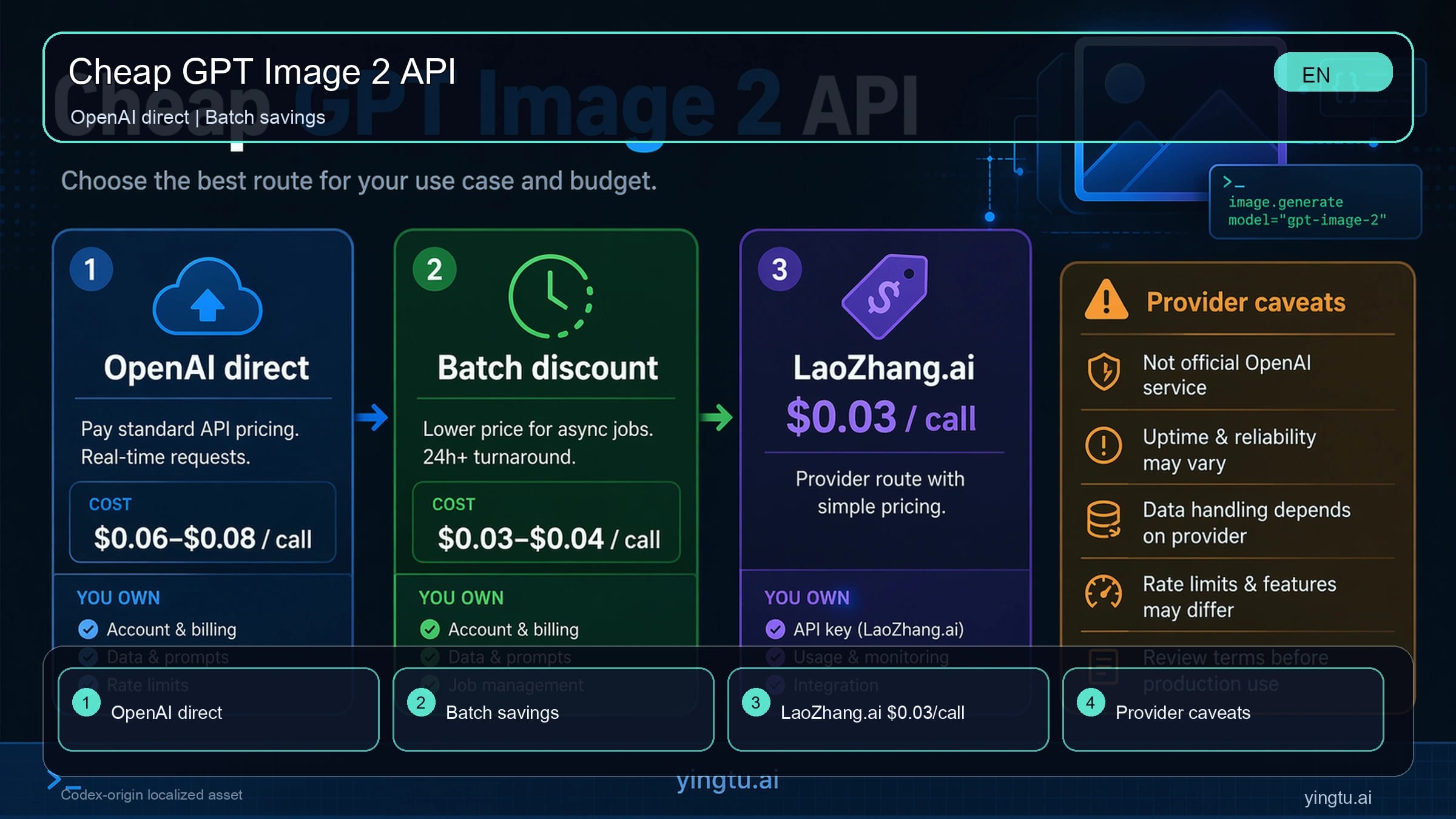
For a 3840x2160 GPT Image 2 request with explicit size and quality controls, the flat-price route to test first is LaoZhang.ai's default-group gpt-image-2-vip, documented at $0.03 per call on July 16, 2026. That provider-owned price is below Kie.ai's current $0.08 4K row, HiAPI's general $0.06 4K row, and OpenAI Standard's current output-only estimates for medium (about $0.100) and high (about $0.400) 4K output.
That does not make LaoZhang.ai universally cheapest for every 4K job. OpenAI direct low-quality 4K is about $0.011 in output tokens before input costs, and some provider-owned low-quality endpoints list below $0.03. Use LaoZhang.ai when predictable flat-call billing and a copyable 4K gateway route matter; use OpenAI direct when first-party accountability, privacy, policy, or support is the requirement.
| Route | Current 3840x2160 row | Contract boundary | Best fit |
|---|---|---|---|
LaoZhang gpt-image-2-vip | $0.03/call | Provider-owned flat call; verify the returned file and bill | Predictable medium/high 4K testing |
| Kie.ai | $0.08 | Provider-owned 4K row; quality equivalence is not stated | Playground-led alternative |
| HiAPI general route | $0.06 | Provider-owned resolution tier | Alternative general 4K route |
| Segmind | about $0.02 / $0.11 / $0.41 low/medium/high | Provider quality tiers | Low tier can undercut a flat call |
| OpenAI Standard | about $0.011 / $0.100 / $0.400 low/medium/high | Official output-only estimate; inputs extra | Official synchronous access |
| OpenAI Batch | about $0.006 / $0.050 / $0.200 | Official async output-only estimate; inputs extra | Eligible offline workloads |
Stop after the first call if the token group is not the default per-call group, the response does not contain exactly one usable 3840x2160 file, the recorded charge cannot be matched to the request, or current failure-billing and account-limit terms remain unknown. Do not scale a nominally $0.03 route until those four checks pass.
Use gpt-image-2-vip for LaoZhang.ai 4K at $0.03
The model name is the first place a cheap test can go wrong. OpenAI's official model ID is gpt-image-2, with the current snapshot identified as gpt-image-2-2026-04-21. LaoZhang.ai exposes that model through provider-owned routes, and its current GPT Image 2 documentation assigns explicit size and quality controls to the default-group alias gpt-image-2-vip. For this 4K workflow, do not substitute the default-group gpt-image-2 alias: LaoZhang documents that route without those explicit controls.
The same provider page lists both default-group aliases at $0.03 per call and says the VIP route supports common 1K, 2K, and 4K sizes with low, medium, and high quality. Its July 9, 2026 update records the restoration of size and quality on gpt-image-2-vip. Those are LaoZhang.ai contract facts, not official OpenAI price or service guarantees. Recheck them whenever the route moves from a test script into a budget or launch plan.
The $0.03 contract starts in the LaoZhang API console, not in the JSON body. Create or select a default-group per-call token before running the request. A Sora2Official or GPTImage2 Enterprise usage-billed token follows a different contract even if a model field looks familiar; those groups use model: "gpt-image-2", not the VIP alias. If the bill is not flat per call, check the token group first instead of changing only the model string.
This distinction is why LaoZhang.ai is the practical recommendation here. You get a flat price that is simple to test and an alias that makes the intended 4K controls explicit. You do not get permission to assume that every successful response is 4K, that every quality setting is equivalent across providers, or that an undocumented failure will be billed a particular way. The useful promise is narrower: send one controlled request, inspect the returned asset, and compare the recorded charge.
Send one 3840x2160 request and verify the file
Use LaoZhang.ai's documented base URL, the Image API generation path, and the VIP alias. Supply the API key as an environment variable through your normal secret-management path; the inline value below is a placeholder, not something to commit or screenshot.
hljs bashexport LAOZHANG_API_KEY="YOUR_DEFAULT_GROUP_KEY"
curl -sS https://api2.laozhang.ai/v1/images/generations \
-H "Authorization: Bearer $LAOZHANG_API_KEY" \
-H "Content-Type: application/json" \
-d '{
"model": "gpt-image-2-vip",
"prompt": "Create a wide product hero image with crisp readable detail.",
"size": "3840x2160",
"quality": "medium"
}' \
-o response.json \
-w '%{http_code}\n' > response.status
printf 'HTTP '; cat response.status
case "$(cat response.status)" in
2??) ;;
*) printf 'Request failed; inspect response.json before retrying.\n' >&2; exit 1 ;;
esac
The documented route returns the image in data[0].b64_json by default. Decode that field instead of waiting for a legacy image URL:
hljs bashpython3 - <<'PY'
import base64
import json
from pathlib import Path
payload = json.loads(Path("response.json").read_text())
items = payload.get("data") or []
if len(items) != 1:
raise RuntimeError(f"expected one output, got {len(items)}")
encoded = items[0]["b64_json"]
if encoded.startswith("data:"):
encoded = encoded.split(",", 1)[1]
encoded += "=" * ((4 - len(encoded) % 4) % 4)
Path("gpt-image-2-4k.png").write_bytes(base64.b64decode(encoded))
print("saved gpt-image-2-4k.png")
PY
Then inspect the decoded file rather than treating an HTTP 200 or a populated JSON object as proof. On macOS, the built-in command is enough:
hljs bashsips -g pixelWidth -g pixelHeight gpt-image-2-4k.png
With ImageMagick, use:
hljs bashmagick identify -format '%w x %h\n' gpt-image-2-4k.png
The expected result is 3840 x 2160. OpenAI's current image generation guide allows flexible WIDTHxHEIGHT output for GPT Image 2 when both edges are divisible by 16, the aspect ratio stays between 1:3 and 3:1, the longest edge is no more than 3840 pixels, and the total pixel count stays within the documented range. 3840x2160 fits those bounds, but output above the 2560x1440-class pixel count is still described as experimental. Validate the actual file and your workload's quality bar on every route. For the complete dimension rules and portrait equivalent, see the GPT Image 2 4K generation guide.
If response.status is outside the 2xx range, the response does not contain exactly one data item, or that item lacks b64_json, preserve both files for diagnosis and do not silently retry until something appears. A retry can change the effective cost, and a different response shape can signal that you reached a different route or contract than the one documented here.
Store response.status and response.json under the same request ID or timestamp used in the billing log so every charged retry stays traceable.
Compare 4K prices without mixing contracts
The visible numbers become useful only after four fields match: endpoint, output dimensions, quality, and billing unit. The provider pages in this paragraph were checked on July 16, 2026. LaoZhang's $0.03 is a provider-owned flat call. Kie.ai's GPT Image 2 page publishes a $0.08 4K row. HiAPI's general pricing page publishes a $0.06 4K resolution tier, while its separate image-to-image comparison publishes very different 4K low, medium, and high rows. Segmind's GPT Image 2 pricing page lists $0.02, $0.11, and $0.41 for 3840x2160 low, medium, and high, and dates those measured examples to April 22, 2026. None of those labels proves like-for-like model routing, output quality, failure treatment, or input-image cost.
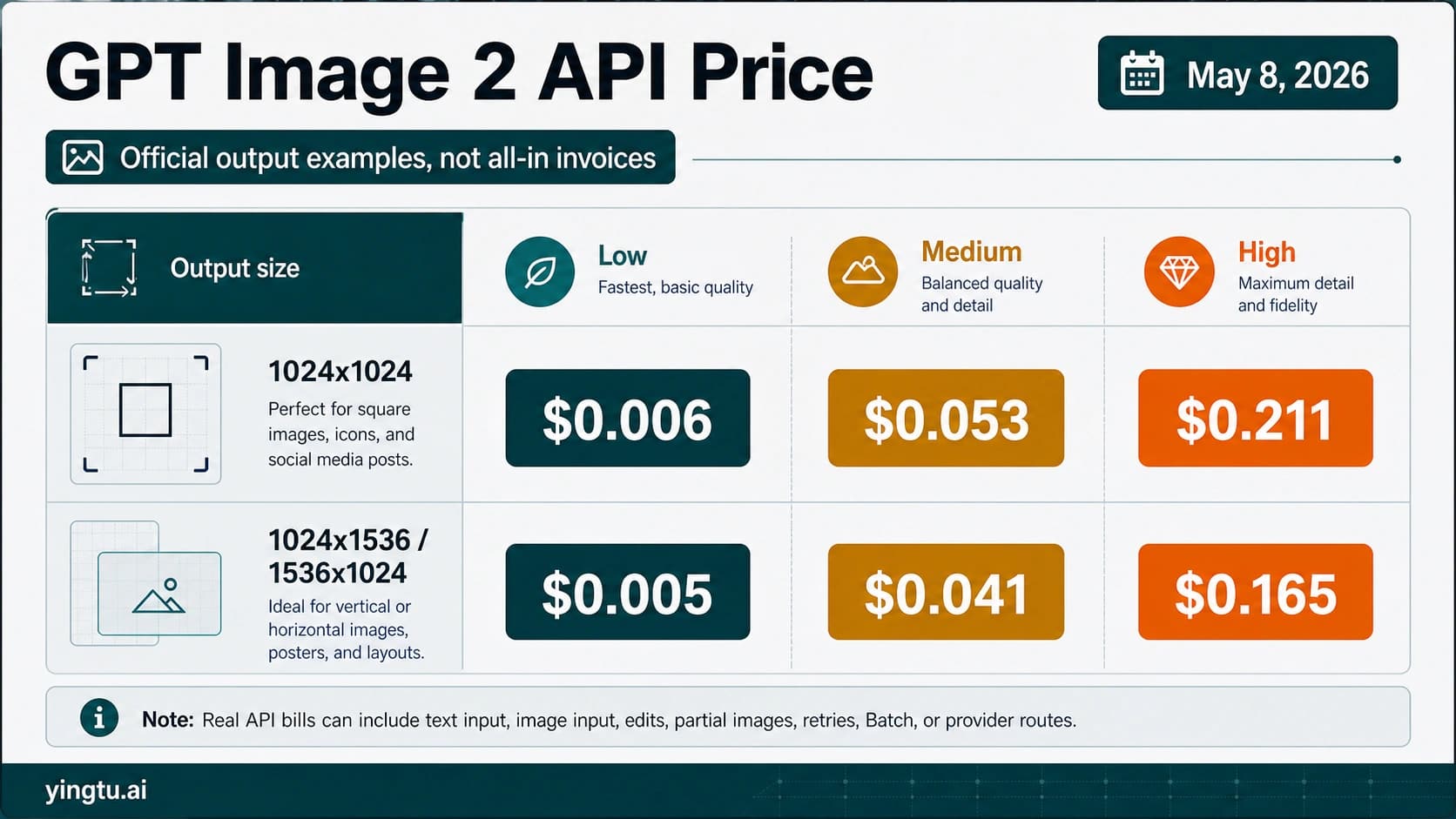
OpenAI direct is a different calculation. The official pricing page publishes GPT Image 2 Standard image output at $30 per million tokens and Batch image output at $15 per million tokens. On July 16, 2026, the official calculator returned 371, 3,336, and 13,342 output tokens for a 3840x2160 result at low, medium, and high quality. Multiplying those token counts by the output rates produces this comparison:
| Contract | Low 4K | Medium 4K | High 4K | What is still outside the row? |
|---|---|---|---|---|
LaoZhang gpt-image-2-vip | $0.03 | $0.03 | $0.03 | Provider flat-call terms, retries, and acceptance rate must be verified |
| OpenAI Standard | $0.01113 | $0.10008 | $0.40026 | Output-only estimate; prompt and edit-image inputs extra |
| OpenAI Batch | $0.005565 | $0.05004 | $0.20013 | Async, output-only estimate; inputs extra |
That table explains both sides of the verdict. LaoZhang.ai undercuts the current official medium and high output-only estimates and offers a predictable number for a synchronous gateway test. OpenAI Standard low can undercut $0.03 before inputs, and Batch can undercut it for eligible asynchronous low or medium work. A single “cheapest” badge would erase the quality and workflow choice that creates the price.
The formula also shows why $0.03 must never be described as OpenAI's official 4K price. OpenAI does not publish one fixed static 4K per-image row; the cost follows token rates, quality, dimensions, and inputs. The GPT Image 2 cost-per-image breakdown covers that official calculation in more detail. For buying decisions, keep the provider's flat call and OpenAI's output-token estimate in separate columns until a real workload supplies the missing inputs.
Calculate cost per accepted 4K output
Sticker price measures an attempt. Production economics should measure an output you can actually use. Define an accepted output before the benchmark starts: the payload decodes, the file is 3840x2160, it passes your task-specific quality review, and it satisfies any content or formatting checks your application requires.
The useful equation is:
hljs texteffective cost per accepted 4K output = total charges for all measured attempts / number of decoded 3840x2160 files that pass the quality bar
Suppose a controlled sample sends 100 LaoZhang calls and, for illustration, every attempt is charged at $0.03. The bill is $3.00. If 92 files decode at the requested dimensions and pass the same review bar, the effective cost is $3.00 / 92, or about $0.0326 per accepted output—not $0.03. This is a workload example, not a claim about LaoZhang's failure rate or failure-billing policy. Replace every assumption with the charge ledger and accepted-file count from your own test.
The same denominator must be used for competitors and OpenAI direct. If a low-quality route generates more files that fail the product's readability, composition, or edit-fidelity threshold, its lower output-token estimate may not produce the lower accepted-output cost. Conversely, if low quality is already sufficient for your job, OpenAI direct can remain below the flat provider price. The benchmark decides; the provider's headline does not.
Choose the route by workload, not by one number
LaoZhang.ai wins the first test when you need explicit 3840x2160 and quality controls, want a flat $0.03 call to budget, and are willing to validate the provider layer yourself. It is a particularly clean comparison point for medium or high 4K requests because the current official output-only estimates are materially higher. Keep the trial bounded: one prompt set, one quality setting, a recorded response, a decoded-file check, and an observed charge.
OpenAI direct wins when first-party model identity, billing, policy handling, privacy terms, support, or organizational accountability is the requirement. It can also be the lower-cost route for low-quality 4K before inputs. Use Batch when the job is eligible for asynchronous processing and the latency tradeoff is acceptable; its output-token rate is half the Standard row used above. These are contract choices, not merely alternate URLs.
A practical route matrix is:
| Workload decision | Start here | Stop or switch when… |
|---|---|---|
| Predictable 4K gateway test | LaoZhang gpt-image-2-vip | Returned dimensions, charge, quality, or provider terms do not match the job |
| Low-quality synchronous output | OpenAI Standard and one LaoZhang comparison | Inputs or acceptance rate reverse the apparent price advantage |
| Offline generation at scale | OpenAI Batch | The job needs immediate responses or is not Batch-eligible |
| Compliance-sensitive production | OpenAI direct | A reviewed provider contract explicitly satisfies the same requirements |
| Resilient multi-route system | Benchmark the primary and fallback with identical prompts | Either route cannot meet the same acceptance definition |
Do not infer that a provider is unsafe merely because it is a gateway, or that official direct is automatically the cheapest because it is first-party. The defensible decision is the one whose billing owner, technical behavior, data terms, and acceptance economics match the workload.
Run production checks before moving past testing
A successful sample proves only that one request worked. Before sending production traffic, turn the unknowns into written checks:
| Check | Record before launch | Stop condition |
|---|---|---|
| Price unit | Whether the quoted price covers an attempt, successful call, or output; how n and retries are counted | The bill cannot be reconciled with request IDs and returned outputs |
| Failure handling | Current terms for timeouts, safety refusals, malformed payloads, and upstream errors | Failure billing is material but still unknown |
| Output proof | Decoded format, width, height, output count, and acceptance result | HTTP success does not produce the requested usable file |
| Quality behavior | Prompt set, quality value, edit inputs, and human or automated review rule | Provider tiers cannot be compared against the same bar |
| Capacity | Current account limits, concurrency, queue behavior, and retry policy | Required throughput depends on unverified limits |
| Data handling | Prompt and image logging, retention, deletion, and subprocessors | The route conflicts with the application's data policy |
| Support | Incident contact, escalation path, model-change notice, and billing dispute process | The team cannot resolve a production-impacting mismatch |
| Fallback | Equivalent request mapping and acceptance test on the backup route | Switching routes changes the workload contract without detection |
Do not fill missing rows with assumptions such as guaranteed uptime, unlimited throughput, automatic refunds, or uncharged failures. LaoZhang's public model page is enough to support the alias, controls, base URL, response field, and current provider price used in this test. Terms that affect production should come from the current dashboard, contract, or support response available to your account.
The final pre-launch test should be deliberately boring: send the same fixed prompt set through the intended primary and fallback routes, decode every response, verify dimensions, apply one acceptance rubric, reconcile charges, and save the results with a date. If the $0.03 route still wins on accepted-output cost and the provider terms meet the workload, the recommendation has survived contact with production reality.
FAQ
What is the cheapest GPT Image 2 4K API for a predictable flat call?
For an explicit 3840x2160 request with size and quality controls, LaoZhang.ai's default-group gpt-image-2-vip is the flat route to test at its provider-owned $0.03/call price checked July 16, 2026. It is not the lowest number for every quality tier: OpenAI direct low and some provider low-quality endpoints can cost less.
Why does LaoZhang 4K use gpt-image-2-vip?
LaoZhang's current documentation assigns common 1K, 2K, and 4K sizes plus low, medium, and high controls to gpt-image-2-vip. Its default-group gpt-image-2 route does not own the explicit size-and-quality example, so using it in a 4K test can leave the core request contract ambiguous.
Is $0.03 the official OpenAI GPT Image 2 price?
No. $0.03/call is LaoZhang.ai provider pricing. OpenAI direct prices GPT Image 2 with input and output token rates, and the 4K figures above are output-only estimates calculated from the official token counts and rates.
Can OpenAI direct cost less than $0.03 at 4K?
Yes. The current 3840x2160 low-quality output estimate is about $0.01113 on Standard before input costs, or about $0.005565 on eligible Batch work. Medium and high output-only estimates are higher. Compare the completed request bill and accepted-output rate, not the output row alone.
How do I verify that a returned image is really 3840x2160?
Decode data[0].b64_json into an image file, then inspect the file with sips, ImageMagick, or your image library. Require both 3840 width and 2160 height before accepting it. A successful HTTP status or non-empty base64 field is not a dimension check.
Is GPT Image 2 available on the official API Free tier?
OpenAI's current model page lists the API Free tier as unsupported for GPT Image 2. That is separate from ChatGPT product access and from provider trial offers. See the GPT Image 2 API free-tier guide for the current boundary.
When should production use OpenAI direct instead?
Choose OpenAI direct when first-party billing, policy, privacy, support, or organizational accountability is required, or when low-quality direct pricing wins your benchmark. Choose LaoZhang.ai when its flat $0.03 gateway contract, output behavior verified by your benchmark, and current provider terms better fit the workload. Keep a fallback only after both routes pass the same acceptance test.