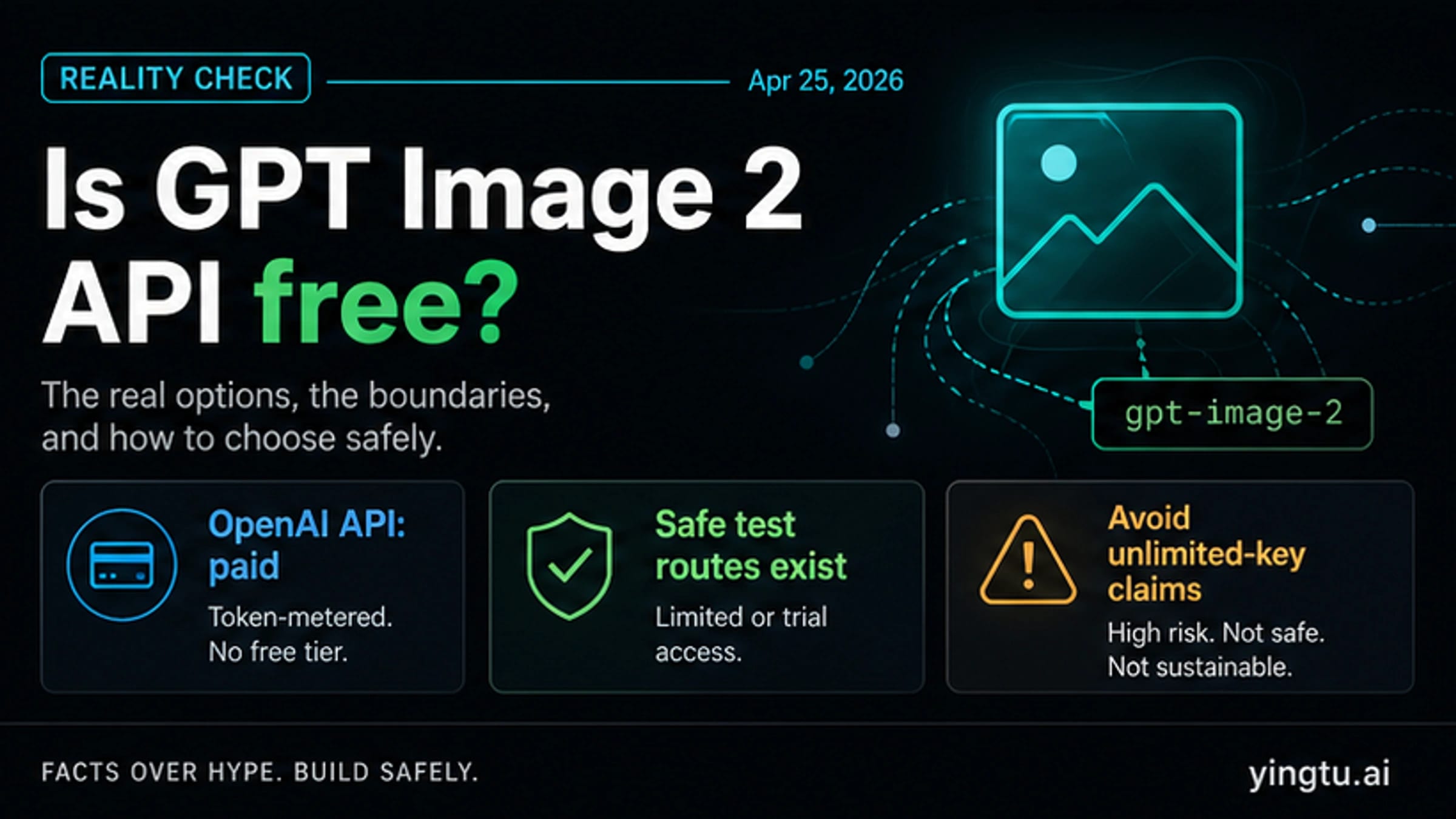
As of April 25, 2026, gpt-image-2 does not have a supported official OpenAI API Free tier. A page that says "free GPT Image 2 API" is usually talking about a different route: a ChatGPT app quota, a browser playground, a provider trial credit, a user-pays SDK, or a wrapper whose owner and terms you still have to verify.
| Route people call free | Who owns it | Who pays | Use it for | Verify before trusting |
|---|---|---|---|---|
| Official OpenAI API | OpenAI | Your API billing account | Production API work | Model ID, pricing surface, org/billing status |
| ChatGPT app image access | OpenAI consumer app | App quota or plan | Trying the product, not backend API calls | Whether it gives API credentials, usually it does not |
yingtu.ai browser test | YingTu | Playground/provider route | Quick prompt and output testing before paid integration | Current model, limits, terms, and whether you need API control |
| Provider trial credit | Third-party provider | Trial credit first, paid account later | Short evaluation | Renewal, price unit, data terms, failure billing, support |
| User-pays SDK | SDK/platform owner plus each user | End user at runtime | Apps where users bring their own session or payment | User consent, abuse controls, rate limits, privacy |
| No-login or shared-key wrapper | Unclear owner | Unknown | Usually reject | Owner, limits, logs, key handling, rights, support path |
The safe rule is simple: if the route does not show who owns the key, who pays after the free action, what limit applies, what terms cover prompts and outputs, and how failures are supported, do not use it for production. If your real question is the cheapest paid way to call GPT Image 2, treat that as a separate provider-cost decision rather than proof that the official API is free.
The official OpenAI API answer
OpenAI's official model ID is gpt-image-2. The current GPT Image 2 model page identifies the model and places it on OpenAI's API surface for image generation and editing. The important free-tier boundary is just as direct: the official model page lists Free as not supported for gpt-image-2. That makes the first decision simple. Do not plan a backend product around a free official OpenAI GPT Image 2 API entitlement.
OpenAI's image generation documentation describes two first-party ways to use GPT Image models: direct image generation/editing through image endpoints, and image generation as a tool inside broader Responses workflows. Those routes can be the right choice for production because OpenAI owns the model contract, billing surface, supported parameters, and account requirements. They are not the same thing as a free playground.
Pricing is also a contract clue. OpenAI's public pricing is token, quality, size, and input dependent, not a flat "free image API" promise. A low-quality small request, a high-quality image, an edit that includes image input, and a multi-step workflow can all have different costs. If a page reduces the official API to "free GPT Image 2 API" without naming billing, size, quality, and account state, it is not describing the first-party OpenAI contract accurately.
Why the free label creates confusion
The word "free" hides at least six different meanings. It can mean no extra charge inside a consumer app quota, a limited provider trial, a browser demo, a developer-free user-pays SDK, a marketing landing page that wants sign-ups, or a risky wrapper that is hiding the real key owner. Those are not interchangeable.
The official API question is about backend entitlement: can your server call gpt-image-2 through OpenAI without a paid API billing relationship? The answer is no. A ChatGPT image action solves a different problem: a person can try image generation inside an app experience, but that does not normally give a developer API key, webhook, retry logic, logs, or production control.
A provider credit can be useful, but it is provider-owned. The provider decides the credit amount, renewal, price unit, failure charging, default quality, rate limit, and data terms. A user-pays route can also be legitimate for a certain app design, but it is "free" only for the developer's server bill. The user still pays through their own account, session, quota, or platform balance.
The riskiest route is the no-login or shared-key wrapper. If a site promises unlimited access without showing the owner, key handling, billing trigger, data terms, and support path, treat it as a stop sign. The phrase "free API" does not remove privacy, abuse, or reliability risk.
ChatGPT app access is not API credit
ChatGPT image access and OpenAI API access share model branding, but they serve different jobs. ChatGPT is a consumer app surface where a user creates or edits images inside the app experience. The API is a developer surface where an application sends requests, receives outputs, handles failures, logs usage, and pays through an API account.
That distinction matters because many readers ask "is GPT Image 2 free?" after seeing image generation inside ChatGPT. App access can help you understand product behavior, prompt style, and expected output quality. It does not prove that your backend can call gpt-image-2 for free, and it does not replace API-specific decisions such as endpoint choice, billing, rate limits, data handling, retries, or output storage.
Use ChatGPT app access when the task is personal testing or creative exploration. Use the official OpenAI API when the task is product integration. If a workflow needs user-facing image generation inside your own app, test the actual API route before you commit the product promise. App success is not the same as deployable API capacity.
What counts as a safe test route
A safe test route has a visible owner, a visible payer, a bounded trial or cost model, and enough terms for the risk you are taking. It does not need to be perfect for production on day one. It does need to tell you what happens after the free action ends.
yingtu.ai can fit the browser-test job when you only need to validate a prompt, compare output behavior, or show a non-engineer what GPT Image 2 style output might look like before you spend time on API integration. Keep the boundary clear: a browser test route is not official OpenAI API credit. If the test proves the idea is worth building, the next decision is whether to use direct OpenAI, a verified provider route, or a separate low-cost provider comparison.
Provider marketplaces can also be useful for short evaluation. Some offer trial credits, playgrounds, bring-your-own-key modes, or simplified API endpoints. The correct question is not "is this free?" The better question is "free until what event, under whose terms, with what billing unit, and with what support path?"
User-pays SDKs need their own label. They can be attractive for apps that do not want to hold a central API bill, but they shift responsibility to the end user. That can be a valid design, but it should be explicit in the user experience, privacy language, and abuse controls. A developer-free route can still be paid, limited, or risky for the user.
A quick verification sequence
Before using any free-labeled GPT Image 2 route, run the same five checks.
First, confirm the model name. If the route does not name gpt-image-2, you may be testing a different image model, an older model, or a wrapper that maps your request silently.
Second, identify the payer. For the official OpenAI API, your API account pays. For ChatGPT app access, the user is inside an app quota or plan. For a provider credit, the provider is subsidizing a bounded trial. For user-pays, the user pays at runtime. For unclear wrappers, you often cannot tell, which is the problem.
Third, test one complete image path. A route that can show an image in a browser may not give you the API features your product needs: programmatic calls, error handling, predictable output count, storage, edits, or a route you can monitor.
Fourth, read the terms that match your risk. A casual prompt test needs less diligence than a product that sends user images, stores outputs, or uses generated images in a paid workflow. The higher the risk, the more you need to know about logs, retention, rights, moderation, refunds, and support.
Fifth, write down the checked date. Model availability, provider credits, pricing, and limits can change quickly. A claim that was true during a launch week can be stale by the time your product ships.
When to choose official OpenAI, YingTu, or a provider
Use the official OpenAI API first when you need first-party billing, official documentation, direct support expectations, and a clean production contract. That is the right default for teams building customer-facing image features, regulated workflows, internal tools with audit needs, or systems where support ownership matters more than the cheapest test.
Use yingtu.ai first when the job is a quick browser test. That can save time when the real question is "does this prompt or image workflow deserve an API build?" It is especially useful before asking engineers to wire up keys, logs, storage, and retries. Keep the recommendation proportional: use it to test and compare, not to claim a free official API entitlement.
Use a provider trial when you need to compare access, latency, output behavior, or billing shape across routes. A provider can be a useful evaluation route if it documents limits and terms clearly. It becomes production-risky when the provider hides failure charging, data handling, support, or fallback options.
Use a user-pays SDK only when your product design intentionally lets each user bring their own account, session, quota, or payment relationship. That route can reduce your central API bill, but it changes onboarding, abuse prevention, support, and privacy expectations.
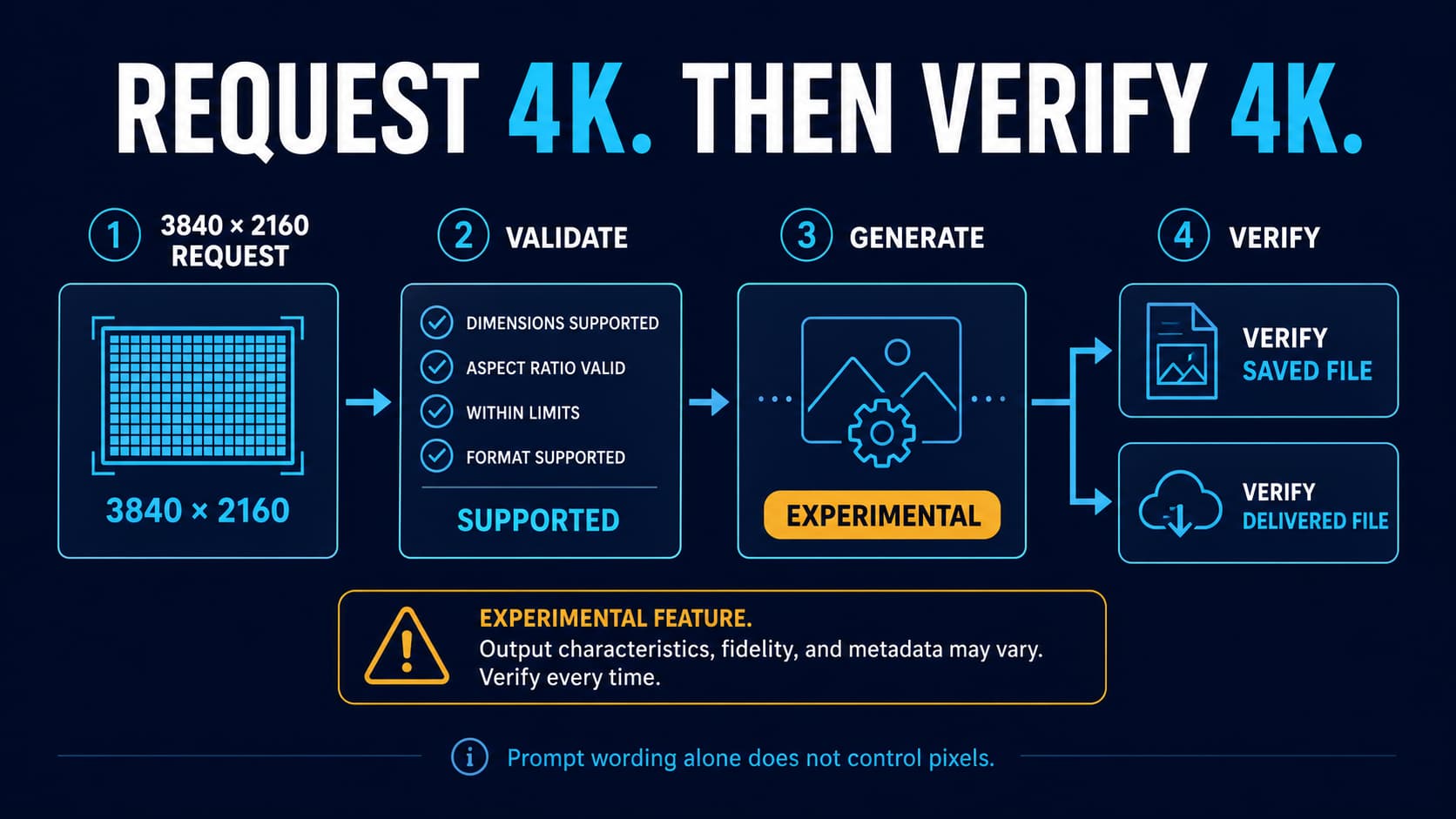
If the next question is "what is the cheapest paid GPT Image 2 API route?" move to the sibling cost guide for cheap GPT Image 2 API options. If the next question is output resolution, size control, or 4K generation, use the GPT Image 2 4K API size guide. Keeping those jobs separate prevents a free-tier article from turning into a price catalog.
Production stop rules
The stop rules are stricter than the test rules. Do not ship a free-labeled route in production if you cannot identify the key owner, billing trigger, route limit, support owner, data terms, and fallback plan. A route can be good enough for a demo and still be wrong for production.
Reject unlimited claims by default. "Unlimited free GPT Image 2 API" is not a production contract unless the owner explains who pays, what abuse controls exist, what happens under load, and what support path exists when requests fail. The more generous the promise sounds, the more concrete the proof needs to be.
Reject shared-key flows for real user data. If you do not know whose key is being used, how prompts and outputs are logged, or whether users have consented to the route, the risk is not only cost. It can become privacy, security, rights, and support risk.
Reject any route that cannot describe failures. Image generation can fail because of safety filters, timeouts, input issues, capacity, account readiness, or unsupported settings. A production route needs to say whether failed, blocked, retried, or partial requests are charged and how the system reports them.
FAQ
Is there an official free GPT Image 2 API key?
No. Do not plan around an official free OpenAI API key for gpt-image-2. Use official OpenAI API access when you need a production API route, and treat free-labeled alternatives as separate route contracts.
Does ChatGPT Free give me GPT Image 2 API access?
No. ChatGPT app access and API access are different surfaces. App-side image access can help a user test the product, but it does not normally create backend API credit for a developer.
Can I test GPT Image 2 without paying OpenAI API costs first?
Yes, but call it a test route rather than official free API access. A browser playground such as yingtu.ai, a provider trial credit, or a user-pays route can help with evaluation when the owner, limit, payer, and terms are clear.
Is a provider credit safe for production?
Not by itself. A provider credit is useful for evaluation, but production use needs price-unit clarity, failure billing, rate limits, data terms, support, and fallback planning.
Is a user-pays SDK really free?
It can be free for the developer's server bill, but not necessarily free for the user. The user may pay through their own account, balance, session, or quota, so the product should make that contract clear.
Are no-login GPT Image 2 sites safe?
Only if they disclose the route owner, key handling, limits, billing trigger, data terms, and support path. If those pieces are missing, do not use the route for production or sensitive prompts.
What should I use if I need the cheapest paid API route?
Use the free-tier answer here to reject unsafe routes, then compare paid provider options separately. The sibling cheap GPT Image 2 API guide covers low-cost paid routes without pretending they are official free API access.