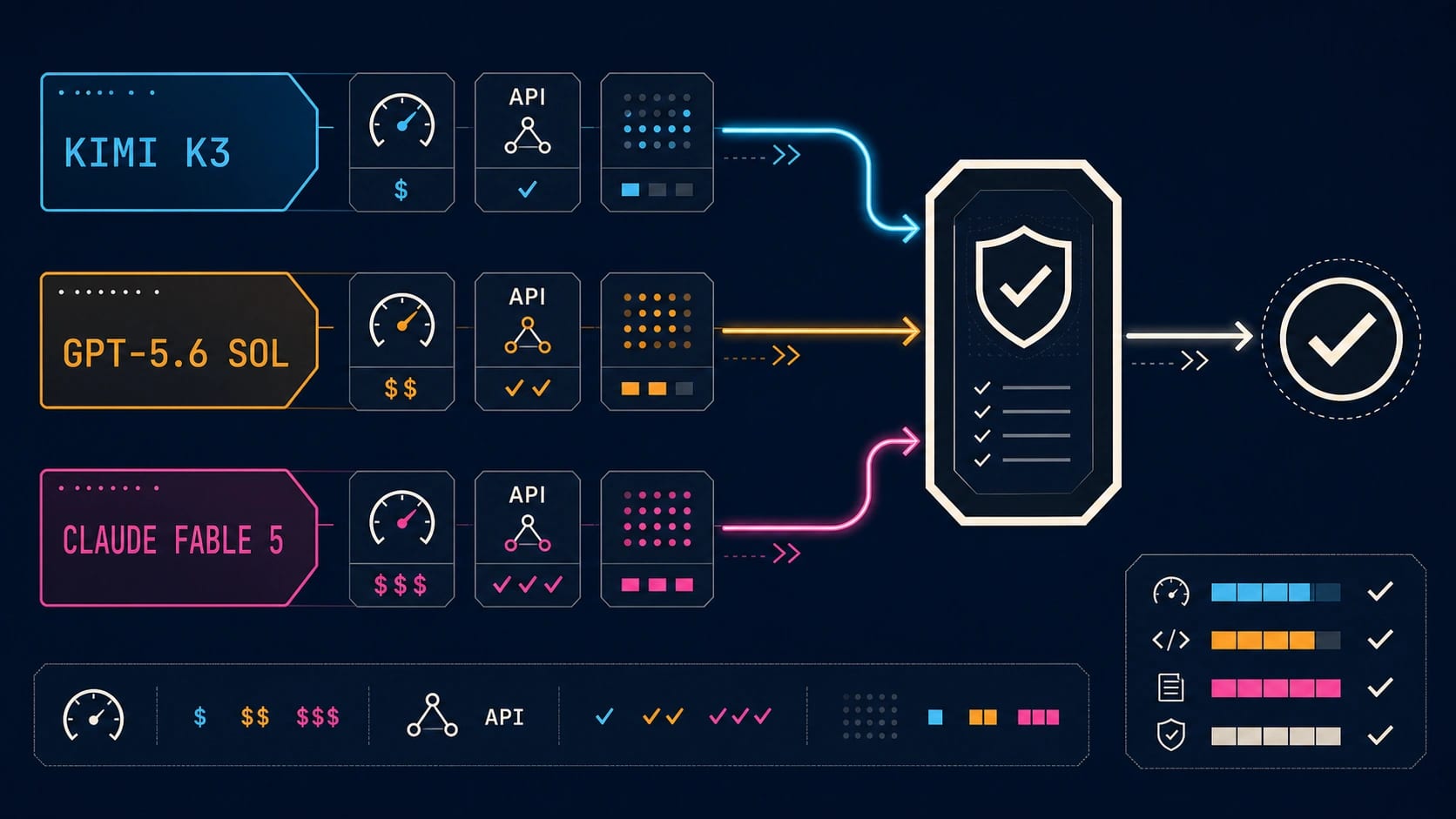
Start with Kimi K3 when cost headroom matters most, GPT-5.6 Sol when you want a balanced tool-integrated default, and Claude Fable 5 when the hardest long-horizon tasks can justify a premium.
As of July 17, 2026, the K3 API is live, but Kimi says its downloadable weights are scheduled for July 27 rather than available today. The gpt-5.6 API alias currently routes to gpt-5.6-sol.
| Your priority | Test first | Why this is the sensible starting lane | Stop condition |
|---|---|---|---|
| Maximum cost headroom | Kimi K3 | The lowest current list price of the three and a planned open-weight route | Do not promote it until it passes the same workload; recheck weight availability after July 27 |
| Balanced production default | GPT-5.6 Sol | A strong current capability-and-tooling balance for coding and agentic work | Track the whole-request price multiplier above 272K input tokens |
| Hardest long-horizon work | Claude Fable 5 | Premium headroom when difficult tasks are worth more compute and review budget | Require enough accepted-task gain to cover its premium, and validate refusal, fallback, and retention behavior |
Do not read the launch benchmark rows as one neutral leaderboard: agent harness, effort, fallback, and test setup change what each number represents. Freeze the same repository, prompts, tools, budget, tests, and review threshold, then count retries, latency, review time, and failures. Promote the cheapest model that passes that acceptance test, escalate only when a harder task justifies it, and keep a rollback path.
Compare the Current Contracts Before the Scores
These models overlap on long-context coding and agentic work, but they are not interchangeable endpoints. Price, output ceilings, tool surfaces, fallback behavior, data retention, and future self-hosting all change the production decision. The table below keeps those contracts dated and attached to the vendor that owns them.
| Model and direct API ID | Price per 1M tokens checked July 17, 2026 | Context and output | Current access | Operational caveat |
|---|---|---|---|---|
Kimi K3, kimi-k3 | $0.30 cache-hit input, $3 cache-miss input, $15 output | 1M context; confirm the endpoint's current output limit before setting a production cap | Kimi API, Kimi, Kimi Work, and Kimi Code | Weights are scheduled for July 27; they are not downloadable on July 17 |
GPT-5.6 Sol, gpt-5.6-sol | $5 input, $0.50 cached input, $30 output | 1.05M context, 128K maximum output | OpenAI API plus eligible ChatGPT and Codex surfaces | More than 272K input tokens makes the whole request 2x input and 1.5x output price; cache writes cost 1.25x uncached input |
Claude Fable 5, claude-fable-5 | $10 input, $50 output | 1M context, up to 128K output | Anthropic API after its July 1 redeployment | Adaptive thinking is always on; refusal, fallback, 30-day retention, and no-ZDR status need an explicit production decision |
The current facts come from Kimi's K3 launch page, OpenAI's Sol model documentation, and Anthropic's Fable documentation. Prices are direct-API list prices, not consumer subscription allowances and not third-party router prices.
K3 has the largest raw price cushion. A workload that uses 100,000 uncached input tokens and 20,000 output tokens costs $0.60 at its current list rates, compared with $1.10 on Sol and $2.00 on Fable before caching, tools, retries, and review. That is a useful reason to test K3—not proof that it is cheaper after failed patches or repeated agent loops.
Sol occupies the middle price lane, but its long-context economics have a cliff. A prompt at 270K and one at 275K are close in size yet belong to different price regimes. If a coding agent repeatedly sends the full repository, tool transcript, or generated files back into the prompt, measure input-token percentiles rather than relying on the nominal 1.05M context window.
Fable has the highest list price and the most distinct operational contract. Anthropic says some requests may return HTTP 200 with stop_reason: refusal, and its fallback options can change which model completes a request. Anthropic also states that Fable and Mythos traffic has 30-day retention and is not eligible for zero data retention. Those are routing inputs for regulated or sensitive workloads, not footnotes to discover after migration.
Match the First Test to the Workload
Choose Kimi K3 first when exploration volume and price headroom dominate. It is the sensible starting lane for repository triage, repeated implementation candidates, frontend iterations, and other work where you can afford to reject a weak result but cannot afford a frontier-priced attempt every time. K3's planned weights also create a future self-hosting question. Until the files, license, serving requirements, and actual availability are verified after July 27, however, that is a future option rather than today's deployment route.
K3 should stop being the default experiment when its lower list price is consumed by extra retries, larger outputs, review burden, or unreliable tool use. A cheap attempt that leaves a reviewer reconstructing the intended patch is not an accepted task. Move to Sol when the balanced lane clears the same acceptance bar with materially less recovery work.
Choose GPT-5.6 Sol first when you need a neutral production baseline. OpenAI positions Sol as the flagship GPT-5.6 tier, and the API model page exposes a current tool surface beside the long context and 128K output ceiling. For teams already evaluating through Codex, that matters because an agentic result belongs partly to the model and partly to the harness that selects files, calls tools, manages context, and verifies changes.
Sol is not automatically the best value. Its price sits above K3, long prompts cross a whole-request multiplier, and reasoning or tool loops can enlarge the bill. It earns the balanced-default role only when its accepted-task rate, review time, and operational fit beat the cheaper lane by enough to cover that difference.
Choose Claude Fable 5 as an escalation lane for the hardest work. Long-horizon repository changes, ambiguous debugging, cross-file refactors, and tasks where a single wrong architectural decision costs hours are plausible candidates. The premium is justified only when Fable rescues tasks that the cheaper routes fail, reduces expensive reviewer time, or prevents costly rollback.
Keep Fable's fallback configuration visible in the result. If a benchmark or production route can fall back to another Claude model, record both the requested model and the model that actually completed the task. A fallback-assisted success is operationally useful, but it is not evidence that pure Fable produced the result by itself.
Why the Benchmark Winner Changes
A coding benchmark score is rarely just a property of a model. It is better read as:
observed result = model + agent harness + effort or token budget + tools + fallback policy + test setup
Kimi's launch table is unusually useful because its footnotes expose this problem. K3 appears with KimiCode on some coding evaluations, Fable appears with Claude Code or Terminus and sometimes fallback, and Sol appears with Codex. Selected rows also produce different winners:
| Vendor-published row | Kimi K3 | Claude Fable 5 | GPT-5.6 Sol | Decision lesson |
|---|---|---|---|---|
| DeepSWE | 67.5 | 70.0 | 73.0 | Sol leads this stack and task definition |
| Program Bench | 77.8 | 76.8 | 77.6 | K3 narrowly leads; the gap is too small to ignore setup variance |
| Terminal Bench 2.1 | 88.3 | 84.6 | 88.8 | Sol and K3 are close while Fable trails in the shown setup |
| FrontierSWE | 81.2 | 86.6 | 71.3 | Fable leads materially on this row |
| BrowseComp | 91.2 | 88.0 | 90.4 | K3 leads the displayed result |
These are Kimi-published comparisons, so Kimi owns the table and its caveats. The rows are evidence that workload and stack change the outcome; they are not a neutral declaration that one model wins overall.
An independent composite snapshot gives a second view, but it still needs configuration labels. On July 17, 2026, Artificial Analysis displayed K3 at 57 on its Intelligence Index v4.1, Sol Max at 59, and Fable at 60 in an “Adaptive Reasoning, Max Effort, Opus 4.8 Fallback” configuration. The same pages showed different speed, token-use, and evaluation-cost profiles:
| Artificial Analysis snapshot | Index score | Output speed | Index output tokens | Full-index evaluation cost |
|---|---|---|---|---|
| Kimi K3 | 57 | 62.0 tokens/s | 130M | $2,690.80 |
| GPT-5.6 Sol Max | 59 | 52.4 tokens/s | 70M | $2,824.18 |
| Claude Fable 5 with stated fallback | 60 | 66.1 tokens/s | 87M | $5,630.52 |
The one-point gaps are less actionable than the configuration and cost differences. Fable's displayed score includes fallback. Sol's coding-agent result is tied to the Codex harness. K3 used more output tokens across this evaluation than either comparator. None of those observations predicts what will happen in your repository without a controlled local test.
Calculate Cost per Accepted Task
Token price is only the first line of the cost model. An accepted task is an output that passes the automated checks and the team's review threshold. A useful worksheet is:
accepted-task cost = (API + tools + infrastructure per attempt) / acceptance rate + reviewer time + expected failure recovery
The acceptance rate must come from the same task set. Do not compare K3's easy-task rate with Fable's hard-task rate, or a cached Sol run with uncached alternatives. Include retries even when the provider does not bill a failed request, because tools, queue time, engineer attention, and fallback traffic can still have costs.
Consider a hypothetical task using 100K uncached input tokens and 20K output tokens. The direct list-price attempt is $0.60 on K3, $1.10 on Sol, and $2.00 on Fable. Now assume—not measure—that the same task set produces 80%, 90%, and 94% accepted results respectively, while review takes eight, six, and five minutes at an internal loaded rate of $60 per hour.
| Hypothetical worksheet | API cost per accepted task | Review cost | Combined cost before failure recovery |
|---|---|---|---|
| Kimi K3 | $0.60 / 0.80 = $0.75 | $8.00 | $8.75 |
| GPT-5.6 Sol | $1.10 / 0.90 = $1.22 | $6.00 | $7.22 |
| Claude Fable 5 | $2.00 / 0.94 = $2.13 | $5.00 | $7.13 |
This example is deliberately hypothetical. It does not claim those models achieve those rates. Its purpose is to show how a low token price can lose after acceptance and review are counted—and how a premium model can still lose if its measured quality gain is smaller than the assumed one. Replace every rate and time with your own evaluation data.
For broader provider prices, batch discounts, router fees, and monthly cost planning, use the LLM API pricing comparison. The K3–Sol–Fable choice remains a narrower workload decision.
Run a Same-Repository Evaluation
Before migration, freeze the workload so the model is the variable. A useful evaluation can be small, but it must cover enough task shapes to expose where each lane breaks.
- Select 30–50 representative tasks from one pinned repository commit. Include routine edits, cross-file changes, bug diagnosis, tool failures, long-context cases, and a few tasks that previously required senior review.
- Use the same system instructions, tool permissions, network policy, sandbox, timeouts, and repository state for every model. Record the agent harness and version.
- Give each route a documented effort or token budget. If adaptive thinking, max effort, or fallback is enabled, label it in the result instead of collapsing it into the model name.
- Define acceptance before execution: build, tests, lint, type checks, security checks, task-specific assertions, allowed file scope, and a reviewer rubric.
- Blind the human review where practical. Record accepted result, retry count, input and output tokens, wall-clock latency, tool failures, review minutes, and rollback-worthy regressions.
- Re-run a stable subset on another day. Launch-week capacity and routing behavior can distort a one-hour snapshot.
Do not tune each model until it wins a separate benchmark. You may need model-specific settings for a fair production configuration, but every exception should be written down: reasoning effort, context trimming, prompt additions, fallback, and retry policy. Otherwise the final choice cannot be reproduced.
The evaluation should answer four questions separately:
- Which model passes the ordinary workload at the lowest accepted-task cost?
- Which model rescues the hardest tasks that the default route fails?
- Which failures are model problems, and which belong to the harness or tool environment?
- Which operational contract—price cliff, fallback, refusal, retention, or future self-hosting—changes the deployment boundary?
If you are migrating an older Kimi integration, the Kimi K2 API model guide owns the older model-ID and route transition details. Do not mix that migration with the K3-versus-frontier evaluation itself.
Promote, Escalate, or Roll Back
Turn the results into a routing policy rather than a one-time winner announcement. The exact thresholds belong to your product, but the following pattern is a practical starting point.
Promote K3 for the ordinary lane when it has no critical regression, stays within an agreed acceptance-rate margin of Sol, and delivers a meaningful accepted-task saving after retries and review. Keep Sol or Fable available for tasks that exceed that lane's complexity threshold.
Keep Sol as the default when it materially improves acceptance or review time over K3, the tooling path is stable, and the gain survives the long-context price multiplier. Escalate individual hard tasks instead of paying the Fable premium across all traffic.
Use Fable as a premium escalation when it rescues a defined class of failures or cuts enough senior-review time to cover its direct price and operational constraints. Record whether fallback was used. For retention-sensitive traffic, the current 30-day and no-ZDR boundary may be a stop condition regardless of quality.
Hold the migration when score differences do not repeat, configuration is not comparable, or the apparent winner creates a new failure mode. A tie with uncertain operations is not a reason to move production.
Roll back when critical regressions rise above the agreed limit, accepted-task cost exceeds the baseline, p95 latency breaks the service budget, tool failures cluster, or a retention/fallback behavior violates policy. Keep the old route and evaluation corpus intact until the new model survives a monitored production slice.
K3 needs one additional checkpoint after July 27, 2026. Verify that the weights are actually published, inspect the license, quantify memory and serving requirements, and re-run the same workload on the intended inference stack. A downloadable model can produce very different latency and cost from Kimi's hosted API, so “weights available” is the start of a self-hosting evaluation, not its conclusion.
Frequently Asked Questions
Is Kimi K3 better than Claude Fable 5 and GPT-5.6 Sol overall?
No. K3 has the lowest current direct-API list price and leads some Kimi-published rows, while Sol and Fable lead others. Harness, effort, fallback, token use, and workload change the result. Treat K3 as the economical first test, then promote it only if it passes the same acceptance set.
Are Kimi K3 weights available for self-hosting now?
Not as of July 17, 2026. Kimi says full weights are scheduled for July 27. Recheck the official page and repository after that date; then inspect the license and serving requirements before calling it a production self-hosting option.
When is Claude Fable 5 worth the premium?
When measured gains on hard, long-horizon tasks reduce failures, retries, or senior-review time enough to cover $10-per-million input and $50-per-million output pricing—and when its fallback, refusal, 30-day retention, and no-ZDR boundaries fit the workload.
Is GPT-5.6 Sol the best value of the three?
It is the strongest balanced starting point for many teams, especially when Codex or OpenAI's tool surface is already part of the evaluation. It is not automatically the cheapest accepted result. Long inputs above 272K change the price of the whole request, and a well-performing K3 route can cost less.
Which model should I start with for coding?
If you have no internal data, use Sol as the balanced baseline, test K3 against it for the ordinary workload, and reserve Fable for the hardest failures. If price headroom is the binding constraint, reverse the first two: start with K3 and escalate to Sol when the same repository proves that the cheaper lane misses the acceptance target.
The durable choice is not a model name. It is a measured routing rule: test the cheapest plausible lane, promote only after the same workload passes, escalate for defined hard cases, and preserve rollback.