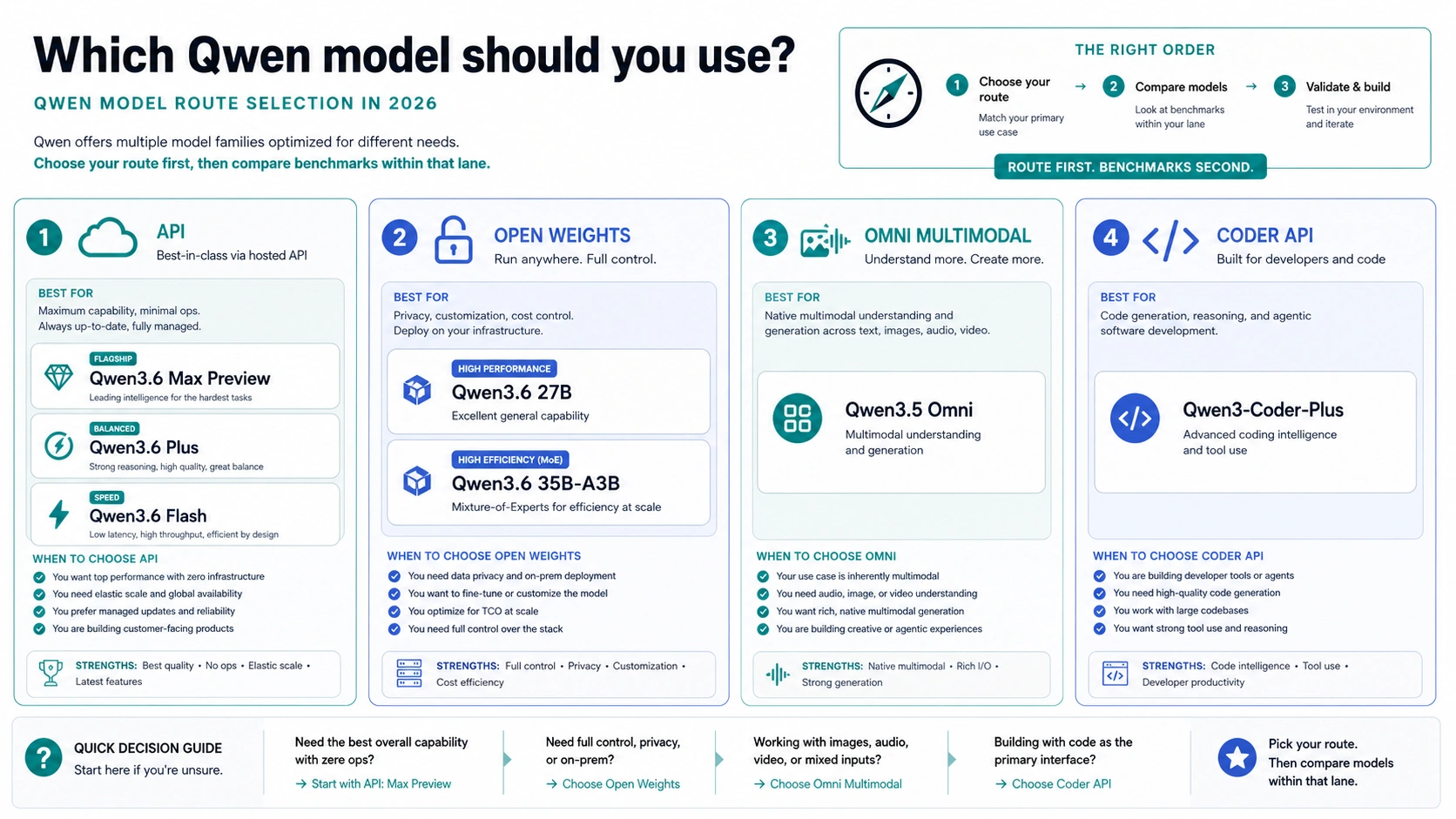
As of May 8, 2026, choose the Qwen route before you compare the model names: start with Qwen3.6-Plus for stable general API work, Qwen3.6-Flash when latency or cost matters, Qwen3.6-Max-Preview for preview-quality testing, Qwen3.6-27B or Qwen3.6-35B-A3B when you need open weights, Qwen3.5-Omni for multimodal audio/video work, and Qwen3-Coder-Plus for coding-agent API workflows. Those names sit in different contracts, so a single "best Qwen" answer is usually the wrong starting point.

| If your job is... | Start with... | Why this route first | Do not assume... | Recheck before production |
|---|---|---|---|---|
| Stable general API integration | Qwen3.6-Plus | It is the safer hosted API default than a preview-only route | That Max-Preview is automatically the stable production choice | Current model ID, region, price, context, and quota |
| Fast or cost-sensitive API testing | Qwen3.6-Flash | It keeps the API route while optimizing for speed and operating cost | That Flash is the same kind of choice as 35B-A3B | Current API table, pricing, rate limits, and quality tradeoff |
| Newest hosted quality evaluation | Qwen3.6-Max-Preview | It is the place to test the newest Max-class behavior | That preview availability equals long-term production stability | Preview status, migration path, and provider support |
| Local or server-side open-weight deployment | Qwen3.6-27B or Qwen3.6-35B-A3B | You can evaluate weights, hosting control, hardware fit, and license boundary | That an open model proves the hosted API contract | Model card, license, weights, hardware, and serving stack |
| Speech, image, video, or multi-sensory work | Qwen3.5-Omni | The job is multimodal, not general text ranking | That Omni replaces every text or code route | Input/output modalities, latency, and API support |
| Coding-agent or software engineering workflows | Qwen3-Coder-Plus | The route is specialized for code generation and agentic coding | That a general chat model is the same testing surface | Tooling, context, repository workflow, and API availability |
Stop before you ship: provider catalogs and community posts can help you discover access routes, but they cannot prove official status, price, license, context window, region coverage, or production readiness. Verify those volatile facts on the Qwen, Alibaba Cloud Model Studio, QwenLM, or model-card source that actually owns the route you plan to use.
Start with the route, not the longest model name
The Qwen model family is no longer one clean ladder where every name is a bigger or smaller version of the same product. The current choice spans hosted API models, open-weight models, multimodal Omni models, and coding-specialized models. That makes route selection more important than a raw benchmark table.
Use the official Qwen site and Alibaba Cloud Model Studio documentation to identify hosted model surfaces, the QwenLM Qwen3.6 repository and model cards for open-weight releases, and the Qwen-Omni documentation for multimodal boundaries. Each source answers a different question. Mixing them into one row of "Qwen models" is how production teams end up testing the wrong thing.
The route question should come before the capability question:
| Decision layer | What it decides | Good first question |
|---|---|---|
| Hosted API route | Model ID, billing owner, quota, region, API behavior, operational support | Do I need a managed API endpoint today? |
| Open-weight route | Weights, license, local/server hardware, serving stack, reproducibility | Do I need to run or inspect the model myself? |
| Omni route | Audio, image, video, and multimodal interaction boundaries | Is the job actually multimodal rather than text-only? |
| Coder route | Code generation, repository work, agent scaffolding, IDE or CLI workflow | Is the evaluation based on software engineering tasks? |
| Provider route | Access wrapper, catalog mapping, credit, retry policy, data terms | Is this source proving official facts or only providing access? |
Once the route is clear, model comparison becomes more useful. Plus and Flash can be compared as API tradeoffs. 27B and 35B-A3B can be compared as open-weight deployment choices. Omni and Coder can be evaluated against their own workflow jobs instead of being squeezed into a generic chat leaderboard.
Use Max-Preview, Plus, or Flash for API work
For direct hosted API work, the relevant source is the Alibaba Cloud Model Studio text-generation documentation. That page is where model IDs such as qwen3.6-max-preview, qwen3.6-plus, qwen3.6-flash, and qwen3-coder-plus belong as API-facing choices. Treat it as the owner for current model naming, API route, and supported capability rows before you put a model into code.
Qwen3.6-Plus is the most sensible first test when the job is a normal production-style API integration: support chat, retrieval-augmented answering, structured extraction, drafting, classification, or business workflow automation. The reason is not that Plus is universally "better" than every other Qwen model. The reason is that a stable general API route is easier to validate than a preview route or a self-hosted model when the main risk is integration correctness.
Qwen3.6-Flash belongs to the same hosted API lane, but the first question changes. Flash is the route to test when latency, throughput, or operating cost matters enough that you are willing to compare quality tradeoffs. It is not a synonym for Qwen3.6-35B-A3B. Flash is an API model choice; 35B-A3B is an open-weight route with different deployment and evidence needs.
Qwen3.6-Max-Preview should be handled as a preview-quality evaluation route unless the current official docs for your target environment say otherwise. Preview models are useful: they let teams test the newest behavior, stress difficult prompts, compare reasoning quality, and decide whether a migration is worth planning. They are weaker as the first production default if your team needs stable procurement, predictable availability, region coverage, or long-term compatibility.
The API-route test should be deliberately small. Pick one representative prompt set, log the exact model ID, record input/output shape, and compare Plus, Flash, and Max-Preview only on the same job. Do not compare a chat prompt on Plus to a coding-agent task on Coder-Plus and then call the result a model ranking. The task surface has changed.
Use 27B or 35B-A3B when you need open weights
Qwen3.6-27B and Qwen3.6-35B-A3B belong in the open-weight conversation. Their first value is not "cheaper API alternative"; it is control. You can inspect release artifacts, evaluate local or server deployment, choose a serving stack, test hardware fit, and decide how much operational responsibility your team is willing to own.

The 27B route is easier to reason about when you want a dense model with a simpler mental model for deployment testing. It may be the first local/server evaluation when your team wants a strong Qwen family model but does not want to begin with a more complex mixture-of-experts route. The exact hardware and serving requirements still need model-card and stack-level verification; do not infer them from the parameter count alone.
The 35B-A3B route is a different kind of open model choice. The A3B wording signals that the active parameter behavior is not the same as a dense 35B model. That can matter for throughput, memory planning, benchmark interpretation, and serving economics. Read the official model card and repository notes before translating a community performance claim into production capacity planning.
The clean open-weight evaluation has four steps:
- Confirm the exact model card and repository source.
- Confirm the license and whether your intended use fits it.
- Run a same-task local or server test with the serving stack you would actually operate.
- Compare output quality together with latency, memory, observability, failure recovery, and update cost.
Open weights also change accountability. If a hosted API fails, you inspect model status, API route, billing, quota, and provider logs. If a self-hosted deployment fails, you inspect inference server, GPU memory, quantization, prompt template, context handling, batching, and release version. The model family is related; the operational owner is not.
Keep Omni and Coder in separate workflow lanes
Qwen3.5-Omni should be evaluated as a multimodal route. If the job is speech understanding, video, audio interaction, image-plus-text input, or multi-sensory assistant behavior, Omni may be the correct family to test before a general text model. If the job is a normal text API or coding-agent flow, Omni is not automatically better just because it supports more modalities.
The practical Omni test should include the modality you care about. A text-only prompt does not prove the audio or video path. A short demo does not prove production latency, turn-taking behavior, streaming needs, or media preprocessing. Start with the official Qwen-Omni documentation, then build one test that uses the real input shape: audio clip, image plus text, video segment, or mixed interaction.
Qwen3-Coder-Plus belongs in the coding-specialized lane. It is the candidate to test when the work is code generation, debugging, refactoring, repository analysis, agentic coding, or tool-assisted development. The right comparison is not only "Coder-Plus versus Plus on a generic answer." The right comparison is whether Coder-Plus handles repository context, patch planning, test feedback, and instruction following better for software work.
For coding-agent evaluation, use a repeatable same-repository task:
| Test job | What to measure | Why it matters |
|---|---|---|
| Small bug fix | Correct file selection, minimal patch, test result | Shows whether the model can act inside a real codebase |
| Refactor with constraints | Scope control, no unrelated churn, compatibility | Separates useful coding behavior from broad rewriting |
| API integration | Doc-following, error handling, environment assumptions | Tests developer workflow rather than trivia |
| Test repair | Ability to read failures and make bounded fixes | Reveals loop discipline |
| Review task | Bug-finding specificity, line-level evidence | Shows whether the model can critique code, not only write it |
This split prevents the most common Qwen mistake: using one conversational benchmark to decide a multimodal or coding workflow. Omni and Coder are route names because the job shape changes.
Treat providers as access layers, not source truth
Provider catalogs are useful because they reveal what developers can try quickly. A catalog may expose a Qwen model through an OpenAI-compatible endpoint, show a price unit, provide a playground, or compare latency. That is valuable for discovery. It is not the same as official model identity.
Use this evidence hierarchy:
| Claim you want to publish or rely on | Stronger source | Weaker source |
|---|---|---|
| Official model ID or hosted API availability | Alibaba Cloud Model Studio or Qwen official page | Provider catalog row |
| Open-weight release identity | QwenLM repository or official model card | Forum or benchmark roundup |
| License and model-card notes | Official model card and repository license | Screenshot or social post |
| Provider access, endpoint mapping, credit, retry behavior | The provider's own docs and dashboard | Another site's catalog summary |
| Practical local-model friction | Your own same-task test, model-card notes, hands-on reports | A single benchmark number |
This distinction is especially important for volatile claims. Price, free quota, region support, context window, provider coverage, rate limits, and preview status can change. If a release note, integration doc, or internal proposal cannot say which source owns the claim and when it was checked, the claim should be qualified or removed.
Provider routes can still be a good fit. If your team needs a temporary evaluation endpoint, a gateway layer, or a controlled comparison across models, a provider can reduce setup work. Just keep the language precise: "this provider offers an access route" is not the same as "Qwen officially guarantees this model is production-stable through that provider."
Check volatile facts before production
Before committing a Qwen route to production, recheck the facts that can invalidate the decision fastest: exact model ID, preview or stable status, context window, output limits, price, region, quota, provider coverage, license, model-card changes, and migration notes. Do that on the route owner, not on a cached comparison table.

The production checklist should be concrete:
| Before you commit | Check this source | What can go wrong if you skip it |
|---|---|---|
| Hosted API model ID | Alibaba Cloud Model Studio docs | Code points at a deprecated, preview, or wrong model name |
| Preview/stability status | Qwen or Alibaba official surfaces | A preview test becomes an unsupported production assumption |
| Pricing and quotas | Current billing, pricing, and rate-limit surfaces | A cheap prototype becomes an expensive or throttled workload |
| Region and account support | Account dashboard and official docs | The model is visible in docs but not usable in your environment |
| Open-weight license | Repository and model card | The deployment violates usage or redistribution terms |
| Hardware and serving plan | Your serving stack plus model-card guidance | Local success does not fit production latency or memory |
| Provider mapping | Provider dashboard and docs | The provider label does not match the official route you expected |
| Benchmark claim | Benchmark owner or your own same-task test | A ranking number does not predict your workload |
The safest final decision is usually not "one Qwen model forever." It is a route pair: a primary model for the main job and a fallback rule for the first known failure. A team might choose Plus for stable API work and Flash for latency-sensitive requests. Another team might evaluate 35B-A3B for self-hosted code review while keeping Coder-Plus for API-based coding-agent flows. A multimodal product might test Omni for media turns and Plus for text-only support. Those are route plans, not universal rankings.
FAQ
Which Qwen model should I try first?
For a general hosted API integration, start with Qwen3.6-Plus. Use Qwen3.6-Flash if speed or operating cost is the first constraint, Qwen3.6-Max-Preview if you are evaluating the newest Max-class behavior, Qwen3.6-27B or Qwen3.6-35B-A3B if you need open weights, Qwen3.5-Omni for multimodal jobs, and Qwen3-Coder-Plus for coding-agent workflows.
Is Qwen3.6-Flash the same kind of choice as Qwen3.6-35B-A3B?
No. Qwen3.6-Flash is a hosted API route. Qwen3.6-35B-A3B is an open-weight route. They can both be relevant to a Qwen evaluation, but they answer different operational questions: managed API speed and cost on one side, self-hosted deployment control on the other.
When should I use Qwen3.6-Max-Preview?
Use Max-Preview when the task is evaluation: difficult prompts, quality comparison, migration planning, or checking the newest Max-class behavior. Treat it carefully for production planning unless the current official docs for your account and route support that commitment.
When is Qwen3.5-Omni the right choice?
Use Qwen3.5-Omni when the core job is multimodal: audio, speech, image, video, or mixed media interaction. Do not choose Omni just because it looks broader than a text model. Test it on the real media format you need.
When is Qwen3-Coder-Plus the right choice?
Use Qwen3-Coder-Plus when the evaluation is about software engineering: code generation, debugging, repository analysis, refactoring, agent workflows, and test repair. Compare it on real coding tasks, not only on general chat answers.
Can I use a provider catalog to prove Qwen availability?
Use provider catalogs as access evidence, not official status proof. A provider can show that a model route is available through that provider. Official model identity, release status, API behavior, license, and long-term support need Qwen, Alibaba Cloud Model Studio, QwenLM, or official model-card evidence.
What should I recheck right before production?
Recheck exact model ID, preview or stable status, context window, output limits, price, quota, region, license, provider mapping, and migration notes on the actual day you ship. If a claim affects cost, availability, legal use, or uptime, do not rely on memory.