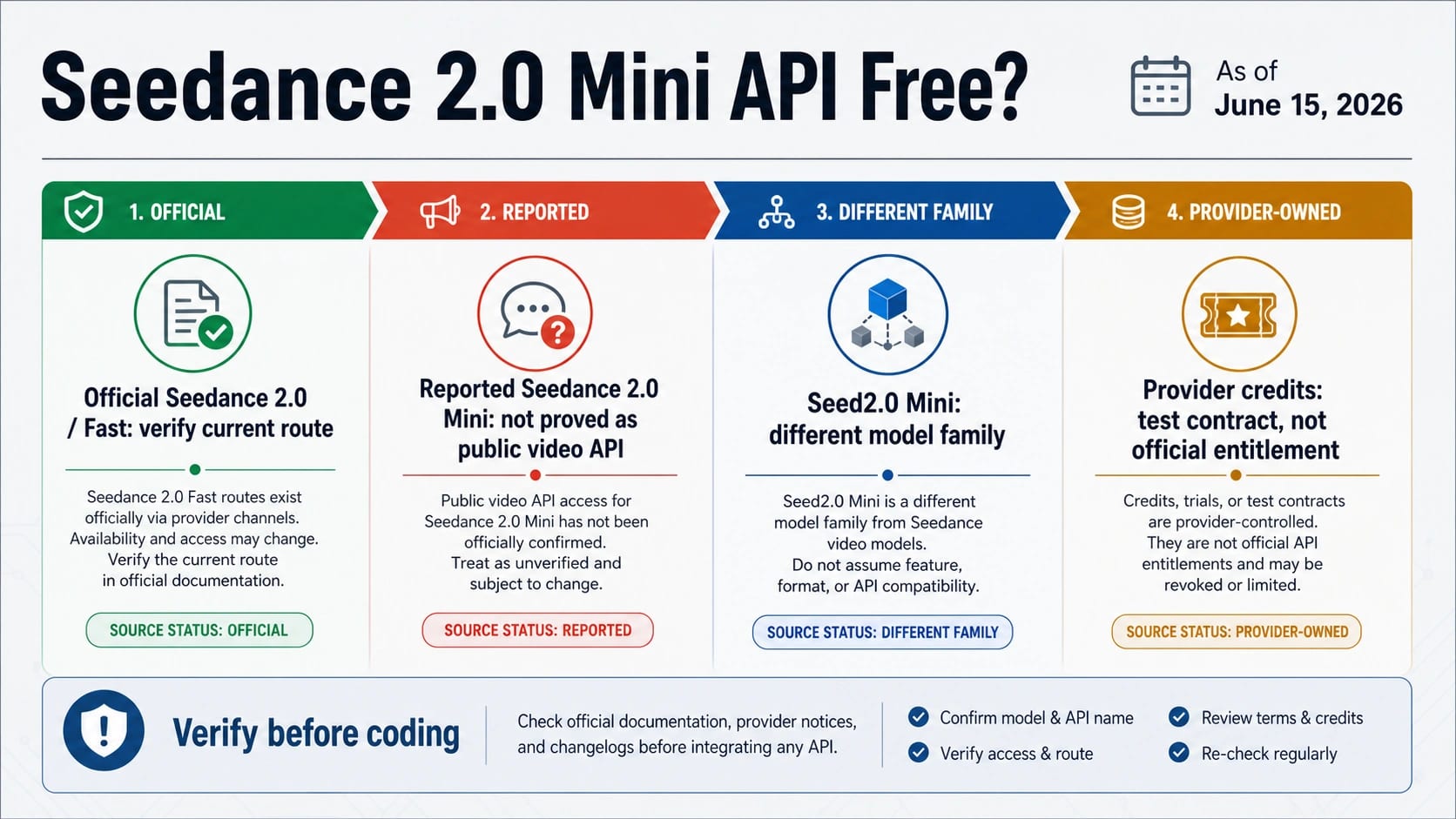
As of June 15, 2026, Seedance 2.0 Mini API free should not be treated as an official public video API contract. The verifiable video route to check today is Seedance 2.0 or a route-owner Fast surface, while Seed2.0 Mini is a different ByteDance model-family name and does not prove a Mini video API. Provider credits can be useful for a small test, but they are a provider-owned contract, not official free production entitlement. Before you code, pay, or upload real assets, require owner proof for the model ID, endpoint, quota, billing terms, task lifecycle, retention, rights, support, and failure behavior.
Current status board
| Claim you may see | Current status | Safer next move |
|---|---|---|
| Official Seedance 2.0 API | Verifiable baseline through owner and route-owner pages. | Check the current ByteDance Seed and BytePlus/ModelArk surfaces before building. |
| Seedance 2.0 Fast | Route-specific speed lane when your route exposes it. | Treat it as a Fast variant to verify, not proof of Mini or free access. |
| Seedance 2.0 Mini API | Reported or market-visible claim; not proved here as a public official video API. | Wait for owner proof before using it as a build target. |
| Seed2.0 Mini | Official ByteDance Seed2.0 family name, but a different model family. | Do not use it as proof of a Seedance video Mini API. |
| Free API credits | Provider-owned test promise. | Use only non-sensitive tests until terms, limits, billing, and rights are clear. |
What is official today
The strongest official video baseline is still Seedance 2.0. The ByteDance Seed Seedance 2.0 page identifies Seedance 2.0 as a multimodal audio-video generation model and frames its work around text, image, audio, video references, camera control, and coherent motion. That is first-party model identity.
For developer access, the route owner to verify is BytePlus/ModelArk or another documented route owner that names the exact video model surface, account requirements, task flow, and billing behavior. BytePlus pages currently show Dreamina Seedance 2.0 and a separate Seedance 2.0 Fast-style route in its AI/model surfaces. That supports the practical baseline: check Seedance 2.0 and Fast where the route owner exposes them.
What the official baseline does not prove is just as important. A Seedance 2.0 model page does not automatically grant an API key, free credits, a public Mini endpoint, production rights, or universal region access. A pricing or model list page also needs to name the exact model, account mode, quota, and billing row before it becomes a usable engineering fact.
So the first decision is not "where is the free Mini API?" The first decision is whether the model name is currently owned by a public route. If you cannot find a route-owner page that names Seedance 2.0 Mini as a video API with a model ID or selector, keep Mini out of production planning.
Why the Mini name is confusing
The confusing part is that there is an official ByteDance page for Seed2.0, and that page includes Pro, Lite, and Mini variants. That is real. It is also not the same as Seedance 2.0 Mini video access.
ByteDance Seed's Seed2.0 page describes a general-purpose agent model family. Its Mini variant belongs to that Seed2.0 family. The name similarity can make snippets, summaries, or provider pages look like they are confirming a Seedance video Mini route, but the subject is different.
Use this naming rule before you trust any claim:
| Name | What it can mean | What not to infer |
|---|---|---|
| Seedance 2.0 | ByteDance Seed video model baseline. | That every provider exposes identical API terms. |
| Seedance 2.0 Fast | A faster video route or variant where documented. | That Fast is cheaper, free, or equivalent for final output. |
| Seedance 2.0 Mini | A reported lower-tier video claim unless owner proof appears. | A public official API, price row, or quota. |
| Seed2.0 Mini | Official Mini name inside a different ByteDance model family. | Proof of a Seedance video Mini API. |
The practical wording should stay strict: official for the owner-proved pages, provider-owned for third-party routes, reported for Mini video chatter, and not proved when the public owner trail is missing. That avoids both extremes: calling a reported Mini "fake" without evidence, or treating a similar name as an API contract.
Where free API claims usually come from
Free API claims usually come from route owners other than ByteDance Seed itself. A provider may offer sign-up credits, a playground, a limited trial, a wrapper endpoint, or a sample workflow. Those can be useful, especially when you need a fast non-sensitive test. They do not become official free Seedance 2.0 Mini access just because they include the words Seedance, API, and free.
A current provider page such as Atlas Cloud's Seedance 2.0 API free guide is best read as a provider-owned route. It may explain that provider's credits, key workflow, examples, or integration promise. It does not prove a ByteDance or BytePlus free Mini entitlement, and it does not prove that the model name in a snippet is the current official Mini video API.
Treat each route according to the owner that can actually support it:
| Route type | What it may be good for | What it cannot prove alone |
|---|---|---|
| ByteDance Seed model page | Model identity and capability framing. | API entitlement, account activation, quota, or free usage. |
| BytePlus/ModelArk docs and console | Developer route, model activation, task lifecycle, usage, and billing checks. | Provider credits or universal free access. |
| Provider API credits | Small low-risk tests under that provider's terms. | Official ByteDance/BytePlus entitlement or production guarantee. |
| GitHub wrapper or community code | A lead that someone has tried a route. | Current model availability, quota, billing, rights, or support. |
| Forum or article commentary | Market pressure and user language. | Official status, price, model ID, or launch date. |
If a provider gives you credits, test with disposable prompts and safe assets. Log which account owns the key, which route accepted the task, whether the result can be retrieved, whether failed jobs bill, and what the provider says about retention and rights. Stop before production if the answer depends on an unverified model ID or a marketing label.
The Mini API proof checklist
A Mini/free API claim becomes usable only when it survives a proof checklist. The checklist is deliberately stricter than a search snippet because developers have to pay for retries, handle user uploads, store outputs, and debug failures.
Before using Seedance 2.0 Mini in code, verify:
| Proof item | Why it matters |
|---|---|
| Owner page | The route must be named by ByteDance, BytePlus, or the provider that actually serves it. |
| Model ID or selector | Code needs a current callable identifier, not a market nickname. |
| Endpoint or task route | Video generation usually needs submit, poll, retrieve, cancel, and failure handling. |
| Account eligibility | Public docs do not mean your account, region, or project can activate the model. |
| Quota or credits | Free credits, trials, resource packs, and paid billing are separate commitments. |
| Billing terms | You need to know what charges, whether failed jobs bill, and who owns the spend. |
| Retention and rights | Uploads, reference images, clips, prompts, and outputs need usage and deletion rules. |
| Support path | Production needs support for stuck tasks, failed retrievals, billing disputes, and policy blocks. |
If any item is missing, the safest language is not "Mini is unavailable forever." It is "Mini is not proved as a public build target today." That leaves room for the route to become real later while keeping today's article honest.
A safe first test path
If you still need to test now, start with the route that has the clearest owner. For a video model baseline, check Seedance 2.0 or Fast on the official or route-owner surface you can access. For a provider test, treat the provider as the owner of the test, not the owner of the underlying model family.
Use this order:
- Confirm the route owner and account owner.
- Confirm the model name or selector shown inside that route today.
- Run one non-sensitive prompt or mock asset.
- Record task creation, polling, retrieval, failure behavior, and billing or credit movement.
- Read retention, commercial-use rights, support, and deletion terms before uploading real assets.
- Stop if the route depends on an unproved Mini name, unlimited-free promise, copied API key, unknown wrapper, or unsupported asset type.
This is slower than copying the first code sample you find, but it prevents the expensive mistakes: building on a model nickname, uploading client footage to a wrapper without terms, assuming provider credits are official, or discovering after launch that the model ID was never your account's production route.
Where adjacent Seedance questions belong
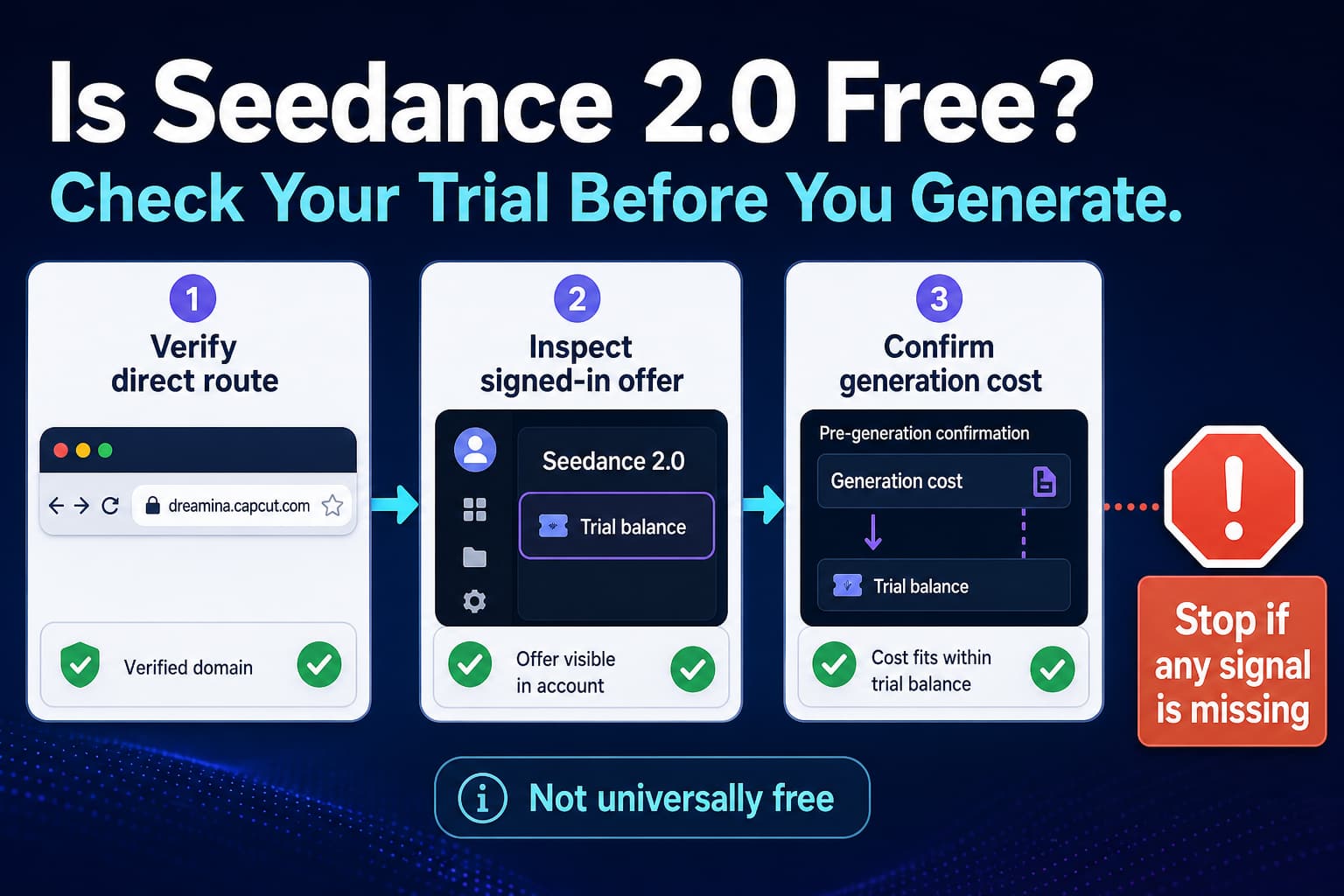
Keep the Mini/API/free question narrow. If your actual problem is broader access hygiene, use the Seedance 2.0 access guide. That route covers official source checks, APK/MOD risk, Google Play listings, provider routes, upload stop rules, and general free/unlimited claims.
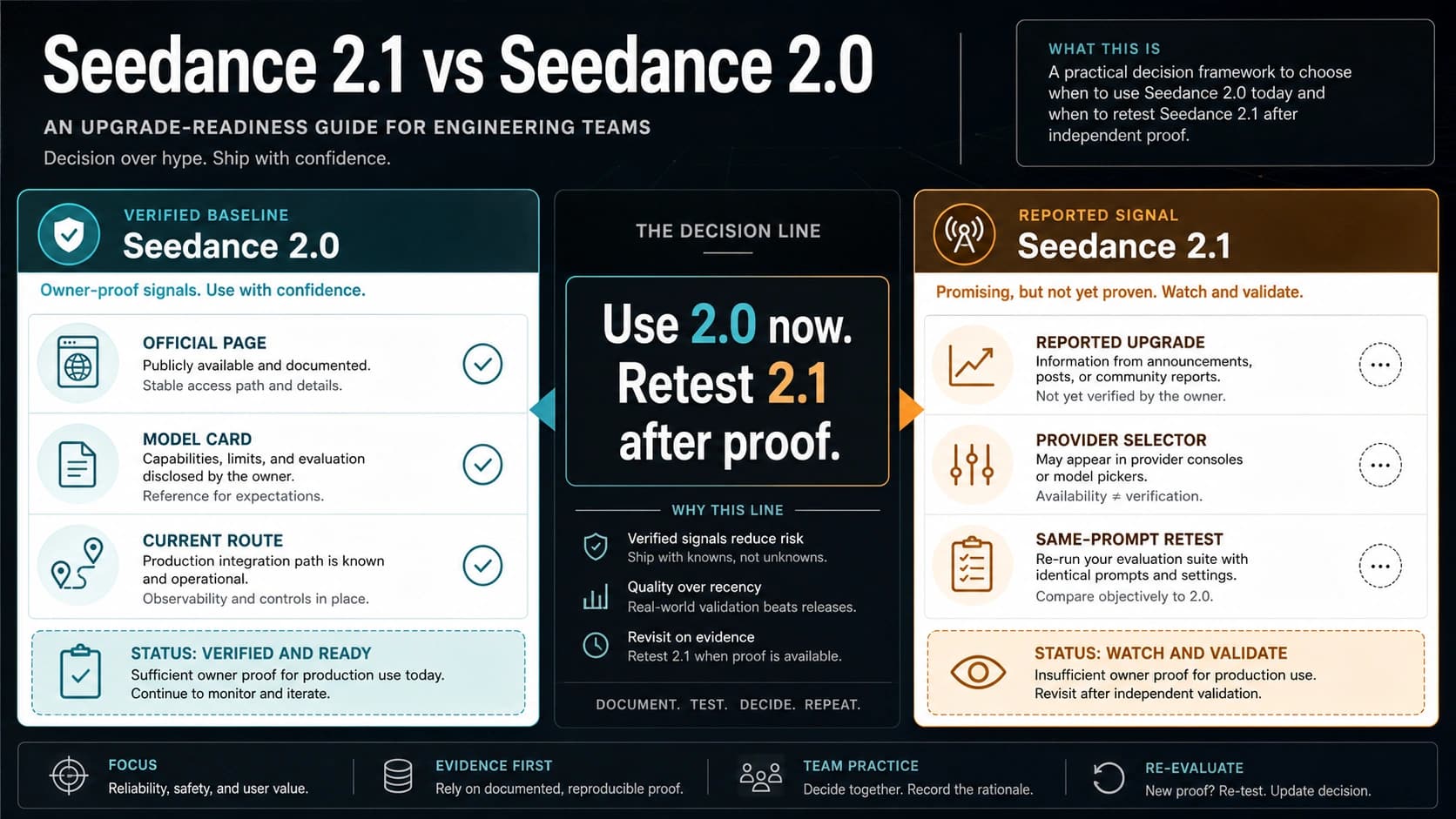
If your question is version readiness, use the Seedance 2.1 vs Seedance 2.0 guide. That page keeps 2.0, Fast, reported Mini, and 2.1 in the right upgrade lane and explains when a reported variant becomes worth retesting.
Keep these lanes separate:
| Reader job | Better page |
|---|---|
| "Can I safely access Seedance 2.0 at all?" | Access and upload-risk guide. |
| "Should I switch from 2.0 to 2.1?" | Version readiness guide. |
| "Can I use real people's faces?" | Human-face consent and verification guide. |
| "Is Mini API free official?" | Mini/API/free proof guide. |
The separation matters because "free," "Mini," "API," "version," "provider," and "upload" are different risk surfaces. A single page that treats them as one shortcut will either overpromise or become too vague to use.
FAQ
Is Seedance 2.0 Mini API officially available for free?
Not as a public official video API contract proved on June 15, 2026. Official Seedance 2.0 and route-owner Fast surfaces are the safer baseline to verify. Mini/free claims need owner proof before they become usable.
Is Seed2.0 Mini the same as Seedance 2.0 Mini?
No. Seed2.0 Mini is an official name in a different ByteDance model family. It should not be used as proof that a Seedance video Mini API exists.
Can provider credits still be useful?
Yes, but only as provider-owned test credits. They can help you run a small non-sensitive experiment under that provider's terms. They do not prove official free production entitlement, model availability for every account, or rights outside the provider contract.
What proof would change the answer?
A route-owner page or console surface would need to name Seedance 2.0 Mini as a video model, expose a callable selector or model ID, explain account eligibility, quota, billing, task lifecycle, retention, rights, support, and failure behavior. After that, you would still run a same-route low-risk test before production.
Should I use Seedance 2.0 Fast instead of waiting for Mini?
Use Fast only if your route owner exposes it and your workload can accept the output, latency, cost, and terms. Fast is a current route to verify, not proof that Mini exists or is free.
Should I copy a GitHub wrapper or sample endpoint?
Only after you know which route it calls and whether your account owns the usage. A wrapper can be a useful lead, but it cannot prove current model status, billing, retention, rights, or support by itself.
Can I upload client footage or real assets to test a free route?
Do not start there. Use mock prompts and non-sensitive assets until the route owner, terms, retention, deletion, commercial-use rights, and support path are clear. Real assets should wait until the route can be audited.