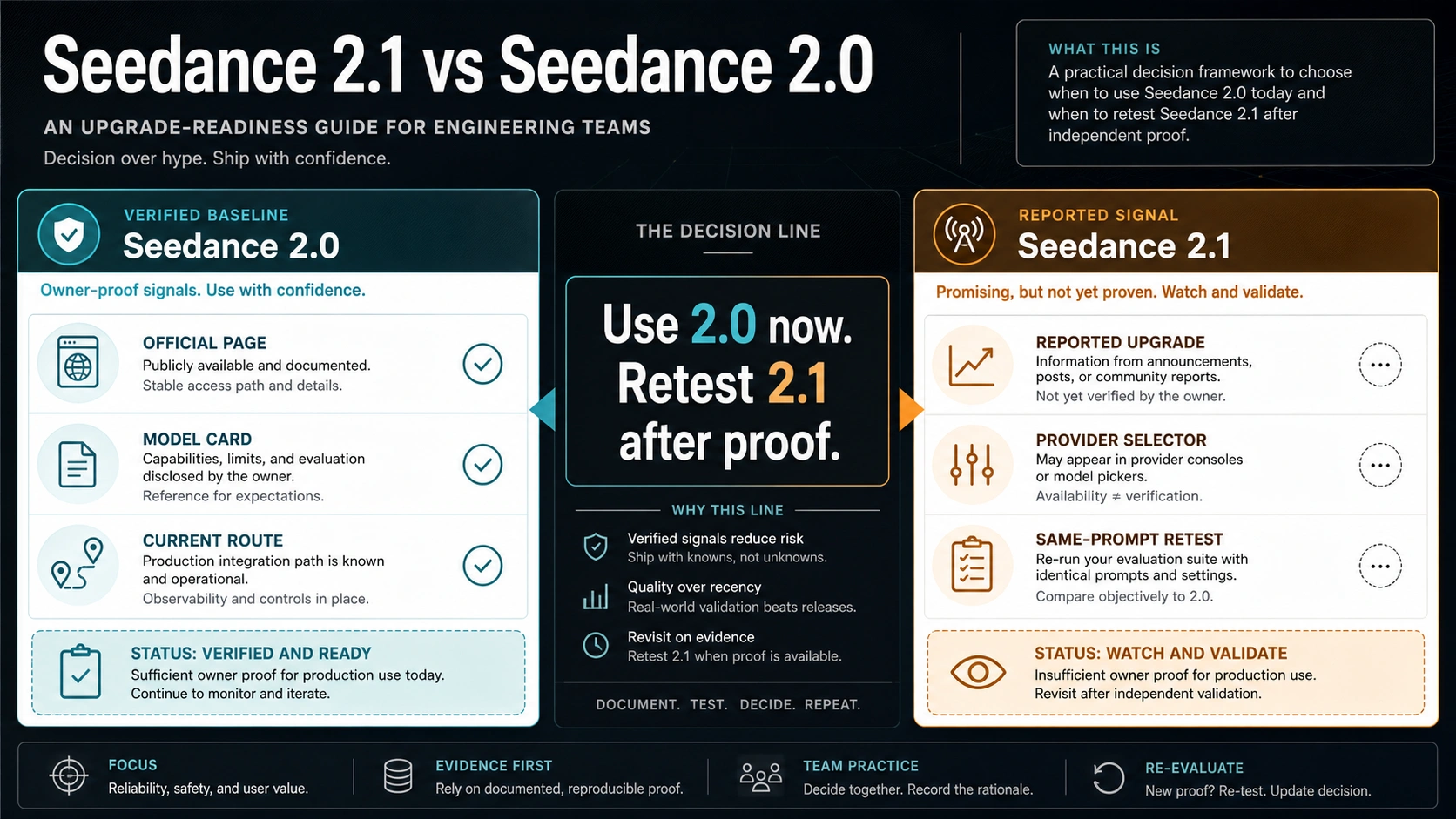
Seedance 2.0 is still the version with first-party proof you can plan around today. Seedance 2.1 is worth watching, but the current evidence makes it a reported upgrade signal, not a production replacement. Switch only after owner documentation, route availability, and same-prompt results show that 2.1 beats your current 2.0 workflow on the criteria that matter.
Current verdict
As of May 21, 2026, the practical answer is to keep Seedance 2.0 as the baseline for real creator or developer work. Seedance 2.1 belongs on your watchlist, but it does not yet have the public owner proof, route selector, API contract, price row, and same-prompt results needed to replace a working 2.0 setup.
| Decision | Use this status | What to do now |
|---|---|---|
| Production video workflow | Seedance 2.0 is the verified baseline | Keep the route that already has owner proof, docs, and your own tests. |
| Upgrade monitoring | Seedance 2.1 is a reported signal | Track owner pages and route-owner docs before making plans around it. |
| Fast iteration | Seedance 2.0 Fast is a route-specific speed lane | Use it only when your chosen route exposes it and your quality bar survives. |
| Lower-cost speculation | Seedance 2.0 Mini is reported, not a finished price contract | Do not build price or quota assumptions until an owner publishes the terms. |
The important point is not that Seedance 2.1 is uninteresting. A same-family upgrade can matter a lot if it improves motion stability, reference consistency, realism, rejection behavior, or cost per accepted clip. The problem is evidence status. A reported gain is a reason to design a retest, not a reason to rewrite production defaults.
What is verified about Seedance 2.0
Seedance 2.0 has the evidence position that 2.1 does not yet have. The ByteDance Seed model page identifies Seedance 2.0 as the official model surface and describes a unified multimodal audio-video generation system that can work from text, image, audio, and video inputs. The official launch post gives the dated launch context and frames the model as a high-quality multi-shot audio-video generation system with editing and extension use cases.
That same official layer also keeps the comparison honest. Seedance 2.0 is not perfect, and ByteDance's own launch material discusses areas where detail stability, hyper-realism, dynamic vitality, multi-subject consistency, text rendering, complex editing effects, and occasional audio distortion can still matter. Those limitations are exactly the kind of issues an eventual 2.1 upgrade would need to improve in a measurable way.
The Team Seedance model card on arXiv adds the technical baseline. It describes Seedance 2.0 as a native multimodal audio-video model, anchors the open-platform duration and resolution context, and includes the Fast variant boundary. That makes 2.0 more than a marketing name: it is a concrete baseline you can test, compare, and keep as a control.
What is reported about Seedance 2.1
Seedance 2.1 is being discussed as an upgrade, but the claims available on May 21, 2026 are still reported claims. A WaveSpeed preview summarizes market reports around a roughly 20% quality improvement and a possible Mini tier, while also noting that stronger ByteDance model-card evidence is still needed. Gate's pickup of a Pandaily-attributed report repeats the same kind of quality-gain framing. Chinese financial-media pickups, including Sina, point in the same direction.
Those sources are useful because they explain why people are asking about 2.1 now. They are not enough to call 2.1 official, available, cheaper, faster, or better for your workload. Until ByteDance Seed, BytePlus, Volcengine, or a route owner publishes a concrete 2.1 route, the safe wording is "reported." The reported 20% number should stay a question for testing, not a fact you apply across every prompt style.
A real 2.1 comparison would need to answer narrower questions. Does it improve character continuity across a multi-shot prompt? Does it keep camera motion more stable? Does it reduce rejections for the same safe input? Does it produce the same or better output with fewer attempts? Does it preserve audio-video timing? Does it export through the same route at a predictable cost? Without those answers, "2.1 vs 2.0" is a status decision before it is a winner decision.
Why Seedance 2.0 still matters
Seedance 2.0 matters because it is the version you can currently reason about with first-party proof. If your workflow already has prompts, reference assets, approval rules, cost notes, and output expectations around 2.0, that baseline has operational value. Replacing it before 2.1 is documented would remove your control group before the upgrade has earned the role.
For creators, the baseline is practical. You can judge whether Seedance 2.0 handles your subject, motion style, camera language, reference images, scene length, and editing needs. For developers, the baseline is even more important because the production question is not only "which clip looks better?" It also includes account eligibility, task creation, polling, output retrieval, moderation behavior, retries, storage, terms, and billing.
That is why a reported upgrade should not erase the current route. If 2.1 becomes available tomorrow, the right move is not to assume every 2.0 workflow is obsolete. The right move is to run a same-prompt retest against your actual use case and keep 2.0 as the fallback until the new route wins repeatedly.
Do not collapse 2.0, Fast, Mini, and 2.1
One source of confusion is that the names sound like a simple ladder. They are not the same decision.
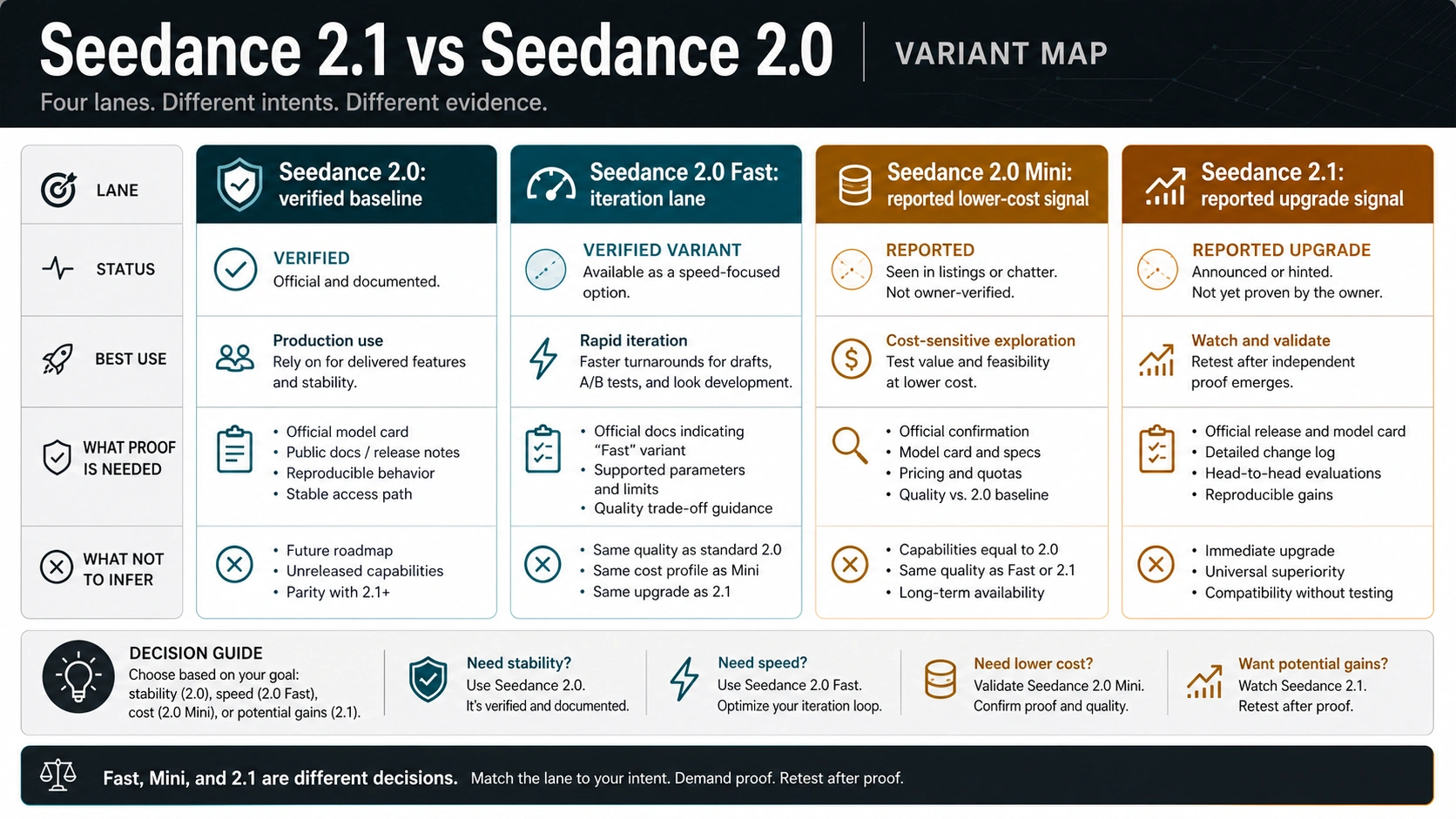
| Name | Evidence status on May 21, 2026 | Best reader question | Do not infer |
|---|---|---|---|
| Seedance 2.0 | Verified first-party baseline | What can I use and test today? | That every provider exposes the same settings or terms. |
| Seedance 2.0 Fast | Technical or route-specific speed lane | Can I trade some quality margin for lower latency? | That Fast is always the right default for final output. |
| Seedance 2.0 Mini | Reported lower-tier signal | Could a cheaper or lighter lane appear? | Any exact public price, quota, or production route. |
| Seedance 2.1 | Reported upgrade signal | What proof would justify retesting and switching? | That it is official, available, or better for your prompt set. |
This split prevents two common mistakes. The first is treating Fast as an older or weaker version of 2.1. Fast is about iteration speed and latency when a route exposes it. The second is treating Mini as a price guarantee. A lower-tier signal is not a published billing contract. Keep speed, cost, and quality as separate variables until owner sources bind them together.
The switch threshold
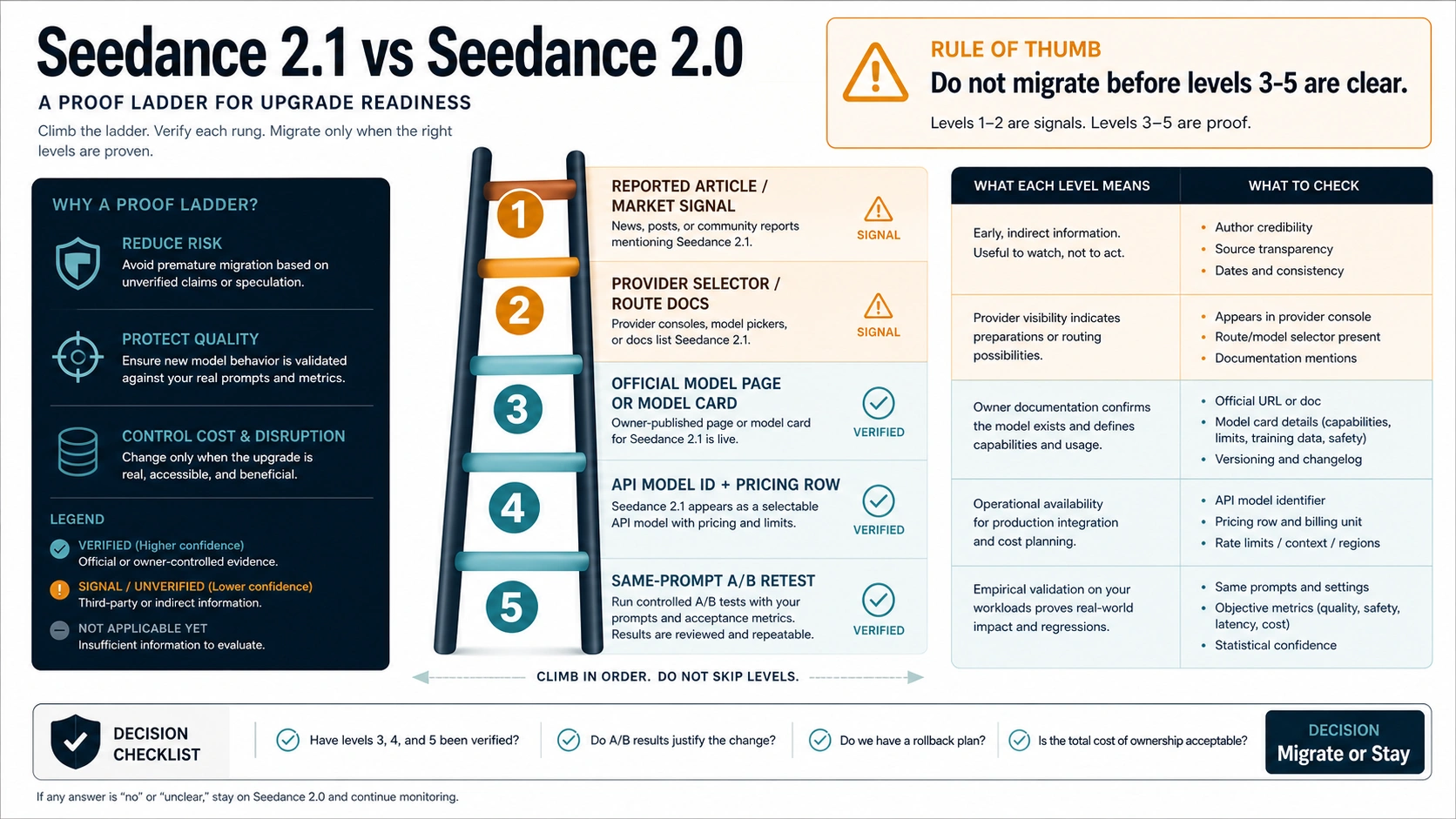
Seedance 2.1 becomes actionable only when the proof ladder moves beyond reporting. The minimum threshold is an owner-controlled page or document that names the model, explains availability, and lets a real user select or call it. For a developer workflow, that also means a model ID or task contract, input and output rules, moderation behavior, retrieval rules, rate or quota behavior, and a billing unit. For a creator workflow, it means a visible model selector or route setting with current plan, export, rights, watermark, and support terms.
After that, run the practical threshold: same prompt, same references, same target format, and enough repeated outputs to separate real improvement from one lucky sample. A single impressive demo does not prove that 2.1 should replace 2.0 for product work, client footage, character continuity, brand assets, or any queue that needs predictable recovery.
Use this switch rule:
| If you see... | Treat it as... | Decision |
|---|---|---|
| News pickup, AI summary, forum note, or video demo | Signal | Watch, but do not switch. |
| Provider landing page without selector, docs, or terms | Provider marketing | Verify the route before upload or billing. |
| Owner page, model card, or docs naming 2.1 | Proof candidate | Start a controlled retest. |
| Provider selector plus route terms | Route availability | Test with low-risk assets first. |
| Same-prompt wins across your own criteria | Workflow proof | Stage a migration, keep 2.0 fallback until stable. |
Same-prompt retest workflow
When a documented 2.1 route appears, do not compare it with memory or with a different prompt. Use a small test harness that mirrors your real work.
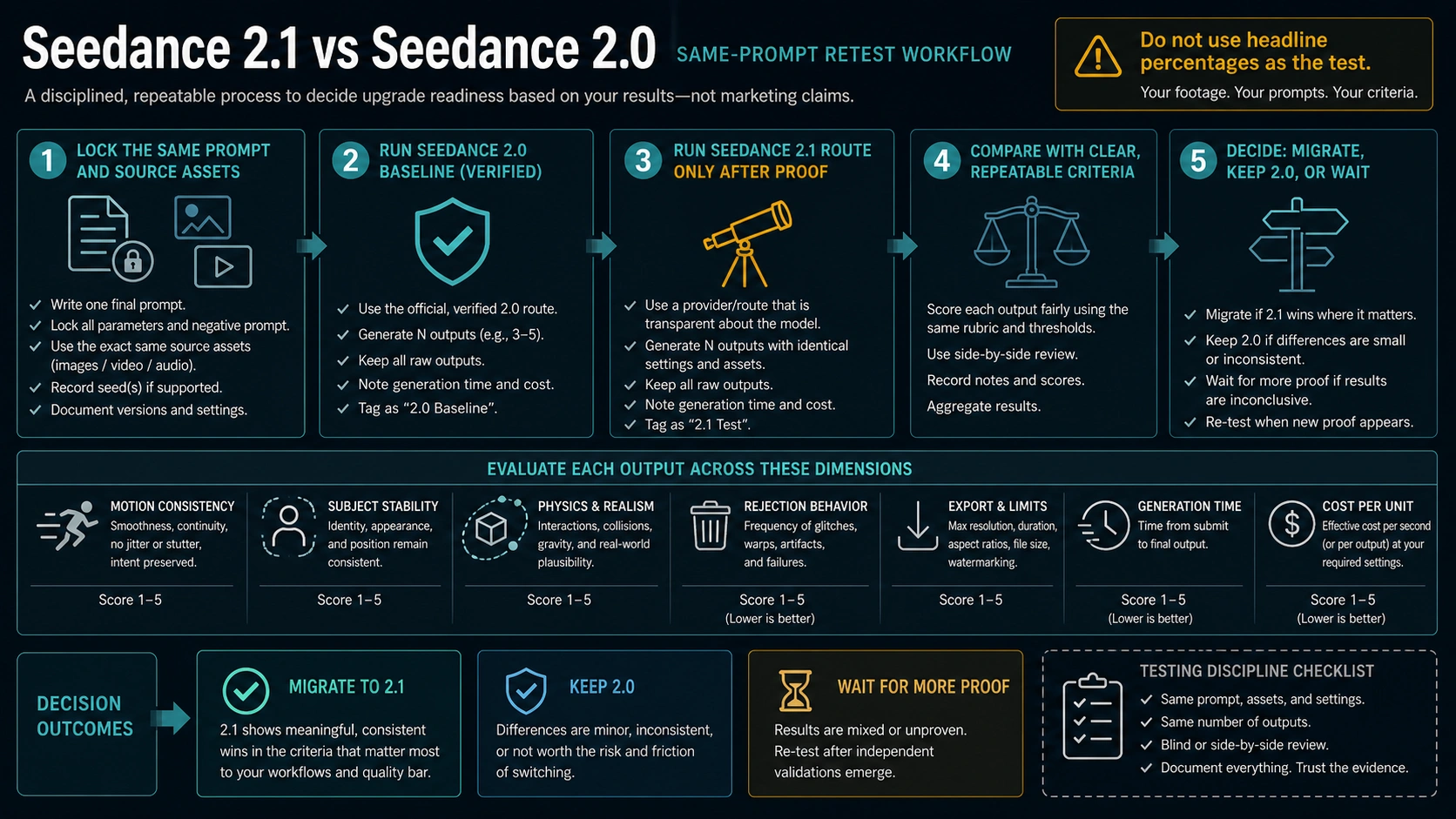
Start with three to five prompts that represent your workload. Include at least one ordinary prompt, one hard camera-motion prompt, one reference-image prompt if you use references, and one prompt that previously caused failures or unacceptable artifacts in 2.0. Keep the input assets identical. Keep the duration, aspect ratio, quality mode, and seed-like controls identical when the route allows it.
Score the outputs before you look at cost or hype. A useful scorecard includes motion coherence, subject consistency, camera intent, temporal stability, prompt obedience, text or logo handling if relevant, audio-video sync if relevant, rejection behavior, export reliability, retry count, and accepted-output cost. Do not average everything into a single beauty score. Your real decision is whether 2.1 improves the bottleneck that made 2.0 insufficient.
Then make the migration decision in stages. If 2.1 wins on output but loses on rejection behavior, export reliability, rights, or cost predictability, keep it as an experimental lane. If it wins on the bottleneck and the route contract is clear, move a small batch first. If it wins only on showcase prompts, keep 2.0 as the production default and revisit when the route matures.
Where sibling topics take over
This comparison should stay focused on switch readiness. If your next question is how to open Seedance safely, use the Seedance 2.0 access guide. That route decision covers official source checks, browser options, provider-owned routes, and fake-site upload risk more directly than a version comparison can.
Keep API implementation, provider rankings, and price planning separate as well. Exact model IDs, async task creation, polling, retries, storage, region eligibility, price rows, free credits, and provider billing units change too quickly to tuck into a 2.1 status article. Recheck the current owner docs or the focused API, pricing, and provider pages before committing engineering time or customer-facing promises.
The same boundary applies to broad model selection. If you are choosing between Seedance, Veo, Sora, Kling, Wan, or another video model family, the question is no longer "should 2.1 replace 2.0?" It becomes a workload comparison across owners, routes, policies, speed, cost, and output style.
FAQ
Is Seedance 2.1 official?
Not as a public production contract in the sources checked on May 21, 2026. Seedance 2.1 is visible as a reported upgrade signal, but a first-party public model page, model card, API contract, or documented route was not the proof basis for this comparison.
Is Seedance 2.1 better than Seedance 2.0?
It is too early to write that as a fact. Reported coverage points to a possible quality improvement, including a roughly 20% figure, but that number needs owner proof and same-prompt testing before it can guide production decisions.
Should I wait for Seedance 2.1 instead of using Seedance 2.0?
Do not wait if Seedance 2.0 already solves the job and you have a current route that works. Use 2.0 as the baseline now, then retest 2.1 when a real route appears. Waiting makes sense only when your current project depends on the exact weakness that 2.1 is reported to improve and your deadline can absorb uncertainty.
Is Seedance 2.0 obsolete?
No. Seedance 2.0 remains the verified baseline. An eventual 2.1 may become the better default, but 2.0 still matters as the control group, fallback route, and documented workflow until the upgrade proves itself.
What is the difference between Seedance 2.0 and Seedance 2.0 Fast?
Seedance 2.0 is the baseline model family name. Seedance 2.0 Fast is a speed-oriented lane described in technical context and route-specific surfaces. Treat Fast as an iteration option to test for latency-sensitive work, not as automatic proof that quality, price, or rights match the baseline route.
What would make Seedance 2.1 worth switching to?
A credible switch needs three things: owner or route-owner proof that 2.1 is available, a clear contract for access and usage, and same-prompt results that beat your current 2.0 workflow on the criteria that matter. Without all three, keep 2.1 in watch-and-test mode.