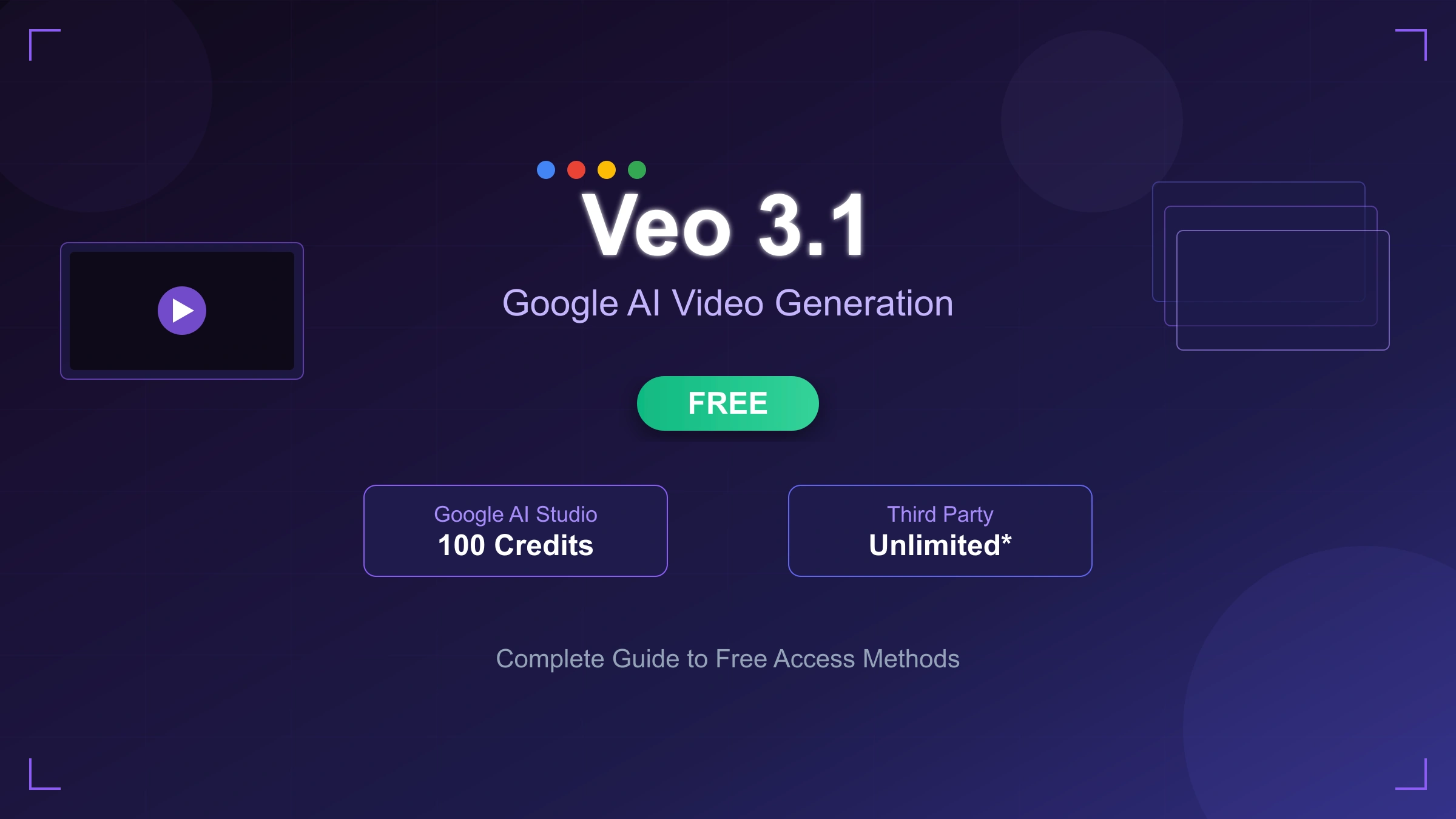
As of June 11, 2026, Google does have an official Veo 3 trial offer, but that is not the same as a universal free Veo entitlement. The right next step depends on the route: claim the Google Cloud offer if you are eligible, use Flow or Gemini credits for consumer video creation, use Gemini API paid billing for development, treat Cloud Free Trial credit as a separate Cloud program, and evaluate third-party wrappers as separate products with their own terms.
| Route | Best first use | First check |
|---|---|---|
| Official Cloud offer | Eligible business or Cloud trial evaluation | Offer region, account, and trial terms |
| Flow / Gemini credits | Personal video creation and prompt testing | Plan, credit balance, product limits |
| Gemini API | Developer integration and automation | Paid-tier availability and billing setup |
| Cloud Free Trial credit | General Cloud evaluation | Whether the credit applies to the surface you need |
| Third-party wrapper | Fast demo without using a Google surface directly | Owner, quota, watermark, upload privacy, and cancellation terms |
If you only want to test prompts, start with Flow or Gemini credits. If you need API integration, read the Gemini API paid-tier boundary before building. If a site promises unlimited free Veo, check who owns the service, what the free quota includes, whether uploads are retained, and whether export or cancellation rules change after signup.
The five routes people collapse into "free Veo"
The hard part is not whether Veo exists. Google has official Veo surfaces, and the current model family is visible across Google Cloud, Gemini, Flow, DeepMind, and the Gemini API documentation. The hard part is that each surface answers a different contract question.
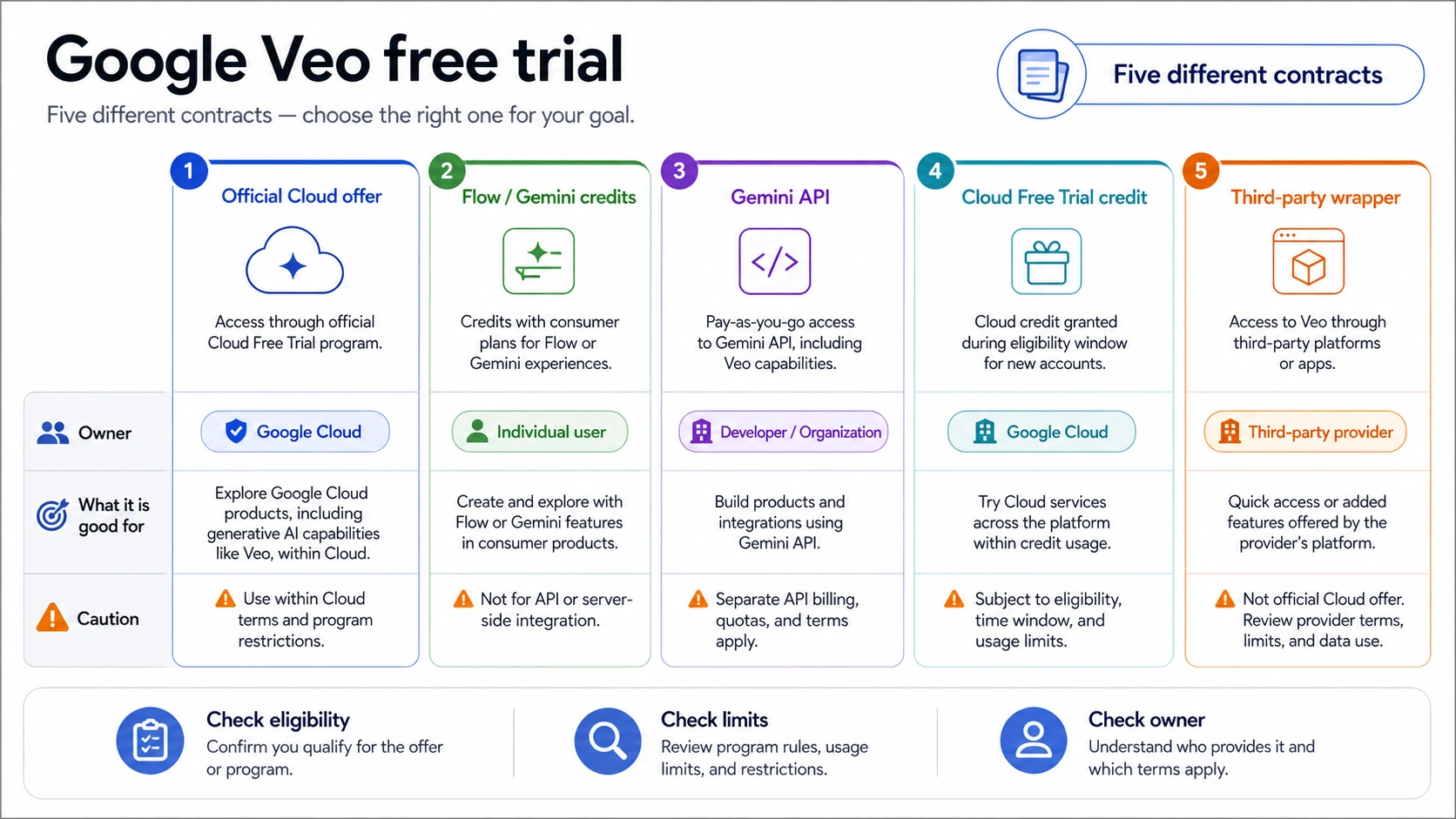
Use the phrase "Google Veo 3 free trial" as a routing question:
| What the reader means | Correct owner | What it can prove | What it cannot prove |
|---|---|---|---|
| "I saw a Google Cloud offer" | Google Cloud offer page | Whether an official Veo 3 trial offer is currently available to an eligible account | That every Google or Gemini route is free |
| "I want to make a few videos in a product UI" | Google Flow, Gemini app, and Google AI plan pages | Whether the consumer surface gives credits or trial access for your account | That developer API calls are covered |
| "I want to call Veo from code" | Gemini API pricing and billing docs | Current model IDs, tier, and billing requirement | That consumer app credits become API quota |
| "I have Google Cloud trial credit" | Google Cloud Free Program docs | Cloud trial credit amount, duration, and billing verification rules | That the credit pays for every Gemini or AI Studio cost |
| "A third-party site says Veo is free" | The wrapper's own product, pricing, privacy, and export terms | What that wrapper claims to offer | That the route is official Google access |
That split matters because the wrong route wastes time in different ways. A creator may spend an hour reading API billing docs when they only need Flow. A developer may sign up for a consumer trial and still get blocked on API billing. A person following a video tutorial may upload private assets to a wrapper without knowing who stores the prompts, images, or generated clips.
Route 1: the official Google Cloud Veo 3 trial offer
The most direct official answer is the Google Cloud page for the Veo 3 Free Trial Offer. That page is the current owner for the exact "Veo 3 free trial" promise. It describes an extended 3-month trial for Veo 3, and it is the first route to check when the reader wants a Google-owned trial rather than a wrapper demo.
Treat that offer as an eligibility path, not as a blanket product rule. Before relying on it, check:
- whether your account and region are eligible;
- whether the offer applies to the exact Google Cloud or Veo surface you plan to use;
- what happens after the trial window ends;
- whether billing, payment verification, organization status, or sales contact requirements apply;
- whether the offer terms limit commercial use, quota, geography, or supported workloads.
Use "Veo 3" for this offer because that is the market-visible wording on the Google Cloud offer surface. Use "Veo 3.1" where the official product or API page uses the newer model name. Mixing those names without the route context is how many stale guides end up promising a trial for a surface Google does not actually describe as free.
Route 2: Flow and Gemini credits for consumer video creation
For personal creation, the practical starting point is usually Google Flow or the Gemini app, not an API dashboard. Google's Google AI plans page currently shows Flow access and plan-based Flow credits. On June 11, 2026, the page showed Flow access on the free tier, 200 Flow credits on AI Plus, 1,000 Flow credits on AI Pro, and larger Flow-credit allocations on AI Ultra. The page may render local pricing by region, so do not copy a price from another country into your own decision.
Google's Google One AI credits help page is the safer source for the credit principle: usage limits depend on the product, feature, and Google AI plan. It also says Pro and Ultra members can buy extra credits for Flow and Antigravity. That means the useful question is not "how many free Veo videos does everyone get?" The useful question is: which product am I using, which plan or trial is attached to this account, and what does the product show as the current credit balance and limit?
Do not convert credits into guaranteed video counts unless Google displays that conversion for the product and mode you are using. Video length, mode, quality, account type, region, and product packaging can change. For prompt testing, credits are still useful, but they are a limited consumer creation budget, not a transferable developer allowance.
Route 3: Gemini API is a paid-tier developer route
The most important developer boundary is simple: consumer credits are not Gemini API quota. If you plan to call Veo from code, start with the Gemini API pricing page, not a Flow credit balance.
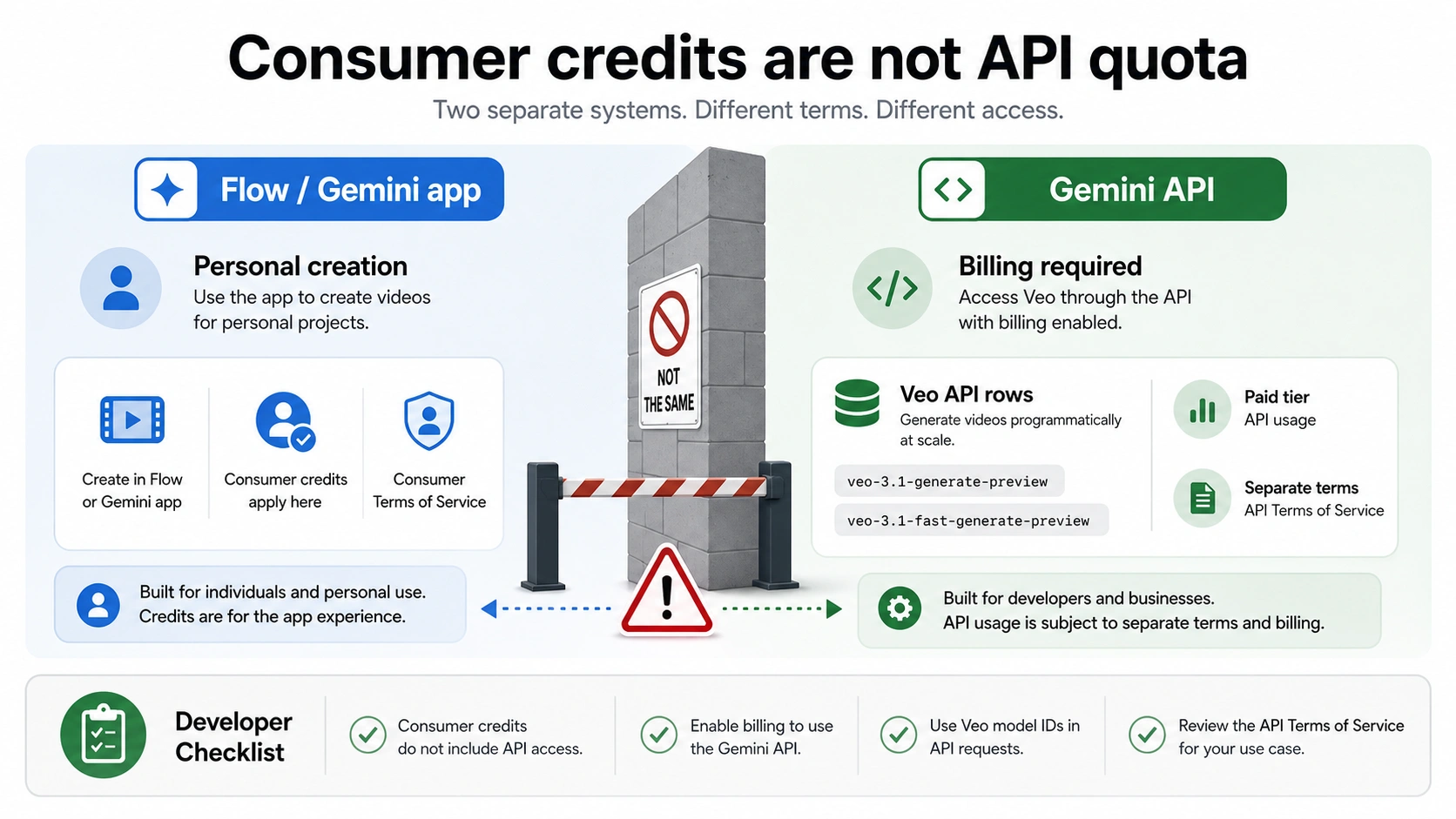
On June 11, 2026, the Gemini API pricing surface listed Veo developer models such as veo-3.1-generate-preview, veo-3.1-fast-generate-preview, and veo-3.1-lite-generate-preview. The Veo 3.1 rows showed Free Tier as not available and placed the models on the paid tier. Veo 3 rows also showed Free Tier as not available.
That does not mean the model is unusable. It means the developer route is a billing route. A developer should check:
- the exact model ID required by the SDK or API request;
- whether the model is preview or stable;
- whether the project has billing enabled;
- what rate limits and regional constraints apply;
- where generated video files are delivered and how long URLs remain valid;
- whether the workload belongs in API automation or in a manual Flow/Gemini product surface.
This is also where a sibling API-limit resource is more useful than a free-method list. If the route you need is developer integration, read a dedicated Veo 3.1 API rate-limit guide after you confirm paid-tier access. If your real problem is provider cost and reliability, use a provider/cost comparison only after the official API boundary is clear.
Route 4: Cloud Free Trial credit is a separate Cloud program
Google Cloud Free Trial credit often gets pulled into Veo discussions because it sounds like a developer free path. It is not the same contract as a Veo API free tier.
Google's Cloud Free Program documentation describes a $300 credit for new eligible Cloud customers, valid for 90 days, with payment verification. The same documentation states that the $300 credit cannot pay for Gemini API in AI Studio costs. That caveat is easy to miss because "Cloud credit", "Gemini API", and "AI Studio" all sound adjacent.
Use Cloud Free Trial credit for general Cloud evaluation only after you confirm the specific service you want accepts that credit. Do not assume it covers Veo API calls, Flow credits, Gemini app video generation, or AI Studio costs. When a forum post or video says "use Cloud credits for free Veo", translate the claim into a service-specific question: which product is being billed, which account owns the charge, and where does Google's current documentation say the credit applies?
Route 5: third-party wrappers are separate products
Third-party pages can be useful for quick demos, but they are not proof of official Google access. A wrapper may expose a prompt box, advertise Veo 3 or Veo 3.1, offer a no-login first generation, or show a "0 credit" label on a landing page. Those are product claims from that site.
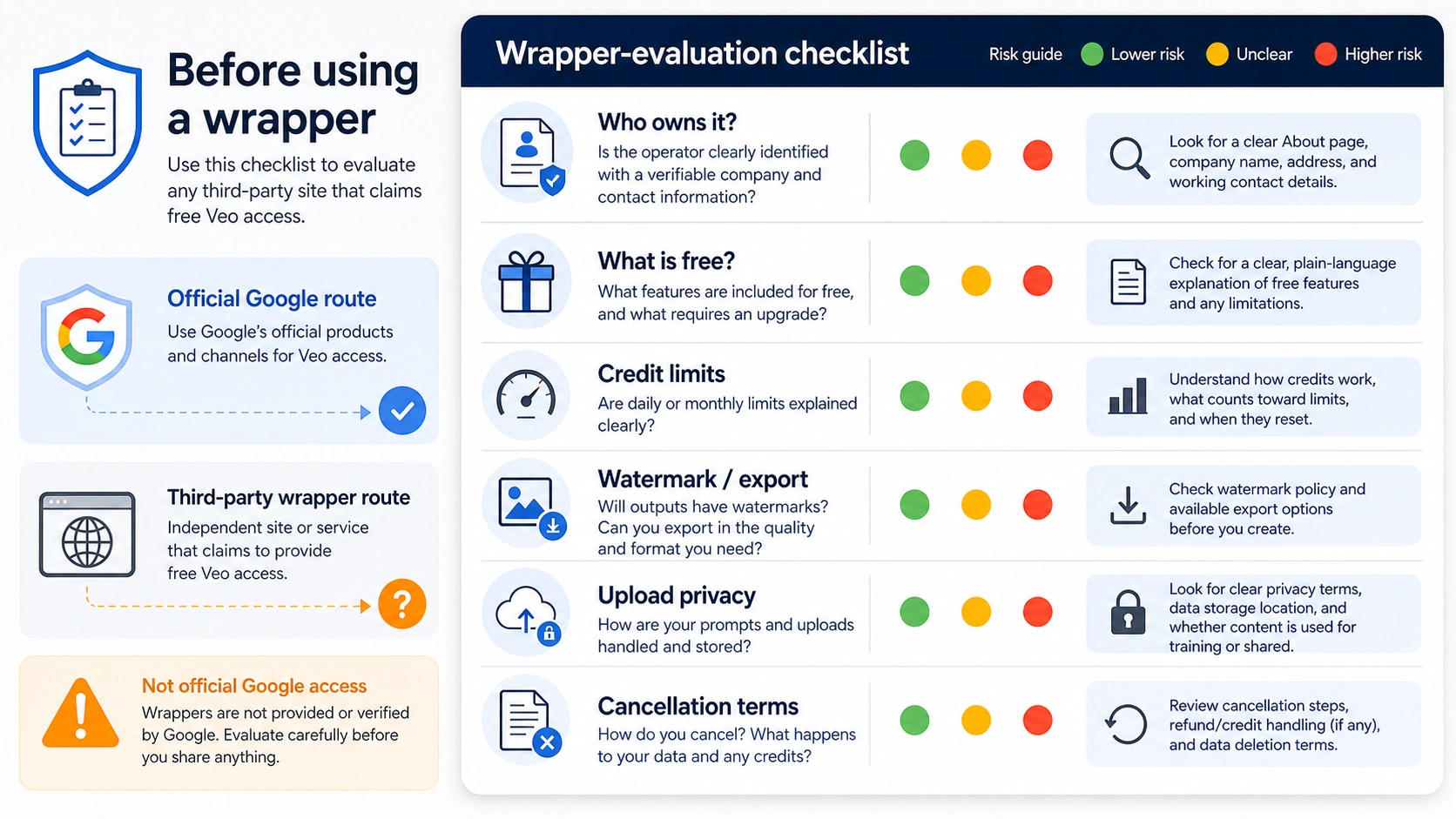
Before uploading text, images, reference frames, voices, or brand assets to a wrapper, check:
| Check | Why it matters |
|---|---|
| Owner | You need to know who operates the service and who supports failures. |
| Model route | "Powered by Veo" can mean official API, provider route, cached demo, or marketing copy. |
| Free scope | A free prompt box may still limit resolution, watermark removal, queue priority, downloads, or commercial use. |
| Credit unit | The wrapper may use its own credits rather than Google Flow or Gemini credits. |
| Upload privacy | Video prompts, faces, logos, and reference media may be stored or reviewed under wrapper terms. |
| Export terms | Watermark, resolution, duration, retention, and reuse rights can change after signup. |
| Cancellation | A trial that asks for payment details should make renewal and cancellation timing visible before upload. |
The safest low-risk wrapper test is a non-sensitive prompt with no private images, no client material, no face, and no brand asset. If the wrapper cannot answer owner, quota, privacy, export, and cancellation questions, do not treat it as a production route.
Which route should you choose?
Use the route that matches the work, not the one with the loudest free claim.
| Reader job | Best first route | Avoid |
|---|---|---|
| Try a few personal prompts | Flow or Gemini credits | Building an API project before you need automation |
| Evaluate an official Google business trial | Google Cloud Veo 3 offer | Assuming the offer covers every account or region |
| Build a backend integration | Gemini API paid-tier route | Treating Google AI plan credits as API quota |
| Learn Cloud basics | Google Cloud Free Trial credit | Assuming the credit pays AI Studio or Gemini API costs |
| Test a wrapper quickly | Non-sensitive wrapper demo | Uploading private media before reading terms |
| Find "unlimited free Veo" | Stop and verify owner, quota, and payment path | Trusting unlimited language without a contract |
The cleanest path for most readers is sequential. First, decide whether you are a consumer creator or a developer. Then choose the Google-owned route if it fits. Only after that should you compare wrappers, provider routes, or model alternatives. If the route still feels unclear, write down the owner, payer, limit source, data terms, and failure support path. If any of those five fields are unknown, the route is not ready for serious work.
FAQ
Does Google Veo 3 have a free trial?
Yes, Google has an official Google Cloud Veo 3 Free Trial Offer page. Treat it as an eligibility-based Cloud offer. It does not automatically make Flow, Gemini app video generation, Gemini API, Cloud Free Trial credit, and third-party wrappers one universal free route.
Is Veo 3.1 free in the Gemini API?
Not as a public free-tier row on the pricing page checked on June 11, 2026. The current Gemini API pricing surface listed Veo 3.1 developer model IDs on the paid tier and showed Free Tier as not available. Recheck the pricing page before building because model IDs, preview status, and pricing rows can change.
Can Google AI Pro, Plus, or Ultra credits be used for API calls?
Do not assume that. Flow and Gemini credits are consumer product credits. The Gemini API is a developer billing surface with its own model rows, tier, project, and billing requirements. If you need API automation, verify the API route directly instead of reading a consumer credit balance.
Do Google Cloud $300 credits pay for Veo or Gemini API?
The Cloud Free Program is a separate Cloud trial program. Google Cloud documentation describes $300 credit for eligible new Cloud customers and also says that the $300 credit cannot pay for Gemini API in AI Studio costs. Confirm the specific billed service before relying on Cloud trial credit.
Are Reddit methods, promo codes, or 15-month free claims reliable?
Treat them as leads, not proof. Promo, student, regional, partner, and account-specific offers can exist without becoming a public default. Use official Google pages or checkout/account surfaces for current eligibility. Do not upload sensitive media or create production plans from a forum claim.
Is there an APK or no-login method for free Veo?
An APK, mirror, or no-login prompt page is not official Google access unless Google itself owns the route. For mobile apps and wrappers, verify the developer, terms, privacy policy, credit model, watermark/export rules, and cancellation path before use.
Can I get unlimited free Veo videos?
No official Google source linked above supports a universal unlimited free Veo entitlement. "Unlimited" language usually belongs to a wrapper, tutorial, or temporary promotion. Ask who pays, what limits apply, what data terms cover uploads, and what happens when the free allowance ends.
Does free access include 4K or commercial use?
Do not assume it. Resolution, watermark, duration, commercial use, retention, and export rules depend on the route and plan. Check the exact Google offer, Flow/Gemini product surface, API row, or wrapper terms before using outputs in client or commercial work.