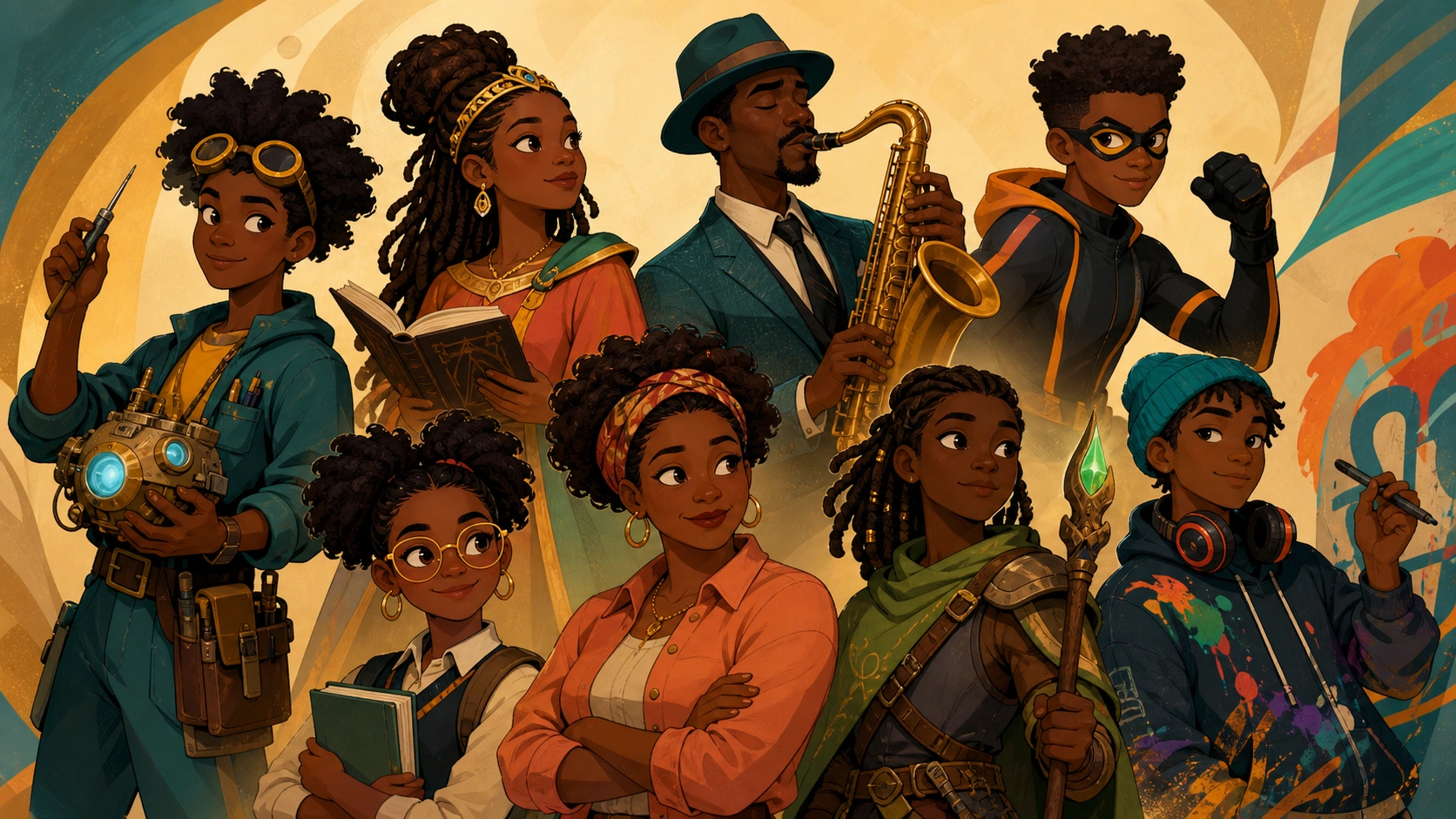
Princess Tiana, Penny Proud, Static, Frozone, Huey and Riley Freeman, Numbuh Five, Susie Carmichael, Gerald Johanssen, Miles Morales, Cyborg, Storm, T'Challa, and Joe Gardner are some of the Black cartoon characters readers usually expect to see named first.
The scope is animated TV and film characters, with comic-origin heroes included only where animated shows or films made them part of the cartoon conversation. This is not a universal ranking; it is a curated map of character names, source context, representation value, and design lessons.
Use the list for recognition and nostalgia, then use the criteria and design section to study what makes a character memorable without copying protected costumes, silhouettes, personalities, or scenes from famous IP.
Start With These Black Cartoon Characters
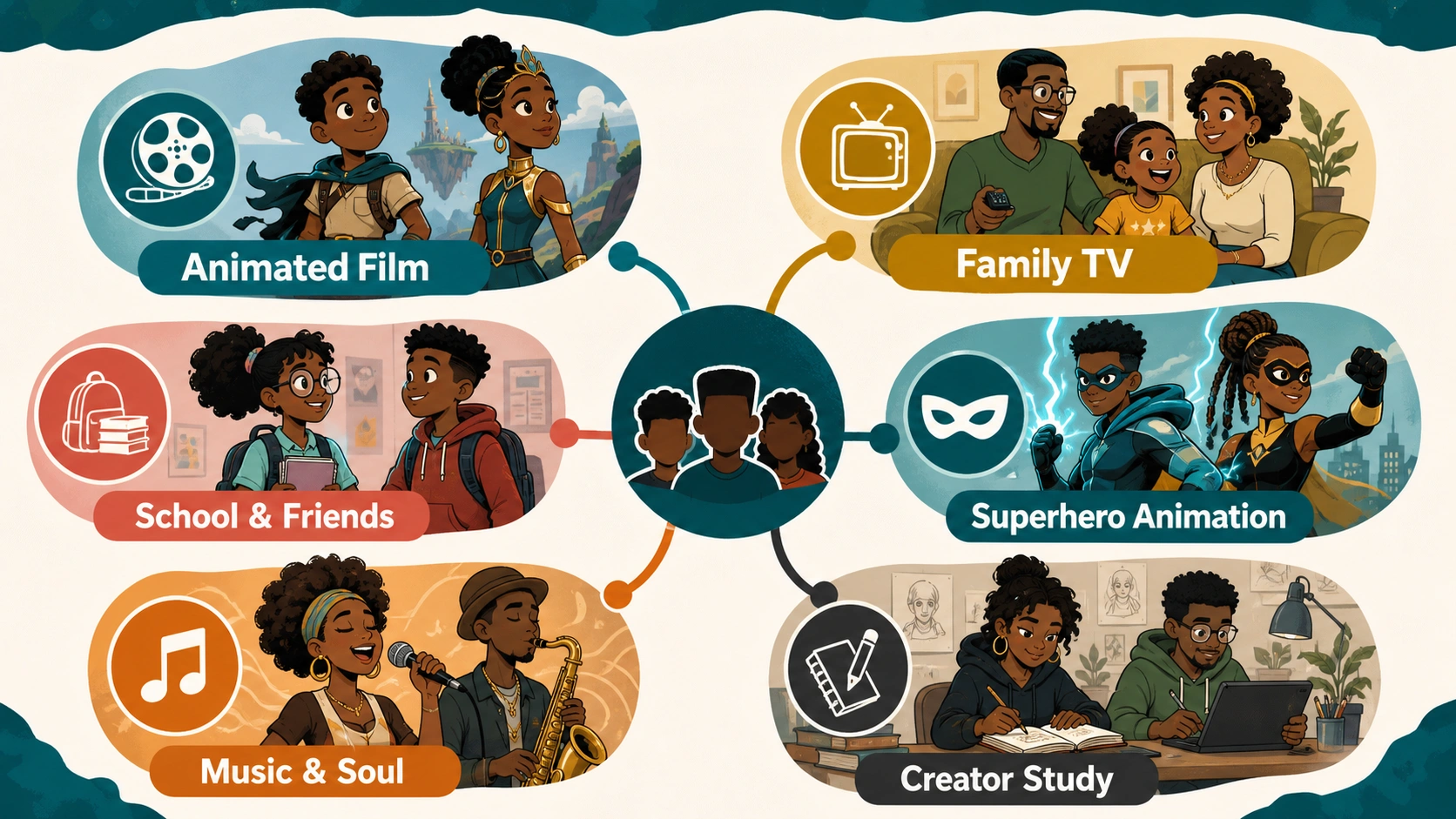
Start with these names because they cover the main ways Black animated characters became memorable: family films, Saturday-morning and after-school television, superhero animation, music-centered stories, and shows where friendship or school life made the character feel familiar.
| Character | Best-known animated context | Why the name belongs in the first answer |
|---|---|---|
| Princess Tiana | The Princess and the Frog | A widely recognized Disney princess whose ambition, work ethic, and New Orleans setting made her central to family animation conversations. |
| Penny Proud | The Proud Family and The Proud Family: Louder and Prouder | A lead character whose family, school, and coming-of-age stories made Black family life part of the show's everyday center. |
| Static / Virgil Hawkins | Static Shock | A teenage superhero whose animated series gave many viewers a Black lead in a Saturday-morning action format. |
| Frozone / Lucius Best | The Incredibles | A memorable Pixar superhero with sharp visual identity, loyalty, comic timing, and instant recognition. |
| Huey and Riley Freeman | The Boondocks | Two brothers whose different personalities turn the same family setup into political satire, social commentary, and character contrast. |
| Numbuh Five / Abigail Lincoln | Codename: Kids Next Door | A cool, competent team member whose design and voice made her stand out inside a large ensemble. |
| Susie Carmichael | Rugrats and All Grown Up! | A neighbor and friend whose confidence, kindness, and musicality gave a young Black girl a strong presence in a major kids' franchise. |
| Gerald Johanssen | Hey Arnold! | A loyal best friend and storyteller figure whose confidence and urban-kid charisma made him more than a sidekick. |
| Miles Morales | Spider-Man animated films and series | A modern superhero whose animated presence expanded what a Spider-Man story could look and sound like. |
| Joe Gardner | Pixar's Soul | A music teacher and jazz pianist whose story connects adulthood, purpose, mentorship, and Black cultural settings. |
That first answer should be name-heavy because most readers arrive wanting recognition. The value comes from what happens next: sorting the names by context, explaining why they matter, and drawing creator-safe lessons from the way memorable characters are built.
Why These Characters Are Memorable
The strongest Black cartoon characters are not memorable because they fit one visual template. They stay in public memory because story function, personality, design, voice, and cultural context all work together.
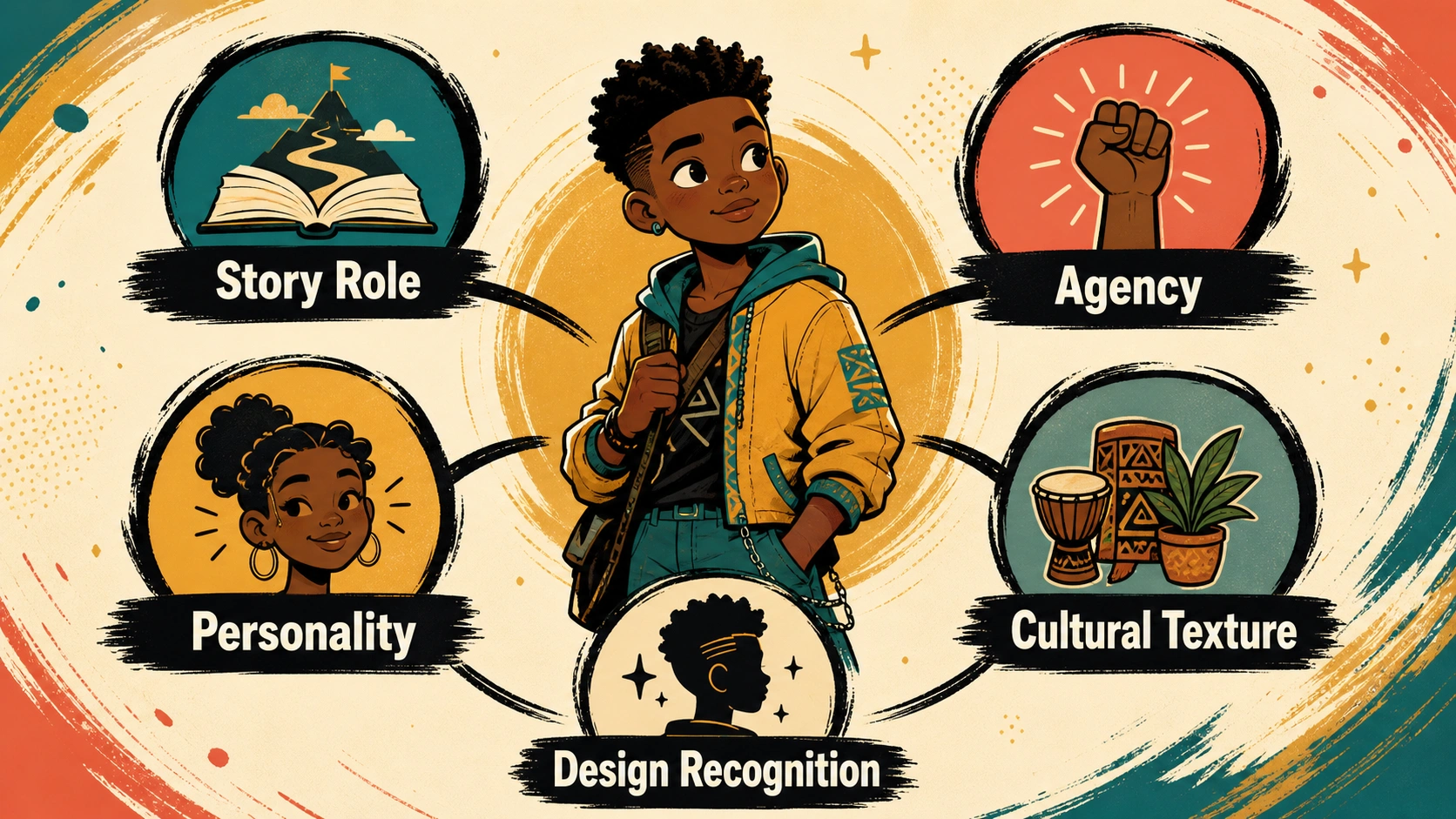
Story role comes first. A lead character like Penny Proud or Static has room to make choices, make mistakes, and change the direction of an episode. A supporting character can still matter when the role is specific: Frozone is not only "the Black superhero friend"; his calm style, ice powers, marriage joke, and tactical competence make him a clear part of The Incredibles world.
Agency matters next. Characters with agency want something and affect what happens. Tiana wants to build her restaurant. Joe Gardner wants a life in jazz before the story forces him to reconsider what a meaningful life includes. Static wants to handle school, family, friendship, and hero work while learning what power costs. Those desires give the character more weight than a visual cameo.
Personality and voice carry the memory. Huey and Riley Freeman are useful examples because they are not interchangeable. Huey is controlled, skeptical, and political; Riley is impulsive, image-conscious, and comic in a different way. The contrast is the engine. For creators studying character design, that lesson is more useful than copying either character's look.
Cultural texture should be specific without becoming a stereotype. Pixar's official material for Soul describes Joe Gardner as a middle-school band teacher and jazz musician, while the film's New York and barbershop settings give his world social detail. Disney's official Tiana material frames her through focus, ambition, and the dream of opening a restaurant. Those concrete story anchors matter more than generic "representation" language.
Design recognition is the final layer. Silhouette, color rhythm, hairstyle, costume logic, posture, and recurring props all help viewers identify a character quickly. That recognition does not require copying a protected design. It means understanding how a character's life and role produce visual choices.
Disney, Pixar, and Family Animation Names
Disney and Pixar examples matter because family animation reaches viewers across generations. They are also the easiest names for many readers to remember first.
Princess Tiana is usually the first Disney name to mention. The official Disney Princess Tiana character page emphasizes her determination and restaurant dream, which is exactly why she should not be reduced to a costume or a color palette. Tiana's design and story work because ambition, setting, food, music, romance, and family pressure all point in the same direction.
Joe Gardner from Pixar's Soul gives a different kind of representation. He is an adult, a teacher, a musician, and a person whose central conflict is not simply proving himself to others. That makes him useful for readers looking beyond children's-show nostalgia. His story shows how a character can be ordinary and philosophical at the same time.
Frozone remains one of the most recognizable Black superhero figures in mainstream animated film. His powers are simple to read, his costume is clean, and his relationship to the Parr family gives him immediate story context. He also shows how a supporting character can become iconic when the performance, visual identity, and comic timing are all distinctive.
Penny Proud belongs in this family-animation cluster even though her main home is television. The Proud Family made Penny's household, friends, school pressure, and teen self-consciousness the center of the story. For many viewers, the importance was not that a Black character appeared; it was that the show gave a Black girl a full everyday world.
Other Disney-family names can belong depending on how broad the list becomes: Doc McStuffins for preschool animation, Moon Girl / Lunella Lafayette for superhero science energy, and characters from ensemble films or series where Black family life and friendship are not just background decoration. The key is to explain the role instead of padding the list.
TV Animation Characters to Know
Television animation often builds deeper attachment than a film because viewers meet the same character repeatedly. That is why Nickelodeon, Cartoon Network, Adult Swim, Disney Channel, and PBS-era memories show up so often in conversations about Black cartoon characters.
Susie Carmichael from Rugrats is a strong example of a supporting character with presence. She is kind without being bland, talented without being unreachable, and confident enough to stand up to Angelica. Her role works because she changes the social balance of the group.
Gerald Johanssen from Hey Arnold! is another classic television example. He is Arnold's best friend, but he also carries his own aura: streetwise, funny, expressive, and often the keeper of neighborhood stories. That storyteller function makes him part of the show's texture, not just a friend-shaped accessory.
Numbuh Five, Abigail Lincoln, from Codename: Kids Next Door shows how a character can become memorable through competence. She has a cool visual read, a steady attitude, and a team role that makes her feel reliable. For creator analysis, she is a reminder that "cool" usually comes from behavior and rhythm, not only outfit design.
Huey and Riley Freeman from The Boondocks are more complicated because the show is sharper, older-skewing satire. They still belong in the conversation because the characters became culturally recognizable through animation. They also show why representation discussions need nuance: the same family can hold radically different political, comic, and emotional energies.
Franklin from Peanuts is worth mentioning as a historical television and comics-adjacent figure. He is not built like modern character-centered animation, but his presence matters in a different way: he reflects an earlier stage of Black representation in mainstream cartoon culture, where inclusion itself carried significance even when the characterization was quieter.
Superhero Animation and Comic-Origin Characters
Comic-origin characters should not automatically dominate a list of Black cartoon characters, but they belong when animated shows and films made them part of the viewer's cartoon memory.
Static is the clearest case. DC's Static material identifies Virgil Hawkins as the hero behind Static, and Static Shock gave him a complete animated identity: school, neighborhood, friendship, family, villains, and powers. The reason Static matters is not only that he is a Black superhero; it is that the animated version let viewers spend time with a Black teenager learning how to live with power.
Miles Morales belongs because animation made him globally visible in a new way. The Spider-Verse films use movement, music, comic-panel texture, family pressure, and bilingual New York energy to make Miles more than a replacement Spider-Man. He carries his own rhythm, which is the real design lesson.
Cyborg, Victor Stone, is another major animation name through Teen Titans, Teen Titans Go!, and DC animated projects. He often carries the team-tech role, but the best uses of Cyborg also deal with body, identity, humor, and belonging. Those tensions make him more than a mechanical silhouette.
Storm, Ororo Munroe, enters through X-Men animation for many viewers. She is not always framed as a "cartoon character" first because her comic history is so large, but animated series made her voice, powers, poise, and leadership legible to a broad audience.
T'Challa / Black Panther also belongs with a scope note. He is a comic and film character first, but animated series and episodes have made him part of children's and superhero-animation lineups. When including him, keep the context precise: he is a Black animated superhero when the discussion is about his animated appearances, not because every version of the character is a cartoon.
Boundary Notes: Anime, Games, and Black-Coded Characters
The phrase Black cartoon characters can stretch in several directions, so a useful list needs boundaries.
Anime is the first boundary. Some readers include anime when they say cartoon; others separate anime as its own animation tradition. Characters such as Afro Samurai, Killer B from Naruto, or Canary from Hunter x Hunter may appear in broader Black animated character discussions, but they are better handled in a separate anime-specific section or list. Mixing them casually with U.S. television and film animation can flatten very different production contexts.
Games are the second boundary. A character from a video game may be animated, but that does not automatically make the character a cartoon character. Game-origin characters belong only when the reader's intent clearly includes animated adaptations, cutscenes, or cartoon-style media.
Black-coded characters are the third boundary. Some animated characters are read by audiences as Black-coded because of voice performance, music, styling, dialect, cultural references, or design cues, even when the story does not explicitly name race. That can be a valid media-analysis conversation, but it should be labeled as interpretation, not treated as confirmed identity.
The final boundary is color confusion. "Black cartoon characters" usually means Black people in animation, not characters who are colored black, wear black clothing, or have a dark costume. A list about characters wearing black would be a different reader job.
How to Design an Original Black Cartoon Character Safely
For creators, the safer move is to borrow design principles, not a named character's identity. Do not ask an image model, illustrator, or designer to make "a character like Tiana," "a Black Frozone," or "Miles Morales but different." That prompt still points the work toward protected expression and often produces weaker character design.
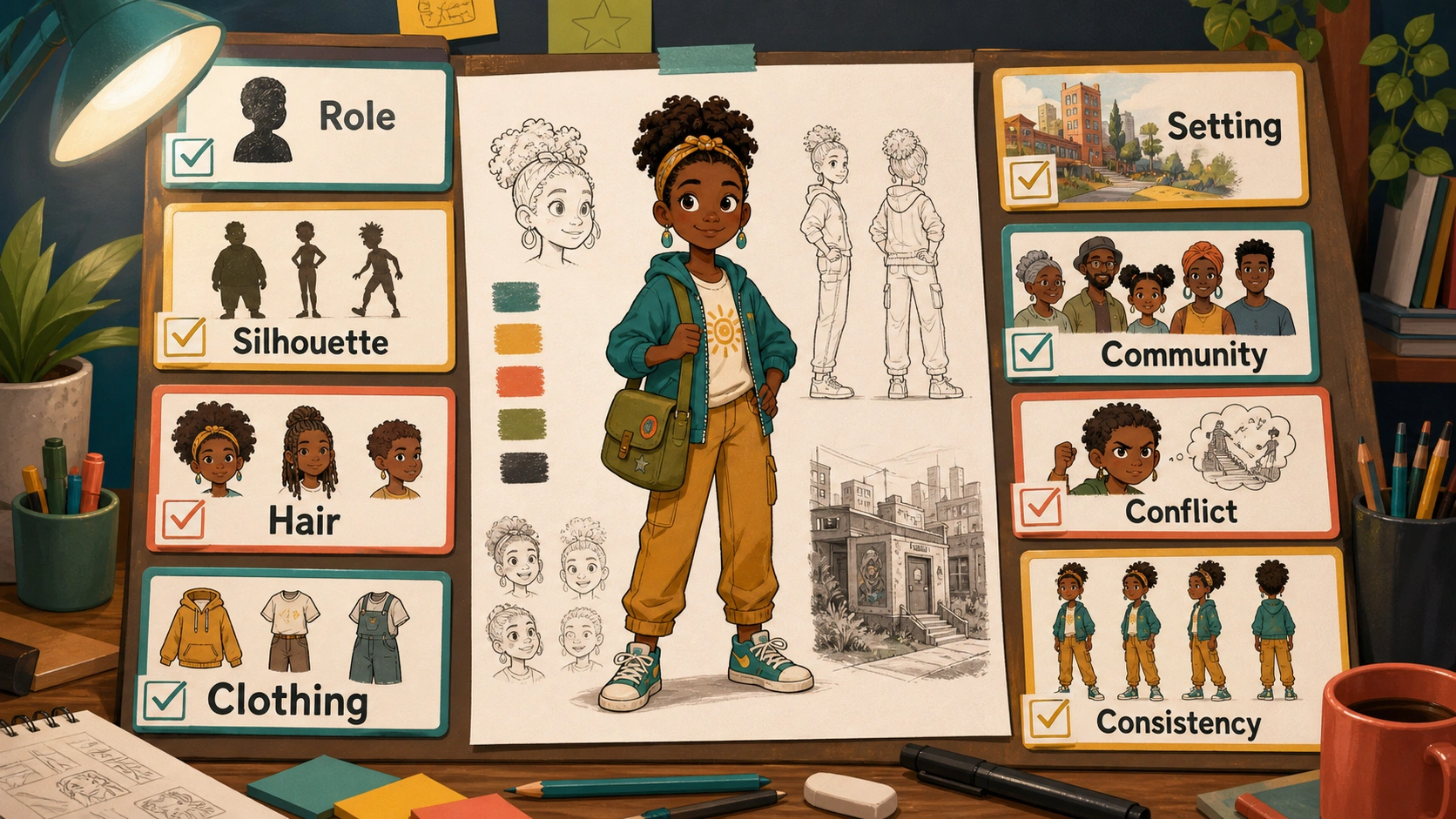
Start with role. Decide whether the character is a lead, rival, mentor, sibling, trickster, inventor, musician, athlete, or reluctant hero. Role controls what the character does in scenes.
Build personality before outfit. A cautious young inventor, a loud class clown, a disciplined dancer, and a tired single parent should not stand the same way, speak with the same rhythm, or choose the same clothes. Personality gives the design pressure.
Make silhouette and movement distinct. A character can be recognizable through posture, hair shape, bag, headphones, jacket cut, walking rhythm, or the way they hold tools. Distinct silhouette is safer and more original than borrowing a famous costume.
Treat hair, skin tone, clothing, and setting with specificity. "Black character" is not a finished design brief. Think about age, region, family background, subculture, climate, school or work setting, and daily routine. Specificity keeps the design from becoming generic or stereotyped.
Give the character community. Memorable characters rarely exist alone. Family, classmates, bandmates, neighbors, rivals, and mentors give the character a world. That world also prevents the design from leaning too heavily on one visible identity trait.
Define conflict. What choice does the character keep facing? Tiana's ambition matters because the story tests it. Static's powers matter because they complicate school, family, and responsibility. A new original character needs a pressure point just as much as a look.
If AI image generation is part of the workflow, use an original brief and a consistency process. A good starting prompt describes role, personality, silhouette, setting, and visual style without naming a famous character. For multi-scene work, pair that with a reference and consistency workflow such as a consistent character generator, but keep the reference original. Copyright guidance from the U.S. Copyright Office and WIPO is a useful reminder of the broad boundary: ideas and concepts are different from the specific protected expression of a character design. This is creative safety guidance, not legal advice.
FAQ
Who are the most famous Black cartoon characters?
Princess Tiana, Penny Proud, Static, Frozone, Huey and Riley Freeman, Numbuh Five, Susie Carmichael, Gerald Johanssen, Miles Morales, Cyborg, Storm, T'Challa, and Joe Gardner are among the most recognizable names. The exact list changes depending on whether the scope includes films, TV, anime, comics adapted into animation, or video games.
What cartoons have Black main characters?
Examples include The Proud Family, Static Shock, Craig of the Creek, Moon Girl and Devil Dinosaur, Doc McStuffins, The Boondocks, and Soul if animated films are included. Some shows have Black leads; others have major ensemble characters who became memorable without owning the whole story.
What are some Black Disney characters?
Princess Tiana, Penny Proud, Joe Gardner, Frozone, Doc McStuffins, Lunella Lafayette / Moon Girl, and Libby Stein-Torres are commonly cited Disney or Disney-owned animation examples. Keep the list scoped: Disney princesses, Pixar films, Disney Channel series, and Marvel animation all sit under different brand contexts.
Is Miles Morales a Black cartoon character?
Miles Morales is Afro-Latino and belongs in many Black animated character discussions when the scope includes animated superhero films and series. The best wording is precise: he is an Afro-Latino animated superhero whose Spider-Verse appearances made him one of the most visible modern examples.
Should anime characters be included?
Only if the list explicitly includes anime. Many readers use cartoon broadly, but anime has its own production history, fan vocabulary, and representation debates. A clean article can mention the boundary, then handle anime in a dedicated section or separate list.
Can I use AI to create a character inspired by famous Black cartoon characters?
Yes, if the inspiration stays at the level of principles: role, agency, silhouette clarity, expressive movement, community, and conflict. Do not prompt for a named character's costume, face, color scheme, pose, or franchise world. Build an original brief first, then use references only from assets you own or have permission to use.