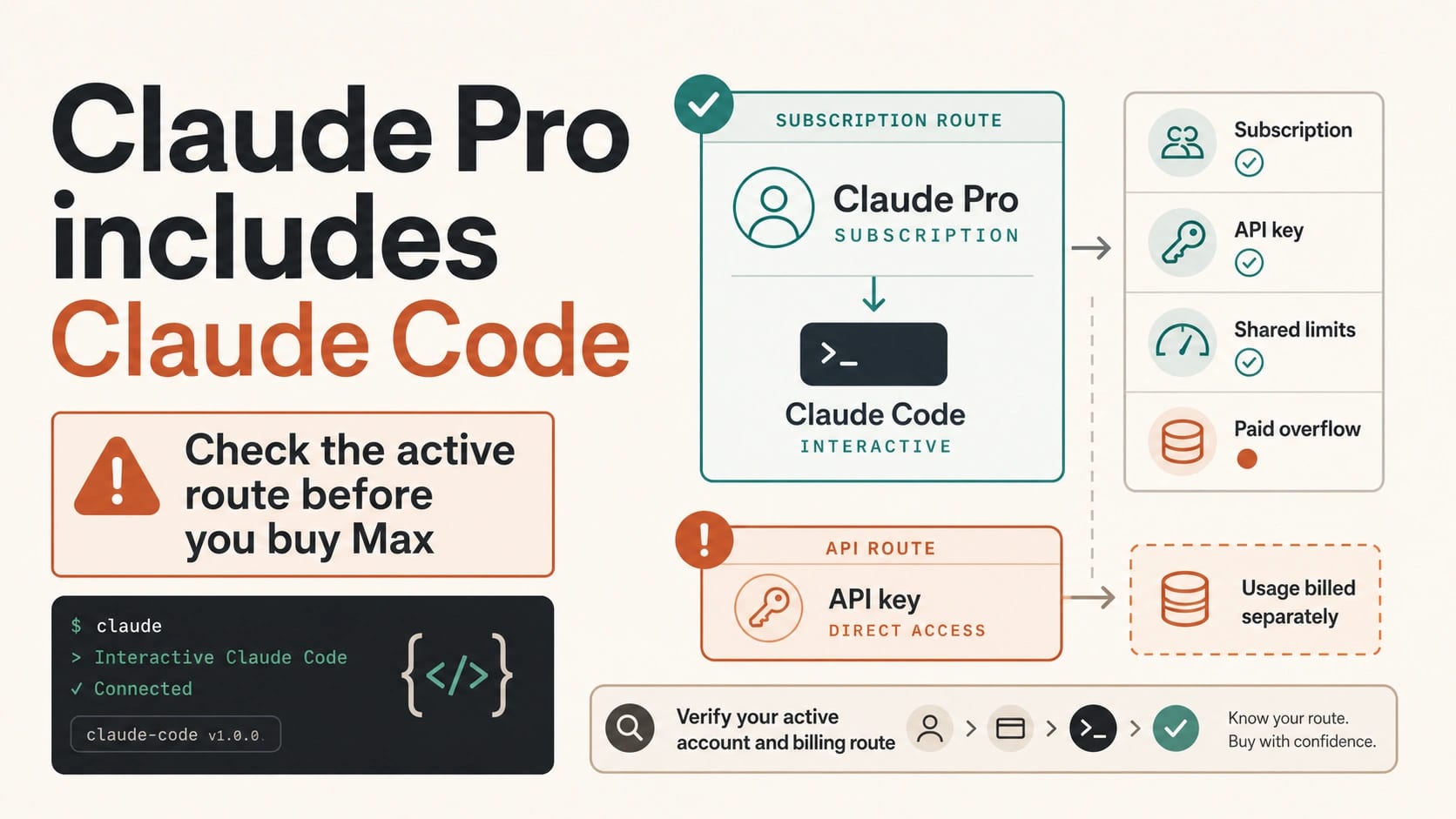
Yes. As of July 13, 2026, Anthropic lists interactive Claude Code as included with Claude Pro. Pro is $20 per month in the United States, or $200 per year, but the subscription does not include Claude Console API usage and its included Claude/Claude Code capacity is limited.
If Claude Code asks for API credits, stops earlier than expected, or appears to require Max, do not treat that symptom as proof that Pro lost access. The signed-in Claude account, an ANTHROPIC_API_KEY override, the shared subscription meter, and the usage-credit setting can each change what you see and who pays for the next request.
This answer is for interactive Claude Code after subscription login. Anthropic documents non-interactive claude -p, the Agent SDK, and third-party integrations on a separate policy surface, so verify that surface before assuming the interactive subscription contract applies unchanged.
| What you see | Likely owner | First proof | Next action |
|---|---|---|---|
| Claude Code is not using your Pro access | Account route | Run /status and confirm the active Claude account. | Use /logout, then /login with the subscribed account. |
| Requests appear on an API bill | API-key route | Inspect whether ANTHROPIC_API_KEY is set. | Remove the override for subscription use, or keep it knowingly for API billing. |
| Interactive work stops at a limit | Shared Pro meter | Check the usage state shown by /status. | Wait for reset or enable paid usage credits if continuity is worth API-rate billing. |
| The route is correct but capacity is repeatedly too small | Workload capacity | Compare a normal week of demand with Pro's included allocation. | Consider Max only for more recurring included capacity. |
Stop before you buy Max: run /status, confirm the signed-in account, and inspect ANTHROPIC_API_KEY. Max adds included capacity; it does not repair an accidental API-billing route.
What Claude Pro includes today
Claude Pro's current plan boundary is straightforward. The Claude pricing page lists Claude Code inside Pro, and Anthropic's Pro plan guide names Claude Code as a Pro benefit. The public US price is $20 when billed monthly or $200 when billed annually, equivalent to $17 per month. Taxes, mobile-store billing, currency, and regional availability can change what a particular account sees.
That purchase gives one person higher-capacity access to Claude's consumer surfaces and interactive Claude Code through the same subscription login. Anthropic's Claude Code plan guide covers terminal use and supported IDE integrations. It does not turn the personal subscription into a Claude Console API balance.
This distinction prevents three different questions from collapsing into one:
- Access: can the signed-in Pro account open and use interactive Claude Code?
- Capacity: how much included use remains in the shared plan allocation?
- Billing: is the request using the subscription, a separately funded usage-credit balance, or an API key tied to a Console account?
A “yes” to access does not answer the other two. A Pro user can be correctly signed in and still reach a limit. The same user can also have a valid Pro subscription while a local API key sends requests to API pay-as-you-go billing. Diagnose the owner of the next request before changing the plan.
Diagnose who owns the next Claude Code request
Start inside Claude Code with /status. Anthropic uses that command as the first place to inspect account, plan, and usage state. If the active account is not the one that owns Pro, use /logout, then /login and select the subscription account. Running claude update first is sensible when an old client does not show the current login or status behavior.
An API key changes the answer even when the account is correct. Anthropic states that ANTHROPIC_API_KEY takes precedence over an authenticated Pro or Max subscription. When the variable is active, Claude Code can bill the API account associated with that key rather than draw from the subscription allocation. This is useful for an intentionally managed Console workflow, but surprising when an old shell profile, IDE environment, or team setup supplies the key silently.
On macOS or Linux, this check reports only whether the variable exists; it does not print the secret:
hljs bashif [ -n "${ANTHROPIC_API_KEY:-}" ]; then
echo "ANTHROPIC_API_KEY is set"
else
echo "ANTHROPIC_API_KEY is not set"
fi
If the variable is set and you intend to use the subscription, follow Anthropic's API-key environment-variable guidance. Unsetting it in one terminal may not be enough if a shell profile, IDE, container, or launcher restores it. Reopen Claude Code and run /status again after the change. If the key belongs to a team or automated workflow, do not remove it globally until the owner confirms the intended billing route.
Usage credits are a third route, not a hidden Pro bonus. A paid-plan user can deliberately fund a balance so work continues after included limits are reached. The continuation is billed at standard API rates and remains separate from the subscription charge. Check the usage setting and the funded balance before assuming a credit prompt means the login failed.
The diagnosis is complete only when three facts agree: /status shows the intended Claude account, the environment has no unintended API-key override, and the usage surface shows the meter you meant to fund. If those facts agree and interactive Claude Code still denies access rather than reporting a capacity stop, collect the exact message, time, client version, and account surface before contacting Anthropic support.
A limit message is not an access change
Claude Pro includes Claude Code, but neither Pro nor Max is unlimited. Anthropic's Pro documentation describes a session-based limit that resets roughly every five hours and a weekly limit shared across all models. The included allocation is also shared between Claude and interactive Claude Code, so a long Claude conversation can reduce what remains for a coding session, and the reverse is true.
Anthropic does not promise one universal prompt count. Repository size, selected model, context length, attached files, tool use, and demand all affect consumption. A fixed “messages per day” estimate is therefore a poor basis for a purchase. The useful evidence is the status of the signed-in account and meter when the interruption occurs.
A capacity stop normally leaves the account relationship intact: /status still shows the expected subscription, and the message points to usage or a reset window. An access-route problem looks different. The wrong account may be active, the client may be logged out, or an API-key route may own the requests. That is why buying Max before checking the route is risky: a larger subscription allowance cannot fix a session billed through the wrong key.
When the shared limit is the real owner, the first decision is whether the work can wait. Waiting for the next reset costs nothing. For future sessions, narrower context and a more focused task can reduce avoidable consumption, but they do not erase the weekly limit or guarantee a particular number of turns. If interruptions are occasional, that is usually a better response than changing a recurring subscription.
Choose the least expensive continuation contract
Once the account and billing route are correct, choose continuity by urgency rather than frustration. There are three practical responses to an exhausted included allocation.
| Choice | Best fit | Who bills it | Stop rule |
|---|---|---|---|
| Wait for reset | Work can pause and interruptions are occasional. | No additional charge beyond Pro. | Do not buy capacity to solve a one-off long session. |
| Fund usage credits | A deadline makes occasional paid overflow worthwhile. | Separate usage-credit balance at standard API rates. | Confirm the active meter and spending controls before continuing. |
| Move to Max | Shared limits repeatedly interrupt a normal work week. | Higher monthly Claude subscription. | Upgrade only after observing recurring demand on the correct route. |
Anthropic's usage-credit guide describes paid continuation after the included limit. It is useful when the value of finishing now exceeds the variable cost. It is not free credit, and it does not change the five-hour reset rhythm of the included plan. Treat the balance and any spending cap as a separate budget.
Max is the recurring-capacity choice. Anthropic currently prices Max 5x at $100 per month and Max 20x at $200 per month; both are monthly subscriptions and both remain limited. The labels describe more included usage than Pro, not a guarantee that every workload will run uninterrupted. Before upgrading, record a representative week: how often the correct Pro route stops, how long the waits are, and whether paid overflow would have cost less than the price difference.
API pay-as-you-go serves a different owner. It may be the right route for a Console-managed budget, scripts, or work that should not belong to one person's subscription. It also creates separate rate limits and variable charges. For a deeper cost boundary, use the dedicated Claude API pricing versus subscription guide rather than treating an API key as a way to “extend Pro.”
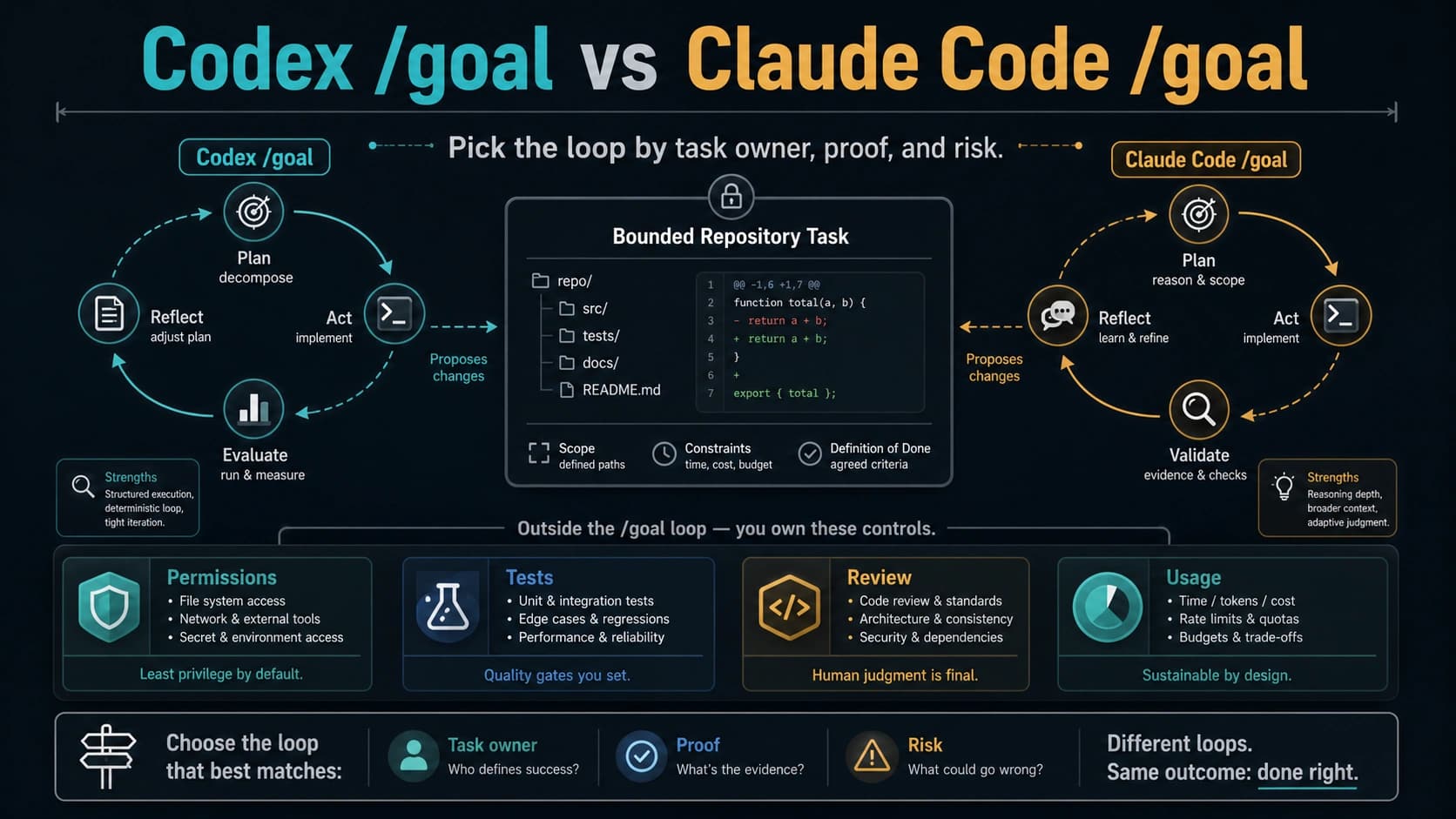
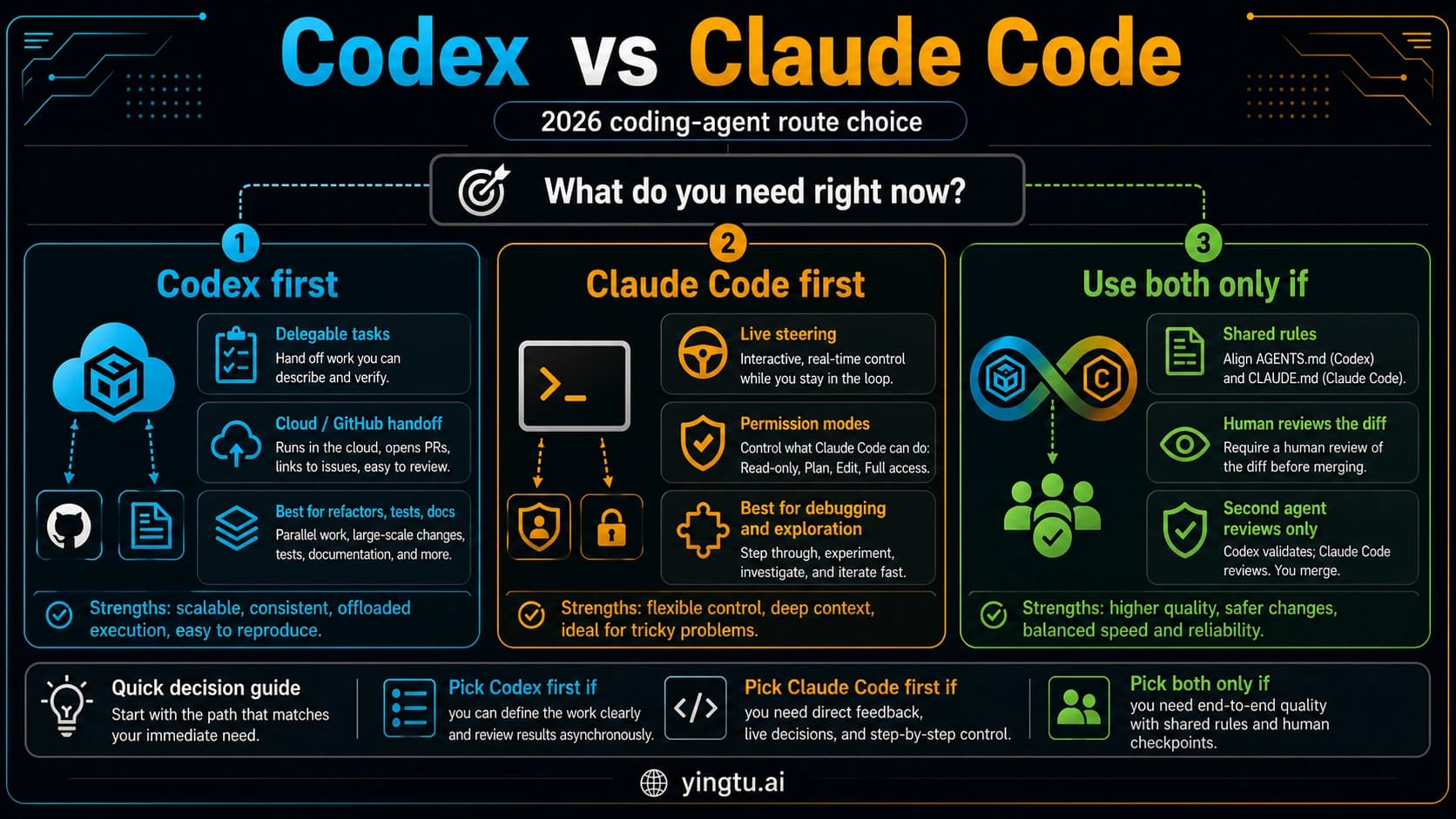
If the account route is correct and capacity is adequate but the workflow itself is a poor fit, that is a tool-choice question rather than a plan-status question. The Codex versus Claude Code comparison separates interactive terminal work from queue-and-review workflows. Do not switch tools merely to escape a billing route that has not yet been diagnosed.
Interactive use and automation need separate checks
Interactive Claude Code has the clearest subscription path: sign in with the Pro account, use the terminal or a supported IDE, and share the plan's allocation with Claude. Non-interactive claude -p, the Claude Agent SDK, and third-party integrations have been the subject of a separate policy change, so old announcements can be misleading.
As of July 13, 2026, Anthropic's Agent SDK plan page says the announced separation planned for June 15 is paused. For now, Agent SDK, claude -p, and third-party app usage continue to draw from subscription limits. The monthly SDK credit described in the earlier announcement is not currently available.
This is a volatile boundary. Do not budget a production automation around the paused announcement or assume the present arrangement is permanent. Before launching a scheduled job or third-party integration, reopen the policy page, identify whether the process uses subscription authentication or an API key, and decide which account owns cost, rate limits, and failure handling. If an API key is present, its billing precedence still matters.
Why older April 2026 articles disagree
The conflicting claims came from a real but limited event. Around April 21–22, Anthropic changed public plan copy in a way that made Claude Code appear absent from Pro. Contemporaneous reporting quoted Anthropic describing the change as a test affecting roughly 2% of new prosumer signups. The same incident-time statement said existing Pro and Max subscribers were not affected.
That evidence explains old screenshots; it does not own today's entitlement. Current Anthropic pricing and Help Center pages include Claude Code with Pro. The narrow lesson is that plan packaging and public copy can change, so a dated article or social image should never outrank the live plan, account, and checkout surfaces for a new purchase.
The incident-time reassurance is not a permanent renewal guarantee either. If Anthropic changes packaging again, judge the change from the notice attached to the account, the plan page available in the reader's region, and the current Claude Code Help Center—not from the fact that an earlier test was reversed.
Recheck the contract in two minutes
Use the same short audit before subscribing, renewing, enabling paid continuation, or moving to Max:
- Open Claude plans and pricing and confirm that the Pro card still names Claude Code.
- Open the current Pro plan and Claude Code plan-access guides for the plan/API and limit boundaries.
- Run
/statusand confirm the signed-in account, plan, and usage state. - If the account is wrong, use
/logoutand/login; update the client if the expected route is unavailable. - Check whether
ANTHROPIC_API_KEYis set without printing the key, then confirm whether subscription or API billing is intentional. - Review usage credits before funding them, and compare Max only after the correct Pro route has shown repeated capacity pressure.
- For
claude -p, the Agent SDK, or a third-party app, recheck the separate automation policy immediately before relying on it.
Free credits, guest passes, gifts, and alternative backends belong to a different access decision; see the Claude Code free-access guide. A promotion or trial is also separate from normal Pro entitlement and is covered in the Claude Pro trial guide. If the symptom is a concrete 429 rather than the shared plan meter, use the Claude rate-limit error guide so an API error is not misdiagnosed as a subscription change.
FAQ
Is Claude Code included in Claude Pro right now?
Yes. As of July 13, 2026, Anthropic's pricing and Help Center pages include interactive Claude Code with Pro. The subscription has shared usage limits and does not include Claude Console API usage.
How much does Claude Pro cost?
The current public US price is $20 per month or $200 billed annually, equivalent to $17 per month. Taxes, currency, region, and mobile-store billing may change the amount shown to a particular account.
Does Claude Pro include API credits?
No. A Pro subscription and Claude Console API billing are separate. Usage credits for paid-plan overflow are also separately funded and charged at standard API rates; they are not free API credits included with Pro.
Why is Claude Code charging my API account when I have Pro?
Run /status, then check whether ANTHROPIC_API_KEY is set. Anthropic says that environment variable takes precedence over subscription authentication and bills the API account associated with the key.
Does Pro include unlimited Claude Code usage?
No. Pro has a session limit that resets roughly every five hours and a weekly all-model limit. Claude and interactive Claude Code share the plan allocation, and actual consumption varies by model, context, files, tools, and demand.
What are Claude usage credits?
Usage credits are paid overflow for Pro and Max users who want to continue after included limits are reached. They use a separately funded balance at standard API rates and do not turn the subscription into an unlimited plan.
Do I need Max to use Claude Code?
No. Pro currently includes interactive Claude Code. Max is appropriate when the correct Pro route repeatedly lacks enough included capacity; it should not be the first response to a wrong account or API-key override.
Are Agent SDK and claude -p included with Pro?
Anthropic currently says the announced June separation is paused, so Agent SDK, claude -p, and third-party app usage still draw from subscription limits. The announced monthly SDK credit is not available. Recheck the policy before budgeting automation because this boundary can change.
Was Claude Code removed from Pro in April 2026?
Anthropic tested a packaging change for roughly 2% of new prosumer signups, according to incident-time reporting, and public copy briefly made the change look broader. Current official pages include Claude Code with Pro, so the April event is historical context rather than the present plan contract.