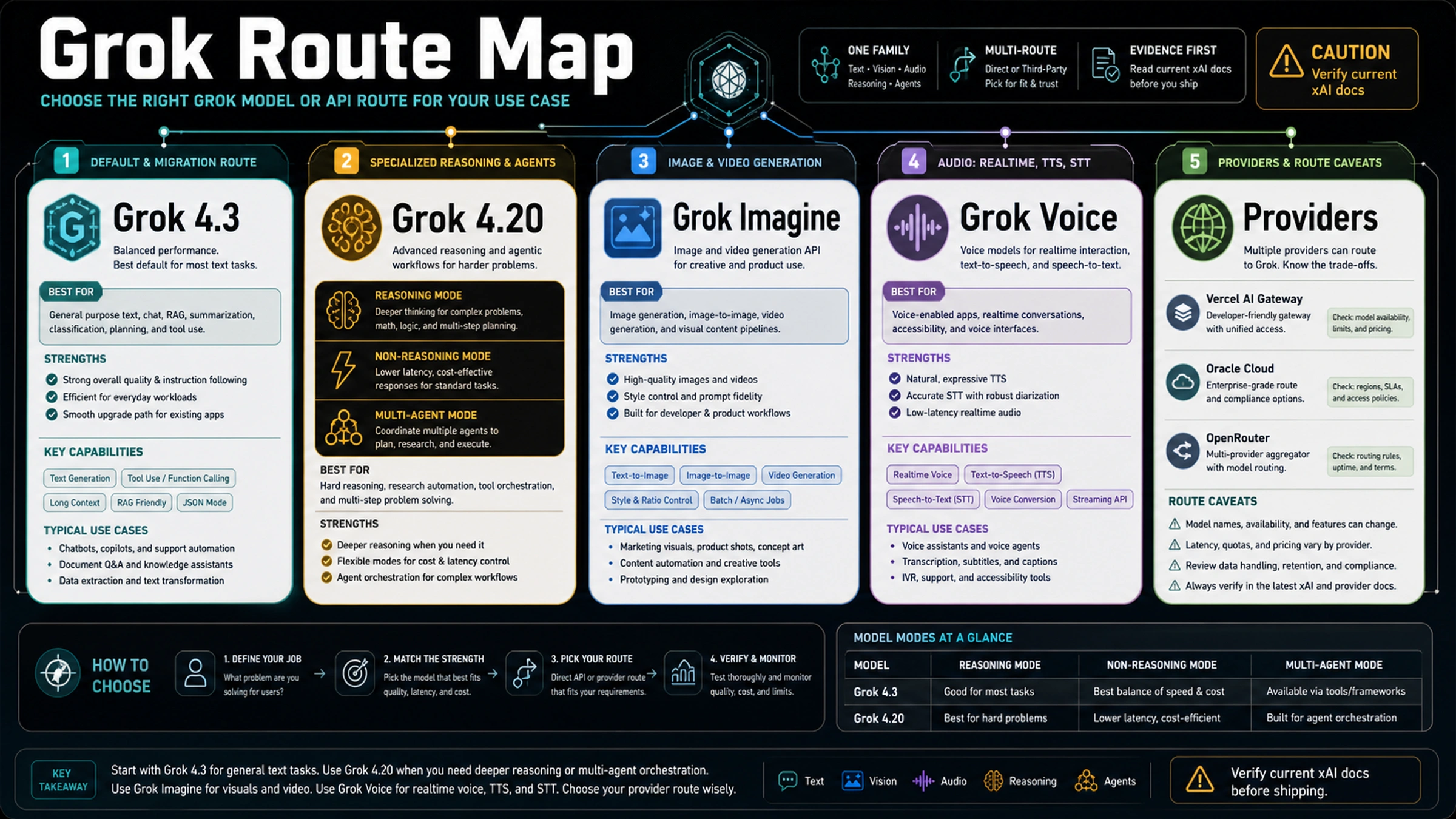
If you are choosing a Grok route now, start with grok-4.3 for most new or migrated text API work. Keep Grok 4.20 for specialized reasoning, non-reasoning, 2M-context, provider, or multi-agent cases. Treat Grok Imagine and Grok Voice as separate image/video and audio API families, not as text-model upgrades.
| Route | Use it when | Verify | Caveat |
|---|---|---|---|
| Grok 4.3 | You need the current first-party text model for new or migrated API work. | xAI model docs, grok-4.3 aliases, context, pricing, and migration notes. | Exact price, context, alias, and availability are freshness-sensitive. |
| Grok 4.20 reasoning / non-reasoning | You have a specific reasoning, latency, 2M-context, beta, or provider-visible requirement. | xAI or provider model IDs and supported modes. | Do not treat every 4.20 label as a universal successor to 4.3. |
| Grok 4.20 multi-agent | The task benefits from parallel agents, tools, and deeper research or coding work. | Responses API multi-agent support, agent count, tool use, and billing behavior. | Multi-agent can multiply tokens and cost; prove the workload first. |
| Grok Imagine | You need image or video generation. | grok-imagine-image, grok-imagine-video, endpoint, quality, duration, and migration notes. | Imagine is a media route, not a chat-model mode. |
| Grok Voice | You need realtime voice, speech-to-text, text-to-speech, or custom voices. | Realtime, TTS, STT, voice-agent, and custom-voice docs. | Voice is an audio route with its own endpoint and price surface. |
| Provider routes | You are using Vercel, Oracle, OpenRouter, or another gateway. | That provider's model page, pricing, limits, and deployment contract. | A provider listing does not prove first-party xAI availability or parity. |
Stop rule: do not choose multi-agent or a provider alias until you know the route owner, endpoint family, cost surface, and workload. If the job is image/video or voice, leave the text-model comparison and verify the Imagine or Voice route directly.
Start with the route, not the release name
Grok model names now mix at least five different contracts: first-party xAI text models, older or specialized 4.20 variants, multi-agent orchestration, image/video generation, and audio/realtime voice. The practical mistake is treating those names as one ladder where a larger number always wins. In an API implementation, the safer first question is narrower: which route owns the workload, which model ID or endpoint does that route require, and who owns the availability claim?
As of May 8, 2026, xAI's Grok 4.3 model page lists grok-4.3, grok-4.3-latest, and grok-latest as current text-model names, with configurable reasoning effort including none, low, medium, and high. xAI's May 15 retirement guide also recommends grok-4.3 as the replacement path for several older Grok 4, Grok 3, reasoning, non-reasoning, and coding model IDs. That makes Grok 4.3 the clean default for most new or migrated first-party text API work.

Grok 4.20 still matters, but not as a blanket replacement. xAI's Grok 4.20 reasoning page lists a 2M context window and aliases such as grok-4.20, grok-4.20-reasoning, and beta names. Provider pages also expose 4.20 variants. Those are useful when the workload specifically needs the 4.20 branch, but they should not erase the simpler migration rule: use Grok 4.3 first unless the workload proves the need for a narrower 4.20 mode.
When Grok 4.3 should be the default
Use Grok 4.3 when the job is a normal text API integration: customer support, business workflow automation, extraction, summarization, classification, RAG answer generation, writing assistance, or a migration away from older Grok model IDs. The reason is operational, not promotional. A current first-party model with documented aliases, reasoning controls, and migration guidance gives a cleaner contract than a beta alias or provider-specific route when the main risk is shipping a stable integration.
The most useful Grok 4.3 test is small and explicit. Pick grok-4.3 or grok-4.3-latest, set reasoning effort deliberately, run the same prompt set through your expected request shape, and record latency, output quality, token use, refusal behavior, and error handling. If the workload does not need extended context, multi-agent orchestration, media generation, or voice, this first test will usually answer the implementation question faster than jumping into every visible Grok name.
Non-reasoning workloads do not automatically require a different model family. The migration guidance points non-reasoning replacements toward grok-4.3 with reasoning effort set to none. That is a valuable distinction because it keeps the route on the current first-party model while still letting the request avoid deliberate reasoning overhead. If the output is a fast direct answer, classification, or formatting task, test grok-4.3 with reasoning_effort: none before searching for a separate non-reasoning alias.
Keep the exact price and context numbers close to the source that owns them. On May 8, 2026, the Grok 4.3 page listed a 1M token context window and API pricing of $1.25 per 1M input tokens and $2.50 per 1M output tokens. Those values belong in a dated budget note, not in permanent product copy. Before a production rollout, re-open the current model page and console because geography, account limits, rate limits, and availability can vary.
When Grok 4.20 still belongs in the decision
Keep Grok 4.20 in the decision when the workload is specifically about the 4.20 reasoning branch, a 2M-context experiment, a provider catalog that exposes a 4.20 variant, or a beta surface your team has already validated. The xAI reasoning page and provider docs make the name real, but real does not mean universal. It means the developer must decide whether the 4.20 contract is the owner of the job.
The reasoning branch fits complex logic, long analysis, or research-style work where a deeper answer is worth the additional evaluation time. Oracle's OCI documentation, for example, separates reasoning and non-reasoning Grok 4.20 modes and describes reasoning as the better fit for complex analysis, while non-reasoning is framed around speed and throughput. That is useful provider-route confirmation, but it is still an OCI route, not a first-party xAI promise for every account and every endpoint.
The non-reasoning branch is narrower. Vercel's AI Gateway page describes Grok 4.20 Non-Reasoning as a beta speed/direct-answer model and exposes a provider-specific model string, xai/grok-4.20-non-reasoning. That can be exactly what a Vercel AI Gateway user needs. It is not proof that every first-party xAI setup should migrate away from grok-4.3 with reasoning set to none.
Use this split in code review:
| Need | Safer first test | Escalate only if |
|---|---|---|
| Current first-party text model | grok-4.3 | 4.3 fails a workload-specific acceptance test. |
| Direct low-latency text answer | grok-4.3 with reasoning off | A provider route already owns the deployment and documents a non-reasoning 4.20 model. |
| 2M-context analysis | Grok 4.20 reasoning route | The extra context is actually used and recall is measured. |
| Gateway-only implementation | Provider-specific model ID | The provider's price, limits, data policy, and availability are acceptable. |
The important word is "measured." A 2M context window does not prove perfect recall, and a non-reasoning label does not prove the cheapest accepted output. Test the same workload, compare accepted answers, and keep provider-specific aliases out of first-party configuration unless the provider route is the product choice.
Multi-agent is a workload decision, not a flex
Grok 4.20 multi-agent is the branch most likely to be overused. xAI's Multi Agent documentation describes grok-4.20-multi-agent as a beta route that coordinates multiple agents, supports built-in tools, exposes the leader output by default, and can run 4-agent or 16-agent configurations. That makes it a serious option for research, coding, broad information gathering, and tool-heavy reasoning. It also makes it a poor default for routine chat, extraction, or small support answers.

The cost boundary is the real test. xAI's multi-agent docs state that leader and sub-agent tokens are billed, and that server-side tool calls are billed as well. In practice, the question is not whether multi-agent is more powerful. The question is whether extra agents reduce total failure cost enough to justify their usage. A single strong answer that prevents three engineer-hours of manual research can be cheap. A 16-agent run for a simple FAQ rewrite is waste.
Use multi-agent when all four conditions are true:
| Condition | Why it matters |
|---|---|
| The task has parallel subproblems | Multiple agents need independent work to do. |
| Tool use or live research materially changes the answer | Otherwise a single text model can handle it. |
| The output has a review or acceptance process | More generated work needs stronger validation. |
| The budget can absorb leader, sub-agent, and tool usage | The cost surface is not the same as one normal completion. |
Multi-agent also has API-shape implications. It belongs to the Responses API route described in the docs, not to every older chat-completions wrapper. If your application, SDK, provider, or observability stack expects a simple one-response chat model, verify compatibility before you treat multi-agent as a drop-in model string.
Imagine and Voice are separate capability routes
Grok Imagine is not the image mode of Grok 4.3. It is an image and video route with its own model IDs, endpoints, temporary asset behavior, pricing surface, quality choices, and migration notes. xAI's image generation documentation describes grok-imagine-image, OpenAI-compatible /v1/images/generations, batch generation, aspect ratios, and resolution choices. The same docs checked on May 8, 2026 say grok-imagine-image-pro is scheduled for deprecation on May 15, 2026 and recommend grok-imagine-image-quality for new image-generation requests.

Video belongs to the same Imagine family but has a different implementation shape. xAI's video generation documentation uses grok-imagine-video, async generation and polling, temporary video URLs, 1-15 second durations, and 480p/720p resolution options. The grok-imagine-video model page listed dated price rows on May 8, 2026, including per-second output pricing. Treat those rows as budget inputs to verify again before shipping user-facing pricing.
Grok Voice is separate again. xAI's Voice overview covers Voice Agent API, Text to Speech, Speech to Text, and Custom Voices. Voice Agent API uses a realtime route rather than the same request shape as a text model. If the product requirement is a spoken agent, live voice interaction, transcription, text-to-speech, or a custom voice, the implementation question is an audio endpoint question, not a Grok 4.3 vs 4.20 model ranking.
Keep developer routing separate from adjacent Grok image jobs. If the reader's issue is consumer Spicy Mode visibility, use the Grok Imagine Spicy Mode availability guide. If the issue is broad adult image policy, use the Grok xAI NSFW image generation policy analysis. If the issue is replacing Grok Imagine with a free image tool, use the Grok Imagine free alternatives guide. The current route decision is developer model and API selection.
Provider routes can be useful without owning first-party truth
Vercel, Oracle, OpenRouter, and similar providers can be practical ways to reach Grok models through existing infrastructure. Their pages can also clarify how a provider packages reasoning, non-reasoning, or multi-agent variants. That is useful evidence for that route. It does not prove the same model string, rate limit, price, region, API feature, or lifecycle on xAI's first-party console.
Use provider pages as route contracts:
| Provider evidence can prove | Provider evidence cannot prove |
|---|---|
| The provider exposes a named model or alias. | xAI first-party availability for every account. |
| The provider's current price, gateway ID, or deployment surface. | The official xAI model's permanent price or lifecycle. |
| The provider's SDK, observability, retry, or billing behavior. | Feature parity across xAI Console, API, and other gateways. |
| A practical way to test from an existing stack. | That a beta label is safe as a long-term production default. |
Oracle's documentation, for example, exposes Grok 4.20 reasoning and non-reasoning choices inside OCI and separately documents a multi-agent route as API-only rather than Console-available. That is a valuable implementation detail for OCI users. It should still be labeled as OCI behavior. Vercel's AI Gateway model pages are similarly useful for Vercel AI SDK users, but they should not be copied into first-party xAI pricing or availability claims.
The production checklist is short: verify the owner, the model ID, the endpoint, the price, the rate limits, the data policy, the region, the lifecycle note, and the fallback. If any of those facts come from a provider, keep the provider name next to the claim.
A migration checklist for current Grok work
Before changing a Grok integration, write down the route decision. That one step prevents most of the confusion around Grok 4.3, Grok 4.20, Imagine, Voice, and providers.
| Check | Pass condition |
|---|---|
| Current workload owner | Text, multi-agent, image/video, voice, or provider route is explicit. |
| Model or endpoint string | The config uses grok-4.3, a documented 4.20 variant, grok-imagine-*, a realtime/audio endpoint, or a provider-owned alias intentionally. |
| Retirement or deprecation risk | Older Grok text IDs and grok-imagine-image-pro are reviewed against current xAI migration notes. |
| Reasoning setting | Non-reasoning work uses a deliberate setting or documented route, not a guessed alias. |
| Cost surface | Token, sub-agent, tool-call, image, video, voice, or provider billing is attached to the route that owns it. |
| Availability proof | xAI docs, xAI Console, status page, or provider docs are used for the exact claim being made. |
| Rollback | The previous model and acceptance tests are recorded before migration. |
Status belongs in this checklist, but only as a timestamped health signal. xAI's status page can show whether components such as API, Console, Docs, Grok Web, Grok in X, iOS, or Android have declared incidents. A green page does not prove your account has access, and a provider page does not prove first-party status. For consumer high-demand banners or account-recognition issues, use the separate Grok heavy-usage recovery guide.
FAQ
Is Grok 4.3 newer than Grok 4.20?
For most current first-party text API work, grok-4.3 is the route xAI points to in its current model and migration docs. Grok 4.20 still appears for reasoning, beta, provider, 2M-context, and multi-agent routes, so the right answer is route-based rather than a simple version-number ranking.
Does Grok 4.3 replace Grok 4.20?
It replaces several older and related text-model routes for many migration jobs, but it does not erase every 4.20 branch. Keep 4.20 when the workload specifically needs the documented reasoning, non-reasoning, 2M-context, provider, or multi-agent route.
Which model should I use first for a new Grok API app?
Start with grok-4.3 unless the product requirement is multi-agent research, image/video generation, realtime voice, or a provider-owned route. Set reasoning effort deliberately and test the workload before adding specialized branches.
When is Grok 4.20 multi-agent worth it?
Use multi-agent when the task has real parallel subproblems, tool use changes the answer, the output will be reviewed, and the budget can handle leader, sub-agent, and tool-call usage. It is not the first route for routine chat or simple extraction.
Is Grok Imagine part of Grok 4.3?
No. Grok Imagine is an image/video route with model IDs such as grok-imagine-image and grok-imagine-video. It has separate endpoint behavior, media assets, quality options, duration/resolution constraints, and dated pricing.
Is Grok Voice a text model?
No. Grok Voice is an audio capability family covering realtime voice agents, text-to-speech, speech-to-text, and custom voices. Choose it when the product requirement is audio or realtime speech, not because a text model comparison is inconclusive.
Can I trust Vercel, Oracle, or OpenRouter model names?
Trust them for the route they own. A provider page can prove that provider's model alias, price, SDK path, or availability. It cannot automatically prove first-party xAI availability, lifecycle, pricing, or feature parity.
What should I re-check before production?
Re-check xAI model docs, xAI Console access, migration notes, Imagine and Voice docs, provider model pages, current price rows, rate limits, status, and any account-specific availability. The volatile facts here are useful only when they stay tied to their owner and date.