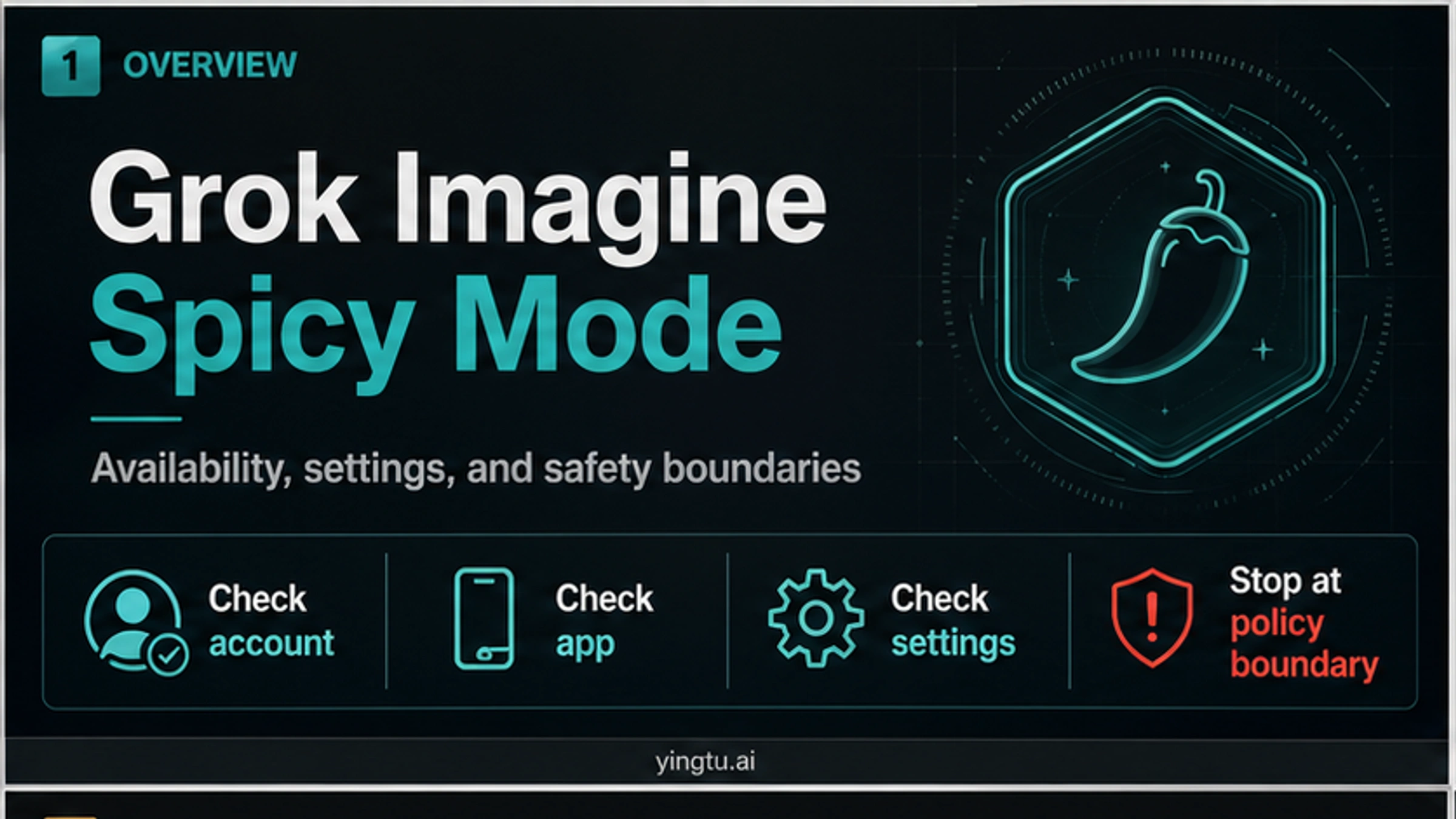
Grok Imagine Spicy Mode is not something every account can simply unlock. Treat it as a conditional consumer feature: check the current Grok or X app, the account's sensitive-content and age controls, the live subscription screen, and local availability; if the request involves minors, real-person sexualization, non-consensual imagery, or safeguard bypasses, stop instead of troubleshooting.
As of April 27, 2026, the safest answer is conditional rather than absolute. Spicy Mode may appear only when the account, app surface, content settings, age checks, subscription state, region, rollout status, and xAI/X policy enforcement all allow it. Older setup posts that quote exact prices, daily limits, model-version names, or universal mobile-only rules should be treated as stale unless the same claim is visible in your current official account or checkout screen.
| Situation | What to check | What it means | Safe next move |
|---|---|---|---|
| Spicy Mode appears in your current Grok or X app | Account, app version, content controls, and current subscription screen | Your account currently meets the visible conditions for that surface | Use it only inside xAI/X policy boundaries |
| The option is missing | App surface, account state, sensitive-content controls, age, subscription, region, rollout, and policy limits | One required condition may not be met, or the feature may not be available on that surface | Verify legitimate controls; do not look for bypasses |
| The feature appears in posts or videos but not for you | Those posts may reflect another app version, account, region, or date | Community screenshots are not a durable access contract | Trust your current official UI and policy pages |
| You are reading xAI image or video API docs | API docs describe developer image/video generation surfaces | They do not prove consumer Spicy Mode parity | Keep consumer Grok controls separate from API planning |
| The request depends on a real person, a minor, non-consensual imagery, exploitation, or filter evasion | xAI Acceptable Use Policy and X adult-content rules | This is no longer troubleshooting | Stop |
Quick Answer: Is Grok Imagine Spicy Mode Still Available?
Spicy Mode is best understood as an account-bound, app-bound, and policy-bound mode inside the consumer Grok/X experience. It is not a public guarantee that every user can generate adult content, and it is not a promise that every surface, country, plan, or developer route exposes the same controls.
The legitimate check starts in the current official Grok or X experience you actually use. Confirm that you are signed into the intended account, using a current app or web surface, and reviewing the current content and safety settings. X's sensitive-media help explains that users can control whether sensitive media is displayed, and X's Adult Content Policy separates permitted adult material from prohibited categories such as minors, non-consensual content, and exploitation. Those platform rules still matter if Grok output is viewed or shared through X.
Do not treat exact dollar prices or daily generation counts from older posts as current truth. X Premium, SuperGrok, app-store pricing, region availability, and UI placement can change quickly. If price or entitlement is part of your decision, use the live subscription or checkout screen that belongs to your account, not a static table copied from an old article.
What To Check Before Assuming Spicy Mode Is Gone
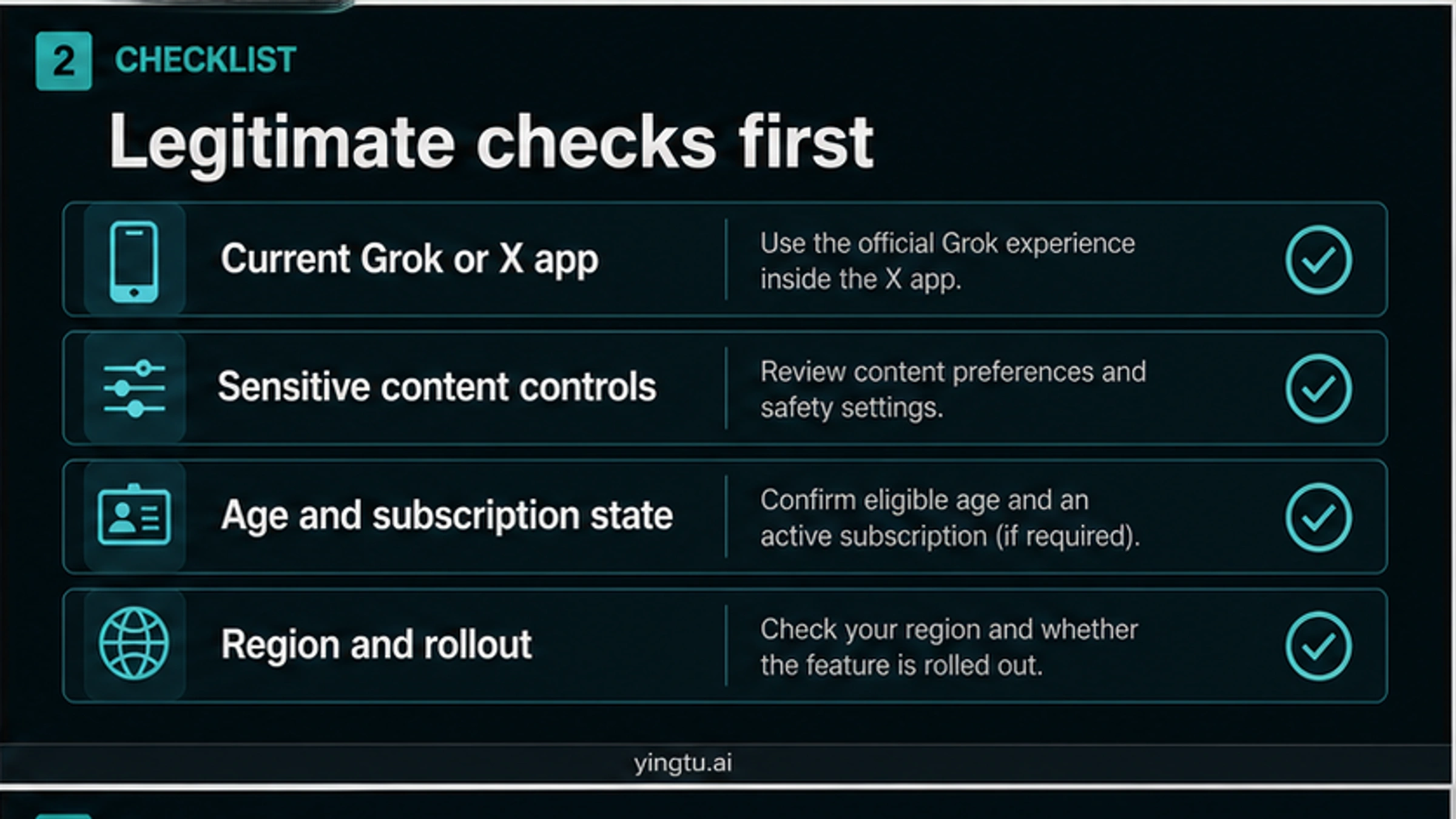
Start with the surface. Grok can be reached through multiple consumer routes, including Grok in X, standalone Grok surfaces, and mobile apps. A feature visible in one route is not automatically visible in another. If Spicy Mode does not appear, the first useful question is not "what is the trick?" It is "which official surface am I using, and does that surface currently expose this feature for my account?"
Next check account state. The signed-in account, linked X account, subscription owner, age state, app-store route, and regional availability can all affect visible controls. A paid plan may improve access to Grok features, but it does not erase age, region, rollout, or policy enforcement. If the account recently changed plan or billing route, sign out and back in once after verifying the official subscription screen.
Then check content controls. X has account-level settings around sensitive media, and official Grok/X guidance may point users toward privacy and safety content settings. UI labels can change, so a current answer should not pretend one exact toggle name is permanent. The durable rule is narrower: review the current official content controls for the account and do not assume a missing mode is a bug until the legitimate account and app conditions are clear.
Finally check region and rollout. Adult-content features are especially likely to vary by country, account age, app version, regulatory environment, and staged rollout. A missing option can mean the feature is not available to your account today. It can also mean the app has not rolled out the same UI to your surface yet. Neither case justifies using mirror apps, shared accounts, modified clients, or prompts designed to defeat safeguards.
Why Spicy Mode May Not Show Up
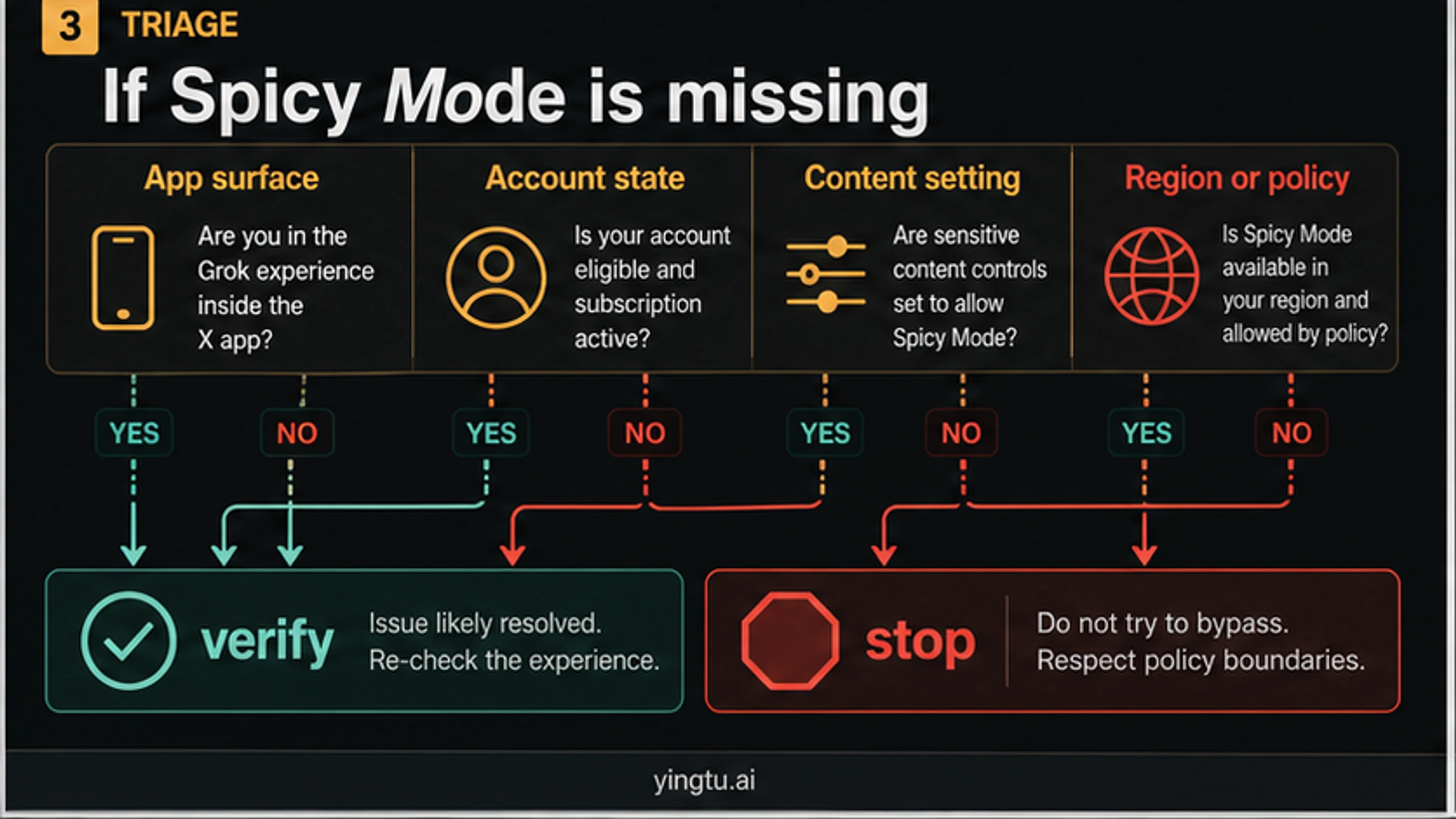
Missing Spicy Mode usually falls into one of four branches.
| Branch | Legitimate check | If the answer is no | What not to do |
|---|---|---|---|
| App surface | Are you inside a current official Grok or X app surface that supports Imagine controls? | Try one other official surface if available | Do not install unknown APKs or modified clients |
| Account state | Is the intended account signed in, age-eligible, and seeing the correct subscription state? | Fix account recognition or verify checkout state | Do not buy the same entitlement twice because one screen is stale |
| Content setting | Are the current sensitive-content controls set the way the official app expects? | Change only legitimate account settings | Do not use prompt wording to bypass missing controls |
| Region or policy | Is the feature available in your region and for your use case? | Treat it as unavailable or blocked for that account | Do not search for circumvention routes |
A clean troubleshooting pass changes one condition at a time. Update the official app, verify the account, check the live subscription screen, review current content settings, and test one official surface. If the feature remains missing, that is useful information. It means the account, region, rollout, or policy layer may not allow it. Repeating the same prompt or copying a workaround from a forum does not make the result more legitimate.
The strongest signal is the current UI on your account. Community posts may be real for the poster and still wrong for you. They may come from another country, another subscription route, another app build, another date, or a feature state that has since changed. For a feature tied to adult content, current official controls should outrank screenshots.
What The Policies Block
xAI's Acceptable Use Policy and X's adult-content rules are the hard boundary for this topic. The practical point is simple: troubleshooting stops when the request depends on exploitation, minors, non-consensual intimate imagery, real-person sexualization without consent, harassment, impersonation, or attempts to evade safeguards.
That boundary should stay visible because public Spicy Mode discussion often mixes legitimate access questions with unsafe "unlock" language. A useful Spicy Mode explanation can tell adults where to check current account controls. It should not teach users how to push moderation toward sexualized output, how to reword blocked prompts, or how to use real people's images. Those are not missing-mode fixes; they are misuse paths.
X's Adult Content Policy also matters after generation. Even if an account can view or generate mature material inside a permitted surface, sharing it on X has platform rules around labeling, consent, prohibited content, and placement. The safe assumption is that Grok's feature controls and X's sharing rules both apply when the output touches X.
Safety criticism is not abstract here. RAINN's January 2026 warning about Grok's Spicy setting focused on image-based sexual abuse risk, which is exactly why a responsible access page should include stop rules before it includes any troubleshooting detail. A missing option is not a reason to look for a bypass.
Consumer Grok Controls Are Not The Same As The xAI API
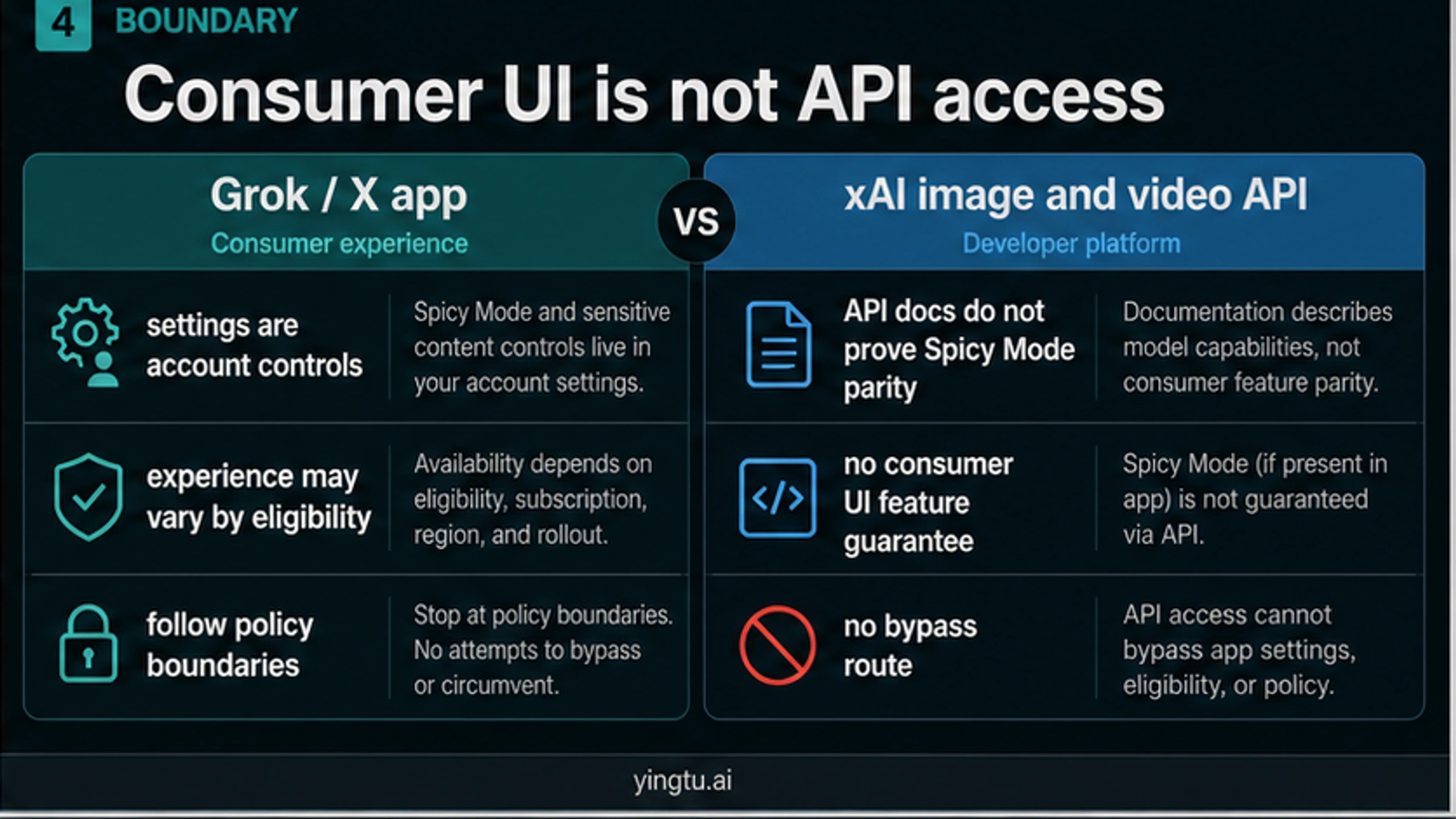
xAI publishes developer documentation for image generation and video generation. Those pages are useful for understanding that xAI has developer-facing image and video surfaces. They do not prove that consumer Spicy Mode is exposed through the API, that API accounts inherit consumer settings, or that an API key bypasses app eligibility.
Keep the contract split clean.
| Surface | What it controls | What it does not prove |
|---|---|---|
| Grok or X app | Consumer account UI, content controls, app rollout, subscription recognition, and policy enforcement | It does not prove API access or developer limits |
| grok.com or another official Grok surface | Current consumer web behavior for the signed-in account | It does not guarantee feature parity with mobile or X |
| xAI image/video API docs | Developer request formats, model surfaces, and API behavior | It does not prove consumer Spicy Mode parity |
| Third-party wrappers | Provider-specific product behavior | They do not prove official Grok account availability |
This matters for buying decisions. If your goal is consumer Spicy Mode access, API documentation is not the checkout proof. If your goal is developer image or video generation, consumer Spicy Mode screenshots are not an API contract. Mixing those two surfaces is how old articles end up with misleading plan tables and unsupported promises.
Old Prices, Limits, And Launch Claims To Re-Check
Older Spicy Mode posts often contain four kinds of unstable claims: exact plan prices, daily generation limits, platform-only availability, and model-version or launch statistics. Those claims are risky because the product can change without leaving a stable public page behind.
Use this rule instead:
| Claim type | Trust only if | Safer article language |
|---|---|---|
| Exact plan price | Visible in current official checkout or account billing | "Check the live subscription screen for your account" |
| Daily image or video limits | Documented in current official account or plan pages | "Limits vary by account, plan, and surface" |
| Country or platform matrix | Confirmed by current official feature or availability pages | "Availability can vary by region, app, and rollout" |
| Model names, launch metrics, or video specs | Confirmed by current xAI product or release docs | Omit if not needed for the access decision |
| API parity | Explicitly documented in xAI API docs | "Consumer controls and API docs are separate" |
Removing stale numbers does not weaken the article. It makes the answer more durable. A reader who wants to know whether Spicy Mode is available should not be pushed into a price table that may already be wrong. The useful move is to tell them where current proof lives and which old claims should no longer drive the decision.
When Not To Use Spicy Mode
The right answer is sometimes not another setting check. Stop when the request requires a non-consenting real person, a celebrity or private individual, a minor or age-ambiguous subject, coercive or humiliating sexualization, harassment, impersonation, or attempts to evade safety filters. Those are not "edge cases." They are the conditions that make adult-image systems harmful.
Also stop when the only path forward is a non-official client, a shared account, a marketplace seller, a prompt pack that promises to bypass filters, or a request for cookies, one-time passwords, ID documents, or billing screenshots. Adult-content access is not worth account compromise.
For fictional, consensual, policy-compliant creative work, keep the request non-graphic and respect whatever the current Grok/X controls allow. If the official surface refuses the request, treat that as the boundary for that account and session. The safer creative decision is to change the project scope rather than keep pushing the same blocked direction.
Where To Read Next
For platform rules, start with the official xAI Acceptable Use Policy and X's Adult Content Policy. For current account controls, use the official Grok or X app surface tied to your account. For developer routes, read the xAI image and video API docs as API documentation only, not as consumer Spicy Mode proof.
For deeper context on the policy controversy, regulation, and risk landscape, read the separate Grok xAI NSFW image generation policy analysis. That page owns the broader policy story; the access decision here is narrower: check legitimate controls, keep volatile claims current, separate consumer UI from API docs, and stop at the safety boundary.
FAQ
Can Grok Imagine still have Spicy Mode?
It may, depending on the account, app surface, subscription state, age controls, region, rollout, and current xAI/X policy enforcement. Treat the current official UI for your account as the source of truth.
Is Spicy Mode free?
Do not rely on old free-versus-paid claims. Feature access and limits can change by account and plan. Check the current Grok/X subscription or checkout screen if price or entitlement affects your decision.
Why does Spicy Mode not show up for me?
Common legitimate causes include using a surface that does not expose the control, signing into the wrong account, incomplete age or content settings, subscription recognition issues, region or rollout limits, and policy restrictions.
Does enabling sensitive media on X guarantee Spicy Mode?
No. Sensitive-media display settings are only one part of the broader account and platform control surface. They do not guarantee that Grok Imagine will expose a generation mode for every account or region.
Can the xAI image or video API access Spicy Mode?
Do not assume that. xAI image and video API documentation describes developer API behavior. It does not automatically prove parity with a consumer app mode or account setting.
What content is blocked even if a mode appears?
Stop for minors, age-ambiguous subjects, non-consensual intimate imagery, real-person sexualization without consent, exploitation, harassment, impersonation, or attempts to evade safeguards.
Should I use a workaround if the option is missing?
No. If legitimate account, app, setting, subscription, and region checks do not expose the option, treat it as unavailable or blocked for that account. Workarounds create safety and account-risk problems.
Why did old guides list exact prices and limits?
Many older posts tried to capture a moment in a fast-changing product. Prices, plan names, UI placement, limits, region availability, and policy enforcement can change, so current official account surfaces should replace static old tables.