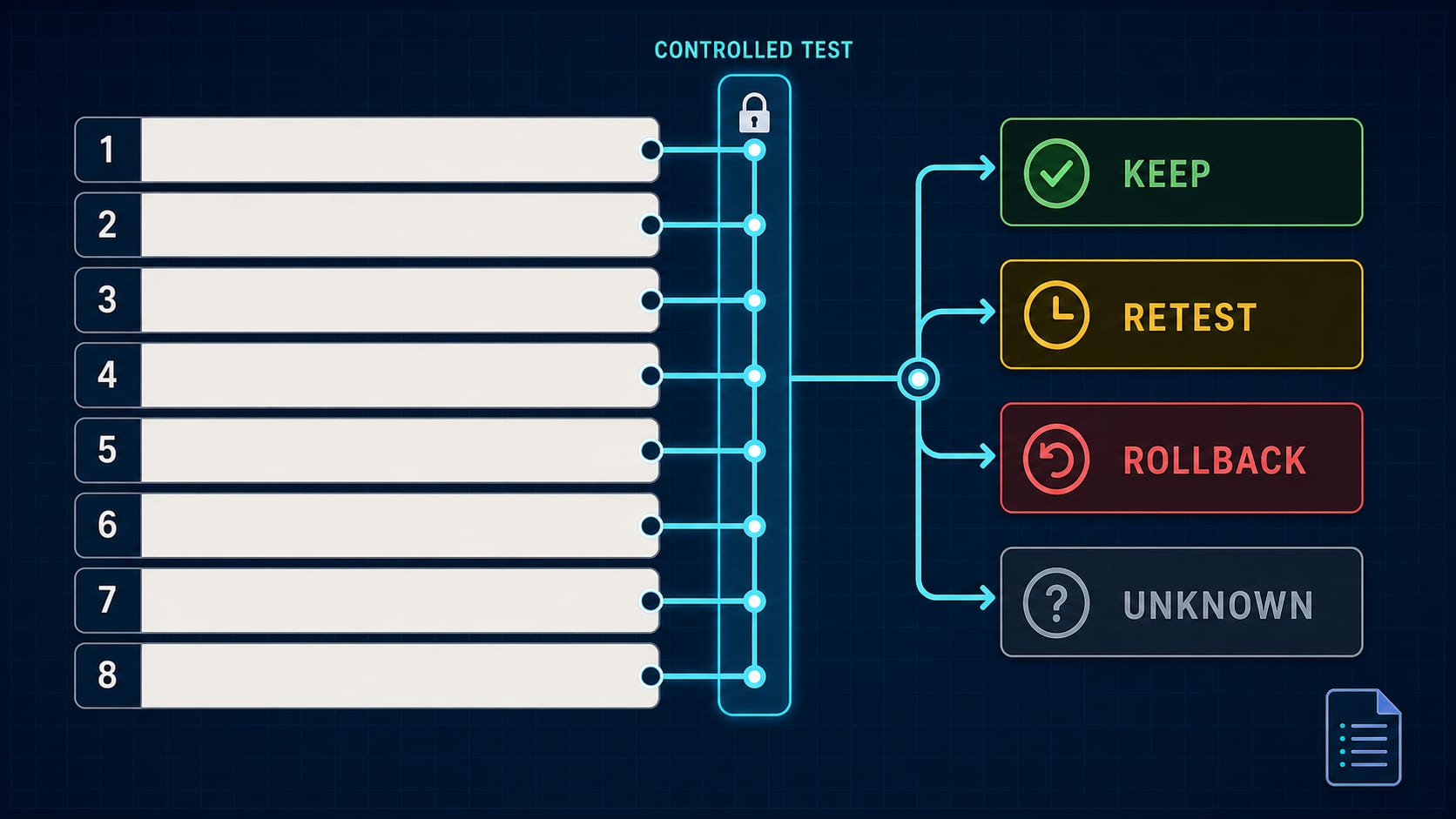
Do not switch a production workflow to Midjourney V8.2 because one image looks fresher—or reject it because one grid looks worse. Put eight prompts from your actual workload through a controlled acceptance record. Keep the prompt, aspect ratio, Raw and stylize settings, execution mode, and available seed control visible. Allow no more than two retries per row. Then choose keep V8.2, retest one variable, or roll back from the evidence you recorded.
Midjourney released V8.2 as the default on July 24, 2026. Its release note says the update focuses on aesthetics, image quality, and Personalization, and encourages users to try both old and new Personalization profiles. Those are product claims and test suggestions, not proof that the model improves every prompt, style, client job, or production pipeline.
The release changed the default, not your acceptance standard
The current Midjourney Version documentation identifies V8.2 as the default and says versions can interpret prompts, style, and image quality differently. That is enough reason to test a saved workflow again. It is not a reason to lower the standard that made an older output acceptable.
Write that standard before you generate:
- What subject, object, or scene must remain present?
- Which composition constraints are contractual rather than optional?
- At what delivery size will you inspect fine detail?
- Is the goal literal prompt adherence, productive surprise, or a named house style?
- Does Personalization need to preserve an established taste profile?
- How many retries can the job afford before the new default stops being useful?
If you cannot answer those questions, a prettier thumbnail will make the decision for you. That is taste exploration, not production acceptance.
Separate version behavior from community symptoms
Current English-language community discussions describe conflicting experiences. Some users report attractive V8.2 work and stronger detail. Others describe unexpectedly fast, weak-looking results, confusion about quality or Draft controls, changed Personalization behavior, or a shift from surreal interpretation toward more literal scenes. A recent showcase discussion even paired “stunning at a glance” with a complaint that small structures stopped making sense when enlarged.
These reports establish that upgrade questions exist. They do not establish prevalence, cause, a universal regression, or a universal improvement. A mode mistake, changed profile, different seed behavior, prompt sensitivity, selection bias, or a genuinely different model preference can look similar in a forum post. Diagnose your own workload with recorded controls.
One compatibility check belongs before the image comparison:
| Control or feature | What the current official documentation says | What to do in an upgrade test |
|---|---|---|
| Version | V8.2 is the current default; a version can also be selected with --v or settings. | Record the old accepted version and V8.2 explicitly. |
| Seed | The V8.1/V8.2 chart describes seed behavior as approximately 99% identical. | Use the same available seed as a close control, never as a promise of pixel-identical images. |
| Quality parameter | The merged V8.1/V8.2 compatibility chart marks the Quality parameter unsupported. | Do not treat --q 2 or --q 4 as a documented V8.2 quality repair. |
| Draft Mode | The same chart marks Draft Mode unsupported for the V8.1/V8.2 column. | Record the visible execution mode; do not compare an uncertain draft-like result with a production result. |
| HD or SD | The chart lists HD images for the V8.1/V8.2 family. | Keep SD/HD mode fixed inside a comparison and inspect at the intended delivery zoom. |
| Omni Reference | Midjourney says adding an Omni Reference automatically runs the prompt in V7. | Treat that as a V7 route, not native V8.2 evidence. |
Compatibility is volatile. Recheck the official table before relying on a parameter in a paid delivery.
Choose eight prompts that can disprove the upgrade
Do not build the pack from eight easy variations of the same portrait. Select jobs that represent the consequences of being wrong. Replace every cue below with a saved prompt from your own work.
| Row | Selection cue from your workload | Task-critical constraint to write down |
|---|---|---|
| 1 | A previously accepted “normal” job | The baseline subject and composition that must not drift |
| 2 | Your smallest important detail | The mark, texture, edge, accessory, or structure that must survive delivery zoom |
| 3 | A crowded or multi-subject scene | Count, position, ownership, or interaction constraints |
| 4 | A prompt where literal wording matters | Required objects, exclusions, spatial relations, or camera instruction |
| 5 | A prompt valued for productive surprise | The minimum concept that must remain while interpretation stays open |
| 6 | A style-reference or moodboard-heavy job | The intended visual language without loss of task content |
| 7 | A Personalization-dependent job | The taste traits an old or new profile is expected to preserve |
| 8 | The hardest real deliverable | The failure that would force manual repair, client rejection, or rollback |
The pack should be representative, not flattering. If your work is packaging, include the hardest brand-detail constraint. If it is editorial illustration, include the prompt where metaphor matters. If it is environmental concept art, include small structures at the final crop size. An upgrade passes the work you actually deliver, not an abstract model ranking.
Copy the eight-prompt V8.2 acceptance pack
This is a protocol and an empty evidence record. No Midjourney outputs were generated or scored for this article. Every result cell below starts as NOT RUN / UNKNOWN. An unknown cell is neither a pass nor a failure.
First, freeze the run-level controls:
hljs textMIDJOURNEY V8.2 UPGRADE ACCEPTANCE PACK Project / workload: Reviewer: Review date: Previous accepted version: V8.1 / V7 / other: New version: V8.2 FIXED CONTROLS Prompt text and negative constraints: Aspect ratio: Raw setting: Stylize value: Seed or closest reproducible control: Execution mode visible in the UI: SD / HD: Style Reference / Moodboard controls: Old Personalization profile: New Personalization profile: Delivery size and inspection zoom: Maximum retries per row: 2 IMPORTANT - A seed is a close control, not a pixel-identity guarantee. - Change version first while holding the chosen profile fixed. - Test the old versus new Personalization profile only after the version comparison, with V8.2 and the other controls held fixed. - Record unsupported, unavailable, or unrun feature paths as UNKNOWN.
Then use all eight rows. Duplicate this row block exactly eight times; do not delete rejected evidence.
hljs textROW 1 OF 8 Prompt / production job: Task-critical constraints: Previous accepted output reference: VERSION PAIR Previous version + fixed profile output: NOT RUN / UNKNOWN V8.2 + same fixed profile output: NOT RUN / UNKNOWN PERSONALIZATION PAIR V8.2 + old profile output: NOT RUN / UNKNOWN V8.2 + new profile output: NOT RUN / UNKNOWN CONTROL VALUES Prompt unchanged: NOT VERIFIED / UNKNOWN Aspect ratio unchanged: NOT VERIFIED / UNKNOWN Raw and stylize unchanged: NOT VERIFIED / UNKNOWN Seed or closest control recorded: NOT VERIFIED / UNKNOWN Execution mode and SD/HD recorded: NOT VERIFIED / UNKNOWN ACCEPTANCE DIMENSIONS Subject and task-constraint retention: NOT RUN / UNKNOWN Detail coherence at delivery zoom: NOT RUN / UNKNOWN Prompt adherence and composition: NOT RUN / UNKNOWN Personalization fit: NOT RUN / UNKNOWN Retry 1 change and evidence: NOT RUN / UNKNOWN Retry 2 change and evidence: NOT RUN / UNKNOWN Retry count: NOT RUN / UNKNOWN ROW DECISION: UNKNOWN / NOT RUN Reason: Next action:
Use the same fields for rows 2–8:
| Row | Output evidence | Constraint retention | Detail coherence | Adherence and composition | Personalization fit | Retry count | Decision |
|---|---|---|---|---|---|---|---|
| 1 | NOT RUN / UNKNOWN | UNKNOWN | UNKNOWN | UNKNOWN | UNKNOWN | NOT RUN | UNKNOWN |
| 2 | NOT RUN / UNKNOWN | UNKNOWN | UNKNOWN | UNKNOWN | UNKNOWN | NOT RUN | UNKNOWN |
| 3 | NOT RUN / UNKNOWN | UNKNOWN | UNKNOWN | UNKNOWN | UNKNOWN | NOT RUN | UNKNOWN |
| 4 | NOT RUN / UNKNOWN | UNKNOWN | UNKNOWN | UNKNOWN | UNKNOWN | NOT RUN | UNKNOWN |
| 5 | NOT RUN / UNKNOWN | UNKNOWN | UNKNOWN | UNKNOWN | UNKNOWN | NOT RUN | UNKNOWN |
| 6 | NOT RUN / UNKNOWN | UNKNOWN | UNKNOWN | UNKNOWN | UNKNOWN | NOT RUN | UNKNOWN |
| 7 | NOT RUN / UNKNOWN | UNKNOWN | UNKNOWN | UNKNOWN | UNKNOWN | NOT RUN | UNKNOWN |
| 8 | NOT RUN / UNKNOWN | UNKNOWN | UNKNOWN | UNKNOWN | UNKNOWN | NOT RUN | UNKNOWN |
Why the profile test comes second
If you change the model version and Personalization profile in the same pair, an improvement or failure has two possible causes. First compare the previous accepted version with V8.2 under one fixed profile. Then keep V8.2 fixed and compare the old and new profile. Midjourney explicitly encourages trying both profile generations, but only the separated sequence tells you whether the version, the profile, or their combination changed the result.
Apply hard keep, retest, and rollback thresholds
Do not average away a critical failure. A hero-image workflow does not pass because seven easy prompts score well when the one client-critical logo, handoff composition, or architectural detail fails repeatedly.
Keep V8.2 only when all eight rows preserve their task-critical constraints, no critical row fails detail coherence or prompt adherence, Personalization preserves or improves the intended taste, and no row exceeds the two-retry budget.
Retest one variable when evidence is incomplete, one control changed unintentionally, or one non-critical row fails with a plausible isolated cause. Repeat that row after changing one recorded variable only. Do not rewrite the prompt, swap the profile, change stylize, change the aspect ratio, and switch HD/SD together.
Roll back when a task-critical row repeatedly loses required content or coherent detail, multiple rows exceed the retry budget, or the new default breaks a feature path the production job requires. Set the prior accepted version explicitly for that workflow and retain the rejected V8.2 evidence for a later recheck.
Keep it unknown when the row was not run, the output was not retained, a control is unverifiable, or the feature path actually routed to another version. Unknown evidence must never be counted as a win or a loss.
Diagnose a weak-looking V8.2 result before blaming speed
A generation that finishes faster and looks worse can be real evidence of a problem, but elapsed time alone does not prove the cause. Use this order:
- Confirm the version shown for the job and record it.
- Confirm the visible execution mode and SD/HD setting.
- Remove unsupported “quality repair” assumptions from the test.
- Compare one saved prompt under the previous accepted version and V8.2 with the same profile and closest available seed control.
- Inspect at delivery zoom, not only the grid thumbnail.
- Score constraints, detail, adherence/composition, and Personalization separately.
- If one dimension fails, spend one retry on one plausible variable.
- If the critical failure repeats or the row needs more than two retries, roll back that workflow instead of endlessly prompt-tuning it.
The result may be “V8.2 is good for concept exploration but not yet accepted for this packaging job.” A version decision can be workload-specific. It does not need to become a universal verdict.
Use the official Midjourney surface for the test
This page teaches a decision protocol; it does not provide a Midjourney generator. The current YingTu model configuration does not expose Midjourney V8.2, so the correct execution route is Midjourney’s official web or Discord surface. There is no YingTu or LaoZhang product recommendation attached to this workflow.
If your real task is different—finding an image generator you can try without an account rather than deciding whether to migrate a Midjourney production default—the adjacent no-sign-up image generator guide owns that next decision.
Frequently asked questions
Is Midjourney V8.2 the default version?
Yes. Midjourney’s current Version documentation says V8.2 became the default on July 24, 2026. That status is time-sensitive, so recheck the official page if you are reading this after another release.
Is Midjourney V8.2 better than V8.1?
Not for every workflow by default. Midjourney says V8.2 targets aesthetics, image quality, and Personalization, but it has not supplied a benchmark for your prompts. Run the eight-prompt acceptance pack and decide from your critical constraints, delivery zoom, profile fit, and retry budget.
Can --q 2 or --q 4 fix V8.2 quality?
The current official compatibility chart marks the Quality parameter unsupported for the merged V8.1/V8.2 column. Do not treat those flags as a documented V8.2 repair. Confirm the current table and the mode visible in your account.
Will the same seed make V8.1 and V8.2 identical?
No. The official chart describes seed behavior for V8.1/V8.2 as approximately 99% identical, not pixel-identical. Use a seed as the closest reproducible control and judge the outputs against task-level acceptance criteria.
Does Omni Reference test native V8.2 output?
No. Midjourney’s Omni Reference documentation says adding an Omni Reference automatically runs the prompt in V7. Label that row as a V7 feature path; do not count it as native V8.2 evidence.
When should I roll back to V8.1 or V7?
Roll back the affected workflow when a task-critical row repeatedly loses required content or coherent detail, multiple rows exceed two retries, or a required feature path does not operate in V8.2. Keep the evidence and retest after a material official model or compatibility update.
Evidence boundary
This article checked Midjourney’s V8.2 release note, current Version and Omni Reference documentation, a recent English explainer that had already become outdated after the default changed, and current community discussions showing both successful outputs and unresolved quality questions on July 29, 2026. The article did not access a Midjourney account, run image generations, observe account-specific settings, or produce a benchmark. Community reports are symptoms to diagnose, not model-wide statistics.