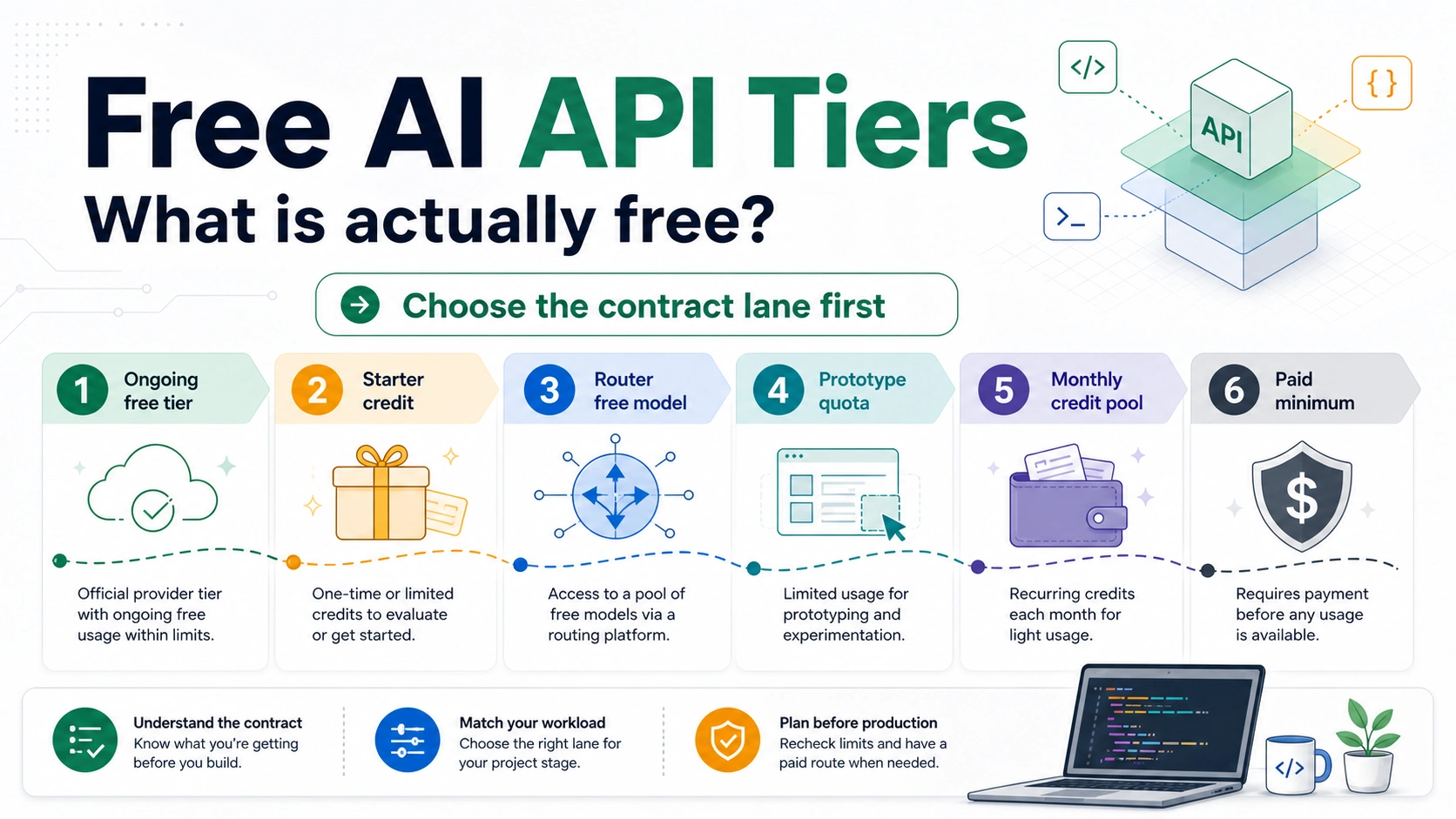
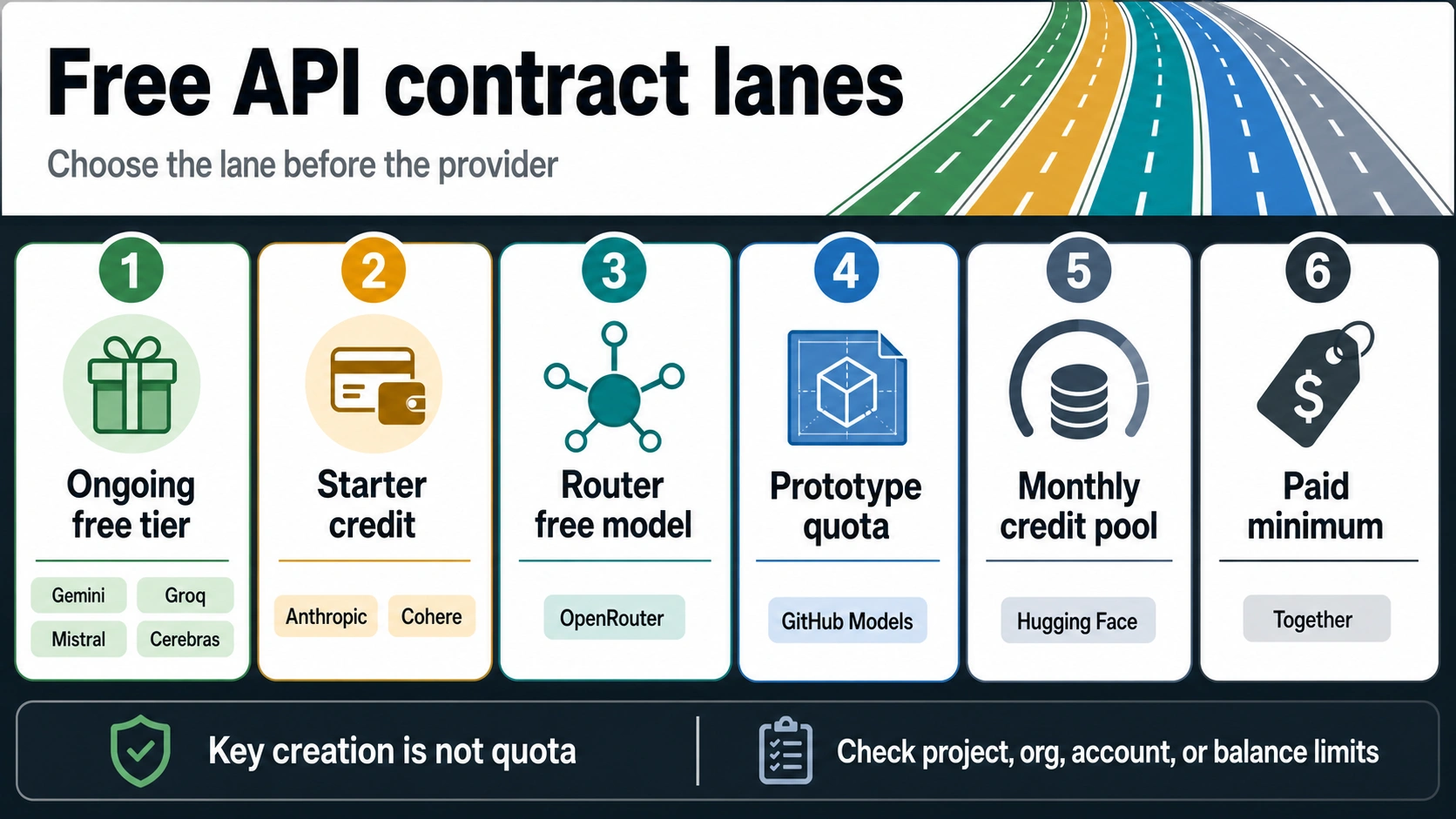
Free AI API access is not one promise. In 2026, a zero-cost API route can be an ongoing provider free tier, a starter credit, a router-hosted free model, a prototype quota, a monthly credit pool, or a paid-minimum product that only becomes usable after you fund it.
Use the lane first: Gemini, Groq, Mistral, and Cerebras belong in official or developer free-route checks; OpenRouter is a router pool for free model variants; GitHub Models is a prototype surface; Hugging Face is a small monthly credit pool; Anthropic and Cohere are starter or trial routes; OpenAI depends on account and billing state; Together currently belongs in the paid-minimum lane.
Before you run repeated jobs, agents, eval loops, or a user-facing app, check the active project, organization, account, or balance limits and keep a paid route ready. The table below compares the free contract first, then the provider.
Free Contract Matrix
| Route | Free contract lane | Quota or billing owner | Best first use | Stop before production when |
|---|---|---|---|---|
| Google Gemini API | Ongoing free tier for selected model and surface rows | Google project and AI Studio limits | General prototyping, prompt checks, small internal tools | You need stable throughput, paid data terms, or exact live limits beyond the project dashboard |
| Groq | Developer free route with org-level limits | Groq organization | Low-latency experiments and fast model trials | Normal traffic depends on rate-limit headroom or paid support |
| OpenRouter | Router free models ending in :free | OpenRouter account, credit balance, and router limits | Trying many model families behind one API shape | You need provider-owned official quota, sensitive data terms, or predictable capacity |
| Mistral AI | Free mode and console-owned usage limits | Mistral workspace or organization | Testing Mistral models before pay-as-you-go scale | The workload needs higher limits, specific model rows, or contractual production support |
| Cerebras | Free public endpoints subject to rate limits | Cerebras account and endpoint limits | Public endpoint experiments and fast inference checks | The job needs dedicated throughput, more model families, or SLA-backed endpoints |
| GitHub Models | No-cost prototype quota | GitHub account, organization, and project limits | Playground/API experiments inside a GitHub developer workflow | Production needs opt-in paid usage or bring-your-own-key |
| Hugging Face Inference Providers | Monthly credit pool when routed through Hugging Face | Hugging Face account credit balance | Sampling hosted providers without setting up each provider account | Credits run out or you need a custom provider key, production support, or direct provider terms |
| Anthropic Claude API | Starter credit for new API testing | Anthropic account and usage tier | Small Claude API evaluation | The credit is exhausted or the app needs durable paid capacity |
| Cohere | Free rate-limited trial key | Cohere account and key type | Testing and proof-of-concept work | You need a Production key or sensitive-use review |
| OpenAI API | Key creation is separate from usage; API use depends on account billing or credits | OpenAI organization, project, credits, and usage limits | Official OpenAI API testing when your own account shows usable billing or credits | You are assuming ChatGPT app access or old fixed-credit claims will fund backend calls |
| Together AI | Paid minimum start | Together account credit balance | Paid evaluation after funding the account | You need a zero-cost first request |
What Free Actually Means
"Free AI API" is useful search language, but it is too broad for implementation. A developer choosing a route needs to know which contract is in play.
An ongoing free tier is the cleanest free route when it is supported by the provider's own pricing and rate-limit pages. Google Gemini API belongs here for selected model and surface rows, but the usable limit still belongs to the project. Mistral free mode and Cerebras public endpoints also fit the official-route lane, with the same caution: the console or account owner decides the active limit.
A developer free route is similar, but it is often framed as a starting plan rather than a timeless public entitlement. Groq is useful for low-latency tests, yet its rate limits are tied to the organization and model rows. Treat the docs and console as the source of truth before using it for repeated traffic.
A starter credit or trial key is not a durable free tier. Anthropic describes free credits for new API users to test Claude, and Cohere gives a free, rate-limited trial key before production. Those routes are valuable for evaluation, but the right mental model is "sample the API", not "build a free production backend".
A router free model is a separate contract. OpenRouter free variants ending in :free are useful because they let you test many models behind one API shape, but the free route is owned by OpenRouter, not by the original model provider. OpenRouter's documented limits and account credit state decide what works.
A monthly credit pool is another route. Hugging Face Inference Providers gives free users a small monthly credit pool when calls are routed through Hugging Face. That is helpful for sampling, but it is not unlimited provider-owned API access, and it changes when you use your own provider key.
A prototype quota is useful but narrow. GitHub Models gives no-cost, rate-limited access for playground and API experimentation. It is designed for experimentation; production needs paid opt-in or bring-your-own-key.
A paid minimum start should not be forced into a free comparison. Together currently belongs in that lane because API access requires purchasing credits first. It still belongs in the table because developers often compare it beside free-to-start providers, but the answer is not "free".
Provider Notes And Recheck Points
Google Gemini API is usually the first official free-route check for a broad developer prototype. Use the Gemini API pricing page for current model free-tier rows, then use Gemini API rate limits and AI Studio for the project behind the key. Billing can change limits and data-use terms, so the free route is not just a cheaper paid route. For a deeper Gemini-only breakdown, use the dedicated Gemini API free tier guide.
Groq is a strong low-latency test route when the models you need are available on the developer plan. Check Groq rate limits and Groq model rows before naming exact capacity. The useful comparison point is speed plus developer access, not a promise that every workload has enough no-cost throughput.
OpenRouter is best understood as a router pool. Its limits documentation distinguishes free model variants and account-state limits, and its FAQ explains route behavior. This can be excellent for model discovery, fallback tests, and OpenAI-compatible routing experiments. It should not be written as an official free tier from the underlying model owner.
Mistral's free mode gives developers an official way to create keys and test within the console's active limits. Check Mistral usage limits and the current model or pricing pages before writing a workload plan. If the application needs higher throughput, pay-as-you-go scale, or account support, the free route has done its job and should hand off to a paid plan.
Cerebras public endpoints are useful when the first question is whether the inference route fits. Its model overview separates free public endpoints from dedicated endpoints for higher throughput and production needs. Keep that public-endpoint boundary visible so a fast demo does not become an accidental production plan.
GitHub Models is a good route when your prototype already lives in the GitHub workflow. GitHub's billing concepts for GitHub Models and prototyping docs frame no-cost use around experimentation, with paid opt-in or BYOK for production. That makes it a prototype lane, not a general free backend entitlement.
Hugging Face Inference Providers is useful when you want a small monthly credit pool and a unified place to sample hosted providers. The Inference Providers pricing page is also clear about the routing boundary: free credits apply when routed through Hugging Face, not when you use a custom provider key.
Anthropic and Cohere are trial lanes. Anthropic's Claude pricing page describes test credits for new API users, while Cohere's going-live documentation distinguishes trial keys from Production keys. These routes answer "can I evaluate the API now?" They do not answer "can I run a durable no-cost product?"
OpenAI should be handled carefully. Creating a Platform API key and using ChatGPT in the app are separate from backend API billing. OpenAI's error-code guidance and prepaid billing help support a billing-and-quota model; they do not justify a universal current free API tier for every account. For the OpenAI-specific version of that boundary, use the OpenAI API key free trial guide.
Together belongs in the paid-minimum row. Its billing and credits documentation describes credit purchase and positive balance requirements, so it should not be sold as a zero-cost API start unless its official policy changes.
First Route By Workload
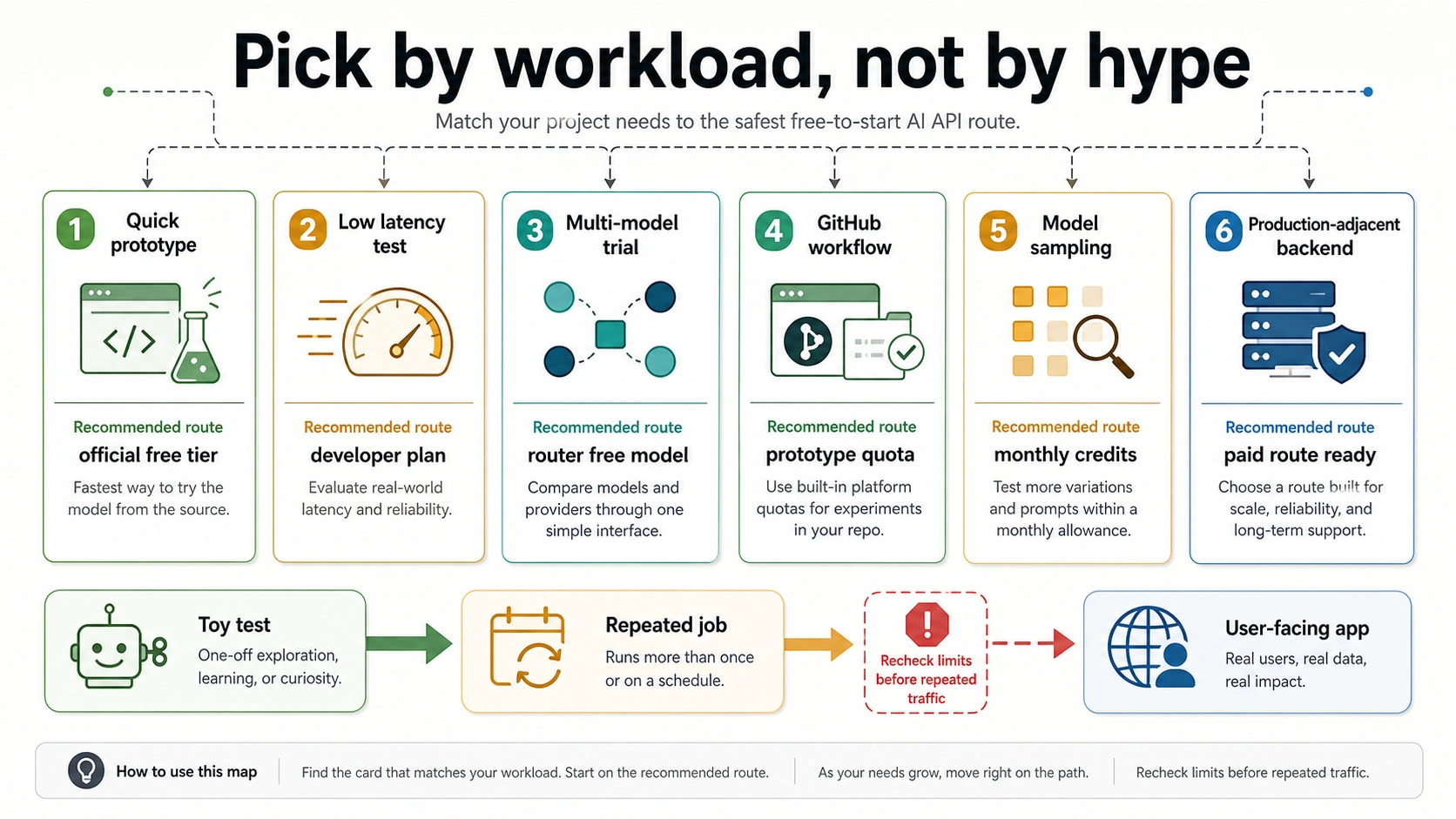
If you are learning API basics or comparing prompt behavior with low stakes, start with Gemini, Mistral, Cerebras public endpoints, GitHub Models, or a clearly labeled trial route. The priority is frictionless evaluation with non-sensitive data and visible owner limits.
If latency is the first variable, test Groq and Cerebras early. Keep the model row, organization limit, and public-versus-dedicated endpoint boundary beside every result. Fast response in a demo is useful evidence, but it does not remove the need for production capacity planning.
If model variety matters more than provider ownership, OpenRouter is often the fastest scouting route. It lets you compare many model variants behind a familiar API shape. The tradeoff is that you are testing a router contract, so any conclusion about official provider capacity still needs a provider-owned check.
If your prototype is already inside GitHub, GitHub Models is the natural first lane. It is especially useful for quick prompt tests, repository-linked experiments, and developer evaluation. Move out of the prototype lane before you promise user-facing availability.
If you want a broad hosted-model sampling surface, Hugging Face Inference Providers can be useful until the monthly credit pool or routed-provider boundary becomes the limiting factor. Once you need direct provider billing, production support, or custom terms, shift the decision to the provider account.
If you need Claude or Cohere specifically, use the starter-credit or trial-key route to measure fit. Do not mistake the existence of a starter route for a long-term free tier. The key question after the first test is whether the paid route is acceptable for the workload.
If the product will serve users, process customer data, run scheduled jobs, or support agents and eval loops, choose the paid-ready route before launch. Free routes are excellent for discovery. They are poor as the only capacity plan for an application that needs reliability, logs, support, and predictable billing.
API Key Is Not The Quota Owner
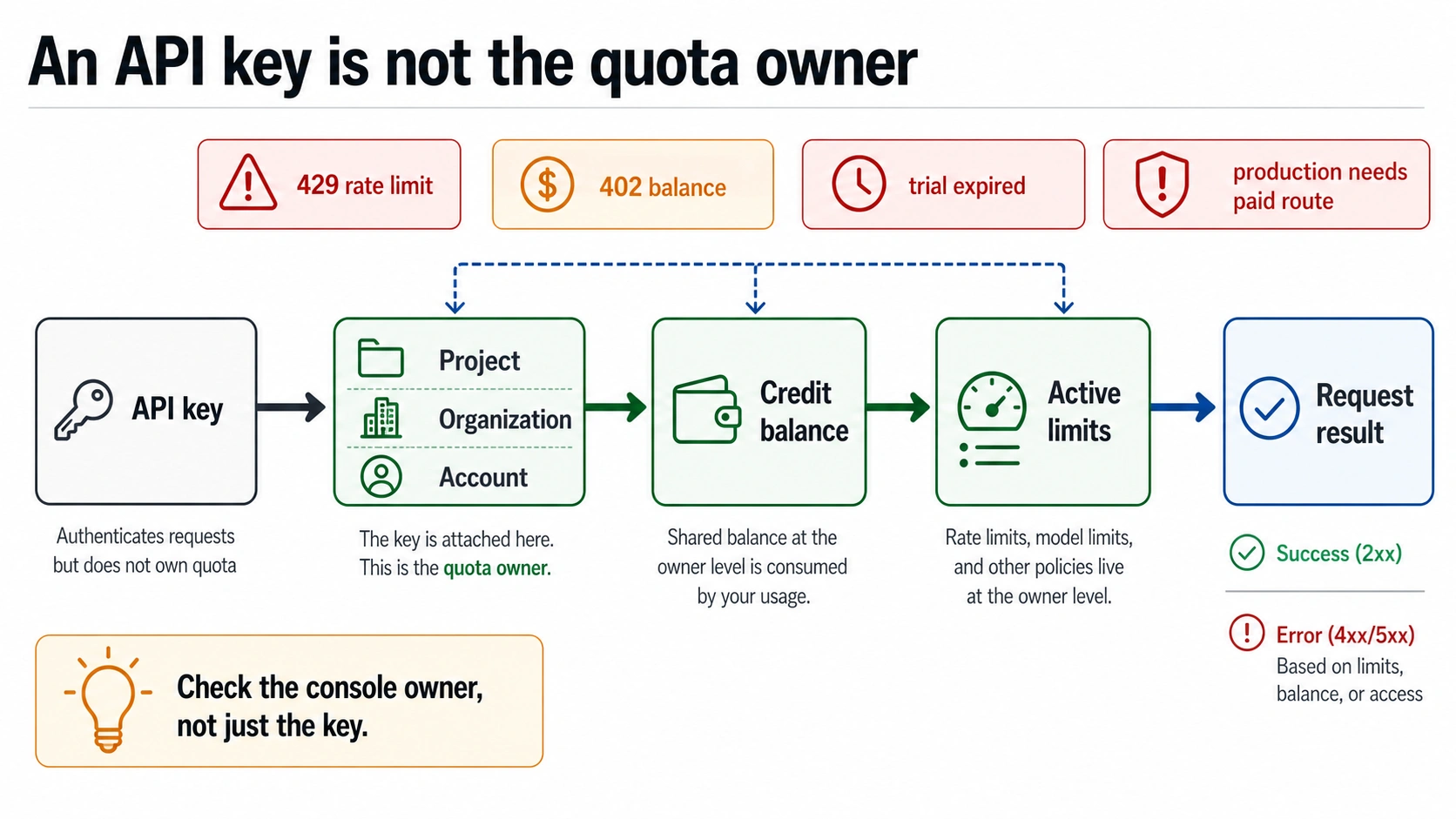
An API key is a credential. It authenticates a request and points to an account, project, organization, workspace, or balance owner. It does not create a separate free allowance by itself.
That boundary explains many "free API key" failures. A Gemini key can be valid while the Google project has exhausted its free-tier daily quota. A Groq key can be valid while the organization hits a model-specific limit. An OpenRouter key can work for one :free model and fail when account credit state or daily caps block the next call. An OpenAI key can be syntactically correct while the project has no usable billing or credits.
For every route, write down five owners before trusting the free path:
| Owner to identify | Why it matters |
|---|---|
| Credential owner | Tells you which account, project, org, or workspace the request acts inside |
| Quota owner | Explains which requests, tokens, or daily caps can stop the call |
| Billing owner | Shows who pays after credits, free quota, or trial allowance end |
| Data owner | Determines prompt, output, retention, and product-improvement terms |
| Support owner | Decides who can debug failures, limit changes, and production incidents |
Creating more keys inside the same owner usually helps with rotation and environment separation. It does not multiply quota. If the owner is exhausted, fix the workload, change the route, or move to paid capacity.
Router And Gateway Boundary
Router routes are useful when the reader's real job is model discovery, API-shape compatibility, or fallback testing. OpenRouter and Hugging Face can reduce setup friction because they give one account surface for many models or providers. That convenience is the product value. It is not proof that the underlying provider grants the same free capacity directly.
A gateway route belongs even later in the decision. After official free tiers, trial credits, and router pools stop fitting, a developer may want one OpenAI-compatible gateway to simplify paid model switching or compare paid routes. For that API-developer job, laozhang.ai docs and the laozhang.ai API route are worth evaluating as a separate gateway contract.
Keep the boundary clean. A gateway should not appear inside the official free-tier comparison rows, and it should not be used to claim provider-owned free quota, provider support, model coverage, speed, uptime, or price unless those claims have current route-owner evidence. The official provider remains the right source for official free limits, data terms, and model-owner support.
Production Stop Rules
The free route should stop being the default before the first user-facing promise. The trigger is not moral; it is operational. Repeated jobs, customer data, background agents, eval loops, and service commitments need owners, logs, retry policy, billing alerts, and support.
Use this stop-rule table before shipping:
| Signal | Why free is no longer enough | Next action |
|---|---|---|
| The job repeats on a schedule | Free quota can reset, throttle, or change independently of your schedule | Move to a paid-ready project or route with alerts |
| Users depend on the answer | Trial, router, or prototype limits can fail without your product controlling the owner | Add paid fallback, user-facing error states, and support runbooks |
| Prompts contain customer or business data | Free and paid data-use terms can differ by provider | Verify the data terms before sending production data |
| The app needs a specific model row | Free access may not include the exact model, modality, context window, or region | Check the provider pricing and model page for that row |
| You need predictable latency | Public endpoints and free developer plans are usually shared capacity | Test paid or dedicated capacity |
| Errors mention quota, balance, billing, or rate limits | The blocker is owned by the account/project/org/balance, not by the key string | Fix the owner state instead of rotating keys |
The cheapest reliable architecture is often hybrid: use free routes to learn, keep non-sensitive experiments cheap, then switch only the workloads that need reliability to paid capacity. That beats pretending every provider row is a free production backend.
Decision Rule
Start with Gemini API when you want the strongest broad official free-tier check and you can verify the project limits yourself. Test Groq or Cerebras when latency is the main variable. Use OpenRouter for model variety and fallback scouting, while remembering that it is a router contract. Use GitHub Models for GitHub-native prototypes. Use Hugging Face when a monthly routed credit pool is enough for sampling. Use Anthropic or Cohere trial routes when those models are the target. Treat OpenAI as billing- or credit-dependent unless your own Platform account shows usable API capacity. Treat Together as paid-minimum until the official billing route changes.
The comparison is not won by the provider with the most generous-looking word "free." It is won by the route whose owner, quota, billing, data terms, and stop rule match the workload you are about to run.
FAQ
Which free AI API is best for most developers?
For broad official free-tier testing, start with Gemini API and verify live project limits in AI Studio. For low-latency experiments, test Groq or Cerebras. For model variety, use OpenRouter as a router free-model pool. The best route depends on workload and owner limits, not a universal winner.
Does OpenAI have a free API tier?
Do not assume a universal current OpenAI API free tier. Creating an API key is separate from having usable API billing, credits, model access, rate limits, and project usage limits. ChatGPT app access also does not fund backend API calls.
Is the Gemini API free?
Selected Gemini API model and surface rows have Free Tier access, but the usable limit belongs to the Google project and active AI Studio view. Check Google's current pricing and rate-limit docs before writing code around any exact number.
Are OpenRouter free models official provider free tiers?
No. OpenRouter :free models are router-hosted free model variants. They can be useful, but OpenRouter owns the route limits and account-state rules. They are not the same as the underlying model provider giving you official free capacity.
Can I use free AI API tiers in production?
Only for very low-risk production where throttling, changing limits, data-use terms, and support gaps are acceptable. If users depend on the result, if the prompts are sensitive, or if the job repeats, plan a paid-ready route before launch.
Does a new API key create new free quota?
No. A key is a credential. Quota usually belongs to a project, organization, account, workspace, or balance. Creating more keys under the same owner is not a quota strategy.
Which AI API can I use without a credit card?
Some official, router, trial, or prototype routes may allow no-card evaluation, but the useful question is still who owns the quota and what happens after the free action. Avoid treating no-card access as production readiness.
When should I move from free to paid?
Move when normal traffic hits rate limits, when the exact model row is paid-only, when prompts contain sensitive data, when users need reliability, or when support and logs matter. Free routes are for learning and scouting; paid routes are for controlled capacity.