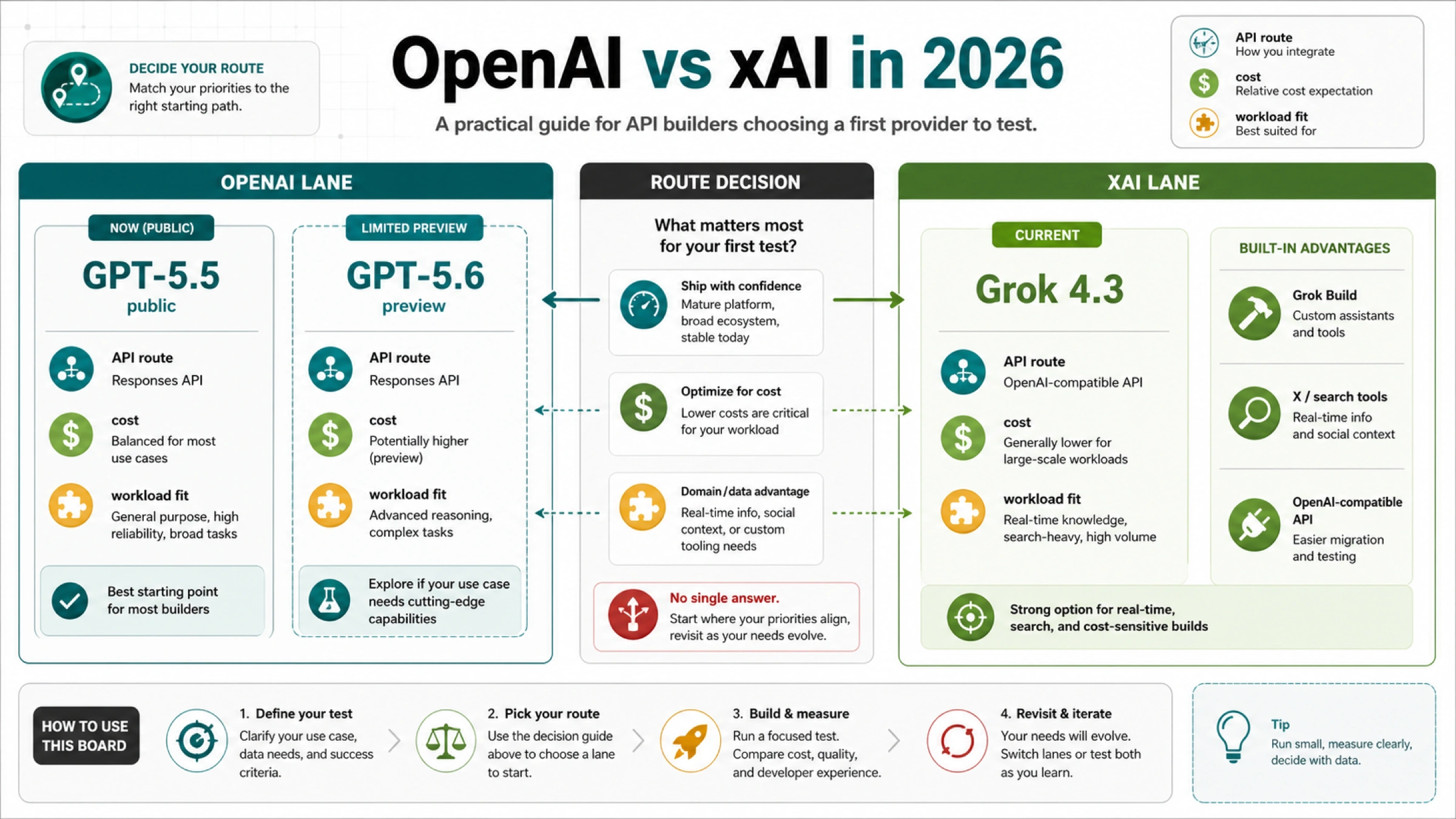
The right OpenAI-vs-xAI choice in 2026 is a route decision, not a universal winner: start with OpenAI when you need the broad public GPT-5.5 and Responses API ecosystem, start with xAI when Grok 4.3 cost/context or xAI's X/search, coding, media, or voice routes fit the job, and treat GPT-5.6 as preview-only unless your organization is approved. GPT-5.5 remains the safer public OpenAI planning baseline for complex API work, while xAI's current route is broader than one cheap text row: Grok 4.3, Grok Build, tools, media, voice, Batch, and Priority can each change the answer.
| First test | Use it when | What to verify before launch |
|---|---|---|
| OpenAI first | You need mature public API coverage, GPT-5.5-level reasoning or coding, Responses API state, hosted tools, account controls, or enterprise operations. | Current model access, price row, cache or long-context rules, tool charges, service tier, and account controls. |
| xAI first | Grok 4.3 cost/context, OpenAI-compatible integration, X/search analysis, Grok Build, image/video, or voice routes match the workload. | xAI model ID, tool charges, Batch or Priority behavior, policy charging, media or voice route, and support owner. |
| GPT-5.6 only with approval | Your organization has explicit preview access and the workload justifies preview risk. | Access, model name, price, cache behavior, endpoint support, and fallback to GPT-5.5. |
| Test both | Accepted-output cost, latency, tool behavior, or policy outcomes decide more than the model list. | Same prompt set, same data, retries, tool calls, blocked calls, logs, and accepted result rate. |
Stop rule: do not choose a provider from token price alone. Count cache, long context, tools, service tier, retries, policy stops, support owner, and accepted-output cost before moving production traffic.
Start with access, not the biggest model name
OpenAI and xAI are not competing through one clean pair of model IDs. On the OpenAI side, the current planning split is public access versus preview access. OpenAI's API model pages checked on July 2, 2026 positioned GPT-5.5 as the starting point for complex reasoning and coding when a developer is unsure, while GPT-5.6 Sol, Terra, and Luna were limited preview models available only to selected organizations. That means GPT-5.6 can matter to approved teams, but it should not be the default assumption in a public build plan.
xAI has the opposite trap. It is easy to summarize xAI as "cheaper Grok," but the official route is not one generic row. xAI's model documentation checked on July 2, 2026 listed Grok 4.3 as the default text model route, Grok Build as a coding model, Grok Imagine for image and video, Grok Voice for audio, and separate tool, Batch, and Priority cost surfaces. If the workload needs live X/search analysis or an OpenAI-compatible integration path, xAI can be the sharper first test. If the workload needs mature hosted tools, stateful Responses workflows, broader public model coverage, or account controls, OpenAI is still the safer first test.
The practical decision is therefore not "which lab is ahead?" It is "which route owns the workload today?" If the answer is a public developer application with strict support expectations, OpenAI has the broader mature surface. If the answer is cost-sensitive text, X/search-heavy analysis, or a codebase that can test xAI through familiar OpenAI-style SDK patterns, xAI deserves an early proof. If the answer depends on GPT-5.6, put a preview-access checkpoint before budget, architecture, or marketing promises.
For OpenAI-only model routing, use the OpenAI model map. For xAI-only routing, use the Grok model route guide. For an OpenAI-vs-xAI decision, keep the comparison anchored to which provider route should be tested first.
Price comparison: raw token rows are only the first line
The cleanest headline comparison favors xAI's standard text route. On July 2, 2026, OpenAI's official GPT-5.5 standard short-context price was listed at $5 per 1M input tokens, $0.50 per 1M cached input tokens, and $30 per 1M output tokens. xAI's Grok 4.3 row was listed at $1.25 per 1M input tokens and $2.50 per 1M output tokens, with a 1M context window. If your workload is high-volume text generation with few tools and a simple acceptance bar, that difference is material.
But the price table changes as soon as the workload becomes realistic. OpenAI's GPT-5.5 long-context row was listed at $10 input, $1 cached input, and $45 output per 1M tokens. OpenAI's model page also said prompts over 272K input tokens are charged at higher input and output multipliers for the full session under standard, batch, and flex processing. OpenAI Batch and Flex were listed at half of standard pricing, while Priority had a premium row. A team that can batch extraction work may see a different answer from a team that needs immediate stateful tool calls.
xAI has its own multipliers. xAI's pricing page checked on July 2, 2026 said Batch API can reduce token costs by 20% to 50% and usually completes within 24 hours, while Priority Processing is billed at 2x standard rates for supported endpoints. It also listed Web Search, X Search, and Code Execution at $5 per 1,000 calls, file attachments at $10 per 1,000 calls, and collections search at $2.50 per 1,000 calls. That can still be attractive beside OpenAI's web search call pricing, but it proves the same lesson: tools are a second bill.
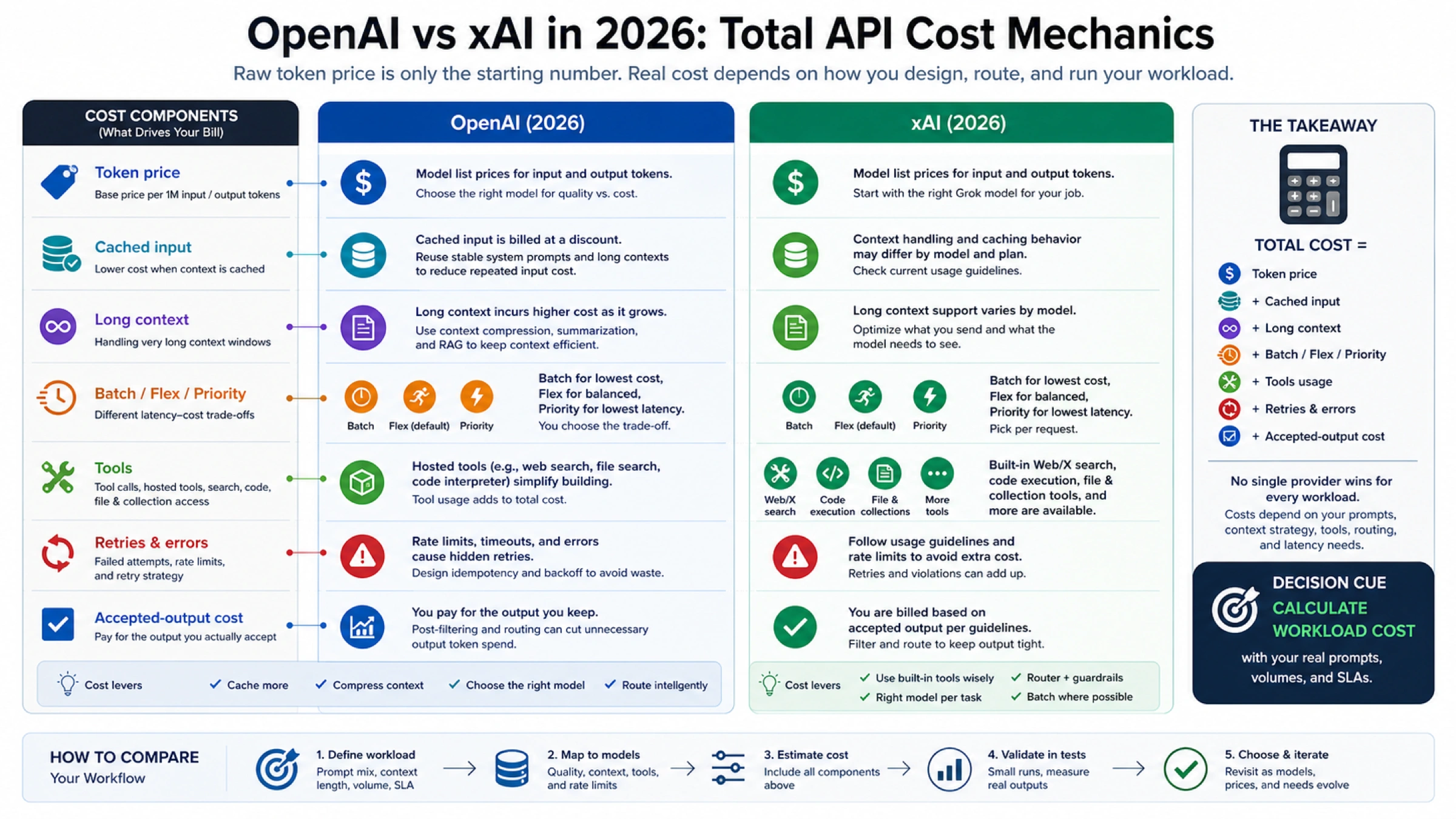
Use this compact cost model before choosing:
| Cost component | OpenAI question | xAI question |
|---|---|---|
| Base model tokens | Which GPT-5.5, GPT-5.4 mini/nano, or preview model is actually available? | Is Grok 4.3 enough, or does Grok Build, media, voice, Batch, or Priority own the job? |
| Cached input | Can repeated context be cached, and what cache row applies? | Is the route token-only, tool-heavy, or media/voice-specific? |
| Long context | Does the prompt cross the threshold where GPT-5.5 long-context or multiplier rules matter? | Does Grok 4.3's 1M context solve the job without extra retrieval, retries, or review cost? |
| Tools | Are web search, file search, containers, or hosted tools part of the answer? | Are Web Search, X Search, Code Execution, files, collections, or remote tools part of the answer? |
| Service tier | Is Batch, Flex, standard, or Priority the real route? | Is Batch delay acceptable, or does Priority double the token cost? |
| Blocked or rejected work | Which policy, moderation, or refusal behavior creates retries? | xAI's pricing page says guideline-violating requests can still be charged, so policy fit belongs in the cost estimate. |
The winner is the provider with the lower accepted-output cost for your workload, not the lower input-token number. Accepted-output cost includes the calls users keep, the calls they reject, the retries needed to fix tool behavior, and the engineering time spent around logs, errors, and support.
Model routes: public OpenAI, preview OpenAI, and xAI's Grok branches
OpenAI's public route is broad. GPT-5.5 is the main complex-workload lane for reasoning and coding in the public API guidance checked on July 2, 2026. GPT-5.4 mini and nano belong in latency and cost-sensitive branches. GPT-5.5 also supports text and image input with text output, a large context window, and Responses, Chat Completions, and Batch endpoint support. That gives teams a familiar way to scale from prototypes to production without betting the page on a preview-only model.
GPT-5.6 should be framed differently. OpenAI's preview materials listed GPT-5.6 Sol, Terra, and Luna as limited preview models for selected organizations, with separate preview pricing and cache behavior. If your account has access, GPT-5.6 can be part of a private evaluation plan. If your article, product, sales page, or internal roadmap is meant for ordinary public API users, GPT-5.6 should appear as "preview-only unless approved," not as the default OpenAI choice.
xAI's current text route starts with Grok 4.3. The xAI model page checked on July 2, 2026 described Grok 4.3 with agentic tool calling, a non-reasoning mode, a 1M context window, and pricing of $1.25 input and $2.50 output per 1M tokens. The same model list pointed developers to Grok 4.3 for general chat and text work, Grok Build for coding, Grok Imagine for images and video, and Grok Voice for audio. That is why a fair comparison must split "xAI" into text, coding, media, voice, and tool routes.
Grok Build matters when the job is code generation or coding-agent work. It is not the same as saying every xAI workload should use a coding model. A support summarizer, RAG answerer, or structured extraction worker should still prove Grok 4.3 first if that route is cheaper and sufficient. A coding assistant or agentic repository workflow should test Grok Build directly, then compare accepted patch quality, tool behavior, retry count, and review time against GPT-5.5.
API compatibility: familiar request shape is not provider equivalence
xAI's quickstart documentation shows OpenAI Python and JavaScript clients configured with an xAI base URL and xAI API key, including Responses API and image generation examples. That is a real integration advantage: a team with existing OpenAI-style client code can often create a quick proof without replacing every SDK abstraction first.
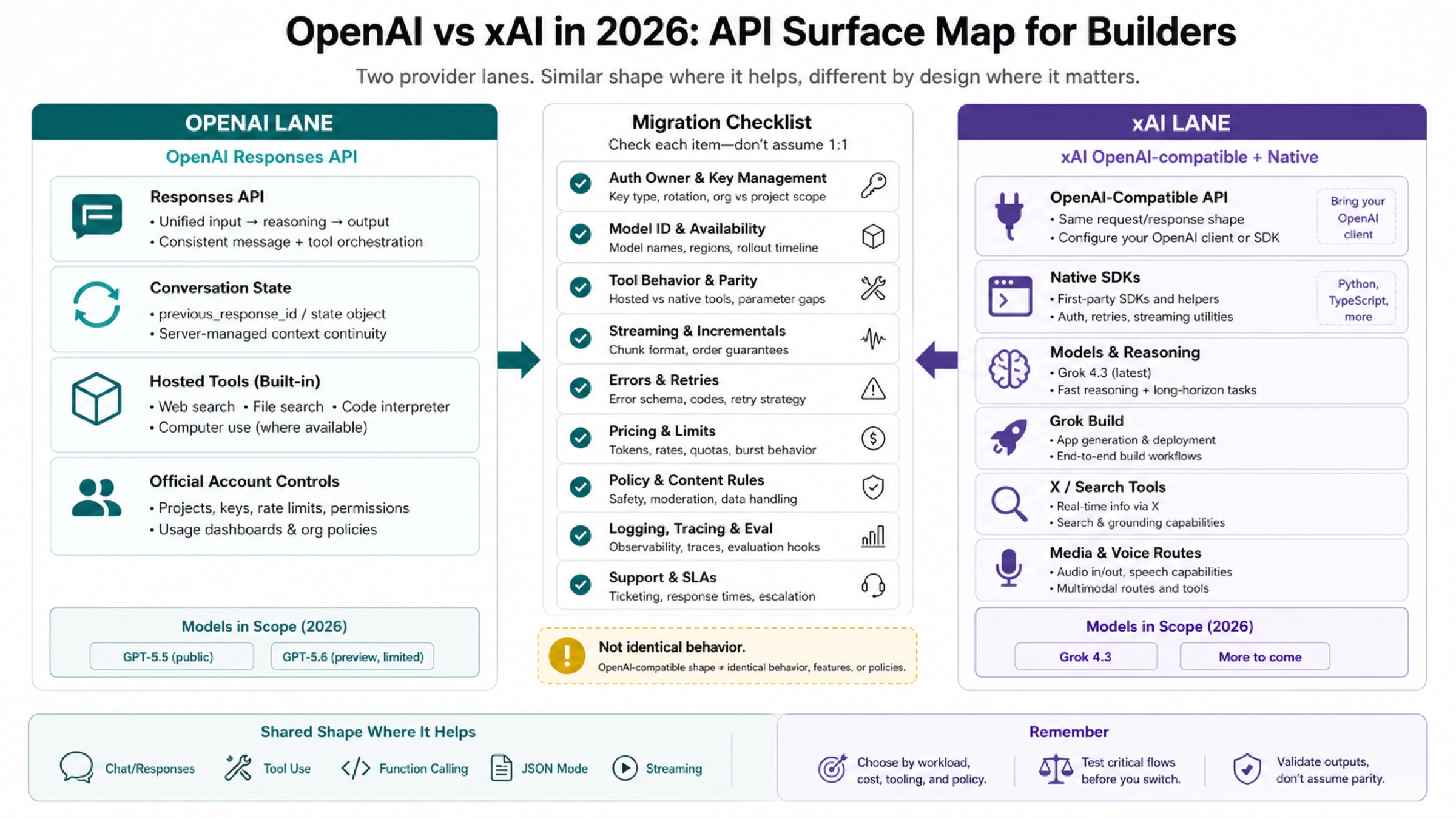
Compatibility still has limits. xAI owns its model behavior, supported tools, pricing, policy handling, logs, support, model IDs, and availability. OpenAI owns its hosted tools, Responses semantics, account controls, service tiers, and model lifecycle. If a migration test passes with one text prompt, you have proven that one request shape can run. You have not proven that streaming events, tool call structure, file handling, error codes, retry behavior, policy outcomes, or billing match your OpenAI path.
Use this migration checklist:
| Check | Why it matters |
|---|---|
| Authentication owner | The key, billing account, organization, and support path change. |
| Model ID | A compatible client still needs provider-owned model names. |
| Tool behavior | Web, X, file, code, hosted tools, and containers do not share one contract. |
| Streaming and state | Conversation state and response events can differ across providers and endpoints. |
| Errors and retries | Retry logic built for one provider may over-retry, under-retry, or hide billable failures on another. |
| Logs and audit | Observability and governance are part of production cost. |
| Policy behavior | Rejected, blocked, or guideline-sensitive requests can affect both output rate and spend. |
If the migration job is mostly reducing integration friction, xAI's OpenAI-compatible route is a strong reason to test. If the job depends on exact tool semantics, hosted files, enterprise controls, or established OpenAI operational behavior, OpenAI should stay in the first test set.
Best use cases: which provider should you test first?
The useful comparison is workload-specific. A benchmark headline can tell you what to investigate; it cannot tell you which provider will produce the cheapest accepted output in your app.
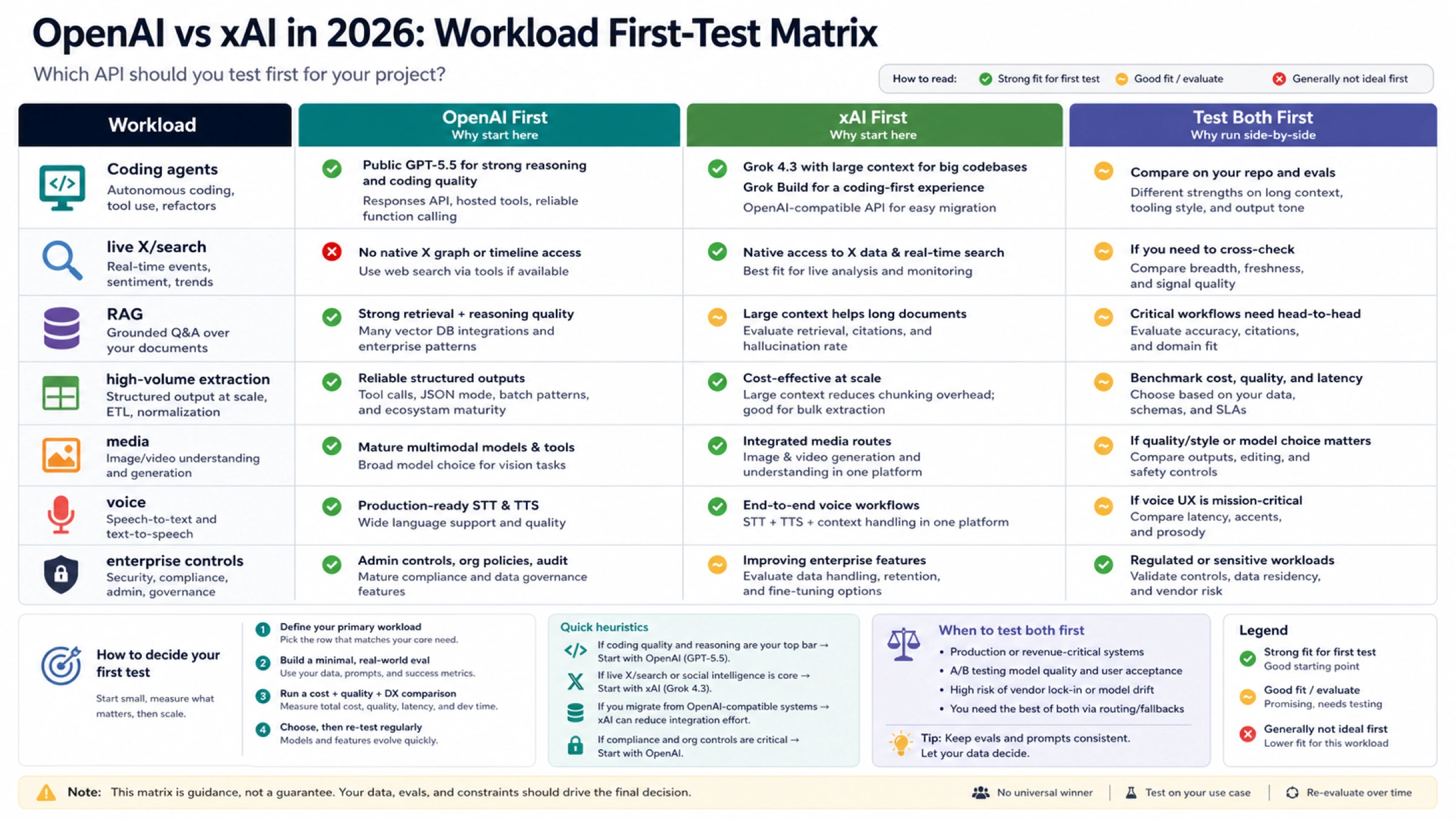
| Workload | Test OpenAI first when | Test xAI first when | Often test both when |
|---|---|---|---|
| Coding agents | You need GPT-5.5 public reasoning, mature tool workflows, state, and enterprise operations. | Grok Build or Grok 4.3 can handle your repo task at lower accepted-output cost. | Review time, patch acceptance, or tool traces decide the real cost. |
| Live X/search analysis | You need OpenAI's hosted web tooling or your stack already depends on OpenAI tools. | X Search or Web Search is central to the answer and the xAI tool route is acceptable. | The same question needs both broad web context and X-native signal. |
| RAG and enterprise search | You need OpenAI file/search/tooling behavior and account controls. | Grok 4.3's context and cost reduce retrieval complexity for the corpus. | Long context, retrieval quality, and refusal behavior all affect acceptance. |
| High-volume extraction | Batch/Flex, mini/nano routes, or caching make OpenAI cheap enough. | Grok 4.3 base price and Batch discounts reduce accepted-output cost. | Output validation, error handling, and policy stops dominate cost. |
| Image and video | You already use OpenAI media APIs or need the broader OpenAI product stack. | Grok Imagine owns the specific image/video route you need. | The user-facing output standard decides; do not infer media quality from text pricing. |
| Voice | You need OpenAI realtime/audio behavior and existing tooling. | Grok Voice route and pricing fit the product. | Latency, interruption, voice quality, and transcript accuracy all matter. |
| Regulated or enterprise work | Account controls, governance, support, and established internal approvals matter most. | The xAI route is approved, logged, and supportable inside the same governance process. | Risk review requires dual-provider resilience or fallback coverage. |
There is also a valid "use both" architecture. OpenAI can remain the default for complex tool-heavy workflows while xAI handles cost-sensitive long-context summaries or X/search-specific analysis. The key is to route by workload owner, not by brand preference. A dual-provider setup should define fallback behavior, logging, policy review, and cost caps before traffic is split.
Budget worksheet: estimate accepted-output cost
Before publishing a budget or changing providers, run one worksheet with real prompts. Keep it small enough to finish in a day and strict enough to catch hidden costs.
- Pick 20 to 50 representative tasks, not only easy examples.
- Run the same task set through the candidate routes: for example GPT-5.5 standard, GPT-5.5 Batch/Flex if latency allows, Grok 4.3, Grok Build for coding, or xAI with search tools.
- Record input tokens, output tokens, cached input eligibility, long-context thresholds, tool calls, retries, policy stops, and failed outputs.
- Mark accepted outputs, not just successful API responses.
- Multiply by the route's current token row, tool row, and service-tier multiplier.
- Add reviewer time or engineering handling where failed outputs create manual work.
- Repeat after prompt, retrieval, or tool changes.
The spreadsheet does not need to be elaborate. It needs to separate three numbers: request cost, accepted-output cost, and operational cost. Request cost is what the provider bills for the call. Accepted-output cost is what you pay per result your product can actually use. Operational cost is the support, review, and engineering work that appears when a cheaper route fails more often or logs less cleanly.
Production recheck checklist
Prices, model availability, and preview access can change faster than an article or procurement note. Recheck these items before shipping a public recommendation or production routing rule:
| Recheck item | OpenAI owner source | xAI owner source |
|---|---|---|
| Model availability | OpenAI API models and model-specific pages | xAI model list and model pages |
| Preview status | OpenAI Help or launch page for GPT-5.6 | xAI model pages or migration notes for beta/special routes |
| Token prices | OpenAI pricing page | xAI pricing page |
| Cache and long context | OpenAI pricing/model pages | xAI model and pricing pages |
| Tool prices | OpenAI pricing/tool pages | xAI pricing/tool pages |
| Batch/Priority/Flex | OpenAI pricing and service-tier docs | xAI pricing endpoint support notes |
| API shape | OpenAI Responses docs | xAI quickstart and API reference |
| Media and voice | OpenAI image/video/audio docs | xAI Imagine and Voice docs |
| Provider listings | Treat as provider-owned only | Treat as provider-owned only |
If a third-party calculator disagrees with official docs, use the owner source for publishable facts and use the calculator only as a planning aid. If a provider gateway lists a model that first-party docs do not show for your account, the provider owns that route's billing, logs, support, and data contract.
FAQ
Is xAI cheaper than OpenAI?
For standard text generation, xAI's Grok 4.3 token row checked on July 2, 2026 was much lower than OpenAI's GPT-5.5 standard row. That does not automatically make xAI cheaper for every workload. OpenAI caching, Batch/Flex, smaller GPT-5.4 variants, hosted tools, and operational fit can change the final cost. xAI tools, Priority, media, voice, retries, and policy stops can also change the final cost.
Is GPT-5.6 generally available in the OpenAI API?
No, not based on the official materials checked on July 2, 2026. OpenAI described GPT-5.6 Sol, Terra, and Luna as limited preview models for selected organizations. Public planning should use GPT-5.5 as the OpenAI complex-workload baseline unless your organization has explicit GPT-5.6 preview access.
Is xAI's API compatible with OpenAI?
xAI documents OpenAI-compatible SDK usage through its API route, which can reduce migration friction. Compatibility does not mean identical behavior. Model IDs, tools, pricing, policy handling, support, logs, and availability remain xAI-owned. Test streaming, tool calls, errors, and billing before treating it as a drop-in provider swap.
Which is better for coding agents?
Test OpenAI first when you need public GPT-5.5 reasoning, mature Responses workflows, hosted tools, and account controls. Test xAI first when Grok Build or Grok 4.3 can solve your coding workload at lower accepted-output cost. For serious coding agents, compare accepted patches, review time, tool traces, retry rate, and failure recovery rather than asking which model is better in the abstract.
Which is better for live search or X data?
xAI deserves the first test when X Search or xAI's search tooling is central to the answer. OpenAI deserves the first test when your workflow is already built around OpenAI hosted web tooling, file/search tooling, or broader Responses workflows. If the answer needs both broad web context and X-native signal, run a small dual-provider proof.
Should a startup use both OpenAI and xAI?
Often, yes, but only with clear routing rules. OpenAI might own complex tool workflows, governance-heavy requests, or customer-facing fallback. xAI might own cost-sensitive long-context summaries, X/search-heavy analysis, or selected coding/media/voice jobs. A dual-provider setup needs logs, cost caps, fallback behavior, and support ownership before it becomes production-safe.
Can provider or gateway prices replace official OpenAI and xAI prices?
No. Provider pages can be useful for that provider route, but they do not prove first-party OpenAI or xAI availability, pricing, support, or lifecycle. Keep provider-owned prices out of first-party comparison tables unless the article is explicitly about the provider route.
What is the safest default recommendation?
Use OpenAI first when you need the mature public API ecosystem and account controls; use xAI first when its cost/context, X/search, coding, media, voice, or OpenAI-compatible integration route fits the job; use GPT-5.6 only with approved preview access; and choose the final route by accepted-output cost, not by a model-name headline.