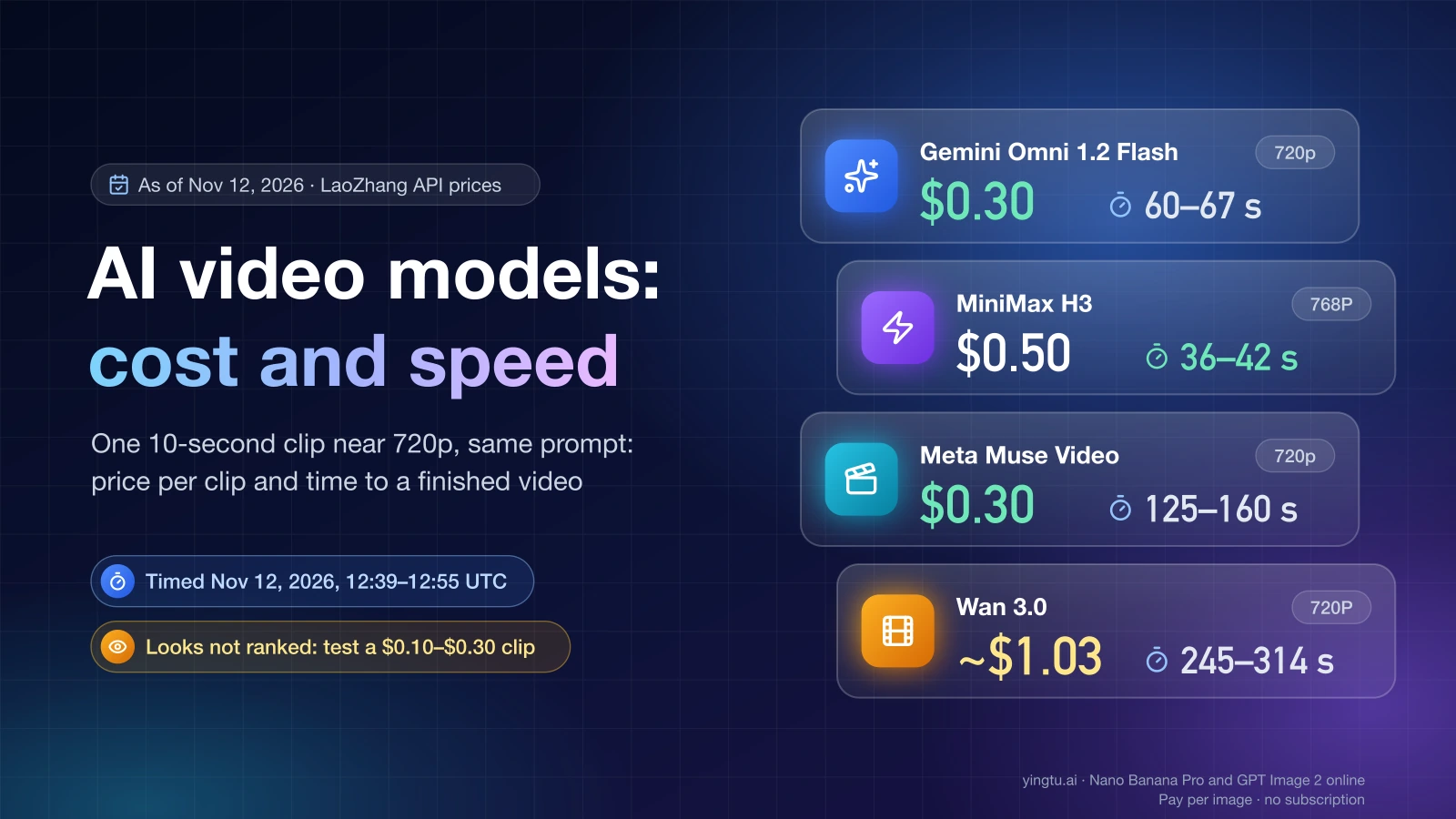
Gemini Omni 1.2 Flash (Google), MiniMax H3 (MiniMax), Meta Muse Video (Meta) and Wan 3.0 (Alibaba, with the older Wan 2.7 alongside) are AI video models that turn a prompt or an image into a short clip with its own sound track. As of November 12, 2026, one 10-second, 16:9 clip at about 720p costs $0.30 on Gemini Omni or Muse, $0.50 on MiniMax H3 and about $1.03 on Wan 3.0, charged to your own LaoZhang API key. In a same-prompt test run that day, H3 finished in about 40 seconds, Omni in about a minute, Muse in 2 to 3 minutes and Wan 3.0 in 4 to 5 minutes.
The short version of the choice:
- 10 seconds or less, lowest bill: Gemini Omni 1.2 Flash, $0.30 at 720p or $0.10 at 360p.
- Fastest result, 2K output, or a 4–5 second clip: MiniMax H3.
- Longer than 15 seconds at 720p: Meta Muse Video, up to 60 seconds for $1.55.
- 1080P past 15 seconds, or editing an existing video: Wan 3.0 or Wan 2.7, the slowest and most expensive here, and they need a separate key.
None of this ranks how good the clips look. Resolution, length, sound, frame inputs, speed and price can be measured; looks are your call, and a $0.10 to $0.30 test clip is the cheapest way to judge them.
Gemini Omni vs MiniMax H3 vs Muse vs Wan for one 10-second clip
For the same 10-second text-to-video clip, Gemini Omni and Muse tie on price at $0.30, MiniMax H3 is the fastest at about 40 seconds, and Wan costs more than three times as much while taking the longest.
Test clip: one prompt, 16:9, 10 seconds, no input images, the roughly 720p tier of each model. Prices are LaoZhang API prices as of November 12, 2026. Times were measured on November 12, 2026, between 12:39 and 12:55 UTC, with all models submitted at the same moment in each round.
| Model and setting | Price per 10-second clip | Submit to finished video | Output file | Sound | Longest clip | Key |
|---|---|---|---|---|---|---|
| Gemini Omni 1.2 Flash, 720p | $0.30 | 60, 66, 67 s | 1280×720, 24 fps | Stereo | 10 s | Regular LaoZhang key |
| MiniMax H3, 768P | $0.50 | 36, 41, 42 s | 1344×768, 24 fps | Stereo | 15 s | Regular LaoZhang key |
| Meta Muse Video, 720p | $0.30 | 125, 135, 160 s | 1280×720, 24 fps | Mono | 60 s | Regular LaoZhang key |
| Wan 3.0, 720P | about $1.03 | 245, 314 s | 1280×720, 30 fps | Stereo | 30 s | Wan-group key |
| Wan 2.7 text-to-video, 720P | about $1.03 | 458 s (one run) | 1280×720, 30 fps | Stereo | 10 s | Wan-group key |
Notes for reading the table:
- MiniMax H3 has no 720p tier. Its lower tier, 768P, renders 1344×768 at 16:9, a little larger than 720p, so it is the closest match.
- All 15 test tasks finished, none failed, and every file showed the barista scene the prompt asked for. Each file had an audio track; Muse's had one channel, the others two.
- H3 returned a 10.12-second file for a 10-second request. MiniMax H3 often runs a fraction of a second long, and the extra is not billed.
- These are LaoZhang prices, not the model makers' list prices. Google's own Gemini API price for Omni 1.2 Flash is $0.07 per second at 720p, or $0.70 for 10 seconds. MiniMax's own pay-as-you-go price for H3 is $0.08 per second at 768P, or $0.80 for 10 seconds.
Which is cheapest for 5, 10, 15 or 30 seconds
The cheapest model changes with length: MiniMax H3 wins below 6 seconds, Gemini Omni and Muse tie from 8 to 10 seconds, and Muse is the cheapest past 15 seconds.
That happens because the four bill differently:
- Gemini Omni 1.2 Flash charges one flat price per video by resolution: $0.10 at 360p, $0.30 at 720p, $0.45 at 1080p. A 4-second clip and a 10-second clip cost the same.
- Meta Muse Video charges per video by length band: $0.30 for 5, 8 or 10 seconds, then $0.55 for 20 s, $0.80 for 30 s, $1.05 for 40 s, $1.30 for 50 s and $1.55 for 60 s.
- MiniMax H3 charges per second: $0.05 × seconds at 768P, $0.08 × seconds at 2K.
- Wan 3.0 charges per second: $0.0514 at 480P, $0.1028 at 720P, $0.2057 at 1080P. At 720P that is $0.1028 × seconds.
Price at the roughly 720p tier, as of November 12, 2026 (a dash means the length is not offered in the YingTu studio):
| Clip length | Gemini Omni 1.2 Flash 720p | MiniMax H3 768P | Meta Muse Video 720p | Wan 3.0 720P | Cheapest |
|---|---|---|---|---|---|
| 4 s | $0.30 | $0.20 | — | — | MiniMax H3 |
| 5 s | $0.30 | $0.25 | $0.30 | about $0.51 | MiniMax H3 |
| 8 s | $0.30 | $0.40 | $0.30 | — | Omni and Muse |
| 10 s | $0.30 | $0.50 | $0.30 | about $1.03 | Omni and Muse |
| 15 s | — | $0.75 | — | about $1.54 | MiniMax H3 |
| 20 s | — | — | $0.55 | about $2.06 | Muse |
| 30 s | — | — | $0.80 | about $3.08 | Muse |
| 60 s | — | — | $1.55 | — | Muse (only option) |
Two things the table hides:
- At exactly 6 seconds, H3 768P ($0.05 × 6 = $0.30) ties Gemini Omni. Below that, H3 is cheaper; above it, Omni is.
- For 11 to 15 seconds, H3 is the cheapest model that offers those lengths ($0.60 for 12 s, $0.75 for 15 s; Wan 3.0 also makes 15 s, for about $1.54). A 20-second Muse clip costs $0.55, less than either H3 price, if you are willing to trim it. Muse builds anything over 10 seconds from 10-second parts, and motion can slow for a moment where the parts join.
At other resolutions, the price of a 10-second clip, as of November 12, 2026:
| Model | Lowest tier | About 720p | Highest tier |
|---|---|---|---|
| Gemini Omni 1.2 Flash | 360p (640×360): $0.10 | 720p: $0.30 | 1080p: $0.45 |
| MiniMax H3 | — | 768P: $0.50 | 2K (2560×1440): $0.80 |
| Meta Muse Video | — | 720p (only tier): $0.30 | — |
| Wan 3.0 | 480P: about $0.51 | 720P: about $1.03 | 1080P: about $2.06 |
| Wan 2.7 | — | 720P: about $1.03 | 1080P: about $1.71 |
The single cheapest video of the four is a Gemini Omni 360p clip at $0.10 for any length from 3 to 10 seconds. MiniMax H3 at 2K is the only option above 1080p.
Which is fastest: MiniMax H3 at about 40 seconds
MiniMax H3 at 768P returned a finished 10-second clip in 36 to 42 seconds, faster than Gemini Omni 720p (60 to 67 seconds), Meta Muse Video (125 to 160 seconds) and Wan 3.0 720P (245 to 314 seconds). Wan 2.7 text-to-video took 458 seconds in its one run.
How the times were taken: the same prompt went to every model through the LaoZhang API that the YingTu video studio calls, all at the same moment, in three rounds. The prompt was:
A barista pours steamed milk into a cup of coffee on a sunny cafe counter, making a leaf pattern. Slow camera push-in, soft morning light. Sound: milk hissing, a cup clinking on the saucer, quiet cafe chatter.
Each time runs from sending the create request to the first status check that reported the video done. Status was checked every 5 seconds, so each figure is accurate to about 5 seconds either way. For Wan, the create request alone took 30 to 60 seconds to return a task ID, and that wait is included.
Higher resolution costs time. One extra round in the same 16-minute window gave these results:
| Setting (10 s, 16:9) | Submit to finished video | Price |
|---|---|---|
| Gemini Omni 1.2 Flash 360p | 37 s | $0.10 |
| Gemini Omni 1.2 Flash 1080p | 91 s | $0.45 |
| MiniMax H3 2K | 120 s | $0.80 |
These are one to three runs per setting in one 16-minute window through one provider, not averages or guarantees. Queues change through the day, and other providers or other hours can be faster or slower. In the browser studio, add a few seconds for image upload and page polling. Only text-to-video was timed; runs that start from a first frame or reference image were not.
Earlier single runs at other settings point the same way: a 4-second H3 768P clip took about 16 seconds (November 9, 2026), and a 5-second Wan 3.0 480P clip took 4 to 5 minutes (November 12, 2026). Wan 2.7's time depends heavily on length and queue: a 5-second 720P clip took about 97 seconds on September 25, 2026, against 458 seconds for the 10-second clip in this test.
You do not have to watch the page while a slow model runs. Tasks keep going after you close the tab. Gemini Omni, H3 and Muse result links stay up for 7 days, while Wan task IDs and links last only 24 hours, so download Wan clips the same day.
Max length, aspect ratios and first/last frame inputs compared
Meta Muse Video goes longest (60 seconds), MiniMax H3 goes highest (2K), and Gemini Omni is the only one of the four with no last-frame input in either the studio or the API.
What each model offers in the YingTu studio, as of November 12, 2026:
| Gemini Omni 1.2 Flash | MiniMax H3 | Meta Muse Video | Wan 3.0 | |
|---|---|---|---|---|
| Resolution | 360p, 720p, 1080p | 768P, 2K | 720p only | 480P, 720P, 1080P |
| Lengths | 4, 5, 6, 8, 10 s | 4, 5, 6, 8, 10, 12, 15 s | 5, 8, 10, 20, 30, 40, 50, 60 s | 5, 10, 15, 20, 30 s |
| Aspect ratios | 16:9, 9:16 | 16:9, 9:16, 1:1, 4:3, 3:4, 21:9 | 16:9, 9:16, 1:1, 4:3, 3:4 | Same six as H3 for text-to-video; image-to-video follows the image |
| First frame | Yes | Yes | Yes | Yes |
| Last frame | No | Yes | Yes | API only |
| Reference image | Yes, up to 6 images including the first frame | Yes, but not together with frames | Yes; carries outfit, hair and style, not an exact face | API only |
| Sound | Stereo; characters speak lines you write in the prompt | Stereo music and sound effects | Music and sound, mono | Stereo, on by default |
Details that change a choice:
- Gemini Omni takes a first frame and reference images together, up to six in total, but no last frame. It is the model of the four built to voice dialogue you write in the prompt: put the line in quotes and say who speaks it.
- MiniMax H3 takes either a first and last frame, or reference images, but not both in one request. The studio has one reference-image slot; through the API the first 5 reference images are free and each extra one costs $0.03 at 768P. The API also accepts a reference video and reference audio.
- Meta Muse Video takes a first frame, a last frame and a reference image, and can use all three in one request. A last frame needs a first frame. A reference image keeps outfit, hair and style rather than an exact face. Its 20 to 60 second clips are built from joined 10-second parts, each starting from the last frame of the one before. The studio adds six preset looks and thirteen camera and transition presets.
- Wan 3.0 in the studio does text-to-video and first-frame image-to-video. First-and-last-frame, reference-to-video (up to 10 images) and video editing or extending exist in the API only.
Wan 2.7 sits in the same studio as four separate models, all at 720P or 1080P, 5 or 10 seconds and 16:9: text-to-video; first-frame image-to-video, which through the API also takes a driving audio track for lip-sync; reference-to-video, where the reference image sets the subject without being used as the first frame; and video edit, which takes a source video plus a reference image. An edit bills the source video's seconds plus the output's.
Which model to pick for your clip
Pick by the one constraint you cannot move, then check the price for your exact length in the tables above.
- If the clip is 10 seconds or less and price matters most, use Gemini Omni 1.2 Flash: $0.30 at 720p, $0.45 at 1080p, or $0.10 at 360p for a draft. Choose Muse at the same $0.30 instead if you need a last frame or a 1:1, 4:3 or 3:4 frame.
- If you need the video back fast, need 2K, or want a 4 to 6 second clip, use MiniMax H3. It was the fastest in every round and is the cheapest at 4 and 5 seconds.
- If you have both a start image and an end image, use MiniMax H3 or Meta Muse Video. Omni has no last frame, and Wan 3.0 takes one only through the API.
- If you want a first frame plus a reference image in one clip, use Gemini Omni or Muse. H3 makes you choose frames or references.
- If characters need to say specific lines, start with Gemini Omni, which voices dialogue written in the prompt. For H3 and Muse, the listed audio is music and sound effects.
- If the clip runs longer than 15 seconds at 720p, use Meta Muse Video: $0.55 for 20 seconds up to $1.55 for 60 seconds, though motion can slow for a moment at each 10-second join.
- If you need 1080P past 15 seconds, or want to edit a video you already have, use Wan 3.0 or Wan 2.7. Budget for it: a 30-second Wan 3.0 clip is about $3.08 at 720P and about $6.17 at 1080P, and you need a Wan-group key.
- If you only have $0.10, the one video that fits is a Gemini Omni 360p clip.
When the choice comes down to looks rather than features, render the same short prompt on each candidate before paying for a long or high-resolution clip. A 5-second test costs $0.25 on H3 768P, $0.30 on Omni 720p or Muse, and about $0.51 on Wan 3.0 720P; an Omni 360p draft is $0.10.
One LaoZhang key runs Omni, H3 and Muse; Wan needs a Wan-group key
Gemini Omni 1.2 Flash, MiniMax H3 and Meta Muse Video all run on a regular LaoZhang API key, the same key the YingTu image studio uses. Wan 3.0 and Wan 2.7 need a second LaoZhang key created in the Wan group.
How video works on YingTu: you open a model's studio page, paste your own LaoZhang API key, and each video is charged to that key at the prices above, with no subscription. You can create a key at laozhang.ai.
Points that affect what you pay:
- Video is not part of YingTu's free credit. The trial credit you get by signing in with Gmail covers images only.
- The one free way to try is a new LaoZhang account. It comes with a $0.1 balance, which pays for exactly one Gemini Omni 360p video. That is not enough for H3 (from $0.20), Muse ($0.30) or Wan, and Wan needs its own key anyway.
- Failed tasks do not cost you. Omni and Muse charge when the task is created and refund the full amount if it fails, including when a prompt is blocked by moderation. H3 and Wan do not bill failed tasks. Submitting the same prompt again creates and bills a new task.
If you are calling these models from code rather than the studio, the LaoZhang video API pricing guide lists the model IDs (gemini-omni-1.2-flash, MiniMax-H3, muse-video, wan3.0-video) and request parameters. One trap there: if a Wan request leaves out the resolution, it defaults to 1080P, the most expensive tier.
Questions about these four video models
Is MiniMax H3 the same as Hailuo?
MiniMax H3 is the video model that Hailuo AI is built on, and it is sometimes called Hailuo 3. Its prices here are LaoZhang's: $0.05 per second at 768P and $0.08 per second at 2K, as of November 12, 2026.
Does Gemini Omni 1.2 Flash cost $0.07 per second or $0.30 per video?
Both figures are real; they come from different providers. $0.07 per second at 720p is Google's own Gemini API price, so a 10-second clip there is $0.70. Through LaoZhang, the same model is billed per video: $0.30 at 720p for any length from 3 to 10 seconds, as of November 12, 2026.
Is Meta Muse Video available through an API?
Yes. Meta Muse Video runs through the LaoZhang API as muse-video for 5, 8 or 10 second clips ($0.30) and as muse-video-20s up to muse-video-60s for longer ones ($0.55 to $1.55), as of November 12, 2026. These are LaoZhang's prices, not a Meta list price.
Can MiniMax H3 do image to video?
Yes. MiniMax H3 accepts a first frame and a last frame, or reference images, but not frames and references in the same request. In the studio it takes one reference image; through the API it also accepts reference video and audio.
Do all four models make video with sound?
Yes. Every clip in the November 12, 2026 test came back with an audio track. Gemini Omni, MiniMax H3 and Wan produced stereo; Meta Muse Video produced mono. Gemini Omni is the one built to voice lines written in the prompt. For H3 and Muse, the listed audio is music and sound effects, and Wan 2.7 can lip-sync to an audio track you supply through the API.
Should I use Wan 3.0 or Wan 2.7?
Use Wan 3.0 for 15 to 30 second clips, a 480P draft tier or aspect ratios other than 16:9. Use Wan 2.7 for video editing or reference-to-video in the studio, or for lip-sync to your own audio through the API. At 720P both cost $0.1028 per second as of November 12, 2026; at 1080P Wan 2.7 is cheaper ($0.1714 versus $0.2057 per second). In the test above, Wan 3.0 finished a 10-second 720P clip faster than Wan 2.7 (245 and 314 seconds versus 458), but both were the slowest of the group.