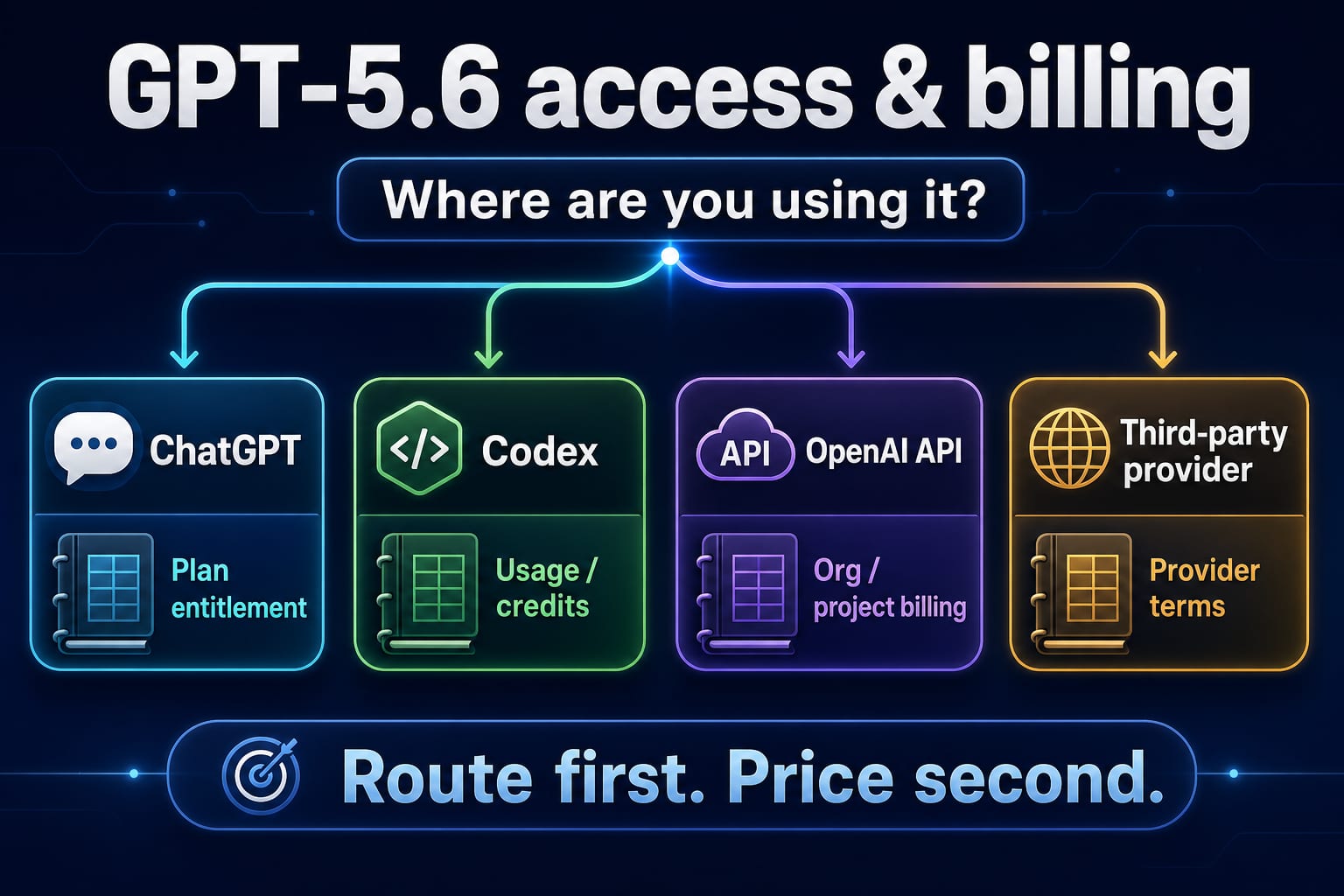
There is no single GPT-5.6 price or “free trial” answer. Start by identifying where you are trying to use the model: ChatGPT, Codex, the OpenAI Platform API, or a third-party provider. Each surface can use a different entitlement and billing ledger, so a ChatGPT subscription does not become API credit, and a provider balance does not describe your OpenAI account.
For current ChatGPT availability, use the plan-and-model table in OpenAI’s GPT-5.6 in ChatGPT Help article as the official reference. Free and Go do not include GPT-5.6 Sol in standard ChatGPT conversations, while their Codex route includes GPT-5.6 Terra—an immediate example of why access must be checked on the correct surface. Confirm your actual account or workspace model picker and any admin controls, because managed-workspace settings and gradual rollout can affect what appears. The route check below tells you which ledger to inspect before you compare costs or buy anything.
First, match your GPT-5.6 surface to its billing ledger
Use the place where you select or call GPT-5.6—not the name of a subscription or promotion—as the deciding signal.
| Surface | Ledger that controls cost | What to check now | Do not confuse it with |
|---|---|---|---|
| ChatGPT | ChatGPT plan entitlement and, where applicable, flexible ChatGPT credits | Compare the current Help table with the live model picker; in a managed workspace, also check admin controls | Platform API balance or a provider balance |
| Codex | Codex usage included with the applicable ChatGPT plan and any relevant flexible-credit usage | Check the Codex surface and its usage or credit status for the signed-in account | Platform token billing merely because Codex uses an OpenAI model |
| OpenAI Platform API | The Platform organization or project that owns the request | Check model access, pricing, usage, and balance in that organization or project | A ChatGPT subscription or ChatGPT credit balance |
| Third-party provider | That provider’s balance, package, and routing terms | Verify the exact routed model and charges in the provider dashboard or documentation | Your ChatGPT or Platform balance, unless the provider uses your own OpenAI API key |
The practical rule is simple: surface first, ledger second, official next action third. If GPT-5.6 is absent from the relevant picker or model list, do not assume that buying credits will unlock it. Verify availability on that same surface first. Only then inspect the matching ledger.
ChatGPT and Codex access are related, but not interchangeable
The current published distinction is unusually important for Free and Go accounts: they do not include GPT-5.6 Sol in standard ChatGPT conversations, but Codex includes GPT-5.6 Terra for those plans. In Codex, Plus, Pro, Business, and Enterprise can choose Sol, Terra, and Luna. This is a Codex entitlement; it is not evidence of Platform API balance or a universal entitlement in standard ChatGPT conversations.
| ChatGPT plan | Standard ChatGPT conversation | Codex route |
|---|---|---|
| Free | GPT-5.6 Sol not included | GPT-5.6 Terra |
| Go | GPT-5.6 Sol not included | GPT-5.6 Terra |
| Plus | Use the current Help table and live picker | GPT-5.6 Sol, Terra, and Luna |
| Pro | Use the current Help table and live picker | GPT-5.6 Sol, Terra, and Luna |
| Business | Use the current Help table, workspace picker, and admin controls | GPT-5.6 Sol, Terra, and Luna |
| Enterprise | Use the current Help table, workspace picker, and admin controls | GPT-5.6 Sol, Terra, and Luna |
This table is a route guide, not a promise that a model will already be visible in every account. OpenAI describes a gradual rollout, and a managed workspace can apply admin controls. The live picker for the account or workspace remains the decisive access check.
ChatGPT plan prices are not GPT-5.6 API prices
The reviewed Codex comparison surface displays these US-denominated monthly values:
| Plan | Displayed monthly price |
|---|---|
| Free | $0 |
| Go | $8 |
| Plus | $20 |
| Pro | From $100 |
These displayed prices help identify the plan ledger; they do not quote a per-token API rate. Checkout, taxes, market, and account-specific offers determine the amount actually payable. Most importantly, a paid ChatGPT subscription does not include OpenAI Platform API usage. API requests are billed separately.
Flexible ChatGPT credits do not become API credits
Flexible usage credits in ChatGPT can extend eligible supported features after included limits. They expire after 12 months, do not roll over, are generally non-refundable, and are non-transferable.
That balance stays inside the eligible ChatGPT feature system. It does not fund API-key requests, and it does not turn into a Platform organization balance. When troubleshooting a missing model or a rejected request, ask two separate questions:
- Is GPT-5.6 available on the surface I am using?
- Does the ledger for that same surface have entitlement, included usage, or balance remaining?
Answering only the second question can lead to the wrong purchase. Credits cannot fix an availability restriction on another surface.
GPT-5.6 direct API pricing
OpenAI publishes GPT-5.6 API prices in US dollars per 1 million tokens. Input, cached input, cache writes, and output are separate billable buckets.
| Model | Input | Cached input | Cache write | Output |
|---|---|---|---|---|
gpt-5.6-sol | $5.00 | $0.50 | $6.25 | $30.00 |
gpt-5.6-terra | $2.50 | $0.25 | $3.125 | $15.00 |
gpt-5.6-luna | $1.00 | $0.10 | $1.25 | $6.00 |
Source: OpenAI’s GPT-5.6 announcement and pricing. The cache-write figures are arithmetic derivations from OpenAI’s published rule that cache writes cost 1.25 times uncached input; cached reads receive a 90% discount. They are shown explicitly so the units can be audited, not as a separate quoted price card.
An auditable Terra cost example
Assume a billing period contains the following gpt-5.6-terra usage, with no individual request crossing the 272K-input threshold:
- 2 million uncached input tokens
- 0.5 million cached input tokens
- 0.5 million output tokens
The calculation is:
hljs textUncached input: 2.0 × $2.50 = $5.00 Cached input: 0.5 × $0.25 = $0.125 Output: 0.5 × $15.00 = $7.50 Total: $12.625
The exact subtotal is $12.625, before any other applicable charges. If a billing view rounds currency for display, retain the token counts and unrounded rate calculation when reconciling it.
There is an additional long-context rule: for a request above 272K input tokens, OpenAI applies a whole-request multiplier of 2× input and 1.5× output. “Whole request” matters—the multiplier is not limited to only the tokens above 272K. Estimate ordinary and long-context requests separately instead of applying one blended rate to all traffic.
Platform prepaid credits have their own expiration rules
Purchased Platform API prepaid credits expire after one year and are non-refundable. In the reviewed setup flow, auto recharge is enabled by default unless disabled. Those credits belong to the Platform billing system, not the ChatGPT flexible-credit ledger.
No reviewed official source promises either a universal new-account API credit amount or a standing GPT-5.6 API free trial. An account-specific incentive, data-sharing offer, or grant should be treated as an offer for that account—not generalized into a public entitlement. For the broader distinction between an API key, trial balance, and prepaid billing, see the OpenAI API key and free-trial guide.
“Free trial” and student credits need their full conditions
Paid ChatGPT trials and referral links are campaign-specific. Some require payment details and automatically renew unless canceled before the trial ends. The existence of an OpenAI Help page about invitations or promotions does not establish a standing trial for every user. If an offer appears in your account, check its eligibility, end date, renewal price, and cancellation deadline before accepting it. The ChatGPT Plus free-trial guide covers those generic trial checks without turning them into a GPT-5.6 access promise.
OpenAI’s reviewed Codex for Students offer is narrower and should be described precisely. A verified university student who is enrolled and resides in the United States or Canada can receive $100, displayed as 2,500 ChatGPT credits, expiring 12 months after the grant. It requires a ChatGPT Free, Go, Plus, or Pro account. These are not API credits and the offer is not a general GPT-5.6 free trial.
Treat a third-party provider as a separate commercial contract
A provider can expose a model through its own account, package, and balance, or it can ask you to supply an OpenAI API key. Those two arrangements have different ledgers and risk boundaries. Before paying, verify all of the following from current primary documentation:
- the exact routed model and model ID;
- the price unit and any quota or rate limit;
- whether billing uses the provider balance or your own OpenAI key;
- privacy and data-handling terms;
- support and refund terms.
There is not enough reviewed public evidence here to recommend a third-party route for GPT-5.6. In particular, the reviewed LaoZhang.ai public documentation does not establish GPT-5.6 availability, model ID, price, free trial, or free credits. The responsible next action is verification, not a provider recommendation.
A two-minute GPT-5.6 access and billing check
- Name the surface. Is the model selected in ChatGPT, Codex, the Platform API, or a provider product?
- Verify availability there. Use the official Help table or model documentation, then confirm the live picker, model list, and any workspace admin controls.
- Open the matching ledger. Check ChatGPT plan usage or flexible credits, Codex usage, the Platform organization or project, or the provider dashboard.
- Confirm the unit. A monthly plan price, ChatGPT credit balance, and per-million-token API rate answer different questions.
- Read the exception. Check rollout status, expiration, renewal, long-context multipliers, and refund terms before paying.
- Reconcile with evidence. For API use, retain the exact model ID and token buckets. For a provider, retain the routed-model and charge record.
If you follow that order, “Can I use GPT-5.6?” and “What will it cost?” become answerable account questions instead of one misleading universal-price question.