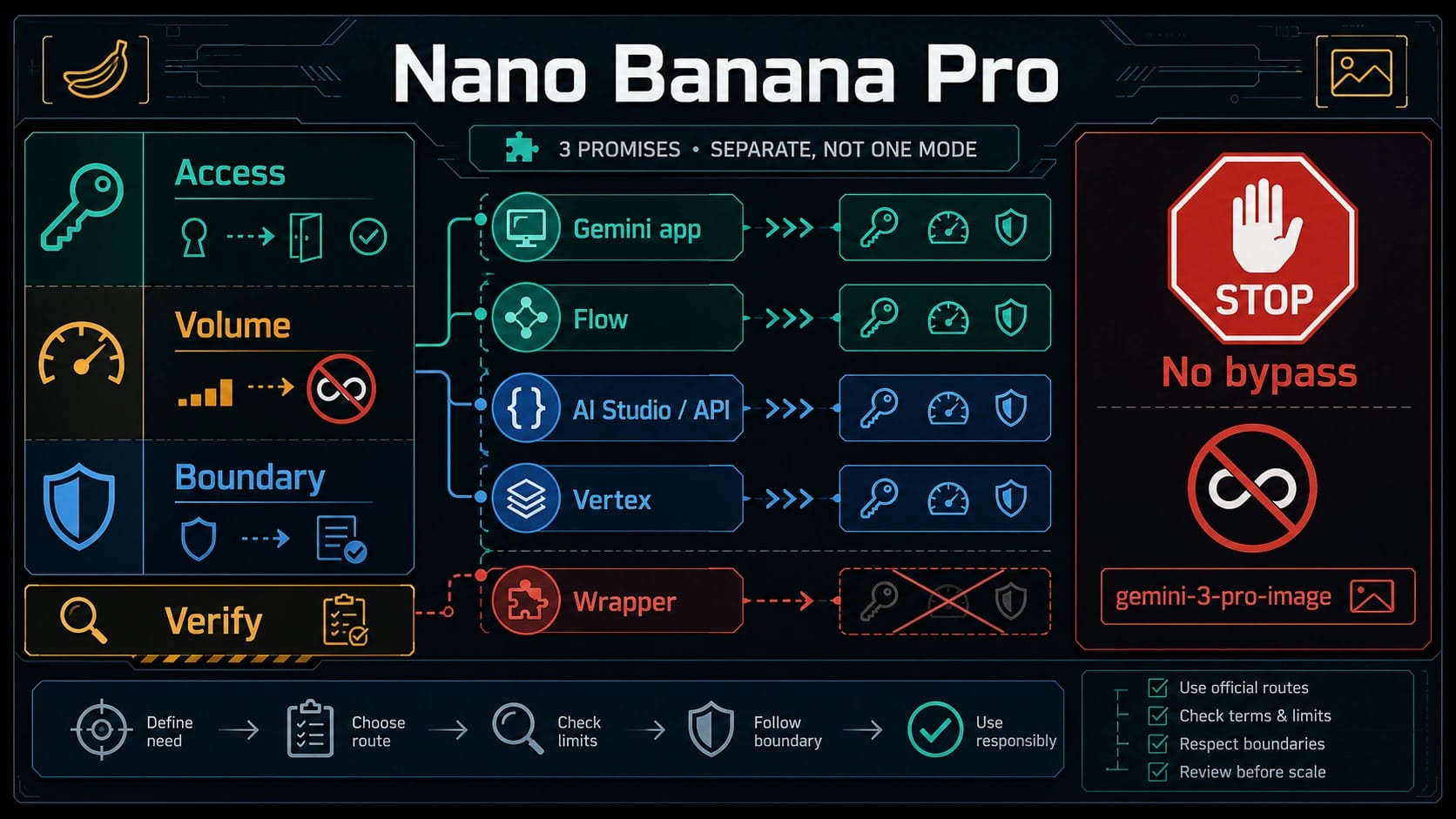
Nano Banana Pro is not an official no-cost, no-limit, no-policy image mode. When a tool, video, or API wrapper says "unrestricted," "unlimited," or "uncensored," first decide which restriction it claims to remove: access friction, usage volume, or content boundary.
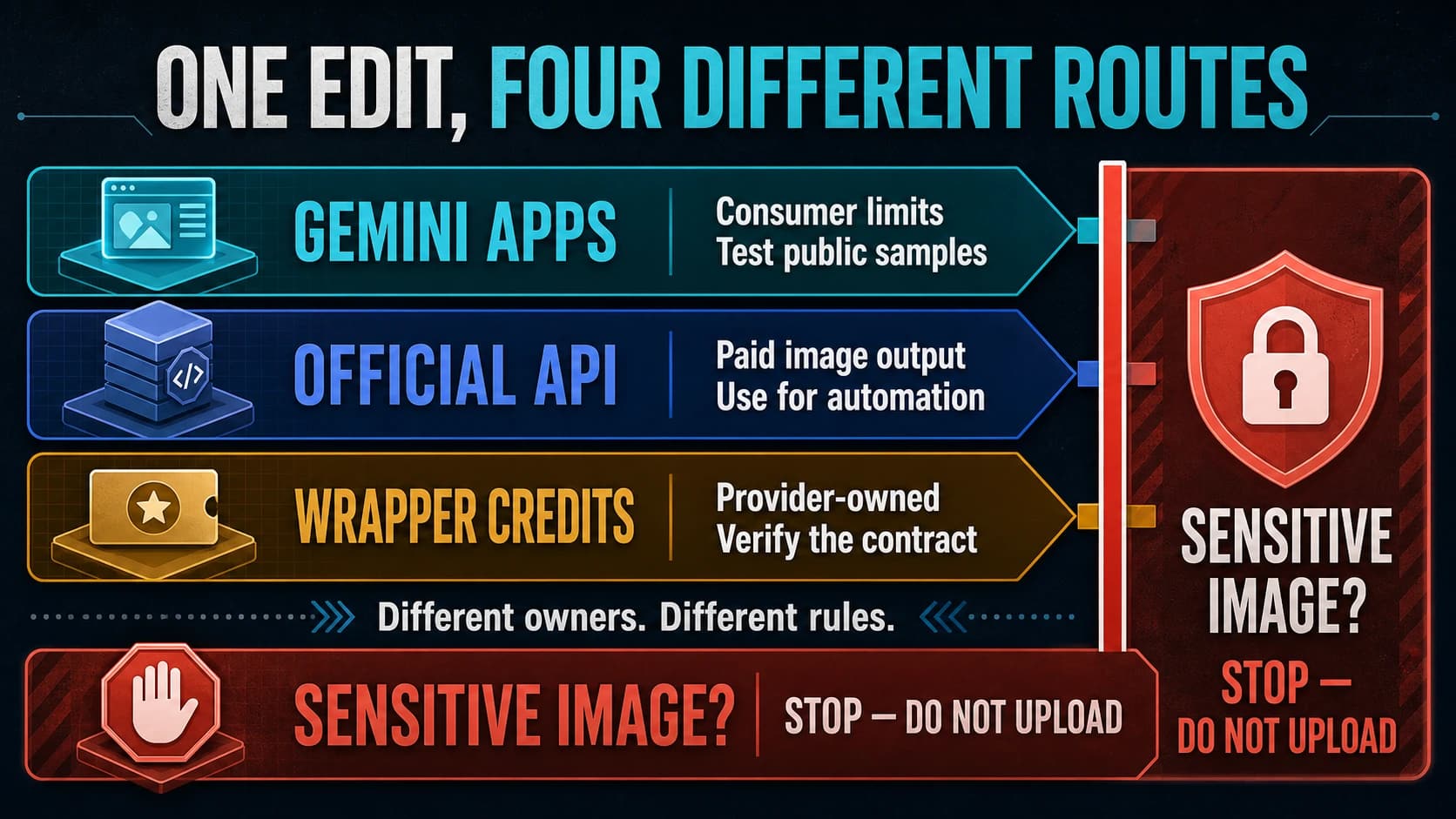
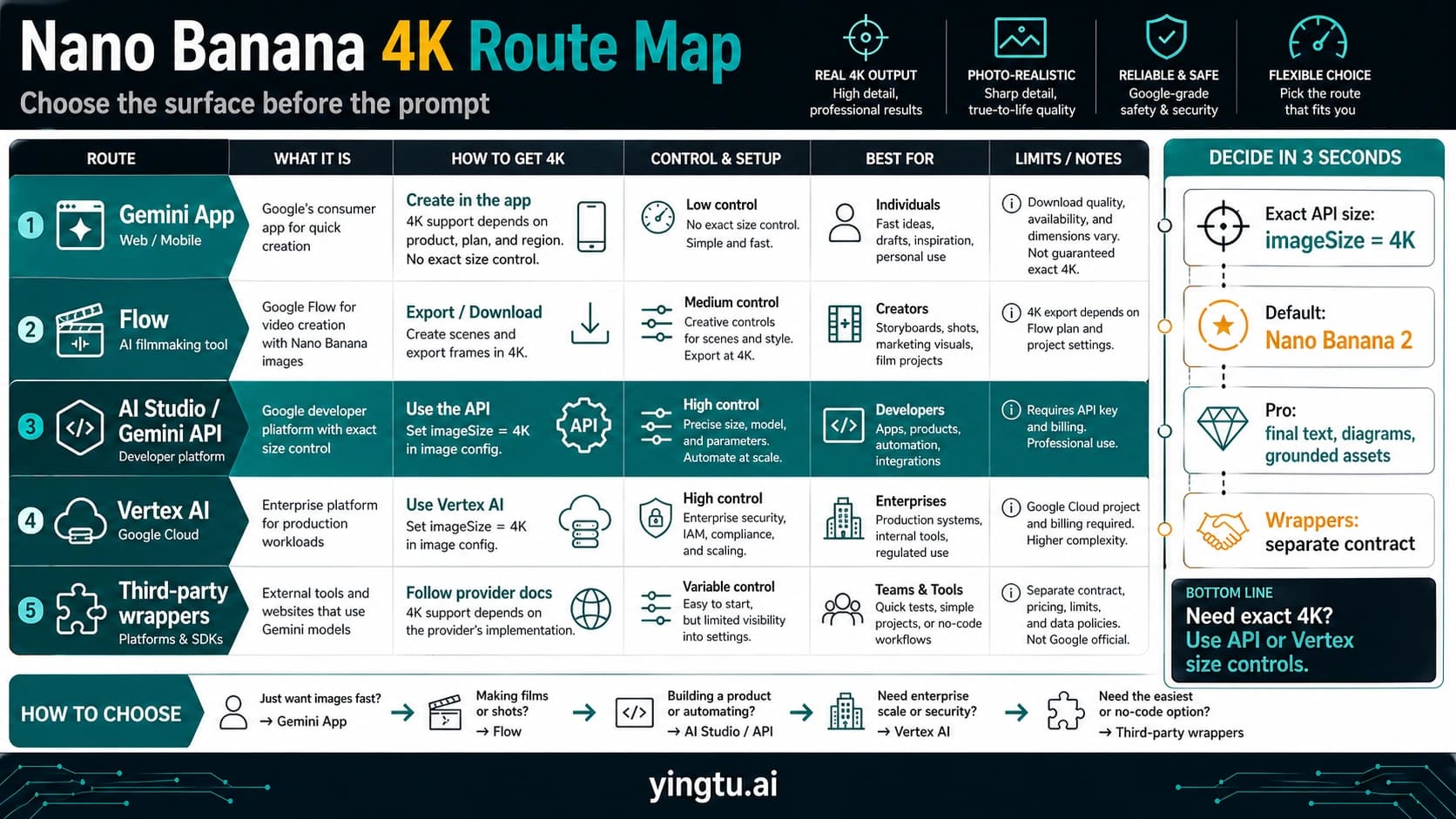
Use the route board before you pay, configure, or switch tools. Gemini app, Flow, AI Studio/API, Vertex, and third-party wrappers can each change different parts of the experience, but none turns policy boundaries into a bypass route. If the result you want depends on bypassing safety protections or prohibited content rules, stop there and choose a compliant route instead.
The quick verdict: what the three promises really mean
The three words sound like one offer, but they point to different owners. One route may reduce sign-up friction, another may raise capacity, and another may expose more developer configuration. Those changes do not merge into an official unlimited or uncensored Nano Banana Pro mode.
| Promise on the tool page | What it can legitimately mean | Who owns the proof | What it cannot prove |
|---|---|---|---|
| Unrestricted | Easier access, fewer UI gates, broader region or account availability, or a less restrictive workflow within allowed use | The route you are using: Gemini app, Flow, AI Studio/API, Vertex, or a wrapper | That prohibited content becomes allowed |
| Unlimited | A paid plan, higher quota, provider credit pool, queue capacity, or marketing shorthand for generous usage | The billing owner and current limit dashboard | That no rate limit, daily cap, project quota, or provider throttle exists |
| Uncensored | Sometimes a claim about adjustable safety settings or fewer provider-side prompt blocks | Official policy and the route's terms, not the claim wording | That safety filters, core protections, or prohibited-use rules can be bypassed |
The safest first move is to ask a smaller question: "Which restriction is blocking me right now?" If the answer is price, limits, region, API access, safety threshold, policy rejection, watermark, or wrapper credits, the owner changes.
What the official Nano Banana Pro route is
Google's current developer naming matters because many older pages, examples, and wrapper pages still use preview-era wording. Checked on July 8, 2026, the official Gemini API model page lists Nano Banana Pro under Gemini 3 Pro Image with the stable model ID gemini-3-pro-image. Nano Banana 2 belongs to the high-efficiency lane, gemini-3.1-flash-image. If another current Google table or migration note still shows gemini-3-pro-image-preview, treat that as a route-specific clue to verify, not as a general reason to call old preview examples current.
That model map only answers identity. It does not answer every access promise. A Gemini app user, a Flow user, an AI Studio developer, a Vertex AI team, and a third-party wrapper customer can all say they are using Nano Banana Pro while living under different account, billing, quota, logging, support, and policy contracts.
Use the route owner before judging a claim:
| Route | What can change | What stays separate |
|---|---|---|
| Gemini app | Consumer UI availability, plan state, app limits, and fallback behavior | API project quota, Vertex enterprise controls, and wrapper terms |
| Flow | Creative workflow access, project credits, media workflow state, and queue behavior | API billing, app limits, and provider promises outside Flow |
| AI Studio or Gemini API | Model ID, request shape, project quota, safety settings, and billing project | Consumer app subscriptions and wrapper credits |
| Vertex AI | Enterprise project controls, governance, regional setup, and cloud billing | Consumer app limits and independent wrapper marketing |
| Third-party wrapper | Its own account system, credits, queues, UI, support, and logs | Google's official policy boundary and the wrapper's actual upstream proof |
What unrestricted can and cannot mean
"Unrestricted" is the easiest word to overread. In a legitimate sense, it can mean less friction: a tool may not require the same UI flow, may package access behind its own account, may accept more file types, may make billing simpler, or may expose API access in a familiar format.
It can also mean nothing more than marketing. If the page does not name the model ID, route owner, billing owner, current limits, and support path, the claim has not earned trust. A wrapper can reduce friction, but it does not automatically remove Google's policy obligations or guarantee the same availability as a first-party route.
Classify the restriction before acting:
| Restriction you feel | Better wording | Next check |
|---|---|---|
| "I cannot access Pro in the app" | App or plan availability | Check the visible Gemini app account, plan, and fallback route |
| "The API blocks my request" | Request, project, safety, or policy branch | Check model ID, response body, safety ratings, project, and official policy |
| "A provider says no restrictions" | Provider-owned access promise | Ask for model ID, logs, credit rules, limits, refunds, and terms |
| "The image has watermark or provenance marks" | Output provenance boundary | Read the watermark and SynthID route facts before chasing removal claims |
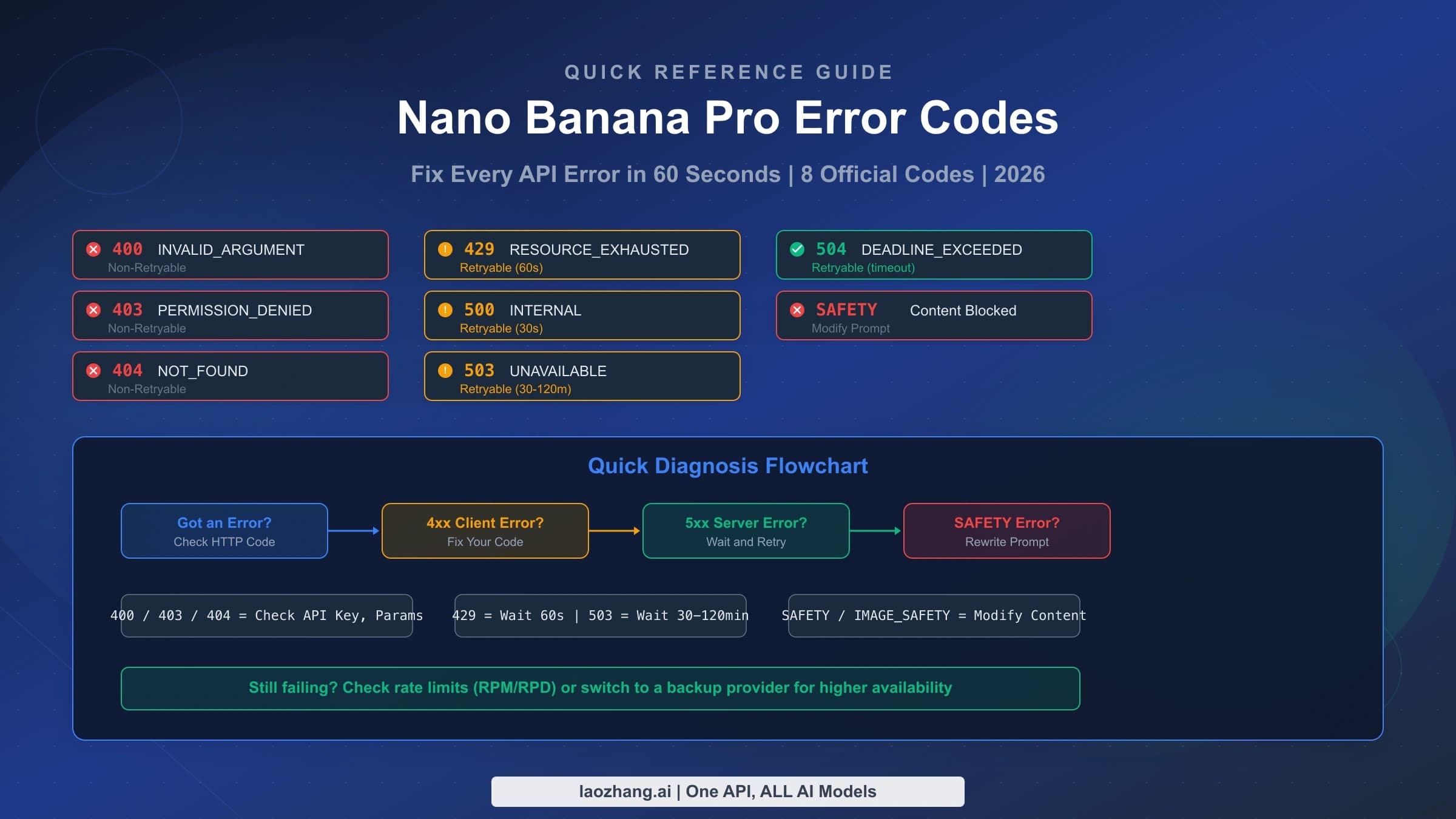
If the route you need is simply a blocked-output diagnosis, use the dedicated Nano Banana Pro policy and blocked errors guide. A claim-audit board cannot replace exact error troubleshooting.
What unlimited usually means in practice
"Unlimited" usually means a billing or capacity promise, not an absence of limits. Treat a no-limit API claim as a route-owner claim until the billing project, provider contract, and current dashboard prove who pays and whose limits apply. Google's Gemini API rate-limit documentation describes limits by dimensions such as requests per minute, tokens per minute, and requests per day, and those limits attach to projects and usage tiers rather than to a universal API key entitlement. Consumer routes and Flow have their own visible limits, credits, or queue behavior.
As of July 8, 2026, Google's pricing page and rate-limit page are the sources to check before publishing exact cost or capacity assumptions. The important production rule is simpler than the number: no route should be treated as no-cost and no-limit unless the current route owner says that in enforceable terms and you can see how limits, resets, and overages work.
Provider language needs extra care. A provider may say "unlimited" while still applying fair-use rules, daily caps, queue throttles, concurrency limits, account reviews, lower-priority processing, or credit resets. That may still be useful, but it is not the same thing as unlimited Google capacity.
When the real problem is cooldown, quota, or project throughput, branch to the Nano Banana Pro cooldown and limits guide. When the real problem is cost, free-tier status, or whether a key gives entitlement, use the Nano Banana Pro pricing and quota guide.
Why uncensored is the wrong promise
"Uncensored" is not a good buying criterion for Nano Banana Pro. Google's safety settings documentation describes configurable filters for API use, but configurable does not mean policy-free. Some protections remain outside ordinary application tuning, and less restrictive applications can carry review obligations.
The hard boundary is policy. Google's generative AI prohibited-use policy explicitly includes circumvention of abuse protections or safety filters, so an API setting should be treated as a legitimate configuration surface for allowed applications, not as an invitation to defeat protections.
Use this stop rule:
| Situation | Safe interpretation | Next move |
|---|---|---|
| You need fewer false positives for allowed professional content | A safety-setting or route-specific review question | Adjust only within documented settings and keep logs |
| You need content that a route rejects for policy reasons | A policy boundary, not a prompt optimization problem | Stop, revise the task into allowed content, or choose a compliant alternative |
| A provider promises "uncensored" generation | A provider claim with high policy risk | Demand written terms and avoid prohibited-content workflows |
| A tutorial offers bypass wording or filter-avoidance steps | Circumvention risk | Do not follow or publish those steps |
The distinction matters for teams. A product may need lower false-positive rates for medical, educational, fashion, moderation, or safety review workflows. That is different from seeking prohibited sexual, violent, deceptive, abusive, or rights-violating outputs.
Route board: app, Flow, AI Studio/API, Vertex, and wrappers
The route board is the practical check before payment or integration. The same model family can appear through multiple doors, but the door controls the evidence you need.
| Route | Good reason to use it | Proof to look for | Common mistake |
|---|---|---|---|
| Gemini app | Fast consumer image creation and redo workflows | Visible account, plan, image-limit wording, and fallback behavior | Assuming a paid app plan raises API quota |
| Flow | Creative projects that need Google's video or media workflow | Project credits, export behavior, queue status, and supported model path | Treating Flow credits as free API usage |
| AI Studio/Gemini API | Developer integration and direct model calls | Current model ID, project limits, safety settings, billing, request logs | Treating an API key as unlimited entitlement |
| Vertex AI | Enterprise controls, governance, cloud billing, and deployment discipline | Project, region, model availability, IAM, logs, and quota | Assuming consumer app behavior applies to cloud projects |
| Third-party wrapper | Convenience, unified billing, different UI, or provider-managed access | Model ID, upstream route proof, limits, credit reset, logs, terms, refunds, data handling | Treating wrapper wording as official Google capability |
The route can be useful even when it is not magical. A wrapper may simplify payment or queue management. Vertex may be better for governed production work. AI Studio may be the fastest way to test request shape. The mistake is treating convenience as proof that the underlying policy or capacity boundary has disappeared.
Provider and tool claim checklist
Before you trust a tool page that says Nano Banana Pro is unrestricted, unlimited, uncensored, free, or no watermark, verify the claim in writing. Screenshots and demos are not enough for a production workflow.
Use this checklist:
| Check | What a trustworthy route should show |
|---|---|
| Model identity | Current model ID or route name, with clear distinction between gemini-3-pro-image and other Nano Banana models |
| Upstream owner | Whether the route is Google first-party, Vertex, provider-managed, or a wrapper on top of another service |
| Billing owner | Who charges, how credits are consumed, and what happens when credits run out |
| Limit owner | Current RPM, RPD, queue, fair-use, concurrency, or daily-image rule |
| Safety terms | Written policy for blocked content, configurable settings, reviews, and prohibited use |
| Watermark and provenance | Whether visible watermarks, metadata, SynthID, or platform marks are present |
| Logs and support | Request IDs, timestamps, error bodies, escalation path, and support response time |
| Refund and failure handling | Whether failed attempts consume credits and how disputes are handled |
| Data handling | Storage, retention, reuse, deletion, and enterprise controls |
If a provider cannot answer those questions, treat the promise as unverified. If the provider claims to remove policy, avoid the route. If the provider only offers a convenience layer, judge it on convenience, price clarity, support, and logs, not on impossible promises.
For provider/API selection specifically, the Nano Banana Pro third-party API guide is the better next branch, but re-check any provider price, coverage, or uptime claim before relying on it.
If your real issue is a specific restriction
The three promise words often hide a narrower job. Once you name that job, move to the owner that can actually solve it.
| Real issue | Better next branch |
|---|---|
| Prompt or output is blocked | Use the policy and blocked errors guide and keep the task within allowed content |
| App, API, or wrapper slows down | Use the rate limits guide and identify the reset owner |
| You need to know whether Pro image API is free | Use the pricing and quota guide before assuming a key is an entitlement |
| You care about visible marks or provenance | Use the watermark guide before chasing no-watermark promises |
| You want an easier provider route | Audit the provider with logs, limits, terms, and data handling before integrating |
This branch discipline saves time. The wrong branch creates false fixes: prompt rewrites for quota problems, provider switches for policy blocks, app subscriptions for API quota, or API keys for consumer UI limits.
FAQ
Is there an official uncensored Nano Banana Pro mode?
No. The official route supports configurable safety settings in some API contexts, but that is not an uncensored mode and does not permit bypassing protective measures or prohibited-use rules.
Does an API key make Nano Banana Pro unrestricted?
No. An API key identifies access to a developer project. The project still has model availability, billing, quota, safety, and policy boundaries.
Can a third-party wrapper make Nano Banana Pro unlimited?
Only within that provider's own contract, and only if the terms, dashboard, and support logs prove it. A wrapper cannot prove that Google's first-party route has no limits.
What should I check before paying for an unlimited provider?
Check model ID, route owner, credit reset, fair-use limits, blocked-content policy, refund rules, request logs, support channel, and data handling. Avoid any provider whose value depends on policy bypass.
Is BLOCK_NONE the same as uncensored?
No. It is a safety-setting threshold used in documented API contexts. It does not remove every built-in protection, review obligation, or prohibited-use boundary.
Why do some pages say Nano Banana Pro is free?
They may be describing a consumer trial, a provider credit offer, a limited demo, or a different Nano Banana route. Treat free claims as route-specific and current-date dependent.
What if my prompt is blocked even though it seems harmless?
Keep the route stable, read the exact error or safety signal, remove ambiguity, and stay within allowed content. For systematic troubleshooting, use the policy-blocked branch instead of looking for bypass wording.
Does no watermark mean unrestricted?
No. Watermark, visible branding, metadata, SynthID, and provenance are output-policy questions. They do not decide quota, safety, billing, or content permission.