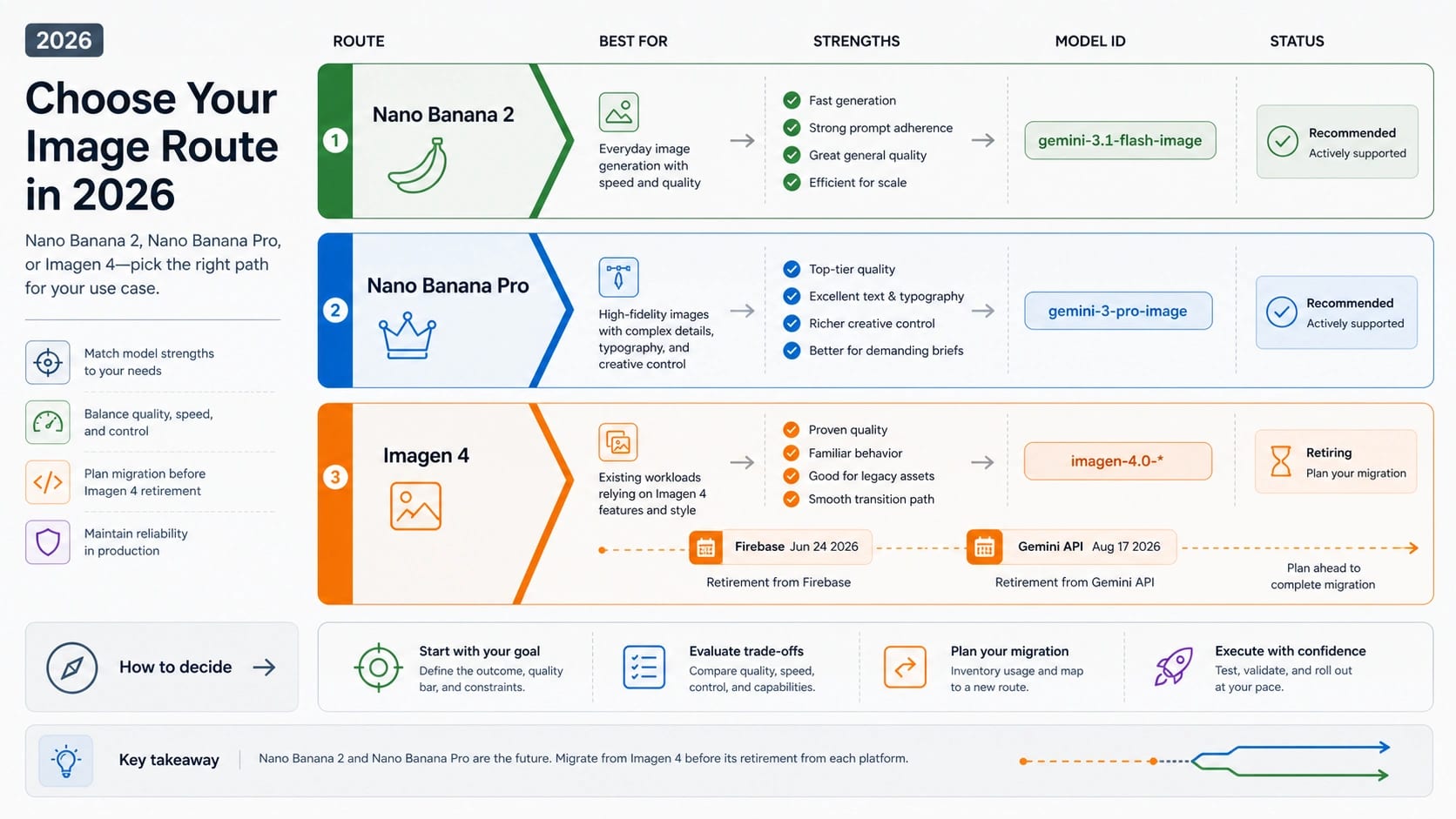
For new Google image work in 2026, start with Nano Banana 2 as the default test, escalate to Nano Banana Pro when text, 4K, references, or review cost demand it, and treat Imagen 4 as a temporary or legacy lane until its official surface status is checked. Firebase AI Logic currently points to June 24, 2026, while Gemini API Imagen endpoints are listed with an August 17, 2026 shutdown, so the safe decision is not a universal winner; it is a route choice plus a same-prompt proof set.
Current Route Board
| Route | Current role | Use it first when | Hold back when |
|---|---|---|---|
| Nano Banana 2 | Current Google default test route | You need fast iteration, many variants, edits, or cost-sensitive API work. | The job fails on dense text, complex layout, reference fidelity, or final 4K review. |
| Nano Banana Pro | Premium Google image route | The asset carries text, layout, references, grounding, 4K finish, or high review cost. | Nano Banana 2 passes the same prompts with acceptable retries and cleanup. |
| Imagen 4 | Retirement-bound Imagen lane | You are maintaining an existing Imagen workflow or need a short controlled comparison before shutdown. | You are starting new work, writing new code, or cannot verify the surface-specific date. |
The practical stop rule is simple: do not copy a social comparison, a stale model ID, or a single beautiful sample into production. Map the names to current IDs, check which Google surface you use, then test the same prompt set before deciding whether Imagen still has any temporary role.
Start With The Current ID Map
The name "Nano Banana" is useful for readers, but it is too vague for code, pricing, retirement, or migration decisions. Current Google documentation separates the family into Nano Banana 2 and Nano Banana Pro. For current Gemini API routing, Nano Banana 2 maps to gemini-3.1-flash-image, while Nano Banana Pro maps to gemini-3-pro-image. Imagen 4 maps to the Imagen endpoint family, including imagen-4.0-generate-001, imagen-4.0-fast-generate-001, and imagen-4.0-ultra-generate-001.
That map should come before quality claims because a lot of old examples now fail at the access layer. If a snippet still calls gemini-3-pro-image-preview, gemini-3.1-flash-image-preview, or an Imagen-specific generation method, do not score the result as a model-quality problem until the route is current. Preview IDs, wrapper labels, AI Studio names, Gemini App labels, Firebase snippets, and Gemini API endpoint names are related, but they are not interchangeable.
Use this compact translation table when auditing examples:
| Reader-facing name | Current route to check | Owner label | Practical meaning |
|---|---|---|---|
| Nano Banana 2 | gemini-3.1-flash-image | Gemini API model row | First test for most new Google image generation and editing work. |
| Nano Banana Pro | gemini-3-pro-image | Gemini API model row | Escalation route for precise text, layout, references, grounded context, and premium assets. |
| Imagen 4 | imagen-4.0-generate-001, imagen-4.0-fast-generate-001, imagen-4.0-ultra-generate-001 | Imagen endpoint family | Temporary or legacy branch that needs a surface-specific shutdown check. |
| Older preview strings | *-preview variants | Migration cleanup | Do not use as the default for new work unless the exact surface still documents that string. |
The Google Flash-vs-Pro route comparison goes deeper on the two current Nano Banana routes. Keep that narrower question separate from Imagen retirement because the Imagen date and migration mechanics add a different risk.
Treat The Retirement Date As Surface-Specific
The hardest current fact is not whether Imagen 4 is retirement-bound. It is which official surface owns the date for your work. On June 21, 2026, Firebase AI Logic's Imagen migration page says all Imagen models are deprecated and will shut down on June 24, 2026. The Firebase supported models page repeats the same Firebase-side warning and tells developers to migrate to Gemini Image models, the Nano Banana routes.
Google's Gemini API documentation currently gives a different endpoint schedule. The Gemini API image generation guide and Imagen guide say Imagen models are deprecated and will be shut down on August 17, 2026. The Gemini API deprecations page also lists the Imagen 4 endpoint IDs with an August 17, 2026 shutdown and recommends gemini-3.1-flash-image as the replacement.
Do not flatten that into one universal date. A safer operating rule is:
| If your surface is | Treat the date as | Practical action |
|---|---|---|
| Firebase AI Logic | June 24, 2026 is the urgent migration boundary. | Move Imagen traffic immediately and verify Firebase-specific examples. |
| Gemini Developer API Imagen endpoints | August 17, 2026 is the listed endpoint shutdown. | Plan migration now, but label the schedule as Gemini API endpoint-specific. |
| Vertex, AI Studio, Gemini App, or a wrapper | Not proven by the other rows alone. | Check that exact surface before committing prompts, examples, or customer-facing claims. |
That date split changes the recommendation. Imagen 4 can still matter for a controlled legacy comparison, a short-running migration audit, or a workload that already depends on an Imagen-specific endpoint. It should not be the first route for a new integration, a new prompt library, or a new production review process. The replacement path is already visible enough that new work should prove the current Nano Banana route first.
Use Nano Banana 2 As The Normal First Test
Nano Banana 2 is the usual first test because it is the current efficient Gemini image route. It is the right place to start when the job expects iteration: social variants, product-scene drafts, catalog refreshes, prompt tuning, rough campaign boards, internal reviews, or edits where a few retries are normal. The decision is not "Flash is weaker, so start cheap." The decision is "start with the route that should handle broad work before paying for a precision lane."
Use Nano Banana 2 first when these signals are present:
| Workload signal | Why Nano Banana 2 belongs first |
|---|---|
| Many variants are expected | Iteration is built into the workflow, so raw output cost and speed matter. |
| The asset is a draft or internal review item | Minor issues can be accepted, revised, or regenerated without large external cost. |
| Text is short or optional | The premium text/layout advantage of Pro may not change acceptance. |
| Reference fidelity is useful but not strict | A close result may be enough for planning, mood boards, or exploration. |
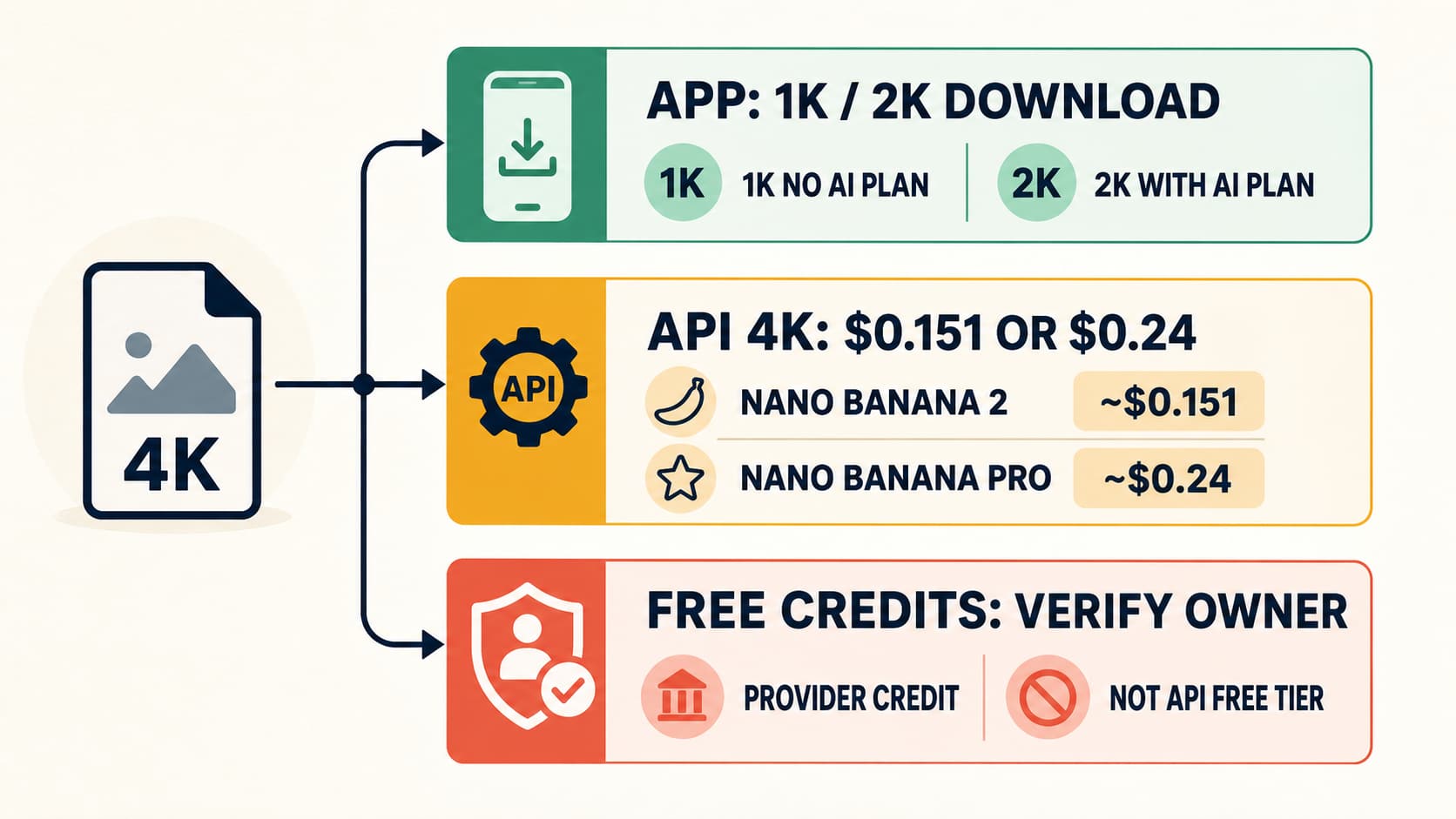
| The output size is not the main risk | 4K support alone does not prove Pro is needed. |
The correct measurement is accepted-output cost, not the number on one pricing row. If Nano Banana 2 produces one accepted image after two quick attempts, it may beat Pro on both cost and time. If it produces five outputs that still need manual correction, it becomes expensive even when each call looks cheaper.
Escalate To Nano Banana Pro For Expensive Failures
Nano Banana Pro is the premium route when image failure costs more than the higher call. Google's Nano Banana Pro and Gemini 3 Pro Image materials emphasize stronger reasoning, text rendering, multilingual and localization support, reference handling, creative controls, and 2K/4K output. Those strengths matter most when the asset is closer to final production than to exploration.
Move Pro earlier when any of these failures repeatedly appear:
| Failure pattern | Why Pro may pay for itself |
|---|---|
| Dense text breaks | A spelling, label, or hierarchy error can invalidate the whole image. |
| Layout drifts | Infographics, UI boards, packaging, and presentation graphics punish structural mistakes. |
| Reference identity changes | Product shape, material, person consistency, pose, or brand cues need tighter preservation. |
| Premium 4K work is reviewed externally | Review time, retouching, and approval delays can cost more than model price. |
| Multilingual image text matters | Translation, line breaks, and local typography can create high rejection cost. |
Pro should still earn the production default. A single excellent sample is not enough if Nano Banana 2 passes the same workload with acceptable retries. Conversely, a higher raw price can be rational when Pro cuts five review cycles down to one. The route answer is therefore not "Pro beats Imagen" or "Imagen is more photorealistic." It is: use Pro when the workload makes precision failure expensive.
Keep Imagen 4 As A Legacy Or Narrow Exception
Imagen 4 should now be treated as a lifecycle-managed branch. It may still be worth testing when an existing prompt set, existing evaluation harness, or legacy product path is already built around Imagen. It may also remain relevant for a short comparison where the question is whether a specific Imagen photorealism result can be replaced without unacceptable drift.
That exception is narrow. The date conflict means Imagen 4 work carries planning risk. The official replacement guidance means new code should not start by copying Imagen-specific request patterns. The current Nano Banana routes also cover more of the mixed image-generation and editing work that modern product teams usually need: text-heavy images, reference edits, layout boards, localization, and iterative proof.
Keep Imagen 4 only when all four checks pass:
| Check | Passing condition |
|---|---|
| Surface status | The exact Firebase, Gemini API, Vertex, AI Studio, or wrapper surface still documents usable access. |
| Time horizon | The work ends before the relevant shutdown or has a tested migration path. |
| Workload reason | Imagen solves a concrete image problem that Nano Banana 2 or Pro has not passed yet. |
| Rollback plan | Prompts, examples, evaluation logs, and output acceptance rules can move to Nano Banana without rewriting the whole workflow. |
If any check fails, treat Imagen as migration material, not the next route. For a deeper cleanup of old Gemini preview examples, use the Gemini 3.1 Flash Image preview API guide as a migration reference rather than preserving old endpoint strings in new work.
Migrate The Request Shape, Not Just The Name
Replacing Imagen 4 with Nano Banana is not only a string swap. Gemini API migration guidance points developers away from Imagen-specific APIs and response objects and toward Gemini image generation through generate_content and response parts. That means the migration can affect request construction, output parsing, logs, retry handling, safety review, and tests.
Before changing production traffic, audit these items:
| Migration item | What to change or verify |
|---|---|
| Model ID | Replace Imagen endpoint IDs with the current Nano Banana route you actually choose. |
| API method | Move away from Imagen-specific generation calls when the target surface requires Gemini content generation. |
| Response handling | Parse image data from Gemini response parts instead of Imagen-specific response shapes. |
| Test harness | Re-run prompt, reference, size, language, and acceptance checks after the route changes. |
| Error logging | Separate access/deprecation errors from image-quality rejection reasons. |
| Documentation | Remove old preview or Imagen examples from internal readmes and customer instructions. |
The most common migration mistake is judging Nano Banana on a test that still contains Imagen assumptions. If the old prompt depended on Imagen behavior, tune the prompt after the route is current. If the old parser expects Imagen response objects, fix parsing before you score quality. If the old benchmark used a preview Nano Banana string, update the ID before making a production claim.
Keep Pricing And Free-Tier Claims Owner-Labeled
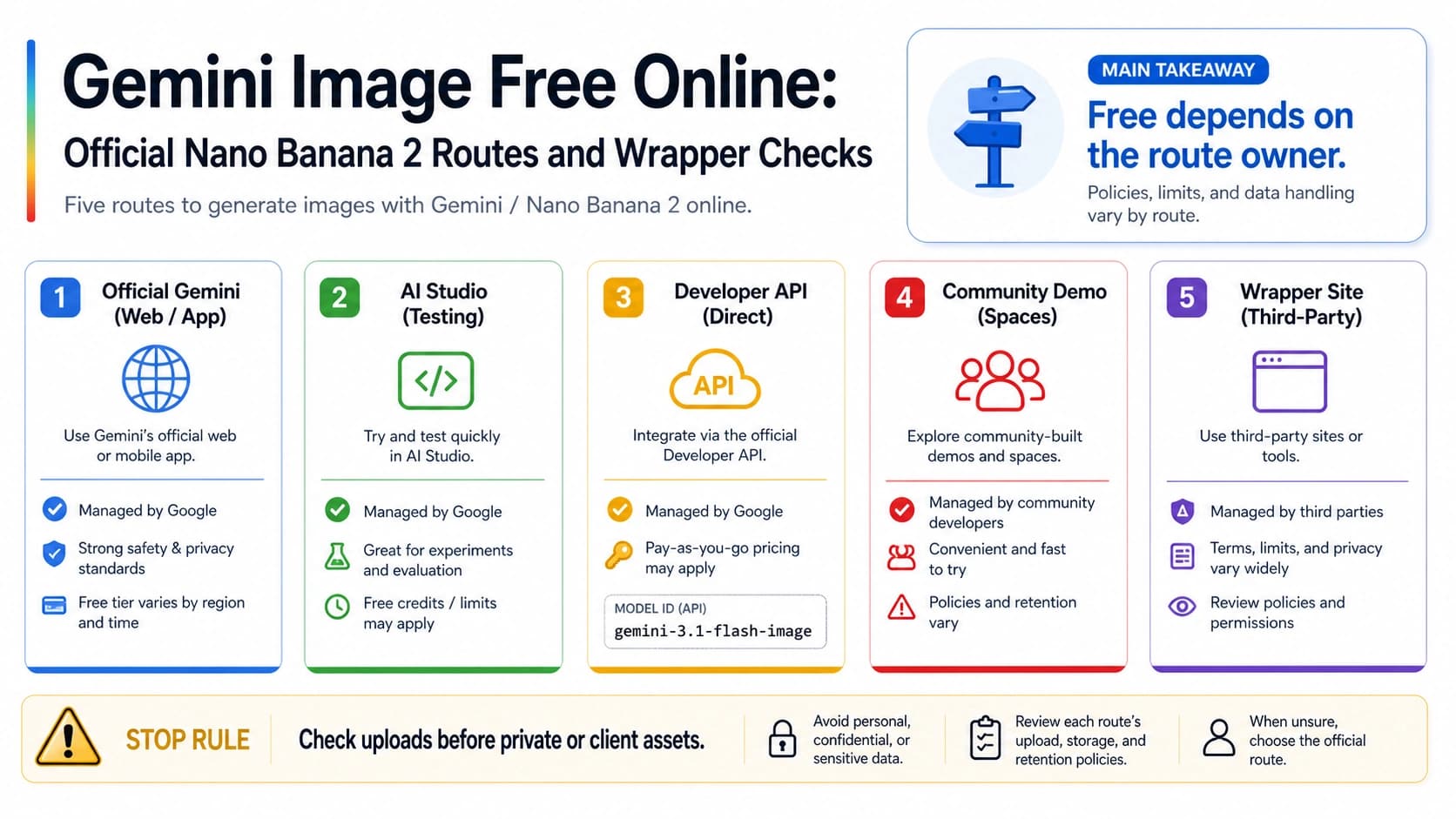
Pricing should help the route decision, not hijack it. On June 21, 2026, Google's Gemini API pricing page lists paid image rows for gemini-3.1-flash-image, gemini-3-pro-image, and Imagen 4 IDs. The same evidence does not make consumer Gemini App quotas, AI Studio behavior, Vertex terms, or provider dashboards equivalent to the official API price table.
The useful pricing boundary is:
| Claim type | Safe wording |
|---|---|
| Official Gemini API price | Date it, name the model ID, and keep Standard, Batch, or Flex labels separate. |
| Free Tier | The current image rows are not Free Tier rows; do not turn an API key into a free-image entitlement. |
| Consumer app access | Treat it as a separate product surface unless that exact app quota was verified. |
| Provider or wrapper price | Do not mix it into official Google pricing unless the provider was separately audited. |
| Cheapest route | Compare accepted-output cost after retries and cleanup, not one generation price. |
For a broader cross-provider route choice, use the GPT Image 2 vs Google image routes comparison. The narrower job here is to choose the safe Google-side route while Imagen 4 is retiring.
Run A Same-Prompt Proof Set Before Switching
No current public comparison can replace your own proof set. The proof should be small, repeatable, and harsh enough to expose the errors that make your team reject images. Use the same prompt, references, language, aspect ratio, target size, and acceptance bar across Nano Banana 2, Nano Banana Pro, and any remaining Imagen 4 exception.
Use at least these prompt families:
| Prompt family | What it reveals |
|---|---|
| Dense text board | Spelling, label placement, hierarchy, repeated words, and multilingual copy. |
| Product shot | Material, lighting, identity, realism, and brand-safe detail. |
| Reference edit | Whether the route preserves the source object while following the edit instruction. |
| Diagram or UI board | Layout stability, grouping, visual order, and label discipline. |
| 4K hero asset | Detail stability, artifacts, crop tolerance, and final-use readiness. |
| Legacy Imagen prompt | Whether an existing Imagen pattern can be migrated without unacceptable drift. |
For every output, record retry count, accepted result, rejection reason, cleanup time, target size, and estimated cost. If Nano Banana 2 wins enough accepted outputs, keep it as the default. If Pro reduces high-value failures, escalate. If Imagen wins one narrow prompt but fails the lifecycle check, treat that win as migration evidence, not as permission to build new work on Imagen.
FAQ
Is Imagen 4 better than Nano Banana?
Not as a current default. Imagen 4 can still be relevant for a legacy workflow or a narrow photorealism comparison, but new Google image work should usually start with Nano Banana 2 and escalate to Nano Banana Pro when precision failures justify it. Imagen also needs a surface-specific retirement check before any new dependency.
Is Nano Banana the same as Imagen?
No. "Nano Banana" is the reader-facing family name for current Gemini image routes, while Imagen 4 is a separate retirement-bound Imagen endpoint family. For code and pricing, map Nano Banana 2 to gemini-3.1-flash-image, Nano Banana Pro to gemini-3-pro-image, and Imagen 4 to the imagen-4.0-* endpoint IDs.
What replaces Imagen 4?
For Gemini API endpoint migration, Google's deprecations page currently recommends gemini-3.1-flash-image for Imagen 4 endpoint replacements. In practical route choice, start with Nano Banana 2, then test Nano Banana Pro when the workload needs stronger text, layout, reference fidelity, grounded context, or premium 4K output.
When does Imagen 4 retire?
Use the date that belongs to your surface. Firebase AI Logic pages currently say June 24, 2026. Gemini API image generation, Imagen, pricing, and deprecations pages currently list August 17, 2026 for Imagen 4 endpoints. If you use Vertex, AI Studio, Gemini App, or a wrapper, check that exact surface before publishing a date.
Is Nano Banana Pro always worth it over Nano Banana 2?
No. Nano Banana Pro is worth testing when dense text, layout, references, localization, 4K finish, or review cost makes failed outputs expensive. Nano Banana 2 remains the better first route for broad iteration, edits, drafts, variants, and cost-sensitive work when it passes the same proof set.
Can I keep using Imagen 4 until shutdown?
Only for controlled existing work where the exact surface still supports it, the time horizon is short, and a Nano Banana migration path is already tested. Do not start a new prompt library, SDK example, customer workflow, or production review process on Imagen 4 just because an older comparison still looks good.
Are the Gemini image API routes free?
Do not assume that. The current official Gemini API image rows are paid rows, not Free Tier rows. Consumer Gemini App access, AI Studio experiments, Cloud billing, and provider dashboards can have different rules, but they must be checked as separate surfaces.
What should I test first?
Test Nano Banana 2 first for most new Google image work. Add Nano Banana Pro when the acceptance bar includes dense text, layout, references, multilingual image text, premium 4K, or high review cost. Include Imagen 4 only as a legacy baseline or short exception after its official surface status is verified.